Image credit: Kate Geraets "We Rock" (click image for link)
The semester has been flying by, here we are in week 10, two-thirds through and I have to say we here at UMW’s Division of Teaching and Learning Technologies are moving at a pretty amazing clip. It’s as if everything has clicked, and we all “can still jack in and know what do to.” It’s like a team that just starts to hit their stride, and when they do it all just feels so natural. A beautiful sense of peaking where everything around you slows down and you can just see what’s coming next, and nail it. Working at UMW’s DTLT right now is a rare professional privilege, and I find myself racing to work everyday to ride that high. But all of this might just sound like sugar coated cheerleading, so let me layout what exactly has got me so excited about working at DTLT right now.
UMW’s Online Learning Initiative
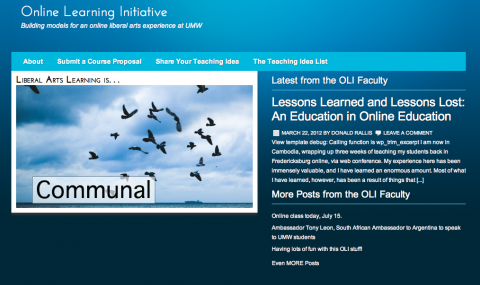 Steve Greenlaw is leading up an initiative at UMW that I think is one-of-kind when it comes to online learning. UMW’s Online Learning Initiative, amongst other things, is trying to organize and formalize some of the amazing digitally-based work happening at UMW into the foundation for an approach to teaching fully online courses across the disciplines by focusing on bringing the principles of a liberal arts education to web-based learning, i.e., interaction, community, self-directed-learning, intimacy, etc. We believe that University of Mary Washington is in a unique position to design and teach courses which instill the values of a liberal arts & sciences experience into a fully online environment that are at least comparable quality to our traditional face-to-face courses—and that’s what we’re doing.
Along with Steve, Martha Burtis, myself, and just recently Alan Levine (but more on him in a bit) are working with a cohort of nine faculty to get at least eight fully online courses up and running this Summer and Fall. It’s extremely exciting, and the approach is in many ways groundbreaking—for the most part these are not just online courses, they are courses that are on and of the web and that for me is where the excitement comes in.
Additionally, the actual process for proposing courses, reviewing those proposals, and sharing ideas and commentary has been happening on a series of sites Martha Burtis designed that are nothing short of amazing. Last Summer, the faculty involved were asked to consider in-depth the value system of a liberal arts community. We then started exploring how these values might be integrated into the online courses they were developing to avoid the all too common problem of trying to graft the face-to-face on the online space. Their final course proposals were based around a series of core liberal arts values (you can see the Liberal Arts values I keep referring to here) we were all in agreement on and then each proposal was reviewed by two internal reviewers, one UMW student, and two external reviewers .
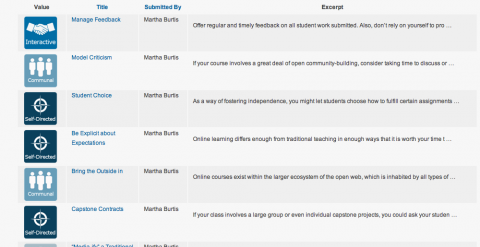 The review process was streamlined by Martha’s submission site for proposals here, as well as the ultimate reviewing and commenting site that was done in digress.it for commentary and feedback for each of the course proposals. You can see two examples of these course reviews here and here. Finally, she has come up with a site that allows the faculty from UMW, and beyond, to share quick teaching ideas with one another based on the core values of UMW’s Online Learning Initiative, it has the potential to be an absolutely amazing resource for sharing ideas around teaching in general, but teaching online specifically. (You can see the repository of teaching ideas here.) The long and the short of the OLI is this: a lot of universities and colleges have gone at online learning as cost saving, convenient, efficiencies for the university (all of which we know we can provide well) —what we are interested in experimenting with in the OLI are the interfacing of the technology and people at UMW to actually make online courses social, interactive, and intimate spaces for teaching, learning, and sharing that augment the face-to-face experience at UMW—and further coalesce the community.
Domain of One’s Own Rebooted
 If the OLI wasn’t enough, we also have a project that is near and dear to my heart building some serious steam on campus. Tim Owens came on board in July, and he has been batting about .450 every since. He’s a machine. He single-handedly re-invigorated the group around the Domain of One’s Own project and has owned it since, and if all goes well we’ll be committing to a pilot for this Summer and Fall that will provide anywhere from 200-400 students with a web host and domain of their own for the entirety of the next academic year and beyond (with sites on the whole Freshman class for 2013). Let me say that again, if all goes well we will be committing to a pilot for this Summer and Fall that will provide anywhere from 200-400 students with a web host and domain of their own for the entirety of the next academic year and beyond. How sick is that? What’s more, it will have specific curricular and departmental hooks around campus and across disciplines. It’s not a done deal yet, but just the idea that we are even this close to such a concept becoming a reality on campus is an absolute coup in my mind.
Alan Levine
 Oh yeah, and by the way, Alan Levine is now an instructional technologist at UMW. Let me say that again, Alan Levine is now an instructional technologist at UMW! Are you kidding me? How sick is that?! We are rich as kings, and can you imagine being a student at UMW and having Alan Levine coming in to talk to you about using WordPress for a portfolio? —or working with a professor to imagine the possibilities for Digital Storytelling or a PirateBox? —or you name it….it’s an absolute dream come true for me to be able to work so closely with Alan, and I know for a fact I am not alone in this sentiment.
A New Media Shop
 Andy Rush has taken a lot of shit from us for years for being the New Media guy here at UMW—what is “New Media” again we constantly ask? But as usual his deceptive searching for his flow and rhythm is purely cover for setting the standard and direction for the group. Not only did he turn us on to the video kit and the initial possibilities for live streaming that Tim Owens ran with for DTLT Today (you remember that quiant little site?), but he’s now collaborating with Alan Levine on top notch video projects like this, developing comprehensive and brilliant resources for our students to navigate the complex work of digital media like working with digital audio and video. He’s got all of us excited about the new Final Cut Pro, and he’s producing regular resources like this awesome guide to ripping, shrinking, and copying DVDs. En fuego.
Canvas
 Oh yeah, did I fail to mention we moved to Instructure’s Canvas as our institutional LMS this year as well? If I failed to mention it, it’s because Lisa Ames has been so amazing at running this transition and seeing to it that our faculty are happy with this new system that we basically introduced overnight as our previous Online Learning Coordinator and LMS administrator took off two weeks befor the migration. A Herculean task that provides yet another source of stability and service on UMW’s campus that allows so much of the innovation to thrive.
UMW’s Website on WordPress
 One more thing, before I forget, UMW’s website is now running entirely on WordPress. It is a multi-network setup, and the whole thing is beautiful. It was all possible by the brilliant work of Cathy Derecki and Curtiss Grymala, and this process deserves a whole series of posts and discussions, but one quick thing to take away from: as a result of Cathy and Curtiss’s work we are contributing directly to the WordPress community as state workers. This idea of building the commons as part of our jobs is coming to fruition more and more everyday at UMW, and it is an amazing thing.
And I just know there’s more, but this post is too long already 😉

 What’s more, Andrew shared the particular stats of this hit with me before they shut the server down and they are by far the biggest numbers we’ve had yet in terms of ds106 or UMW Blogs going viral, here they are according to Google Analytics:

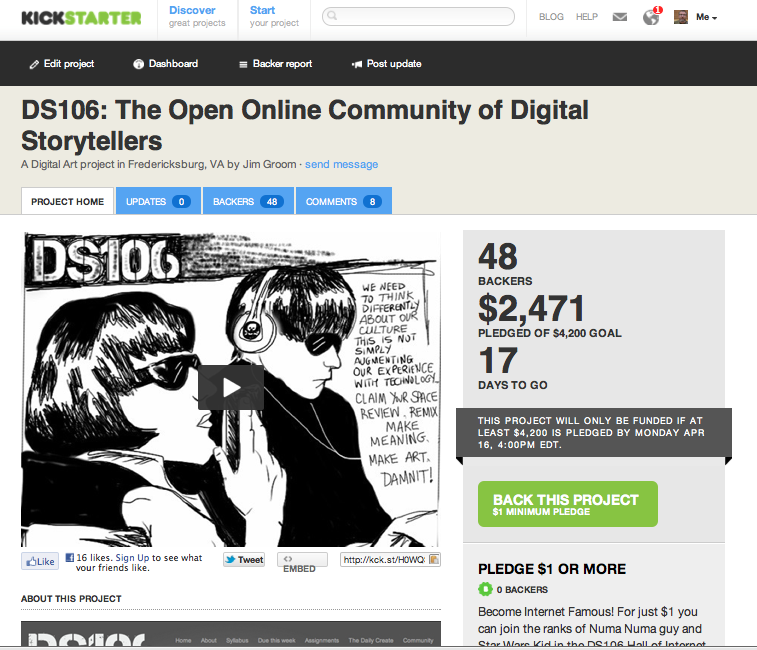
 2) Fund the ds106radio server for another year. Grant Potter has been sustaining that for too long, and we had some donations for a pledge drive for the Radio that squared us until this October, but why not seal that up for another year? ($1000?)