The ds106 99: #24 Presentation on Social Media at UMW

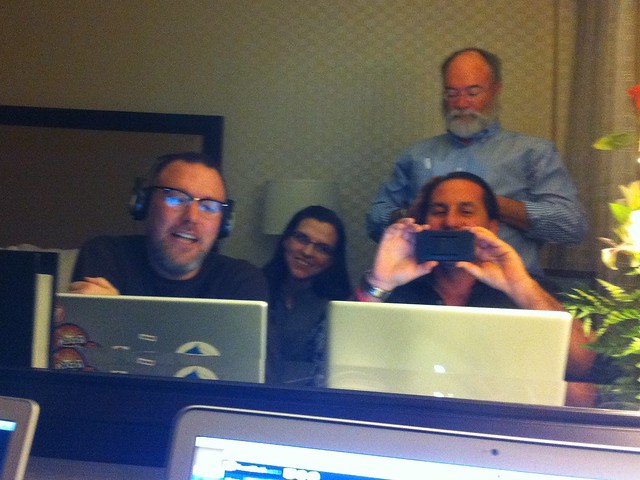
Last week Will Richardson asked me to speak for about 20 minutes to a group of professors at the University of Washington, Bothell (I kept saying Bethel, I don’t know why–some kind of strange block) about the use of social media at UMW. The actual talk happened yesterday, and to complicate things I decided to experiment with cross-casting it to both ds106 Radio and ds106.tv. I had nothing prepared (by design), and I was basically fielding questions from Will—we also got a few minutes to talk about ds106—which was fun.

The session was in Elluminate, but as it turns out a number of folks had issues getting Elluminate to work—go figure 🙂 —so they used the d106.tv stream for the presentation. The only stupid thing was that I didn’t pull Will into the ds106 TV broadcast via Skype. You can hear his questions through the radio archive (which I have here) but not on the video above of the TV stream. I’m still a novice and figuring this media insanity out as a I go—but the Skype thing would have been a cinch with SoundFlower in Wirecast—I’ll know better next time—if and when there is a next time.

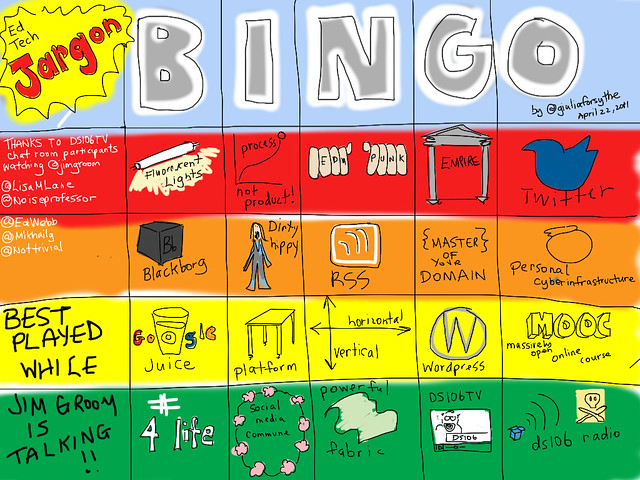
I think the best things about this presentation was Giulia Forsythe’s Ed Tech Jargon Bingo Card drawing (featured below) that emerged from the ds106.tv chat (between Ed Webb, CogDog, Mikhail Gershovich, Guilia, Noise Professor, Timmmmyboy, and others I may be leaving out) as the presentation was happening. They were betting on my next jargony term —and what emerged is brilliant.

Image by Guilia Forsythe

Image credit: Giulia Forsythe’s “EdTech Jargon Bingo”

What’s more, soon after that Noise Professor produced this animated GIF with the abbreviated version of the talk. And to add yet another example of how amazing the ds106 community is Timmmyboy had the video up on YouTube in no time at all as one, complete file and tweeted Will with the link.There is power in community, and it is a privilege and an honor to have such amazingly creative, fun, and cool people to work alongside of as a result of ds106. #4life

Finally, if you want to catch my 17 minute rant against LMSs and Blackboard on ds106tv before the actual presentation, see the first part of this video on Justin.tv here (note there is some noise at the beginning cause I forgot to turn on my lapel mic).

Posted in digital storytelling, ds10699, ds106radio, ds106tv | Tagged , | 2 Comments

The ds106 99: #23 Animated GIM

No sound, but all the non-verbal cues. I love Noise Professor, his Photoshop skills are pretty epic. And the actual presentation, which I will be blogging about shortly, is not nearly as good as this animated GIF. I’m best heard wit the sound turned down.

Image of Jim Groom TV

Also, a quick note, thanks to the awesomeness that is Zach Davis bavatuesdays, ds106, and all my other sites are on a new server. Ironically, as the semester ends the ds106 digest emails have started to work and the automatic syndication through feedwordpress (no more lost hours manually changing timestamps) are fixed. I can’t thank both Zach and Lucas (of Cast Iron Coding fame) enough for all they do for ds106, they have basically hosted me for free over the last year cause I have been too poor to pay them—but that will change soon!—and also provide ds106 students at UMW who choose their hosting option with a cheap, reliable, and up-time all the time service. They rock, and not only has Zach been a great friend all these years, but also an amazing teacher—thanks Portland hippies!

Posted in digital storytelling, ds10699 | Tagged , | 1 Comment

The ds106 99: #22 Laura Falcon

Last Spring Laura Falcon was part of the first iteration of the Digital Storytelling class I taught at UMW. That was a tough semester for many of those students—who were an amazing bunch—because I was very much imagining the course on a day-by-day process. And as much as some students have issues with the way the current class is setup, they have it easier in terms of expectations and example—this first group was running in the dark and I was only falling over the furniture a few feet in front of them.

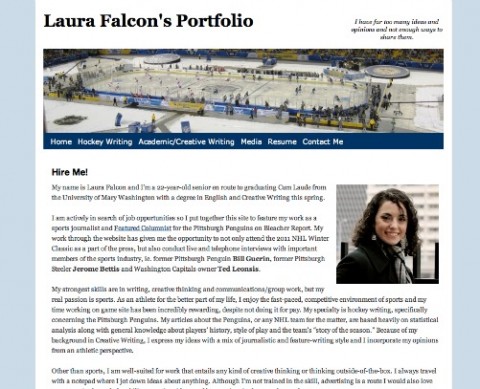
Anyway, Laura Falcon and I have crossed paths since ds106 on a number of occasions. She was in Michael McCarthy’s News Gathering course, Anand Rao’s Visual Rhetoric course, as well as the Literary Journals course that tasks students with creating their own journal in 15 weeks. She has very much been part of a curriculum here at UMW that encourages creative approaches that give students a space of their own as well as a series of works to feature as part of an online portfolio. Increasingly, I think we should be recommending students get their own domains and map host it themselves, or map it to UMW Blogs, or host it on some third-party service—take back the idea of an eportfolio to mean something they control, own and take with them as way of chronicling, archiving, and featuring the work they have done. Kinda like this….

All this to say Laura actually met with me a few weeks ago to map her own domain on her UMW Blog as a resume/protfolio site that shows off her work as a creative writer, sports writer, journalist, and academic. She is an avid Pittsburgh Penguins fan and blogs for Bleacher Report as a featured Penguins writer. What more, she had press credentials for the Winter class this year, and wrote about her experience here. She is an amazing example of how so many of our students are  producers of remarkable works that they need to own and take with them. Laura is graduating in a couple of weeks, and I have no doubt she will be doing remarkable things in the very near future—-the Penguins really need to hire her, the proof is in the pudding.

Posted in digital storytelling, ds10699 | Tagged , | Leave a comment

The ds106 99: #21 Aisle 2 Bin 36

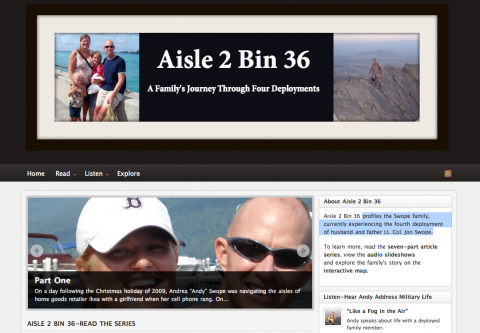
Last week the award-winning student-run newspaper at UMW, The Bullet, wrote this article about the final project Megan Eichenberg did for ds106. It was an amazing project, and I am ashamed I haven;t featured it sooner, but thanks to awesomeness that is UMW’s Bullet these days I don’t have to 🙂

The article was written by Julie Dymon, and she interviewed me about Megan’s work in the class and my impressions of her project which is titled Aisle 2 Bin 36 (and you can find it here) which profiles the Swope family, currently experiencing the fourth deployment of husband and father Lt. Col. Jon Swope. It is a remarkably well done work in 7 parts, and Megan’s attention to both the overall thematic of her work as well as the details of each and every part of the story. But rather than repeat myself, let me reproduce some of the quotes about her work from the Bullet:

Groom felt that Eichenberg went well beyond the requirements of the class and showcased the family’s story in a professional and culturally relevant way.

[Aisle 2 Bin 36 is] unbelievably all-encompassing in terms of the media and in terms of the narrative,” Groom said. “I am surprised that the Washington Post or the New York Times doesn’t bring it up as a feature because I haven’t seen anyone do a work like that about someone who is home and dealing with what it means for a husband to be away at war.

I really like the way that that narrative expressed how it is not necessarily bookended by tragedy and horror but bookended by a psychological loss that is very hard to express,” Groom said. “What Megan really reflects for me is a new journalist of a new era and a new age […] I would hold Megan up as an example not of UMW, but across the board of what great media journalism can be.

So this is my long overdue tribute to the unbelievable work Megan did for ds106 this past fall. She rocks, and this project is a model for just about anyone thinking about what kind of work is possible when you let students follow their interests and put their passions to good use.

Posted in ds10699 | Tagged , | 1 Comment

The ds106 99: #20 #jimgroomstudentproblems

The third iteration of ds106 is coming to an end in the next week or so, and there is no question in my mind that this last semester with its open, online component really elevated this course to the next level. That coupled with team-teaching with Martha Burtis at UMW has pushed this class into the stellarsphere. There is a lot to write up in this iteration, and this ds106 99 posts series is my simple way of pushing myself to try and chronicle some of the magic of this experience before it vanishes.



Anyway, something that happened last night—thanks to Ivania Martinez, Catherine Mohr, and Miña Recta (who actually took ds106 last semester)—was an excellent example of how this class has emerged as part of the fabric of the UMW community as well as moved beyond it. A simple thing Ivania started with the twitter hashtag #jimgroomstudentproblems illustrated for me how and why Twitter has been such an indispensable part of this course. It has been crucial from the beginning for the open and online portion of this course, but also proved invaluable for the completely online section I’m teaching at UMW. Let me explain what happened with this hashtag last night as a way to try and understand why twitter has blown my mind this semester in ds106.
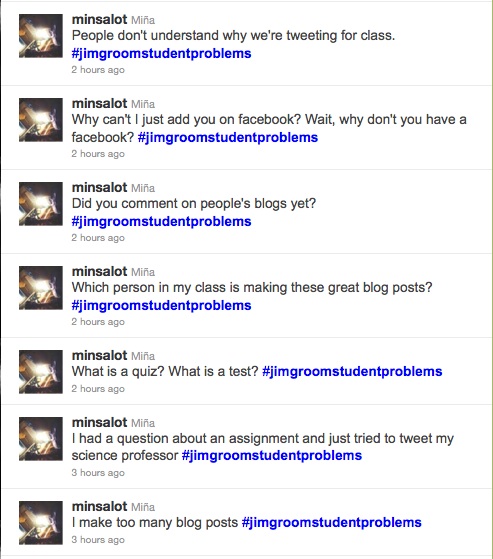
First off, Ivania was trying to get in touch with me last night through Twitter—as an aside Twitter has been where almost all of my communications with students has happened this semester in both my online and face-to-face classes—and I had been a bit incommunicado because I’d been working on some other stuff I needed to get done. Now when I say I am incommunicado on Twitter it usually means I take more than 2 minutes getting back to someone, say closer to about 10 or 20 minutes 🙂 And I really have had a constant stream of conversation and immediate feedback with so many of the ds106 UMW students on twitter that I believe this component has made the students in the online course at UMW feel like they are part of a larger learning community that is also instantaneous, even though they don’t have a scheduled class time (we haven’t met synchronously once all semester save the first day).
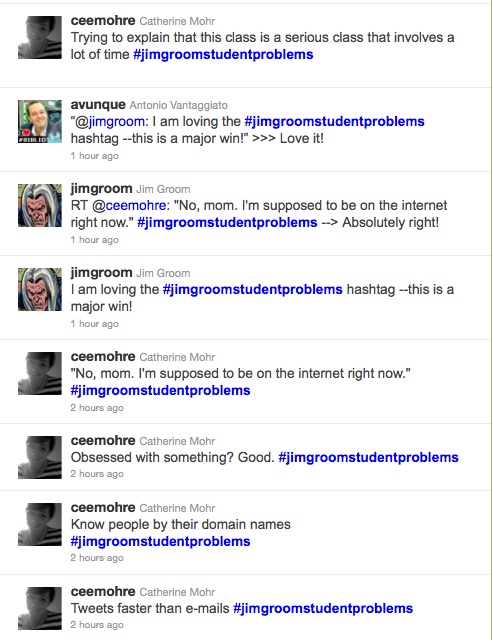
What twitter has brought to the online ds106 equation became apparent to me when Ivania, Miña, and Catherine (all disembodied presences in ds106) figured out a way to get my attention, have some fun, and use twitter as a tool to build the ds106 community. How did they do it? Well, they came up with a hashtag theme that uses creativity, banter, and a bit of comedy to characterize some of the unique problems of the ds106 student. When they did this they did a number of things: they turned a simple query about whether I had watched their mashups yet into a playful game; they framed a narrative about the class; and provided a way in for others to riff creatively on a theme. They were using twitter hashtags as a way to tell a kind of flash story—and what happened is at least one student from every one of the three sections of #ds 106 I’ve taught over the last year and a half joined in and played along on Twitter. Isn’t that crazy? I mean even some UMW students who never took the class, but rather heard about it on twitter and beyond, chimed it.
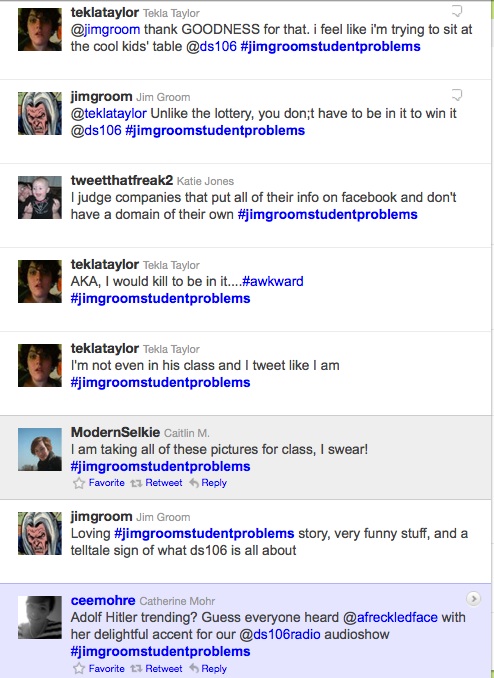
Students who took the class more than a year ago were still apart of the stream, making it easy for them to play along and help shape the story of the class as an ongoing experience well beyond the arbitrary start and end dates of a course. It dawned on me just how powerful this indiscriminate tool for broadcasting 140 characters really can be for creating an online course community that is so often missing from the traditional online course—it becomes a virtual, public and communal space that moves beyond our idea of the classroom—and in many ways remains equally ephemera (try recreating conversations in twitter from a year ago)l. And the way it represents layers of students from various classes over the course of a year and a half is even more amazing. This is by no means the first time alumni of ds106 have come back on twitter, or even back to the actual face-to-face classroom or remained present through their blogging—a good number of them have remained part of the community. What’s crazy though is an increasing number of UMW students who never took the class have contributed a major amount of time and effort to it—whether by helping their roommates, suite mates, friends, boyfriends, girlfriends, etc., do their assignments (I’m talking about you Karen Karnage and Ace Bessman—and that is not cheating, that is ds106!) or jumping into the Twitter stream to have fun with the narrative of the class as it unfolds.


Maybe the fact that all this and more has happened isn’t unique to Twitter per se, but I would argue that Twitter’s dead simple interface, quick format, intuitive grammar and syntax, beautiful visualization of an open network, and less than no overhead approach made the ability for others to follow along as they like and jump in and out as the stream caught their attention has been crucial. What’s more, Twitter (or any networked space like it, though how many are there really like it?—a critical mass of people is important for serendipity and network effects) is ideal for a class like ds106 that is a constant happening not controlled by any one person. A space where things, events, and ideas emerge amongst various groups of people organically. In what other environment can you so easily scan the community activity, chat with one another, joke, share links, post videos, or even use twitter itself to tell the stories of the class (Electrovert’s final project is doing this brilliantly) out in the open?

It has been through the ds106 hashtag on twitter that I have been keeping abreast of what’s going on at any given time, it has even spawned at least two other hashtags/communities: #ds106radio and #ds106tv. What’s more, it has drawn attention to the class itself, as well as the work of students—so many of whom are doing some truly amazings stuff. The art of promoting and reinforcing the creative habit through a tool like Twitter cannot be underestimated for getting students excited about what they’ve done. I know first hand how well it works for me when someone bumps the work I have done.


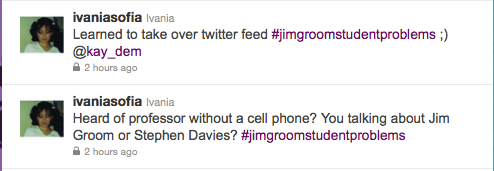
What’s more, the hashtag is a dead simple syntactical element that allows you to search for tweets on a particular theme, topic, subject, course, etc. But these hashtags can also be hijacked to let you have some fun, they can encourage others to be creative, to riff on an idea, and to make something playful out of something seemingly functional. I think the #jimgroomstudentproblems tweets exemplify this exceptionally well.
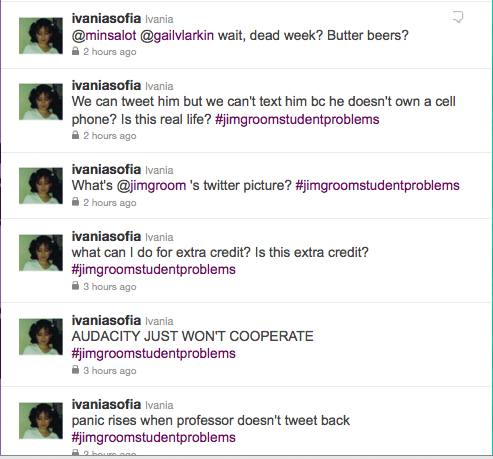

Fact is Ivania, Catherine and Miña told a very powerful story for me last night about Twitter and its impact on ds106. So I’d like to thank them! And when you add to that other examples like the use of twitter in ds106 helping at least one student land a job as a journalist at a newspaper in New Jersey the case for it seems to be made in my mind. And while I’m not simply saying ds106 got Jessica Masulli that job—she did that all by herself—but it doesn’t suck that the practices of networked, open learning we explored in ds106 could actually be reinforced for her (and me) as something that various employers need from graduates of our institutions. Not should this be considers an important, practical means of communication at UMW—but it also needs to be a considered, critical practice of communication in and around the participation of online (and face-to-face) courses more generally. I would argue it should be a requirement for online courses—where else can you get such a powerful platform for making a larger community for all online students at a university? Experimentation along these lines might breath new life into an often antiquated and reactionary vision of the liberal art—that vision should be hijacked, much like a Twitter hashtag—for the digital age. It should be about the creative act and shaping the media environment we currently exist within—that seems to me a far more powerful and useful vision for the future of liberal arts. Who is currently rethinking the liberal arts along these lines? That is not a rhetorical question.
Posted in digital storytelling, ds10699 | Tagged , , | 2 Comments

The ds106 99: #19 Bava Late Night Radio

I finally got back into ds106radio after a bit of time off from live shows so that I could finish up a bunch of work that was due. Feeling a bit relieved, and being goaded by Dr. Garcia, I jumped back on the airwaves last night for a long two hour set that covered a wide range of topics from Langston Hughes’s poetry (with him reading and commenting on his work), a bit on William Faulkner, some stories from back in the day, and a piece on skateboarding. There is also music from The Ramones, The Replacements, Agent Orange, and The Beastie Boys that punctuates the show throughout. It was all over the place, but it was also exhilarating to be back on ds106radio tearing it up. Special thanks to Dr Gracia, Noiseprofessor, Rowan Peter, and Nigel Robertson for following along via Twitter.

Bava Late Night Radio

Posted in digital storytelling, ds10699, ds106radio | Tagged , , | 1 Comment

The ds106 99: #18 ds106radio T-shirt

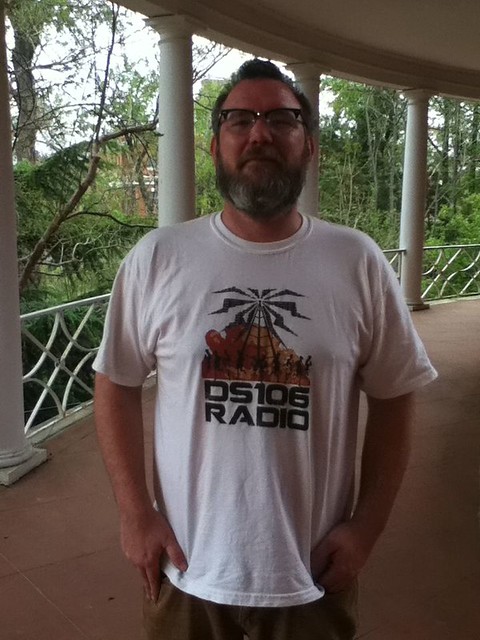
Taking a page out of Todd Conaway’s book I got my ds106radio t-shirts a couple of weeks ago and I ma finally sporting it around campus. Special thanks to Andrew Allingham for the design, and I hope to get more for Northern Voice, we will see.

Here’s a picture:

Image of the ds106radio shirt

And the video:

Special thanks to Jenn Arndt for snapping the pic and video.

Posted in digital storytelling, ds10699, ds106radio | Tagged , | 4 Comments

The ds106 99: #17 Annihilating my network

You might be wondering why this bava post has all these images of various people from my network just sitting there in neat rows like a traditional classroom. Well, you’ll just have to watch the video below to find out.

[kml_flashembed movie="http://redbaiters.com/annhilating_the_network.swf" width="640" height="480" wmode="transparent" /]

View the larger version here.

Special thanks to Laughing Llama who alerted me to the awesomeness that is this: http://erkie.github.com/

Posted in digital storytelling, ds10699 | Tagged , | 7 Comments

Weeks 14-15: Fandom, Archiving, and Wrap-Up

It has been a long, inspiring semester—but now it is coming to an end and this post will take you through the last of it. Please read it all, and please read it carefully.

Also, important note for UMW students, tomorrow I will be distributing course reviews at the beginning of class (and be sending out links for the UMW-based online students) this is your time for payback. If you miss class, you lose all your power to stop ds106 from infecting future generations—act now!

I. Final Week Conferences
As promised, UMW students will be having yet another individual conference with me during finals week (the third and last). This will be a 5-10 minute meeting. We will square up on assignments, I will make sure you have archived your site (see below), and you will receive your final grade.

Here is the sign-up sheet: http://ds106.us/wiki/index.php?title=Week_15_Meeting_Sign-Up

II. Fandom Assignment
For the last creative assignment we will be doing a fandom assignment. This assignment—and the archiving and reflection pieces detailed below— will be due at least 24 hours before we meet for the last time so I can review everything and assign you a grade. Please meet this deadline.

The fandom assignment gives you free reign to intervene in a story, TV series, film, artwork, comic, novel, poem, etc., that you are a fan of. Don’t tell me you are not a fan of something—everyone is a fan of something! The idea here is that most of what we have been doing all semester has been an intervention in a series of texts through a variety of media. In this assignment you choose the text, the media, and the form of intervention you want to make. It can be as simple or as complex as you like, and I simply want to see where you go with this. Have fun, and impress!

Assignment tag: “fandom” (no quotes).

III. Advice for Future ds106ers
As a final reflection on the class, I want everyone to write a letter to an imaginary future student of ds106. Feel free to tell them whatever you want, just back it up with examples and points to speak to. Don’t simply say “Don’t take this class!” —explain why one should not take the class in some detail.

Assignment tag: “ds106advice” (no quotes).

IV. Archiving your blog(s)/website(s)
Everyone needs to archive their website/blog before they meet with me next week.

* If you are keeping your web hosting and domain as they are than you won’t have an issue. There is no archiving required then.

* If you plan on one of the following two options:
1. Keeping your domain but moving to a new web host
2. Getting rid of both your domain and your webhost

You should follow the instructions/tutorials here.
http://ds106.us/?p=15628

You will have questions about this process over the next two weeks, and I am around to help you out with whatever you need.

V. Section 3 Final Session
Section 3 will be meeting during the final exam period on Thursday, April 28th at 6:00PM in Combs 139 for an event/wrap-up/surprise. There will be no final presentations, though your attendance during the final period is mandatory unless you have spoken with me (this goes only for the face-to-face class). Ther ewill be an open, online component of this final session as well.

It has been an awesome semester, finish strong!

Posted in digital storytelling | Tagged , | 3 Comments

The ds106 99: #16 The Bitch Session

Image of the ds106 bitch session in progress

cc licensed ( BY ) flickr photo shared by cogdogblog

One more from the Nicecast Archive before I move on to another topic. I don’t think I actually posted the audio to the ds106 radio bitch session Martha Burtis, Alan Levine, Steve Greenlaw, and I did back in week 6 of the class (February 15th to be exact) from the EDUCAUSE Learning Initiative conference. This was a pretty amazing session of ds106, and mainly because the entire class was treated like a live call-in talk radio show wherein the UMW ds106 students called in and bitched about the class. I couldn’t be at UMW for the class that night because I was presenting at ELI in Washington, DC, so we had the idea of doing the class remotely as a call-in radio show wherein we take the pulse of the class and basically get a sense of how things are going. Stuff like are the comfortable with the class thus far? —what things could be better? —what sucks about the class? etc. Here is how I wrote it up:

The topic will be “Bitch about ds106? and it is where I take live callers—and tweeters—concerns, ideas, and general impressions about ds106 thus far. I’ll ask you to consider what’s working, what’s not, what do you like, what should we kill, keep, etc. It’s no holds barred radio. I have done this every semester so far at about week 6, and doing it via the radio station is not only expedient, but could be very fun. I expect you all to play along. [Full post here.]

As I said above, I’ve done this every semester of ds106 thus far as a way to recognize this class is unconventional and I need their feedback while it is unfolding in order to make it better, and hopefully make those who are freaking out more comfortable. In general this is good practice when you are doing something as experimental as ds106, what’s more—students have more than a little feedback to give you if you just ask. They know what they want from a class, even if it is hard for me to hear it sometimes. Anyway, a little more gold from the archives of ds106radio—and Alan Levine also posted about this session on the ever great CogDogBlog, and he even did it in a timely fashion….bastard!

The ds106 Bitch Session

Posted in digital storytelling, ds10699, ds106radio | Tagged , , | 1 Comment