
Tales from the Teaching Crypt: Discipline and Punish

DSC_0012.JPG

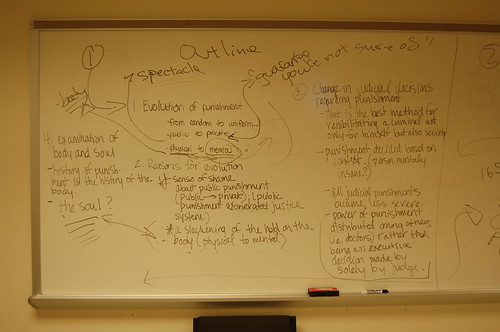
OK, so last night’s class was so inspiring (a.k.a. sick) that I thought I would blog about it right quick. I have been leaving traces of some of the resources I have been finding on YouTube, and alluding to some ideas about categories, tagging, and WordPress -but last night demonstrated a couple of amazing things for me. The image above is the last “physical’ remnant of an amazing discussion about the first chapter of Michel Foucault’s Discipline and Punish, “The body of the tortured.” This chapter is, in many ways, a twenty-eight page outline of his overarching argument throughout the rest of the book, he defines the terms of transformation for crime, criminality and the penal system as well as his methods and notion of body, soul, power, knowledge and genealogy. Amazing stuff, yet for the last ten to twelve pages this chapter is intensely dense and abstracted to conceptualize the fields of power in relationship to the im/materiality (a necessary forward slash) of something he terms the “Soul.” In fact, an extremely difficult concept that walking in to class I was not certain I could entirely get my own head around, no less articulate intelligently. I’m glad I wasn’t alone in working through this text! In effect, the discussion was a distributed space of attempting to work through his argument using the tools to define the overarching points he outlines throughout the chapter, as well as a focused close reading of particular sections of the text.

But this post is not about how well the class went (well, it is, but not really) or how good a teacher I am (well, it is, but not really), yadda, yadda, yadda, it’s about an approach I stumbled upon while discussing the notion of history, categories, and generalizations with my wife, Antonella. The approach is quite simple: have the students respond to each and every reading through the class blog by selecting three or more categories that define their understanding of the text, then they need to explain their choice of this category (which is wide open) with a close reading (read more about the approach here). Simple enough.

While preparing for class yesterday and foregoing an awesome conversation with Laura Blankenship and a whole host of folks from Faculty Academy, I started to think about how I was framing (through my “lecture” notes) my own reading of this chapter (you can see them on the class syllabus/wiki here) according to a very structured notion of his argument. This approach was the very thing that would provide me a way to start talking about this insane text in some orderly, syncopated fashion. So, it dawned on me that they have all done the reading, they have created their own categories independently on the blog about this reading, why not ask them to take the first 20-30 minutes of class and do something similar. Can they together, as a class, outline the argument Foucault is making throughout this chapter on the board? I asked them as much, left the classroom for a half an hour, then came back -and wow! I have never, ever, in my now eight years of college teaching had a groovier experience in my life.

What you see in the image above is an outline (a trace) that they created together and thereafter were each asked to explain its logic at some length. What is the trajectory of the chapter, where is the evidence for this reading, what do you think Foucault means by “loosening hold upon the body?” How do we understand the notion of body in this text in relationship to what he terms the soul? What is the “medico-juridical complex”? It was all there, I wish the outline on the board was even more indicative of the rich, brilliant discussion that emerged from them explaining their readings to me, both individually and as a class. I was blown away, everyone was engaged, everyone had something to say, and the argument/reading was theirs -I couldn’t help from chiming in because I wanted to play too!

Moreover, the class ended in an epiphany of light when one student reading the following two lines quite closely and beautifully summarized our entire discussion, “A ‘soul’ inhabits him and brings him to existence, which is itself a factor in the mastery that power exercises over the body. The soul is the effect and instrument of a political anatomy; the soul is the prison of the body.” I fumbled around to do the teacherly thing and rephrase it, but couldn’t -she nailed it! She framed and summarized the class better than I ever could have. And, me, well I was all fired up. So fired up I had to go and find a camera and take a picture of the white board to remind myself of this class for a long, long time.

What does this all mean? I don’t know exactly, and the class is still young and things could still flop (I’ve had one of them all too recently!). For the moment, however, my thinking about language, categories, definitions, tags, and taxonomy more generally due to my work in instructional technology and a general engagement in the concepts and issues surrounding the questions of knowledge, relations of power, the body, and the “soul” in this fascinating line of work made me a much better teacher and student, at least for an ever-fleeting two and a half hours.

Posted in WordPress | Tagged , , , , | 14 Comments

Stuart Hall on YouTube

Did you know this amazing talk by Stuart Hall is freely available on YouTube? My class is quickly changing before my eyes thanks to this amazing resource. Below is a lecture by Hall on media and representation -ever more relevant in this day and age -but in continual need of being re-articulated and re-formulated as the means of media become ever more prevalent and sophisticated.

[youtube]aTzMsPqssOY[/youtube]

Posted in video, YouTube | 1 Comment

“The Terrorists Hacked My Son’s Site!”

What do you think? Does this sound like a great new b-movie coming to a theater near you? Read this crazy bit about the Pentagon, MySpace, and conservative talk show hosts via BoingBoing here. Man, the 50s cold war tactics of fear, terror and misinformation are all too close to us these days.

Woman Screaming

Tagged | 4 Comments

Disney Mashup Explains Copyright

Pretty remarkable explanation of copyright laws using bits and pieces of a wide range of Disney animated cartoons. A lot of fun! Eric Fadden, a professor at Bucknell University, is responsible for this Fair(y) Use Tale.

Posted in video, YouTube | Tagged | Leave a comment

Knowledge, Categories, Tags, and Crime

Well, I have been furiously putting together my syllabus for the class on Early American Crime Narratives I’ll be teaching this first Summer session, which starts tomorrow! The class will be tracing a series of narratives from the colonial period through the U.S. revolution. More specifically, we will be examining the reformulation of crime and criminality between the 17th and the 19th centuries. The logic of this class comes from the superb work of David Kazanjian: a brilliant scholar, teacher, and person.

The class deals with a lot of different modes of “literature” (i.e., historical, political, popular, etc.) given the fact that it precedes the moment when the idea of a rarefied national literature of the U.S. was established with figures like Emerson, Fuller, Whitman, Melville, Hawthorne, and the like. Most literary anthologies of North and South America are re-imagining themselves along these lines -but for a long time literature in the Western hemisphere centered around writers like Emerson and Whitman, with a preface of Ben Franklin, Washington Irving, and James Fenimore Cooper -often neglecting much of the contemporaneous work from South America and Canada, not to mention the innumerable narratives and histories from the 16th, 17th, and 18th centuries, and lest we forget the ever elided Native American cultural legacy. But I digress, all this is to say that the course will be approaching the literature of crime as a means to examine the space of early America as a prismatic lens for numerous and variegated contact zones (thanks Barbara) of cultures, contexts, and disciplines -in fact, one could argue that early American literature is “always already” (sorry Gardo!) inter-disciplinary- one more reason why it is such a shame it has so little representation as “literature” at UMW 🙂

Ok, but somewhere along the way I was planning on making a point, hmmmm -let me see… Oh yeah, I am planning on having the class write nightly reactions to the work we read on the class blog (one centralized blog for this endeavor). The logic of these reactions to the readings will be in line with what I think Foucault is beginning to trace out in Discipline and Punish, namely that as large historical narratives congeal, they offer the intellectual, student, etc. a series of more generalized categories by which to understand a particular moment of time. For example, I recently listened to a podcast on Victorian Literature and Pessimism from BBC’s “In Our Time.” Much of the discussion focused on Matthew Arnold’s “Dover Beach” as a way to trace the more general historical trends of the mid-nineteenth century Victorian zeitgeist, namely an increasing loss of faith, a concern with the state of hierarchy, the rise of the middle-class gentry (parvenus), fear of alternative political systems (framed often as anarchy) -but all of these ideas are so general they can be read into just about any Western literature of the last four hundred years!

But thankfully, many of these anxieties of the day can be further contextualized within the historical effects of the industrial revolution or the intellectual impact of Darwin’s theories on evolution, or even Hegel’s philosophy of dialectics, etc. Now all of these things make a lot of sense, especially when framed by scholars as a series of key intellectual developments and social/historical phenomenon during a specific period of time. But, what I started to realize today while re-reading Foucault’s Discipline and Punish, is that this more generalized historical mapping of ‘key concepts’ often limits our approach to any given time period to these more generalized categories. Much like most of the survey approaches to themes and topics within literary periods, often packaged neatly in centuries with some over-arching ideas about faith, throw in some unrequited love, peppered with aesthetic principles, a smidge of historical context, a large portion of biography, and a couple of literary terms for good measure.

Now I am not saying this is wrong, nor do I fail to see the value of such intellectual categories for organizing and cataloging information and relevance -or even for testing or paper writing. However, it might also be important to keep in mind that they are systems and that perhaps they offer up a series of pre-fabricated approaches to a series of questions that might be more generatively approached from a perspective that doesn’t assume the preconditions of historical/literary generalizations. That is the point of most original research, in fact, start with the particular and dig your way out somehow to add to the conversation -yet how much harder is this when the tradition is re-framed for you consistently in various time periods according to the same general principles?

Well, here’s where I loop back to Foucault and eventually my class. The theoretical premise of Discipline and Punish does not necessarily depend upon the common historical and thematic explanations of the changing nature of punishment in Europe during the 18th and 19th centuries, i.e., public execution and bodily torture was barbarous and necessarily leads to more civilized modes of incarceration, reform, and rehabilitation (think Clockwork). Rather, he begins by asking the question of whether or not the changing nature of penality in the Western world from the late 18th century through the 20th century suggests a shift in the very definitions of crime and criminality -which, at its root, allows for a juridical abstraction of the subject. In other words, a re-formulation that affords the definition of crime, guilt, and punishment a much less direct and bodily conception of punishment towards a much more indirect, abstracted, and pervasive framing of the crime in relationship to one’s “soul”. And with such a change does the very nature of judgment change as well? Does judgment now move beyond the specifics of “Who committed it?” or “What law do we enact?”

According to Foucault, we move into a series of questions surrounding, what he terms the “scientifico-juridical complex,” or the space wherein crime and guilt intersect with a large number of different and competing ideas of expertise wherein the legal process is judging something other than the crime, but rather the mental state, intentionality, circumstantial evidence etc. All of this may seem natural and logical given the way in which judicial power must account for more complexities within a society, yet the side-effect is the absence of a referent point for responsibility for judgment or punishment. All judgment is directed in terms of a cure and hence becomes entangled with various fields of knowledge, technology, and science that effectively distributes and changes the power to punish while simultaneously displacing the point at which judgment is conferred.

Now whether or not you agree with this is certainly fodder for the comments I look forward to. However, the point this reading brought me to today was that Foucault’s conceptual framework is not dependent upon the general categories of a historical period or literary movement. Rather, he is using the historical archive to closely read the subtle discrepancies in descriptions and definitions surrounding crime over a two hundred year period to make some more specific claims on its changing nature. This is literary close reading at its best! This is a means to approach and challenge the general, categorical descriptions of a historical moment from within the archive.

Now, all of this got me thinking about the problems with more general categories on blogs and the ways in which we might be able to imagine categories on posts as very specific, close readings of our content. Or, even cooler, our content as close readings of our quite specific categories we choose for each post. Point being, at the end of any given course you have a number of core ideas that you are coming away with, how about asking students to frame and author those “core ideas” as categories (or tags) and explain why they choose these two or three categories to explain Foucault’s Discipline & Punish or Daniel Williams introduction to Pillars of Salt or Patience Boston’s crime narrative, etc. The idea here is to have an active, reflective and conscious series of writing exercises designed around the process wherein they are asked to both closely read and define (categorize? tag?) something they have thought about before they write it. One possibility is to encourage the focus on the particulars of a work (perhaps this may be a bit closer to the idea of a tag than a category) while the notion of categories can expand or contract according to the ideas that we want to fill them with. Additionally, as they do these writing exercises the categories/tags they define for each response will begin to proliferate, cross pollinate, and reproduce one another. As a nice feature, these category tags can be visualized through a weighted tag/category cloud (thanks D’Arcy), offering a collective visual index that represents how they are framing their ideas around a series of texts. I don’t know, it’s kind of a wild way to think about category tagging not so much as an after-thought or general repository for ideas, but as a specific act of declaratively defining the way in which they closely read the works and write about them.

Tagged , , , , , | 13 Comments

Reverend Jim, a little context please…

Reverend Jim The recent discussion and commodification of “Reverend Jim” at Faculty Academy 2007 might be better understood with a bit of context. I have to admit that I’m a bit scared that without a stable referent -or at the very least some clarification- this little joke may be misinterpreted. The reverend Jim is not to be confused with Reverend Jim Jones, the notorious lunatic who made all too many folks drink the Kool-Aid. Rather, it is in reference to a much more lovable lunatic , Jim Ignatowski, who after ingesting those “funny brownies” was never the same thereafter. The brownies in this case are the numerous sessions and overall “buzz” of Faculty Academy 2007. Who knows, music lovers out there may also make some connections with the Reverend Horton Heat as interpretation runs wild and intentionality is thrown to the wind.
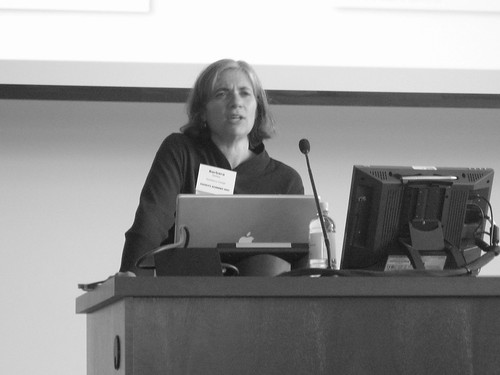
Be that as it may, I think the whole “Reverend Jim” joke is a testament to the play and joy we all get out of the work we do at UMW. I’d like to take a moment and thank Barbara Ganley, Laura Blankenship, and Alan Levine for stepping into the nut house and having so much fun with it all -and raising the play and joy to yet another unthinkably amazing level. I’d also like to recognize the faculty at UMW for continuing to awe all of us each and every day we work together -most of my own groove these last few days has been fueled by the revelation that so many of the faculty grok and are implementing the “small pieces loosely joined” philosophy. Additionally, the absent presence of all the people in the ed-tech network that make this, without question, the coolest field in the world in which one could be thinking and imagining currently. Finally, I’d like to thank my colleagues at DTLT for making UMW such an inspiring and generative place to work, live, and play, despite the horrifying fact that they are currently using my uncomfortable status as fanboy to turn me into a bonafide lunatic! I’m feeling a lot of passion, joy, and general good will right now, much like I did after Northern Voice 2007, which is a very good great sign!

[youtube]ACF4XDznGEs[/youtube]

Tagged , | 7 Comments

Slow blogging: “An archive of learning that intersects with others learning”

Barbara Ganley at Faculty Academy 2007

Barbara Ganley poses the following question at the beginning of her talk:

What is the correlation between your own personal use of Web technologies and the way you use them in the classroom?

Well, what is it for me? The correlation falls at the interstices of making the process an active, open archive of learning that pushes the limits of sharing, collaborating, and building upon their own relationships with a larger social, political and economic context. The correlation is a vision of finally using technology to rethink the access to education and the ways we help one another think, learn, discover and share ideas. A network we could have only dreamed about 200, no less 20 years ago.

Random quotes from Barbara Ganley’s discussion of slow blogging: “Sending letters to self…slow blogging as an organic evolving portfolio…writing to and for actual people…links on the internet that don’t exist in real life…how do you know excellence when you see it…we will become the course…we will shape and define the course…An archive of learning that intersects with others learning…Use the tools of the time to teach to the time”

I have so much more to say about this talk and will be thinking and re-watching this presentation very soon, but to be quick and to the point (quite the opposite of Barbara’s beautifully nuanced presentation about slow blogging): it was the best discussion on the uses of the blog in life, learning, and love I have yet to see, hear, or read. Wow, Barbara -amazing. Thank you!

Tagged , , | 1 Comment

“It’s a movement…”

As we gear up for Faculty Academy 2007, I’d like to throw something out there. Matt Mullenweg, founding developer of WordPress, recently blogged about how his labor of love with WordPress over the last four years might be re-purposed by numerous media outlets for one of capital’s favorite narratives: the entrepreneurial wunderkind and their overnight success. This is not to downplay the fantastic work Matt has done, rather to frame his important work within a larger context of social relations that manifests itself within a vibrant community.

Now, I’ve been folksonomically tagged as a fanboy, or even more recently as the “WordPress Hammer.” I really enjoy such labels because they reside at the intersection of passionate intensity and myopia (all my favorite literary figures live there: Captain Ahab, Raskolnikov, Thomas Sutpen, or even the Misfit from Flannery O’Connor’s “A Good Man is Hard to Find”). Nonetheless, lately I have become a bit suspect of my own inclination to “write to the tool” and was planning on re-gearing my discussions towards more important things like the relationship between institutional learning, power and scholarship. Or even push more of my energy towards the discursive community working towards a free, open, and distributed learning environment.

This was all before I realized that I am already doing that by promoting and contributing to the WordPress “caravan” (to quote Gardner Campbell’s brilliant meditation on this very topic) for it is not a Web 2.0 tool, rather it is a movement! A community that promotes and augments the possibilities for publishing content of all kinds at the low. low cost of free. More than that, unlike many of the other applications out there that do much the same thing (Moveable Type, Blogger, etc.) -there seems to be a sense of commitment on the part of the WordPress community to keep it that way for the foreseeable future. Well, so much for any hopes of abandoning my monomania!

WordPress rules!!!

Posted in WordPress | Tagged , , , | 7 Comments

Freddy’s Bar, Donald O’Finn, and Underground Video Art

Freddy's Bar, BrooklynOne of the many, many things I miss about Brooklyn is Freddy’s Bar. This storied speak easy represents the best combination of dive bar and underground cultural mecca. Unfortunately, Freddy’s very existence is currently being threatened by Bruce Ratner’s Atlantic Yards Project which, among other things, plans on bringing the New Jersey Nets to Brooklyn and making tons of money while ruining the spirit of this fine city in the process (read more about this at Fans for Fair Play).

There are many great things about Freddy’s and a million reasons to save it, but one that I want to focus on in particular is the underground video art of its manager Donald O’Finn. Having a drink at Freddy’s is not only more pleasant and significantly cheaper than any where else in NYC, but you also get a lot more than a few drinks for your visit. The television on the wall behind the bar often offers an ongoing collage of clips from various films, the pacing of which is simply mesmerizing. I was originally attracted by the videos because of their use of innumerable clips from obscure b-movies. I found myself trying to name the movie, or find some kind of reference so that I could somehow get my hands on it. After watching these videos a number of times, I began to notice a some thematic patterns for these collages. They were not meaningless montages (is there such a thing?) but rather narrative sequences that tell a series of compelling stories. In short, brilliantly imaginative stuff!

Donald O’Finn is the artist behind this genius and the bio on his website gives us a bit more:

Since 1982 Donald O’Finn has used TV and video imagery as found objects to repurpose, constructing what he calls “Narratives from Appropriated material”. The village voice “Best Of”Âť referred to his “feverishly edited encyclopedically strange video collages”Âť as “lively rivers, a liquid experienceÂť.” Stating that “his editing is so hyper-intuitive that the culture shocks and time warps gel into a state of half vertigo and half trance.” Mr O’Finn considers his product much closer to poetry or painting, than to film or TV. His videos have enjoyed exhibitions and screenings at various cult venues, as well as the Hershhorn Museum of Art in Washington D.C., and both Lincoln Center and the Anthology Film Archive in N.Y. City, performing with the multi media audio-visual collective known as rev.99.

I recently did a search for Donald O’Finn on YouTube to see what I could come up with and, as usual, my efforts were quickly rewarded. Take a look at some of his videos and be sure to patronize Freddy’s Bar the next time you’re in town -you are certain to be greatly rewarded.

Please note you can see much higher resolution versions of these videos on Donald O’Finn’s site here.

Posted in movies, video, YouTube | Tagged , , , , , | 4 Comments

Faculty Academy 2007: One School to Rule them All

FA07

Well, it’s hard to believe, but the University of Mary Washington’s Faculty Academy is just five short days away -May 16th and 17th. For those of you who may be new to it, this is a unique event that has been held annually for the last 12 years at UMW to feature the uses of technology to enhance, augment and re-imagine various approaches to teaching and learning. We have an action packed line up for you this year, and leading the charge some of the finest. We have Barbara Ganley, Director of the Project for Integrated Expression and Lecturer in the Writing Program and in English at Middlebury College. She has been doing nothing less than stellar work with blogs in her writing courses, and UMW is extremely fortunate to have lured her down to these parts.

We were also lucky enough to catch Alan Levine (aka the CogDog), who some might argue is the Babe Ruth of instructional technologists. Alan was recently named Vice President for Community and Chief Technical Officer of the New Media Consortium, and he is certain to inspire, challenge, and entertain any and all attendees.

Finally, our keynote, Dr. Karen Stephenson, is a corporate anthropologist lauded as a pioneer and “leader in the growing field of social-network business consultants.” Founder and CEO of Netform, Inc., she will be speaking on social network analysis as a transformative agent in higher education. To find out more about Dr. Stephenson’s talk click here.

Needless to say, it is going to be a phenomenal two days of teaching, learning, technology, philosophy, and Web 2.0 Online Educational Video Parties. So, I would strongly urge anyone who may be in harm’s way to register for this 100% free and open conference here, then get yourself down to Fredericksburg to see what the bleeding edge of educational technology looks like!

Tagged , , | 2 Comments