A cry for help! Can we build a bliki plugin to integrate WordPress and MediaWiki?

Over a month ago we started playing with the idea of bringing MediaWiki pages into WordPress post. The logic being you can combine the presentation possibilities and RSS feed generation of WordPress with the ease of formatting, editing and collaborative sharing of MediaWiki. The term Bliki is one of the ways folks have been identifying such a hybrid, and I have been really interested in the possibilities (here is a brief overview of the idea from a presentation for the MAC Learning Environments web conference). Andy Rush found themes for both WordPress and MediaWiki that seamlessly tie the two together visually (read more here). Alan Levine found an authentication extension for MediaWiki that allows you to create the same login and password for both applications in one shot (read more here). The next step is pulling MediaWiki pages into blog posts, and we have been doing some preliminary trials here at UMW’s Division of Teaching and Learning Technologies. In particular, Patrick Gosetti Murray-John’s has coded the beginnings of what we are provisionally calling the GrabMediaWiki plugin (which is based on the name of a Typo3 plugin that does this very thing and inspired my thinking about it) which can be found here.

I have gotten an earlier version of this PHP code to work (see it here). I have included the exact code I used in that post below -you will need a plugin like EXEC-PHP for this to fly- with varying levels of success: it works well with WP 2.1 and MediaWiki 1.6.8 using the Monobook theme, but balks on the MistLook theme for MediaWiki. Also, it doesn’t seem to treat all MediaWiki installs equally. So, in short, we’re out of our league and we need your help! You can find a working basis of the code on Patrick’s blog and below, but this is a far cry from a seamless WordPress plugin that allows you to enter a MediaWiki URL in a field on the WordPress write post tab and whammo, integration! We are not expecting that outcome immediately by any means, just the possibility that folks who may have some programming chops, or know programmers with lamb chops, take a look at the code (or even a shot at the integration) and see what they might come up with (many eyeballs…). The future of educational technology rests squarely on your shoulders -are you geek enough to save the galaxy;)

get_elements_by_tagname('div');

foreach ($divs as $div) {

if ($div->get_attribute('id') == 'column-content') { //grab only the body of the mw page

$contentDiv = $div; }

if ($div->get_attribute('id') == 'jump-to-nav') { //kill navigation div

$parent = $div->parent_node();

$parent->remove_child($div);

}

$div->remove_attribute('class'); //clear off classes to avoid style collisions. might need to do the same if style attributes are present

}

$h3s = $contentDiv->get_elements_by_tagname('h3');

foreach ($h3s as $h3) {

if ($h3->get_attribute('id') == 'siteSub') { //kill the reference to original mw page

$parent = $h3->parent_node();

$parent->remove_child($h3);

}

}

echo $wppageDOM->dump_node($contentDiv); //spit it out!

?>
Posted in WordPress | Tagged , | 16 Comments

Facing the Facts of Facebook

Darren Barefoot recently blogged about Facebook as an “Ad Hoc Engine for Folding Time.” Here’s a quote from his brilliant framing of this widely popular application:

Imagine the advantages of providing an online community where past, present and future members of an organization (a university faculty, a non-profit group, a company and so forth) can gather and exchange information.

To stick with my theatre example, imagine enabling a high school student in Campbell River to talk to a current UVic [University of Victoria] student, and enabling an acting student to talk to a graduate who’s now a working actor.

I could never have put the promise and possibility of Facebook this eloquently or cogently, so rather than trying, I implore you to go read his entire post (linked above) then come back for a few banal reasons why I find myself spending a lot more time in Facebook as of late.

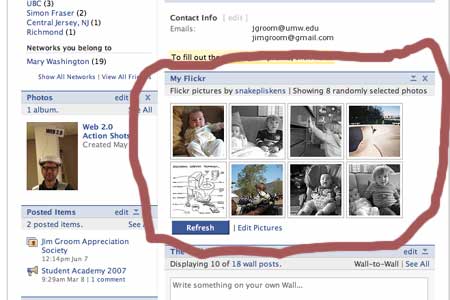
Reason #1: Facebooking flickr!

Flickr FB

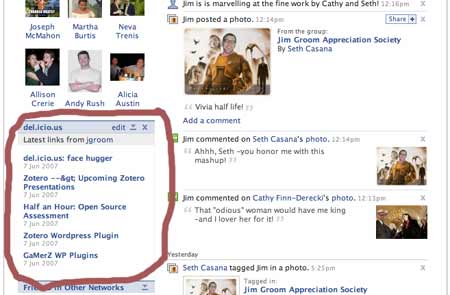
Reason #2: del.icio.us bookmarks anyone?

delicious Facebook

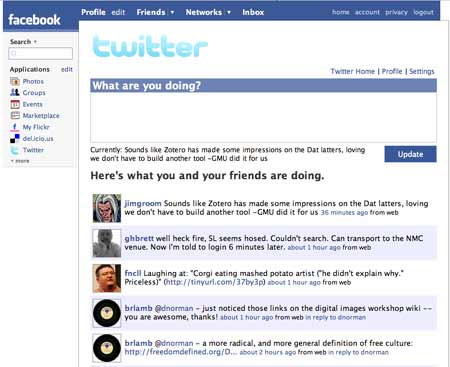
Reason #3 Facebook twits

Twitter Facebook

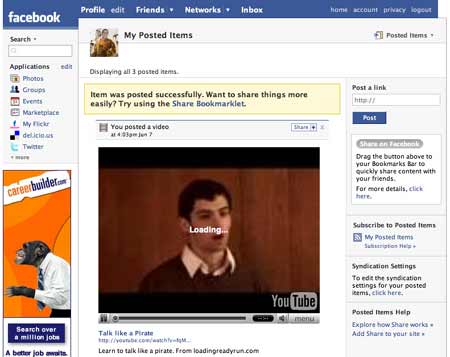
Reason #4 YouTube videos can be embedded! See here for details.

YouTube_FB

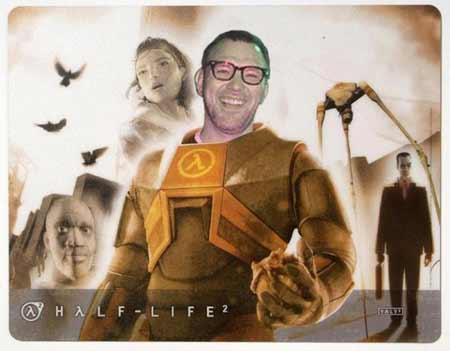
Reason #5 As with everything, it always comes back to fun, community, and the cult of me, me , me, me, me!!! (Sorry Barbara, and thanks go to Cathy and Seth -for further feeding an ego that knows no bounds and who have made Facebook all the more interesting these days with some pretty entertaining photoshop mashups.)

President Groom

Caption reads: “Jim Groom is feted by UMW as he accepts the offer of Presidency of the University. He turns his head to the camera, asking someone to please remove this odious woman from his sight.”

Freeman facebook

Caption reads: “Yeah, I guess I do see the resemblance.”

So, in short, I guess I have to finally face the facts that perhaps for all the right (or wrong) reasons I find myself in Facebook a lot more these days. It’s intensely simple, insanely connected, and has recently allowed for some exponentially exploding possibilities. Now this no way challenges my status as WordPress fanboy, and I am intensely sensitive to the fact that Facebook is not open source and I can’t host a version on my Bluehost account (which would undermine the whole logic of it). All the same, it has become extremely compelling for a long time hold-out skeptic like myself. I think I am becoming a believer -you all know what that means, don’t you?!

Posted in YouTube | Tagged , | 9 Comments

Pirates in our midsts

William Fly's Title Page

Title Page of The Vial Poured Out Upon the Sea, from Daniel E. Williams’s Pillars of Salt: An Anthology of Early American Criminal Narratives.

The topics of pirates and piracy has been on my mind a lot as of late. In the Early American Criminal Narratives class I have been talking about at length in other places on this blog (see here, here, here, and here) we have come across a few Pirate narratives that have raised some really fascinating discussions in regards to our own understanding of this term at the dawn of the 21st century. Why has the collective fascination with all things piratical been exponentially magnified recently? Can we blame Disney, Johnny Depp, and The Pirates of the Caribbean film franchise? Or do other traces like the international Talk Like a Pirate Day phenomenon (which is September 19th), and the accompanying “How-To Talk like a Pirate” video (watch it below, thanks for the link Scott Leslie) suggest broader trends beyond the merely commercial? Is there any simple way to explain the re-emergence of countless pirate-inspired clothing, T-shirts, toys, and paraphernalia for adults and children alike? There is no one single origin for such a fascination and to be fair, a broader interest in the lives and exploits of pirates is by no means entirely new. However, I do think we live in a cultural moment wherein the internet more generally, alongside the increased access to exponentially increased bandwidth, storage, and decrypting/cloning technologies more specifically, frame the emerging struggle over the broader questions of property, copyright, ownership, digital rights management, and a more pervasive notion that corporations and interest groups are increasingly accusing their consumers of being pirates. Piracy as a threat to the economy, and by extension some more abstracted notions of property and welfare, have become ubiquitous at the moment. So much so that we are almost to the point where the mention of the term immediately suggests that there is always already “a pirate in our midsts.”

[youtube]2tL1jbs0ppQ[/youtube]

Warnings against piracy of music and movies is nothing new, but the presentation of the message has become somewhat interesting. How have we moved from what, in retrospect, seems like the good old days of static anti-piracy FBI warnings to the much more propagandistic filmic construction of today’s pirates? The rapscallions are no longer portrayed as peg-legged, eye-patch wearing caricatures, but rather as teenagers in their comfortable suburban homes who, like a common thief, rapes and pillages the coffers of the entertainment industries. Hmmmm, a very interesting message, and even more so because of the insistence in this pre-movie trailer that in fact what you are doing is a crime! This may, at first, seem fairly straight-forward, right? Of course they have to re-iterate its a crime using MTV style editing and blaring music to communicate to a generation of perceived threats that don’t seem to understand this fact (see a video example of such a warning below). Yet, like all good propaganda, it is not premised on a discussion of the existing laws and their uses (or even their potential problems -how might that look?), but an attempt to reform and correct through fear and terror of being “disciplined and punished” (something the RIAA is making an art of recently). This is a perfect example of a forceful internalization of a logic that is still unclear as we move into an age where access to digital media has become far more efficient, and at times more effective, than the measures some companies have taken to manage your digital rights for you (think of the SONY copy protection scandal in 2005) which makes the distinctions between pirates and corporate privateers all the more ambiguous. But I am not an copyright expert, nor can I pretend to follow these issues as closely as folks like Cory Doctorow at Boingboing (who recently taught a class on these very issues at USC) that do a phenomenal job of following these issues on a daily basis.

[youtube]l5SmrHNWhak[/youtube]

Nonetheless, the pirates we are reading about in class are not the 21st century scallywags who have become the new poster children of crime (though many students in University might to identify with this representation given the RIAA’s relentless targeting of them), rather they are of the 17th and 18th century variety that often represented as heretical and unrepentant thieves and murders whose life of crime defies the structures and logic of nations, churches, and hierarchies more generally. Marcus Rediker has written extensively on pirates and their trans-Atlantic exploits as watery circuits of nation-less subversives. Motley crews (or many-headed hydras) of resistance that might be read as alternatives to some of the dominant power structures of Empire that controlled the seas through the regulation of mobility, trade and commerce. His most recent book, Villains of All Nations: Atlantic Pirates in the Golden Age argues that “At their best, pirates constructed their own distinctive egalitarian society, as they elected their officers, divided their booty equitably, and maintained a multinational social order.” So how much of our contemporary fascination with Pirates is born out of a desire to see the current systems of control and order equitably managed? How much might an examination of the “romanticized vision” of Atlantic pirates during the 17th and 18th century tell us about our own particular moment wherein the valences associated with digital piracy seem fluid, uncertain, and up for a more protracted public discussion? What do you think? Would a freshman seminar that examines the Pirate narratives from the 17th and 18th centuries (the Golden Age of Pirates) tell us something about our contemporary struggles with the pirate in all of us (real or imagined)?

Pirates of the Internet

Tagged , , , , , | 2 Comments

If category clouds could talk…

…they might say something like this:

Engl375mm Cloud Tag

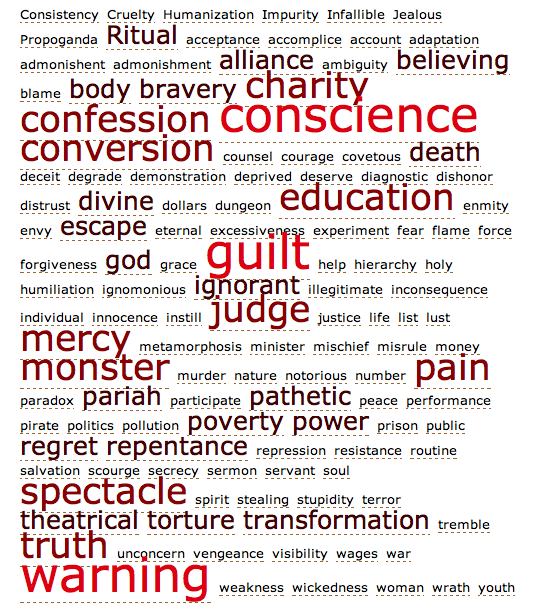
This is a current snapshot of the ever changing category cloud for the Early American Crime Narratives class I have been teaching and experimenting with this Summer session. Read about the conception of this category tag project here, a rare success in this classroom with this approach here, and a bit more about having fun with Early American lit and Cotton Mather in a Web 2.0-ready classroom here. For a close look at the class site as well as category cloud in action go here.

Tagged , , , , , | 13 Comments

MediaWiki/WordPress User Integration: One step closer to a bling bling bliki!

Update: I tested this extension with WPMU to no avail. Looks like it works only with single WP installs 2.1 or higher with MediaWiki installs that are PHP 4 based (I got it to work with version 1.6.8).

Alan Levine off-handedly tweeted and del.icio.us’d a little extension for MediaWiki that he found @ Hery-Dev). What does this extension do? Well, it does nothing less than allow any users within a specific WordPress blog to seamlessly login to an associated MediaWiki install with the same login and password. Users do not need to create a login and password twice, for anything they do in WordPress is carried over into the authentication process for MediaWiki (even subsequent password changes, yes!). In other words, you can now have a class/group site for a WP blog and have the users login into a MediaWiki install without going through the process of creating another account -we are getting one step closer to single sign-on for these disparate web applications.

Keep in mind that I do not think in works in reverse, so if you create a user in MediaWiki, he/she will not necessarily be able to login into the related blog -but I still have to test that scenario.

If you have a use for this here is a very helpful hint that may save you some time if you are thick-headed as I am. After you install the extension and include your database information for WordPress in the LocalSettings file of MediaWiki, you may have trouble logging into MediaWiki with your pre-existing WikiSysop username and password. I was banging my head against the wall all day to figure this out, after innumerable Google searches and a re-install, it so happens that the simplest solution was the right one. You simply need to create a WikiSysop username (or what ever login/password combo you were using in MediaWiki) in WordPress and you’re money.

The Bliki is getting ever more bionic these days! Next up, try it out on WordPress Multi-user.

Posted in WordPress | Tagged , , , , | 8 Comments

Cotton Mather, Marvel Supervillian?

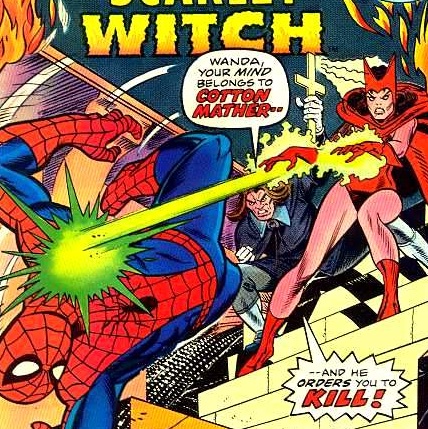
Cotton Mather Marvel Character Doing some last minute prep for class this evening I stumbled across an interesting fact about the iconic early American minister Cotton Mather. Not only was he arguably one of the most important figures in shaping the regrettable Puritan legacy of the U.S. with works like the Magnalia Christi Americana, but he also had played a small, but crucial, role in the Marvel Team-Up comics series that ran from 1972 to 1985 (check out the wikipedia article for the amazing cast of characters this series featured).

Want some more details about this lesser known fact regarding the Fire and Brimstone patriarch par excellence? Below is the tale of the tape (original source found here):

Real Name: Cotton Mather Cotton Mather Marvel Character

Identity/Class: Human (magic user?), 17th Century

Occupation: Witch hunter, magic users seeker

Group Membership: None

Affiliations: The Dark Rider, the puritans of Salem

Enemies: John Burroughs, Dr. Doom (Victor Von Doom), Moondragon, Scarlet Witch, Spider-Man (Peter Parker), Vision, all the magic users in the world, all the servants of evil

Known Relatives: None

Aliases: The Great Inquisitor, Hatemonger, Servant of God, High Priest of God

Base of Operations: Salem, Massachusetts, USA

First Appearance: Marvel Team-Up I#41 (January, 1976)

Powers/Abilities: Mather powers’ origin are unknown (probably they were granted to him by the Dark Rider). Mather could sense and find magic beings, project his voice (or thoughts) at very long distances, control and command other’s will by touching them or hitting them with the fire shot from his wooden cross. Mather seemed stronger than a normal human. Mather used a wooden cross as weapon. The cross could shoot a “purifying” fire, not burning things, but strong enough to hurt Spider-Man and drive the Vision off. The fire also allowed him to control Scarlet Witch’s will.

I really love the way his character profile reads like something out of the Advanced Dungeons & Dragons Monster Manual: “Class -Human/Magic User; Special Powers -mind control, fire shooting wooden cross…” It is really quite fun to find a pop culture reference for one of the most feared and dreaded writers of colonial period. His work is much more exciting and dynamic than often assumed, and a little spilled Marvel ink never hurt to make that point!;) Tonight we discussed his work Pillars of Salt -a history of Crime in New England through sermons, confessions, discourses, and narratives from 1642 until 1698. Believe you me, there is some wild stuff happening in these narratives. If you are at all intrigued, be sure to read the very short and entertaining section of this crime anthology that deals with the punishment of recalcitrant bestiality in Puritan New England here (bottom of page 405 to top of 407 -thanks google books!). Nonetheless, it was really a nice change of pace to start the class off with an image of Cotton Mather portrayed as a Witch-hunting murderer who is trying his “damnedest” to finish off the Amazing Spiderman with the ever dreaded fire-breathing wooden cross!

Are we really still questioning the unbelievable resources the internet more generally, and web 2.0 services and applications more specifically, provide a curious teacher for approaching their subject matter from all sorts of exciting perspectives? I didn’t think so!

Spiderman and Cotton Mather

See full cover of this particular comic here.

Posted in Uncategorized | Tagged , , , , | 18 Comments

Deanimator Re-visited, or the Post that just keeps on giving!

Photo Sharing and Video Hosting at Photobucket

A while back I posted a link to an online flash game called the De-Animator. A fun, simple game wherein you kill zombies. Pretty straightforward, and a lot of kicks for a Night of the Living Dead fan like me (which, by the way, is freely available as a high res movie here on archive.org). What has proven so rewarding about this particular post is that it has kind of taken on a life of its own.

Six months ago I got what I believed to be a respectable, if not impressive, high score of 58 (it took me a while to get to such lofty heights). Well, somehow this post has transformed into a stomping ground for some highly skilled video game addicts who continue to blow my mind. A few months ago Anna_Bannanana reported that she had completed stage 12 during here 7th block class (what is a 7th block class?) -impressive Anna. Then, KayZ, over the last two months claimed he had scored over 200 on De-Animator, a herculean feat in my book. I, naturally, asked for photographic evidence, and he soon supplied me with a screen shot featuring a mind blowing 206 high score! Way to go, KayZ!! Today, Timmy noted that he has scored 255! Two Hundred and fifty Five on De-Animator!!!! Get outta town…

We are moving quickly towards off the chart numbers here folks. I don’t think any of you civilians realize the time, energy and skill that goes into such a high score. For now I have linked to KayZ’s screenshot of his 206 highscore above, at least until Timmy gives me a link to his monumental accomplishment. But, in the end, you’re all winners in my book. Having grown up in smoke-filled pool halls a video game junky with games like Pacman, Defender, Joust, Crush Roller, and Asteroids to while away my childhood (without guilt or penance), I fully understand and applaud the feeling of utter and absolute satisfaction at having championed the machine with what may very well turn out to be an ephemeral conquest. For at least a moment, we were all on top of the (our) game. Anna, KayZ, and Timmy, and all those about to game -FIRE!!!- WE SALUTE YOU!!!

Posted in video games | Tagged , | 20 Comments

Nothing like subliminal messages…

From what I understand, this is Canada’s latest smoking campaign. Nice to see our neighbors to the North have finally caught on.

Summer is Smoking Season

Re-blogged from Coeruleus‘s post here.

Tagged , | 2 Comments

Keira, when in NYC you must “Shoot the Freak”!

This one is for you, Keira McPhee!

Image of Shoot the freak in Coney Island by PhotoPunk

Image courtesy of Default Punk

OK, Keira is going to NYC in the next few days and she sent a request for recommendations of places to go, eat, see, etc. via twitter. Man, what a fun request! I started putting together a google My Maps page of some of my favorite spots with some idiosyncratic recommendations (it is a work in progress, Keira, so be sure to check back often while eating the Apple!). You can view this mini-map-masterpiece here.

Now, I need all you maniacs out there to build upon my very Brooklyn-centric approach to Keira’s request and use the comments (anyone know if they can add to my Google maps?) to offer up some of your own favorite spots in the Greatest City in the World (period). Can you do it? Or are y’all too busy dreaming of that cheap knock-off across the ocean known as Paris. I know you NYC folks are cordial and giving, build upon my near perfect list. 🙂

Oh yeah, be sure to “shoot the freak,” Keira, and enjoy yourself lots. What a great time you will have!

Update: I refer to Dante’s Inferno at Coney Island on the map. Here is a photo of this crazy, crazy funhouse (be sure to check out the original for details and search “dante’s Inferno Coney Island” in flickr for some much wilder shots.

Image of Dante's Inferno at Coney Island
Photo courtesy of J Cody Simms

What a blast writing this post was, the blog still blows Twitter out of the water, despite how much I like that little sounding board!

Tagged , , , , , , , | 23 Comments

WPMU permissions hack for new users

If you are using or administrating WordPress Multi-User you may have come across the following error message for new users creating just a login name (not getting blog):

You do not have sufficient permissions to access this page.

This problem can get pretty frustrating if you are using a single blog on WPMU that has several users. For example, I created one blog for my class this Summer that has six additional users. Each of the students created a login name without a problem, but when they tried to sign on to the site (and I had given them all editing permissions) they received the above message. This can be worked around clunkily with a couple of hard refreshes and a handy edit button on a post, but there is a better hack.

On the WPMU forums I found the following solution. According to this thread, and others like it, this is a more general issue with WPMU 1.0 and hasn’t really been addressed as of yet. However, as is often the case with open source applications, someone has come up with a quick hack that has worked perfectly for me thus far. Below is the code for the plugin to make this problem go away.

domain==$current_site->domain) { // logged in at main site -- no caps
// if user has blog, send user there - code copied from menu.php
$primary_blog = $wpdb->get_var( "SELECT meta_value FROM {$wpdb->usermeta} WHERE user_id = '$user_ID' AND meta_key = 'primary_blog'" );
if( $primary_blog ) {
$newblog = $wpdb->get_row( "SELECT * FROM {$wpdb->blogs} WHERE blog_id = '{$primary_blog}'" );
if( $newblog != null ) {
header( "Location: http://" . $newblog->domain . $newblog->path . "wp-admin/" );
exit;
}
}
}
// user has no caps here
// user either has no existing primary blog of his/her own or did not log in at main site
// redirect to front page of the blog at which s/he logged in
header( "Location: http://" . $current_blog->domain. "/" );
exit;
}
}
add_action('admin_menu', 'adrx_nocaps_login');
?>

Just copy the above code into a text editor, save it as adrx.php, and copy it into the mu-plugins folder of your WPMU install. That’s it! Hopefully this will be solved in the next version, for it is a pretty big problem if you are going to have a multi-user blog within this environment.

Posted in WordPress, wordpress multi-user | Tagged , , , | Leave a comment