Citizentube


[youtube]RGKF2BZLdFY[/youtube]

YouTube has recently introduced citizentube. This channel kind of reminds me of Jon Udell’s post about recording local politics and making it widely available for a more nuanced look at a candidate’s stance on a wide range of issues. He also suggested here that the idea of making these resources widely available should not simply be for vitriolic attacks and mashups to garner viral attention, but rather for a closer analysis of what candidates are saying and how their own positions can be understood more comprehensively.

So, can we think of citizentube as one potential repository for these resources that we can then augment with a tool like Mojiti? I feebly tried a quick experiment along these lines here. Might a collaborative annotation tool like this broaden the possibilities for a more pointed “close reading” of what the candidates are saying? I am really starting to agree with an off-handed comment that the CogDog made at the NMC Conference on Video Converge: 2006/2007 is the year of the video! (Alan, am I misrepresenting what you said here?) The larger question now is how do we use it to make some kind of intelligent and responsible impact on 2008 and beyond.

Posted in Uncategorized, video, YouTube | Tagged , | 4 Comments

A fish tank called Wanda

Fishtank
Photo courtesy of Mataparda

D’Arcy Norman has been rethinking eduglu, as have a bunch of folks at UMW. I am nowhere near smart enough to retrace the steps of the conversation, which is for the moment all offline. A couple of things D’Arcy discusses get at the heart of some of the many things we have been thinking about. Do we need to create a new tool or rethink the entire logical structure we have been working through -I don’t think so. The idea of the university creating a self-service tool (as D’Arcy says, OPML or whatever) for students and professors to feed and manage the sites that they are following would allow for more personalized portals of direct relevance to the individual.

The part that is missing, however, is a space to let all of these individual feeds interact with one another in some useful, but not necessarily prescriptive, way. So how about we take the tool D’Arcy vaguely describes and harness all the users’ feeds throughout a particular university and find an interesting way to re-present them to the campus at large. The controlling metaphor in my mind (ahhh, the potential uses of quotidian poetry!) is the campus fish tank. Create a graphical interface whereby the feeds swim around in a space that literally looks like a fish tank, the feeds can look like fish of the user’s choice, and similar feeds can “school together” as Andy Rush suggested. Infrequent users can be bottom dwellers, overzealous bloggers can be sharks, you get the idea.

Patrick Gosetti Murray-John came up with the name for this fish tank- Wanda -and I think we all believe that a graphic interface that may somehow make the feeds both transfixing and at the same time non-intrusive would help showcase the activity swirling around the local, virtualized mind-meld. Such a space might offer UMW a new, powerful way to capture the interstitial online work being done that all too often goes unnoticed for lack of a compelling space to interact within. So go on, click on a random fish, you never know what you might find!

Posted in Uncategorized | Tagged , | 7 Comments

Newt-jiti!

Looking for the perfect opportunity to try out Mojiti? Well, Newt Gingrich, after his inflammatory remarks about Spanish as the language of the ghetto, released a video apologia -in Spanish- on YouTube (thanks Jerry!). So, why not take this opportunity to annotate this video with what we all, “the people,” really you think he is saying here. I leave the video an “open book” for any and all folks to stop on by and offer their own interpretations (the only catch is you need a mojiti account to annotate).

Posted in video, YouTube | Tagged | 5 Comments

links for 2007-04-05

Posted in Uncategorized | Leave a comment

I dwell in possibility

Emily Dickinson PortraitI dwell in Possibility–
A fairer House than Prose–
More numerous of Windows–
Superior–for Doors–

Of Chambers as the Cedars–
Impregnable of Eye–
And for an Everlasting Roof
The Gambrels of the Sky–

Of Visitors–the fairest–
For Occupation–This–
The spreading wide my narrow Hands
To gather Paradise–

Last night I had the good fortune to sit in on a lecture about Emily Dickinson at UMW delivered by Claudia Emerson. The talk was part of the Great Lives series -the title and theme of such a lecture series on the biographical history of genius (or “greatness”) is not necessarily the most appealing to my sensibilities. Intellectual history can often be misappropriated as a “great man” theory of the past as well as a rationale for problematic vanguard, elite politics. That being said, the talk last night opened up some amazing possibilities for framing some of the ideas on that have been emerging through the edtech blogosphere as of late.

To begin, Chris Lotte posted an amazing bit here about the “resurgence of the humanities” and philosophy into the discussion of educational technology. Granted my own background as a humanities-phile biases me, I have to say that his sentiments really resonate with my own intense attraction to this field:

I also enjoyed the resurgence of the humanities– and philosophy– into the discussion. I believe more than ever that we are in the middle of a culture-change that is on par with the emergence of science and rationalist thinking and then the industrial revolution and mechanical apparatus. Orienting ourselves to this radically changing environment in which we will have ubiquitous smart objects, ambient networking, promiscuous presence demands rethinking the very foundation of our thought and approach to the divide and connections between us and the world.

The idea of orienting ourselves within a radically changing moment frames the importance, if not necessity, of capturing and reflecting upon the poetry of the medium. The short, lyrical ideas that are born from sharing and thinking about these concerns together. Prof Emerson did a masterful job of dispelling the myth of insanity surrounding the figure of Dickinson and her work, while simultaneously examining her particular space (literally and figuratively) as a woman within late nineteenth-century New England.

An extremely generative conceit Emerson used to describe Dickinson’s isolation was the idea of “removes.” Mary Rowlandson’s foundational The Narrative of the Captivity and the Restoration of Mrs. Mary Rowlandson (1682) is framed by twenty removes at the hands of the Native Americans that place her, to quote the Narrative, “into the vast and desolate wilderness.” This powerful metaphor of a simultaneously physical and psychological journey into the space of the vast unknown seems entirely appropriate to Dickinson. Dickinson intense meditations on the simultaneously “vast and desolate wilderness” of consciousness that frame the relationship amongst her own removes (being “motherless,” husbandless, childless, and godless), the historical moment she lived in, and the immensely powerful legacy of her artistic vision.

Nonetheless, despite the best attempts to explain her life through the poetry or the poetry through her life -the words are on the pages within the fascicles as a relational sequence of lyrical poetry that simultaneously fosters, conceals, and agitates the possibility of meanings. Poetry is something akin to, and more than, philosophy -as “my special lady friend” Antonella points out beautifully- for before the aristotelian focus on logic and reason there was a space amongst the pre-Socratic poets for an alternative vision for the possibility of language -and by extension reason, logic, and laws (sometimes there’s nothing like a classical education at an Italian Lyceo!).

All this to say, Stephen Downes frames what he is working on through the lens of Wittgenstein (that is my reading -he may very well disagree with my emphasis) and Brian Lamb soulfully muses on the “Disintegrated thoughts on content integration and remix” -I echo Chris Lotte’s celebration of the resurgence of the humanities in the conversation about edtech. The problems of language (specifically the complex and ambiguous space of accurately relating words to meaning) we face when approaching eduglu can learn much from the precise and economical lyrical poem of Dickinson that is both shrouded and illuminated by uncertainty, discomfort, and ambiguity. Our greatest asset is sustaining the creative and imaginative energy that enables us all to continually “dwell in possibility.” Poetry may very well be that manna!

Tagged , , , , , | 6 Comments

links for 2007-04-03

Posted in Uncategorized | Leave a comment

links for 2007-04-02

Posted in Uncategorized | 1 Comment

Newt in the news

Newt GingrichUMW’s commencement speaker this year is Newt Gingrich. And while I have my own misgivings about such a selection, I also recognize that a) education is premised upon access to a broad horizon of differing viewpoints, ideologies, and perspectives, and b) I’m not calling the shots. So, in the spirit of access, here’s a quick sample of one of Newt’s more recent opinions:

The American people believe English should be the official language of the government. … We should replace bilingual education with immersion in English so people learn the common language of the country and they learn the language of prosperity, not the language of living in a ghetto.

Link to CNN article.

So, in summary, Newt Gingrich, who is not beyond presuming he speaks for the “American” people, believes that any language other than English spoken formally in the US is akin to economic, intellectual and cultural depravity. Or is this only one way to interpret ‘ghetto’? Perhaps it is more akin to a lens for framing ethnic and racial differences? Or maybe it is wrapped up in the fallacy that economic wealth and prosperity is somehow a reflection of a person’s (or country’s) unassailable moral character. I’m really not sure.

However, I would certainly like to be part of a dialogue around some of these ideas when he comes to Fredericksburg this May. If Gingrich is thinking about using UMW as a stop along the road to presidential candidacy, then it would seem quite important not only to address an audience of college graduates, but to openly discuss and engage the issues facing this country along with the ostensibly misdirected and offensive rhetoric that’s driving it into the ground. If only a commencement speech was more like a blog post!

Tagged | 7 Comments

Russian Agit-Pop video via WFMU (is there any better blog going?)

Russian Agit-Pop Video by Lyapis Trubetskoy
from WFMU’s Beware of the Blog by Station Manager Ken

Sucker that I am for propaganda imagery, I couldn’t resist this video by the Belarus band Lyapis Trubetskoy for their song “Kapital.” Click the image for the streaming video from their (Russian) site:

(Link.)


I can only make out “Kapital” and “Marx.” Mikhail, can you translate this bad boy for us in the comments? Or at least an overall summary. 🙂

Posted in video | Tagged | 7 Comments

Student Academy 2007, Hallelujah!

Some amazing stuff at UMW’s Student Academy 2007 this year. Ranging from presentations on Sylvia Plath to the real world economy of World of Warcraft! You can see the presentation schedule and detailed abstracts here. I can’t say enough how innovative and thoughtful UMW students show themselves to be at an event like this. Now how do we make the convergence of an event like this more apparent on a regular basis?

IMG_0476.JPG

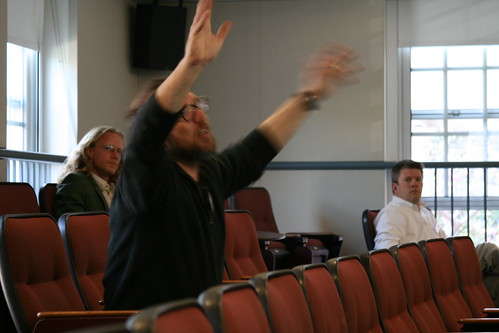
Chip German (UMW’s CIO) caught me on camera, along with Patrick and Andy as my witnesses, filled with the spirit – call it a ghost in the machinima!

See some more photos of the event here.

Unbelievable quote from today’s morning session that I will be writing about in more depth was Professor Claudia Emerson’s reference to Ralph Waldo Emerson when describing the process of blogging as a “radical correspondence.”

You just gotta love poets!

Posted in Uncategorized | Tagged | 4 Comments