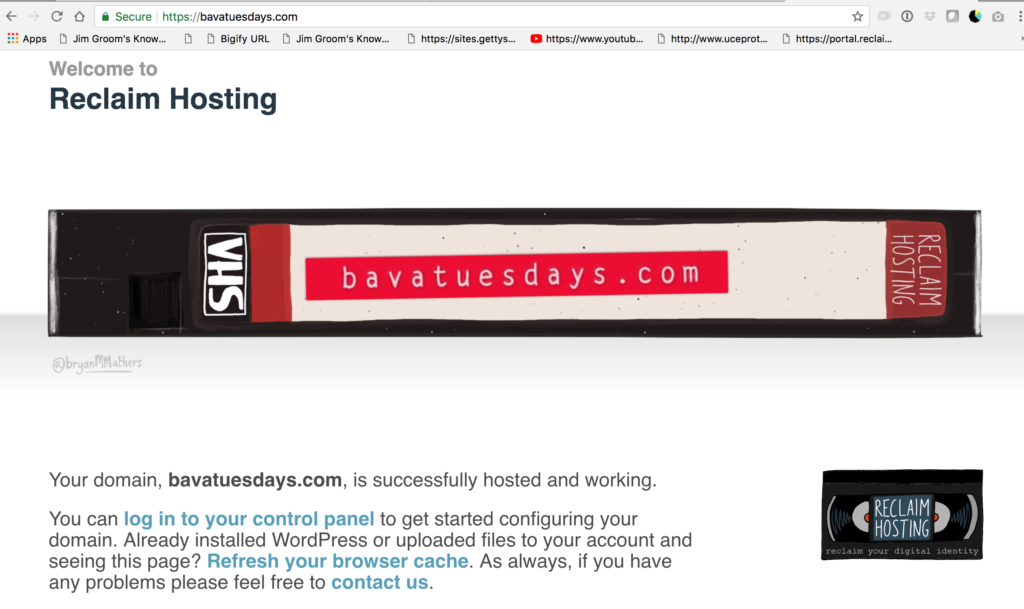
Bryan Mathers‘s developed a VHS splash page for Reclaim Hosting, and we really, really like it. I’ll let him explain the details, while I just revel in its beauty. I will note that the title on the VHS tape is automatically generated based on the domain someone signs up for, so before they install anything in the root of their domain, this is what they will see:
Who has more character than Reclaim Hosting, you ask? #NOBODY!!!!
I’ve been procrastinating this post because I have so much to say about my time at the Re:publica conference in Berlin almost two weeks ago, but that never works out well.* So, where to start? I think I’ll start with two quick recommendations. I highly recommend danah boyd’s keynote “How and Algorithmic World can be Undermined” that opened day 1:
As well as Orit Halpern‘s “Resilient Speculation:”
They were both insightful and relevant, and I hope to return to both for a blog post. I am holding off because I have not watched boyd’s version of this talk at SXSWedu a couple of months earlier, and I wanted to given it came up in the Virtually Connecting session later that day (more on that soon). I also need to re-watch Halpern’s talk because there was a lot going on and I came in about 5 minutes after it started. They way she re-frames the term resilience to examine economics, environmental planning, and technology was quite wild, I found myself imagining turning her subject matter into a dystopian scifi novel (and even went as far as optioning the script in my daydream). I tried to sit through Chelsea Manning‘s fireside chat session, but the first twenty minutes were pretty terrible. There was no real direction for the conversation, and quickly everything turned into a kind of empty slogan around the times. Not sure where this broke down cause I was looking forward to it, but you can see it for yourself here and let me know how wrong I was:
After that I stole away to get some work done. During this time I kinda got a better sense of the venue and conference. Turns our Re:publica started as a blogging/Web 2.0 conference in 2007, which makes it a year younger than Northern Voice. In fact, Re:publica is probably a fairly accurate representation of what NV would have become if it remained a thing: namely a fullblown media conference where any relics advocating lower case b blogging have long since been disinvited. Which begs the question how I got in? —although my session turnout will certainly prevent them from making that mistake twice 🙂
In the afternoon of Day 1 I met up with Christian Friedrich—it was amazing to spend so much quality time with him, a real highlight of the trip—and we had a blast doing Virtually Connecting atop a garbage can. There were no real quiet spaces in Re:publica we could use, so we had to take to the mean streets of Berlin. Christian and I were basically reporting from the conference to give Joe Murphy, Terry Greene, Taskeen, and the OG VC herself Maha Bali a sense of what Re:publica was all about. It was a ranging conversation and this is where some issues folks had with boyd’s previous talk at SXSWedu came up. I just always seem to have fun when I do a Virtually Connecting session, and this one was no different. Christian and I made on good on-site team. After that I went back to the hotel and worked some more, went to see Infinity War, and crashed hard. The next day I got to connect with Jöran Muß Merholz and Philipp Schmidt for a meetup focusing on “10 Directions to Move Open Education Forward.” It was a fun session that about 20-30 people came to and we worked together in several groups discussing and building upon at the Capetown Open Declaration recommendations 10+ years later.
After that, I went back and worked on my presentation for the following day on Domain of One’s Own. I had no intention of talking about EDUPUNK at all, but when I woke up Friday I saw this tweet from someone who had been following the meetup the previous day:
I took it as a sign from the German gods 🙂 I immediately tweeted back and forth with the Bildungs Punks crew. And while Ines Bieler was not on site, I did get to meet Christine Skupsch:
The joy was all mine. We chatted about the idea of EDUPUNK† as they are iamgining it, and this groups is made-up of a distributed group of teachers that aggregate and share their ideas around technology in the classroom. It’s worth noting that there is a certain amount of excitement around the possibilities of educational technology in Germany right now, part of the reason is they are basically starting from scratch. The long history of LMS/VLEs that dominated the landscape for the last two decades in the U.S. was not the case in Germany, rather they had very little in the way of edtech at all. I think that is where this sense of possibility comes from, and I personally appreciated looking on all this stuff through fresh eyes. That said, my talk was playing off this, and became a bit of a cautionary tale encouraging them to avoid the LMS path which leads to mediocrity and data collection.
So, given the EDUPUNK mug I woke up to, I had to re-work my talk a bit to incorporate EDUPUNK by focusing a bit on The Glass Bees and The Twenty Days of Turin, which opened up the door for me to return to some of the 70s scifi art I presented about in Australia. Which, in turn, will hopefully result in my trying to work on this talk a bit more for a presentation I’ll be giving at the MyData confernece in Helsinki come August because I think it could actually be good. But for now you are stuck with what was:
Finally, I met some very cool people on day 3, including a young graduate student from Scotland named Tom Wallis, another graduate student (Iva Karabatic) who I will be interviewing about a domains project she started using a national domain space in Croatia—so cool, and finally (and insanely enough), during my post talk meetup a gentleman saw my name on a monitor and asked me, “Did you teach ds106 back in 2012?” Turns out it was Victor Ofoegbu who was running the open online course in Ghana!
Random news from the awesomeness of #ds106 annals, ran into @ofoegbuvictor of #ds106 Ghana fame at #rp18. Truly wild moment of global convergence through a hashtag, some silly assignments, and many smiles. Easy to forget how brilliant that community was, is, and still can be. pic.twitter.com/K4aNmZyxGT
It was a humble reminder for me how awesome this stuff can be. So, in summary, my time in Berlin at Re:publica 2018 was pretty awesome.
*Although, to be fair, the procrastination on this post has resulted in a kind of clearing of the blog decks on OER18 thoughts, random Twitter links, a good Reclaim Video post or two, some blogging reflections and more 🙂 So maybe it doesn’t work out for coherence of the Re:publica memories, but my blog numbers are definitely up!
†I am pretty sure they never heard about the other EDUPUNK (there goes my case for Weller’s 25 years of EdTech :). Crazy, and it occurred to me that in just ten days EDUPUNK will turn 10 years old.
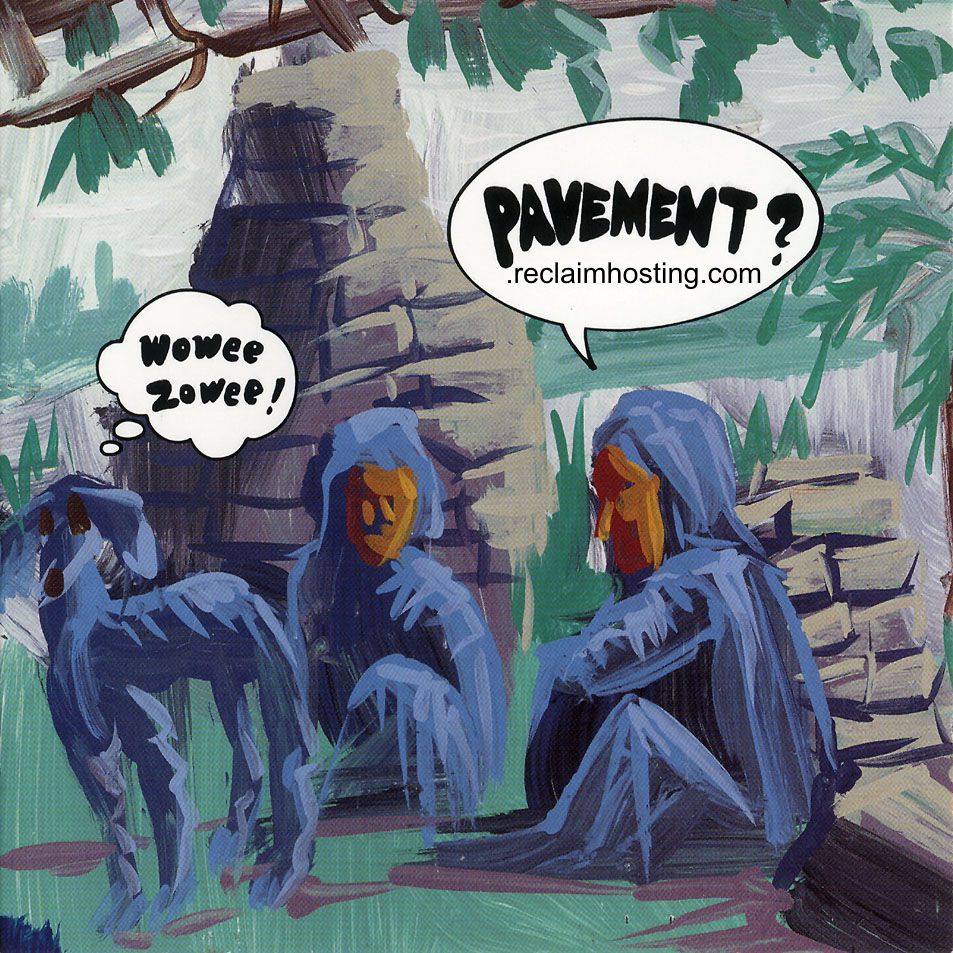
The migration email went out yesterday, so it’s official. We are retiring the Unwound shared hosting server after 2 and a half years of faithful service and will be migrating all accounts over to our newest server: Pavement. Sticking with the post-punk music scene of the 1990s, Pavement getting the nod was just a matter of time. Pavement is interesting to me because while they had a modicum of success with the song “Cut Your Hair” off their 1994 Crooked Rain, Crooked Rain album in the early 90s and could have easily signed to a major label, but they remained committed to small, independent record labels and their next album, Wowee Zowee, is considered their most bizarre and experimental. I love this bit from the Wikipedia article about the album framing why that might be:
Rolling Stone speculated that the relative success of their previous album [Crooked Rain, Crooked Rain] (having sold 169,000 copies by this time[citation needed]) was a reason for this album’s eclectic nature; the magazine’s review claimed Pavement were afraid of success. Stephen Malkmus refuted this, saying that while his judgment may have been clouded by excessive marijuana usage, the songs “sounded like hits” to him.[citation needed
As you can tell from the pull-quote above, citations are still needed—so be sure to fact-check this—but I love the idea of Malkmus saying they sounded like hits to him. It’s a brilliant retort, and frames beautifully the ridiculousness of chasing hits for success. That said, Pavement’s performance on The Tonight Show in 94 might be used to counter this argument given they don’t even seem to be trying, but honestly that has always been my experience when seeing them live 🙂
Pavement gets cited as one of the most influential bands of the 90s, and are probably the least popular band to have two albums highlighted in the top 25 of Rolling Stone‘s “100 Best Albums of the 90s.” Chances are most folks have heard of just about every other band on that list save Pavement, and their influence on the alternative music scene of the 21st century is everywhere apparent. But, if you ask were to ask the late Mark E. Smith of The Fall he would say: “it’s just The Fall in 1985, isn’t it? They haven’t got an original idea in their heads.”* But it’s hard agree with Smith given how many awesome songs Pavement laid down, and below are just a few. Previously I would have implored you listen to them in a Pumpkin-free environment, but nothing gold can stay 🙂
https://www.youtube.com/watch?v=i5OeoVkTDLM
And there are many more where those came from should you care to take the leap.
The great Chris Lott (most recently of Katexic fame) shared a post with me titled “Small b blogging” by Tom Critchlow that had some pretty salient points about why you should blog. I’m gonna share a few below that resonated—but I highly recommend you read the entire post. He starts with the example of a couple of posts he wrote that had over 2000 and 1000 views respectively, which struck me cause I was like, “Really? That’s nothing.” And that was the point, it only seems like nothing because we have become enthralled by sheer numbers and scale and volume has become the only thing truly valued by networks like YouTube (“How many subscribers? How many views?”), Twitter (“How many followers?”), and Facebook/Instagram (“How many likes?”). It’s a race to the bottom. Critchlow defines his idea of small b blogging as a network designed on and for a personal scale:
Small b blogging is learning to write and think with the network. Small b blogging is writing content designed for small deliberate audiences and showing it to them. Small b blogging is deliberately chasing interesting ideas over pageviews and scale. An attempt at genuine connection vs the gloss and polish and mass market of most “content marketing”.
It’s interesting, and Critchlow nails my contempt for Medium and other “blog networks” when he explains the allure behind what he frames as big B blogging:
….much of what you read on the web is written for large audiences. Too much content on the web is designed for scale, for sharing, for gloss and finish. It’s mass media, whether it’s made by a media company or an individual acting like one. So when people think of blogging their natural reference point is create something that looks like the mass media they’re consuming. Content designed for pageviews and scale.
This is why it’s appealing to people writing on the web to get it in a prestigious publication, or place it somewhere with an in-built audience. i.e. Medium, Inc, Entrepreneur, Fast Company etc.
And for me that is the kicker, most folks treat their blog as if it were some kind of glossy headshot of their thinking, whereas the beauty and freedom of blogging was that it was by design a networked tool. Blogging provides a space to develop an online voice, connect with a particular network, and build a sense of identity online in conjunction with others working through a similar process. Scale in many ways became a distraction, one which was magnified to such a degree by the hype around MOOCs in edtech that anything less that 10s of thousands of “users,” “learners,” “participants,” followers,” etc. was tacitly considered somehow less than optimal for effective online learning. It was, and remains, a symptom of the capital-driven ethos of Silicon Valley that places all value on scale and numbers which is rooted in monetization—a reality that has infected edtech and helped to undermine the value and importance of forging an independent voice and intimate connections through what should be an independent media of expression. When scale is the endgame the whole process becomes bogged down in page views, followers, and likes rather than the freedom to explore and experiment with your ideas online. It’s a uniquely web-based version of Hell where the dominant form of communication online is a Medium think piece written by your friendly neighborhood thought leader.
In some ways Critchlow’s piece highlights the real value of the “back to the blog” moment that seems to be discussed here and there by folks. It provides an opportunity to re-direct some of the energy invested in the massive scale platforms like Facebook, Twitter, Medium, etc. and re-invest that labor on a personal scale. Because, in the end, small b blogging is as much about launching a full frontal assault on the armies of annoying thought leaders gentrifying the blogosphere as it is about self-expression, experimentation and deep connections. bavatuesdays is a “b” blog, after all 🙂
We are big fans of the SPLOT at Reclaim Hosting, and Alan Levine has been doing a ton of work developing and managing these tools over the last couple of years. Not so much because folks are paying him too, but because that’s who he is. He follows his interests and over-sized heart from fun project to funner project, living the life of a nomad edtech. Not so much “The Man Without a Name” as “The Man without an Institution”—but damn that creep can blog! I guess if you have a good enough blog you don’t need an institution 🙂
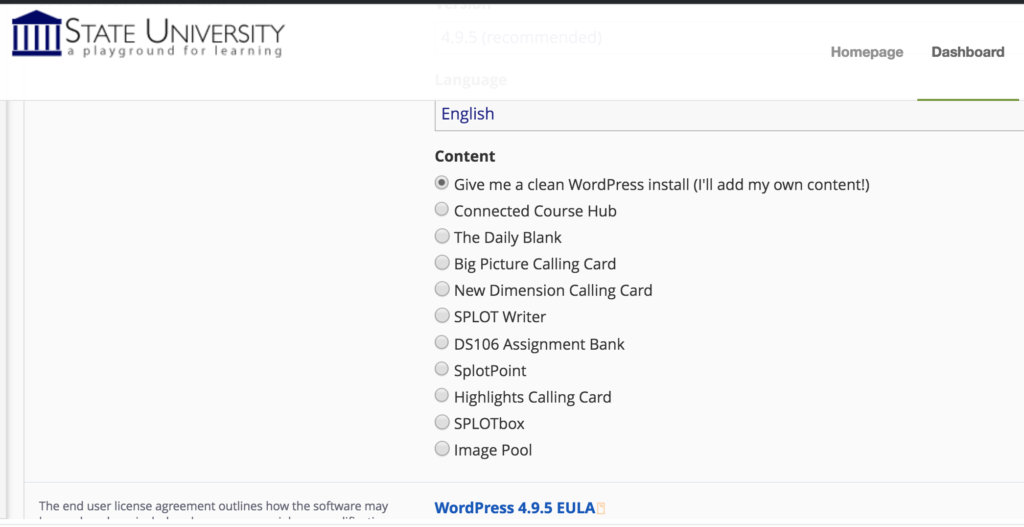
Anyway, Alan’s tireless work around SPLOTs is something we have wanted to build on top of at Reclaim for a while now. Specifically, we want to be able to package up SPLOTs as individual apps that someone can install with one click. Alan has been maintaining a number of SPLOTs on our demo server StateU that are available as variables on top of WordPress:
StateU SPLOTs
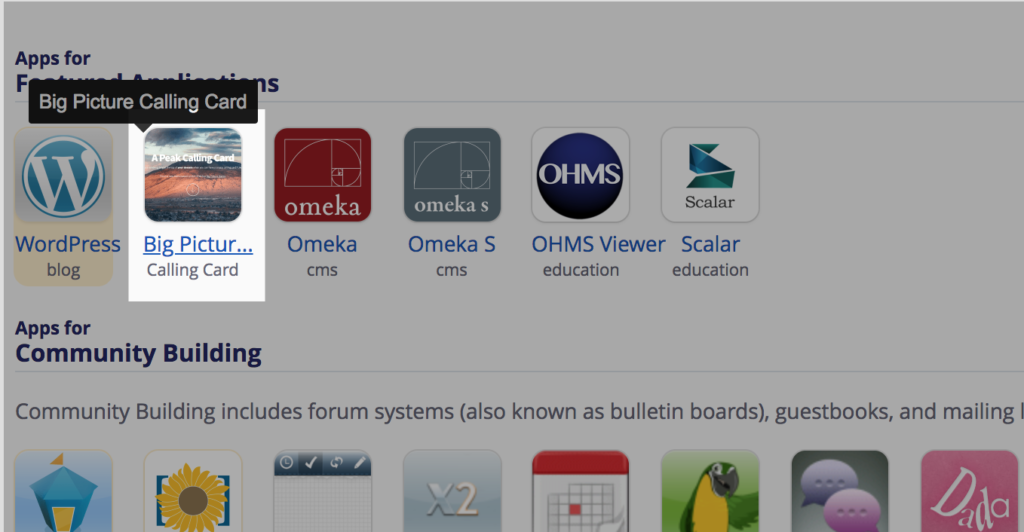
But when Alan joined us in Fredericksburg for our Workshop of One’s Own to talk SPLOTs in March, we made some headway on making each tool a stand-alone app that can be showcased in cPanel alongside WordPress, Omeka, etc.
Big Picture Calling Card SPLOT as its own application
And the idea is to try and get a series of these SPLOTs in cPanel dashboards across our shared hosting and institutional servers, not only to give folks access to these tools—although definitely that—but also in hopes people will see what’s possible and make their own SPLOTs that can in turn be shared back for others to use. In this way Reclaim could help provide a hub to distribute these “tiny teaching tools” (to misquote Tom Woodward). So, that’s the plan, and to buttress Alan’s efforts and hopefully make it more widely available to others we have started a year-long fellowship at Reclaim in order to support Alan’s work with SPLOTs for the next 12 months. And, as it will be no surprise to anyone who follows his blog, Alan has been bobbing blogging and weaving all kinds of SPLOT goodness.
Being able to support the efforts of independent edtechs like Alan Levine is exactly what Reclaim Hosting was born to do—it is, after all, the house that 106 built! And, hopefully, we can do more of just this kind of thing in the future.
Lauren posted about this back in January when we first got the art because she is better than me, but Reclaim Hosting‘s site has undergone a subtle re-branding from vinyl to VHS. We launched the new art for our site back in April when we unveiled the Reclaim Video project at OER18. The idea is that the shelf is getting a bit more cluttered 🙂 Next to the vinyl you have those upstart VHS tapes demand some of the real estate. The new logo is a VHS tape, but if you look close enough, all the elements of the vinyl are still there, which was quite brilliant on Bryan Mathers part—surprise, surprise.
The tape is now replacing the record on the site, but the easter egg is still fully operational:
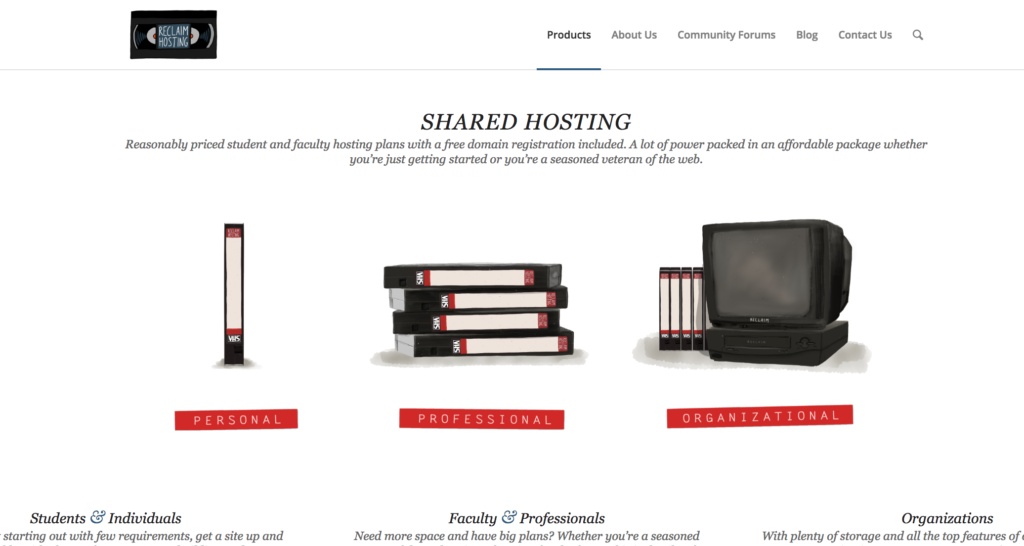
The art is pretty much inline with our aesthetic, so perhaps rebranding is too strong a characterization—but it does feel like a new look for me. I particularly like the way shared hosting packages are re-imagined:
Almost works better than the albums, and the single VHS tape with a blank label is something we still need to play with. Bryan worked on a tool that would basically right a URL on the label, something like this:
Or even better , this 🙂
So, when you create your site for the first time at Reclaim Hosting the splash page could be this VHS tape with your domain name 🙂 This might be something we need to return to sometime soon. As usual, I am completely enamored with Bryan Mathers handy work, and it is the collaboration that just keeps on giving.
I put together a series of GIFs for a slideshow that was going to play in the background, between sessions, etc. at OER18. I don’t think that ever came to fruition—or at least I didn’t see it—but I kinda like it, so I am going to post it here. It’s kind of an abstract GIF story about Reclaim Video, or something like that … I’m not sure it is all that good or special, but I do enjoy it.
I was part of two sessions at OER18 a couple of weeks ago. Lauren Brumfield already blogged and shared the slides of the session she authored on Digital Literacy. I say authored rather than presented because, unfortunately, she fell ill on day 2, and Tim, Meredith, and myself had to step in and deliver the talk. It went off seamlessly because Lauren had already written us into the plot, but the design and execution was all Lauren’s doing—we were just errand boys and girls sent by a grocery clerk to collect a bill 🙂
Meredith also presented, and I will post about that separately, but it’s worth taking a moment to comment on the importance of having everyone at Reclaim Hosting getting comfortable with proposing and presenting their ideas at conferences. I know it was huge for me when I was encouraged to present as soon as I started working at UMW. I was pushed to work with the rest of DTLT to hone how we told our story, and that resulted in so much goodness over the years. It’s important to provide a space for exploration and narration as part of life at Reclaim, and OER18 provided an intimate, welcome environment for us to do just that—even beyond Reclaim Video 🙂
So, having some time to present with Tim about the possible future of Reclaim Hosting in beyond the LAMP environment was a lot of fun. We focused on our explorations of CloudRon, which was timely, given we have a couple of schools particularly interested in exploring a container-driven environment like this for their respective programs.
What is CloudRon? It’s an open source environment for running containerized applications, making it simple to run apps in Node.js, Ruby, etc. which do not run cleanly in a LAMP environment. Below are the slides from our 15 minute lightening presentation, not necessarily all that informative given they are screenshots, but basically comparing cPanel to the CloudRon experience—although to be clear it is not necessarily one or the other.
We discussed how folks have pared down cPanel to just WordPress to make things easier, as well as how software like CloudLinux for cPanel has made it possible to install Ruby apps like Jekyl or Node.js apps like Ghost, but the process is not easy. From there we looked at how dead-simple Cloudron has made it not only to install applications, but map DNS, and even copy and share applications templates. It’s an increasingly compelling space for us to be exploring, and we are fortunate enough to have a couple of partners interested, so I imagine you’ll be hearing much more on this front from Reclaim in the coming months.
I am hearing a lot from @avsa that sounds identical to OpenID. I think we need to learn from previous web2 attempts & evolve / change things. This Wired article has some OpenID failure background https://t.co/WHXyrbYeqM#walletconf
I need to break through the forming wall of posts I need to write and just blog to get things rolling. And, at least for me, sometimes the easiest way at that is a quick post completely unrelated (or at least seemingly so) to what I should be writing. While at the Edcon conference, Boris Mann tweeted a link to a Wired article from 2011 chronicling Open ID “the webs most successful failure.” The title struck me, and I was interested to find out what happened to this open standard for identity management. A couple of points jumped out from the article which I will include below, but before that what is OpenID?
OpenID promised to solve two problems. First, it would offer an easy way to log in to any website without needing to create a new account. And, second, it would enable you to have a consistant identity across the entire web. This worked well with the limited audience of bloggers and tech-savvy users that were part of the original vision.
Ok, so why didn’t it take off?
The main reason no one uses OpenID is because Facebook Connect does the same thing and does it better. Everyone knows what Facebook is and it’s much easier to understand that Facebook is handling your identity than some vague, unrecognized thing called OpenID. That’s why, despite the impressive sounding billion URLs and 50,000 sites supporting OpenID, it pales next to Facebook Connect. Facebook Connect has been around less than half the time of OpenID and yet it’s been adopted by some 250,000 websites, is available to the hundreds of millions of Facebook users and has the advantage of Facebook’s brand familiarity.
And the kicker:
Facebook also added a key ingredient that helped drive other sites to adopt Facebook Connect – sharing user data. One of the reasons more sites support Facebook Connect is that they get a piece of the user pie.
I thought these bits from the demise of OpenID were interesting given the current uproar around how Facebook is using/abusing personal data, and a good reminder that there were options a decade ago that did not collect and freely distribute the user pie. But brand recognition and the difficulty—as with RSS—for certain open standard technologies to become more accessible and widely adopted has had real implications on the current state of the web, even if both OpenID and RSS continue to drive the often hidden, underlying logic of these information ecosystems.
So last night while exploring a service called Dock.io, I made a pretty big blunder. I was importing my Google contacts (first mistake) and unintentionally invited all of my Gmail contacts to the service (second very big mistake)—definitely not good. Beyond embarrassing—this was a blockchain identity management service after all—doing something like this shakes people’s trust. No one wants to be spammed, and we designed Reclaim Hosting around the very idea of no up-sell and no BS, so this gaffe is doubly excruciating for me. But, I did it, and it’s my bad and I have to own that and apologize to folks who got a spammy email from me yesterday.
I cannot vouch for dock.io given it is a new service and I have only become to explore it myself, what’s more I’m by no means sold on blockchain as a solution to anything. But I was interested in how they’re allowing you to use their service to update your personal information across your various distributed accounts. It jives with the idea of the Personal API that we have returned to with BYU, and I wanted to get a sense of their interface and how they are doing this. What this does remind me of, and this is something I am going to work to divest myself of a bit, is how easy it is to pull all of my Google data into another service to send spammy emails. There are many reasons why this is a huge red flag, and should have know better. Now I have some more self-flagellation to attend to..
is an ongoing conversation about media of all kinds ...
Testimonials:
Generations from now, they won't call it the Internet anymore. They'll just say, "I logged on to the Jim Groom this morning.
-Joe McMahon
Everything Jim Groom touches is gold. He's like King Midas, but with the Internet.
-Serena Epstein
My understanding is that an essential requirement of the internet is to do whatever Jim Groom asks of you while you're online.
-James D. Calder
@jimgroom is the Billy Martin of edtech.
-Luke Waltzer
My 3yr old son is VERY intrigued by @jimgroom's avatar. "Is he a superhero?" "Well, yes, son, to many he is."
-Clint Lalonde
Jim Groom is a fiery man.
-Antonella Dalla Torre
“Reverend” Jim “The Bava” Groom, alias “Snake Pliskin” is a charlatan and a fraud, a self-confessed “used car salesman” clawing his way into the glamour of the education technology keynote circuit via the efforts of his oppressed minions at the University of Mary Washington’s DTLT and beyond. The monster behind educational time-sink ds106 and still recovering from his bid for hipster stardom with “Edupunk”, Jim spends his days using his dwindling credibility to sell cheap webhosting to gullible undergraduates and getting banned from YouTube for gross piracy.
























 I need to break through the forming wall of posts I need to write and just blog to get things rolling. And, at least for me, sometimes the easiest way at that is a quick post completely unrelated (or at least seemingly so) to what I should be writing. While at the