Turns out what started out as rough idea Maren Deepwell and I concocted to get bloggers to talk about their writing road has become a pretty fun and compelling (at least for me) way to be reminded of the power of blogging. I already highlighted our firstfive guests, so it might be a good idea to get ahead of the game and announce our May line-up, which will be happening each and every Friday starting May 8th at 12 noon ET. I’ve termed the series “On Writing” to be both descriptive and keep the focus sharp.
If you’re interested in seeing any and/or all of these sessions you can subscribe for notifications from Reclaim’s Events calendar. I’m really excited about the coming month’s discussions, and the coolest part is there are still so many folks to talk to. We all have to do our part to keep blogging alive!
After watching Francois Truffaut’s The 400 Blows (Michael’s brilliant choice for the Family Pictures Podcast) it was my turn to come back with a follow-up.* While watching the classroom scene at the start of The 400 Blows, Antonella suggested Federico Fellini’s Amarcord (1973) might be a nice complement for all sorts of reasons, and as usual she was right. The formative role of school in many of the family films we’ve watched thus far deserves its own post, but more broadly the sharp realism of The 400 Blows plays nicely off the nostalgic remembrances of Fellini’s childhood Rimini. They’re two radically different frames for a coming of age story: one focused on an existential isolation of a post-war child in Paris, while the other chronicles a small coastal city in Italy enmeshed within the fascist norms of “Dio, patria and famiglia” (God, homeland, family) in 1937.
Still from the making of Amarcord during the fascist parade. Foto Credit: Davide Minghini, Biblioteca Gambalunga Rimini
As I mention in the podcast, the year 1937 is significant because it marks a kind of national point of no return for Itlay leading up to World War II. It’s the year just before a series of Racial Laws were put into place that aligned Italian fascism more closely with that of the Nazis. What’s more, “Dio, patria, and famiglia” is not just a slogan we see on a banner during the Fascist parade during the film, but a 19th century nation-building manifesto taken up by the fascists to tie Italian national identity to a strict Roman Catholic vision of family values.
In fact, this watching of Amarcord was even more resonant given the rise of extreme right-wing governments in both Europe and the US. Italy’s prime minister Giorgia Meloni has recently defended the use of “Dio, patria, famiglia” as part of her party’s discourse (Fratelli di Italia is a post-war political party considered the successor to Mussolini’s). The slogan encapsulates the conservative vision of the national character of not only Italy, but much of the Western world. It’s this holy trinity of a Christian identity that’s ostensibly everywhere under attack. You can easily substitute “illegal” (often Muslim) immigrants from North Africa with European Jews of the 30s to capture much of the current rhetorical context—very often still rooted in religious differences.
Fellini’s seemingly benign dreamlike fantasy of a quaint Italian city on the Adriatic (not far from Mussolini’s birthplace) sustains a razor sharp attack on a culture that’s sleepwalking towards a militant radicalization of this identity. In Amacord that ire initially manifests against the anarchists and communists, but just beyond the scope of this moment it would transform into a targeted racial attack against the Jews. As it happens, I was reading about this very moment in another masterpiece of Italian art, namely Giorgio Bassani’s The Gold-rimmed Spectacles (Gli occhiali d’oro). In this novel a Jewish university student narrates the quickly developing impact of the Racial Laws on the Ferrara† community in which he lives. It’s a beautifully lyrical, yet haunting, novel that highlights how corrosive the everydayness of fascism becomes for the fabric of the Jewish community in Ferrara, many of whom were fascist up and until the Racial Laws were passed.
What my father had so long feared had, unfortunately, proved exactly true. No more than a week after Fadigati’s departure, in all the Italian newspapers, including the local Corriere Padano, the crude campaign of vilification, which within the space of a year would bring in its wake the announcement of the Racial Laws, had suddenly begun in earnest.
What you start to realize from Bassani’s novel is that the orchestrated vilification of the Jews in Italy was relatively abrupt, and within a year’s time Italian citizens were being stripped of their rights and some even deported to concentration camps outside the country. An excellent example of Faulkner’s words of wisdom:
The past is never dead. It’s not even past.
Unlike Bassani, Fellini’s film doesn’t fully explore the impact of fascism on the Jewish communities in Italy. Possibly because the racial laws were not yet in effect so the fiction of a more “gentle” Italian fascism could still be floated? Not sure, but this idea of the Italian character as incapable of the same kind of fascism as Germany is something Bassani underscores when one of the narrator’s “goyim” friends holds onto a milder Italian fascism in late 1938 despite the increasingly hostile climate:
‘Oh, we Italians are too buffoonish for that,’ he replied … “We may imitate the Germans in some things, even the goose-step, but not the tragic sense they have of life. We’re too old, too sceptical and worn out.’
Maybe the absence of the darker side of the Racial Laws in Amarcord can be read as a self-aware, embedded critique of the limits of his own nostalgia for the Rimini of his youth? I have to believe Fellini was well-aware of Bassani’s novels given another Italian film auteur, Vittorio De Sica, had just adapted another novel from Bassani’s Ferrara Trilogy: The Garden of the Finzi-Continis. This novel, as well as Behind the Door, are set against the backdrop of fascism in Italy during the 1930s.
I guess the resurgence of “Dio, Patria, Famiglia” here in Italy struck me so hard while watching this film because what seemed like a relic from the past was a current event. What’s more, my ex-patria’s “America First” is an analogous white-nationalist slogan engineered by the rich, wicked, and powerful to create internal divisions that may very well tear us asunder
These are all the things I wanted to mention in this podcast, but sometimes a blog post can be just as good.
________________________________
*In many ways our film choice for each episode has developed into its own kind of playful dialogue, choosing each week’s film is a large part of the joy.
†Ferrara is in Emilio Romagna, the same region as Rimini, which has a significant Jewish population that took the brunt of 1938 Racial Laws.
The 2024 iteration of Middlebury College’s Demystifying AI series
In 2017 Amy started the Digital Detox initiative at Middlebury College so participants could critically examine the role technology plays in their lives. Over the last two years it has focused specifically on trying to demystify AI. In the 2024 iteration of this theme that took the form of helping folks understand these new tools and thinking through how they work. Each tool was often framed by what AI is and is not, such as “it’s not magic, it’s math,” in an attempt to resist the urge to obfuscate the tech behind these tools. What’s more, Tom designed an interactive “course” site wherein the community could play with the tools and then share their results as a means of engaging the tech to surface findings, issues, and lingering questions.
The 2025 iteration of Middlebury College’s Demystifying AI series
For this year’s iteration, the focus of Demystifying AI pivoted from specific tools to the larger questions at the heart of the cultural impact of AI. This year’s Detox transformed from playful prompts to a topical deep-dive that helps frame many of these big questions through linked resources. It not only aims to orient participants in a cacophonous space of pronouncements and manifestos, but also intends to help them navigate the polarized discourse surrounding AI. At the heart of this year’s Detox is a herculean shared writing project through which they share their collaborative findings with others, a process that has pushed the entire team at Middlebury beyond surface mud slinging on the topic in order to dig in and inform not only themselves, but also the broader community.
I love this project that features the critical role of writing as intellectual exploration, professional development, and the generative attempt to move beyond simple dichotomies to provide much needed context, subtlety, and critique (all in an open, web-based blog/site easily shared and modeled, it’s like 2008 up in here!). Seems like this whole blogging thing might have legs!
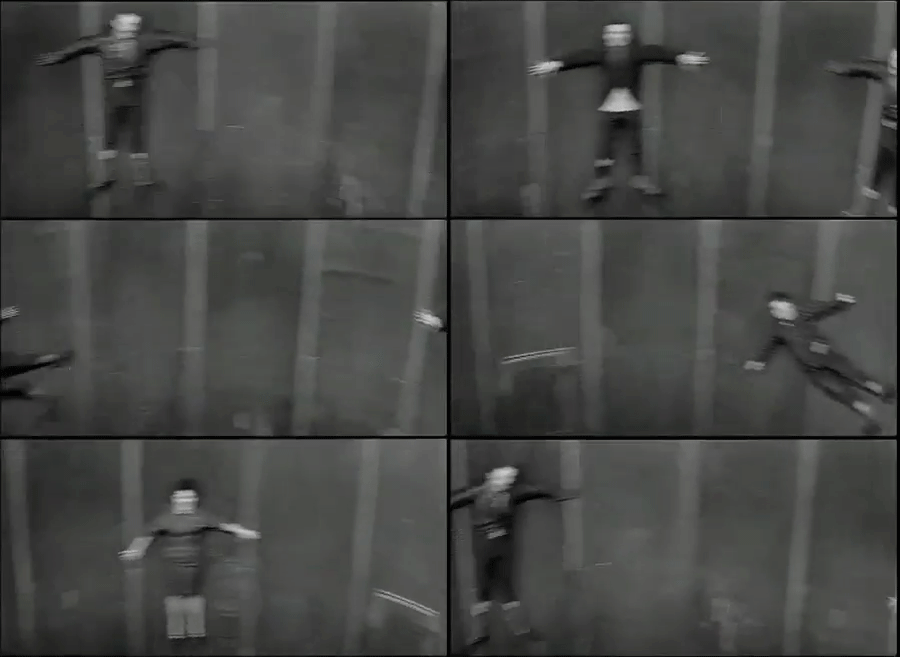
For episode 11 of the Family Pictures Podcast MBS and I finally take on a heavy weight of world cinema with François Truffaut’s French New Wave masterpiece 400 Blows (1959). This was Michael’s pick, and I was thrilled because I love this film and have referenced it more than once on the bava over the years. I even created a GIF of the classic rotor scene.
Animated GIF from 400 Blows featuring the spellbinding Rotor scene
I enjoyed the conversation this time around because Michael is a huge fan of Truffaut—and this film in particular—so he brought a lot to the conversation, such as how Truffaut was banned from Cannes the year before he would triumphantly return winning the Palme d’ Or best director for 400 Blows—his very first film. The context around the making of the film is fascinating too: Truffaut was known as a fierce critic of French cinema at that time, regularly proclaiming it moribund. So his transition from critic to filmmaker was quite risky given he’d made more than a few enemies in the industry. It’s a cool story all around.
There are also a bunch of great short documentary bits out there about this film, like this 1960 interview wherein he discusses the opening of 400 Blows in the US. He mentions he’s watched over 3,000 films by this point, which would be the ripe old age of 28. During the podcast Michael compares him to Tarantino, which is a fitting parallel given the two seem absolutely obsessed with the medium and can move seamlessly between the roles of auteur and critic. I already mentioned my favorite scenes in a post back in 2010 and not much has changed, although this time around I have a new found love for the opening scene in the school room. There is just so much goodness in this film that it was an absolute joy to spend an hour talking about it with a fellow fan.
Over the last few months I’ve been getting old gold bloggers in my network to talk about writing more generally. Namely their origin stories and thinking through how their process has developed over time. I’m doing this as a way to highlight the power of writing in the open and to underline the need for more independent voices as we double down on Bloggers Anonymous. Folks who challenge our basic assumptions and do the work openly without being beholden to any one corporate or institutional master are harder and harder to hear above the noise.
I got lucky enough to start the series with Audrey Watters, for many the epitome of that independent and individual voice who has led the charge of challenging the Silicon Valley logic. Even her doom visions for the field might have underestimated how bad and how fast that logic would accelerate—the curse of being so god damned right. Get more truth to power by subscribing to her newsletter Second Breakfast. And chances are she has already seen ‘Matter and Space” the latest episode (at least the first 10 minutes or so) of the soon to be promoted to Black Mirror episode dealing with AI and higher ed. I don’t even know what to say about that other than it is the strangest predatory vibe I have seen in a while, or since the “Common People” episode of this season’s Black Mirror. You can really see them hocking this “disruption” with no sense of irony or reflection on their role in hollowing out the core.
Kin Lane was a natural follow-on from Audrey given they are very much a team in the way they imagine the world we find ourselves in. Kin’s output as a writer is remarkable, he will write several posts in a day across several blogs rocking like it is 2007. What’s more, he brings various personas to the table ranging from the API Evangelist to Alternate Kin Lane with the subtitle: “Nothing you will read here is true, but some of it may resemble the world you know.”
Finally, I caught up with Mike Caulfield last week—it’s been too long. Our chat looks back to the earlier days of the blogosphere and brings us up to the weaponized pre-packaged arguments omnipresent on social media. Mike discusses how he uses writing to dig deeper on topics in order to test underlying assumptions that others tend to bandwagon, his recent post about “Critical Reasoning with AI” twas just that kind of deep dive on AI, asking us to think about where that technology is at the moment (and its potential value) framing the idea of “reasoning patterns.”
Stay tuned because later this month I’ll be chatting with Amy Collier and Tom Woodward about the role writing has played in their careers as well as the development of the brilliant Demystifying AI series that pushes folks, like Mike, to dig in on critical reasoning with AI.
Love seeing Andy Rush playing hard in the fediverse. He recently got his own PeerTube instance up and running at AndyTube, now I have to figure out how to subscribe. I was pushed to get my PeerTube upgraded to 7.1 thanks to Taylor Jadin‘s Docker kungfu. I understand why Andy needs a service like FediHost for hosting PeerTube because upgrades are not self-evident like WordPress. I’m totally onboard with Andy’s sense of an alternative space for video storage and streaming as a smaller YouTube alternative (one not laden with the endless ads and AI-driven content checks) that allows you to capture some of the cultural artifacts you were discussing on your blog, say.
I just found several videos from 10+ years ago at UMW where I was talking with Howard Rheingold and Nada Dabbagh about building their own personal learning environment for teaching and learning with Domains. It’s been a minute.
So I put those up on my bava.tv site to ensure I have a web copy available given my local hardware storage is abysmal. I also do irregular small streams playing with some retrotech like Windows 98 and RetroPie. My idea before my dad died was to play a season of Madden 2001 on the PS1 and build an AI universe around the stats and details of each football game on a weekly basis, somewhat reminiscent of Coover’s Universal Baseball Association, Inc. The idea of getting lost in the world of the imaginary, a fantasy/nightmare ever more complicated by the promise of AI. One way to materialize this would be to explore AI tools that are designed to reproduce cultural realities like blog posts, call-in radio, talk shows, memes, imagery, and video playback. That would be more a bavatube affair, I guess, something decently produced with a regular stream of Madden 2001. Currently the site is used for random archiving and experimentation—more of a bava.tv thing or, just the junk I decide to throw up there without any rhyme or reason.
Thing is, I just love playing with video and streaming and PeerTube is definitely a safe space for that, especially since I have been burned by YouTube in the past. As of now I have so many possible stream setups for this AI Madden 2001 project it’s dizzying, insane how involved it is to get a Raspberry Pi running RetroPie or Batocera to stream cleanly to a YOLO Box with clean audio, correct aspect ratios, and an unobtrusive second camera all streaming to PeerTube. It’s never simple, and that is part of the joy. Anyway, Once I return to that project and lock it in I’ll do my best to graduate from bava.tv to bavatube 🙂
It’s been a couple of months since my last bavacade update. I was under the impression I hadn’t done much since January, but after taking some notes I realized I was mistaken. Real headway was made and I even added a few more items to the to-do list below.
Stuff that is done:
Pole Position has been put on wheels and that game was re-assembled and is working beautifully in its new home at the bavacade.
Social media relic of my progress (click for more)
Back-up Scramble board being used in Super Cobra. Key difference is that the Scramble board now has a multi-game kit that allows me to default to Super Cobra at boot-up so that cabinet now has free play. #winning
Roberto copied Super Cobra ROMs from working board so the back-up board is no longer throwing garbage, soon after realized audio is crapping out. So one board working perfectly and the other has audio issues.
Super Cobra ROMs copied thanks to Roberto
Tested 440 Dev Kit on non-working Crossbow and it was still throwing garbage. I replaced original chips on board and sent it off to Mike to take a look and he reported it works perfectly, so still confused on this one.
Wide-view of Crossbow board with 440 Dev kit installed and ROMs removed
After testing Crossbow boards to no effect (see above), I disassembled the cabinet and Alberto put it on wheels. Once the boards come back from US will start to re-assemble the cabinet, but also waiting on new molex power connectors given I need to clean-up/replace some of the board connectors that regularly come loose.
Another social media relic about my arcade repair progress (click for more)
Both the switching power supply and power brick and wiring harness for Make Trax is in for clean-up with Roberto (in addition to the Robotron power board and brick). I realized the extra power brick and power supply board I had lying around for Joust will work fine in Robotron –so got that game back up and running.
Secured the edge connector for yoke wires on Make Trax which needed to have wires inverted for Crush Roller board to work.
Make Trax Yoke connectors inverted for Crush Roller PCB (image before proper connector installed)
Had Mike repair a Super Break-out board Roberto wanted me to test: (1) Updated LM323K $20; (4) 2102 Ram $24; (1) 7408 $0.
Super Breakout board before repair
Ordered a ton of molex and edge connectors that should arrive any day and will help with my general maintenance project to clean or replace as many of the connectors as possible.
Built a shelf to organize and store all the extra arcade equipment and back-up boards in bavacade.
Things Still To Do:
Re-assemble Cheyenne.
Test 19″ tube with a Hanterex Polo chassis connector that Roberto brought me. If it works I might finally have a replacement for dull Phoenix tube.
The new tube gives re-newed impetus for getting extra Hanterex Polo chassis fixed.
K4600 back-up chassis slated for repair still in pieces and has not been attended to.
I messed up the new lock on Pole Position and need to see if I can replace it, that was stupid, also need to add a lock to the lower coin vault door.
Venture wiring needs to be cleaned up more, considering swapping in the Condor +5V power supply given that’s only voltage the switching power supply in that game is being used for —and this might clean-up the ugly on-board soldering happening now.
Ugly wiring in Venture that will soon be cleaned up
Venture power supply has two soldered wires to the board (shown here) going to +5V on a switching power supply unit
Cover image for “Coffee, Tea, and Drinks” issue of 70s Sci-Fi Art
Adam Rowe’s 70s Sci-Fi Art site/newsletter is an absolute gem if you’re into retro-futurism. When it arrives in my inbox I usually save it for when I have some time to explore the images and links, because I love the aesthetic so much. He does a really good job of arranging his missives around a specific theme, and the recent “Coffee, Tea, and Drinks” is a great example of the deep dives on topics as quotidian as beverages in the future. David Schleinkofer’s cover for Nightside City by Lawrence Watt-Evans featuring a woman having her coffee while gazing out on a Fifth Element-esque scene is peak 80s scifi art. Everything from the braid to the holstered gun to the grey space suit complete with wrist and ankle computers just makes her seem like such a bad-ass. Now put all that against a cheery Blade Runner cityscape, and I’m hooked. It reminds me a bit of Larry Elmore’s art from the 80s sci-fi role playing game Star Frontier, although a lot more contemplative and subdued—I mean she is drinking her morning coffee. Here is Schleinkofer’s art in its entirety:
David Schleinkofer’s 1989 cover for Nightside City, by Lawrence Watt-Evans
I just love folks like Rowe who scour far and wide to curate and deliver the best art of a given genre. His site led to the publication of the physical book World Beyond Time: Sci-Fi Art of the 70s that I finally purchased this morning (while drinking coffee) given how much joy this site has brought me over the years.
If you are into old school sci-fi art from yesteryear, this is ground zero. The fun themes and intelligent commentary just add that much more to his ridiculously cool finds. Do yourself a favor and lock it in!
I’ve been making a point of working regularly in bava.studio this year and most of the last. It’s done wonders for my sense of home/work separation; nothing like a change of scenery to inspire new work flows. One of the things I started doing recently is playing VHS tapes on the 27″ Sony Trinitron while working. They serve as background visuals that often have the volume down given I take calls and meetings throughout the day. But the plan is not to watch the entire film, but rather savor the joy of catching glimpses of naked shots and scenes without audio, possibly providing a different insight to an old favorite.
Stack #1 of VHS casually watched while working in bavastudio
On rare occasions I have the ability to work from the couch in front of the TV and watch one of these through with the sound on (that was the case with History of the World Part 1), but by-and-large they’re just part of the bavastudio scenery that might provide a sneak peek of a moment from the VHS collection. I kinda dig it.
Stack #2 of VHS tapes casually watched while working in bavastudio
Anyway, these images represent the tapes played thus far, and I’m going to try and create images of the stacks over time to document those films watched while working in the bavastudio. Film knowledge osmosis is a thing, right? I should be able to learn more about these gems simply by having them on in the same room, regardless of whether I am watching or not, right?
This 1996 EDUCAUSE paper by G.D. Bothun of University of Oregon, “Teaching Via Electrons: Networked Courseware at the University of Oregon” provides a compelling look into the early questions and concerns surrounding instructional technology involving the web. It was striking to see just how many of the topics mentioned are still relevant, in particular this bit on the yet undecided future of web-based open content:
In an open system, other professionals in the field will have access to the developed curriculum products and can build on them. The curriculum development effort at the UO has certainly not been done in a vacuum, as material from elsewhere has been used. In turn, we make all our developed material freely available. This open exchange of resources potentially allows for joint curriculum development among experts in a format that is easy to update.
Huzzah! the beginnings of open education, the revolution will be networked! But wait, here come the commercial publishing houses….
It has long been customary in most disciplines to choose certain textbooks which define the core-course curriculum. Unfortunately, textbooks do not rapidly respond to feedback from the users to redesign the curriculum. In theory, network-based curriculum resources could rapidly evolve into a very high quality, somewhat standardized product. Clearly, this has not yet happened in any discipline. Herein lies another profound challenge for the higher education community. A wide variety of knowledge sources are making their data and research available on the World Wide Web. The key is for effective integration of these individual knowledge sources into subject-based curriculum products. Will this integration be done by the content experts located at colleges and universities or will it be done by the commercial publishing houses that may only offer limited access?
Reminds me of another passage, this one in Ecclesiastes 1:9 from the Good Book:
What has been will be again, what has been done will be done again; there is nothing new under the sun.
is an ongoing conversation about media of all kinds ...
Testimonials:
Generations from now, they won't call it the Internet anymore. They'll just say, "I logged on to the Jim Groom this morning.
-Joe McMahon
Everything Jim Groom touches is gold. He's like King Midas, but with the Internet.
-Serena Epstein
My understanding is that an essential requirement of the internet is to do whatever Jim Groom asks of you while you're online.
-James D. Calder
@jimgroom is the Billy Martin of edtech.
-Luke Waltzer
My 3yr old son is VERY intrigued by @jimgroom's avatar. "Is he a superhero?" "Well, yes, son, to many he is."
-Clint Lalonde
Jim Groom is a fiery man.
-Antonella Dalla Torre
“Reverend” Jim “The Bava” Groom, alias “Snake Pliskin” is a charlatan and a fraud, a self-confessed “used car salesman” clawing his way into the glamour of the education technology keynote circuit via the efforts of his oppressed minions at the University of Mary Washington’s DTLT and beyond. The monster behind educational time-sink ds106 and still recovering from his bid for hipster stardom with “Edupunk”, Jim spends his days using his dwindling credibility to sell cheap webhosting to gullible undergraduates and getting banned from YouTube for gross piracy.
 Turns out what started out as rough idea Maren Deepwell and I concocted to get bloggers to talk about their writing road has become a pretty fun and compelling (at least for me) way to be reminded of the power of blogging. I already highlighted our first five guests, so it might be a good idea to get ahead of the game and announce our May line-up, which will be happening each and every Friday starting May 8th at 12 noon ET. I’ve termed the series “On Writing” to be both descriptive and keep the focus sharp.