Davidson Domains

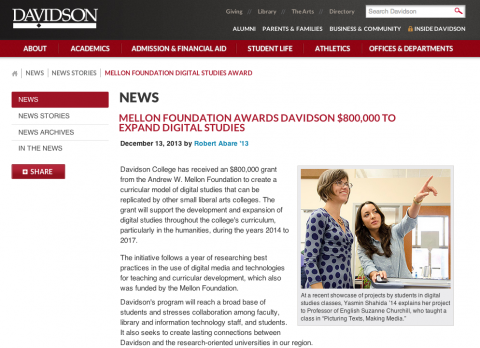
Screen Shot 2013-12-13 at 5.15.26 PMDavidson College just announced they were awarded a Mellon Grant “to create a curricular model of digital studies that can be replicated by other small liberal arts colleges.” Pat Sellers coordinated the grant and Mark Sample will be the lead for developing the curricular model. I was particualrly excited that one of the centerpieces of the grant will include “Davidson Domains” which in many ways reinforces some of the work we’re doing with Domain of One’s Own:

Among these initiatives is “Davidson Domains,” which will provide every Davidson student a unique domain name and access to an open source platform like WordPress. The Web domain will serve as a foundation students’ online presence at Davidson and beyond. As students progress through the Davidson curriculum, they will learn how to add content to the domain from any aspect of their experience. Students might use it to display outstanding assignments, samples of internship work or research experience, and more.

This is awesome for Davidson, it’s also awesome for UMW Domains and Reclaim Hosting to help reinforce the value of some of the work we’ve been doing along these lines. External validation works wonders in-house, as I’m sure many of you know. It also helps establish that both the technical and curricular integration of something like Domain of One’s Own are not nearly as crazy as they might have seemed just a year ago. I want to believe we’re beginning to witness a subtle, yet profound, shift in thinking about how institutions can invest in a future of educational technology that is premised around networks that enable everyone on campus to help imagine what’s possible from their own online platforms. The secret sauce is working through how we can divine a sense of coherence as a campus community through syndication, aggregation, and generative juxtaposition. I really think that the fact  that Davidson Domains has framing their digital studies curriculum in this way further buoys my sense that this approach defintiely has legs.

It also reaffirms what Mike Caulfield noted on Twitter a while back 😉

Boss just asked me why she’d never heard of UMW and #ds106 if it was so influential. Told her UMW was like the Velvet Underground of edtech.

Posted in Domain of One's Own, reclaimopen | Tagged , , , , | 2 Comments

Float like a Butterfly, Sting like a Bee


On Twitter yesterday Luke Walter linked to this video of Muhammad Ali fighting Cleveland Williams at the Astrodome in Houston, Texas on November 14, 1966. It’s a remarkable, high quality display of just how accurate his declaration that he can “float like a butterfly, sting like a bee” truly was. The Greatest, indeed.

Posted in video, YouTube | Tagged , , , | 2 Comments

True Crime: Some Final Thoughts and Videos

I’m sad to say the True Crime Freshman Seminar Paul Bond and I taught this semester has come to an end. We watched the final vidoes last night, and they’re working on posting their final reflections to the course blog so this semester can quickly become a memory. But before it vanishes entirely, I want to get a few final thoughts down about the experience as well as share out the final three videos the students did for the course.

Below are somesome thoughts about the process.

Co-Teaching
Two-HeadedGiantSharing the teaching responsibilities for this course with Paul Bond was awesome. I think Paul and I have developed a good groove between this course and Hard Boiled.  The bestthing about co-teaching the course was that it forced me to do a few things I might not otherwise. First, we spent more time than I might alone shaping and re-shaping the syllabus by throwing ideas off one another. Second, we spent more time conceptualizing the structure of the class. We made the experience a true seminar that put the students in charge of the readings and discussion each week, which forced them to actively particpate, discus, and create. This was crucial for me because given an option, and if I was solo, I would have talked and talked and talked. Finally, Pual taught me how to teach this stuff by doing it, his weekly blog posts on the readings were awesome, and as trucrimer Shelby pointed out in her final reflection “Enjoy Paul….he has the best Posts of the class.” I couldn’t agree with that more.

Video Production

Image Credit: Paul Bond

Image Credit: Paul Bond

The video production element of this class was intense, and this was a trial run to see the idea of a seminar or content class like this can simultaneously become a video production shop—turns out it can. But it’s a hell of a lot of work, just ask any of the students 🙂 The student groups produced eleven  videos over the course of the semester, and they consistently got better as they went on. I really enjoy trial by fire when it comes to teaching, and the video production process really got them working together as a course community quickly. Rapid prototyping of video premises, scripts, costumes, settings, etc. was the magic of this class. We didn’t give them much time, we pushed them to be creative, and eventually it started to pay off. Not all the videos were great, mind you, but with little or no direction they eventually starting making some really compelling and creative commentaries on the works we read. I also wanted an alternative to the research paper/essay—I figure they’ll see enough of that over their four years—I wanted them to have fun creating and they did. You’ll see some evidence of this  below.

Group Presentations and Wiki

il_fullxfull.156688661The last thing I’ll say is that I couldn’t have been happier with the structure of the group presentations and wiki. Students compalined it was a lot of work and we read too much and made too many videos—but isn’t that the point? They should feel the pain, this ain’t no party, this ain’t no disco, this ain’t no folling around! There were five groups, and each group was tasked with uiding a discussion for two separate weeks and framing the context for dicussion on the course wiki. I was amazed how well they did with this for the most part. We spent the semester pushing the groups to move from simply summarizing the works we discussed to actually enagaging the historical context, themes, how they relate to other works we’ve read, and some broader signifiance cultually. It wasn’t always easy or successful, but by having them run the discussion we had a much cleaer understanding of where they stood in relationship to the texts. What’s more, it was a major boon for discussion, interaction, and a general sense fo community for the class. This course had, by far, the strongest sense of community and shared experience of any course I ever taught—and for me that is the real point of a Freshman Seminar. Mission accomplsihed, Bond!

In short, the truecrimers ruled!

Final Videos

Now, the final thing I want to share are the final videos the students created for the course. Is I mentioned earlier there were 11 videos in all created, and you can see them all here (along with a few clips from movies we watched). The following videos were by three separate groups of students. They were charged with trying to integrate various characters, readings, and situatiosn from the entire semester into a 5-7 minute video—while at the same time examining some of the themes in the class.

Baggage
The first video is dating gameshow called “Baggage” in which various criminals we read about this semester share their baggage with the lucky contestant. It is a testament to how funny and entertaining these students could make the situations, characters, and themes.

Dinner with the Killers
This video was fascinating to me because it actually had the scholar Steven Pinker, whose Ted Talk we watched at the beggining of the semester, having dinner with various criminals we read abut over the semester. Turns out Charles Manson and Nat Turner get into a brawl over Manson’s theory of Helter Skelter.

Wax Museum
The final video was a bit disjuncted and their could have been a bit clearer narration around the bits, but the ideas was excellent. Created a wax museum of murder scenes that a curator takes you through and explains the details and their signifiance. I would love to rework this for another version of this course—the ideas is so cool—execution a bit rough give the time limitations. That said, there are some awesome moments.

Talkign with Paul alst night after the class, the thing that struck me with this setup is that I would now feel comfortable re-imagining this as an online, open course now with the video production, wiki work, and distributed possibilities for building these beyond the class—it could bea blast. I hope we get to teach this again soon so we can start experimenting with the next stage of this class. Until then.

Posted in True Crime | Tagged | 2 Comments

Andreá Livi Smith Teaches, Learns, and Lives By Design

DTLT Today: Episode 109 – Andreá Livi Smith from Jim Groom on Vimeo.

It’s finals week and everyone is slammed for time right now on campus, but Historic Preservation professor Andreá Livi Smith was still generous enough to sit with me for a half hour and talk about the work she’s done as part of the Domain of One’s Own faculty initiative and beyond. Andi is a remarkable faculty member, and she is behind some of the most exciting work happening at UMW right now. She not only blogs like it’s her job at Digital Bridging, but she’s also designed a brilliant homepage for her courses, research, and social media presences, something we explore at length in this video.

We also talk about the work she has done with Martha Burtis designing a database on UMW Blogs called Surveying the Burg. This site enables students to survey houses from around Fredericksburg on smart phones from the field. It’s remarkable in that it starts to demonstrate just how much more than a blog  this open source, relatively simple software can be—namely,  a fullblown research resource that undergraduates help build and populate.

We finished up the conversation talking about Plunked!—a board game Andi and her students designed that teaches you about the principles of preservation planning. The work they’ve done is pretty remarkable, and it gets at a broader theme Andi touched on throughout the discussion. The importance of design in the work she does not only around urban planning, but also the crucial role it plays in her teaching, computing, and her life more generally. For Andi, the design of spaces both online and off frame one’s relationship with others in so many different contexts beyond the purely professional, and the way in which she truly lives her identity ebulliently across all of those domains makes her so compelling as a professor, researcher, and colleague, but more than all of those, as a person. She’s an inspiration!

About the Series

This is the fourth episode in an ongoing series focusing specifically on the amazing work faculty at UMW are doing with teaching, learning, and research as it intersects with technology. You can see my previous discussions with UMW’s humanities librarian Jack Bales on his Chicago Cubs research, as well as a conversation with English professor Marie McAllister (episode 107) about mastering ehr own domain. I’m still editing a fascianting back-and-forth I had with Political Science Steve Farnsworth (episode 108) about building his online presence through Domain of Ones Own—that will be published shortly.

Posted in digital identity, Domain of One's Own, dtlt, DTLT Today | Tagged , , , , | Leave a comment

#FiveWordEdTechHorrors

Earlier today on twitter I was watching the river flow when I saw the following tweet by the great Bud Hunt:

I was intrigued, and figured what would my five word edtech horror story be. I came up with the folowing:

I was hooked, for the next 45 minutes or so I was having a ball reading and writing FiveWordEdtechHorrors on Twitter, it was pretty remarkable to follow that hashtag and watch hundreds of edtechs chime in from all over the place in order to palyfully have fun with their frustrations. A fun loving professional catharsis in the form of a hastag—it’s a beautiful thing. from what I understand Carl Hook just modified the trending #FiveWordTechHorrors, and a Twitter event was born.

There were a ton of fun Tweets, I’ll include a few of my favorite below, but if you work in edtech, the stream is still going and it speaks to how creative and inspired a loosely distributed community can be if given the right prompt.

The following Tweet by Martin Weller is an inside joke given that someone made this pronouncement at the MOOC Research confernece, but it made me bust out laughing nonetheless.

Bud Hunt was on fire…

How can we forget MOOCs….

I always enjoy LMS bashing….

But there was something for everyone!

So much fun, this made my semester. I really haven’t had a moment like this in a while on Twitter. Unexpected, but pure joy!

Update: Origins are always tricky, Frank Nochese seems to have been behind this madness 🙂

Posted in fun, twitter | Tagged , | Leave a comment

Shenandoah Three Years On

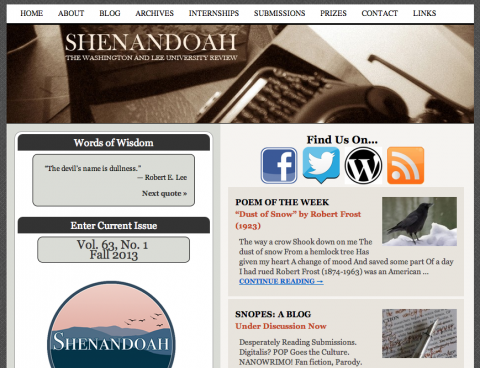
Shenandoah Literary ReviewWashington and Lee’s Literary Review Shenandoah started making its transition from a print to an entirely online publication almost three years ago. I know this because I helped the editor, Rod T. Smith, imagine what it would mean to move into the online world. I’ve blogged about this a few times before. Three years later I’m still working on Shenandoah, although its pretty much run itself for the last two years. I remain involved because it’s one of those compelling testaments to the awesome contemporary culture you can access freely on the web. The latest issue is just the most recent example of what’s been freely published online since Fall 2011 (five issues in all, and the sixth comes out this Spring).

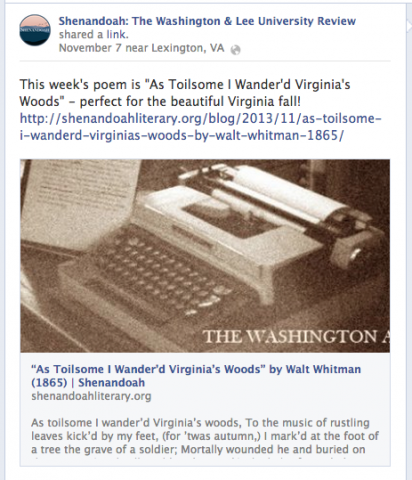
Screen Shot 2013-12-11 at 4.55.13 PMBut what I wanted to mention here quickly is that this semester the site, issue, and blog had a different vibe than I’ve seen so far. The student interns who helped run the journal as part of a course started to really take over the site. They pushed the various weekly and daily features hard on social networks like Twitter and Facebook. The “Poem of the Week” became a staple on Facebook, and drove regular traffic to the site that led to more people discovering the most recent issue. They also did an amazing job taking turns to make sure Shenandoah‘s blog was regularly updated with their thoughts and insights about the state of literature.

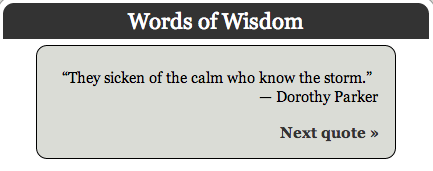
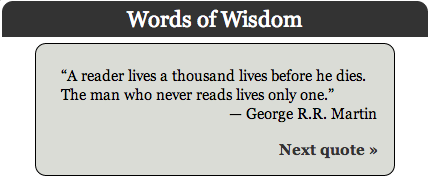
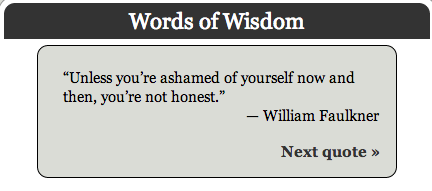
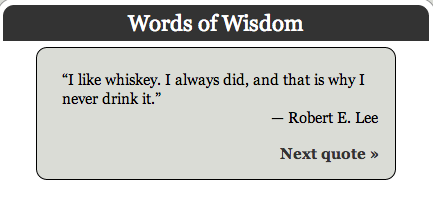
They also did an excellent job populating the “Words of Wisdom” quote generator on the frontpage with some awesome quotes.

Words of Wisdom 4Screen Shot 2013-12-11 at 5.36.03 PM

Words of Wisdom 1 Screen Shot 2013-12-11 at 5.36.33 PM

Screen Shot 2013-12-11 at 4.54.38 PMThe site has started to take on a sense of vibrancy that seems directly related to the students’ engagement and excitement. The way they used Facebook, for example, was awesome. The did Halloween “unmasking” posts that featured each of the student interns process while preparing for the launch of the latest issue. They were compelling because they framed a person’s experience bringing this issue to life. What’s more, it highlights how a digital literary journal like Shenandoah can be effectively promoted through social media. These students literally doubled the traffic to Shenandoah over the coruse of the semester, and they seemed to have a lot of fun doing it while gaining invaluable experience for publishing in the new world. We can talk all day about the technology and platforms (which I understand the importance of given my own purview as a technologist), but nothing can replace the excitement and passion of a group of students to make something feel special and relevant. Their takeover of the site this semester gave the online features soul, and kudos to Rod for letting it flourish.

Turns out Shenandoah is not only a gem for the contemporary literary world, it’s also a gem for teaching and learning in our digital moment. I’m really enjoying this because what could have (and for many was) been seen as a loss might now be understood as a rebirth of open access literature, enagagement for the publication, and  empowerment for the students running it. Very cool.

Posted in Shenandoah | Tagged | Leave a comment

Where’s all the Dominant Narratives at?

The MOOC Research conference has resulted in some really interesting discussions that are playing out right now, and I want to take a moment to try and capture a few of them. I’ll start with Michael Feldstein’s thoughtful post “Changing the Narrative” that does an excellent job framing one of the concerns that arose in Arlington: the open education narrative being hijacked by corporate influences.

Is there a world in which an original idea like “edupunk” or “MOOC’ could both become dominant and remain true to its roots? One narrative we should be particularly careful of is the narrative of co-optation. The notion that some pure Idea is insidiously taken over by Forces and corrupted to their Evil Ends is both convenient enough to be almost inevitably wrong and simple enough to contradict the epistemological tenets that undergird the very idea of connectivism.

I think this is an excellent framing of the difficulty at the heart of the co-optation narrative—no idea is pure and the drawing of such stark visions of right and wrong tends to shut down any and all convesation. Agreed. That said, the contention surrounding the idea of open remains really important for the field right now. What the term MOOC brought to light was that, to echo Martin Weller’s  post from a while pack, “openness has won now what?” Throughout the entire edtech field (whether public, private, for-profit, or corporate)  the value of open educational resources, courses, and experiences as an inherent value of the digital landscape for teaching and learning—a narrative David Wiley has been laying down for fifteen years—as been almost universally acknowledged. That’s not our revolution any more. And this is exactly where Feldstein’s point about the term MOOC having helped to change the narrative is right on. But to point to a very timely article published this past weekend by Martin Weller, the battle for the narrative isn’t about MOOCs, even if it has been a very important intervention, it’s a “battle for [the] narrative taking place … around the issue of openness.”

I think that might be a really interesting starting point to consider how issues of power, capital, and culture play out around a term like MOOC. That might be the current focal point, but the longer view is how openness as a more  ethos continues to pervade the work in this field, and that is where the struggle remains. As Stephen Downes notes on the topic:

I’ve watched the narrative – mine and others’ – be changed over and over the last 20 years. LMSs. Learning Objects. Educational Modeling. Content syndication. OpenID. E-Learning 2.0. EduPunk. Learning Networks. Connectivism. OERs. MOOCs. The result is always the same. Sometimes it’s ignored. More often it is co-opted and somehow becomes the property of the very institutions it targets. You can’t change the world – or the establishment – with a narrative.

It’s hard to argue just how effectively the narrative gets hijacked again and again, but I think Feldstein’s point might be that this is a demonstration of how effective the narratives have been. One continually informs the dialectic it enters, and the narrative is neither wholly co-opted or entirely pure as we imagine them—but something else. Always a sense of potential that moves us on (not necessarily forward), and for that I tend to believe narratives can change the world. So, I’m still a believer. And I don’t think I’m alone in this. There’s a lot of really smart people focusing on the importance of just this idea of narratives as they relate to open. Bon Stewart got me all excited about the idea to begin with, and Mike Caulfield was laying down some of these most brilliantly expansive bar room conversation around this idea and shipping, and big data I’ve ever been party to (more on that in my next post). I think we also forget, as Feldstein notes, just how much a few rogue bloggers have done to shape the open argument as it stands now. That said, it always feels like its on the verge of being transmorgrified into a venture capitalists’ wet dream of unbundling education from state funding. Damnit, there I go again with that narrative 😉

But why stop there?

I can think of other folks in the field that are going about openness in some really awesome and interesting ways that have been outside these narratives to some degree. The dynamic duo of Kin Lane and Audrey Watters have no institutional affiliations, and together represent a truly fascinating rogue perpetual motion machine that has been conceptualizing, narrating, and building the means to open up the technology at the level of the mind, soul, and API. I’m a huge fan of what they’re doing, and their sense of what was, what is, what’s coming, and what will be seems right on. I’ve learned a ton from them this year, and hope I learn even more next.

Also, the work Joss Winn and Mike Neary are quietly doing to transform Lincoln University is remarkable, and it certainly has a well articulated narrative of the edtech space in relationship to the political, social, and economic factors shaping it currently. Below is an excerpt from Winn’s recent post “A Co-Operative University:”

 …the practice of collectively producing, owning and controlling the means of production remains a very important objective for me and any criticism I have of the free and open source software movement(s) and free culture movement in general, are so as to develop the purpose and practice of common ownership and collective production, and help defend it from being subsumed by the dominant mode of production i.e. capitalism: a highly productive form of social coercion for the private accumulation of value.

The notion of open source as a radical movement that engenders the possiblity of a culture that can re-imagine its relationship to common ownership and production is yet another narrative. On that’s a bit more difficult for corporate-sponsored rockstar professors to fully get behind, or media outlets to channel as anything other than an updated vision of the red scare. So the idea that we have intervened in the grand narrative of edtech might not account for the fact there are more than a few discourses out there in this space that would add to the dialectics.

It’s for all these arguments, approaches, and positions that have some truly intelligent, engaged people behind them that I’m really optimisitc these days. The edtech field has, interestingly enough, become a site where many of the most important discussions around the future of higher ed are taking place currently, and it takes courage to struggle with them openly and honestly. What’s more, as I noted at the MOOC Research Conference, it’s a field wherein many of the folks involved in the discourse are on the margins of traditional, tenure-track academia (which, ironically, has itself become a margin). Populated with Ph.D. dropouts, technologists, and a wide diversity of disciplins and degrees, it represents an interesting moment for the voice of higher education’s future. Although it probably won’t last. The armies of Ph.D.’s without a tenure-track position are gonna figure out how much better edtech folks have it than them (travel budgets, no teaching load, a steady paycheck, relevance, etc.)—that’s why God created the Digital Humanities and #altac! Not to mention the simple fact that, for better or worse, a terminal degree is the coin of the realm—although most folks with a terminal degree in instructional techology are about as relevant as typewriters currently.

Well, maybe I’m not that optimisitc after all?  Damned if I know what the hell is going on in edtech, but this conference really got me thinking. And what I do know for sure is that this post is already too long, rambling, and incoherent. Let the record show I recognized this fact before I clicked “Publish.”

Posted in open education, open source | Tagged , | 17 Comments

De-Icing the MOOC Research Conference

DAY-OF-THE-MOOC

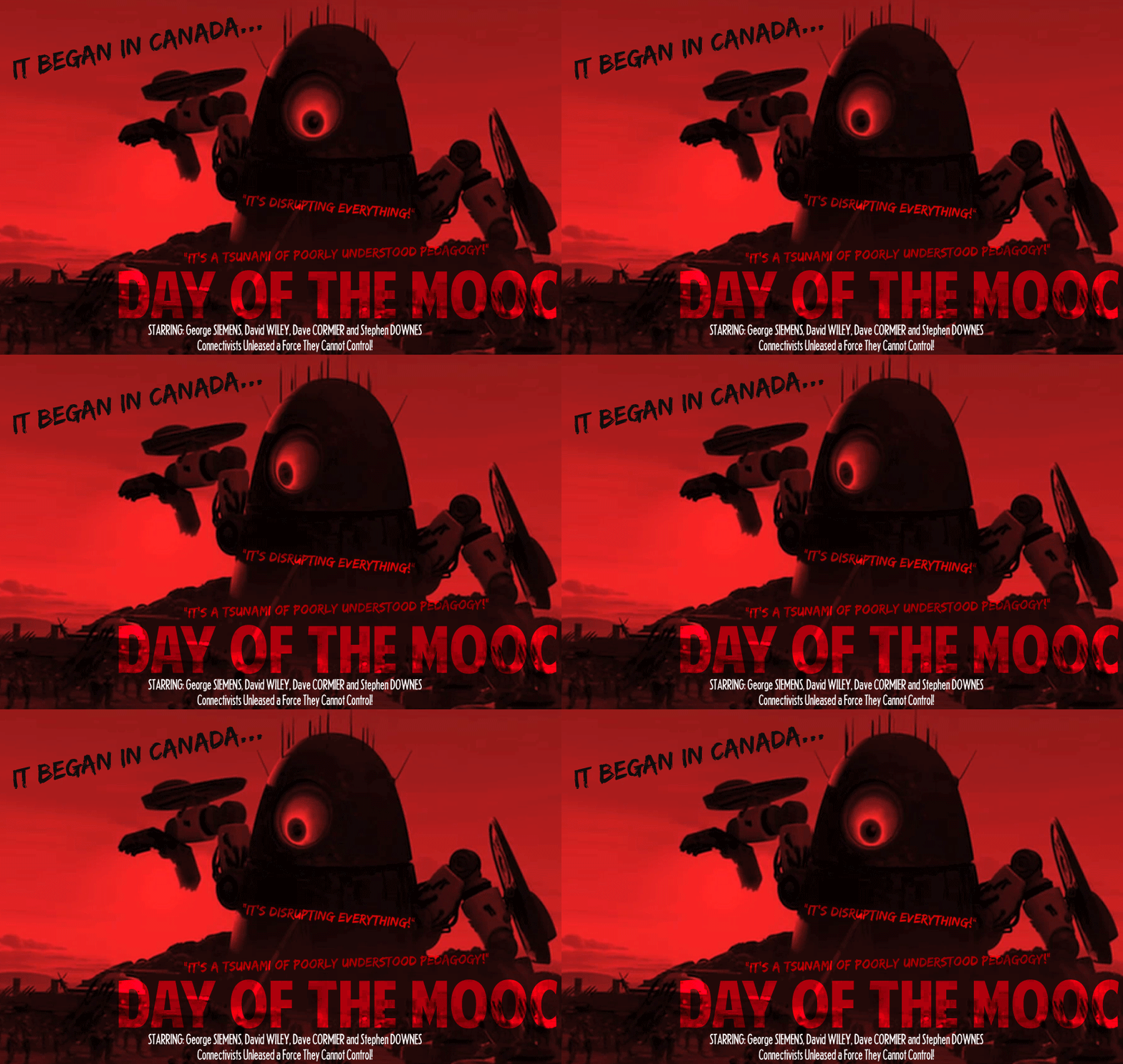
Image credit: Michael Branson Smith’s awesome “Day of the Mooc”

I am currently sitting in Dallas Fort Worth airport hoping to escape the ice storm that hit Dallas during the MOOC Research conference. Despite the atypical elements, this is one of the best conferneces I’ve been to in a while, right up there with OpenEd (kudos to George Siemens, Amy Collier, and Tanya Joosten for a job well done). The quality of people was amazing and the vibe, as Mike Caulfield already mentioned, was almost dreamlike. I also had the distinct pleasure of finally meeting a number of awesome folks who I’ve been following on the internet for a long while now, in particular Bon StewartMartin Weller and Martin Hawksey.

I also met a whole bunch of new folks, and attended a wide range of sessions in hopes of moving beyond some of the MOOC-hype (which I think this conference did quite well) and look at what we’re really starting to learn from this phenomenon. And while I’m not convinced that large, corporate MOOCs are educating the world and feeding the children, I do have a better sense just how variegated coporate MOOCs can be in their approach thanks to Weller’s research. It was also apparent just how much this moment has served to reinforce the fact that online learning has arrived in the hearts and minds of administrators everywhere.

It still befuddles me just how quickly big brand, research 1 universities have been to give away the farm to third-party, for-profit platforms. Especially as the MOOC hype has been somewhat tempered by Saint Sebastian’s recent pivot (which I think was very good for the tenor of the conference more generally). At the same time Bon Stewart’s admonitions for some kind of organized response to start filling the temporary void of direction with alternative narrative still rings in my ears—and it is very much the lesson I took away from Audrey Watters keynote at OpenEd.

Finally, it was cool to see the O.G. triumvirate George Siemens, Stephen Downes, and Dave Cormier representing their frankenstein-like brainchild 🙂 I have to take a moment to hand it to all three of them, they’ve weathered a pretty intense hi-jacking of their ideas from back in 2008 with a tremendous amount of class  (lesser folks, like me, would have crumbled). What’s more, they’re stewarding the conversation in ways I think do the entire field a great service. What’s more, Stephen Downes was really happy. I mean really happy! I guess that’s a result of him getting the well-deserved and long overdue credit and resources to really start making his orginal vision of the technological aggregation of these disparate networks a reality. Congratualtions!

As for me, well, I slayed them!

More seriously, for my last few talks  (since my University of North Florida presentation in September) I’ve been trying to narrate the progression of the work I’ve been part of more broadly at UMW. In particular, I focus on the development of projects in UMW’s Division of Teaching and Learning Technology from the BlueHost Experiment to UMW Blogs to ds106 to Domain of One’s Own and beyond. The narrative is a compelling one, and it is an honor to represent the work we’re doing at UMW to folks from around the world. It’s also cool to situate ds106 as a creative alternative within the MOOC discourse. At the same time, I’m becoming more comfortable with my role at UMW as an ambassador for the work DTLT, our faculty, and students are doing. It always feels a bit awkward, but at the same time people are beginning to recognize and understand UMW as a hub for the “Digital Liberal Arts” in part because of these presentations—and that’s not necessarily a bad thing. Anyway, below is the abstract for the talk as well as the slides for the presentation. If and when there is a video I will share it here as well. [Update: there is a video recording and here’s the link.]  Now if I could only make it home.

This presentation will examine a decade worth of experimentation and development at the University of Mary Washington that has resulted in a series of innovative projects such as UMW Blogs, ds106, and Domain of One’s Own—not to mention its recent spin-off Reclaim Hosting. What all these projects have in common is they operate from a shared ethos of supporting an open environment for teaching and learning online by helping faculty and students alike exert control over the digital spaces they learn, teach, and ultimately live in.

Posted in open education, presentations | Tagged , | 20 Comments

ds106 Interview for Reclaim Open Learning

ds106_A couple of months ago Alan Levine, Martha Burtis, and I sat down with Anya Kamanetz to be be interviewed about ds106 for the Reclaim Open Learning initiative. I just realized this had been published on the Recalim open Learning site , and it’s a good snapshot of how the three of us are thinking about ds106 at the moment. Martha captures the larger spirit of what ds106 has come to mean for us at UMW, it’s part of a longer history of experimenting with what teaching and learning means for narrating and shaping one’s online presence in an increasingly networked world.

I think it’s fair to say that a lot of this grew out of experiences that we have been having at UMW dating back to 2004 where everyone in the division had gotten their own domain name and web hosting space, and it had changed the landscape of our work. This space became a place for narrating our own experiences and the process of learning. That grew into the notion that students could use the space to do that more broadly and more richly.

Posted in digital storytelling | Tagged , , , | Leave a comment

GIF it Up for the 80s

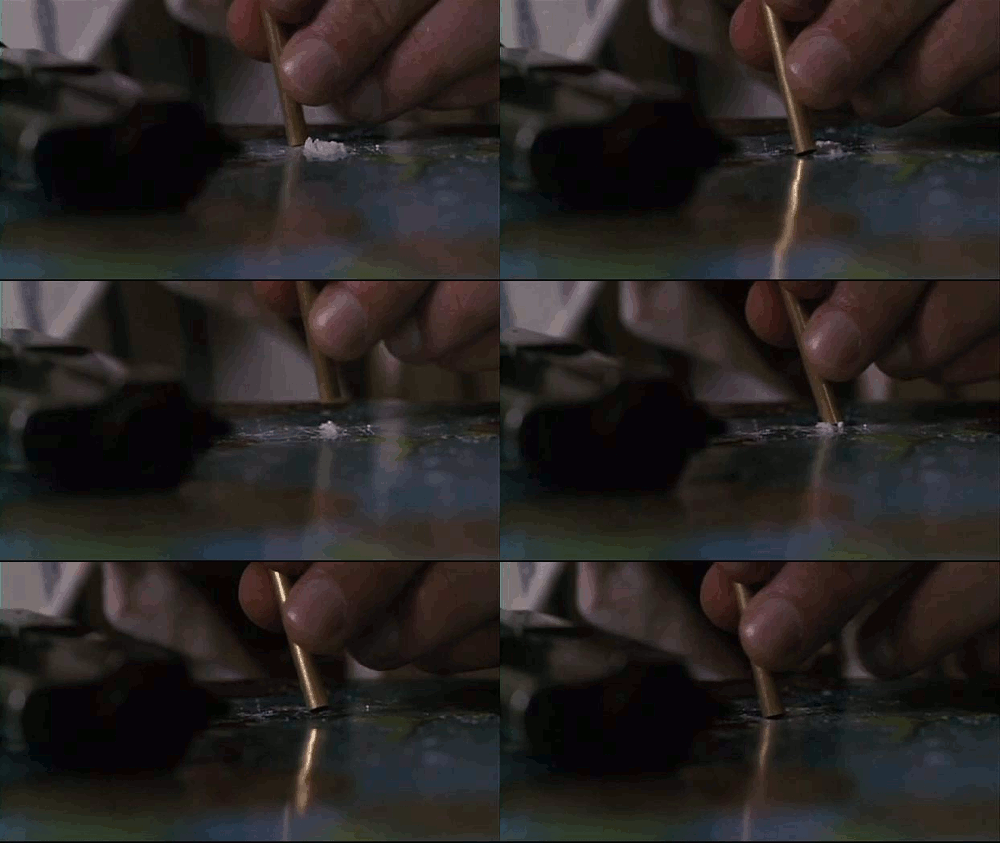
A Goodfellas GIF to snort about!
GoodFellas-may11scene 01

Posted in True Crime | Tagged , , | Leave a comment