 I’ve had a bit of extended travel time on planes and trains over the last couple of weeks. A situation that’s very conducive to leisure reading, at least for me. I’ve finished off a few books already during this European vacation, the latest of which is Philip k.Dick’s 1964 novel The Simulacra. By no means amongst Dick’s best novels, it’s still an accurate representation of the direction our society is heading: puppet leaders controlled by cartel monopolies that use technology to engineer a tiered system of social control. It falls down a bit regarding the various plot threads and characterizations that never truly work together to create a compelling universe. But that didn’t stop me from enjoying it, the joy of reading Dick is not the quest for accurate predictions and representations of what life will be like in the future. Rather, it’s the alternative framing of what that future could have looked like from the vantage point of 1964. A genre of possibility like Science Fiction is necessarily rooted within its particular moment, perhaps more than any other.
Anyway, here are a few gems from The Simulacra I noted while reading. And while I said I wasn’t reading Dick for predictions, it’s hard not to comment on a couple of those prescient moments—a foolish consistency is the hobgoblin….
When Pharmaceuticals Rule the World
 A.G. Chemie is a powerful pharmaceutical cartel in this novel, one of the two most powerful corporate entities running the country—the other is simulacra manufacturer Karp und Söhne Werke. Early on in the novel (page 6 in the Vintage edition) this corporate cartel is selling the world on the fact that drug-therapy, not psychological counseling, remains the only solution to the ubiquitous mental health issues. And it has just sponsored a law to prohibit all psychological counseling in the USEA (United States of Europe and America). Here’s a bit from the novel on this:
The powerful German cartel [A.G. Chemie] had sold the world on the notion of drug-therapy for mental illness; there was a fotune to be made, there. And by corollary, psychoanalysts were quacks, on a par with orgone box and health food healers.
This future scenario seems all too present. Psychoanalysis hasn’t been outlawed de jure, it’s just been made increasingly more difficult for much of the general population to get access to. Insurance companies in the U.S. see psychiatric counseling at the hourly rate of a medical doctor (or counsellor with an equivalent credential) as cost prohibitive. And the tale of the tape is apparent: “the percentage of outpatient mental health visits that involve only medication and no psychotherapy jumped from 44 percent to 57 percent between 1998 and 2007.” Almost two out of three mental health patients are being treated with drugs alone! And a majority of those who are getting psychotherapy receive it from a counsellor (often a social worker) trained in the basics of Cogntive Behavoiral Therapy. A world sold on the notion of drug-therapy for mental illness, indeed, Philip Kindred Dick!
The Future of Spam
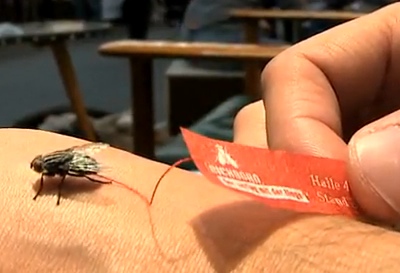 Dick is all about the details, and one that stuck with me in The Simulacra was the description of the Nitz: invasive, fly-like commercials that invade people’s space.
Something sizzled to the right of him. A commercial, made by Theodorus Nitz, the worst house of all, had attached itself to his car.
“Get off,” he warned it. But the commercial, well-adhered, began to crawl, buffeted by the wind, toward the door and the entrance crack. It would soon have squeezed in and would be haranguing him in the cranky, garbagey fashion of the Nitz advertisements.
He could, as it came through the crack, kill it. It was alive, terribly mortal: the ad agencies, like nature, squandered hordes of them.
The commercial, flysized, began to buzz out its message as soon as it managed to force entry. “Say! Haven’t you sometimes said to yourself, I’ll bet other people in restaurants can see me! And you’re puzzled as to what to do about this serious, baffling problem of being conspicuous, especially-”
Chic crushed it with his foot. (41)
Given what we already know the virtual possibilities of spam, I think its easy to imagine its physical instantiation in the form of a fly becoming a reality shortly. Actually, looks like there’s a German who has already figured it out.
Famnexdo
 A running together of the phrase “the family next door,” famnexdo is a simulated family that were created to make the move to
 the suburbs in the 1960s Mars in 2041 that much easier for space prospecting families.
…at the far end, taking up most of the available space, he saw four simulacra seated in silence, a group: one in adult male form, its female mate and two children. This was a major item of the firm’s catalog; this was a famnexdo…
A man, when he emigrated, could buy neighbors, buy the simulated presence of life, the sound and motion of human activity – or at least its mechanical near-substitute – to bolster his morale in the new environment of unfamiliar stimuli and perhaps, god forbid, no stimuli at all… The famdexdo were actually not next door at all, they were part of their owner’s entourage. Communication with them was in essence a circular dialogue with oneself; the famdexdo, if they were functioning properly, picked up the covert hopes and dreams of the settler and detailed them back in an articulated fashion. Therapeutically, this was helpful, although from a cultural standpoint it was a trifle sterile. (55-56)
An excellent example of Dick’s sense of play in this novel, a commentary on the sterile cultural reality that would be a result of the mass exodus from the U.S. cities to the suburbs during the 1960s.
The Vision & Videodrome
 Towards the end of the novel Richard Kongrosian, a musician with telekinetic powers, turns his “psi” powers against the agents of the state trying to oppress him. During the culminating scene of the novel Kongrosian realizes his powers are far more vast than simply playing the piano without touching the keys. Akin to Marvel superhero Vision (who was introduced in 1968, four years afte this novel was published), Kongrosian realizes he can physically become part of the objects all around him. Here’s a bit from this realization wherein Kongrosian literally absorbs objects with his body:
Kongrosian said, ‘I sent them away. They made it even more difficult for me. Look — see that desk? I’m now part of it and it’s part of me! Watch and I’ll show you.’ He scrutinized the desk intently, his mouth working. And, on the desk, a vase of pale roses lifted, moved through the air towards Kongrosian. The vase, as they watched, passed into Kongrosian’s chest and disappeared. ‘It’s inside me now,’ he quavered. ‘I absorbed it. Now it’s me. And — ‘ He gestured at the desk. ‘I’m it!’ (194)
Not only does he absorb the inanimate objects, but his physical flesh can become part of them. The corporeal description of which immediately reminded me of David Cronenberg’s 1984 film Videodrome:
In the spot where the vase had been Nicole saw, forming into density and mass and colour, a complicated tangle of interwoven organic matter, smooth red tubes and what appeared to be portions of an endocrine system. A section, she realized, of Kongrosian’s internal anatomy. Perhaps, she thought, his spleen and circulatory configurations that maintained it. The organ, whatever it was, regularly pulsed; it was alive and active. How elaborate it is, she thought; she could not take her eyes from it… (194)
There is even a scene wherein the state official Pembroke, who is behind the governmental coup unfolding in this scene, turns his gun on Kongrosian in an attempt to stop him, which results in a scene even more resonant of Videodrome.
‘Listen, Kongrosian,’ Pembroke said harshly. He turned the gun towards the psychokinetic concert pianist. ‘What do you mean by sending the TV crew out of here? … You go and tell them to come back.’ He gestured at Kongrosian with the gun. ‘Or get a White House employee who —‘
He broke off. The gun had left his hand.
‘Help me!’ Kongrosian howled. ‘It’s becoming me and I have to be it!’
The gun vanished into Kongrosian’s body.
In Pembroke’s hand a spongy, pink mass of lung-tissue appeared; instantly he dropped it and at once Kongrosian shrieked with pain.
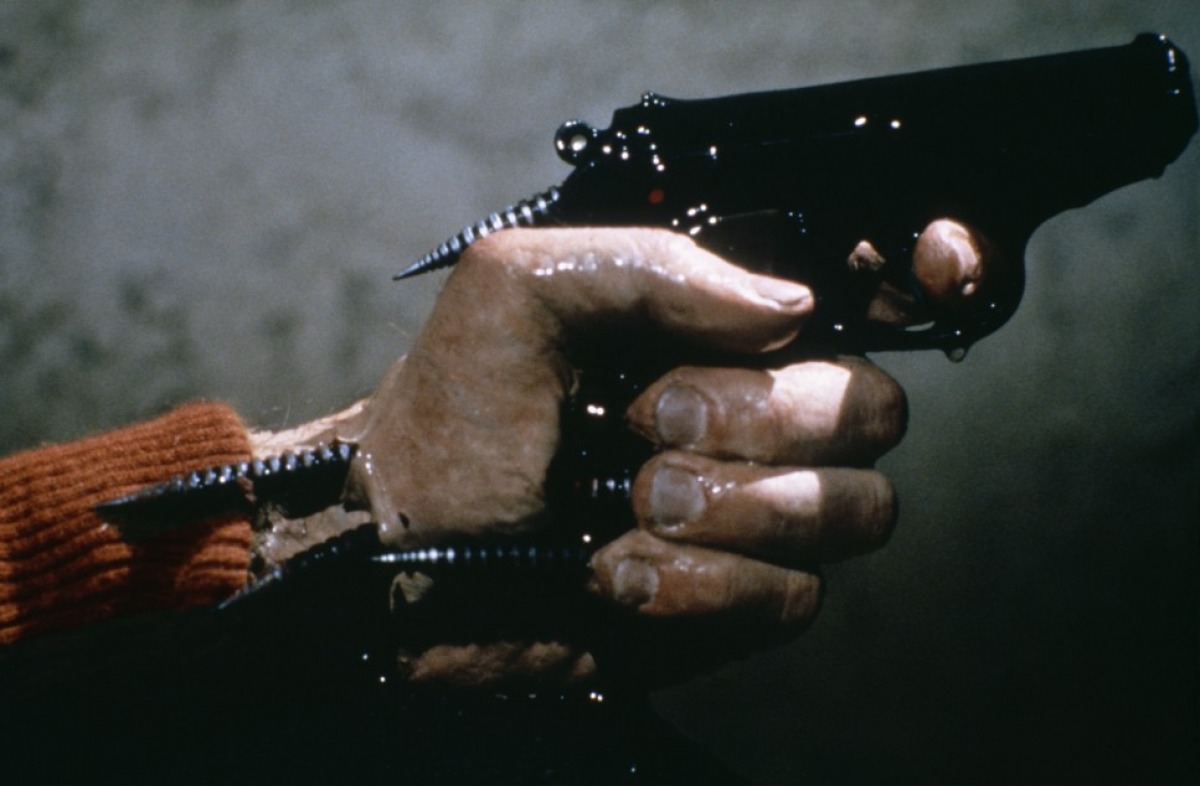
Scene from David Cronenberg’s Videodrome
The physicality of Kongrosian becoming part of the gun, literally ingesting it in this scene, is parallel to what happens to Max Renn at the end of Videodrome. Add to that the moment wherein Pembroke is holding Kongrosian’s “spongy, pink” lung in his hand was the clincher in connecting the themes of bodily mutations that define Cronenberg’s work with Dick’s climax of The Simulacra. I love these far-fetched connections!








.jpg)