Charlie’s Angels: The Short Case

logo3Truecrimers Sara Akbari, Meredith Fiero, Gloriana Smith, and Jack Harris did an excellent job on their second video assignment. Back in week 10 they did an excellent presentation on Jack Webb’s telling of one of the great unsolved cases of the 20th century in the U.S.: the Black Dahlia. In a stroke of genius on the part of this group, they set Charlie’s Angels loose on the ostensibly unsolvable case of Elizabeth Short. Will they break it wide open? Will the Black Dahlia finally be put to rest? Well, if the Angels, faithly supported by Bosley, can’t solve this one—who can?

Posted in True Crime | Tagged , , , | 1 Comment

Breezy Point

I was spending some time last night exploring Google Maps to find a few true crime sites in Brooklyn and Queens (I’ll talk about this in more detail in my next post). While browsing a birdseye view of Brownsville and East New York,  the Cross Bay Bridge caught my eye. This led me to jump Jamaica Bay and check out Breezy Point. This beach town, situated on the Western end of a barrier island in Queens, was one of the hardest hit areas by Hurricane Sandy last October. The superstorm resulted in a fire that incinerated several blocks of homes.

Breey Point Sandy Fire

Image credit: Business Insider

I started exploring Breezy Point from the streetview perspective on Google Maps, and was blown away by the images of houseless foundations—it almost stands like a cematary of what was.


View Larger Map
Google Maps stands as a pretty imrpessive archive of a block-by-block documentation of the devastation just three months later (the images of Breezy Point currently available are from January 2013). It would be interesting, once we have enough streetview images, to start telling the story of specific places through a series of coherent impressions of an entire town (or even city) collected over a number of decades. A whole new kind of cultural history.

The images below are ones I grabbed screenshots of while exploring Google Maps Street View, and I would would argue they paint a pretty compelling picture of effects of Sandy on the lives of too many families.

Screen Shot 2013-11-24 at 11.37.03 PM Screen Shot 2013-11-24 at 11.35.55 PMScreen Shot 2013-11-24 at 11.35.07 PMScreen Shot 2013-11-24 at 11.35.37 PM

Posted in google, maps | Tagged , , | Leave a comment

From this Distant Vantage Point

UMW Fine Art professor Carole Garmon shared some of her student’s work from the Approaches to Video Art course with me yesterday. I was particularly taken with Joshua Luebke’s “You are here.” This project takes a reading by Carl Sagan from his book Pale Blue Dot and adds it to a series of sequential images of a random street in Fredericksburg over the course of a day. It is remarkably hypnotic and powerful video. I’ll be sharing more of these students’ videos as I find them, this course is always good for a number of gems.

Posted in umw, video | Tagged , , , | Leave a comment

Distinguished Adjunct Professor

eagle_eye_oblivion

I admit the title of this post is a bit tongue and cheek and might potentially trivialize the larger crisis in higher ed surrounding adjuncts. That said, adjuncting has been an integral part of my experience at UMW over the past eight years (and my life in highered for the past sixteen years). My current day job is in the field of instructional technology, but my professional training is in 18th century American literature, cultural studies, and film (with vary degrees of ongoing  attention to all three). Ultimately however, I was more of a teacher than a scholar because I spent a lion’s share of my time at the CUNY Grad Center as an adjunct at one of CUNY’s various campuses. What’s more, I’m a shitty writer and researcher but fairly decent communicator and performer ,both of which are crucial to good teaching. I never did finish my Ph.D., but my experience adjuncting convinced me teaching undergrads is my calling, even after graduate school and the path to being a professor had lost its allure.

My foray into instructional technology in 2004/2005 was, at the time, a practical way to make ends meet and finish my dissertation. Little did I know it would be such a rich field that would quickly become the basis of a career almost unimaginable to me while in grad school. Even cooler, it was still firmly grounded in teaching and learning which was something I had almost a decade of experience with when I came to Fredericksburg in 2005. Eight years later and I’m still at UMW. I’ve taught eight different courses in three different departments. One of those courses, ds106,  kind of went viral. Fact is, for me the teaching I’ve done at UMW has been just as important as the instructional technology because the one reinforces the other—and vice versa. The separation of instructional technology from teaching and learning, which epitomizes the LMS for me, is the death of both arts.

And while the pay for adjuncts remains criminal, I was lucky enough not to solely depend on that income (though I certainly have come to depend on it the more kids we have). But more than that, it’s the freedom adjuncting at UMW has afforded me to experiment wildly with various courses that has been awesome! And while all courses are not created equal, and I’m constantly trying out new topics, new approaches, and new material (which can get exhausting and full fo failures), I absolutely love what the experience has provided me in terms of remaining tuned in and turned on to what happens in a  classroom. Ideas are shared, minds explode, and we are forced to wrestle with the concepts that shape who we are.

So, in today’s EagleEye (which is UMW’s faculty and staff newsletter) I played off my history of experimental teaching at UMW and posted about the installation piece Tim Owens and I did at the recent Open Education conference. I posted on EagleEye about the distinguished adjunct professor Brian Oblivion recent guerrilla art installation. I know it’s kind of stupid, but at the same time it’s also fun. It’s indicative of the play at work in the UMW culture that has made it more than just a job, it has been an unbelievable opportunity to explore what’s possible with teaching, learning, and technology. Running your online course with an alternative identity is just one example of interrogating digital identity online through an experimental pedagogy of uncertainty—and kudos to UMW for not sacking me long ago 🙂

Screen Shot 2013-11-21 at 7.37.08 PM

Posted in dtlt, fun, umw | Tagged , , , , | 1 Comment

DTLT Today Episode 107: Marie McAllister’s Domain of Her Own

For the 107th episode of DTLT Today, I sat down with English professor Marie McAllister to talk about her ongoing experimentation with technologies in her teaching over the last decade more generally. In particular, the amazing work she has done with the ever growing poetry anthology site Eighteenth Century Audio—a perennial UMW Blogs site that is one-of-a-kind on the web. Marie was part of the Domain of one’s Own faculty initiative this past Spring, and what I love about her approach is that she is not afraid to experiment. Over the course of this discussion we talk about her work with an honor’s  Medical Writing course on DocuWiki, the English Coffee House Bulletin Board built within phpBB, her various forays intoWordPress, and her long history with MediaWiki. This is truly a domain of her own, and she epitomizes the vision of faculty becoming sysadmins of their profesional spaces online.

What’s more, I obviously agree with her when she says every university should be experimenting in this space right now—but this kind of reaction amongst our most discerning faculty is really encouraging. I can’t thank Marie enough for sitting down with me, and it’s remarkable just how articulate she is about the future of Domain of One’s Own—I thought that was my job! 🙂 There’s nothing better than listening to UMW faculty imagine this space, and we have only just begun.

Posted in Domain of One's Own, DTLT Today | Tagged , , , , | 2 Comments

From Mansonism to Bundyism

manson_clapping_better 01
The 1976 TV movie Helter Skelter ends on a fear-mongering tear about “the social compost heap” from which Charles Manson sprang that may lead to an even more “virulent strain” of “Mansonism.” [This usage of Mansonism pre-dates, and I imagine was the inspiration for, the other Mansonism of the 1990s.] It’s probably the best bit in the entire film, and it lays bare the moral at the heart of the film: Manson introduced a special variety of hippie that will endlessly multiple and grow increasingly more aberrant and antisocial. They represent  a “virulent strain” of the youth movement that is coming of age presently, and that the viewer must be particularly wary of these mutants. Here is the clip, watch it through:

According to Helter Skelter, the idealism of 1960s youth movements in search of social justice, peace, and a better future effectively devolves into anarchic, violent cults led by fervent fanatics. A pretty effective narrative to stem popular support for any socially responsible activism during the 1970s. In fact, Vincent Bugliosi’s final commentary on this “era of madness” (which just as well could refer to the 1960s more generally as it does to the Manson murders) was probably the scariest thing about the TV movie when I watched it as a kid in 1976. The rabid Mansonites were out there multiplying wildly in mass orgies. It’s an image somehow akin to what 1950s youth must have felt when watching the xenophobic horror and scifi films of that era, namely Them! (1954) or  Invasion of the Body Snatchers (1956). But the difference now was the threat was from within (something John Carpenter’s 1982 The Thing updates brilliantly about the films from the 1950s).

Such a message of paranoia and fear in Helter Skelter informs the general public’s idea of the hippies as the modern incarnation of violent commies. And it gets even more interestingly when set against another burgeoning identity group of the era: the yuppies. The emergence of this category of young, conservative, upper-class urban professionals was the opposite extreme to the feral Manson hippies. White, clean-cut, all-American capitalists who are living the dream of social status and conspicuous consumption. The poster children for a re-worked vision of class consciousness that would ultimately celebrate the idea of material privilege in the mainstream media of the 1980s. Something that reaches its logical extreme with Bret Easton Ellis‘s 1991 novel American Psycho, but it can’t get there without first passing through Bundyism.
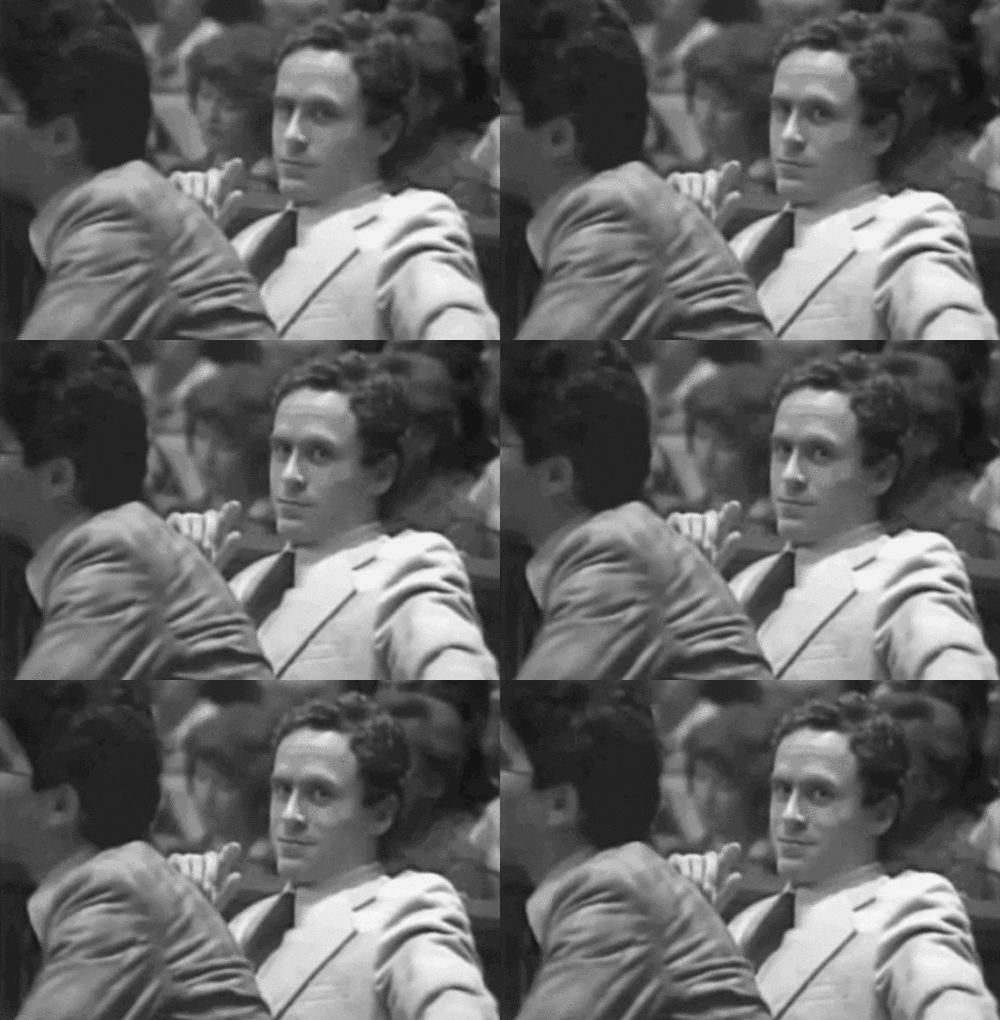
Ted Bundy on Trial

American Psycho

Ted Bundy in many ways was the prototypical yuppie during the late 1960s and early 1970s. A staunch college Republican who openly denounced student movements. In Ann Rule’s  The Stranger Beside Me (1980) she notes Bundy’s longtime girlfriend, Meg Anders, was asked by police what he had said when asked about the lug wrench with a taped handle he kept in his car (which he used to crush the skulls of women he abducted) he answered, “You never know when you can get caught in the middle of a student riot” (193). A bizarre transference of his aggression onto the socially oriented activism of the day.

Yet, he seemed to use the university as a cloak of privilege as well as a hunting ground for his victims. He hid within an affectation of culture, and dressed the part of a prep—complete with turtleneck, blazer, white tennis shoes, and corduroys. What’s more, he resisted any communal idea of organizing, he was an individualist. His determination to become successful was described by Ann Rule as “an almost Horatio Alger-like metamorphosis” (21). What’s more, he was anything but a radical:

He believed totally in the orderly progression of changes in the system of government through legislation. His stance made him something of a loner among the work-study students working at the Crisis Clinic. They were semi-hippies, in both their garb and their political views, and he was a conservative Republican. (36)

I love the way Ann Rule delineates the two foci of “semi-hippies”: clothes and politics. Can’t the same be said of Yuppies? In this regard Ted Bundy really is a stand-out. He’s the very opposite of Manson, and in many ways scarier. He’s a clean-cut kid with predatory appetite that represents the most primal vision of a political rhetoric around social Darwinism that seems to buttress a system that amasses its fortunes in terms of human trophies, or said another way: disinvestment. He is the logical extreme of  such a system of accumulation. Without God, without fate, and within a very flimsy world tied together by a fragile lattice of coincidence, survival of the fittest is all you have left. It’s the horror at the heart of the vision of the serial killer that explodes throughout the 70s and 80s—we’re being preyed on by forces out of our control. We’re supine in the face of chance, we can only hope to survive the predations of the most twisted among us. It’s a view of the world Ann Rule seem to buy into, one wherein weakness is a trait that must be culled at all costs:

Had the man who approached these young women divined somehow that he had come to his victims in a time when they were particularly vulnerable, when they were not thinking as clearly as they usually did? It would almost seem so. The stalking, predatory animal cuts the weakest from the pack, and then kills at his leisure.

Is Rule suggesting here that the common condition of the women who were abducted, beaten, raped, and then mutilated by Bundy might have been avoidable? Are we blaming the victims here? If only these women weren’t so vulnerable, if only they had a sense of how savage the world truly is, if only we were more scared of that stranger beside us. Ted becomes the one in total charge, the figure of power—the women become the “weakest of the pack.” And this metaphor of nature’s culling of the weak tends to reinforce the most conservative political rhetoric. The strong will survive and the weak shall perish. It’s the mantra of the corporate world, and it’s been an enduring a vision of our  society for the last forty years that in many ways could be considered at the opposite end of the spectrum from the revolutions of the 1960s. In such a predatory world there’s no sense of community, no support for the vulnerable, and a return to a pre-civilized moment in which humanity is on par with animals on the hunt. It’s the closest thing to a worldview in Rule’s book, and it’s probably the best way to sum up the escalation of U.S. political culture as we enter the 1980s. And like Bugliosi’s view of Mansonism, it’s equally feral, just far less distinguishable from normalcy.

And there is so much more. Bundy’s defining romance with Stephanie (a girl from an affluent family) that ultimately becomes a source of rejection. After undergraduate, she no longer considered theirs a viable, longterm relationship based on his prospects (which might be read as a class division). The whole thing kinda reads like the plot of a John Hughes film from the 1980s. It’s as if Bundy was the other side of Manson, the bizarre horror of submerged class consciousness as well as the worst of sensationalized violence against women. As Bundy is coming into the national scene as a media sensation, so are slasher movies. The popular vision of violence against women is another cultural touchstone. The deranged killers of the slasher cycle of films that represent so much psychic baggage of a decade of deeply scarring turmoil, from Mario Bava’s Twitch of the Death Nerve  (1971) through Halloween (1978), Friday the 13th (1980), and many many more. Culture doesn’t happen in a vacuum, that’s why they call it culture. And the struggle between the horrific caricatures of Manson and Bundy might be exactly the political battle we are still fighting today, to borrow from Mike Caulfield‘s awesome comment here that inspired much of my ramblings above 🙂

But let me end this post somewhat haphazardly with another quote from Ann Rule’s book that captures for me an image of Bundy’s life that I believe supports my theory of him as the prototypical yuppie. In this scene during May, 1975 Ted is entertaining people he used to work with in Washington in his apartment in Salt Lake City:

The trio from Washington found Ted’s apartment very pleasant; he’d cut pictures out of magazines and tried to duplicate the decor he favored. He still had the bicycle tire, hung from the meat hook in his kitchen, and he used that to store knives and other kitchen utensils in a mobile effect. He had a color television set, a good stereo, and he played Mozart for them to accompany the gourmet meals he prepared.

It almost seemed like a scene out of some bratpack movie from the 80s like St Elmo’s Fire. The attention to decor, the Mozart accompanied by gourmet good, not to mention the hifi system. Ted is about things, he is about possessions and appearance, but as this passage also makes clear he also has a meat hook that holds knives and maybe even the cleaver he brings on his midnight forays. Part of the vision here is out of  style magazine, and the other part a slasher film. Ted is the premise of a cultural flashpoint of consumption, predation, and affectation that would come to define the next 15 years of U.S. culture. If Helter Skelter killed the hippie, then The Stranger Beside Me gave the yuppies their first serial killer, but certainly not there last!
Posted in True Crime | Tagged , , , , , | 6 Comments

Boing Phonar Boing ds106

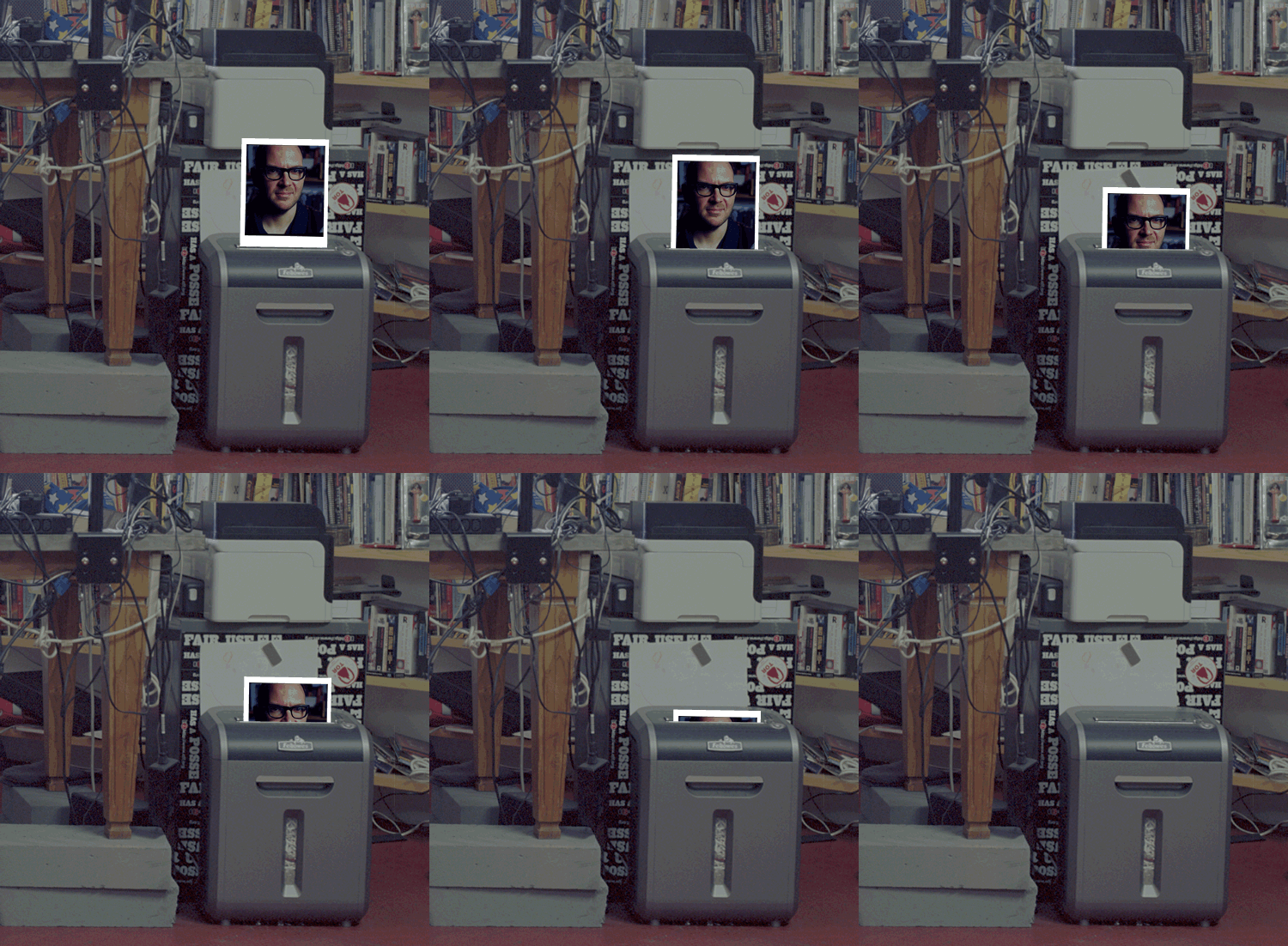
Image credit: The awesome John Johnston’s “Ripping Up a Shredder Head”

Major kudos to Jonathan Worth and  Alan Levine whose cross-course re-mix assignment was picked up by BoingBoing. Alan and Jonathon have been synchronizing and collaborating on certain assignments between Phonar and ds106, and the assignment to remix Corey Doctorow portraits taken by Jonathon himself put Phonar on the BoingBoing map.

What’s more, the BoingBoing article oh so generously mentions that little open, online conflagration known as ds106. The Dog continues to take ds106 to new heights! And now that corporate MOOCs are just retooled for-profit vocational classes and big data metrics for student success packaged as proprietary software are not what they seem, perhaps people will start paying attention to the real innovation happening in Phonar and ds106 when it comes to open online classes. And look, Mom, no venture capital!

It’s a proud moment to see so many amazing people in the open edtech community refusing to get sucked in by the hype, staying the path, and calling the silicon suckers on their bullshit hype. Fact is, in the end the corporate players lack any notion of an educational ethos or a vision of social justice. The only philosophy they can worship is the one that turns the learner into a commodity.

Posted in digital storytelling | Tagged , , , | 4 Comments

1983 Allen Losi Deck

losi_variflex_1983

Iconic image of the great ALan Losi

Iconic image of the great ALan Losi

My first skatedboard was the 1983 Variflex Allen Losi deck, featured above alongside Lance Mountain’s and John Lucero’s decks.  I was a huge fan of Losi (I was also a fan of Mountain, but who wasn’t a fan of Lance Mountain?) in the early 80s, and the video below of Losi at the Del Mar Skate Ranch in 1985 is a good indicator of his style. I would imagine by today’s standards some of his fluid, handplant-rich style might be consider quotidian. He was a grinder, his sets were full of backside bonelesses, lap-overs, fakies, 50-50s, and interspersed with blasts of air. And why some of these tricks might seem unremarkable given how insane the sport has gotten, for my brother and I they were awesome. We revered lesser known skaters from the 80s like Neil Blender, Lester Kasai, and Jeff Phillips. The joy of wathcing them was not necessaily the precision of their tricks, but a sense of style and fluidity that made it all seem real and human. As much as I love Tony Hawk, I mean he is the best vert skater the sport has ever seen, and he’s nothing short of a trick machine. At the same time, his mechanics were less than exciting in that you knew he was going to make it, his precision left little to the imagination. Awesome, but not all that human. Skating was a subculture in the early 80s, premised on illicit halfpipes, hijacking backyward pools, punk rock, and transgressive spirit that made the celebration of precision somewhat hard to reconcile.

Posted in skateboarding, skating | Tagged , , , | 7 Comments

Wither Blip.tv? Another Lesson in Reclaiming

I found out the hardway this morning, thanks to this comment from Alan Levine, that all the videos in my Blip.tv archive have been deleted. I quickly started searching around for the EdTech Survivalist videos that were there before the Blip.tv purging of November 7th, 2013. They were all gone. I eventually found two of the three in a low-res 320×240 flv file (far from ideal), but that’s better than nothing. Still looking for the EdTech Survivalist video titled “Embedded” wherein Tom Woodward and I re-interpret a scene from First Blood (1982) where he plays Johnny Rambo and is embedded in the web (rather than a cave in a Northwest mountain range) and won’t come out. “Johnny, Johnny, listen to me Johnny!” And there are five or six other videos I uploaded to Blip.tv I still have to find an original for.

Add to that the flamethrowing, zombie killing presentation “The Revolution will be Syndicated” Tom Woodward and I delivered for NMC in Second Life back in 2008. As of now it has been eaten up as well. In fact, NMC’s entire archive on Blip.tv has been deleted which sucks given there were probably a lot of awesome archived sessions on there. I wouldn’t be totally surprised if a version of that presentation shows up somewhere, but at the same time the fact that it’s out of our control is pretty annoying.

But don’t confuse me for a complainer, I know full well losing the videos from Blip.tv is my own fault. I’m sure I got the email last week (though I can’t find it currently), and I should have planned accordingly. So don’t confuse this post for an outraged plea for mercy from the big bad corporation. I knew full well I was getting into bed with a machine all those years ago. At the same time I’m surprised at how lax I have gotten over the last five years with my personal archiving. I put the stuff on these services, blew through two or three computers, conducted haphazard backups, and basically assumed my stuff would be there. I was stupid, and I can remember six or seven years ago, before the cloud had its current name, that I was still concerned with the implciations of putting my videos (and images, audio, documents, etc.) on someone else’s space.

That said, I understand I have most of my stuff on a commodity web hosting server I don’t fully control, but to date I have a much better trackrecord with work I have personally archived on my own server than any third party site. Case in point, of the 30 videos I uploaded to Blip.tv from 2008-2010, I found more than half on my server space. And to be fair, I’m lucky it was only thirty videos, which is nothing compared to the 200+ videos I lost when YouTube deleted my account for copyright infringement (still putting the pieces together from that nightmare) over a year ago. My history with third-party video hosting services has been shakey at best, and for the last year or so I’ve been putting my videos on my own web hosting space, UMW’s Media Server, and a brand new external storage drive. I’ve seen the light, host locally and back-up liberally.

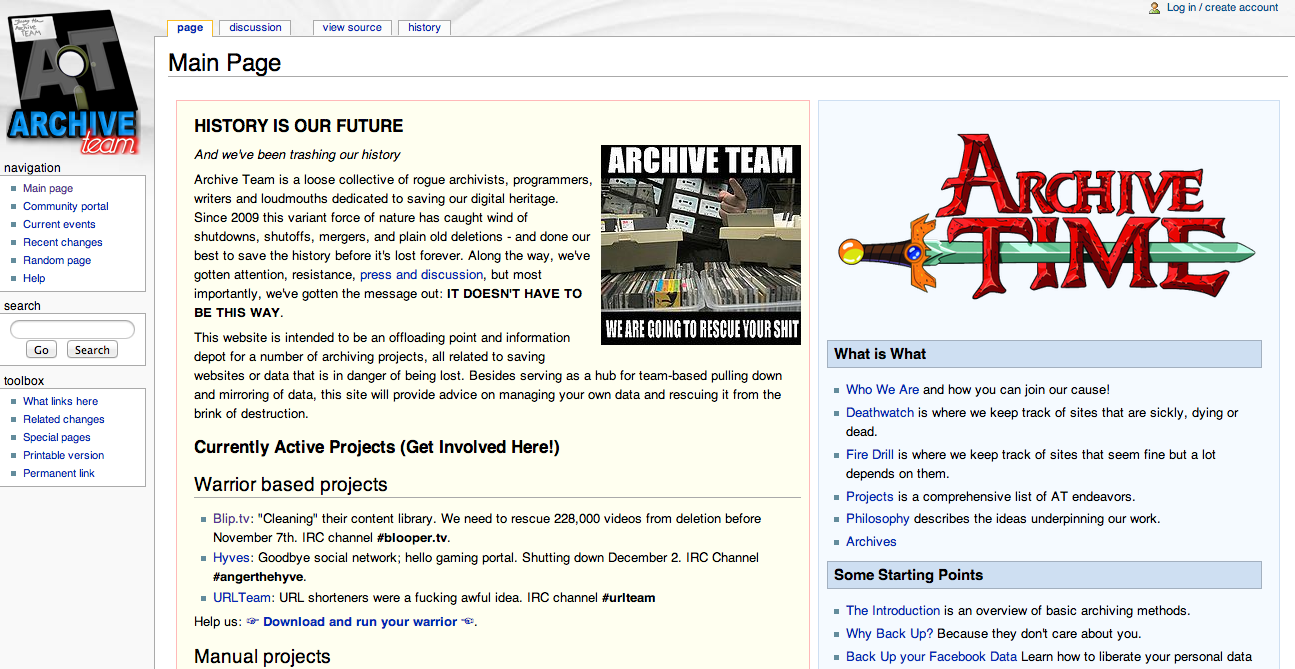
The Archive TeamAs I was searching for my lost videos and looking for solace on Twitter, the great Grant Potter pointed me to the Archive Team site. This amazing group of folks has been working to try and download and backup the third party web more generally, and one of their current projects is to download and archive all 228,000 public videos on Blip.tv before they are deleted. They provide a tool called the Archive Team Warrior which is a virtual archiving appliance. Anyone can run it, and it download sites and uploads them to the A-Team’s archive. I love this, a collaborative community working to preserve the open web.  I sent them a tweet this evening to see if they might have an archive of Blip.tv videos in the near future, how awesome would that be?

Anyway, Blip.tv’s transformation is not a surprise, and losing these videos is all my fault. It acts as a simple reminder why reclaiming one’s work from these third party services (even if just as a backup/archive) is becoming evermore important as more and more of the services we slept around with for the last ten years start eventually making us pay way or the other 🙂 Live and learn.

Posted in reclaimopen | Tagged , , | 4 Comments

Bugliosi’s Helter Skelter Bogus Conspiracy Theory?

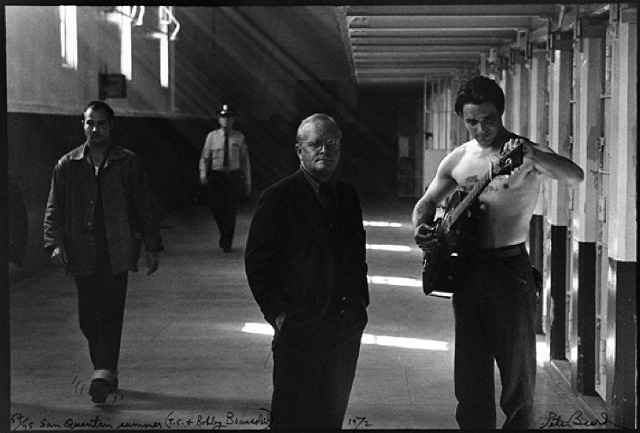
"Truman Capote and Bobby Beausoleil at San Quentin " by Peter Beard

“Truman Capote and Bobby Beausoleil at San Quentin ” by Peter Beard

As my last post made all too clear, this week in True Crime we’re talking about the 1976 TV movie Helter Skelter. Last night, as a follow-up to the discussion of the film, we discussed the interview between Truman Capote and Bobby Beausoleil published in 1973 as “Then it All Came Down.” Capote went to San Quentin in 1972 to talk with Beausoliel who was (and still is) serving life in prison for killing Gary Hinman—the first of the Manson murders. What’s fascianting to me about this conversation is that it suggests Vincent Bugliosi’s Helter Skelter scenario argued during the Manson trial, namely that the various murders were committed to spark a global race war, is overstated.

Instead, the Sharon Tate and LaBianca murders were actually attempts to free the charismatic and handsome Beausoleil from prison. In fact, Capote lays this theory out pretty clearly in the preface to the published interview:

It all began with the murder of Gary Hinman, a middle-aged professional musician who had befriended various members of the Manson brethren and who, unfortunately for him, lived alone in a small isolated house in Topanga Can­yon, Los Angeles County. Hinman had been tied up and tortured for several days (among other indignities, one of his ears had been severed) before his throat had been mercifully and lastingly slashed. When Hinman’s body, bloated and abuzz with August flies, was discovered, police found bloody graffiti on the walls of his modest house (“Death to Pigs!”) ­graffiti similar to the sort soon to be found in the households of Miss Tate and Mr. and Mrs. LaBianca.

However, just a few days prior to the Tate-LaBianca slayings, Robert Beausoleil, caught driving a car that had been the property of the victim, was under arrest and in jail, accused of having murdered the helpless Mr. Hinman. It was then that Manson and his chums, in the hopes of freeing Beausoleil, conceived the notion of committing a series of homicides similar to the Hinman affair; if Beausoleil was still incarcerated at the time of these killings, then how could he be guilty of the Hinman atrocity? Or so the Manson brood reasoned. That is to say, it was out of devotion to “Bobby” Beausoleil that Tex Watson and those cutthroat young ladies, Susan Atkins, Patricia Krenwinkel, Leslie Van Hooten, sallied forth on their satanic errands.

So, after watching the TV movie which spends three hours articulating and celebrating the brilliance of Bugliosi’s elaborate conspiracy theory tying the Manson murders to the Beatles’s song “Helter Skelter,” Capote offers a very logical, condensed version in just two short prefatory paragraphs. Rather than buying into an overblown theory that The White Album was the basis of an impending global racial conflagration, Capote argues Manson and the family had come up with the bloodiest, most horrific way to get Beausoleil out of jail. Still twisted thinking, no doubt, but somehow more believable than the vision of Helter Skelter laid out during the trial. That said, I must admit Bugliosi’s elaborate theory is far more entertaining than Capote’s, and maybe that’s the point.

Posted in True Crime | Tagged , , , , | 1 Comment