Helter Skelter or, how I came to hate the dirty hippies

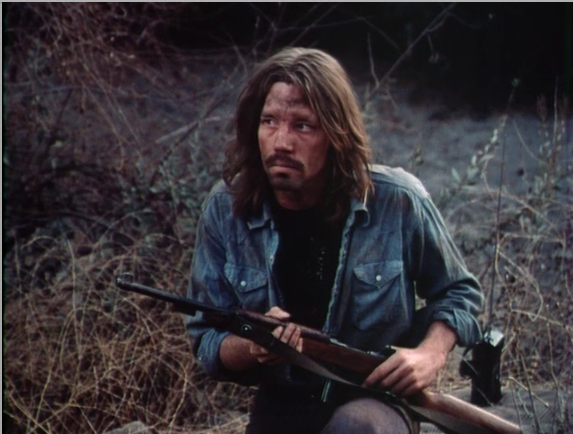
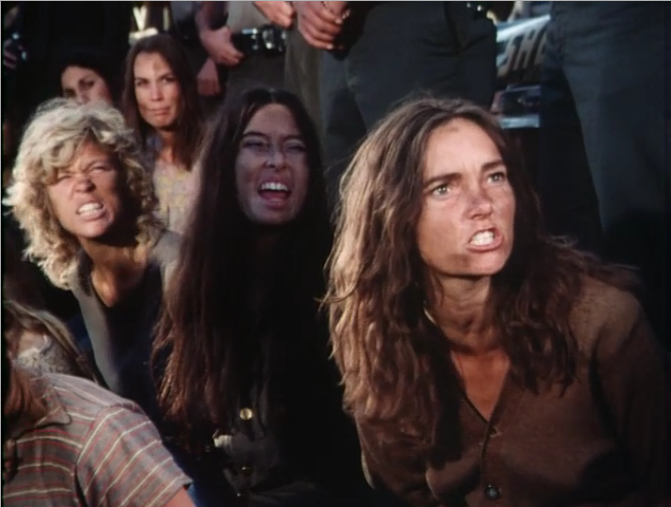
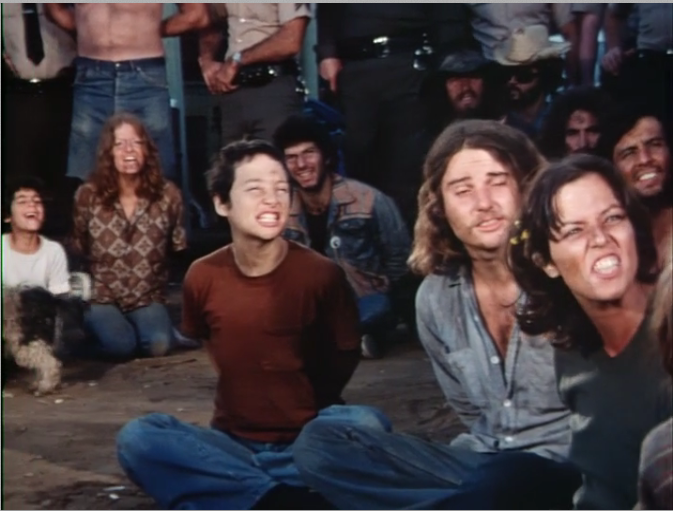
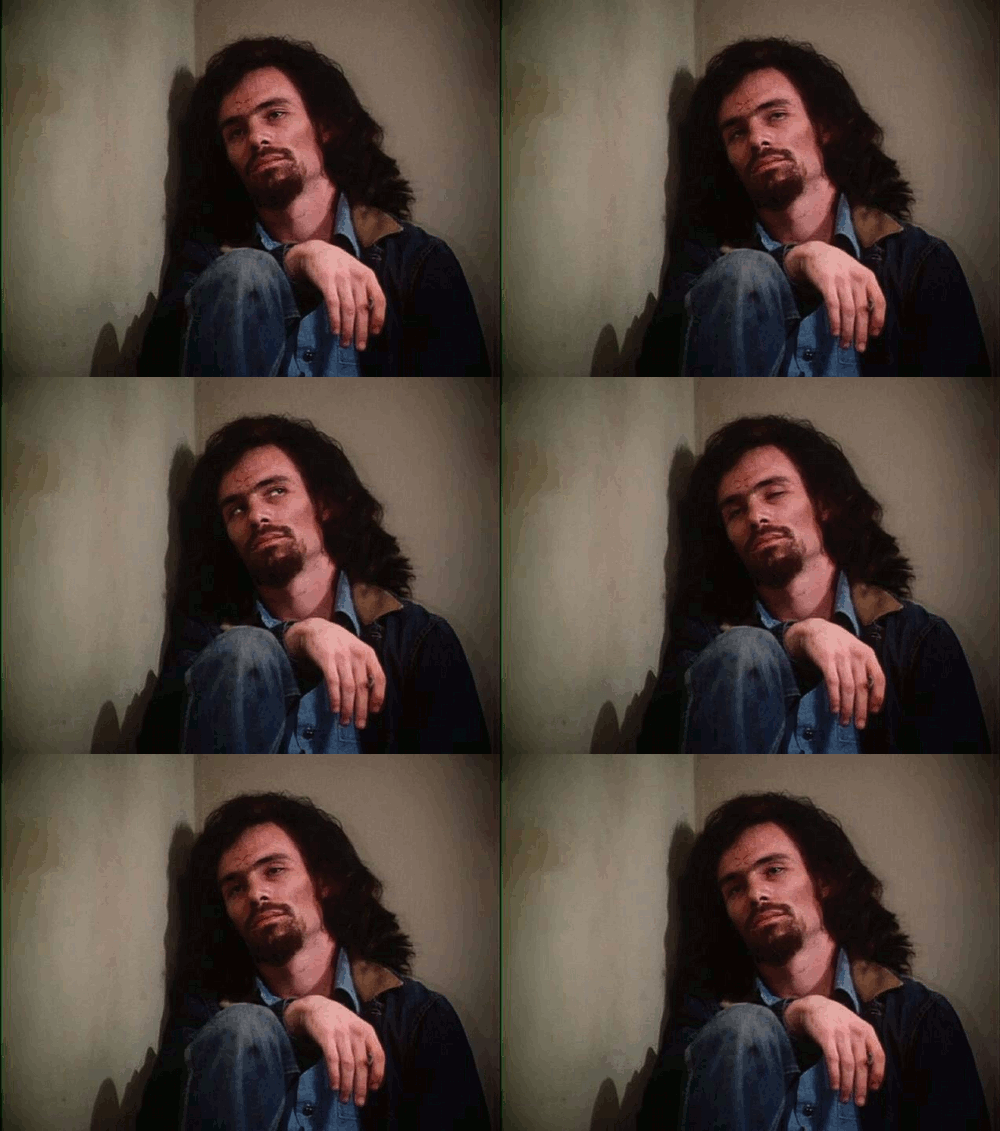
This weekend I watched the 1976 TV documdrama Helter Skelter for the first time since I was a young boy. And while watching it again I came to the stunning realization that this TV movie is the reason why I’ve hated dirty hippies so viscerally for the last three decades. In fact, this TV movie could have just as well been named The Family: A Bunch of Dirty Hippies. And when I say dirty hippies, I mean DIRTY hippies. According to this TV movie, the love children that were part of Charles Manson’s family may have been the dirtiest people ever. Just take a look at the evidence presented as part of the TV movie, these shots come early on in the program when the Ranch is raided by the police.

Dirty Hippie with Gun

Dirty Hippie with gun protecting the ranch

A series of dirty hippies making ugly faces

A series of dirty hippies making ugly faces

A depth of dirty hippies

A depth of dirty hippies

There is some serious dirt going on here, and I would normally scratch this up to overenthusiasm on the part of the director if it wasn’t reinforced throughout the movie. In fact, there’s a scene between Vincent Bugliosi (the crusading hero determined to stomp out the last remnants of filth) and his wife in which he breaks the Helter Skelter conspiracy behind the murders wide open. While Bugliosi is ennumerating this vision his special lady friend delivers the final blow by tying the Family’s lack of cleanliness to their senseless preying on the lives of the showered establishment people.

I can’t tell you how much this scene made me love this movie. It reinforces everything I feel about Hippies, the 1960s, and Manson more generally, In fact, this TV movie has a few themes it is trying to push pretty relentlessly: 1) Hippies are dirty, 2) the free love movement of the 1960s would ultimately devolve into psychos like Manson taking control of their minds, 3) Manson is the devil, 3) Bugliosi is a legal genius, and 4) Mansonism is a growing epidemic consisting of burgeoning dirty hippies that murderously misinterpret Beatles’ song lyrics.

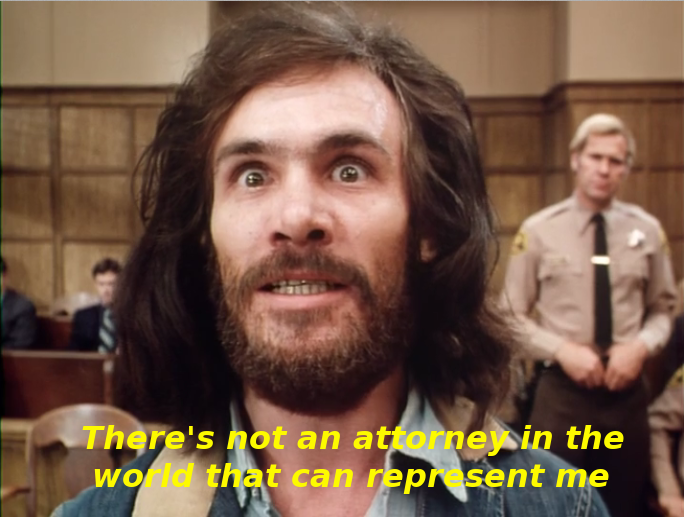
Scene from Helter Skelter wherein Manson decides to represent himself.

Scene from Helter Skelter wherein Manson decides to represent himself.

While we were talking about this movie in class last night, Seth Dorman brought up the point that this was a major network TV event. In fact, it’s the 16th highest rated movie to air on network television of all time! This was a cultural phenomenon of epic proportions, and I only half joke when I suggest this TV movie had an indelible imprint on my current view of hippies. I can remember the ranch, the filth, the descriptions of love-ins, and the resulting bloodshed. In the U.S. at least, April 1st and 2nd of 1976 were the final days of the 1960s. Helter Skelter put the final nail in the popular peace and love movement perpetuated in the mainstream by Woodstock. It made way for the 1980s, and for that I am ever grateful!

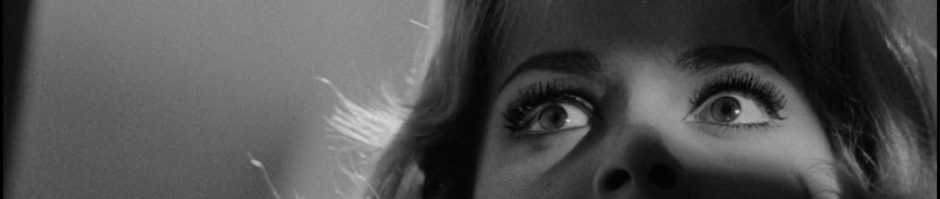
You've Got Charlie Manson Eyes

Posted in True Crime | Tagged , , , , , | 14 Comments

Domain of One’s Own presentation at TEDxUSagradoCorazon

I already blogged a bit about both this presentation for TEDxUSagradoCorazon as well as a related talk I gave at Sagrado Corazon about how blogging informed my vision of media more generally, and edtech quite specifically, from the beginning of my career as an isntructional technologist. I literally stumbled into the field as a wayward literature Ph.D. candidate, and the ideas I discovered during the first days of personal blogging, namely creating, openly sharing, remixing, and archiving, continue to drive the work I am part of a decade later. For all that has changed, the ethos has stayed the same.

The Domain of One’s Own presentation at TEDxUSagradoCorazon is actually four minutes shorter than the 18 minutes allotted, and I think I do a decent job of relating the Jon Udell’s idea of trailing edge technologies to the power of the web as a space that is predicated on open formats, free-for-all sharing, and distributed empowerment that scales globally yet is grounded in the individual. I think I was able to get at most of these ideas somewhat cleanly, and besides the fact I am busting out of my suit these days (too many barbacoa burritos at Chipotle! 🙂 ) I think this is a solid attempt—within a long line of attempts—to try and both explain and conceptualze Domain of One’s Own more broadly.

Posted in presentations | Tagged , , , , | 9 Comments

Data is the New Flesh, Long Live Dr Oblivion

There’s a lot to report out about this year’s Open Education Conference (#opened13), George Siemens already blogged about David Kernohan’s remarkable documentary keynote which I was lucky enough to catch. I was sorry to miss Siemen’s keynote, and almost equally sorry to miss Andrew Ng’s keynote given how “disruptive” it was 🙂  That said, I thought Audrey Watters‘ keynote was truly a beautifully wrought deconstruction of the mythos of technological solutionism that defines much of the popularized vision of our cultural moment (recent films like Cloudy with Chance of Meatballs 2 and The Internship confirm this popular world view in very eerie ways). It was a thoughtful, pointed, and downright punk rock presentation! What’s more, there were even a couple of Cthulu slides.

Cthulu Slide

In fact, there were more than a few excellent presentations I attended, tons of amazing people (some old friends and many new acquaintances), and a very mellow, inviting vibe. I’ve been to every other OpenED conference since 2007, and this may have been my favorite one to date. Part of this could be because I spent a good amount of time groking the mind blowing maturation of the publishing infrastructure Novak Rogic and his amazing crew at UBC have been building for the last four or five years. I’d argue there’s no other university web services group in North America doing such wildly innovate web development in-house. UMW has a ton to learn from them, but this will require its very own post (coming soon).

The Preparation

All this said, I particularly enjoyed this year’s OpenED conference because I got to experiment with a guerrilla presentation/art installation I’ve been dreaming about doing since 2008 when I Antonella and I saw a 35mm slide projector that projected single word exclamations on a screen in a dark room every 3 or 4 seconds at the Hirschhorn Art Museum (this piece was part of a larger installation featuring works from Giuseppe Panza’s collection of minimalistic and conceptual art). I found it mesmerizing, the single words were big concepts like FAITH, GOD, DEATH, SEX, LOVE, HUNGER, etc. I was struck by this immediately, and was wondering what it would be like to have such a presentation focused around our the concepts in out current IT infrastructure at universities, something like SECURITY, PRIVACY, EMBED, IT, GLOBAL, EFFICIENCY, DISTRIBUTED, etc. More than a few times over the past five years I’ve wanted to do this, but I’ve never been able to pull it together. So, when Tim Owens and I started talking about what we could do to promote Reclaim Hosting this idea came to me, and we decided to do it!
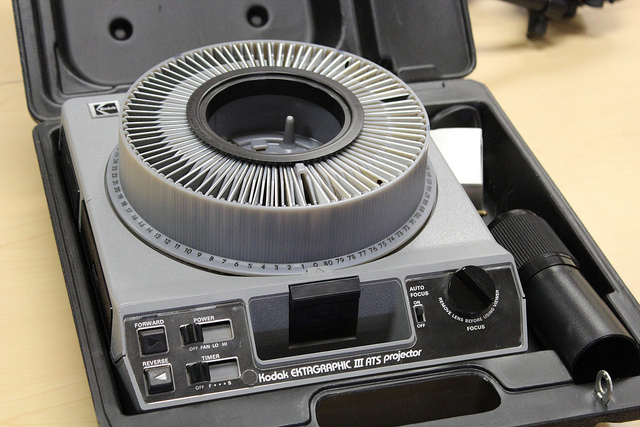
IMAGE OF A Kodak EKTAGRAPPHIC III SLIDE PROJECTOR

Kodak EKTAGRAPPHIC III

It was literally a week before the conference, and a ton of stuff had to fall in palce for it to work. First and foremost, we needed a 35mm slide projector and at least 80 empty slide casings. Thanks to UMW Art History professor Jean-Ann Dabb we got a old gold Kodak EKTAGRAPHIC III slide projector along with extra bulbs, a carrying case, and more than our fair share of good will! And thanks to Fine Arts professor Carole Garmon we got both ideas and the materials to create the single word slides using heat-tempered acetate (artists are the OG makers!). Thanks to the UMW art community I actually got the necessary equipment to accomplish the installation in less than 48 hours.

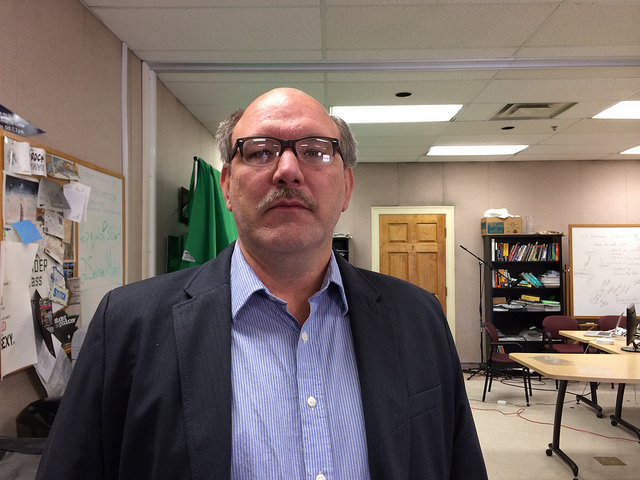
Now, if that wasn’t enough, while Tim and I were talking about the idea Martha Burtis suggested we resurrect Dr. Oblivion so he can play a part in the installation. The idea being we could have Dr. Oblivion speaking to people (meidated by a TV set of course) about the larger philosophical vision behind reclaiming one’s online identity (data is the NEW FLESH!), but being sure he doesn’t shill for a hosting company. Oblivion is a big thinker, not a two-bit salesman. So, I actually took portions from the screenplay of David Cronenberg’s Videodrome and re-wrote them so that the TV screen was now referring to the world wide web. It was simple and fun to do, and Tim actually wrote the larger frame I fit this script into (collaboration all the way). You can see the whole text here. [This is an excellent example how an idea in DTLT’s office quickly becomes a collaborative project that becomes infinitely better as a result of four or five minds rather than one.]

From there we needed to shoot the video, which required me shaving my head and beard and once again taking on the persona of Dr. Oblivion—something I kinda enjoyed this time around. The degree to which I can dramatically alter my physical being with a razor is truly remarkable. Between Tim and I, the video was a one shot affair, and I think it came out rather well considering. The idea was to have it loop on an old school 1980s television which would be waiting for us in Utah. Cool fact, we got our hands on an old school TV 14 minutes after posting the request on Twitter thanks to the great Jared Stein. And soon after got our hands on an old school VCR as well thanks to Mark Suman (to think I talked smack on Canvas at OpenEd—what a jackass I am).

Dr. Oblivion defines the New Flesh from Jim Groom on Vimeo.

OK, so with only three days before the conference we got the slide projector, a looping video of Dr. Oblivion (I believe Tim got it to loop on an actual DVD using iDVD), and a 1980s TV and VCR waiting for us in Utah. The last thing we needed to do was create 80+ slides with the stark IT/Open Education word concepts that might elicit some kind of response (dare I say emotion?). For this, we opened up a Google Doc and asked people on twitter to add in words they thought might work. Within half an hour we had over a hundred words, and we edited them down to 83. After that , Tim put them in MS Word Mail merge we lined them up as labels, and printed 83 words on heat-tempered acetate so we could create 83 slides (only 80 fit in the carousel, but I wanted a few extra in case). The printing, cutting, and assembling the slides was a manual process that took Ryan Brazell, Tim, and I a bit of time, but was oddly satisfying at the same time to be working with this old school technology, and building a presentation/installation by hand.
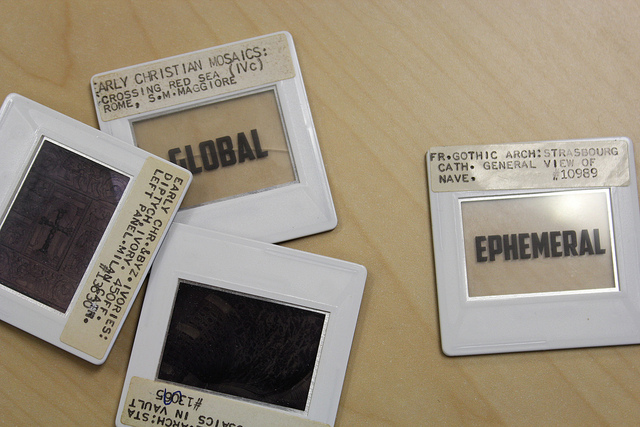
Slides
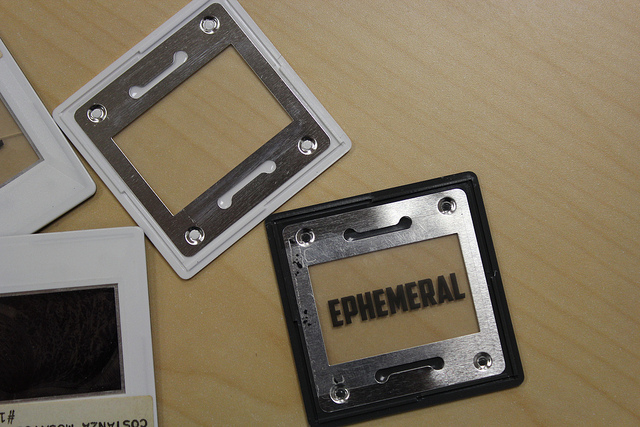
Slide Casings with Acetate

And with that we completed the preparation for the installation. There was still a bit more to the setup once we got to Utah, but before I get to that, I just want to quickly note how cool it was to approach this project as a guerrilla installation. Not only was this collaborative approach different from how I’ve gone about most presentations, but the preparation was so much more than google searching images, knocking out some slides, and canning another logical talk—this was art, dammit 😉 It was hands on. Between reaching out to people in the academic community at UMW, figuring out how to physically make old gold slides, working with a mechancial 35 mm slide projector, opening up the process to others on Twitter, connecting with people across the country to provide 1980s accessories, and altering one’s physical being to make a looping video for something more than another dog and pony show. Like with ds106, and the Summer of Oblivion specifically, it felt like we were  building something. And I am realizing there are few better feelings in the world.

The Installation

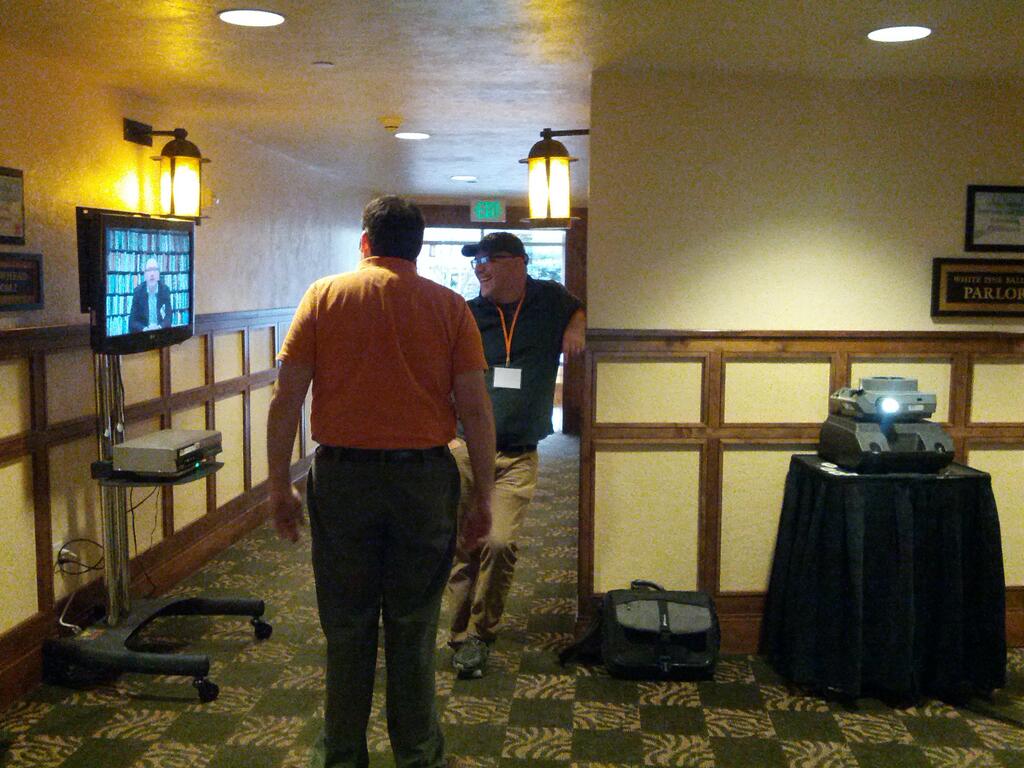
Tim and I got the slide projector on the plane with no issues, picked up the VCR and TV, and made it to Utah without a hitch on Wednesday. The idea was to have the slide projector and looping video of Oblivion run all day Thursday somewhere in the conference hotel.  There was no clear space as we walked around Wednesday afternoon, and between one thing and another we didn’t have the time to figure it out Wednesday evening. So, first thing Thursday Tim and I got up at 7:00 AM and starting scouting the conference space. We decided the best possible place to put the slide projector and TV/VCR was at a junction hallway space that joined the three break-out conference rooms. This area would be highly trafficked during the afternoon, and would allow us to keep it running for more than eight hours. As we were scouting on of the Canyons Resort AV people asked us what we were doing, we asked  if they had any extra screens and projection tables, to which he quoted us a figure of $185. Given our funding was tight, we pleaded for charity given we were setting up a guerrilla art installation using a 35 MM Projector that we dragged all the way from Virginia. As soon as he heard 35 mm slide projector he was sold on helping us. He was intrigued by the old school technology (having dealt with it in another life) and became a major fan of the installation. He gave us a screen, extension cords, a table to set the projector up on, and ultimately a TV when we found we couldn’t get the input on ours to change without a remote, all for free.
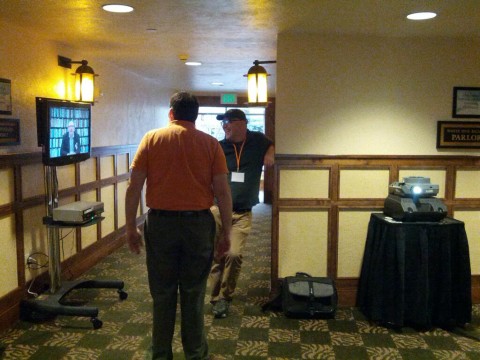
BYeqDbkCcAECNop

We had it all set up by 8:30 AM (well before the keynotes at 9:00 AM). Above is an image care of one of Jon Becker’s innumerable tweets at the conference. The final touch is we left  a bunch of Reclaim Hosting cards on top of the VCR and walked away (notice the subtle difference in the two designs below.

Business_Card

Design 1

Business_Card2

Design 2

I would wander by it on occasion and given I was wearing a hat and had shaved the moustache there were a lot of people who had no idea I was the good Dr. That said, there were even more who didn’t care about the installation at all, it was simply background noise. The syncopated switching of the slide projector and the monotone droning of Dr. Oblivion about the new, digital flesh became part of the space. People walked right by it, had the slides projected on their back, or generally were unphased by the future, and that is beautiful, that’s when it became art for me because the future is always a disregarded reality few pay attention to because they forget it’s already here. IT’S ART. DAMMIT.

Michael Branson Smith and I were talking about this installation over the course of the day because he and I (along with Brian Lamb and Tom Woodward) were toying with the idea of doing a GIF installation in New York City last Spring. Ultimately, it didn’t work out, but we got to talking about how cool it would be to create GIFs with a 35mm Slide projector as one of many pieces within a larger show about GIFs. I’m fascinated by the idea, and hope we come back to it soon. Anyway, Michael was awesome enough to capture the installation with a few short videos that I’m embedding below. And with that, I’ve officially documented by first installation piece, but hopefully not the last!

Dr. Oblivion defines the New Flesh from Jim Groom on Vimeo.
Posted in digital storytelling, open education | Tagged , , , , | 21 Comments

Minding the Future Panel to be Featured on NPR

Looks like parts of the Minding the Future panel along with individual interviews with its particpants will be featured on NPR’s “With Good Reason” radio show this Sunday, November 17th from 1-2 PM on Radio IQ 88.3 Digital. It will be fun to hear what the show makes of the event and its featured speakers. What’s more, I’m hoping Sarah McConnell covers some of the issues, topics, and presentations she saw at the  OpenVA conference the following day. I guess I’ll just have to listen to find out. Below is a copy of the press release released by UMW yesterday. All this just serves as a haunting reminder that I have yet to blog about either of these amazing events that took place almost a month ago. Hope springs eternal!

Highlights from the first Open and Digital Learning Resources Conference held at the University of Mary Washington in October will be featured on the public radio show “With Good Reason.” The conference, known as OpenVA, brought together more than 250 experts from Virginia institutions to examine the future of higher education and technology. The show, “The Future of Higher Education,” will air beginning on Saturday, Nov. 16.
Jeffrey McClurken moderated a panel during the first OpenVA conference at UMW.

The program will feature the panel of David Wiley, Kin Lane, Alan Levine, Gardner Campbell and Audrey Watters, moderated by Professor and Chair of History and American Studies at UMW Jeffrey McClurken. Experts from Virginia Commonwealth University and Virginia State University also will discuss the challenges and opportunities of digital learning. The two-day conference was sponsored by the State Council for Higher Education and the University of Mary Washington. Audio files of the full program and its companion news feature will be posted online the week of the show at http://withgoodreasonradio.org/2013/11/the-future-of-higher-education/.

For full videos from conference sessions, visithttp://www.youtube.com/user/umwnewmedia.

“With Good Reason” is a program of the Virginia Foundation for the Humanities. The show airs weekly in Fredericksburg on Sundays from 1-2 p.m. on Radio IQ 88.3 Digital. To listen from outside of the Fredericksburg area, a complete list of air times and links to corresponding radio stations can be found athttp://withgoodreasonradio.org/when-to-listen/.

Posted in openva | Tagged , , , | 1 Comment

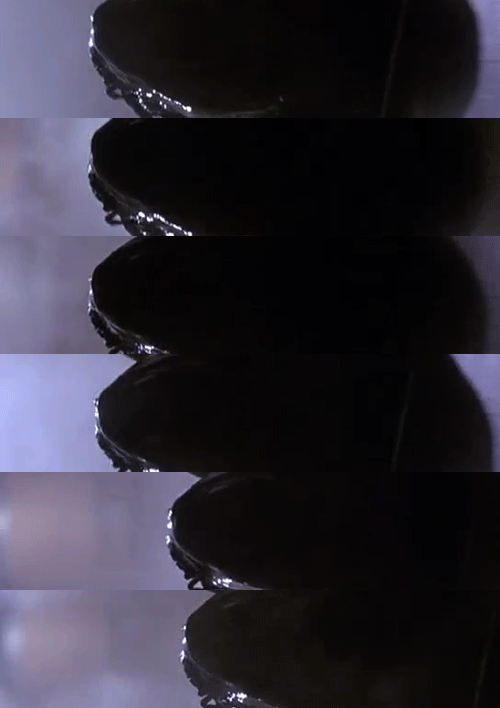
If you stare at it long enough…


…the truth becomes clear.

Blame Tom Woodward, seems he’s become a bit more playful since sharing the news he’s coming back to higher ed. And nothing makes me happier to that, here’ to greatness Woodward, this GIF is a good start 🙂

Posted in fun | Tagged , , , | Leave a comment

A Thing is Born: the Multi-GIF Shot

Michael Branson Smith’s born GIF is nothing short of brilliant. I have seen multi-shot GIFs, but I have never seen a multi-gif shot. Is this a new Thing, so to speak 🙂

I love this so much, and he has a few more on his Tumblr, he is en fuego—a GIF artist of the highest caliber!


Posted in fun | Tagged , , , , | 2 Comments

A Curious Still Life

in_cold_blood_xlgAs I mentioned in my last post, one of the things Paul and I are trying to do with blog posts, videos, etc. for the True Crime course is model some of what we want to see. The group that is leading the discussion on Truman Capote’s In Cold Blood did a good job with background information and summarizing what happened in the first half of the book, but any good discussion of a book needs to anchor its discussion and arguments directly in the text. One of the things you hopefully learn as an undergrad when taking a literature class is how to read closely. How to examine specific passages to pick-up on particular elements of style, voice, etc. At the same time you also need to connect how a given passage connects to the broader themes of the book.

For the second half of In Cold Blood Paul and I have asked each group member to do just that. Choose a passage or two from the book and closely examine its broader themes, particularly elements of style that also feedback into the ideas Capote is getting at in the book. An example we talked about in class on Thursday was from Section 1 and it’s a description of the back seat of Dick and Perry’s car.

Dick was driving a 1949 black 1949 Chevrolet sedan. As Perry got in, he checked the back seat to see a if his guitar was safely there; the previous night, after playing for a party of Dick’s friends, he had forgotten and left it in the car. It was an old Gibson guitar, sandpapered and waxed to a honey-yellow finish. Another sort of instrument lay beside it—-a twelve-gauge pump-action shotgun, brand-new, blue-barreled, and with a sportsman’s scene of pheasants in flight etched along the stock. A flashlight, a fishing knife, a pair of leather gloves, and a hunting vest fully packed with shells contributed further atmosphere to this curious still life. (22)†

I brought this passage up during class Thursday because it, like so many others in this book, foreshadows and encapsulates the tensions and themes that made this book a classic. One of the immediate elements of this passage frame possibly the most powerful theme in this book, namely that cold blooded murderers are actually people. Perry embodies this brilliantly here (and an issue that only gets more complicated as the book proceeds) as he is scanning the back seat for his guitar, which he actually plays at parties fro friends, has deep affection for and demonstrates he can actually create something (not only destroy). This is something that is echoed continually throughout the book as it focuses on Perry as both murderer and human at once—a complex framing of the banality of evil that might be the most horrific part of the whole text.

And this very theme is written brilliantly into this passage as the description seamlessly moves from the guitar to “another sort of instrument” right beside it, namely “a twelve-gauge pump-action shotgun” which captures the murderous side of Perry. What’s more, this shotgun does not invoke an idyllic hunting scene that focuses around pheasants, but rather scenes of two men hunting down a family based on a similarly fanciful vision of gold and treasures to be found on the Clutter farm. This is all further reinforced by the list of hunting sundries in the description that illustrate with painful detail how everyday tools quickly become monstrous when seen through the lens of violence this scene is literally driving towards.

Finally, the the last line of this passage, “curious still life,” made just as well be another name for the entire book. Not only is Capote introducing a more ethereal literary voice to this hardboiled situation, but he’s also providing a curious still life to a moment of time in American culture. The idyllic vision of post-war America running on a crash course with the underbelly of the dream embodied by lost souls like Perry. But this is not an excuse, or even an argument, but rather freezing a documentary moment of time into a literary tableaux —the mashing up of art and reality. A curious still life that at once pushes the story forward as much as it foreshadows what’s to come while at the same time brilliantly demonstrating the larger tensions, themes, and ideas that define this work of art.

___________

† We used this edition of the book for the discussion, so the page number for the quote copied above would be for that edition.

Posted in True Crime | Tagged , , , | Leave a comment

Torso: Biopsy

Torso:Biopsy from Jim Groom on Vimeo.

Two weeks ago the True Crime course Paul Bond and I are running discussed the graphic novel Torso. We’ve adopted a new approach for teaching this Freshman seminar. On a weekly basis the course is run by rotating groups of three students . I’ve loved this approach, students are working together, doing research, adeptly leading discussion, and take=ing ownership of their course. We’ve been asking them to make sure all their prep work for each week is added to the course wiki, and together they’re building a comprehensive document of what we’ve discussed throughout the semester.

The other side of this is because the students truly own the course discussion, it doesn’t always touch on various elements Paul and I might want to lecture about. Let’s face it, I love to talk. I have no problem dominating a course session with my views of what something means, but I’ve been resisting this impulse. That’s very much a side-effect of co-teaching this course, something I find has been awesome for pushing my teaching outside my comfort zone.  That said, the student-driven discussions don’t always cover certain themes, issues, close readings that we might thing are important. And while everyone talks during class, including Paul and I, we try not to hijack the conversation. This is where we use typically targeted posts, comments, etc., to cover anything we think has been missed.

Two weeks ago, while we were talking about Torso, it became apparent that a number of students were uncomfortable with reading graphic novels. Rather than this viusal medium being second nature, as folks might assume, more than half the class found the book confusing because of the format. Give that, Paul and I decided we would try and do a video discussion, like we did for 10 Mario Bava films over the past six months, talking specifically about how you read graphic novels.

Paul put together a presentation with the first 15 pages of the graphic novel, and he took me through doing a close reading in this visual medium on video. I learned a ton about reading graphic novels, and I love the idea of supplementing what the students are doing in their discussions with some follow-up, formalized video discussions like this one. I want to do more with Paul (which is always the case because I love talking to him about this stuff), and I think if we were to teach this course again this would be one way to do a back flip of a particular class. A post-facto wrap-up and recap of the discussion to highlight student points from the discussion they led, and also the opportunity to share our own ideas, readings, and thoughts more extensively. That said, I might just like it cause I can talk more 🙂

Posted in True Crime | Tagged , , , , | 1 Comment

STEMmED II Colloquium: the Return of the Bava

I want to thank the goods folks at Universidad de Sagrado Corazon, particularly the great Antonio Vantaggiato, for once again inviting me to their gorgeous campus to talk about integrating media production into a variety of courses across the curriculum (something I am experimenting with currently with the True Crime course I am co-teaching with Paul Bond). The title of this post refers to a joke between Antonio made while we were there. This is Antonio’s second big Federal STEM grant, and he nicknamed this one in the vein of a b-movie horror sequel: STEMmEd II -The House of Science (the first was titled STEMmEd). You know I love that!

And in that vein, this presentation, which follows talks by Gardner Campbell and Alan Levine (the pressure was on!) I went back to my roots and talked about my early days of daddy blogging, my discovery of the Internet Archive,  and some early examples of imaginging media as part of the curriculum at UMW. It was an extemporaneous presentation, but I want to return to this one and fine tune it because I really like how it felt.

Posted in presentations | Tagged , , | 1 Comment

Will Shuttleworth Reclaim Your Domain?

Shuttleworth Foundation Application Video from Jim Groom on Vimeo.

I just completed and submitted my applciation for a Shutteworth Foundation Fellowship. I’ve been using the Flash Grant I recieved from Shuttleworth over the Summer to build Reclaim Hosting, fund ds106 development, and bring folks like Alan Levine, Audrey Watters, Kin Lane, and David Wiley to Fredericksburg so we could imagine what a project that enabled folks to take control over their online presence might look like. This proposal is in many ways a result of those conversations, projects, and more. I try and layout the idea for this fellowship as clearly as possible in the above video (which I am currently editing down to five minutes) as well buttres the vision in more detail in the application. Take the jump to view the application, and here’s to hoping!

Continue reading

Posted in Domain of One's Own, reclaimopen | Tagged , | 6 Comments