Joe Strummer on Open

Luke Waltzer linked to this clip from a documentary about The Clash in a comment he made on the Bava the other day, and I haven’t been able to stop watching it. In particular, the section at 3:50 that Joe Strummer lays out is a pretty compelling vision of open as an ethos and approach to what you do rather than being pinned down to a product or a license. Sometimes it’s as simple as the doing of the thing.

Posted in Uncategorized | Tagged , , , | Leave a comment

Wrigley Ivy: Jack Bales on the Chicago Cubs

I’ve been meaning to write a post about Jack Bales’s amazing work as part of the Domain of One’s Own faculty initiative this past Spring, but somehow a post seemed inadequate. For more than three years now I’ve been bothering Jack, telling him he should get a domain to feature all the amazing research he does. An effort which resulted in his first domain: jackbales.com. And by no means was I pandering to Jack’s ego (if he even has one), he has eight books under his belt, and his magnum opus—a multi-volume tome on the history of the Chicago Cubs—is being written presently. Jack is a titan amongst librarians, and a veritable icon at Mary Washington. He’s been at UMW for 33 years now, and in addition to his copious research and stellar publication history, his work ethic with faculty and students on a day-to-day basis is the stuff of legend. Like Jack, I support faculty as part of my job here at UMW, so I have a very good idea how much time and energy goes into supporting more than thirty classes on average a semester—it’s Herculean. And on top of all this, Jack is possibly the most congenial, good-hearted, and downright awesome person working at UMW. And just about anyone in the UMW community would echo that sentiment. If I had a career like Jack’s in my line of work, I would consider it a resounding success. He’s a model for us all.

But enough of the Bales love, now we gotta get down to brass tacks. In this episode of DTLT Today Jack shares some of his recent research forays into a few colorful episodes from the Chicago Cubs’ history. All of which are also published on his Cubs site Wrigley Ivy that he started as part of the Domain of One’s Own faculty initiative. He uses that space to publish his research about a wide-range of Cubs history, including the dating of a poem about Tinker to Evers to Chance (a topic that got Jack’s research into the Chicago Tribune), Willian Veeck Sr. (the basis of this article on Veeck in the baseball journal Nine as well as a forthcoming book), the Jurges and Waitkus shootings (which will be the fodder for a forthcoming ChicagoSide article), and the so-called curse of the billy goat (which Jack already turned into an article for ChicagoSide). And that’s not even everything! All this is just the beginning of Jack’s mammoth research work that will be published as a documentary history of the Cubs—it’s amazing to see someone get so deep into a labor so great. But Jack isn’t only a font of facts, contexts, and anecdotes about the Chicago Cubs, he’s also unbelievably enjoyable to talk to as the video will attest.

Unfortunately, Domain of One’s Own can take no credit for Jack’s unbelievable talents as a researcher and writer. However, we can argue it did connect him with a world of people, sources, and possibilities that might not have materialized otherwise. Every campus has their Jack Bales, the question is how can we help to augment these connections within and beyond their professional domains. I’m increasingly convinced that with Domain of One’s Own UMW is at the very beginning stages of developing the richest network of teaching and learning we’ve yet to see on this campus and beyond—and Jack’s experience with this space is a wonderful illustration of it’s amazing potential. Thanks Jack, I am a BIG FAN!!!

Posted in DTLT Today | Tagged , , , , , , | 1 Comment

Open as a Power Relation

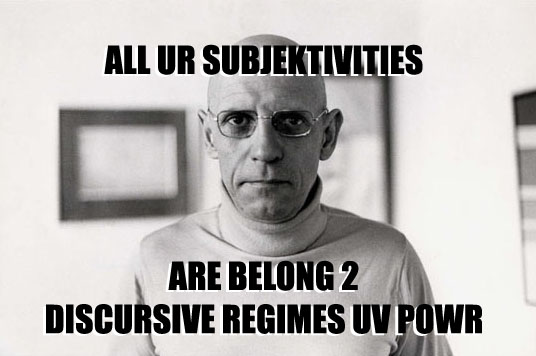
foucault-1I’ve been co-teaching a True Crime course here at UMW (which is a blast), and last night we discussed Michel Foucault’s Discipline and Punish. If any of you out there were in grad school during the 1990s or early ’00s like me, just seeing this book title may cause you to break out in hives. Apologies. That said, it still remains one of the most powerful things I ever read in grad school, and returning to it with a group of Freshman last night reminds me how viscerally accessible and conceptually cryptic this book is all at once.

The discussion about the book last night was led by three students, and as my collaborator Paul Bond noted in this post they did a good job of breaking down the reading and trying to contain the conversation. One of the things they didn’t mention, and which I think is crucial, is Foucault’s methodology—the way in which he’s trying to avoid an over-determined argument about crime and punishment that results in some totalizing claim that as a culture we have become somehow greater (or even worse) than those who have come before us that engaged in ritualisitic public torture and execution.¹

It’s really compelling, and somewhat easy, to fall into an evolutionary theory of history whereby we are the best of all possible developing cultures—not unlike Steven Pinkers’s argument in The Better Angel’s of Our Nature. There’s a methodology at work in D&P through which the transformation of crime and punishment is examined along the lines of specific historical, political, and cultural shifts in the Western world from 1760 through 1840, namely the democractic, scientific, and humanistic revolutions that coalesce as a broader historical moment known as the Englightenment. Foucualt refers to the way he reads this moment as a genealogy, the four general rules of which I outlined here for the truecrimers. Foucualt doesn’t come up with a sensational thesis about whether the Enlightment happened or not (something which Steven Pinker’s argument seems to do with the changing nature of violence), rather he challenges the ways in which it’s couched as a necessary improvement over what was when it comes to crime and punishment. The move away from the body towards the soul, as he describes it, is not so much suggesting that punishment was brutal and is now humane—but that the way we administer punishment has changed for broader political, economic, and cultural reasons. It’s a way of reading and “writing the history of the present” (pg 31 or the final line of chapter 1).

As I was reading the chapters again it reminded me a lot of my facorite cultural critics of edtech right now, namely Audrey Watters, Mike Caulfield, and Brian Lamb. And while all of them may or may not care for my comparison, I think they’re all are doing just the kind of critical studies that I found most enthralling about graduate school, save the jargon and egos of course. They’re constantly looking for a broader “complex social function” of education technology. EdTech is not simply about whether it can save educational from “failing” or not, but how that very frame is connected to a broader complex of social functions. Which immediately begs the second point of Focuault’s genealogical method: “regard punishment edtech as a political tactic.” Exactly, how is edtech being used as a means to shift the larger culture of education as it reales to just about every element of our culture.

Third, “make the technology of power the very principle of the humanization of the penal education system and of the knowledge of man.” How does edtech become the platform and possibility through which power is continually maintained as a relation in the education system. Shit starts to get real. And four, “study the metamorphasis of punitive educational methods on the basis of the political technology of the body”. How does the current shift in our ideas of education move us into different relationships to power, the body and the poltiical technology that everywhere mediates this relation. In other words how do we read and write the broader cultural shifts in education right now in relationship to power, knoweldge, the state, etc. This is crucial to “writing the history of the present” —and when I am looking for such frame for the world of edtech (which is in desparate need of it) I have my goto sources.

This is not something I just discovered, however, I have been counting on all of those folks as filters for these ideas for years. What the reading of Foucault did was to help me reframe it as a kind of methodology that brings some of their underlying methodology of their critiques to light for me. What’s more, it helps me come to terms with increasingly convoluted and denatured concepts like “open” in the sphere of edtech. Nicole Allen tweeted a couple of hours ago that….

The “Open” in MOOC is only meaningful if it is granted with a license

To which I started thinking, hmmm, this suggests that the license undergirds a whole series of relations that are impossible without it, but at the same time that’s not true. In fact, I responded….

And while it seems simple enough, the idea has actually helped me come to terms with the idea of open in a different way than a somewhat linear narrative of good to bad, pure to spoiled, punk to corporate. The problem with the term openwashing, at least for me, is it suggests that open was pure and is now sullied. But I’m not sure that’s the case, because if we just give it a new name the same thing will happen under a different title. The same goes for license, somehow the license became the means by which open became defined, and as a result in many ways transformed a sense of how we understand it. Changed the very nature of its soul, if you will 🙂 Open represents a series of power relations right now that tell us a lot about our cultural moment. Tracking the word, it’s uses and abuses, as well as its limits and possibilities traces a broader cultural shift through the lens of educational technology and beyond that is both truly fascinating and politically important. I seems to be very much what Audrey Watters is already doing with her forthcoming book Teaching Machines (in terms of a methodology if not a particular subject matter)—but that’s no surprise because she’s a million years a head of most of us with all this stuff.

It’s cool for me to start making these connections while teaching a class on True Crime. The ability to move from 17th and 18th century crime narratives to genealogy as methodology to open in edtech on this blog is awesome. This is the reason I signed-up for the higher ed racket in the first place. I wanted to see broad, cultural connections that not only demonstrated something about our moment, but also provide the possibility of staging an intervention all the while. That’s what I want.

________________________

1. We’ve read more than a few narratives and sermons framing public executions in 17th and 18th century colonial America. So the “barbarity” of that era is very much with us.

Posted in open education, open source, True Crime | Tagged , , , , , , , | 8 Comments

Planning the Perfect Crime [Course]

Bruno and Guy plan the Perfect Crime

Bruno and Guy plan the Perfect Crime

Paul Bond and I are start week 3 of our True Crime seminar at UMW tomorrow night. I still have some colonial crime narratives to write about, but before I do I want to talk briefly about the planning and design thinking that went into True Crime. This is the first course that I’ve planned so diligently, and I have Paul to thank for that. We worked on  the readings, assignments, and a particular tech approach on-and-off for almost five months, and it’s already paying off.

We’re reading non-fiction crime narratives from the mid-17th century up through the late 20th. The course traces the trans-valuation of crime and punishment over 350 years of crime narratives in North America (almost all of which are U.S.-centric). I’ll be talking in detail about each of these readings on this blog, but I’m really happy with the reading list on the syllabus. We have sermons, graphic novels, documentaries, feature films, and even a non-fiction novel or two. It might be too late, but the 19th century is in need of rounding out with some examples of slave narratives. I’ll have to consult Paul about that.

More than anything, though, I’m excited by the way we’re organizing the class so tightly. Student groups run the discussion for the entire week, and they’re responsible for the research, questions, and general framing for an entire week. Every fifth week the class breaks to produce a 30 minute True Crime TV episode framing what we’ve covered over the previous five weeks. The cool part is that each group must use the research, questions, and general discussion for the week they led to build there part of that 30 minute TV episode. We are encouraging them to get creative with what they do with that segment of the video, as you will see below with the Gallows Poll.

This idea of producing what you’ve learning is part of a vision I had for a Zombies and Pirates class I never taught. Basically, I wanted to build in video production as part and parcel of sharing the academic work we covered over the course of a semester. That never happened, but while sitting down to plan with Paul we came up with a schedule and process that actually enabled this to happen in an organized fashion.

A True Crime Game Show coming to a blog near you!

In order to frame the expectations of how the groups will run the course over the next twelve weeks, Paul and I have modeled what we expect from the class discussions for the first two weeks, shared our notes and research for the readings in a course wiki, and even begun to show them how to turn a reading of Puritan crime narratives into exploitative gameshow dramas for the True Crime TV episode 🙂 All this while the students are regularly blogging their thoughts on the reading, commenting on each others reflections, and particpating in class.

As I said to start this post, I’m really pretty excited with the architecture we ‘ve designed. It makes the students responsible for the material and engaged with each others ideas, all the while pushing them to be creative with representing the works they have read and researched through media other than the research paper. This is a class even Tom Woodward would be proud of, and I owe it all to Paul—he is a master schemer in all things crime and Bava!

Posted in True Crime | Tagged , | 5 Comments

Let’s Talk ds106 #4life: An Interview with Howard Rheingold

DS106: An Open, Participatory, Student-centric, Community-focused Course on Digital Storytelling from DML Research Hub on Vimeo.

I didn’t realize it at the time, but this interview with Howard Rheingold for the DML Central blog would be the beginning of—as well as the reason for—a richer relationship designing an open source learning environment for his Social Media Issues course at Stanford University this Fall. I’m really grateful for the opportunity. Howard is awesome to collaborate with because he’s not afraid to experiment wildy. What’s more, he’s championing alternatives to the hype-driven attention surrounding corporate MOOCs—and based on the work we’ve done over the last month he’s come to embody those alternative possibilities. He further bolsters my optimisim that what we’re doing matters, is accessible, and can anchor the experience of learning within a humanized vision of experience as easily online as off.

Add to all that the following passage from his post contextualizing the video which might be the most encouragng thing I have read about ds106 to date:

I’ve conducted more than 40 interviews for DMLcentral, and without a doubt, Jim Groom is the most excited and exciting educator I’ve talked to. If I had one wish regarding the way online education will happen in the future, it would be for the work of Groom and his colleagues Alan Levine, Martha Burtis, and Tom Woodward, the architects of ds106, to be as widely known and discussed as the work of Peter Norvig and Sebastian Thrun, the architects of the “100,000 student classroom.” A future in which both approaches thrive is one that could work for me. There isn’t one kind of knowledge. Why should there be one kind of pedagogy?

If you will it, it is no dream!

Posted in digital storytelling | Tagged , , , | 1 Comment

Reclaim Open Learning: ds106 is winning!

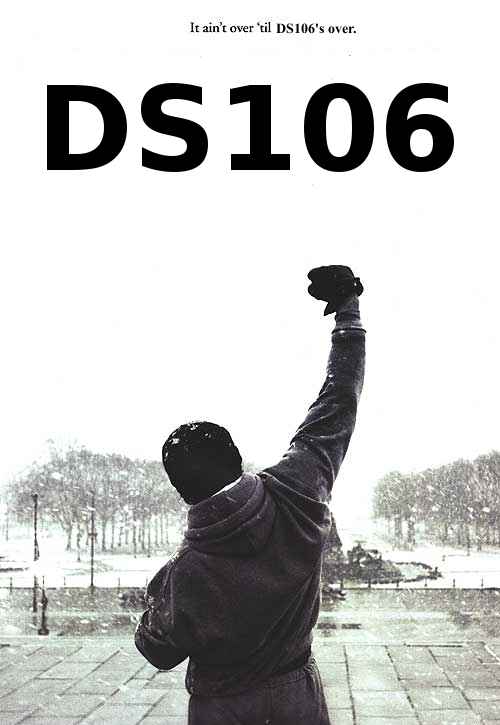
Image Credit: RI12211 “ds106: The Movie Poster”

I’m happy to report that ds106 has been selected as one of five winners of the Reclaim Open Learning Innovation Contest sponsored by the Digital Media and Learning Hub at UC Irvine and the MIT Media Lab. Alan Levine, Martha Burtis, and I applied at the end of July because the contest description spoke directly to the work we’ve been doing with ds106 over the last three years. Here’s the contest call:

The open learning innovation contest invites innovators whose work embodies the principles of connected learning to submit their stories and experiences for consideration. They might be running online or offline courses, activities, learning programs, study groups, or hybrid classes or out-of-school (extra-institutional) activities having to do with independent learning and volunteer work.

ds106 is a pretty compelling example of a connected learning environment, so it’s pretty cool that the course-turned-commuity got some recognition as well as funding—in the form of a $2000 honorarium. The funding will serve to support the awesome work Martha and Alan have done building the ds106 framework out. We’re hoping over the next year we can take some of the ds106 pieces like the assignment bank, Daily Create, a syndication hub, and  feed reader and provide them as plugins, themes, and/or stand-alone, open source  applications.

This is the larger vision behind Reclaim Your Domain that Audrey Watters, Kin Lane and I started knocking around almost five months ago (a conversation we’re about to return to at Minding the Future next month). For me, this is a sign that the persistence of a vision around syndication, supporting faculty, and empowering students might be paying off. And when I see the awesome thought experiments  of people like Martin Hawksey in the rich tradition of Tony Hirst, I’m sure there is still something great in all this syndication nonsense.

What’s more, the work I’ve been doing with Howard Rheingold developing an open source course environment encourages me all the more. Faculty can take control of their course environments with relative ease even now, but if a community of us got together with some funding to make the process that much more seamless, that would be the culmination of years of work so many of us have labored over. It’s by no means the end of that work, but I strongly beleive making this stuff simple enough that good faculty and students who want to do it can would make a huge push towards reaching critical mass with a framwork that is actually innovative—and moving it all to another level.

This will be my work over the next year or two, and it really starts with OpenVA. I want to see if we can’t get critical mass, some serious funding, and the freedom to bring a bunch of people together and start experimenting with what it might mean to build a framwork that allows faculty and students alike to become their own node and hub on the web at once. It would require robust syndication, an array of API integration, cheap hosting/domains (hello Reclaim Hosting), and a collaborative community that is just as focused on making the framework easy as it is developing faculty in an extra-institutional fervor of “free culture” maniacs. Where can I find such a model?

Anyway, all this is to say I want to believe the recognition that ds106 is getting when it comes to connected learning ecosystems is a harbinger of things to come. I remain optimisitc, in fact I never really lost my faith—I’m stupid like that. And while part of me is sad I won’t be able to attend the awards ceremony on September 26th and 27th, another part is glad. Alan and Martha have been essential to the development of this course, as have scores of others around the world. This award recognizes what all of us have done. ds106 is a multi-headed hydra, much like the web, and it’s important to recognize that one person can’t even begin to adequately represent such a rich, complex community. ds106 is not Jim Groom, and that’s why it’s winning 🙂

Posted in digital storytelling, Uncategorized | Tagged , | 4 Comments

Domain of One’s Own, Digital Liberal Arts, and the Popular Imagination

When I saw UMW’s Faculty and Staff Newsletter (a.k.a Eagle Eye) today, the top story was about the fact that UMW was being featured in Virginia Living magazine’s 2013 Educational Supplement as one of Virginia’s innovative schools. The two things responsible for getting UMW mentioned are Domain of One’s Own and the Information Technology Convergence Center (which is coming online next year).

This is a very cool day for DTLT for a few reasons:

First, while we’ve been referenced by the Chronicle a number of times over the years for various projects, focus on the work we’re doing in Virginia Living (the state’s most popualr lifestyle magazine) suggests we’re crossing over. More than just being seen as a fringe “blog” shop, the work we’re doing is starting to impact the broader identity of UMW. We’re becoming a mecca for innovative technologies when it comes to teaching and learning around the state for the average, not-so-tech-savvy Virginian.

Secondly, it also means the projects we frame and the metaphors we use to make them at once accessible and figuratively rich are resonating more widely. This is so important because the ideas we’re trying to help people conceptualize are not necessarily intuitive. To be successful at this we have to be equal parts marketers, technologists, academics, and thinktank—and we’re all those and more 😉 The work we’re doing is developing amazing faculty, empowering students for the future, and capturing a broader imagination—A-game through-and-through.

Finally, DTLT is helping UMW re-imagine itself in a generative way during a moment that more than a few schools are getting caught in the hype headlights of emerging technologies. We have a culture of high quality faculty across the disciplines experimenting with generative technologies as part and parcel of the work they do. This is not only a testament to our faculty, but it also enables UMW to start laying claim to a unique brand of the digital liberal arts. I think the digital liberal arts is ours to shape and define right now. Let’s make the future we want, rather than accept the future we deserve.

Hmmm, so maybe that’s what you get when you invest in good people over and above mediocre technologies. Interesting…..

Posted in Domain of One's Own | Tagged , , , | 4 Comments

What I’m up to….

Think of this as a placeholder post until I can get around blogging each one of the points below in some detail. We’re already midway through week 2 of the semester and I’m desparately trying to keep my head above water. In the meantime, here’s what:

  • Domain of One’s Own: Not only is it up and running, but it’s as awesome as we thought it would be. The initiative is picking up momentum fast at UMW—and without even pushing the curricular side of things we have had remarkable interest. I already blogged out our group presentation the Sunday before classes started, but Martha has the best play-by-play for week 1.
  • Reclaim Hosting: Tim Owens and I started a forked version of Domain of One’s Own for any interested faculty, student, course, department or instituion called Reclaim Hosting. This project blowing up quick. In the last two days alone we’ve had almost 100 sign-ups! Projects by Dave Parry at St Joseph’s, Quinn Warnick at Virginia TechMark Sample at Davidson College, John Maxwell at SFU, and Michael Branson Smith at CUNY’s York College are driving most of the sign-ups as of now. We also have faculty experimenters Howard Rheingold and Nada Dabbagh who are designing their courses in the open! Tim setup a pretty sslick Discourse forum for Howard’s course that has me experiencing some forum envy. What’s remains awesome for me about Reclaim is we’re immediately turning around what we’ve learned from the Domains project for anyone interested in experimenting for next to nothing. Sharing at its best. Also, Tim has figured out how to give a Quinn Warnick control over his students cPanels, and abstracted level of management for faculty to support thier students learning this stuff—I love this whole thing.
  • The Ryan Brazell Experiment: Possibly the greatest thing about my day-to-day life right now is Ryan Brazell. At UMW for just six weeks, he has already been working with more than a dozen professors, doing class visits, imagining Domain of One’s Own, and much more. I would like to take credit, but fact is he is just damn good. Ryan is reminding us all in DTLT how good it is to be at full capacity and have someone on the ground, doing amazing stuff with faculty, and reconnecting us to our core mission: faculty outreach and development. I pretended to mentor him for the first week of classes, but I have officially been depracted to “eye candy,” and the master has stepped in and taken control of the situation. This is all very goood, despite my portestations.
  • The OpenVA and Minding the Future Conferneces: As I mentioned previously, last month UMW’s President, Rick Hurley, asked me if we might be able to build on the momentum of OpenVA to frame some of the national questions of the future of higher education for an audience of university presidents, business folks, etc. This quickly turned into a free, open conference that anyone can attend the day before OpenVA (October 14th) that will feature some pretty awesome folks. And that’s just the prelude to the mian event: OpenVA. I really am blown away by how things aligned with these two events, both of which I think look awesome. That said, I’ve been OpenVA conference boy for almost two years now, I’m ready for this one to happen. I want some of my day back!
  • The Virginia Technology Incubator: This one is also pretty crazy, and is born directly out of the work on OpenVA. I blogged the very long version of all this here, so what follows is the short version. DTLT (with the help of Paul Stacey, Grant Potter,  and Brian Lamb) has helped author a proposal with SCHEV to introduce a state-wide, virtual Technology incubator that will focus on a specific theme for one year and bring faculty, students, and topic experts together to hack at that topic. I’m not sure if this will amount to anything, it still has to get approved by SCHEV and then approvd by the Virginia legislature but if I it falls flat, it’s still been a remarkably eye-opening lesson to learnjsut  how hungry folks are for good ideas when it comes to what we do. If you get a chance, consider working on a state/province-wide committee, I’ve found the experience pretty rewarding thus far.
  • The Mario Bava Film Festival: This ten-week Mario Bava film festival consisting of Paul Bond and me talking about ten of Mario Bava’s films started back in March is still going. We had a few unplanned schedule changes, but it is remarkable to me we are actually still going. We wrap up with Rabid Dogs this week, and I wouldn;t be surprised if we do another ten Bava fims. This is just pure fun, and there is no pressure cause it’s just Paul and I doing this stuff cause a) we love it, and b) we consider it experimenting for our distributed course True Crime (see next bullet 😉 )
  • True Crime Freshman Seminar: Paul Bond and I are co-teaching a Freshman seminar at UMW that chronicles 300 years of True Crime using a variety of texts across numerous media. We are using Domain of One’s Own (which all but one student had up and running in two days) and the students are an excitable bunch. We talked about the colonial execution narratives in yesterday’s class, and the group is getting the hang of the blog. I spent sometime this evening build a Dynamic Course Calendar that I am imagining might capture all the prep notes for each class on a wiki. Reason being, starting next week groups of three students will lead the class discussions each week until week six when we actually create the first of three TV episodes on True Crime. This is one of the most ambitious class projects I’ve been a part of yet, and we’re shooting for three half-hour TV episodes produced collectively by  the end of the class. We’ll see how this goes, and I plan on blogging about this far more extensively very soon.

  • Reclaim Your Domain: A fringe benefit of having folks like David Wiley, Jon Udell, Audrey Watters, Kin Lane, and Alan Levine in Fredericksburg for a weekend is that we can work on the Reclaim Your Domain project that got a started up at MIT last April. The idea is to get these folks in a room for a few hours over two days and see if we can’t build on the beginnings of a loose, open source architecture for syndicating, archiving and managing one’s distributed/fragmented work on the web. Obviously, this aligns with the early work Tim and I are doing with Reclaim Hosting, which is really  the beginning of a larger movement to imagine what a  syndication-orientated framework that’s actually funded (hopefully as a Shuttleworth Fellowship project) might look like. It’s a long time coming,  and also quite exciting to think many of the issues we have been dealing with in the field over the last decade (eduglu anyone?) might actually result in something tangible that makes this stuff a bit more accessible for faculty and studetns alike. Isn’t it hightime we finally had a few awesome thinkers in this realm together imagining some of this?

There’s more, but I am gonna stop here because it is way past my bed time, and I already feel better knowing I got even a little about each of these out—but I have much more to say about all of them. Anon.

Posted in Uncategorized | 3 Comments

The Domain is Right

189mThis past week UMW’s Division of Teaching and Learnign Technologies rolled out what’s most certainly our most ambitious project yet: Domain of One’s Own. I’ve written a lot about this project over the last year or so, and it’s surreal to think it’s up and running. Domain of One’s Own provides any interested Freshman at UMW with his or her own domain and web hosting to start taking control of their identity on the web. The first week didn’t come without it’s highs and lows, and Martha Burtis’s awesomely comprehensive post recaps what’s transpired thus far. While we dreamed 1000 Freshman would sign-up day one, at the same time we knew it was gonna take a lot of work to make this fly. We’ve been through this all before with projects like UMW Blogs and ds06, great things need to grow organically as part of a community. And that’s what we have to focus on this year, and I have no doubt it will be a resounding success because Domain of One’s Own is pure and good and RIGHT.

Which reminds me, last Sunday DTLT did a half-hour presentation for all Freshman in which we introduced and officially rolled out Domain of One’s Own. It was an update of a legendary group presentation we did  back in 2007, and it features everything from a terribly bad video presentation by Martha to a trailer for Bagman comes to UMW (more on this genius below) to an overview of the actual project to the capstone finale: “The Domain is Right” —a gameshow in which students are invited on stage to strut their knowledge of all things web. [For the record, Andy Rush wore his Tuxedo, need I say more?] This was a total blast, and it’s yet another  testament that with the addition of Tim Owens and Ryan Brazell DTLT is as kickass as we have ever been. When you can put together a presentation like this as quickly and easily as we did, the proof is in the pudding. Oh yeah, and then there’s the whole Domain of One’s Own infrastructure Tim Owens nailed last Spring—genius!

As part of the documentation and the more generalized narrative of Domain of One’s Own DTLT has adopted a mascot of sorts: Bagman! While we were out at lunch a week or two before classes started, Martha got the idea that we should have the character Bagman be a Freshman coming to UMW, and work with him to go through all the steps of Domain of One’s own: namely signing-up, choosing a domain, installing applications, etc. The great Brian Ralph Short—who has a million and one other things going on—was unbelievably gracious and agreed to hep us out.  Lo and behold, we have the beginnings of a whole transmedia campaign for Domain of One’s Own starring ds106’s very own Bagman (I love it when world’s collide). Check out the trailer as well as the first three videos below (you can follow the ongoing series here).

The Trailer for “Bagman Goes to UMW”

Bagman’s Introduction to a Domain of One’s Own

Bagman Chooses a Domain Name

Bagman Signs-up for a Domain of One’s Own

UMW is the college upon the hill, and we will shine a light for the heathens and unbelievers! Domain of One’s own is #4life!

Posted in Domain of One's Own | Tagged , , , , , , , , | 5 Comments

bavatuesdays: Twitch fo the Death Nerve

“As flies to wanton boys are we to the gods;
They kill us for their sport.” – King Lear

This week’s film for the Mario Bava film fest was  the 1971  Twitch of the Death Nerve (a.k.a. Reazione a catena, Carnage, Last House on the Left 2, Bay of Blood, and a dozen other titles). This is arguably Mario Bava’s most influential film, often cited as the prototype for the 1980s slasher/body count film like the Friday the 13th franchise. You can see this influence on the slasher genre right down to the settings and increasingly ridiculous murders, Friday the 13th Part 2 quotes at least two of the stylized murders from this film shot-for-shot, namely the billhook to the face of an unassuming manboy and the skewering  of a young couple making love with a spear.

In many ways the thirteen stylized murders are the sport of this film. Story has it Bava and Laura Betti, who worked together previously on Blood and Black Lace (1964)—arguably Bava’s first body count film, were looking for an excuse to work together again and came up with a ludicrous script that was the genesis of this film. Bava, as usual, had next to no budget and shot this on an insanely tight schedule at the producer’s lake house. The plot is easily the most convoluted and absurd of all of Bava’s films , and that’s saying somthing given plots are not his specialty. That said, more than a few Italian film luminaries worked on this film: the aforementioned Laura Betti, special effects legend Carlo Rimbaldi (best know for designing E.T.), b-movie Italian horror movie scriptwriter [Dardano Sacchetti]], and b-movie actor Luigi Pistilli—one of my personal favorites.

But returning to my poit about the stylized murder as the sport of this film, it seems Bava was having fun with Twitch with no real concern for the plot. He seemed to be truly making sport of hyperobolic murder scenes in this one. And unlike Tim Lucas who argues that the gore holds up as realistic in this film, it seems to me far more ridiculous and  over-the-top than any of Dario Argento’s skin slashing gore fests. For me, the quote from King Lear above seems to summarize Bava’s approach in this film. It’s as if he’s a twisted boy treating actors like flies, and the body count is a kind of playful torture of the audience. All of which comes into sharp focus with the shot of the Entomologist’s impaled beetle.

Paul Bond’s GIF from Twitch of the Death Nerve

But the idea of playful torture is important here, because I think every murder is more like a wink and a joke than a shot at one’s sense of decency. As Paul Bondnotes in the video, the above GIF scene with the anguished insect kept Bava up all night, wracked with guilt. [As an aside, if you want a nice reading of intertextual guilt in this film, check out Paul’s post on this one.]

Beyond that, the Twitch continues to play on both the generational tension and youth culture revolution themes we’ve seem recur in his late 60s films like Kill, Baby, Kill (1966) and Danger:Diabolik (1968). Despite the fact the plot is a mess, the ending of this film is still a total shocker, and is one of my favorite endings of any film ever. [Spoiler alert!] After the distributed murders seem to be finished—another interesting note about this film is there are numerous murderes working against one another, not one pyschotic slasher—the final depicts the murderous couple who seem to have emerged victorious from the carnage only to be shot dead by their young children with a shotgun. Again, I can’t help read this as Bava’s utter disdain for the hippie movement (one of the children is wearing a tiedye t-shirt) and its presumed innocence and purity ignoring the deep generational violence thye remain part and parcel of. [I also linked this to the failure of the Baby Boomers more generally and the rise of the adjunct nation in higher ed more specifically in the video 🙂 ] The ending of the film has the children noting how their parents “play dead good” and running down to the lake to frolic on the beach. An idyllic scene that seems irreconcilable with the blood bath that has led up to it—which in many ways are the two narratives of the 1960s in the U.S. at least. 

Posted in bavatuesdays | Tagged , , , , , , , , , | 2 Comments