Crimes of Terror: Piracy and Slave Revolts

Over the last two weeks the True Crime seminar Paul Bond and I are co-teaching has started to catch its groove. As of last week groups of three students have been tasked with introducing the readings, running the class discussion, and generally managing the tenor of the seminar for the week. A new group takes over each week, and they’re responsible for some basic research on the topic, time period, and readings. They’re also expected to perform a close reading of the texts in order to run the seminar discussion, as well as prepare questions and arguments about the work to help galvanize discussion.

I’ve never ran a course like this before so consiously, but at of the end of week four it’s really starting to work. The students are rising to the challenge, and I think they’re beginning to realize the importance of background research, close readings, and focused questions. What’s more, they’re taking ownership of where the discussion goes and how it gets there. Paul and I jump in and re-direct the conversation as needed, but more and more the responsibility rests on their shoulders. Some of this is in response to the Hardboiled seminar we taught last Fall. During that class I tended to dominate the conversation, feed the group my readings, and take center stage most of the time. While I freely admit it’s my incination to do this, I know it has its real limitations as an approach to a seminar.  So we changed it up, and I owe much of the organization and thinking behind this structure to Paul. I’m finding this new model has helped muzzle me a bit. And while I still probably talk more than I should, it’s definitely much better than it might have been otherwise. Most of the students are participating regularly, there’s active discussion, and we’re all getting comfortable with discussing a wide range of topics.
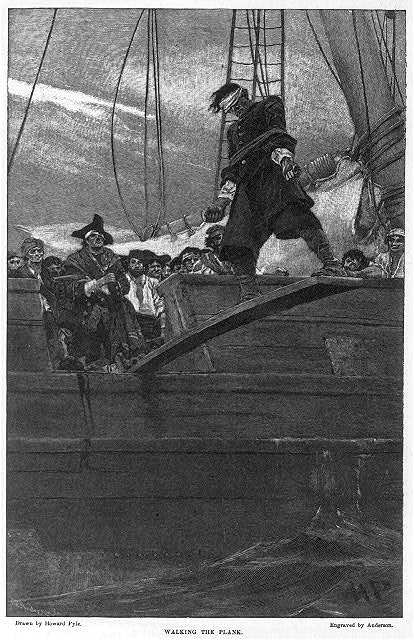
One of the topcis that came up both this week and last that I find particularly interesting is the idea of terrorism and crime in the 18th and 19th centuries. In particular, last week we started talking about the narrative of William Fly, a sailor who in 1726 mutinied and killed his captain, commandeered the vessel, and raised the Jolly Roger. Fly was eventually caught, convicted of murder, and sentenced to hang—as was the fate of most pirates. But, what’s so compelling about Fly’s execution narrative, The Vial Poured out on the Sea written by Cotton Mather, is that unlike all of the others up to this point we’ve read, Fly refuses to play along with Mather’s game of obedience that enshrines the power of the elite and ignores their abuses of the poor. Rather than repenting with his last words, Fly scoffed at Mather in the narrative and warned:

Our Captain and his Mate used us Barbarously. We poor Men can’t have Justice done us. There is nothing said to our Commanders, let them never so much abuse us, and use us like Dogs….all Masters of Vessels might take Warning of the Fate of the Captain that he had murder’d, and to pay Sailors their Wages when due.

This struggle between Mather and Fly over the narrative being told is one that can be broken down between that of powerful, establishment Mather versus the poor, disempowered Fly. Marcus Rediker in his 2004 book on pirates Villians of All Nations argues that what we have at work between the minsiter and the pirate are two distinct kinds of terrors, the hanging of the poor man Fly to protect property, reinforce obedience and instill fear was a terror practiced by the power elite to reinforce their privilege. A second form of terror is that practiced by Fly and his ilk that worked in similar ways by using  violence to terrorize sailors, obtain booty, and seek vengeance on those they considered enemies. Pirates often opted for a different social order than that of Mather, but they nonetheless used terror to accomplish it. In so many ways the summary execution of scores of pirates in North American, the Carribean and Africa from 1715 through 1726 demonstrates how the war on terror in the Atlantic played out during the Golden Age of Piracy.

What I like about Rediker’s frame for the hostile face-off between Fly and Mather is how he uses the idea of terror to illustrate these two social positons in the first chapter of his book. In turn, it gives a bit richer and more complex way to conceptualize the pirate and piracy. Going “on the account” was one way to avoid certain abuses rampant for the average sailor (or laborer more generally) in the colonies. The relationship between those who try and resist the power structure and those who enforce it starts to provide some rather striking examples of the idea of power as a social construction and relation that we read about in Foucualt last week.
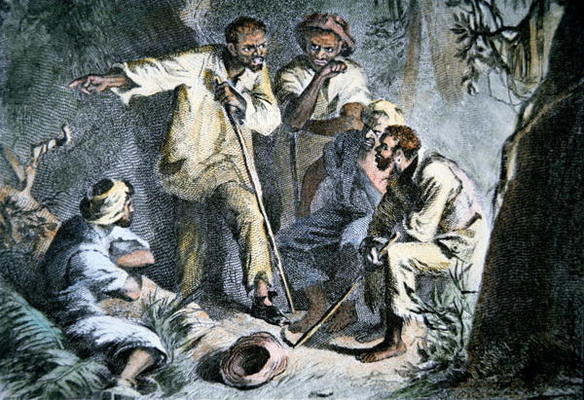
Nat Turner praches religion

All of which seemed to be an important prelude to our discussion this evening about the 1831 narrative The Confessions of Nat Turner. More than a century after Fly’s narrative and a revolution for national independence later, the question of terrorism and slavery re-emerge. In class tonight, one student tried comparing Turner’s insurrection to the 2007 shootings at Virginia Tech, a number of other students resisted this and alternatively suggested Turner’s rebellion was more like the terrorist attacks on 9/11.  Hmmm, where to go from here? How do we understand what Turner did? How is this terrorism? What are the various vantage points? Turner ruthlessly killed men, women and children, 55 in all, why? What was his motive? How does his existence within a peculiar insitution premised upon control, terror, and violence shape this reality?

The conversation was interesting, and I think as a class we’re starting to break free of some of the assumptions that these texts reflect some kind of unbiased truth or reality. Every text is a reflection of a moment’s fears, desires, and concerns and it needs to be read accordingly—keeping in mind our own. Turner’s confessions reflect just how traumitized an entire nation was by the impact of an insurrection of almost 70 slaves ruthlessly murdering men, women , and children. A terrible recognition of the contradictions of freedom, democracy, and slavery coming home to roost. But what was probabaly most powerful about tonight’s class is the final seven minute produced film called Possession in which the contradictions, humanity, and barbarity of this peculiar institution come into sharp focus.


Posted in True Crime | Tagged , , , , , | Leave a comment

(Assignment) Banking a ds106 Thank You

Jim,

I have to thank you (and your cohorts) for the awesome ds106 assignment bank.

http://assignments.ds106.us

My digital media students and I have been using it as an absolutely vital resource since the beginning and it continues to delight and amaze.

Thanks for building and maintaining a terrific learning/teaching tool. I love it!

Barbara-Sawhill-repost-642x250Yesterday I got the above email from one of my WordPress plugin writing heroes who will have to remain anonymous for now because I was too impatient to wait to get permission to name him 😉 It’s really cool to see how an idea dreamed up by Tom Woodward became a working model built by Martha Burtis and is now abstracted as a theme for WordPress coded by Alan Levine that soon anyone can download for free.

The assignment bank is, for me, probably the most impressively participatory element of ds106—and I think it can easily be re-imagined for a wide range of applications beyond digital storytelling. Mike Caulfield is doing just that with his innovative, cross-instituitonal experiment Water106.

It’s nice to think there’s a school out there somewhere that may not necessarily be part of the community, but is  having fun with the assignment bank—that’s the whole idea! And it’s even cooler to think such a model could propagate at a thousand different schools populated by hundreds of thousands of students with millions of assignments 🙂 The web contains multitudes, which is distinct from massive in some important ways.

Posted in digital storytelling | Tagged , , , | 1 Comment

Decentering Syndication or, a Push Away from RSS

Yesterday Steve Covello tweeted a post at wpmu.org my way.

I was prepared  to read about a premium suite of plugins that I could buy for the privilege, but was pleasantly surprised to find Chris Knowles’s post “How to Publish to Multiple WordPress Sites from a Single Install” to be a thoughtful, clear, and  beautifully documented articulation of how the spoke/hub model for pushing content from one site out to another works more generally in Content Management Systems, but for the purposes of his example in WordPress in particular.

452_oseAt first I was interested in this post to start showing faculty and students alike how they can use their WordPress sites to push content out to a number of different social media services like Facebook, Twitter, Tumblr, etc., but still keep their own version of everything they publish. That, for example, is one relatively simple and powerful reason to use such a spoke and hub model, you are the hub that pushes content out to the various spaces around the web you want it to appear.

But as we got talking in DTLT about this model at 9:30 this morning, it started to get much more interesting. In particular, the plugin that is pushing ones posts, images, videos, etc. in WordPress to all these different sites (what I’ll affectionately called “the pusher”) is Push Syndication  Syndicate out [Update: Tim and Martha tried Push Syndication but couldn;t get it to work so went with a similar plugin Syndicate Out]. One way to think about this plugin is it is does the absolute opposite thing then FeedWordPress, rather then pulling RSS feeds in, it uses XML-RPC to  push content out. So, as Marx did to Hegel, DTLT is doing to distributed course blogs—we’re standing syndication on its head 🙂 Rather than insisting on making the course the hub as has been the case with ds106 (and scores of courses sites on UMW Blogs over the years), why not decentralize the syndication and allow each of the sites to push their content to the hub. Same effect, jut a different approach.

But why? What are the benefits? 1)  it is techncially inline with the ethos of giving the students more control over their work; they can control the syndication in this regard because “the pusher” plugin is installed on their blog. 2) It is far simpler than FeedWordPress for faculty to get up and running with—you don’t have to ask faculty to load in tens of feed URLs for the syndication engine to work. 3) It’s immediate, with XML-RPC, there is no wait for the post to show up. Publishing on the course hub is immediate. 4) It allows for both students and faculty alike to become a hub or a spoke. When I was at the Reclaim Open hackathon at the MIT Media Lab in April Kin Lane was conceptualizing the Reclaim Your Domain around this idea. 5) Less load on the server CPU pulling 100s feeds as weas the case in ds106, in this model you decenter that to a distributd push. 6) The whole process can be automated to some great degree on both the Reclaim Hosting and the Domain of One’s Own server thanks to Installatron. Tim Owens did a mock-up of what this might look like for students and faculty alike.

mock-up_the_pusher.png-large


When going through the process of installing a WordPress site in Installatron (pictured above), we can actually build in a dropdown list of courses that you want to publish to from your own site. Martha Burtis, who has been working on the idea of packaging WordPress plugins suites  in Installatron already, is seeing if we can’t get the Syndicate Out plugin to not only get automatically installed and activiated on the student (or spoke) blog, but also identify the hub it will be publishing to based on the dropdown selction. If a student or faculty member choses to create a course on the fly by selecting that option and then naming it accordingly, it will immediately populate in the dropdown along with  a unique identifier. Instantaneously it will allow others to subscribe to it seamlessly. All of this with no mention of RSS! EDUGLU heresy, and I love it!

Thinking out loud here, what Howard Rheingold labored through for his Social Media Issues site, which admittedly is awesome, could be accomplished at the server level with next to no overhead. This is the in-a-box that we actually need to make synidcation course practical in highered. It is a bit hazy here for me (as much of it is right now), but I  think we can manage copy all the login information from the student blogs into the hub at the level of Installatron by grabbing their username and password and copying them to the hub database.  In other words, every student and faculty in such an environment becomes a spoke and/or hub, the idea of the motherblog becomes deprecated  and we start to move toward a more decentered approach wherein each learner can control what syndicates where.

And this is just the beginning, this model would also allow students with a Domain of One’s Own blog at UMW to use the Syndicate Out plugin to seamlessly send their posts out to any UMW Blogs blog they’re an author of. We tried it out today, and it’s absolutely seamless. You can see the spoke post here and the hub republishing on jimgroom.umwblogs.org here. So cool.

We still have a lot to figure out with all this, but as we were talking about it today we started recognizing the fact that Domain of One’s Own has already given way to Reclaim Hosting, Installatron plugins and theme packages, and now a whole new way of approaching spoke/hub syndication models for courses. And I firmly believe this is just the beginning of a whole new level of re-conceptualization, experimentation, and innovation—we’re just now realizing that Domain of One’s Own is more than just giving everyone a domain, WordPress blog, portfolio site, etc.— it’s quickly beginning to feel like a  paradigm shift for what’s possible when it comes to digital publishing at UMW and beyond. It’s actually kinda hard to explain just how exciting it is to go to work these days—my head is constantly buzzing, it’s almost hard to think, no less concentrate, on anything else. DTLT is in the zone right now….

Posted in Domain of One's Own, reclaimopen, umw, UMW Blogs, Uncategorized | Tagged , , , , , , | 16 Comments

An Invitation to a Hanging

Literally!

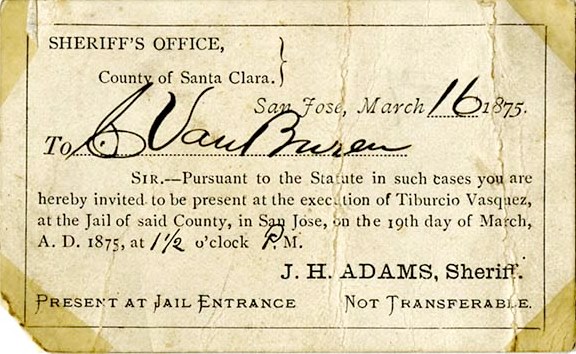
Image of an Invitation to attend the execution of Tiburcio Vasquez

Invitation to attend the execution of Tiburcio Vasquez

We have been talking extensively about public execution narratives in the True Crime I am teaching, which made this scanned invitation to the 1875 hanging of California bandit Tiburcio Vasquez pretty freaking timely and awesome. Thank you, Tom Woodward!

I couldn’t help but search for details about the condemned, and what I found is quite fascinating. According to ExecutedToday.com (I love that site title!), Tiburcio Vasquez was…

Born to a respectable family (his grandfather was the first mayor of San Jose) when the land was under Mexican control, Vasquez was among the many chagrined to find themselves demoted to second-class citizenry by the norteamericano conquest of the Mexican-American War.

That occurred when Vasquez was in his early teens, and soon thereafter the young man was plying California’s ill-policed byways with the whole litany of depredations characteristic of the frontier outlaw: livestock rustling, highway robbing, shopkeep stickups.*

One of the latter furnished the proximate cause of his death and probably the most infamous single incident among his exploits: an armed robbery in Tres Pinos** that resulted in three shooting deaths and a serious manhunt.

For Vasquez, the end of the rope (last word: “Pronto”) was just the last act of a legendary career, of poetry and horsemanship and countless enchanted inamoratas. He was renowned in his own time, and has graduated since into a mythical, and potently symbolic, figure of the other peoples of the Golden West.

Despite the fact ExecutedToday.com has a different date and year for the exuction than the California Historical Society—the  former has  March 19th, 1879 whereas the latter has  March 16th, 1875—I like that they reference the Mexican-American War in imperialist terms, and immediately frame Vazquez as a victim of a hostile landgrab by the U.S. government as part and parcel of the manifest destiny of US expansion during the 19th century. This is a whole rich and complex area of US history, crime, and legend that I didn’t integrate into the course, but could and should have—there is always tomorrow!

It reminds me of another California bandit with a very similar legendary status: Joaquin Murrieta.  His tale follows a narratie akin to that of The Outlaw Josey Wales. He ends up seeking revenge on the landgrabbing white power structure for robbing him of his stake, raping his wife, and lynching his half-brother. He goes on a rampage that has now gained legendary status, and the authorities even had a traveling exhibit of his severed head in 1853 to punctuate his death. From the Wikipedia article:

He and his band attacked settlers and wagon trains in California. The gang is believed to have killed up to 28 Chinese and 13 White-Americans.[3] By 1853, the California state legislature considered Murrieta enough of a criminal to list him as one of the so-called “Five Joaquins” on a bill passed in May 1853. The legislature authorized hiring for three months a company of 20 California Rangers, veterans of the Mexican-American War, to hunt down “Joaquin Botellier, Joaquin Carrillo, Joaquin Muriata [sic], Joaquin Ocomorenia, and Joaquin Valenzuela,” and their banded associates. On May 11, 1853, the governorJohn Bigler signed an act to create the “California State Rangers“, to be led by Captain Harry Love (a former Texas Ranger and Mexican War veteran).

The state paid the California Rangers $150 a month, and promised them a $1,000 governor’s reward if they captured the wanted men. On July 25, 1853, a group of Rangers encountered a band of armed Mexican men near Arroyo de Cantua near the Coast Range Mountains on the Tulare plains. In the confrontation, three of the Mexicans were killed. They claimed one was Murrieta, and another Manuel Garcia, also known as Three-Fingered Jack, one of his most notorious associates. Two others were captured.[4] A plaque (California Historical Landmark #344) near the intersection of State Routes 33 and 198 now marks the approximate site of the incident.

As proof of the outlaws’ deaths, the Rangers cut off Three-Fingered Jack’s hand and the alleged Murrieta’s head and preserved them in a jar of alcohol to bring to the authorities for their reward.[2] Officials displayed the jar in Mariposa CountyStockton, and San Francisco. The Rangers took the display throughout California; spectators could pay $1 to see the relics. Seventeen people, including a Catholic priest, signed affidavits identifying the head as Murrieta’s, alias Carrillo.

I actually read the John Rollin Ridge dime novel The Life and Adventures of Joaquin Murieta for a course during graduate school. An interesting fact about that text is that while the work is fiction, many have mistook it for a factual account—even a few historians. That line between histry, fact, and fiction would be an interesting one to examine in regards to true crime, as would larger themes such a text might raise such as violence and the West, Borderland fiction, national identities, race, ethnicity, and American imperialism.

Update: Forgot to mention that there was some uproar in Califronia earlier this year over a public school named after  Tiburcio Vasquez. Writing the history of the present, indeed.

Posted in True Crime | Tagged , , , , , | 4 Comments

Benjamin Franklin a Serial Killer?

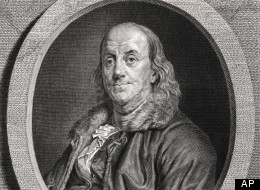
While looking up information regard Benjamin Franklin’s short newspaper article from 1734 titled “The Death of a Daughter” I found this bit of sensationalism—or is it?—on the Huffington Post:

Dead Letters

Was Benjamin Franklin secretly a serial killer? Historians say this is unlikely.

While working on the renovation of Benjamin Franklin’s London home, a construction worker found something odd: a small pit in a windowless basement room.

Inside, sticking through the dirt floor, was a human thigh bone.
Ultimately, 1,200 pieces of bone were recovered, and initial examinations revealed that the bones were the remains of 10 bodies, six of them children, and were a little more than 200 years old.

Where’s the CSI: Colonial Crimes Division when you need them?

Posted in True Crime | Tagged , , , , | Leave a comment

Legends of True Crime: Sawney Bean

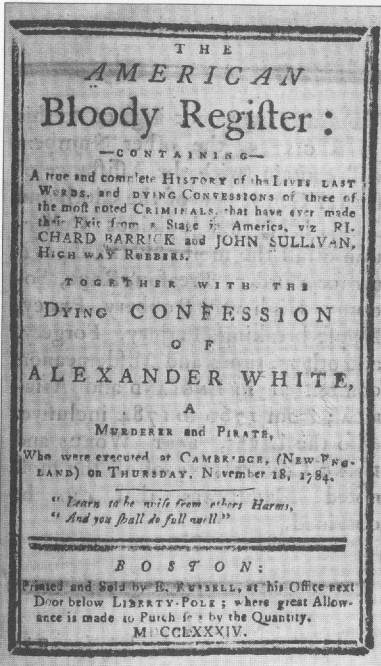
While reading America’s Bloody Register (the subject of my last post for True Crime) one of the things that gives away the shift of crime narratives from moral correctives to popular entertainment are the cliff hanegrs and advertisements. Just as the list of thefts in Richard Barrick’s narrative seem to be coming to a point, the narrative full stops with the following pronouncement:

For the remainder of BARRICK’s Life, which contains a series of heinous crimes perpetrated in Philadelphia, New-York, Harford,New-Haven, in Boston Market, at the vendues and on Winter-Hill) we must refer our Readers to the Second Number of our REGISTER, we we shall publish immediately. In the same Number we intend to publish remarkable conversion of….

In other words a cliffhanger that keeps you wanting more, and as a result will ask you to pay more to get it. One of the things that struck me in the “Second Number” of America’s Bloody Registry is the advertisement for a future issue that there’s no known extant copy of:

THE bloody and cruel History of The KING of ROBBERS and MURDERERS: Being a most surprising and shocking Account of the horrid Massacre of more than Twelve Hundred Men, Women and Children in Twenty-five Years, will be our next.

I couldn’t help but wonder who the hell robbed and murdered more than 1200 people over the course of 25 years? It seemed to me America’s Boody Register was about to jump the shark in just its third issue, and unfortunately we might not ever see what was written on this topic. However, thanks to Daniel E. Williams notes on the subject (you’re all reading his notes, right Truecrimers? -especially those of you presenting…right?) turns out they are referring to the legend of Sawney Bean, a “semi-mythical head of a 48-member clan in 15th- or 16th-century Scotland….reportedly executed for the mass murder and cannibalisation of over 1,000 people.”

What?! Trippy, the rabbit hole has opened! The truth of this narrative is highly questionable, but it reads pretty awesome, here’s the summary of the Newgate Claendar I found after a cursory search and scan of Wikipedia:

According to The Newgate Calendar, Alexander Bean was born in East Lothian during the 1500s.[1] His father was a ditch digger and hedge trimmer, and Bean tried to take up the family trade but quickly realised that he had little taste for honest labour.

He left home with a vicious woman who apparently shared his inclinations. The couple ended up at a coastal cave in Bennane Head between Girvan and Ballantrae where they lived undiscovered for some twenty-five years. The cave was 200 yards deep and during high tide the entrance was blocked by water.

The couple eventually produced eight sons, six daughters, eighteen grandsons and fourteen granddaughters. Various children and grandchildren were products of incest. Lacking the inclination for regular labour, the clan thrived by laying careful ambushes at night to rob and murder individuals or small groups. The bodies were brought back to the cave where they were dismembered and cannibalised. Leftovers were pickled, and discarded body parts would sometimes wash up on nearby beaches.

The body parts and disappearances did not go unnoticed by the local villagers, but the Beans stayed in the caves by day and took their victims at night. The clan was so secretive that the villagers were not aware of the murderers living nearby.

I love the whole cave and incest thing, not to mention the fact that this was all a result of Bean’s deep antipathy for ahonest labor, something the whole clan seemed to genertically inherit. So good.

Posted in True Crime | Tagged , , | 4 Comments

America’s Bloody Register: It’s all about the “Joes”

Screen Shot 2013-09-17 at 10.41.33 AMIn the True Crime seminar last week we discussed Foucault’s Discipline and Punish alongside some of the more sensationalized texts of class and racial others like William Fly (Pyrate), Joseph Mountain (Mulatto/Highwayman), and Thomas Powers (“a Negro”), this week we move more definitively into the early stages of the print-based entertainment industry  emerging around true crime during the Revolutionary War and well into the early 19th century.

America’s Bloody Register is, as Daneil E. Williams notes, North America’s earliest True Crime magazine. As an early crime serial,  it framed its business model pretty squarely on “Murder, Treason, Rape, Sodomy,High-Way Robbery, Piracy, House-Breaking, Perjury, Forgery, and other Crimes and Misdemeanors.” The move from correcting and reforming narratives to a “number of curious and Useful pieces” is well underway—crime narratives as lurid entertainment is in full effect. The shift to a model for exploiting crime as a shocking tale to garner readership is not necessarily new to America’s Bloody Register , it takes its name and  approach from a British serial around the same time called The Bloody Register—you can buy it on Amazon now for $1700!  As Linsday notes, the first two narratives in issue #1 of America’s Bloody Register about the theiving  exploits of Richard Barrick and John Sullivan  are all about the money. It reads like a laundry list of colonial currency taken in from various people in new York and Connecticut. In many ways it reminds me of the list of booty we get when reading Joseph Mountain’s rather boastful account of his conquests as high-way man in England and the colonies.

Screen Shot 2013-09-17 at 10.41.51 AMThis idea alos points to just how diverse and complex the various monies in the colonies was. Anyone know what  “Joes” are in terms of colonial currency? This article on “Money in the Colonies”  by Ron Michener explains the complex landscape of the various currencies in the colonies:

Among the most important of these coins [in the colonies] were the Portuguese Johannes and moidore (more formally, the moeda d’ouro) and the Spanish dollar and pistole. The Johanneses were gold coins, 8 escudos (12,800 reis) in denomination; their name derived from the obverse of the coin, which bore the bust of Johannes V. Minted in Portugal and Brazil they were commonly known in the colonies as “joes.”

This complex currency  of the colonies might also explain why so many of the these crime narratives were focused on counterfieting. Owen Syllavan’s narrative is just one we read , but Daniel E. Williams’s Pillars of Salt anthology includes three more examples of the capital offence of passing bad currency in the narratives of John Jubeart, Herman Rosencrantz, and Joseph Bill-Packer. Interestingly enough, narratives like Bill-Packer’s ad Rosencrantz start to place greed and the love of money as yet another overarching theme in these crime narratives that frames the existing tensions around wealth and class in the colonies. Certain kinds of crime still had everything to do with the haves and have-nots, greed, status, and exploiting weaknesses within a system.

And while I am at it, there’s a couple of more facts about this text I found interesting. It’s all happening within the context of the Revolutionary War, and the fluid movement Barrick and Sullivan on land and water around the Atlantic might point to how certain individuals were using the political upheaval to the moment to their own benefit. Additionally, both of them are Irish, which frames another kind of racial and ethnic villifying that was going on in so many of these narratives, and can be paralleled to racial-porfiling of African-Americans emerging in the accoutns of Mountain and Powers. The other interesting things, at least for me, is how much more mobility and freedom these theives seemed to have as a result of the limits of a communication infrastructure at the time. The majr technological innovations of this time were predominatly maritime, and this shows in the ways so many of these narratives focus on the Atlantic as a source of escape, freedom, and possibility, particularly African-Americans before the Revolutionary war—but more on that in another post.

Posted in True Crime, Uncategorized | Tagged , , , , , , | 1 Comment

Mario Bava must have gotten bit by Rabid Dogs

Paul Bond and I were as good as our word, we worked through ten of Mario Bava’s best films for the Bavafest we’ve been doing since March. This post has the tenth and final (for now!) discussion of what might have been Mario Bava’s  bleakest film: Rabid Dogs.  This film never saw the light of day during Bava’s lifetime because of some bad luck Paul outlines in his post. It was released on VHS in 1998 for the first time, but if it had been released in 1974—when it was scheduled to be—it would most certainly have been considered a classic Poliziotteschi (a subgenre of 1970s hyper-violent and gritty street crime films in Italy). What’s more, it resonates within a broader, international exploration of violence in films at the time, two in particular come to mind, namely the class of 1971:  A Clockwork Orange and Straw Dogs.

Rabid Dogs is the title of the rough cut by Mario Bava, which is significanty different—and  better —than the re-edited version by Lamberto Bava released on DVD titled Kidnapped. I would go as far to say Kidnapped is a radically different film than Rabid Dogs, and not only because it includes a series of additional scenes shot after the fact. Kidnapped includes a few scenes that force feed the surpirse ending, while at the same time subverting the real import of final scene in the the rought cut—essentially changing the entire register of the film (but more on that soon). If you havent seen Rabid Dogs, well today is your lucky day, or for as long as the copyright bots allow it. Below is the full version of the 1998 cut on YouTube.

We moved to Google Hangouts for these discussions since the fifth film, but I hate that we had to. I’ve learned a lot about Hangouts as a result, and I still have a deep-seated loathing of them—even though they’re easy and now in HD! Anyway, during this discussion we were playing with broadcasting YouTube videos within the Google Hangout interface, which didn’t work in the end. So at minute 11:25 to 12:25 we are talking abou the credit sequences—which is a frozen screen on this video. I’m trying to re-edit this discussion, but as a reference point we were talking about the differnet credit sequence for Rabid Dogs versus Kidnapped. You can see the Twitch of the Death Nerve-inspired credit sequence for Kidnapped we mention in this conversation below. What’s more, while we are talking about opening credits, the sequence for Kidnapped on Netflix is just a black background with off-white scrolling text. That was also the case for Kill, Baby, Kill! on Netflix—I wonder what’s going on there.

Here are the credits for Rabid Dogs:

Here are the credits for Kidnapped:

We then talked about the intensity of the opening robbery scene, which is one of my favorite scenes from all of Bava’s films. Once again we tried using the YouTube feature in Google Hangouts to no avail, which I admit is probabaly user error. Anyway, there’s more frozen-screen from 18:53-20:41. You can see the sequence we were trying to share by watching the first video immediatey below. I also included the opening sequence from Kidnapped so you can get a sense of some of the difference between the two films:

Rabid Dogs Robbery sequence

Kidnapped Robbery Sequence

We also showed the car garage scene which I’m including below. It’s another hyper-violent scene from this film that really captures the street violence, as well as the idea Paul Bond hits on when talking about bad luck in this film: “Pretty much every character in the film was unlucky to be in the wrong place at the wrong time. ” Thsi couldn’t be more accurate, and the two women in the following scene who find themselves between the cops and the criminals in a parking garage prove a really powerful and deeply effecting example of this.

Car Garage Scene

A scene we mentioned in passing, but didn’t spend too much time is the “piss scene.” A Scene in which two of the criminals/sociopaths force their hostage to piss in front of them. This is probabaly the most overtly psycho-sexually depraved moment in Bava’s film career (and there are a bunch of them), and it reinforces some of the discussions that Bava is trying to push into new territory. Paul talked about Tim Lucas’s suggestion that given this is the most realisitc world Bavaever created on film, it might demonstrate how he really felt about the world. It’s not something you can ever really know, but if it were the case then both the piss scene and the final scene paint a very dark vision of Bava’s sense of the world. And gven the state of violence in Italy during the “Years of Lead,” it might not be all that surprisng.

Speaking of the final scene, the question camee up during our discussion as to whether or not Kidnapped included the final scene wherein the kidnapper opens up the trunk of his car to expose the body of the what we assumed throughout the film was his deathly ill child. [As an aside, I love the whole crime-within-a-crime twist we shockingly learn about at the end of the film.] I went and checked the version of Kidnapped on Netflix and can confirm that it did not have that final shot of the child in the trunk. Leaving that detail out totally changes the film. Seeing the body of the kidnapped child in the trunk—presumably dead— makes the vision of an already dark film, paranoid, and claustrophobic film downright horrific and misanthropic.

But I can’t end on a misanthropic note, because the process of taking the time and energy to have the conversations of the past five motnhs has been generative. When the conversation starts about each film Paul and I have no clear or rehearsed idea of where it’s going. In fact, it’s amazing how much comes out as a result of letting go of a plan, sharing your ideas with someone, and trusting in a sense the ability to conenct around ideas. I love this process cause it peels it all back to a certain amount of simplicity—take time to read/watch/write the things you dig and share that with others. Learn more about the things you love, share them openly, and experiment along the way. That’s kind of what I’ve come to apprecaite about Mario Bava. Over the course of 13 years of films we watched, hee has a presistent vision of platfulnees, experimentation, not taking himself to seriously, and being at one with his b-status. Less is more for Bava, the less he has, often the more spectacular the film. And regardless of resources, he was continually able to push into new territory and create a vision of what’s possible. His work parallels beautifully with what I feel like we are doing at DTLT for my day job, adn it just further reinforces my deep conenction to his work.

I also want to stop and say that Paul continues to be an amazing partner in all these cultural crimes. I hope we can keep the Bava series going with ten more films, but for the moment we simply need to relish that it’s done. But only for the moment!

Posted in bavatuesdays | Tagged , , , , , , | 1 Comment

With Good Reason Radio Coming to OpenVA

I learned this past week that Sarah McConnell of NPR’s With Good Reason radio show will be coming to OpenVA on October 15th. The With Good Reason crew will be interviewing various people throughout the day from around the state as well as taking in the tech carnival, Fred Talks, afternoon presentations, and featured panels. It’s exciting to learn that a  public radio show focused on education is coming to OpenVA. That said, it’s also entirely appropriate given the conference is focused on findings ways to promote the amazing work happening around Virginia’s public institutions of higher education, as well as fostering more robust and lasting statewide collaborations. Bring your radio voices, people!

Posted in openva | Tagged , , , | Leave a comment

Reclaim Open Interview about ds106 with Anya Kamenetz

Yesterday Martha Burtis, Alan Levine, and I sat down virtually with Anya Kamenetz for an interview about ds106. The interview will be the basis of a piece Anya will writing about ds106 as part of the Reclaim Open Innovation contest it was awarded in early September.

It was a fun discussion that covered a lot of ground. I particularly enjoyed when we talked about how having your own domain and web host might actually be important. I found Martha’s discussion of the metaphysical power of naming a space online you control and manage really compelling. I mean is mine, I named it. I brought it into being and have filled it with thoughts for almost eight years now. I’ve isnpired life into a virtual void. This process has been unbelievably important to me as an edtech professional, a writer, and a thinker. The fact that ds106 uses this reality as a departure point for everyone who takes the course is really cool, it’s hard not to fall in love with this class-cum-community again and again.

Posted in digital storytelling | Tagged , , , , , | 6 Comments