ds106: Building a Framework for Assessment

Yesterday morning I presented a session for the e-Assessment Scotland Conference alongside Martha Burtis and Alan Levine titled “ds106: A Framework for Assessment.”  I kind of mapped out a logic for the session (albeit roughly),  but thanks to technical difficulties that prevented us from broadcasting on ds106.tv, we actually resorted to having a conversation about ds106 and assessment in a Google Hangout. And it proved to be a blast—at least for us.

As for the discussion, it meanders. But that’s expected given that ds106 is a multi-headed hydra and there’s really no one way at the idea of assessment given it aspires more towards becoming a community that remaining a class. That said, there are a few realizations we all seemed to agree on after years of teaching it at UMW (and there are probably more I am missing here):

  • The course infrastructure/design is modelled upon the web unlike, ironically,  most techncial infrastructures for teaching and leanring online. As a result, it has developed an open community that encourages and makes possible a form of communal assessment and feedback that is otherwise inconceivable
  • Assessment is not about the quality of the product, but sharing your thinking and approach to what you did. The importance of process as a means of gauging learning in the form of a blog for ds106
  • The willingness to let go, to make possible a “pedagogy of uncertainty” to lead the class/community in directions none of you could have engineered, or even imagined, otherwise
  • It’s a shitload of work

I have to thank Kenji Lamb, the confernece organizer, for being so cool on all counts with my technical screwup, and more generally for putting on  quite a confernce. There were a number of amazing sessions, and many of them can be found at John Johnston‘s EDUtalk, which is currently doubling as a confernece resource site with audio of talks by Catherine Cronin, Helen Keegan, Doug Belshaw, Cristina Costas, and many more. Now that’s how you run an online confernece, make it distributed, freely accessible, and make all the sessions immediately archived and available. Kudos all around!

Posted in presentations | Tagged , , , , , , , , | 4 Comments

Tracking Over Four Years of Traffic on UMW Blogs

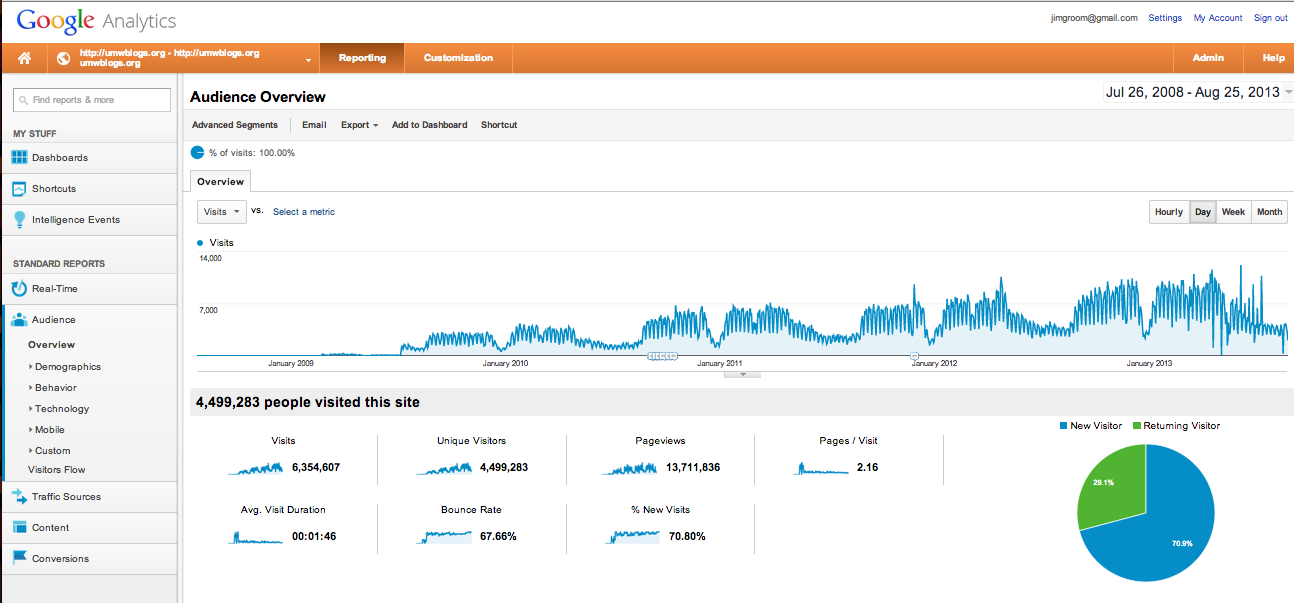
I’m working on presentation about assessment on another front, and as an excuse for a break I decided to post some recent UMW Blogs traffic statistics from the last four years. I know analytics and data is all the rage currently, and these numbers should somehow enable me to better articulate UMW Blogs’ usefulness. Nonetheless, they always seem at once massive and paltry. Massive in that various work produced on UMW Blogs by thousands of students have been viewed 13+ million times over the last four years by milliosn of people. Paltry in that 13 million views is a middling viral YouTube video at best.

Probably like most people in the era of “big data,” I often feel lost in a malaise of statisitcal aggregates—data that ultimately means less than nothing without a context. The only hope I garner from this is that people are finding our work, but not at the aggregate. Seems to me it’s at the ground level—thousands of sites with tens and hundreds of views each, I imagine it far more intimate than these numbers report. In fact, the greater the numbers get each successive year, the further the push towards statisitc ennui. They begin to get squeezed under the load: page visits fall, time on site plummets, and bounce rate increases. There is a story somewhere in all this, but I can’t for the life of me find it in the numbers. That said, I can’t pull my gaze away—a stare at once filled with awe and disdain.

Total Traffic on UMW Blogs from August 2009 – August 2013

Visits 6,354,607 | Unique Visitors 4,499,283 | Pageviews  13,711,836
Pages / Visit 2.16 | Avg. Visit Duration 00:01:46 | Bounce Rate 67.66%
Total UMW Blogs Traffic since 2009

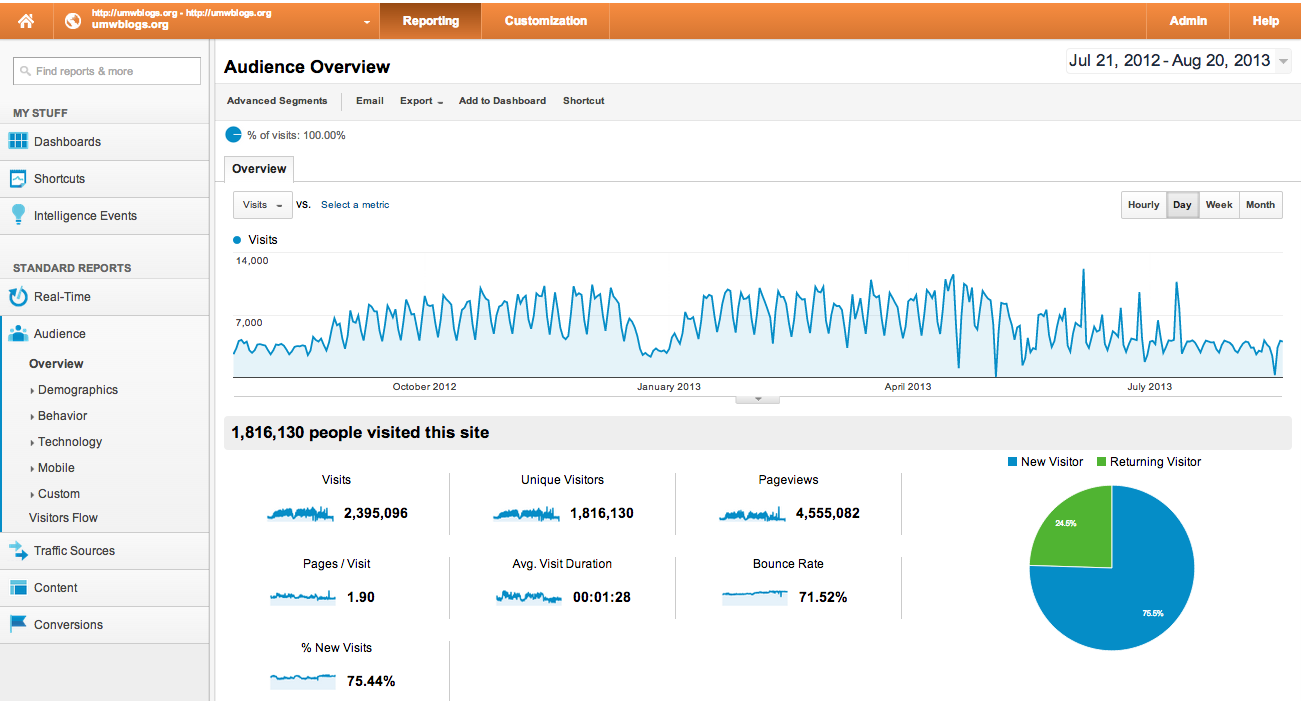
Total Traffic on UMW Blogs from July 2012 – August 2013

Visits 2,395,096 | Unique Visitors 1,816,130 | Pageviews  4,555,082
Pages / Visit 1.90 | Avg. Visit Duration 00:01:28 | Bounce Rate 71.52%
umwblogs_traffic_12_13

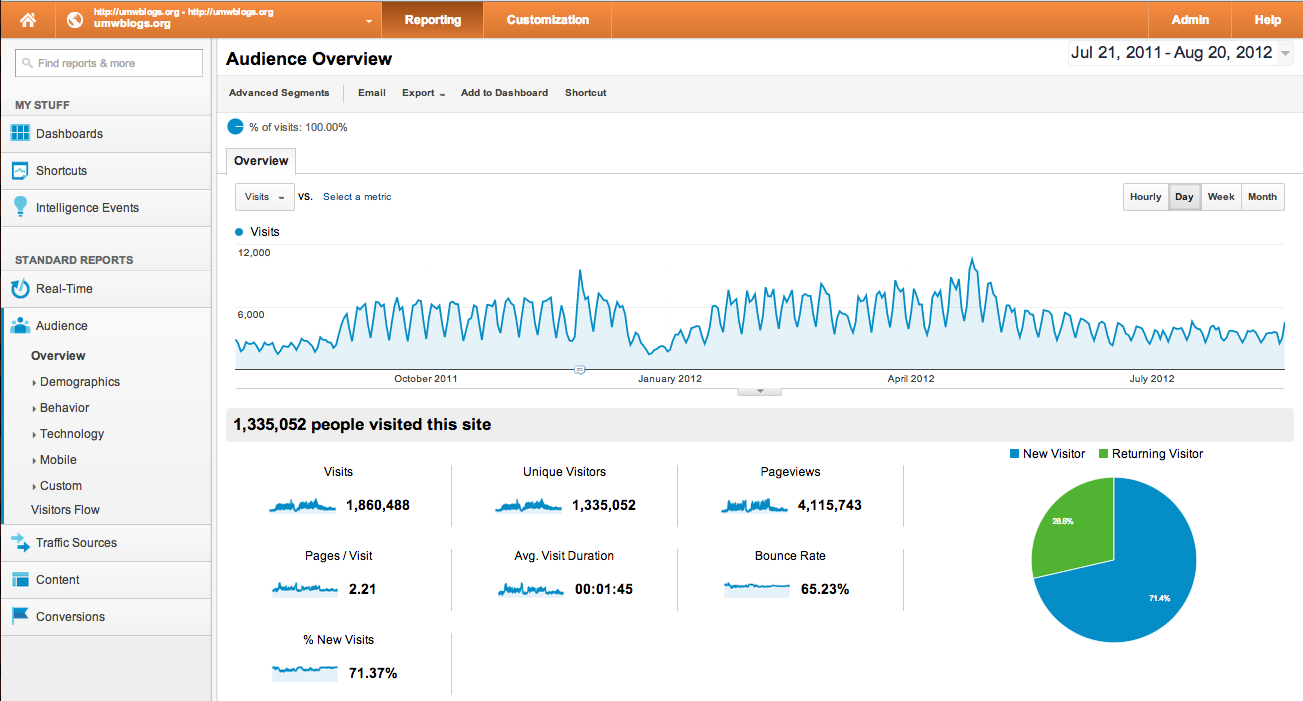
Total Traffic on UMW Blogs from July 2011 – August 2012

Visits 1,860,488 | Unique Visitors 1,335,052 | Pageviews  4,115,743
Pages / Visit 2.21 | Avg. Visit Duration 00:01:45 | Bounce Rate 65.23%
umwblogs_traffic_11_12

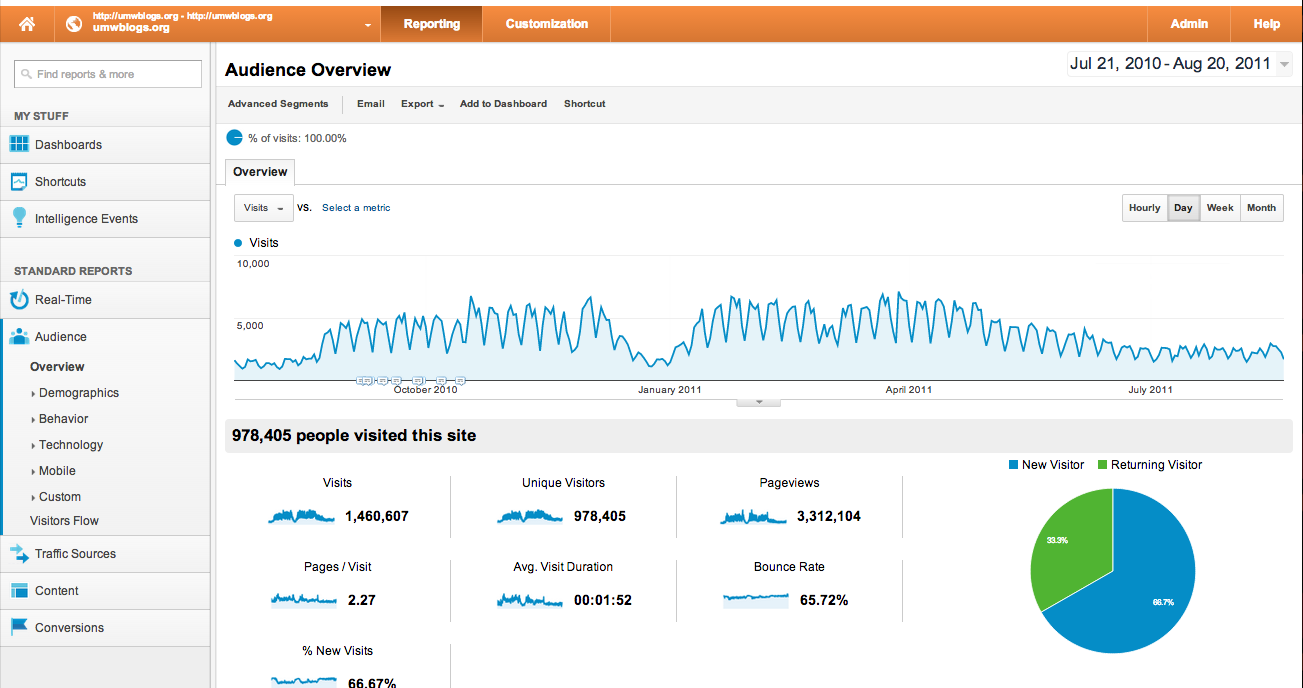
Total Traffic on UMW Blogs from July 201o – August 2011

Visits 1,460,607 | Unique Visitors 978,405 | Pageviews  3,312,104
Pages / Visit 2.27 | Avg. Visit Duration 00:01:52 | Bounce Rate 65.72%
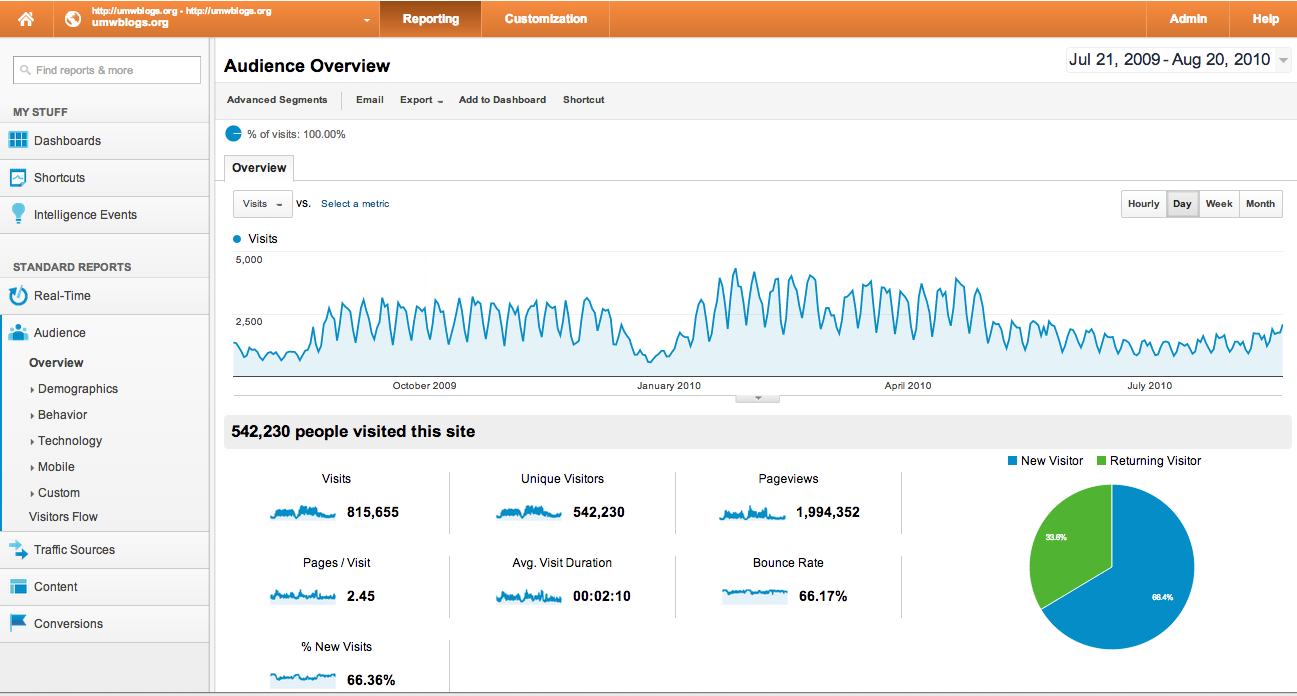
umwblogs_traffic_10_11Total Traffic on UMW Blogs from July 2009 – August 2010

Visits 815,655 | Unique Visitors 542,230 | Pageviews  1,994,352
Pages / Visit 2.45 | Avg. Visit Duration 00:02:10 | Bounce Rate 66.17%
umwblogs_traffic_09_10

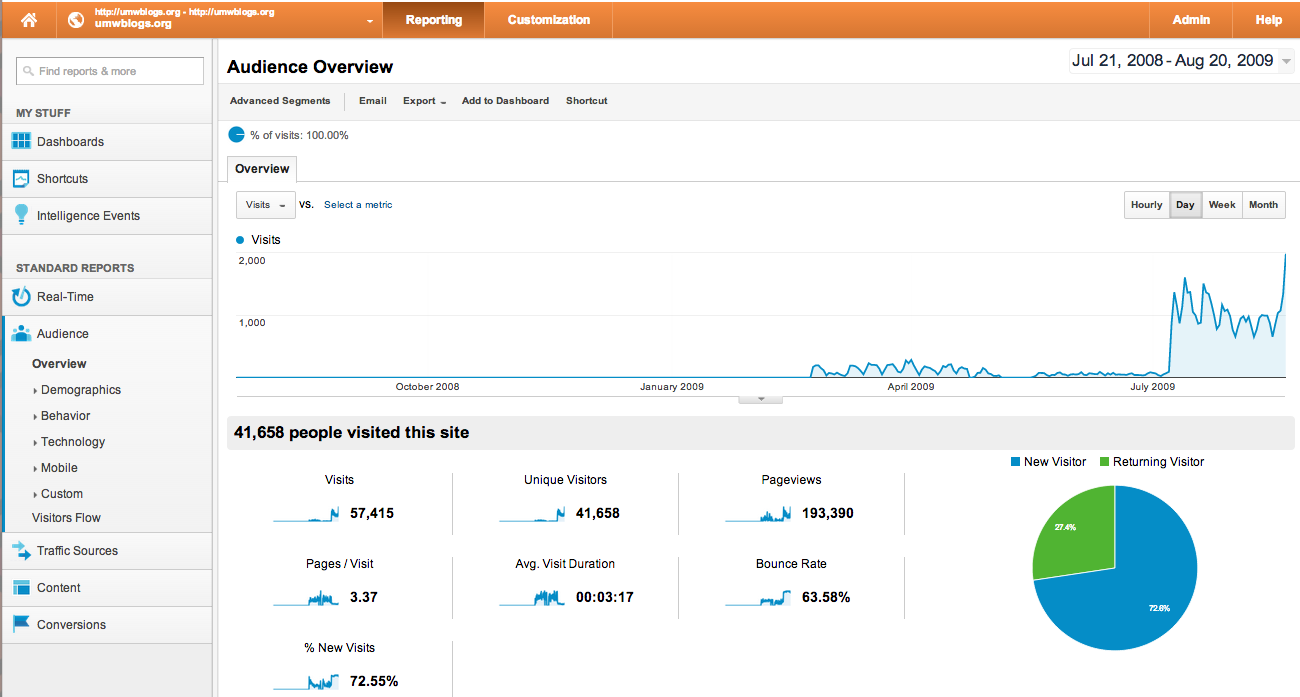
Total Traffic on UMW Blogs from July 2008 – August 2009* 

Visits 57,415| Unique Visitors 41,658 | Pageviews  193,380
Pages / Visit 3.37 | Avg. Visit Duration 00:03:17 | Bounce Rate 63.58%
umwblogs_traffic_08_09

*We started Google Analytics in Summer 2008.

Posted in dtlt, umw, UMW Blogs | Tagged , , , , , | Leave a comment

True Crime: America’s Most Wanted

This semester I have the good fortune of co-teaching a Freshman Seminar on True Crime with Paul Bond, who has been a long time ds106 lifer and blew my mind last Fall as an open, online particpant professor in the Hardboiled course. Paul is an amazing cat: he works as a librarian at the University of Pittsburgh, he has been experimenting with open, online courses for years now, and is amn avid student of all things b-culture (we’ve spent most of the Spring and Summer working through Mario bava’s films). Paul embodies the very best of openly sharing, encouraging, and collaborating with students online, and the work he did with the #emoboilers last Fall was truly amazing. He was a formidable presence both in the class (we brought him in remotely) and on the blogs—his constant feedback and encouragement was a source of inspiration for every student. It’s a real pleasure and honor to be actually stepping-up this relationship and working alongside him to make theTrue Crime seminar rule, and I have no doubt it will as aresult of Paul’s involvement.

But ruling is just another word for taking the time to figure out the course and engineer some real experimentation as part and parcel of the experience. Paul and I have been working on this course on-and-off for a few months, and I’m really happy with what we’ve finally come up with as a syllabus . We’re covering a broad swath of U.S. crime narratives from the Puritans up and until the L.A. gang culture of the 1990s. What’s more, we’re including films, graphic novels, TV, and music—which should add some interesting cultural elements of crime to the experience.

We’ve also thought long and hard about how we can  make the students central to the running of the course. In that regard, over the course of the sixteen week semester we’re having teams of two students lead weekly discussions for at least eight weeks of the semester. In other words, for eight weeks the sixteen students in this course will be doing the research, reading, and leading discussion for all of us–with our modeling and guidance, of course.

On top of that, we wanted to help them make their the rpesentation of their well researched ideas both compelling and thoughtful. To that end we have set aside three weeks in the semester, two during the semester as well as exam week, in which four teams of students (eight in all) will work together to produce a half-hour TV episode in which they creatively and compelling share the research and thinking they have done for their week in the spirit of an America’s Most Wanted TV show. As the syllabus suggests, weeks 6, 11, and 16 will be dedicated to producing a TV episode that very well may, or may not, include Kim Droom and Paul “On the Lamb” Bond. I like how the design of the syllabus really allows us to both model what we want, let them do it, and then tie it up into a TV epside every five weeks.

I’ve been dreaming for a long while now of trying to run a course wherein we all worked together to take the readings and research we do and produce it as several “TV” episodes over the course of the semester. I’ve no illusions that it will be perfect, and I know there’ll be some serious bumps in the road. But I’m of the mindset that you have to try and do great things and push yourself hard as an isnturctor if you want the same of your students. And while we might fail as a group, I have no doubt we we’ll learn a few things along the way and have a blast trying to do the impossible 😉 And plus, Paul “On the Lamb” Bond is crazy enought to be my partner in crime on this one “striaght down the line,” and with his research skills and my good looks, we just might pull this heist off. #truecrime4life

Posted in True Crime | Tagged , | Leave a comment

DEDTECH: GMU’s Nada Dabbagh on Integrating PLEs into a Graduate Seminar

In this video I sat down with George Mason University professor Nada Dabbagh to discuss her vision for integrating personal learning environments into her graduate seminar EDIT 802: Cognition and Technology. Nada is having the students in this course setup a domain and web hosting so that they can manage and control their own learning space and more. In this video we spend some time talking about her reasons for having them create their own learning environments that they control is important.

After that, we jump into the actual environment her students will be working within to provide them with an overview of cPanel, the web hosting management space they will be using. From there we discuss the difference between using subdirectories versus subdomains for installing open source applications like WordPress, as well as the importance of keeping track of all the passwords for the wide array of applications they will be managing.

This video is not only a resource for Nada’s students, but also frames out some good questions around what a domain and web hosting are, as well as providing some metaphors to help you conceptualize the difference. Additionally, the video works through the idea of giving a complete beginner a sense of how this space might be useful as a teaching and learning tool.

What I love about this video, as well as the Howard Rheingold series I have been working on, is that faculty are willing to broadly share their thinking around how the building the technical environment for their course informs the pedagogy, and vice versa. These are some early experiments in what I hope becomes a more extensive series of talking with faculty and technologists about the process they go through when imagining a course. It would be cool to start getting down a format wherein we can talk with particular educators and technologists about how they approach a particular class and why. Such stuff might be pretty useful for other instructors and technologists who want to get a sense of how the process of designing and customizing learning spaces beyond the LMS works.

Posted in reclaimopen | Tagged , , , , , | 1 Comment

Minding the Future – Visions for Higher Ed

I’ll write a much longer post about how this all came together so quickly, but it boggles my mind that I can even publish this right now! Suffice it to say for now OpenVA just got that much more awesome with this conference before the conference. This might just be the EdTech conference of the year. And guess what, if it’s not at least it’s free—-while seats last!

I have to give a quick acknowledgement to UMW’s President Rick Hurley who continues to champion, promote, and sponsor the amazing digital work happening at UMW—this couldn’t have happened without his support.

________________________________

What?
Minding the Future: Visions for Higher Ed
The day before OpenVA, there will be a conference before the conference about the future of higher education. We will be bringing five prominent thinkers from a range of domains to UMW in order to discuss the future of higher education more broadly.

When?
Monday, October 14th, 2013

Where?
The Alumni Executive Center at the University of Mary Washington in Fredericksburg, VA.

Time Schedule:
2:00 – 5:00 Fred Talk—each presenter will give a 10 minute talk about a particular thing they are deeply interested in in regards to technology, education, business, and the future of this domain
5:00 – 6:30 Reception
6:30 – 8:00 Jeff McClurken will moderate the “Minding the Future: Visions of Higher Ed” panel which will engage all of our presenters in a broader discussion on the topic of how technology is “disrupting” higher education.

Why?
Across the nation, higher education is being inundated with initiatives that seek to leverage the advantages of the “virtual” domain to improve affordability, degree completion rates, and educational  outcomes. Many of these initiatives are being driven by calls to fundamentally change the landscape of higher education as we know it — with little conversation or vision for about what the new landscape should look like.

In response to these claims, the State Council of Higher Education in Virginia (SCHEV), a wide range of Virginia’s public higher education institutions, and the Shuttleworth Foundation are sponsoring a two day event that will investigate these calls for disruptive change, and chart a path for Virginia public institutions to navigate the possibilities and challenges in the future.

On Monday, October 14th, five thought leaders from multiple disciplines and professional domains will examine the issues, in light of the national landscape of higher education. A series of focused talks throughout the afternoon will be capped by a panel discussion dealing specifically with whether or not public institutions have their head in the sand when it comes to topics such as  Massive Open Online Courses (MOOCs), distance learning, and the “electronic delivery revolution.”

Who?
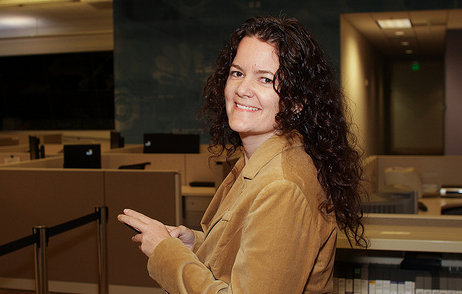
Audrey Watters is a journalist specializing in education technology news and analysis. She has worked in the education field for the past 15 years: as a graduate student, college instructor, and program manager for an ed-tech non-profit. Although she was two chapters into her Comparative Literature dissertation, she decided to abandon academia, and she now happily fulfills the one job recommended to her by a junior high aptitude test: freelance writer. She has written for Edutopia, MindShift, Fast Company, Inside Higher Ed, The School Library Journal, O’Reilly Radar, ReadWriteWeb, and The Huffington Post, in addition to her own blog Hack Education.

Kin Lane is a web programmer living in Bend, Oregon. He began his career as a database application programmer way back in high school and has been at it ever since. For the last 10 years Kin has been building database driven web-application on primarily the Microsoft platform. Kin is a self-made technology entrepreneur with no formal college education or degree. Everything he has learned, he has learned on his own steam and has been either owning my own business and a consultant for most of his adult life.

Lately Kin has been steering his career into toward a focus on the design and execution of social media marketing campaigns including design and development of social media applications and tools.

Jon Udell is an author, information architect, software developer, and new media innovator. His 1999 book, Practical Internet Groupware, helped lay the foundation for what we now call social software. Udell was formerly a software developer at Lotus, BYTE Magazine’s executive editor and Web maven, and an independent consultant.

A hands-on thinker, Udell’s analysis of industry trends has always been informed by his own ongoing experiments with software, information architecture, and new media.

From 2002 to 2006 he was InfoWorld’s lead analyst, author of the weekly Strategic Developer column, and blogger-in-chief. During his InfoWorld tenure he also pioneered the medium now known as screencasting and produced an audio show, Interviews with Innovators.

In 2007 Udell joined Microsoft as a writer, interviewer, speaker, and experimental software developer. Currently he is building and explaining a calendar network that’s based on open standards and runs in the Windows Azure cloud.

Alan Levine is recognized for expertise in the application of new technologies to education. A pioneer on the web in the 1990s and an early proponent of blogs and RSS, he shares his ideas and discoveries at CogDogBlog. Among his recent interests are new forms of web storytelling (including 50+ Web 2.0 Ways To Tell a Story, pechaflickr, and the StoryBox), as well as leading and teaching the open digital storytelling class, ds106.

Most recently he was instructional technology specialist at the University of Mary Washington, following leadership positions at the New Media Consortium and the Maricopa Community Colleges. Currently he is exploring new options under the banner of his own creation CogDog.it

Dr. David Wiley is a Shuttleworth Fellow, working to lower the cost and improve the quality of education. He is currently on leave from Brigham Young University and leading Lumen Learning, an organization dedicated to supporting and improving the adoption of open educational resources by middle schools, high schools, community and state colleges, and universities. As an academic, Dr. Wiley has received numerous recognitions for his work, including an NSF CAREER grant and appointments as a Peery Social Entrepreneurship Research Fellow in the BYU Marriott School of Business, Senior Fellow for Strategy with the Saylor Foundation, and Nonresident Fellow in the Center for Internet and Society at Stanford Law School. As a social entrepreneur, Dr. Wiley has founded or co-founded numerous entities including Lumen Learning, Degreed, and the Open High School of Utah. In 2009, Fast Company named Dr. Wiley one of the 100 Most Creative People in Business.

How?
This event has been made possible by the generous sponsorship of UMW, SCHEV, and the Shuttleworth Foundation

Interested in attending? The conference is free of charge and open to the general public. Our venue seats 220 people so if you are interested signup here as soon as possible.

Posted in openva | Tagged , , , , , , | 2 Comments

Building with Howard: Creating an Open Source Learning Environment Pt 3

This is part 3 of a series Howard Rheingold and I have been working on to demonstrate out the open how to create a learning environment using open source tools like WordPress, MediaWiki, and more. go here for all the videos so far. The idea behind this series is to get faculty and students interested in how they might fashion their own learning environments in a web hosting environment using their own domains. The first fifteen minutes of this video focuses on Howard’s approach to assessment in his Social Media Issues course, which will be experimenting with contract grading. From there we explored a few things in regards to the open source framework we are building.

  • Finding and installing WordPress themes
  • Integrating signins between WordPress and MediaWiki
  • Just how clunky MediaWiki still is after all these years
  • Customizing menus in WordPress
  • Uploading header images and changing the background color in WordPress Themes

The point about how clunky MediaWiki remaisn was the source of a broader mini-rant about how long we have been using these tools, but how difficult some absic things remains. Integrating signups between MediaWiki and WordPress is still a major pain in the ass six years on—the WPAUTH extension for MediaWiki that I’ve been using since 2007 remains the gold standard. Also, to change the logo in my MediaWiki install I need to FTP in and change code in localsettings.php file—WTF?!

I truly would like to see a robust platform like MediaWiki become a lot more ubiquitous in the teaching and learning space, but an application that makes simple administrative necessities that difficult will not be an options for your average user. Also, why haven’t we made some of this stuff easier? And this goes for syndication as well. My thoery is because we’ve wasted too much time chasing the next platform that will sovle our problems and finally truly disrupt education—in other words,  most technologists are fools and zombies.

Posted in experimenting, reclaimopen | Tagged , , , , | 4 Comments

Syndicated Personal Portfolios: The Case of Stephen J. Farnsworth

I’ve still yet to write a manifesto about how awesome the Domain of One’s Own faculty initiative was in some many ways, but the problem is there’s far more than a mouthful of awesome. So, I am trying to deal with this by taking one small bite at a time 🙂  Here’s another…

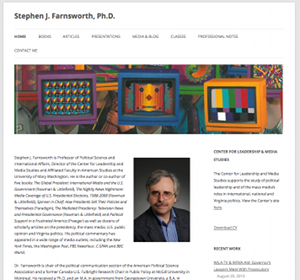
farnsworthStephen J. Farnsworth is professor of Political Science here at UMW, as well as in impressively prolific scholar, pundit, and presenter. He’s constantly being interviewed by news outlets in the DC area on a range of political matters, and as we were working on his personal portfolio site as part of the Domain of One’s Own faculty initiative I started to wonder how we could start syndicating all this stuff in. We quickly discovered that most major news agencies, both locally and abroad, don’t have an easy and consistent mechanism to syndicate specific works he has been a part from their sites.

The only clean feed we could get from any of these various news agencies was C-SPAN—bully for the public sphere! C-SPAN has a recent appearances page for people who were part of their broadcast, and that page has a clean feed that we can pull right into his portfolio via FeedWordPress, but that’s the only one we could find. What a shame, I can’t imagine it hasn’t occurred to The Washington Post, the Richmond Dispatch and just about every local TV and radio station that they need a lightweight taxonomy based on tags or categoroes to organize when a guest has been quoted, interviewed, etc. so that it can be more broadly shared by these people who are contributing to the value of their infromation? This seems to be a larger example of how technical and information literacy is so crucial, and why syndication is still so freaking important as a mechanism to a simple tool for structuring and seamlessly sharing content within and beyond an organization.

Which, in turn, is why I’ve been pushing for UMW to get more savvy when it comes to syndicating content. For example, Stephen Farnsworth has been submitting the professional work he has been doing to EagleEye, UMW’s Faculty and Staff Weekly Newletter on a regular basis over the last two years. He has over eighty entries in the newsletter, and thanks to an agreed upon tag  for all faculty and staff we can pull a feed with all his professional notes directly from EagleEye right into his portfolio page. The feed he is syndicating from is http://eagleeye.umw.edu/tag/sfarnswo/feed and what’s nice is now he shouldn’t have to reproduce effort. Whatever is entered into EagleEye will automatically syndicate into the professional notes section of his portfolio.

Even cooler, we could work this the other way around and have EagleEye pull a tagged feed from every interested faculty and staff member’s personal website as a way to seamlessly syndicate and aggregate their professional notes from their own online space. For example, I could use the tag EagleEye on this blog to send any posts about my own professional work to EagleEye. This not only encourages faculty and staff to share the work they’re doing, which is already a reality thanks in part to EagleEye. But it also enables them to do it on their own space that can seamlessly broadcast to the entire UMW community. Add to that the fact we can now provide them with their own domain and web hosting, and you have the perfect storm for this stuff taking root.

Posted in Domain of One's Own, publishing, rss, tags, umw, umw.edu | Tagged , , , , , | Leave a comment

Domain of One’s Own Poster: Visualizing the Connections

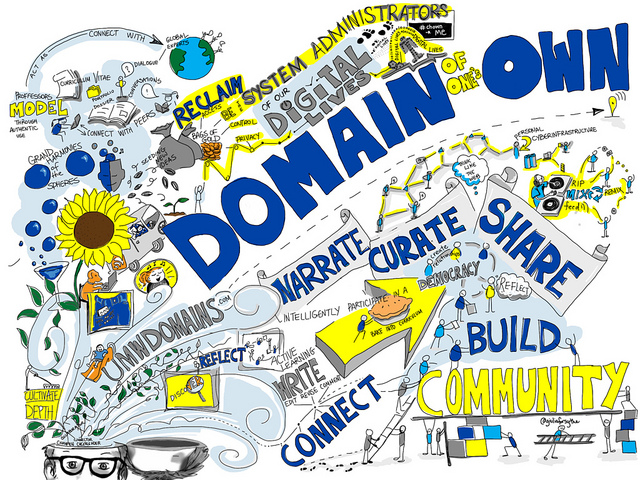
Giulia Forsythe’s Domain of One’s Own Poster

So far we’ve had three different posters printed to promote the Domain of One’s Own initiative, and thanks to Giulia Forsythe we have yet another. Giulia’s visual not only captures all the complex facets and connections that this project represents culturally, curricularly, and communally (Martha Burtis gives an excellent history the long history of Domain of One’s Own), but it is like a rich tapestry to look at. Add to that her thoughtful and nuanced post about the creation process and you have a truly remarkable reflection of what this initiative represents. I plan to have a number of smaller versions printed, but a larger, full-blown version printed and framed for our offices.

Posted in Domain of One's Own | Tagged , | 1 Comment

PediaPress

Over a week ago the Division of Teaching and Learning Technologies (DTLT) met with the six faculty in this year’s cohort of the Online Learning Initiative (OLI) here at UMW. The OLI provides a framework for faculty over the course of a year to try and integrate the values of a liberal arts education into an online learning experience. Martha Burtis has this year’s cohort running like a well-oiled machine, and I think this initiative is really finding it’s groove. (And for that matter so is Martha, full time suits her well, the planet’s must be aligning 😉 .)

But none of that is what I really wanted to blog about, the OLI just happened to be the occasion for me to catch up with Biology professor Steve Gallik—one of UMW’s finest faculty innovators—who turned me on to yet another awesome service of the open web I hadn’t been aware of, namely PediaPress. This is a service that allows you to collect and collate Wikipedia articles into a book that’s then published and sent to you as a hard copy. So, you might be thinking, what’s so cool  about a buying a book full of Wikipedia articles?

Steve

Well, it’s cool when you create a book as a Biology faculty title Protein Structure that is the most comprehensive reference on Proteins cell structure of its kind that you can provide to students as a PDF free of charge. The actual printed book—which cost roughly $40—is for Steve, but the process of creating it enabled him to build a comprehensive resource on proteins for students. What’s more, as a class they’ll be able to locate some of the issues with those Wikipedia articles and hopefully edit them and enrich the commons. Stuff like this is so simple, and at the same time so awesome in so many ways.

I couldn’t resist browsing the PediaPress catalog, and I was struck by a few reference titles: Depeche Mode: A Compilation for the Masses, Pharmacology for Anesthetics 5, The Beatles, and Really Free Culture: Anarchist Communities, Radical Movements and Public Practices.

Posted in dtlt, umw | Tagged , , , , , | Leave a comment

Building with Howard: Creating an Open Source Learning Environment Pt 2

This is part two of a series Howard Rheingold and I are working on wherein we’re openly building the framework for his Social Media Issues course using a variety of open source tools, plugins, themes, extensions, etc. This is really a blast for me because I haven’t gotten into the nitty gritty of a one-off open source learning environment like this since 2007 or 2008 (although ds106 was exactly this in 2011, but I gotta a lot of help). I’m really loving the work with Howard to build out his course site, and once again explore for myself what’s possible with tools like WordPress and MediaWiki. In fact, the whole idea around ds106, Domain of One’s Own, Reclaim Hosting, etc., is that you dig into stuff like this and have a community of support to help you. A huge reason why folks wouldn’t even consider this option is that it’s way too onerous to do alone, but we may just solve that by working on this stuff as a community. Open and distributed edtech—you have a problem, we can help you fix it! We’re DEDtech! Anyway, that’s the dream.

As for this episode, Howard and I spent some time in the beginning on the WHYs. Why have your students blog openly? Why have them take control of their digital domain? Why build these aggregated spaces? What has been the biggest treat about pairing up with Howard is that he makes me explain some of the assumptions I’ve been carrying around for years. I’ve been pushing syndication of student blogs into course hubs at UMW for six or seven years now. We’ve been using the FeedWordPress plugin for five or six of them. This stuff is like water to us, and while others might be waking up to it recently—it’s been part of our edtech DNA at UMW for a while. So having Howard have me try and actually explain why a faculty member might want to do this is awesome. What’s more, as we go through these sessions it’s a real conversation between two people who are negotiating what the course framework might look like. The coolest part is we’re sharing it in hopes that others get some ideas, frame their own questions, and potentially work through a similar model. I feel like I am doing the best kind of instructional technology again: exploratory, customized frameworks that scale to the size of a single professor—a hub that reflects the personality of a course, but refuses to subsume the students within it. This is the kind of instructional technology that truly rocks—LMSs still suck!

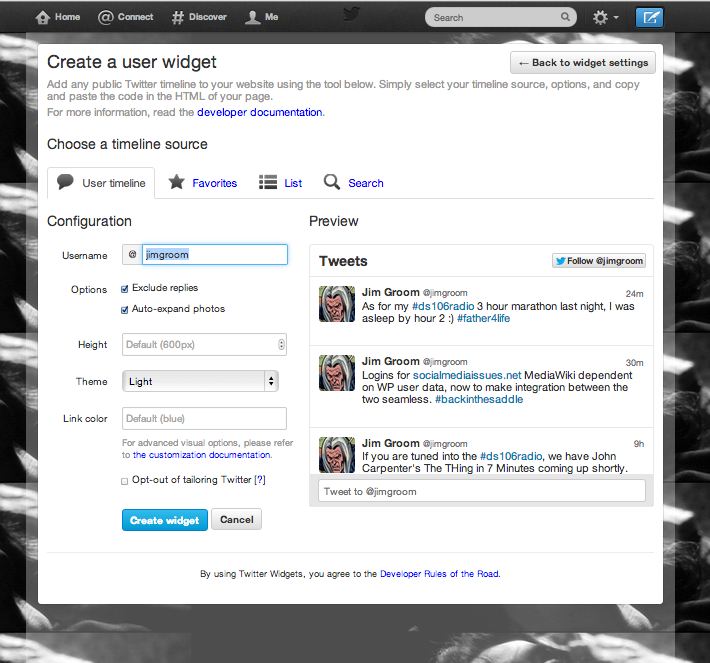
After the WHYs, we covered a few customizations to his WordPress hub such as adding a widget for the Twitter conversation around his #comm182 course hashtag. Thanks to Tim Owens, I recommended the native widget from Twitter that actually works well. Just go to Your Twitter settings–>widgets and you have all sorts of options.

Twitter Widget

After that we discussed how to create custom menus in WordPress to organize pages on the course hub. What’s more, the links option in custom menus is a very useful feature that I think a ton of faculty will find appealing for loosely integrating a range of external sites into one central hub. We flirted with the idea of themes, but we’ll be spending more time in the next episode—which is Tuesday, August 20th btw—talking about the myriad possibilities in that department. About half way through we installed a MediaWiki and went over the affordances of that technology. I particularly liked our discussion about wikis because we actually went back-and-forth about what he may or may not need. I don’t recommend MediaWiki lightly because it can be a real pain in the ass, at the same time it is powerful and every time I set one up for a class I see the immense possibilities all over again. That said, when I soon realize I have to edit a localsettings.php file to get a attractive icon for branding a new wiki some of that luster is lost. Truly a love hate relationship.

I’ve demonstrated some basic editing for MediaWiki that we have document for the course here, and I am working on a broader HowTo wiki page for this class that I’m expecting other folks who want to do a course like this might use, copy, or customize for their own course. I’ll be talking about integrating WordPress and MediaWiki more tightly in the next episode, as well as the possibilities with plugins like Wiki Embed—which I think is awesome. I also found this cool MediaWiki extension I hadn’t seen before that enables seamless Poem formatting, which is a complete nightmare in WordPress. Who knew? I’ll highlight all these MediaWiki extensions, integration, and WordPress themes and more in the next episode. Until then, stay syndicated baby!

Posted in experimenting, reclaimopen | Tagged , , , , , , , | 2 Comments