Bringing Shenandoah online

So over the last six months I have been working with Rod Smith at Washington Lee University on bringing the literary journal Shenandoah entirely online. It is a real privilege to work on this project because Shenandoah has a very rich tradition representing Southern literature. What’s more, it was started by none other that Virginia’s own Tom Wolfe while an undergraduate at Washington and Lee University. And when I first went to the Shenandoah’s office back in September I had just finished reading Cormac McCarthy’s Blood Meridian, and it was amazing to talk with Rod about McCarthy’s vision, and his quick wit and cutting insights got me excited again. Excited about great writing, excited about Southern literature (Faulkner remains my godhead), and feeling the future of publishing has never been greater, and resources like Shenandoah available to everyone for free online was never cooler.

So I talked to Rod’s students last semester about publishing, the online revolution, the amazing thing that is Wikipedia, along with the state of reading and sharing online.

After that I went back to Virginia and I thought about what it would me to bring Shenandoah online. I got feedback from the UMW students, and modeled out a means to do this in WordPress Multi-Site. After looking at a whole series of literary journals online, I was wondering what we could possibly add to the field. To be entirely honest there are not too many inspiring literary journals online, so we have n opportunity with Shenandoah to think about what the next stage of online literary journals might look like. One think I was thinking is allow for each issue online to look and feel differently, which in turn less me to a distributed idea of sites. A main site which acts as the information headquarters, announcements, archival work, admin info, submission stuff, and features the the most recent issue as well. The following image is far from done, and the site is not going live officially until October, but I am going to be blogging its development for the next several months. I’ll be tracking my changes, goals, and ideas here, and it will be my first kinda open development of a site.
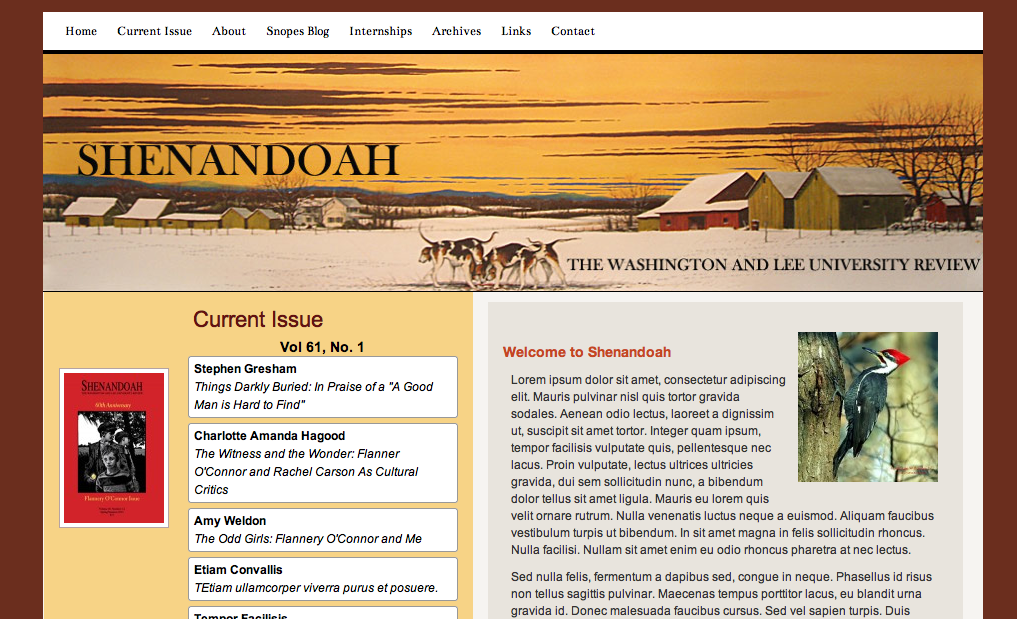
From there we can actually use WordPress multi-site to build out sites for every new issue as we need them. This not only allows the customization of background colors, font, and header images (even entire stylesheets) for each and every issue, it also provides a mean of treating each issue as it’s own kind of entity with it’s unique URL, it also distributes the content across the databases, while at same time creating a centralized resource for all issues with the tags blog (which I will talk about in another blog post when I deal with accessing the archives and searching and linking authors and works between and amongst issues). In other words, a loosely structured series of issues tied together by an admin bar, syndication, and a sense of a distinct immateriality between issues. What I am hoping, is that not only will we see a new design for each issue, but that the design online somehow speaks to and builds upon the issue itself. An attempt to embody and represent the theme of an given in the online space. Not just occupying the online, but rather inhabiting it, assimilating it, becoming part of it. And the fact that it is free and open using open source tools, I believe there is a lot of freedom in this regards, and I applaud the faith, while at times frustrating because of my erratic working style and tenuous promises, I think we are really on to something.

After sitting on my ideas and having don all I could before going to Italy, I came back, locked in to this project, and asked Martha Burtis for advice and help in actually making this idea for distributed model in this journal actually look good, be easily managed by anyone, and enable them to redesign and change the look and feel easily (that is key here and why we went with WordPress, they have no regular tech folks at Shenandoah). What Martha helped me come up with is for me one of the more impressive attempts to frame a journal online. The actual issue is a model of simplicity and economy for the first issue, and I love the table of content and fill paged articles that lead off from them. What’s more, the way in which the issue site snaps to focus really makes the reason why you are there, namely to read, that much more apparent. No distractions, no ads, no nonsense, just literature, the best the South has to offer. And while just the first iteration, the issue site is something I want to be able to think and build a few more variations upon.

What’s more, Rod put me in touch with William Dunlap—who is kind of a realist surrealist in this oddly beautiful way—and his works really set an amazing tone for the journal. The “Unholy Trinity” image on the Snopes blog is a favorite of mine. His artwork really sets an amazing tone for the whole site—and again the aesthetic here becomes part and parcel of the site and the experience, why could each issue feature the design and art of yet another artist as part of the form, and not designed to take away from the literature, but rather enhance the experience of reading it online.
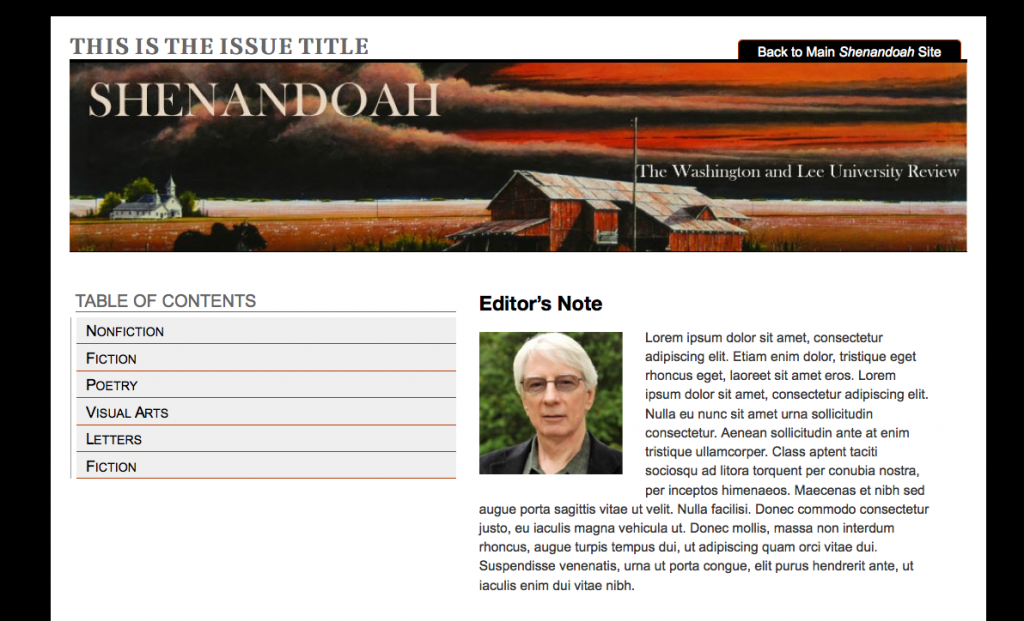
But I still have some work to do, and I will be using this space as a push to do, as well as a way to answer questions of the interns who are working diligently with Rod over at Washington Lee University. So below is a bit of question and answer between myself and the interns.

___________________________________________

These are from Catherine:

CA: What will the “In this Issue” paragraph on the home page say? (If it’s kind of a basic introduction to the issue, but is different from the “Editor’s Note,” maybe it should also appear on the “Current Issue” page.)
JG: Actually in this issue will have a list of all the contributors for this issue. An important detail here as well is that the five or six authors on the sidebar will be rotating randomly. And this was important for Rod to avoid the impression of featuring just a few of the writers. They all were accepted and published based on the merits of the work, not necessarily the name. Something I respect and think sets an excellent tone for the journal. it will not appear on the Current Issue because he Table of Contents will have this.

CA I really like the drop down table of contents on the “Current Issue” page–also, I like that it doesn’t drop down automatically when you scroll your mouse over it, but instead you have to click–that way it doesn’t get annoying!
JG: That is all martha Burtis designing, and I agree, it is very, very slick. And haven’t seen anything like it yet–I love it too.

CA: It seems kind of strange that the Snopes Blog page has the same toolbar (Home, Current Issue, About, etc.) as the other pages on the website, but it’s placed below the picture instead of at the top of the page…it seems kind of awkward and inconsistent, and I wonder if it might be better to have the toolbar at the top of the page and the “Snopes” title lower?
JG: Yeah, we have to fix that. Adding it to the list below.

CA: I noticed a search bar on the Snopes Blog page. Will there also be a search bar for the rest of the website, that can be used to search the current issue or archived issues? I’ve seen this sort of thing on some other literary journals’ sites, and it’s convenient if you’re looking for a certain author or something.
JG: Yeah, I am working on this, there will be an issue searchbar and also an archives search bar across all issues.

CA: Anyway, these are just some suggestions; hopefully they are helpful. Overall, I think the website is looking good, and I look forward to seeing it when it’s all finished!
JG: Thanks, I’m excited too. And it will only get sharper. But your ongoing advice is essential.

These comments are from Mary:

MOK: Because the site looks so great, it was difficult to come up with anything!
JG: Let me know how much I owe you.

MOK: However, one question I have pertains to the the Snopes Blog section’s different format. I really loved the format (when I say format, I’m referring to the placement of the tabs at the bottom of the illustration) — maybe even more so than the rest of the site’s. But, I was wondering why you decided to make this section different than the rest? I think that could be a little confusing to the readers. It might be better to keep the same format/illustration with each section to maintain consistency.
JG: The idea was to really give the blog its own identity, separate it out from the main page. In fact it is a totally distinct site and can be seen and designed as such. it also allows you to run plugins there that you don’t run on other sites/spaces.

MOK: My other comment concerns the photographs on the home page. I found it a little off-putting to mix an illustration with a photograph so closely together. I understand this is inescapable with a photographs of authors/editors, but do you think it would look potentially better if there were a painting of a woodpecker, rather than a photograph?
JG: Will change the other images to Dunlap pictures and we are still figuring out the Woodpecker.

MOK: Despite these small recommendations, I think the site still looks extremely impressive!
JG: I’m a big fan of yours too, and will be sure to buy a first printing of your forthcoming work of extreme brilliance.

These comments are from Laura:

LP: It is wonderful to see the site finally up.
JG: For me too, I was beginning to worry. So much work, so much pressure, so much–you have no idea!!!!

LP: I have a few suggestions.
JG: I was afraid of that.

LP: First, the text within the site is almost entirely in Latin–I don’t know if you are aware of this or not.
JG: I don;t read latin so I had no idea, I mainly speak it informally at home.

LP: I think that there should be more pictures–for instance, under the “Internships” section, you could post pictures and short bios of the current interns. Furthermore, while the background color–brown–goes with the current farming photo (which I love, by the way), it is not very eye-catching. I think that you do not need a background; rather, you could simply expand the existing white space and perhaps add a large background photo in muted colors. Doing so will give the website a more modern (yet still traditional) look.
JG: Good advice, I am going to work on those pages shortly, and one thing I was talking with Rod about is giving the interns access to and training on using the site so you all can start playing with making these changes. What’s more, you’ll realize how easy it is to use. Sound good?

LP: If you would like me to look at the site again once it has been fully updated, please let me know–I would be more than happy to help out in any way. I hope things in the office are going well!
JG: Thanks Laura, i will be calling on you all regularly now. And once you get access, you can actually experiment with what you like.

These comments are from Tim
TA: I didn’t have many comments on the site, but I did want to know how finalized the front page is.
JG: Not finalized at all.

TA: Because the only suggestions we had on that front was possibly integrating the fonts (so that they would be the same type throughout), removing the blank space on the left side, and tightening some of the gaps between the text. Some things are hard to tell because there isn’t any information actually up yet (other than the fill-on scrambled Latin).
JG: Yeah, that is all going to be attended to anon, right now we are sealing up the architecture and seeing how seamless the management and publishing can be for folks who use this model.

TA: We were comparing our website to Blackbird in class, and the main difference between Blackbird and Shenandoah is that the Blackbird site really flows well–there are no periodic gaps on their website, and there is a wealth of information and links to click on the front page without overwhelming the reader. But again, I’m not sure how close to the final product the current Shenandoah website currently is.
JG: Yeah, I am trying to avoid Blackbird as a model more generally interms of aesthetic and architecture. It is a bit text heavy and I am sure they are working on an overhaul. Fact is, for Blackbird every issue is the same look, it has no variety and that doesn’t allow the thing, the journal to speak. it doesn’t inhabit this space, it is simply in it. What we are working for here is an ecosystem of writing and ideas—a space that understands the new medium in occupies as part and parcel of the art: the art of the representation and interaction. .

And now, here are the things I need to do for next Tuesday:

* Blog for my process on both the Snopes blog and my own
*random image headers
* Dunlap art distributed 20 images
* Woodpecker (Icon and bullet points–>)
* PC Internet Explorer 7 and 8
* Gallery and what’s new with WIlliam Dunlap images
* O’Connor image needs to be changed Dunlap
* Random Quote generator
* menu bar for main page of the individual issue
* Fall 2011 text near TOC
Posted in literature | Tagged , , | 2 Comments

Flamethrowers vs the LMS

I love Canvas’s new commercial for Instructure—love they are having with this video. What’s more, their product is now open source, I mean really open source. Now if they could only use this aesthetic on their product web page 🙂

Posted in experimenting | Tagged , | 8 Comments

The Daily Shoot and manic ravings about ds106

Make some art:

DS106 TV Bumper from noise professor on Vimeo.

And some more art…
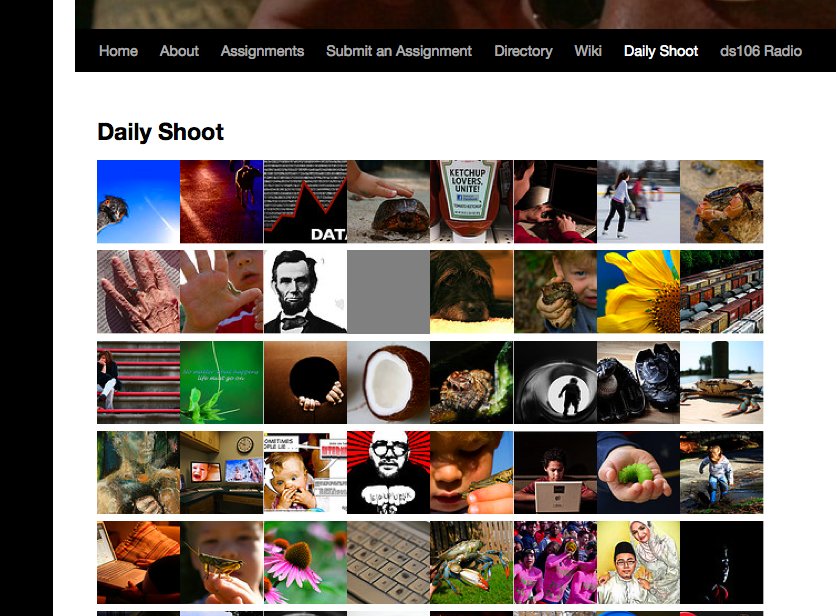
Image fromSamiamumw daily shoot
Image credit Samiamumw’s “DSC00924”

This week is the start of the first hands-on creative section of the course [hahahahah!], but I think we all know what happened to the idea of sections and order in this course. They are blurring and people are creating as the good web deems it their right, and people are talking, coding, creating, mashing, watching, recording, listening, and re-mixing all the while. The #ds106radio station almost seems like it’s always been here, and the class itself is recovering from that meteor and building steam all the while. And Grant is just on fire, his work is legendary at this point, and it is only a week old! I’m in heaven, and I can’t deny it.

(Thank you #ds106radio)
And there is even some excellent reflections (and quite a mashup!), that puts a lot of last weeks events in some perspective for me–while illustrating just how fast, cheap and out of control does have its casualties.

On Tuesday, February 1st, we have D’Arcy Norman coming into our classroom via the airwaves, and he has already given us a rad photography resource (I love the way he presents this, beautiful) to consult as we spend the next two weeks doing daily shoots—amongst other visual assignments (more on them anon). I’m really looking forward to this!!! Piping in folks has been a real highlight this semester, something I picked up from Alec Couros, and finally got my shit together enough to contact and line people up. They’ve been very cool with my late and haphazard notice, and for that I am really appreciative. And I promise there will be many, many more to come!!! What’s more, every relevant class we have on Tuesdays and Thursdays from 6-7:15 for the rest of the semester will be simulcast through ds106 radio if the slot is still available (20 shows already from what I understand).

But here is what I really wanted to say, I am bringing the ds106 daily shoots into the course blog through a plugin called Flickr Tag. Experimented with it today, and it does everything I need, and I am gonna change the blog around a bit come tomorrow afternoon to show them off. But until then, Flickr Tag allows me to pull in up to 100 photos off one (or several) tags of a Flickr photo. So I asked everyone to tag here photos with both ds106 and ds441 (the later being the daily shoot hashtag for that day). I’m also asking everyone to include a third tag that defines their section so I can cut the images yet another way. So, here is an idea what the code is like for Flickr tag

Single tag:
[flickr]tag:ds106(square)[/flickr]

Multiple tags:
[flickr]tag:ds106+ds441(square)[/flickr]

And once I put that in, it automatically adds a link back to Flickr and displays on the blog with litebox. It is a slick plugin and does everything I need it to do. And while I don’t necessarily expect folks to use ds106.us to view each others images (I mean they can use dailyshoot.com, RSS, flickr contacts, etc., just as well, but I like the idea of the visual taking over the blog these next two weeks while we explore photography as well as design (design being a new experiment this semester).

It will be like this in the navbar, and everyday, the new results for the day’s daily shoot will show up:

Here is the ds106 tag only (need to figure out why all Bionicteaching‘s photos are pulling on that one).

And here is for any given day (this being for today #ds441, and only a test).

I know a lot of folks could have done better, but this worked easy for me without a lick of programming on my part. Unlike Aaron (@galagonwagon) who coded up the Twitter bot that announces new tracks for #ds106radio–awesome stuff. Show me a class that has their Computer Science students dreaming out in the wild west building stuff that is integral to the class before the end of week 3? That is really building the airplane while it’s flying, in fact this whole course has been that way so far. I mean Martha not only perfected the animated GIF over the weekend, but cracked the aggregated comments syndication nut in two simple parts here and here. Are you kidding me?

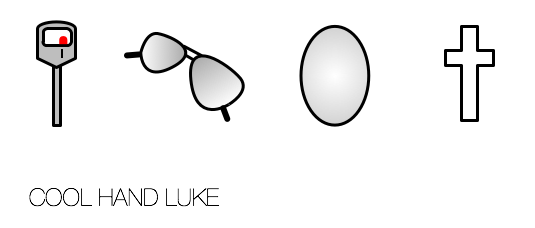
And have you seen this “1 Story in 4 Icons”?
Image of 1 story in 4 icons
See post about our coursification disease here, unlike Cool Hand—cool subtext happening here.

Everyday a new wonder to behold, so many of them I’m sure I am missing a ton, so help me see them. I take tweet requests…because I cannot read everything. More than 1000 posts and we are only starting week 4. Insane!!!

Because I can and I will…
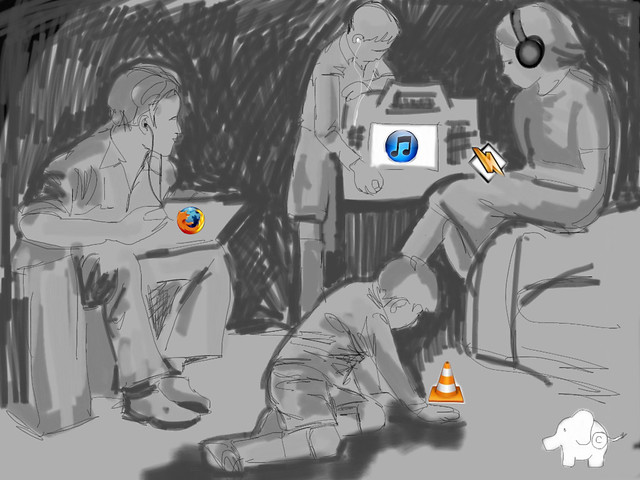
Image of digital storytelling circle
Image credit “digital Radio Living Room” by Giulia Forsythe

And a look forward to week 5!!!

THERE IS SO MUCH GOD DAMNED ART!!!

Posted in digital storytelling | Tagged , , , , | 7 Comments

A little confused…

I am not sure why Leigh Blackall is photoshopping folks in unseemly garb or comparing me to an eduprenuer—I dig Leigh, and I’m down right confused. #ds106 is a vision of freedom, idea of rethinking open ed, and challenging ideas of property ownership and the future of education—even if only a bit. Man, there are few people I’d rather work with, but I maybe just don’t understand the humor, but I want to cause I try not to take myself too seriously—I’ve seen where that can lead you. Let the airwaves help us think and create, and leave the nonsense to institutions.

Posted in Uncategorized | Tagged | 39 Comments

La Radio ds106: Italian Lolita

Last night Antonella and I had a real blast putting together our first 15 minute play list of Italian classics, commercials, and variety show numbers on YouTube mixed in with clips of Peter Sellers as Claire Quilty from Stanley Kubrick’s “Lolita.” Far from perfect, but way too fun, and I hope to get even better.

Here is a break down of the media

Running time is 15 minutes, and you can download the file here—
La Radio ds106: Italian Lolita
Download

We need to come up with a way to remix this stuff and share it. We are talking about that currently in DTLT, and may want to think this through. For now I am using the ta here ds106media. We’ll wee where that leads, though some kind of browsable space might be nice.

Posted in digital storytelling | Tagged , , , , , , , , , , , | 1 Comment

ds106 Radio….lock it in!!!

OK, wow, that was a pretty awesome beginning to ds106, I’ve been having a lot of fun reading and commenting up a storm, but I got a little home sick for my blog, and plus I got tired of seeing everyone else have all the fun. So, in order to get back on my horse, I decided to create a few (of hopefully many, many more) bumpers for #ds106 Radio.

What the hell is ds106 radio? Well, it is the brain child of Grant Potter (and I think Jason Toal and Brian Lamb had a hand in it as well) which basically allows anyone from around ds106 (which means anyone 🙂 ) to upload audio files to a dropbox account which in turn streams that audio out to a play list that you can open up and listen to in iTunes (and I imagine other applications). From what I understand, Brian Lamb was streaming it on his mobile, so this thing is a go. After Andy Rush and I spent the afternoon working to the soundtrack of ds106 we were nothing short of blown away by how good it was. It sounded like a solid hour of Brian lamb’s remixs and mashups, and it was internet soul music. So since then I’ve been uploading to ds106 radio furiously (which may very well kill its soul 🙂 ), and I was so inspired I took some time tonight to create a few radio bumpers—something I’ve never done before—and it has been a blast. So below ar a few very short radio bumpers I made and submitted to #ds106 radio. Process was dead simple, I downloaded the audio from YouTube (I’m liking Andy Rush’s recommendation for “The fastest YouTube downloader” a lot) and edited it in Audacity–simple as pie.

Rorschach Radio #ds106 Bumper
Download “ds106 radio…lock it in!”

The “Shine On” Bumper (this one is for you @rushaw)
Download “ds106 Radio…Shine On!”

“Let’s get physical” Bumper
Download “ds106 Radio Let’s get physical”

#ds106 Radio Airwaves
Download “ds106 Airwaves” (thanks to the Ramones)

How many courses do you know that have their own radio station?! Screw elluminate, we want the airwaves, baby!!!

What can I say Grant? You rock!!!

What’s more, I will be setting up a programming schedule for the radio station in the ds106 wiki shortly, and this is where people can sign-up to broadcast their own radio station for intervals of an hour. I already have a plan to talk 80s film with Martin Weller once a week for an hour and have a variety/call in show with Tom Woodward. Figure maybe me and Martha Burtis, Alan Levine, Tom Woodward and others can have a show reflecting back on the class on a regular basis, who knows. I think the shows will kick off week 4 or 5 when we start ramping up to audio. But don’t let my schedule get in the way, get in there as soon as you like.

Anyway, back to commenting, hope to see you again soon blog.

Oh wait, one more thing to think about is keeping the audio submissions to ds106 radio rather short in order to prevent complete domination. I uploaded a few longer files that I am now regretting, and I hope to talk to the station manager to fix this. Maybe keep ’em on the shorter side out of courtesy and for the sake of variety.

Posted in digital storytelling | Tagged , , , | 28 Comments

he’s a nihilist he believes in nothing

…and believe me it’s exhausting.

I’m gonna revisit this one in Photoshop sometime soon and get it right. Way too big at 9 MBs, and the drift is off, but this is the one I want to perfect. This is the one.

Posted in digital storytelling | Tagged , , | 4 Comments

The Shining Animated GIF

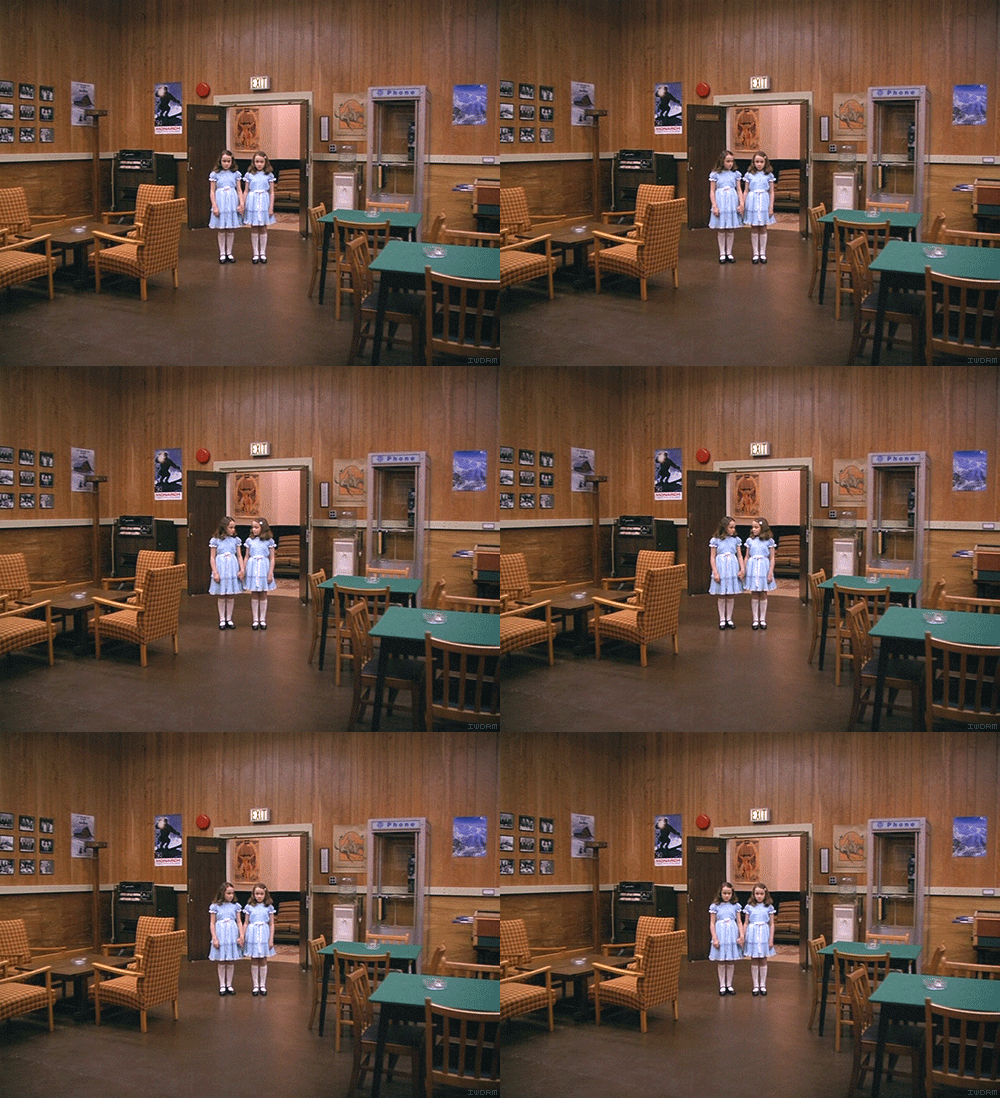
I’m gonna be that guy, I swear I was gonna do this scene before the master over at “If We Don’t, Remember Me” did it first.
Animated GIF of the SHining

I know there will be a moment after this animated GIF obsession, but that moment isn’t now. I can’t get enough of this magic. And I think the Alex breathing one from Clockwork Orange is the best I’ve seen yet.

Animated GIF from Clockwork Orange

Posted in digital storytelling | Tagged , , , | 2 Comments

DS106 week 1: Introductions, webhosts, and a domain of your own

Welcome to ds106, watching the eight minute video for my a rather unofficial introduction:

ds106: Week 1 Intro from Jim Groom on Vimeo.

Assignments for Week 1:

A Quick introduction
By way of introduction tell us all a story about something that happened to you recently. It can be video, audio images, good old text, or any other tool you like. If you like restrictions, try and tell it quick (no more than 30 seconds in terms of audio or video—-extrapolate out from there for the other media).

A Domain of One’s Own: Webhost and Domain

Week 1 will be dedicated to have those interested in getting up and running with their own domain and webhost setup. If you have had the itch to take this plunge, now is a good time to try it out cause there are a lot of people involved in this course who could help you along. What’s more, we could all benefit from hearing about your experience. You can view the assignment and respective tutorials I have provided at the following link: http://ds106.us/2011/01/12/domain-and-webhosting/ I encourage you to add more resources for this process to the comments of that post, or in the course wiki, the more documentation, the better.

I particularly hope Brian Lamb and Martin Weller will get off their asses and set up their own webhost account and manage their own blogs (that goes for you too Blackall!). As D’Arcy Norman would say they’re “corporate sharecroppers,” unless of course their blogs were hosted by the Apple App store—in that case they would be freedom fighters (nothing like starting off this class with a smackdown for my friends 😉 ).

Gearing up for week 2
Already folks have started reading, watching and responding to Gardner Campbell‘s “Personal Cyberinfrastructure” essay as well as the companion video “No Digital Facelifts” (you can find them both here). This will be the focus of the course leading into week two, which will culminate with Gardner Campbell live video streaming for everyone to enjoy on Thursday, January 20th at 6:00 PM (EST)—and yes we will be archiving and sharing this talk after the fact.

And if you want to see what folks have already done with Gardner’s seminal discussion of carving out a domain of one’s own and its implications for teaching and learning, check out Tom Woodward’s Remix of the talk, along with Grant Potter’s remix of Tom’s remix Not to mention Lisa Lane’s discussion of Gardner’s ideas here, which I’ll take a small quote from below:

The practices of narrating, curating, and sharing could put the control back in faculty hands. It’s true that it needs to be in student hands, of course, but for faculty to serve as a model (as Gardner writes in his article) they must somehow free themselves from the autocracy that has emerged along with the technologies.

And all this before we are even out the gate!!!!

So, like my partner in crime has noted so eloquently here, it is time to push yourself beyond your creative comfort zone, time for us to wrestle honestly with the future of education through praxis and engagement and, more than anything else in my book, it’s time to make some damned art already. Let’s go!!!!

Posted in digital storytelling | Tagged , , , | 33 Comments

Email to UMW Online Section of ds106

My fire and brimstone warning email to the students of the online version of ds106 at UMW. I’m looking forward to this course, but I wanted to establish both the amount of work it will require, the fact their are almost 200 other folks who they will be work alongside of who having nothing to do with UMW, and finally remind them that if they are concerned about maintaining their own webhost, working in the open, and dedicating some serious time to this course, they might want to jump ship now. But if they don;t jump ship, well then, hang that ds106 Jolly Roger 🙂

Hello and welcome to the online version of Digital Storytelling (CPSC 106, section 4).

I wanted to take a moment to quickly orientate you all in regards to how this course will be run over the next fifteen weeks.

Let me start by saying this course will probably be unlike most courses you have taken thus far in your school career, and that is not because it will be held entirely online—for it is quite likely in this day and age some of you have taken an online course before. What is different about ds106 (my nickname for the course) is that you will not only be asked, but required, to narrate your process of learning over the course of the semester. You will be required to purchase and manage your own domain and web hosting space, and you will be expected to create a series of online identities across several web services (including YouTube, Flickr, Twitter, delicious, Google Documents, etc.), and regularly update your own web space where you will be installing, designing, and customizing your own blog. More specifically, you will be asked to use these spaces to create digital narratives both individually and collaboratively over the course of the semester—so please be prepared to work together.

Also, it is very important to keep in mind that a lion’s share of the course work and grade will be focused around the regular updating of your own blog as well as commenting on the blogs of your classmates. I can not stress strongly enough how essential both blogging and commenting are to your success is this course. If you foresee any issue with either of these activities—particularly with doing them openly—I recommend you reconsider taking this course.

One other issue that comes up again and again with this course is the time commitment. We will be creating a variety of narratives across a wide range of media, experimenting with everything from digital photography to digital audio to web video. These forms are often quite complicated and time consuming, and while the students who have taken this class in previous semesters enjoyed the process tremendously, they almost all noted it demands a significant amount of time. If you are taking a large number of credits or some particularly difficult classes in other disciplines this semester, you may want to reconsider taking this course. What’s more, if you took this class as a 100-level filler and expect to get by with minimal work or engagement, you will quickly realize that it’s far more than that—and the dangerous part of the course is you will greatly enjoy the work. Don’t be seduced! At any rate, consider this all fair warning from the very beginning–a “you’ve been warned.”

The course site will be located at http://ds106.us. Please go there and register for the site, noting that you are part of the UMW CPSC 106 Section 4 course (the online section) during the registration process. if you have any problems registering let me know.

Something to keep in mind about that course site is that it will include the posts of 100s of students from both UMW and beyond. All of whom will submit to it regularly, and you may find this a rather unique course in this regard as well. DS106 is being taken by 100s of people around the world for free—free because they are not getting credit for the class like you are from UMW. Your work as a class will be filtered into a particular section of the course site, but you will see examples of the various assignments that are submitted by people from a wide range of experience, interests, and cultures—most of whom have no association with UMW whatsoever. This is in many ways a microcosm of the web, we will not be working within a siloed learning management System, rather we will be doing our business out on the open web. If this is concern, then you have yet another reason to reconsider taking the course.

This course is designed to get you to both think about and interact within the digital landscapes and networks that everywhere surround us. Narratives and storytelling provide the frame we need for exploring and experimenting with emerging forms of creative expression in the digital realm as well as means for interrogating the digital environments we are increasingly inhabiting. To this end you will be asked to steward your own website, and one of your first assignments will be to purchase your own domain and establish your own webhost—and by extension your own digital identity, but more on this shortly.

In the meantime, be sure to register for the course site here (http://ds106.us) sometime tomorrow.

Finally, and most importantly, I would ask all of you to meet with me for a brief, in-person orientation about the course tomorrow night (Monday, January 10th) at 6 PM in duPont 215. if you can not make this meeting I expect that you will email me sometime tomorrow explaining why.

Best regards,
Jim Groom

Posted in digital storytelling | Tagged | 3 Comments