“Many things grow in the garden that were never sown there”

My recent feature post on UMW Blogs. What is quickly apparent is that what’s happening on UMW Blogs is continuing to cross pollinate in the community. And the quote from Thomas Fuller (which I have made the title of this post) captures the spirit and possibilities of a university publishing platform that is open and unregulated.

Many things grow in the garden that were never sown there. ~Thomas Fuller, Gnomologia, 1732

Earlier this week Emily Battle of The Free-Lance Star published an article featuring
Bethany Friesner’s vegetable garden at her UMW apartment complex. The take away quote from the article for me the following:

She is reading what she can, and documenting her progress on a blog on UMW’s website.

“The whole point is an adventure,” she said.

Through her blogging, Friesner said she wants to help people understand that they can grow a little bit of their own food even if they only have a small amount of space to work with.

She really embodies the spirit of UMW Blogs by using this space to publicly document and help people understand—that is the very ethos that public education needs to both harness and promote. And thanks to Bethany, we have a brilliant example. Visit her blog here.

Image credit: Peter Cihelka/The Free-Lance Star

Posted in UMW Blogs | Tagged , , | 2 Comments

Into the mud, Scum Web! Or, picking through the ruins that was WPMu

Image credit: Thomas Hawk’s No Dark Sarcasm in the classroom

I’m not sure when I got derailed from the Summer of Love, it was all going so well. And then the bastards, scum bags, and profit-driven web denizens seemed to hang over my thoughts like a dark cloud. I’ve been brooding a lot, and generally gnashing my teeth, in fact I’ve found myself pausing before coffin warehouses, and bringing up the rear of every funeral I meet. And whenever my hypos get such an upper hand of me, that it requires a strong moral principle to prevent me from deliberately stepping into the street, and methodically knocking peoples hats off — then, I account it high time to get back to some tinkering. And the only thing I know how to tinker with is WPMu, which is now gone, so I started playing with WP 3.0 and BuddyPress for a project I am working on (more on this anon).

And for the last few days I have been hacking around in 3.0 and BuddyPress, and doing some research into what is working on UMW Blogs and what isn’t in terms of plugins, themes, etc. And what struck me as I was searching for updated versions of plugins for WPMu (as well as themes for BuddyPress) was just how brilliantly James Farmer has turned the hard, GPL-licensed work of many a WPMu plugin developer that once lived contently on http://wpmudev.org into a subscription-based business model. I mean, it’s as if all those plugins on WPMuDev that the WPMu community consulted and used for years have all but vanished behind a pay wall.

Now don’t get me wrong, there are still a few free plugins there, but the original links to WPMu plugins like Dsaders Userthemes, More Privacy Options, and his Sitewide 3-in-1 Multi Widget Panel have strangely morphed into plugins behind the pay wall. Let’s take a look how this whole SEO, google-inspired, redirect scam works.

So, I look for the 3-in-1 widget and I get to the above wpmu.org page (no link there from this blog, which reminds me that I need to clean up my database, which has become inadvertently full of links to the premium.wpmudev.org site—given the old links to the plugins on wpmudev.org are now all redirected there….scummy). This post about the 3-in-1 plugin is on wpmudev.org, and was submitted to wpmu.org for the WPMu plugin contest sponsored by Farmer and co. for the last few years, and has since become one of the top hits in google for getting this plugin.

Now, what happens when you click the link to get his plugin….

It seems subtle, but what happens here is that wpmu.org is pushing you not to the plugin site (which seems all but gone off wpmudev.org), but rather a plugin cobbled together by the wpmudev premium team that has the same ideas and functionality as dsaders 3-in-1 widget, with one huge difference—its not free to download. Its locked up with the rest of the history of WPMu behind the premium pay wall. And you might say, oh well, such is life. WPMu is defunct now, and those plugins would just be so much internet kipple anyway, so no big loss. In fact, Farmer and his ilk are doing us a favor—they are keeping us clean and honest, not unlike Apple. But what strikes me here, is that those plugins are just as relevant as they were two years ago, we still need to display content from the tags blog in UMW Blogs, and a whole public space of development happened on Farmers server, and when the time was right, he commodified all that work and development to make his brand, seal is google dominance (which is insanely impressive, btw), and I guess he had every right to. He provided the space, and ultimately that means he dicatated the terms. The terms were pretty unilateral in retrospect, and a lot of great work seems all but lost now

And just in the event someone says the example above is an isolated case, let me give you yet another one that I stumbled on while trying to piece together a site.

More Privacy Options, which used to be a plugin that you could get on wpmudev.org through a straight link: http://wpmudev.org/project/More-Privacy-Option (I link to that plugin in this post from 2009) and if you follow the link you’ll quickly see it has been transmogrified into a way to sell Farmer’s premium service plugins (links as capital remains its own crazy economy, and one farmer has figured out very well). It points to a page selling their Privacy options for WordPress MU plugin (almost exactly the same plugin as dsader’s, with one or two tweaks for sitewide settings). So, the bava has become a way of driving traffic, and by extension advertising, wpmudev’s premium subscription and I didn’t even realize it. I’m gonna need to erase a whole series of links from my database. Now doesn’t that seem scummy? Not even a redirect to the plugin which is now in the wordpress.org repository, why? Fact is, all these plugins are still relevant, and this link-laid scam makes it seem as if they are all pay-to-play now—how is that for stewardship of a community?

Is there anyone else out there in the WPMu/WP community that sees this shit going on and is like, “Jesus, wpmudev can suck it!” Sometimes I wonder, and add to that they are the only folks pumping out BuddyPress themes, and it would appear that WPMUDev are the main developers for the flagship projects like multi-site and BuddyPress in the WordPress community. Once again, the Google manipulation works, and the emergence of wpmu.org and wpmudev.org as the dominant sites for wpmu, buddypress, and beyond is all too apparent to me these last days of rusty searching.

But then, there is a light, a strong beacon I can hold onto: this list of free (can you imagine that?!) plugins at CUNY’s Academic Commons gives me hope for an developmental education community around blogging, multi-site, themes, and plugins that is not all about link baiting for Google juice to control the world. Long live Boone Gorges! Oh wait, and then there is the awesome work by the hit squad at UBC’s OLT, featured beautifully in this wiki page on their Management Framework development.

My only question is, can the free and open rebellion survive when the essence of the web, a simple url, is being hijacked for profit or eliminated all together by the gold-lined app revolution?

Posted in WordPress, wordpress multi-user, wpmu | Tagged , , | 3 Comments

“It’s every bastard for himself, the last century hasn’t ended yet”

everything is a commercial. we advertise our memories
we leave our shit on silver platters and THEN we buy whatever’s left
(empty life? ? fine?)

These days I can’t help but turn on Unwound’s magnum opus Leaves Turn Inside You at every chance I get. It’s serving as the textured background for just about all my web reading these last weeks, and it gets me all fired up when I read ’bout the end of this, the beginning of that, the emergence of the new education market, for-profit, leverage, synergize, and on and on and on, but the guitar barrels through it all like an off-the-rail train—it refuses it, it knows everything is a commercial and we are selling our soul. It hits you like only music can, shoots straight to the veins, an anti-opiate for the mind to jack out of all the maneuvering, grandstanding, planning, and public pillage.

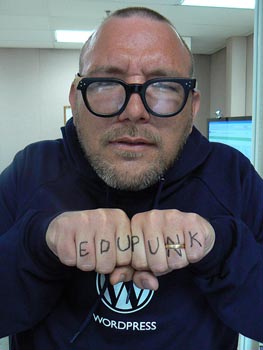
.And while reading the recent series of articles in Today’s Campus (thank you, Barry Dahl) about the business of EDUPUNKS, Edupreneurs, Eduneers, and Edubadgeres I marvel at how quickly the narrative of change in higher education is sucked into the seemingly irrefutable and naturalized logic of business innovation. The entreprenuer as savior of education (a myth Bill Fitzgerald so beautifully deconstructs here) becomes the all-too-apparent solution, and what gets left out through these articles is anything resembling a thought about teaching, sharing, and learning. It’s all about business, markets, possibilities, and vast returns for the sharp young edupreneur— I mean look at the video Bill Fitzgerald’s links to in his post, it’s insane—it’s about a shallowly glamorized culture of capital, and as David Harvey notes here, capital’s goal remains re-inventing and innovating so that we really don’t stop and think about the increasingly vast inequalities in the accumulation of wealth and power. At the same time, it grafts on a hero narrative around the private sector’s financial innovation which in many ways might be part and parcel of the financial crisis we have yet to truly recover from.

And and and, where are all the teachers and professors in the discussion? Where’s the space and shape of teaching and learning as we move forward. The discussion of EDUPUNKS—re-coined “Change Exploiters” (WTF?)—gives way to the next article in the series talking about EDUBANKERS, and new and innovative ways to finance your way through college—sounds like capital simply re-inventing itself in what it hopes becomes a market abandoned by public support and monies. I mean, what do you do with the innovative business SafeStart that basically provides students with an “interest free” line of credit to pay off their loans during the years immediately after graduation when they can’t afford the payments. They are sure to note SafeStart isn’t “insurance,” but that’s purely semantics, that is exactly what it is—a product you purchase to protect against the likelihood you can’t afford the education you have been encouraged to finance. A parasitic market on a market—it’s exactly what Tom Woodward, Brian Lamb, and I predicted in our Uncanny Learning session for NMC last October, which featured John Titan—an education insurance salesman for EduSafe from the future who has come back from the future to encourage us all to buy education insurance.

Talking at length with Brian Lamb last night (my edtech guru), the whole transformation of higher ed from an egalatarian mission to a privilege, along with which comes the price tag, is exactly the issue which Downes nailed in his newsletter yesterday (he’s been on serious fire lately) in three off-the-cuff sentences:

In the 1970s universities were much more egalitarian than they are today. More and more, you have to be the child of rich parents to be admitted and to pay tuition. This results in the student body, as a whole, appearing to have a greater sense of entitlement.

Fact is, we seem to allow the banks, business folk, and financial innovators to help us avoid the real issue of hyper-inflated costs by pointing us to shadow education banking, insurance, and further debt-inducing alternatives that simply serve to fuel the perpetual motion machine that is capital. Now while Anya considers getting her “Skin in the Game” with the for-profit start-ups—where art thou world free of partisanship?—I can’t help but hold on to this quote by Tony Hirst, which I was reminded of by the Today’s Campus article on Change Exploiters—and for me is the vision we need to be working against within our public spaces, and one which the articles in this business rag all seem to ignore:

The disaster that happens when democracy is for sale is nothing when compared to what will happen when learning is for sale.

I’m not sure public education can withstand what’s coming, but it’s high-time we start trying to work through these issues as the market “innovations” get ready to sell us our future. To steal from Brian Lamb, higher ed needs to communicate openly and directly with the public, it needs to make the case for its relevance, and it needs to re-invest in people, possibilities, and reaffirm its role as a responsible leader in the world of ideas with some distance and protection from the market whims of capital. The people need to demand and protect this from the forces of profit that will answer to nothing else but bottom lines. Perhaps it does call for a not-so-secret revolution, but I’d love to hear a bit more clamoring out loud amongst those in higher education who seem to be sitting around playing the fiddle while Rome burns. What’s more, I’d love to seem some ideas and organization from people other than the business leaders—cause it’s that kind of “leadership” that is always in service to the dollar that scares me more than anything.

Posted in edupunk | Tagged | 24 Comments

Psychology, Brain Trauma, and Phineas Gage

Portrait of Phineas Gage Professor Mindy Erchull’s Psychology 100 course is covering everything from brain trauma to memory to Freud in their blog posts. And the range of reflections and incorporation of the ubiquity of psychology in popular culture makes for a fascinating and engaging space to follow. Don’t miss Lucy Bain’s regular and intelligent posts that document her thinking and questioning on the topics being raised.

What’s more, professor Erchull’s link to these two articles on Phineas Gage, “nueroscience’s most famous patient,” makes for excellent reading. From the Smithsonian article you get a nice recounting of this 19th century railroad worker’s story:

In 1848, Gage, 25, was the foreman of a crew cutting a railroad bed in Cavendish, Vermont. On September 13, as he was using a tamping iron to pack explosive powder into a hole, the powder detonated. The tamping iron—43 inches long, 1.25 inches in diameter and weighing 13.25 pounds—shot skyward, penetrated Gage’s left cheek, ripped into his brain and exited through his skull, landing several dozen feet away. Though blinded in his left eye, he might not even have lost consciousness, and he remained savvy enough to tell a doctor that day, “Here is business enough for you.”

Gage’s initial survival would have ensured him a measure of celebrity, but his name was etched into history by observations made by John Martyn Harlow, the doctor who treated him for a few months afterward. Gage’s friends found him“no longer Gage,” Harlow wrote. The balance between his “intellectual faculties and animal propensities” seemed gone. He could not stick to plans, uttered “the grossest profanity” and showed “little deference for his fellows.” The railroad-construction company that employed him, which had thought him a model foreman, refused to take him back. So Gage went to work at a stable in New Hampshire, drove coaches in Chile and eventually joined relatives in San Francisco, where he died in May 1860, at age 36, after a series of seizures.

Read more: http://www.smithsonianmag.com/history-archaeology/Phineas-Gage-Neurosciences-Most-Famous-Patient.html?c=y&page=1##ixzz0sM276v7I

And add to that the fact that the image above, believed to be of Gage holding the tamping iron that shot through his head was discovered recently via Flickr. How cool is that?

Image credit: Smithsonian.com image here.

Posted in UMW Blogs | Tagged , , , , | 3 Comments

Crises of Capital Animated

This is a remarkable talk, and once again David Harvey nails it. What’s more, the RSA animation crew make the talk that much more powerful and entertaining—there’s really a there there with this kind of visualization.

Hat tip to both Matt Gold and Brian Lamb for the link.

Posted in capital | Tagged , , , , | 5 Comments

Summer of Love: Montauk

It’s only appropriate I should kick of the official start of Summer with a Summer of Love post, and nothing symbolizes the Summer’s of year’s past like Montauk, New York. It sits on the extreme eastern tip of Long Island, or as Andy Warhol said, “The next stop is Lisbon, Portugal.” It’s truly an outer limits landscape, with water at every turn and miles and miles of the most beautiful dune-backed sand beaches in the world. What’s more, the town has consciously resisted chain stores from gaining a foothold in the town, which has kept just about everything both local and seasonal. It’s a throwback, a huge time portal leading straight to the 70s and 80s when my family used to come here regularly—very little has changed. The only real difference is the realization with age just how precious this all is, and just what my mom might have been thinking when she was watching me play in the sand, negotiate for a toy, or battle the waves for the first time.

It’s magic to be here right now, and it gives a powerful focus for the impetus and very real reason for the bava Summer of Love— little taking stock of something real in a world of fog and uncertainty.

Posted in bava Summer of Love 2010 | Tagged , , | 2 Comments

Summer of Love: Sunglasses

Image of bava sunglasses
It’s been almost twenty years since I last owned a pair of prescription glasses, and that pair was my only pair before the kickass aviators I purchased today. Fact is, glasses always seemed like a luxury to me, despite the fact I’ve been wearing them most of my life. I always bought cheap, old school frames that lasted anywhere between 2 and 13 years (13 being my record with these bad boys—now almost edtech iconic).

All my images usually lead back to Tom Woodward

My most recent pair where caught between my show and a hard place when I stepped on them yesterday and broke them in half. It’s odd, but the last time I broke a pair of glasses (the one’s featured in the first EdTech Survivalist video —which is still one of my favorite things I’ve done on the bava) was right before I went to Montauk two years ago.

Some strange parallels that reinforce my fears that the singularity is closer than we think.

So, anyway, when I broke this pair I was pretty much forced to get another pair, having no workable backup. And what I didn’t realize for the last 5 years is that my health insurance covers most of my glasses expense. So went I went and picked out a new pair, and was getting ready to be fleeced before my trip, I was pleasantly surprised to find out the lion’s share of the cost was being paid by my state rune health insurance—bully for the public sector! But this, as with all things, led me to dreaming a little bigger. I got my new glasses (which I like a lot), but my eyes kept going back to the gossamer gold Ray-Ban Aviators gleaming at me from the shelf. I was drawn to them, in fact, my attraction all started about a year ago when I had the opportunity to wear Meghan Woodward’s Aviators (cause she so graciously lent them to me in the name of art!) while Tom and I made Shaved (yet another favorite video project).

Fact is, I never got over those sunglasses, and this after image that Tom took sealed the deal for me.
Image of the bava in aviators circa 2009
I wanted Aviators, but I knew that was a luxury I would never really be able to afford, I mean who gets prescription glasses and sunglasses at the same time? Well, I can now say I do. So not only did my insurance cover most of my first pair, but I got 40% off the second pair—once again, bully for state worker insurance—so I could actually indulge, and I did. But something weird happened, once I put on the prescription Aviators, I haven’t been able to take them off, I am actually wearing them right now at 1:00 am while writing this blog post. Frankly, I do think I will wear anything else ever again. The way I feel right now, it is all Aviators all the time: at work, home, conferences, presentations, winter time, night time, morning coffee, whatever the occasion—I’m Jimmy Sunglasses now. And this is a revelation to me, because I never knew how much I loved sunglasses until this Summer, which is strangely enough the bava Summer of Love. What[‘s more, it is interesting how much glasses and sunglasses have played into the bava art over the years—is it an emergent theme? This idea of bava providing the world with a corrected vision of itself? I’m feeling the birth of a whole new aesthetic, the vision of myself as both an edtech survivalist and unheralded North American conceptual artist are beginning to fuse—the next stage of bava is emerging before my very eyes, and as you can see below, it has had a deep impact on my home life.

Image of bavabrood in sunglasses

I really don’t know what the next stage of bavalution will bring, but with my new shades, I’m certain I won’t be blinded by the light.

Image credit: Besides self an family portraits, all my images usually come from Tom Woodward’s artistic brilliance with a camera and photoshop.

Bionichteaching’s “EDUPUNK2”

Bionicteaching’s “Rebirth of slick”

Posted in bava Summer of Love 2010 | Tagged , , , | 8 Comments

Summer of Love: Ray Harryhausen

What’s better than Ray Harryhausen’s stop-motion animation monsters? I’d say very few things in this world. And whenever I come across a clip of his animated art, I long for a moment of film that seemed to actually have a soul. In fact, when I watch something by Harryhausen I am again encouraged to follow a long time dream I’ve had to start a single-screen movie theater in the heart of a small town (and why not Fredericksburg?) kinda like Century’s Baldwin theater which I grew up around the block from. It would have 70s multi-colored carpet, a kick ass concession stand (with Dots and Twizzlers), movie posters galore, and one great film after another. If this theater ever happens—which admittedly is about as likely as education truly reforming—every weekend for the opening month would feature a Ray Harryhausen double feature matinee on both Saturday and Sunday. The program would look something like this:

First Weekend:

Saturday
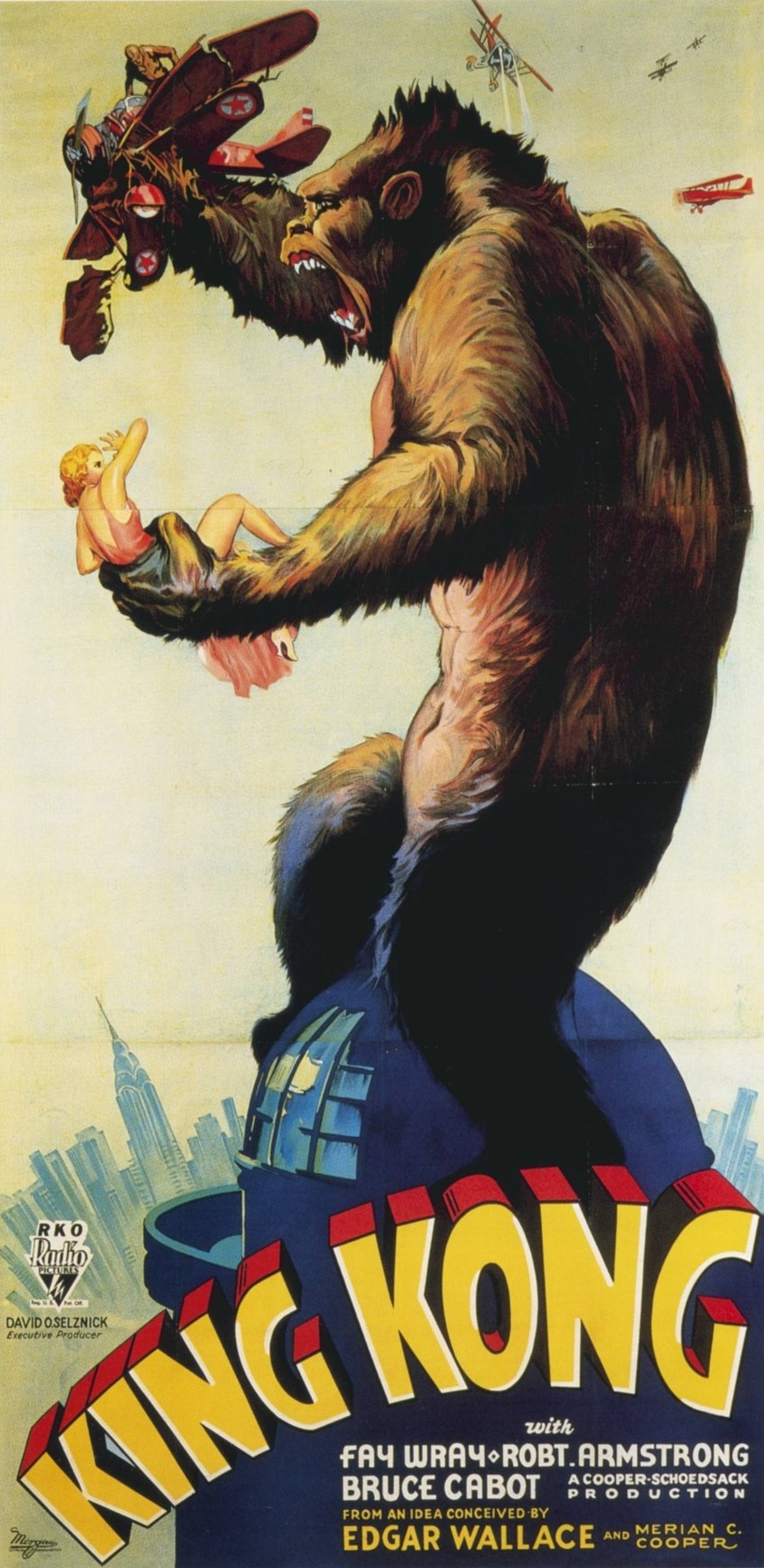
King Kong (1933)*
Image of King Kong Poster
Mighty Joe Young (1949)
Image of Mighty Joe Young film poster

Sunday
The Beast from 20,000 Fathoms (1953)
Image of the Beast from 20,000 Fathoms
It Came from Beneath the Sea (1955)
Image of It came from Beneath the Sea movie poster

Second Weekend:

Saturday
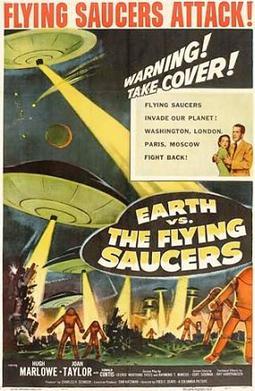
Earth vs. the Flying Saucers (1956)
Image of Earth vs. the Flying Saucers Poster
Twenty Million Miles to Earth (1957)
Image of Twenty Million Miles to Earth film poster

Sunday
The Three Worlds of Gulliver (1960)
Image of the The Three Worlds of Gulliver movie poster
Mysterious Island (1961)
Image of Mysterious Island movie poster

Third Weekend:

Saturday
The 7th Voyage of Sinbad (1958)
Image of The 7th Voyage of Sinbad poster
Jason and the Argonauts (1963)
Image of Jason and the Argonauts film poster

Sunday
First Men in the Moon (1964)
Image of the First Men in the Moon movie poster
One Millions Years B.C. (1966)
Image of Mysterious Island movie poster

Fourth Weekend:

Saturday
The Golden Voyage of Sinbad (1974)
Image of The Golden Voyage of Sinbad poster

Sinbad and the Eye of the Tiger (1977)
Image of Sinbad and the Eye of the Tiger film poster

Sunday
Clash of the Titans (1981)
Image of Clash of the Titans movie poster

Clash of the Titans (1981) [No typo, how can his greatest project not be shown twice?]
Image of Clash of the Titans movie poster

The more I think about our current dearth of classic cinemas, or any kind of re-run movie house culture beyond cable TV, Netflix, and the like (especially if you’re far enough removed from a major city), the more I see it as the death of what proved one of the most important institutions of my childhood. And I often wonder if the “inevitable” passing of the single-screen movie house wasn’t just one possibility amongst many (and I guess the same can be said for its existence in the first place). I wonder what cultivating a social sense of movie going, seems sharing around some of the greatest narratives of the 20th century have really lost their physical context all together. Unlike books, so much of cinema depends upon space, scale, and a shared sense of being in the moment. We’ve lost that tradition to some great degree, but no one seems to bemoan it—-everyone is still weeping over the much heralded death of the book. Whereas as cinema culture has all but died already, and never really got enough disciplinary and curricular respect in the academy to ever really get a proper burial. I feel like cinema, and some kind of larger cultural knowledge of film, is something that is increasingly hard to get, and what better way to work towards the noblest of goals than with a real-life movie theater. A place to experience the wonder and magic of the greatest art form as part of growing up within a community. These are the things I am truly nostalgic for, a deep sense of love driven on by a longing to return home.

*I’m aware Ray Harry Hausen had noting to do with the making of the 1933 King Kong , but King Kong would provide an excellent opportunity t frame the beginnings of stop-motion animation, and suggest what was the very inspiration for much of Harryhausen’s work. Plus, how can you have a double feature with Might Joe Young, and not show King Kong as the first leg?

Posted in bava Summer of Love 2010, movies | Tagged , , , | 15 Comments

Summer of Love: Unwound

I love Unwound. In fact, I love them so much I actually travelled to Seattle from NYC in 2002 to catch their penultimate gig at the NW Asian Art Theatre as soon as I heard they were breaking up. I must have seen them 9 or 10 times since 1995, and they never failed to blow me away. The following clip is the instrumental portion of ‘Terminus” —a song off there near perfect and final album Leaves Turn Inside You (2001)—was performed at Seattle’s Graceland on June 30, 2001. An it gives you an excellent sense of just how amazing this band was live. I keep meaning to write a long, elaborate post of my life as it was lived through the music of Unwound for almost seven years—but that will have to wait. In the meantime, enjoy the Rock ‘n Roll sounds of Unwound.

And here is the original song, go to about 3 minutes to hear the recorded version of what you just listened to live above.

Posted in bava Summer of Love 2010, music | Tagged , , , | 5 Comments

Summer of Love: Keanu Reeves (the nicest guy on the internet)

Image of Keanu Reeves (the nicest guy on the internet)You know, I think this might be my first real break through Summer of Love post, and I say that because part of any real process of cultivating love has to start with owning up, letting go, and letting yourself be vulnerable. I’m about to do all three in one post. In the early 90s I saw about as many movies in the theater as humanly possible. Me and my girlfriend of the time would see two or three movies a day sometimes, and it was a wonderful education, but I still have one regret from those heady days of cinema consumption: I was really hard on Keanu Reeves. I blame my girlfriend of the time, in part, because she was a film student at UCLA, and was being pumped with all these intellectual idea of art and aesthetics, but I have to own up—I trashed Keanu every chance I got. Whether it was him trying to do Shakespeare in My Own Private Idaho (1991) or Kenneth Branagh’s Much Ado About Nothing (1993)—or even a flaccid Johnathan Harker in Bram Stoker’s Dracula (1992). Whatever the film, it didn’t matter, I was unforgiving. I went on and on about how he couldn’t act in my haughty 20 something way, feeling all self-righteous and imperious cause no matter what, I could always lord it over Keanu. And when Speed came out (Keanu’s break through Hollywood A-lister film) I broke all ties with his films, and wrote him off for good. I even forgot that I actually really liked him in River’s Edge (1986), Parenthood(1989) (especially), and Bill & Ted’s Excellent Adventure (1989). I seem to have ignored that he put in an impressive performance in Point Break, (1991) and that he refused to do a lay-up cash money sequel for Speed and varied his filmography, giving as much attention to low-budget, independent films as he did blockbusters.
Now, I still held much of my contempt for Keanu through the 90s, I laughed him off in The Matrix (1999), and held comfortably onto my superiority for almost a decade. But come 2000 I had a scare. I saw Sam Raimi’s The Gift, and while I wasn’t expecting to see Keanu, he showed up nonetheless (as popular actors who vary their roles are apt to do) and his performance as the abusive redneck husband was one of his very best. He was truly haunting, and has come to exemplify the abusive redneck husband for me even more so than Dwight Yoakam in Sling Blade (1996). And while I even tried to fight this realization in the theater seats in 2000 while I was watching The Gift given it was Keanu Reeves, it continued to secretly haunt me. Fast forward ten more years, and it just so happens that The Gift plays just about every night on some premium cable channel (and I have them all!)—and I end up watching it just about every night it’s on. That film is becoming a real favorite of mine, as is A Simple Plan (1998) —long live Raimi!!!

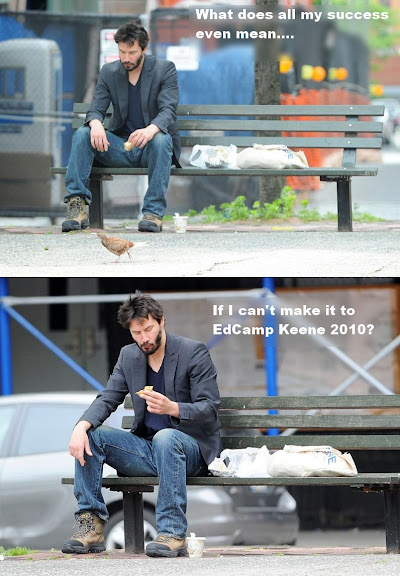
All this said, I had still blocked out my decades of unfair aggression and misplaced contempt of Keanu Reeves until tonight, when it all came clear I had been living a lie, a superficial cover-up of my own deficiencies in my lording it over Keanu’s career. It was a rather accidental series of circumstances that lead me here, but I think it had been brewing for close to a decade, so I am kind of thinking tonight was simply a trigger point. Mike Caulfield’s kitschy advertising for EdCamp Keene brought it on:

Image of Keanu Reeves (the nicest guy on the internet)

Simple enough image, and joyful in its own way. But when I saw that image I started to wonder about Keanu, where is he now? -how’s he doing? -why did I forsake him? I went to his Wikipedia article for the latest, and realized he’d been working quite consistently over the last 25 years, and unlike most actors and actresses there was no real annoying drama or juicy gossip—it was all pretty straight. Keanu works as an actor, he’s not caught up in all the bullshit, he identifies as a Canadian, was a pretty good goalie in high school, and had a pretty tough childhood growing up—moving from place to place and living with step dad after step dad. I never heard him complain about that, did you? And when he was the butt of all the haters self-satisfied acting jokes throughout the 90s I never saw him lose his cool, did you? He took his super stardom in stride, and kept on going to work, doing his job. But then….then I came across this article on the National Post that made me not only feel bad for being a prick to Keanu for all those years, but actually become a fan—to finally be able to confess my love for him. And, what’s more, it is all too apparent I am not alone as the National Post article makes clear:

A comment thread has started on Reddit in which people from all over the internet have stopped in to share their thoughts about actor Keanu Reeves. The comments paint Reeves as the nicest guy in Hollywood – generous with time and money. And well read. And tough. So tough in fact, that we may be witnessing the genesis of a new Keanu Reeves internet meme. Heads up, Chuck Norris.

Some excerpts:

Back in the late 90s and fresh out of college I got my first job as an assistant prop designer on the set of Chain Reaction (Keanu was a supporting actor with Morgan Freeman). EVERY DAY for the last few weeks of filming, Keanu treated the stage hands and “grunt workers” (including myself) by taking us out for free breakfast and lunch. He was genuinely a very nice guy to work with.

I met Keanu when he was in Australia doing the matrix. I knew who he was, but when I asked him what he did for a living he answered “I’m a struggling musician”. I thought that was sweet.

I had a few friends working special effects jobs on the Matrix movies, he bought all of them fucking HARLEYS for Christmas during the shoot for the second one.

There are no bad stories about Keanu. I live in LA and work in North Hollywood, and everyone I’ve ever heard out here tell a story about Keanu says nothing but great things. Everyone loves that guy. It’s made me love his movies. I don’t care how great they are. I love to see him, because he makes me happy. I like to know there’s someone like that.

Paul also told me that Keanu once explained to him why he was getting so many action roles. He had injured himself at some point and had fused vertebrae in his upper back or neck, so when he turned his head, his shoulders and chest tended to follow, because of his limited flexibility. “It makes me look dynamic, rather than disabled” was his explanation.

Chatted with a feature writer for Details who spent basically a whole day with Keanu for his profile last year or maybe the year before. He went to a bookstore with him and (this is in the story) Keanu is REALLY well-read: Keanu mused enthusiastically about Thomas Pynchon, obscure poets, Norman Mailer, etc. as he bounces around the book store. Keanu is also a lot better read than he seems, apparently.

I love that Keanu Reeves is emerging as the nicest man in Hollywood, and by extension the nicest guy on the internet. And maybe, just maybe, the nicest man who ever lived. Given this, it is clear he will forgive me my sins, and at the same time it lets me come clean, a baptism, a washing away of all the petty concerns and unnecessarily harsh judgments. In some odd way Keanu has freed me, and knowing he is so nice makes me envious in different ways—I wanna be that nice too. So, if you ever read this, Keanu, I’m sorry for being a prick in my early 20s, and I take it all back. Being the nicest guy ever, and going by what a search for “keanu + nice” gets you on Google these days, you have something a little bit more than talent, you have what so many of us need: a nice bone in your body—in fact, it sounds like they’re all nice. And if you are really as nice as the numerous stories on the web suggest, than I have to say there is no greater legacy. Keanu Reeves is the Chuck Norris of nice, and being that nice is even tougher than being that tough.

Posted in bava Summer of Love 2010 | Tagged , , , , | 16 Comments