Alejandro Piscitelli – The Facebook Project

I really dig Alejandro Piscitelli. And his project with Facebook, and the passion in which he frames the experiment makes it clear that popular learning can happen within the strangest places, and the very idea of students learning from and within a social application that was experiencing such explosive growth that everyone becomes spectator, participator, and documentarian all at once is simply brilliant. It’s a class of a very particular moment.

Posted in edupunk | Tagged , , | Leave a comment

Summer of Love: 21 Great Stories

Image of 21 Great Stories book coverThe Summer of Love has been sporadic since I’m giving most of my love off the internet this Summer. That noted, I wanted to follow-up my post about Frederick Wiseman’s High School with something a little less “SCHOOL IS DEATH!!!” Not that it isn’t, but I can’t say all my associations with school are necessarily bad. In fact, I have a lot of good ones. And one in particular from my own high school experience focuses around a book that looms quite large in my imagination: 21 Great Stories. This book may very well have been one of the most important “things” in my high school life.

You see, it was a book of great short stories (the title is very descriptive in this regard), but it was more than that to me. It was a book I saw around my house for years before I actually started reading it. I remember at least three of my older siblings reading it while they were in high school, and it seemed afterwards they couldn’t help themselves from talking about Edgar Allen Poe’s “The Cask of Amontillado,” or my brother Kevin (who I shared a room with) explaining the understated cannibalism of “The Two Bottles of Relish” by Lord Dunsany (a story truly worthy of the Infocult). This selection of short stories almost became mythical for me, my siblings typically never talked about books, but this one seemed to spark their imaginations. In fact, it sparked mine, and led me to actually read the book before I even saw high school (one of my siblings kept this school-issued book in our home indefinitely). I got caught immediately with Carl Stephenson’s “Leiningen Versus the Ants,” and soon after was wondering what the hell I had just read in Ambrose Bierce’s “An Occurrence at Owl Creek Bridge.”

Fact is, it’s unassuming cover, and rather hyperbolic title doesn’t really separate it from any other book at first. The fact that I was watching my siblings get hooked in, and listening to my brothers and sisters talk about it made me want to know, and for me that was what sucked me in, the tales themselves simply sealed the deal. I mean look at the line-up below, which is deliciously macabre when you look close enough. Add to that a series of both great and little known authors that cover the genre gamut from action to western to detective story to straight-up horror.

So I began to think, hey, will the web produce the same thing?

Table of Contents

I found and linked above to 20 out of the 21 Great Stories available online “freely,” and the search and discover process was rather interesting. For the public domain works like Poe’s stories, Arthur Conan Doyle Jack London, and Ambrose Bierce it was fairly straightforward—a link to the Gutenberg or Virginia University etext projects. And then there were a few pdf files I discovered on obscure edu domains for Bradbury, Bryan and Brand’s stories (all of which I believe are still under copyright). For other copyrighted texts like Steinbeck’s The Pearl or James Joyce’s “Eveline,” it was much harder to find anything, most of the first 20 or 30 links on a google search were Cliff’s Notes-like cheats or paper writing services, which a few scholarly critiques thrown in, often hidden behind the JSTOR paywall. I could only find these two on Scribd, and they are rather Google adlink infested, but the best I could do. The only story I couldn’t find in any way shape or form was Kaatje Hurlburt’s “Eve in Darkness,” a rather obscure, but excellent, story by an African-American woman writer from NYC. The only traces were interrupted excerpts from Google Books—which did provide a few of these works as well.

In the end, it became rather apparent that very few publishing platforms at colleges, universities, or even high schools were providing much in the way of critical discussion, analysis, interpretation, or general thoughts and notes. And in the end, this is the anecdotally apparent tragedy of the closed web, a simple anthology of Great Stories that are part of a larger cultural inheritance are left to the online dogs to spam, paywall, adlink, and generally commercialize while the commentary, consciousness, and collective understanding of these works that should ideally be happening at educational institutions and beyond seems all but absent. Can;t help but think we’ve grossly overstated the good Google has done for books online, and wonder if we haven’t generally conceded our mission to the link mongers and spam whores. Anyway, I figured this would be an interesting test, and while I like the idea, I wonder if simply buying a used copy of the original 1969 original for as little as $0.65 on Amazon.com may be a far better and more convenient bet. Sometimes the open web doesn’t seem so open, and I can’t help but think universities and colleges are in many ways to blame for this—seems like we can get the content for just about anything—even if with some copyright/spam-driven difficulty, but what’s much harder to find is actual authentic thinking and learning around these works out on the open web for all to see. Isn’t that were the education comes alive on the web? Don’t we have the tools to make this possible already? Do we really need Apple and/or Google to fix the web for us at an ever increasing financial and spiritual fee? Cheap essay writing service sites have already figured this out, why can’t we?

Odd, this started out as a Summer of Love post, and even an attempt to trump up the power of school and education, but look where I have landed….again. But if you want to see my pain, do a Google Search for James Joyce Eveline (arguably the best story of the collection), and look at the horror that awaits you—so much crap (save Wikipedia) before you get a useful and/or thoughtful resource whether inspired by an institution or not. Depressing.

Posted in bava Summer of Love 2010, books, literature | Tagged , , , , | 12 Comments

UMW Blogs Upgraded to WP 3.0 (a play-by-play)

I’m glad (and relieved) to finally say UMW Blogs has been upgraded to the WP 3.0 merged core files without a hitch. Whew! This was a burner for me, a bit more fear and trembling going into this one than usual, but alas all is good in the UMW Blogs hood. In no small part thanks to Ron Rennick who recently upgraded his SharDB plugin to 3.0.1, which did the trick in terms of making sure all was smooth with the multiple-database setup upgrade. You rule Ron!

As for the rest, it was pretty standard, and only one pretty minor hiccup in regards to the Atalhuapa theme which I will outline below (and the fix below comes care of the inestimable Luke Waltzer).

Basics before upgrade
You know the drill by now: Always back up all files and the database (or in my case databases), and make sure not to copy over wp-config.php as well as the wp-content directory.

OK, done with disclaimers, now for some preliminary steps before copying over the WP 3.0.1 core files, make sure you
delete the wp-content/blogs.php file for those upgrading from WPMu (which is whom this tutorial is for).

You will also need to change the .htaccess file, particularly the line pointing to wp-content/blogs.php, which now needs to point to: wp-includes/ms-files.php

This line in our .htaccess file now looks like this:

RewriteRule ^(.*/)?files/(.*) wp-includes/ms-files.php?file=$2 [L]

You should also delete your wpmu-settings.php file located in the root install directory.

If you are like me and you are using SharDB to spread your sites/blogs across several databases, you need to update to Ron’s Rennick’s latest version of SharDB.

And where ever Ron is, Andrea is not far behind (or is that vice versa?). In order to ensure that all the blogs using the default theme (which was Kubrick) are changed to TwentyTen, include the following call in your wp-config.php file (a tip you can find thanks to Andrea here):

Our default theme define in the wp-config.php file looks like this:

define(‘WP_DEFAULT_THEME’, ‘default’);

And to contextualize this a bit more, we changed the twentyten theme folder name to default, and moved the old default theme files for Kubrick into a folder called Kubrick for any of the faithful who still want to pursue it (be sure to make it available in Super Admin). Now, all sites on UMW Blogs that once had the default Kubrick theme now have TwentyTen automatically–which also means Menus will work for all those sites, and there are a good number.

Finally, I was sure to upgrade DSader’s More Privacy Options plugin before upgrading given it was throwing errors in the bavatuesdays WP 3.0 setup, I keep the new version of this plugin in the wp-content/mu-plugins directory.

The Actual Upgrade
Now run the upgrade by simply copying all the core files and directories, except wp-content and wp-config.php, into your WordPress install.

After that, go to http://yourinstall.com/wp-admin/upgrade.php and upgrade the database, cross your fingers!

If that works, go to Super Admin–> Update and updates all the individual blogs, this will take a while if you have a lot.

Finally, in the Dashboard you’ll be asked to add a Nonce Salt to your wp-config.php file. Something like:

define( ‘NONCE_SALT’, ‘yoursuppersecretkey’ ); to your wp-config.php file

The Ongoing Aftermath
The upgrade should then be done, but there may be some cleanup. For example, Luke Waltzer pointed me to this fix If you were using Ataluapa in WPMu, you’ll find none of your customized header images in Ataluapa are there, it returns to the default. This is because the theme is looking for the file wpmu-settings.php (now deprecated) instead of wp-settings.php. A quick find and replace of wpmu-settings with wp-settings on the following three files in the Atalhuapa theme did the trick for me:
functions.php
functions/bfa_header_config
functions/bfa_rotating_headers.php

And, that’s about it thus far, it was all rather smooth in the end. Though I am sure many more issues will emerge over time, I’m sure they will prove resolvable and I am quite relieved—especially given 3 sites within sites (what would now be called multi-networks?) http://greenwoodlibrary.org, http://facultyacademy.org, and http://hamptondigitalhumanities.org all survived unharmed. Saying that, I was also relieved to see that mapped domains were also left intact.

And what’s more, Ken Newquist at Lafayette College sent out the following email to the wp-edu mailing list, and it provides an excellent list of issues and updates on their road to an upgrade to WP 3.0. I’ll reproduce it in it’s entirety below, and it is very good to know new activations of Next-Gen Gallery may have issues:

Everyone,

Back in June there was some talk about WordPress 3.0 and its compatibility (or lack there of) with popular plugins and themes. We’ve recently upgraded our production instances of WordPress to 3.0, and I thought I’d give a rundown of the the problems we encountered.

==More Privacy Options==
The plugin continues to work, but it generates a PHP fatal error when you edit a site’s properties as an admin, making it impossible to save configuration changes. The latest version of the plugin fixes this problem.

==nextGen Gallery: Ignoring MultiSite directory options==
nextGen Gallery has issues with WordPress 3.0 multisite. While existing installations are working ok, folks who add the plugin after the upgrade get this error message:

“Directory wp-content/gallery/ didn’t exist. Please create first the main gallery folder !”

The problem is that Blog Directory Path, which is a network-wide option set under the super admin menu, is no longer being respected at the per site level by nextGen. If you manually set the site’s directory path using the site’s ID (available from the main site directory list in the super admin view), then things work properly, but the default setting is now incorrect.

The plugin author is aware of the problem, and is working on this and other MultiSite-specific issues for the next release.

http://wordpress.org/support/topic/412008?replies=7
http://code.google.com/p/nextgen-gallery/issues/detail?id=286

==nextGen Gallery: Slideshow links don’t work on a static home page==
If you insert a nextGen Gallery into a page, and then make that page your home page, the link to the slideshow will not work.

==Anarchy Media Player==
Anarchy’s settings page no longer loads under WordPress 3.0.

==Mandigo (theme)==
The Mandigo setting page doesn’t load if you’re using Mandigo 1.40.1. It works properly with the current version.

==Mandigo + nextGen + WordPress 3.0==
Here’s a very specific bug — Mandigo uses an older version of JQuery in its theme, one that doesn’t include a particular method that nextGen needs. This causes a fatal error in NextGen, which then causes the JavaScript portions of the Mandigo theme to stop working.

That’s about it, and I’ll be sure to blog any and all issues, problems, or fixes we come across, and I am sure there will be more than a few. In fact, I have to do this fix for Userthemes, thank you Boone.


Posted in UMW Blogs, WordPress, wordpress multi-user, wp30, wpmu | Tagged , , , , , | 10 Comments

High School (1968)

Frederick Wiseman’s fly-on-the-wall documentary style is, at its best, some of the most powerful documentary filmmaking of the last fifty years. Titicut Follies (1967) is a masterpiece, and few films so efficiently capture the absurdity of reality so thoroughly in the first ten minutes.Add to that madness it’s unique distinction of having been the only American film banned from release for reasons other than obscenity or national security—in this case the privacy of the various inmates he filmed—and you have something special.

I am also a huge fan of his 1997 documentary Public Housing, which is a painstaking look at the day-to-day life in a public housing project on the South Side of Chicago (and it very well could have been the inspiration for a large part of the first season of The Wire).

So while I was searching around for stuff on Wiseman recently, I noticed that his second film made the year after Titicut Follies is a fly-on-the-wall documentary about a lower middle class high school in Philadelphia titled High School. Below is a scene I found from the film thanks to MOMA (nice to see MOMA giving out embed code), and it is scary how quickly it becomes apparent that the role of school seems to be designed to crush the spirit of the student, and teach them to fall in line.

“We are out to establish that you can be a man, and that you can take orders.”

And what’s remarkable to me, is that in this scene the kid is vehemently arguing his case, trying to communicate his position to the Dean. But, alas, like most of us, he finally concedes principles to institutional authority and decides to accept his unjust punishment.

I really wanna get my hands on this one, I think a few mashups would be in order 🙂

Posted in movies | Tagged , , , , , | 7 Comments

Get a job hippie! Part Duex: WordPress Developer Wanted

Remember this?


Image credit: Hippies de Valdivia (Chile) by leo.prie.to

After the last time I did a post like this I ended up regretting it, that position was never filled, and I had to ultimately eat some blog crow—and I don’t like that.

But, but, but, I can proudly say that those days are over, and we really are hiring, but this time we want a web developer, web content manager who is familiar with open source technologies, particularly WordPress. That’s right, looks like the university is committed to putting the http://umw.edu website on WordPress, and the call for a Web Content Manager has been posted.

If you apply for and get this position, you’ll be working with our inimitable web master, Cathy Derecki, on bringing WordPress to a college community that is ripe for deep integration of all kinds of cool stuff. Some syndication rich department sites, relationships between those sites and the course and student work on UMW Blogs, as well as some challenging and interesting architecture issues. It promises to be a lot of fun, and you have the opportunity to build a website from the ground up—visionaries welcome 🙂 I’ll be part of the process for at least the next year. But, the fact remains, we need to bring in someone who can both think through and integrate the code “that makes the young girls sing…you are music and you write the code.”

I mean come on, we’re in a depression here, and you could be the proud owner of a state job, health insurance, a regular paycheck, retirement, vacation…hell it’s almost like you died and went to commie heaven, you dirty hippies. So what are you waiting for? –this patchouli patch ain’t gonna smell the room up all day, put down the hackysack and get yourself a real job!

Posted in umw, umw.edu, WordPress | Tagged , , | 11 Comments

TEOTWAWKI

Having taught online for years and being one of those overproduced PhDs who was forced to work in the for-profit sector to eat, I think we are at Chomsky’s stage 6. I developed a course for Embanet and it was the worst possible educational experience ever. I know tons of my counterparts, none of whom, despite great schools, publication, teaching, etc can land a FT-TT job, and are forced to work in the for-profit sweat shops of academia. We are all called “faculty” or facitators and treated like migrant workers. No autonomy, just mandates and shut up. How I wish I had chosen another path… I am getting out soon.

The end is nigh people. We are selling credentials, not educating. Fool yourselves if you’d like, but those of you with tenure are the last generation. Education has been outsourced like the rest of America. We are enaged in creating compliant wage slaves and not educated citizens. Prof Trutteller has it correct. The era of F2F is over and online education with its watered down realities is here to stay.

Quoted from the comment stream on this Chronicle article. I do love the whole “the end is nigh people” sentiment, it brings out the educational survivalist in me.

And I was worried about the LMS all this time, jeez, I really lost the forest for the trees.

But in other, better news, the Library of Congress reminds us there is something resembling sanity still possible in the world of copyright, more from Kathleen Fitzpatrick here.

Posted in copyright, experimenting, intellectual property | Tagged , | 7 Comments

Summer of Love: The 400 Blows

Just watched François Truffaut’s 1959 masterpiece The 400 Blows again tonight because I needed to be transported back to something else, something other, and few, if any, films can do it like this one. This may be one of the greatest meditations on childhood ever, and the pacing coupled with the long, intimate, and kinetic scenes are spellbinding.

Here are my three favorite in no particular order:

Punch and Judy scene:
The way in which the childrens’ energy and excitement at a puppet show, accompanied by the long intimate studies of each of their faces is magical. My favorite scene this time around.

https://youtu.be/0JnZhXPInr4?si=bsu8ObBWvdJILFdK

The Rotor scene: A brilliant idea beautifully captured. Watching the young protagonists trying to pull himself outside of gravity in many ways captures the whole spirit of the film for me.

https://youtu.be/ZcpjrRatyk8?si=dmtsQfKp226XAcnp

The Running scene:
To run like this again….long shot anyone?…Scorsese who? —French New Wave at its best?

https://youtu.be/WkMXJU7n-5U?si=6aah1qW9a4hFmskS

Second time this year I have come back to this film, not sure why I crave it so as of late. Must be that sense of joyous freedom, youth, and possibility everywhere denatured by life and reality.

Posted in bava Summer of Love 2010, film, movies | Tagged , , , , , | 8 Comments

Summer of Love: Bava’s Twitch of the Death Nerve


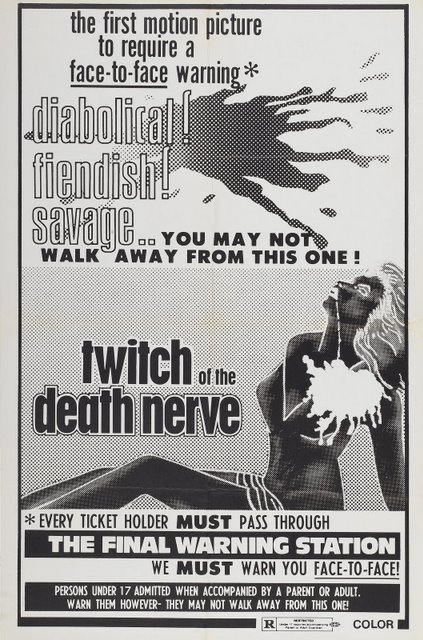
I recently saw the above movie poster for Mario Bava’s Twitch of the Death Nerve (1971), and I just love the whole sense of occasion created by the hysteria: “The first motion picture to require a face-to-face warning!” The exaggeration and performance that is part of the moviegoing culture fascinates me to no end. I’ve been part of 1970s dress-ups, where ushers were tasked to put on Darth Vader or Chewbacca outfits and entertain the lines. What better to get you in the mood? And the fact that one of Bava’s masterpeices, and for many Twitch of the Death Nerve is just that given it’s macabre yet loose—almost tongue and cheek—approach to horror, murder, and gore which gives way to the proto-typical slasher film, the grand daddy of films like Halloween (1978), Friday the 13th (1980), Prom Night (1980), and The Slumber Party Massacre (1982), to name just a few. And these films are particularly special to me, because they mark for me the golden age of the Home Video craze, in the early 80s films like this were now at our finger tips at the local movie rental stores, and the cover art, and pure formulaic gore of much of the b-movie machine saw new life (and markets) on shelves across the country. It was a time before Blockbuster dominated the market for home videos (a 15-20 year reality starting in the early 90s, and now all but at an end) and before Cable turned on the heat with pay-per-view, both of which squeezed out most access to alternatives and possibilities—though the web in the 90s helped alleviate some of this, and then Netflix came along which actually enjoys some of that local movie store feeling, but at the same time not. [Aside: hmmm, BlockBuster (B….b…., do I know anything else like this?]

But I digress, fact is Bava brings the idea of artistic gore to new heights in Twitch of the Death Nerve, and that is all too apparent from the early promotion of the film in the US. The gimmick of the “face-to-face warning” was also run on radio spots for the film. Check this one out from 1971:

Download Touch of the Death Nerve Radio Spot

I love the whole idea of making people think twice about seeing the film you;re promoting, much in the tradition of Hitchcock’s trailer for Psycho, the threat of psychological shock and a more generalized threat to every and anybody planning on seeing this film is not unlike a roller coaster—something could go terribly wrong, and that is why we ride it. Now add to these promos the most badass one of all, and I think you have a great movie without even seeing the movie—which is great by the way. The following 3 minute trailer for Twitch of the Death Nerve (although the film had several international titles, like Bay of Blood and Carnage, which was the initial U.S. title) is for the first release of the film in 1971 by “exploitation specialists” Hallmark Releasing Corporation…

…. [who] copied their own successful advertising campaign for Mark of the Devil by proclaiming that Bava’s film was “The Second Film Rated ‘V’ for Violence!” (Devil having been the first.) The movie was apparently unsuccessful, and it was withdrawn and re-released in 1972 under its most commonly known title, Twitch of the Death Nerve. It reportedly played for years under this title in drive-ins and grindhouses throughout the country.

[Link]

And the trailer they put together for this one is possibly one of the most psychedellic works of art I have yet to see in the movie trailer business. With the colorized film cells, and seductive outlines of what’s happening that let you almost experience the brutal murders as if through a colored veil. See for yourself, it’s gorgeous:

Twitch of the Death Nerve is arguably Bava’s most influential film, given it controlled the tenor of bad horror movies throughout the 80s, even more so than the US classics like Night of the Living Dead (1968), Last House on the Left (1972), and Texas Chainsaw Massacre (1974). The formula was simple, and like most Bava films, he focused on aesthetisizing the gore, and playing with effects and stylization, caring little or nothing for the convoluted plot. All the more the case when you get the crazy ass ending of this film, which for me stands as one of the most shocking endings I have yet to see on film. It’s Mario Bava in a cinematic fever pitch, playing fast and loose with the horror genre—and coming up with the Slasher film formula in the process.

And then there are the 13 murders, each one more preposterous than the previous. And as a special Summer of Love treat. you can find them all below in a chronological filmic collage documenting all the sumptuous blood tones of bava on a killing spree:

Posted in bava Summer of Love 2010, film, movies | Tagged , , , , , , , , , , , | 1 Comment

umw.edu and WP 3.0: some initial architectural thoughts

While nothing is in stone yet, it looks pretty certain UMW will be moving its entire website to WordPress over the next year. This is really exciting for me, and it goes a long way to illustrate the impact UMW Blogs has had on the online environment at UMW more globally. What’s more, if we do this right, I really believe it will have the potential to seamlessly integrate the amazing community of teaching, learning, and discovery happening on UMW Blogs into the umw.edu domain on a department by department basis, if not an individual by individual basis. But to do this right, I think we need to focus on the architecture first, and huge kudos to Cathy Derecki for getting this conversation started out in the open on her blog The Transparent University. Her latest post focuses on whether our install should be using subdomains or subdirectories, and I recommend you reading it  before going on, because it will contextualize my ideas below (which are also in her comments in a more specific form).

Subdomains? Subdirectories? Or mapped multi-networks?
In her post, Cathy is looking for a means to do subdomains for larger departmental/college entities like the College of Education within the umw.edu domain. Something like http://education.umw.edu, and the sites on top of it would be something like http://education.umw.edu/advising. But that’s not really a subdomain setup, because if it were it would be http://advising.education.umw.edu when you created an advising blog—or any other blog under that subdomain. The hierarchical point for architecture Cathy raises is a good one, and I can see the value of subdirectories following a more familiar logic within particular department or administrative sites, even though but the “3 dimensional logic of subdomains” (as Cathy puts it) has its attraction.  Though, to be honest, the real value and distinction of subdomains really has to do with mapping domains on top of a site/blog. As far as I know, and this may have changed, you can’t map a domain on top of a blog using subdirectories. Now this may not be at all important because domain mapping is really for an individual’s site, like http://warrenrochelle.com (a mapped domain on umwblogs). If we were thinking about using the umw.edu space to give faculty, staff, and admin their own sites, while also providing them the option to map their own domain, then subdomains would be essential (am i right in this?). And it would be pretty radical for a university to provide such a slick and cool service on their main domain, and one can ultimately see some value in it. All that said though, UMW Blogs can do that for a faculty, staff or student just as easily, so it may not be key. And if faculty want a professional site on umw.edu, nothing prevents them from creating umw.edu/professorx and using a provided theme for creating an integrated web presence on the umw.edu domain.

Now, the plugin Cathy points to in her post is Donncha’s original domain mapping plugin for WPMu, and we are using this on UMW Blogs. It works beautifully, but all it does is lay a site like sacs.umw.edu on top of sacs.umwblogs.org. It simply masks the domain with a new one, it doesn’t provide subdomains on top of a subdirectory structure.

That said, I was thinking about this a bit, and there may be a way to get at the structure Cathy describes—namely education.umw.edu/advising or business.umw.edu/advising, etc.—that would require not domain mapping, but multi-network domain mapping (or subdomain mapping). In other words, mapping entire networks on top of the existing umw.edu, but still using the same database and installation (no separate installs, hence no extra maintenance).

Here’s how, on umwblogs.org we have several entire networks mapped on the same install. For example, http://greenwoodlibrary.org is one network that enables its own subdomains, and facultyacademy.org is another providing its own subdomains. And whereas http://warrenrochelle.com is simply one site mapped onto http://rochelle.umwblogs.org, these other networks can have innumerable sites within them, like this: http://civilrights.greenwoodlibrary.org

So, in theory (and I believe practice), if we keep the WP 3.0 setup as subdirectories, and we create a series of mapped networks (when a WP 3.0 site has enabled multi-sites it is called a network, many networks are called multi-network—all new terminology for me, so forgive the slippage).  And given that mapped networks (versus mapped sites) would be mapped to various subdomains like education.umw.edu, business.umw.edu, etc., we can actually start thinking of the hierarchical structure along the lines of subdomains for the most important networks—maybe colleges, departments, major administrative offices, etc. So, we can install the whole site as subdirectories, then use the various subdomains we decide upon http://education.umw.edu, etc. as separate networks which will actually create sites within them like http://education.umw.edu/advising

Now, how will this be done? Well, there are a ton of plugins for this, we are using an old one on UMW Blogs, but this one may work just as well: http://wordpress.org/extend/plugins/yet-another-multi-site-manager/

And I’m sure there are some others we can look at. So, to reiterate, this wouldn’t require a subdomain setup for the multi-site option, we’d use subdirectories, and use select subdomains off umw.edu to map on new networks, like education.umw.edu (which is not actually a subdomain install, but a subdirectory install within a subdomain, i.e. education.umw.edu). The beauty of which is it’s all the same database, user management, directories, etc. And makes me think if we want to play with BuddyPress for directory and exploration purposes, it will still provide all the user profile and blogs/sites from the various networks off of umw.edu—am I right in this?

And as I was looking around at the plugins I realized something else kind of cool,  you can control the themes being used on a network by network basis, so each of those multi-networks can have a unique set of theme options for that network. So a particular tweak to education, business, etc. See this plugin for an example: http://wordpress.org/extend/plugins/multisite-themes/

Which, in turn, suggests the important place of theming some kind of uber navigation to bring this hierarchy back together in some easily navigable form. Wondering if the top admin bar in BudyPress may actually provide some of that, or at least the basis for that.

So, those are some of my ideas, I’d love to get feedback, as I’m sure Cathy would too, about this approach, and how others might attack it differently. Anyone see issues in this idea (if you even understand it 🙂 ), or something I am simply overlooking in my abstract naivete? I’d love to know, but remember this is the Summer of Love, so go easy on me.

Posted in umw.edu | Tagged , , , | 10 Comments

Summer of Love: Domain Mapping


Image credit: This cheesy t-shirt over at neatoshop that I love.

My love affair with domain mapping has been well documented on this blog, and last week, before I went on vacation, UMW quietly took a big leap forward in terms of experimenting with domain mapping as a way to bring some of the more official sites being built on UMW Blogs back into the umw.edu domain. Fact is, we have successfully mapped a site on UMW Blogs for the University Faculty Council on this domain: http://ufc.umw.edu (running all the while on http://umwblogs.org).

It was pretty cool to see how easy and pleasant the whole process was (Deb Hovey in Network Services made it a cinch, and the future of IT at UMW is looking bright for all of us these days 🙂 ), and this marks a really important moment for the larger community on all levels seeing WordPress as a solution for communicating and making distributed publishing to the web easier. Our University Relations folks are framing an information site/newsletter running through UMW Blogs, but also pointed to a umw.edu namespace—which will provide official information for the community, and allow more direct conversation across the environment (more on this as it unfolds). Fact is, UMW is poised right now to make a complete transition from our current website structure (a homemade php template driven CMS on top of Adobe Contribute) to a full blown campus wide adoption of WordPress 3.0 Multisite. Looks like I may be working on the consulting with this, and I am now a proud member of the forming web committee. What’s more, there should be a forthcoming advertisement for  a hardcore WordPress developer at UMW to be posted on the bava in the near future 😉 That’s right, UMW is ready to become a WordPress shop for its primary web publishing tool—if all the stars align—and I am just beginning to get excited thinking about the possibilities.

Like why can’t we make UMW’s History and American Studies department site, or the Economics department site, stock for departments. Then start thinking about ways to feed in course content, or aggregate activity through syndication around departments and disciplines—a space where the work on UMW Blogs can be easily featured on umw.edu. And then there are faculty personal sites. Hey, our Novell storage and network space— with the relatively unused www files for hand coded HTML—is going away this November. Why can’t we re-open the discussion of faculty members controlling their own site, and even getting a umw.edu domain to boot if they like, though they could always map their own like Warren Rochelle, to name just one of more than 70 mapped domains on UMW Blogs.

Fact is, this idea is still percolating around campus, and between Zach Whalen’s domain mapping work with his Writing through Media Class, various faculty members simply grabbing their own, and a Digital Storytelling class very much rooted in the idea of one’s domain as a sense of ownership and charge of one’s intellectual presence and online data—a course undergirded by Gardner Campbell’s Personal Cyberinfrastructure epiphany—I would think the conversation and possibilities are just starting to emerge.

And UMW student’s are increasingly realizing the value of creating a domain for framing their experitise. Check out this site created by a UWM student for no class on the fly: hirehassan.com —not a bad way to show off your portfolio work. And to see a beautiful instance of this with student work, check out Rachael Dawn’s Portfolio here, very impressive (and part of Zach Whalen’s aforementioned Writing through Media course).

The domain of one’s own is always fresh to me, and when I see factuly like Jessie Fillerup grabbing and mapping her own domain to blog about Tennis, or Gregg Stull creating his own blog and domain though his own bluehost server, I know it’s a concept we can still go a long way towards cultivating and nurturing a sense of the possibilities throughout the year. And while the actual mapping is not always essential to frame one’s presence, the commitment and notion of conceptual ownership of one’s data and digital identity begins to really matter. And that conceptual shift, whether one chooses it over the long haul or not, is important to a sense of thinking about the deeper questions of digital identity, literacy, and the critical creation of one’s self.

And what’s more, the underlying technology and architecture fueling such a web publishing platform need not be limited to WordPress, it can act as our hub, but it allows us to rethink our use of MediaWiki—which currently runs our documentation, courses lists, and various pages for course sites. How does a well-gardened wiki—as Brian lamb points out here—-help us move  both within and beyond the personal to the collaborative with open technologies? Well, if we look to the outstanding work the UBC team has done to document their process with creating a Resource Management Framework on an enterprise scale, as well as the work the CUNY Academic Commons has done integrating MediaWiki seamlessly into the WPMu/BuddyPress flow, we get  the roadmap to a real powerful content creation frameowrk that is open and flexible. And just yesterday, Joss Winn articulated the benefits of such a system quite brilliantly in this video on WordPress Beyond Blogging (Winn FTW!):

WordPress beyond blogging from UKOLN on Vimeo.

So, seems to me like certain things in the web publishing domain with open source tools are still around, in fact, they are leading some of the most innovative examples of integrating the idea of fluid publishing, identity, and networked learning into the academy on institutional scales. And while the EDUPUNKS are constantly being counted out, or co-opted as the poster children for the decline of education, and by default Western Civilization —I think we still have a few more concrete examples of why all the hoopla around vertically integrated LMS, standards integration, et cetera, still doesn’t get to the heart of the matter—you can’t innovate in a prison house, no matter how vertically integrated it is (just a more tightly run and designed penitentiary). I mean we can look to other companies within the LMS space, or write love letters to Google, but whether or not the free and open web has been bought and sold already, and we re just a burnt out hippie threat, I can’t help but think reporting the meainstream vision of edtech and the web will ever get us anywhere. We need to promote and support what is happening now that is good. And I have yet to find an example in BlackBoard—got any I can see?

Point is, the open web is not a convenience we need to evolve, it is a public good we need to preserve and foster. You cannot do that when it’s all been accounted for and the gig is up—if “open and free is an ideology” then isn’t “closed and expensive” just as ideological as well—and shouldn’t the two be in deep struggle on a larger stage? Rather, what’s happening, is the one is trying to subsume the other under cloud of night and terminological uncertainty. The LIS standard that’s been announced makes systemwide integration easier perhaps, but does it give people control over their identities and data? Does it promote a sense of one’s space and value on the web in real time? Does it deliver on the idea of a Personal Learning Network on the open web undergirded by syndication and community? These things are integral to teaching and learning on the web right now, and they have little, if anything, to do with an LMS, or so it seems to me.

And that is why I love domain mapping so much—it makes all this so perfectly clear to me.

Updated:

All this said, I forgot to mention one of the projects involving an LMS I am actually excited about, the open LMS being openly developed by Stas Su?cov. Given the trajectory UMW is on right now, we can start experimenting with Stas’s work as soon as this Fall, and start thinking how our setup will take care of all the bloated overhead and insane costs that the dreary LMS provides us at such an insane price. I’m ready to push for a replacement, and if I have to go edtech guerilla, as Matt Gold lays the framework, I will. Remember, that $116 million dollars during these times of austerity came from all the blood that’s been sucked out of institutional coffers through such a deal with the devil. Oepn is not over, it’s just been forgotten because there is so much other cool stuff to report on in edtech, like how the iPad has made everything else irrelevant, and at the same time costlier 🙂

Posted in digital identity, digital storytelling, edupunk, Uncategorized | Tagged , | 9 Comments