

Or it might also be found more easily under the title “uninstalling usb-driver.com demo driver,” but either way I hope someone else who has this issue avoids wasting as much time as I did on it.
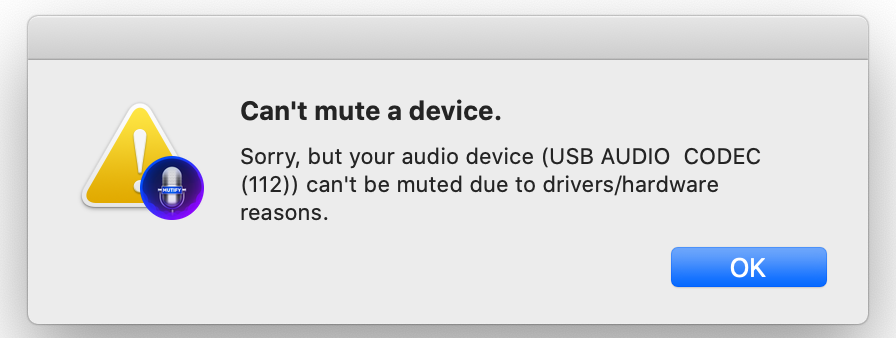
I chose to uninstall, which is what this post is about, but some quick background first. The reason I installed the demo in the first place was to see if I could get a driver fro my USB turntable that would prevent the above message from showing when I try to mute my mic with a keyboard shortcut (more on that in this post). Well, not only did the demo audio codec not solve that issue, but now it was beeping every 30 seconds when I plugged in my turntable, not good.
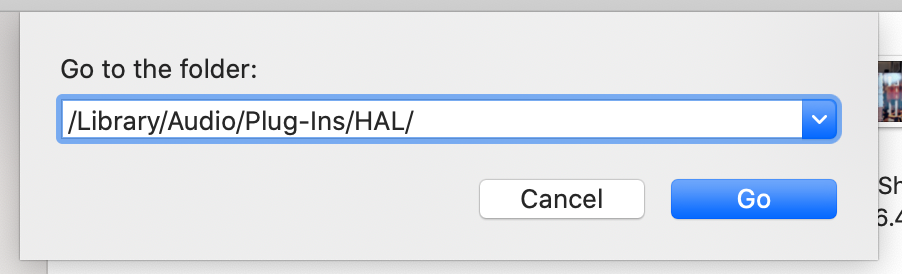
So, if you are having this issue on a Mac open Finder –>Go–>Go to Folder and /Library/Audio/Plug-Ins/HAL (not ~/Library as this guide suggests thanks to this forum post for the heads up) and delete the usb-audio.driver directory.
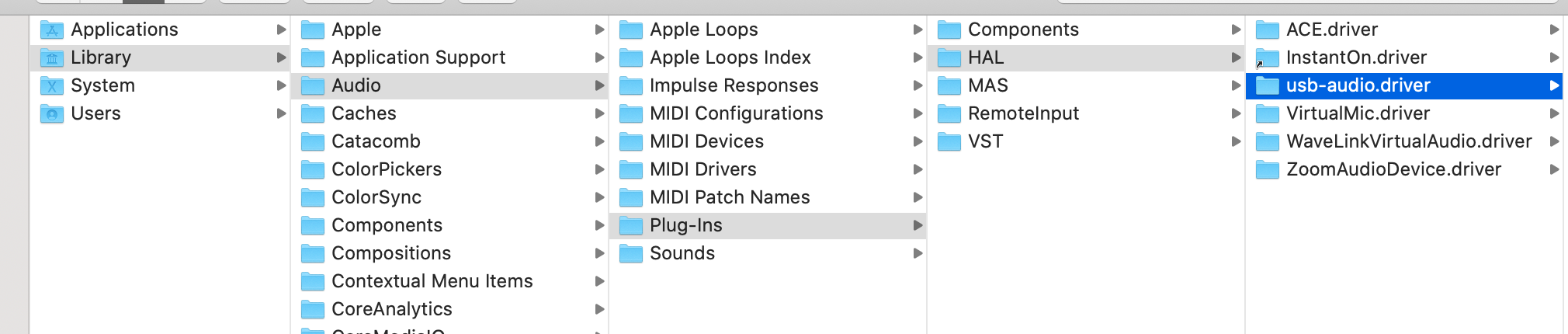
That will get rid of the driver, and after that restart the computer and the USB Audio Codec should be back (rather than USB Audio Codec Demo) when you plugin in your USB device.
If you are having this issue on a Windows PC this guide may work for you.
That’s it, not thrilled at how much time I spent on this at all, but glad it is behind me and if I am dumb enough to do it again I’ll find my own blog post 🙂
The idea was simple enough, broadcast a record over ds106radio and ds106tv. I mean I have been around this block before, but nothing comes easy when you are mass communicatin’. I had been trying to figure out an issue I already wrote about with Mutify to clean-up my incessant mouse clicks while broadcasting on the radio and TV, turns out some of that playing around has come back to haunt me in the form of a beeping sound every thirty seconds when the turntable USB cable was plugged in. I’ll save the gory details for a follow-up post, but suffice to say my attempt to broadcast a #vinylcast was thwarted by my attempt to clean-up my broadcasting act. What did Bruce say? One step forward, two steps back…
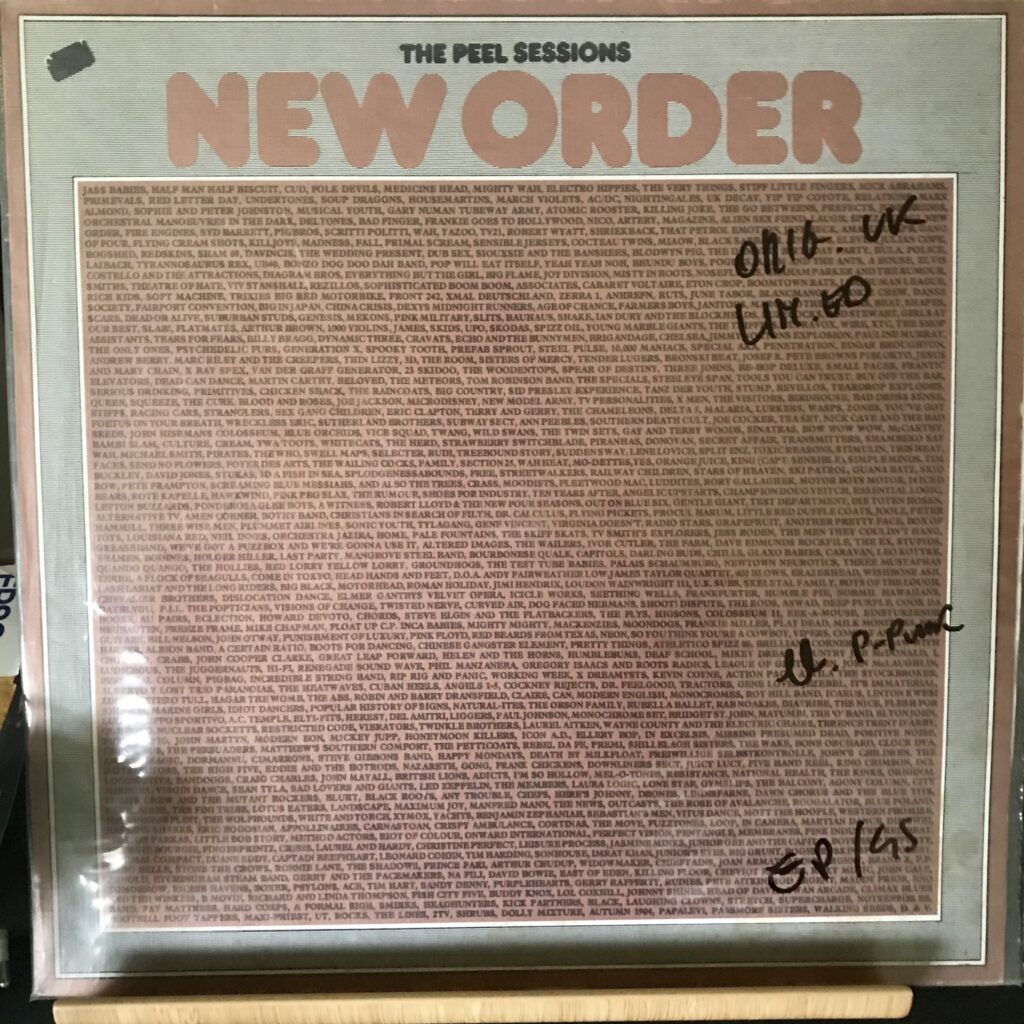
Anyway, after figuring out and getting rid of the incessant beeping noise every 30 seconds, I was able to get back online and broadcast Man or Astro-Man‘s third studio album Experiment Zero from 1996. I picked it up in Los Angeles at Amoeba Records last November, and the album cover and inserts are everything.
I talked a bit about a Man or Astro-man? alarm clock I coveted in the 1990s, but no image is readily available, so apologies. But it was still the most awesome merch I have ever seen, basically a kids alarm clock like the click Batman and Robin version, but this one with an astronaut battling with a psychedelic scifi space monster—truly epic. I am glad to say the vinylcam was pretty seamless, there was a brief issue with the “press button to activate movie shooting” message, but I am working on resolving that. The good part is the audio was consistent, and while the radio crashed, the video stream did not. So, as I have learned recently, you can never have too many streams  We are living the scifi moment Man or Astro-man? could only dream of in their scifi surf punk philosophy.
This is another episode of Reclaim Today focused on our playing around in the Reclaim TV Studio. In this episode Tim does a pretty impressive show and tell of the work he has been doing with Elgato’s Stream Deck for making a seamless streaming broadcast, as well as demoing how he made a Raspberry Pi4 into a streaming bridge based on Aaron Parecki’s YouTube video that demonstrates this brilliantly. In short, this allows me to stream directly to that Raspberry PI which is yet another input for the streaming setup, super cool! What’s more, Tim also figured out a way to get shortcut keys working in Streamyard (which are not endemic) using the Hotkey listener Vicreo in tandem with the Chrome extension Tampermonkey.
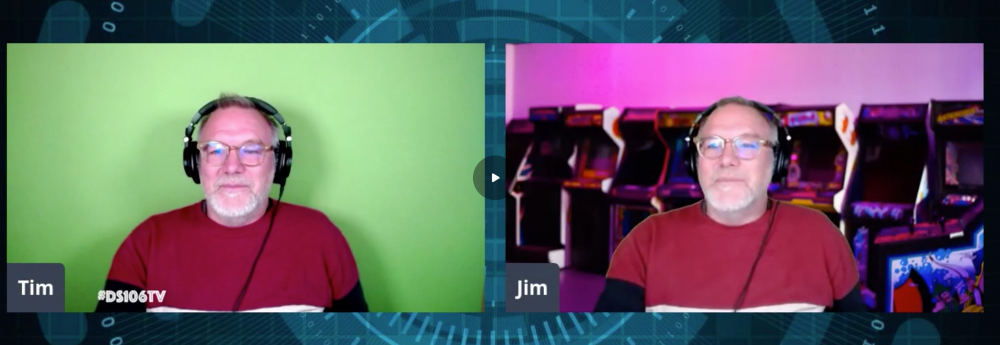
Two Jim Grooms? One was more than enough?
It was a fun episode chock-full of cool stuff, and what’s awesome is that Reclaim Today is starting to find its groove. I’m finding the episodes are tighter and more focused on our experimentation. What’s more, they are proving a whole lotta fun! It helps that we have a dedicated TV studio now—which was an investment—but it is quickly proving quite useful, not to mention really fun to play with. As I was telling Tim after this episode, I get most excited when I wake up these days thinking about broadcasting to the radio or figuring out another angle of the streaming video puzzle than just about anything else. I have a talk coming up in a couple of weeks that I want to try an apply some of what we are playing with in order to see if we can make the virtual presentation experience more fun, engaging, and interactive using a few of these tools, I guess we’ll see if all this fun has a real purpose or not 🙂
It started out as an innocent enough ticket into Reclaim Hosting from Dr. Laura Morreale, whose work involves transcribing and translating texts from medieval manuscripts using online digital facsimiles, asked if we can run eXist-db on her cPanel account in shared hosting. In particular she needed to run TEI Publisher, an open source application that is described as follows in this documentation:
The motivation behind TEI Publisher was to provide a tool which enables scholars and editors to publish their materials without becoming programmers, but also does not force them into a one-size-fits-all framework. Experienced developers will benefit as well by writing less code, avoiding redundancy, improve maintenance and interoperability – to just name a few. TEI Publisher is all about standards, modularity, reusability and sustainability!
A quick look at the basic installation documentation for eXist-db told me it was a Java app which is a hard no for cPanel. But avoiding hard NOs when someone comes asking for help is one of the main reasons we started Reclaim Cloud. A cursory search for a Docker container for this application led me to a container that seemed out-dated. I responded suggesting we could try installing it on the Cloud if they had a current Docker instance, which I was not finding. Turns out I wasn’t looking hard enough, it was linked from the eXistDB homepage right in front of my eyes. I was wrong, and Dr. Morreale responded suggesting she was becoming increasingly frustrated trying to get this application running online saying, and I misquote for comic effect: “Dammit Jim, I am Medievalist, not a server admin!” She was right, and this was why we started the Cloud in the first place; I needed to try harder. What’s more, I appreciated the fact she was so determined to make this work. So much so that soon after after the last email I sent to try and get this working, she sent sent me a link to the right Docker container on the recommendation of the folks at eXist-db:
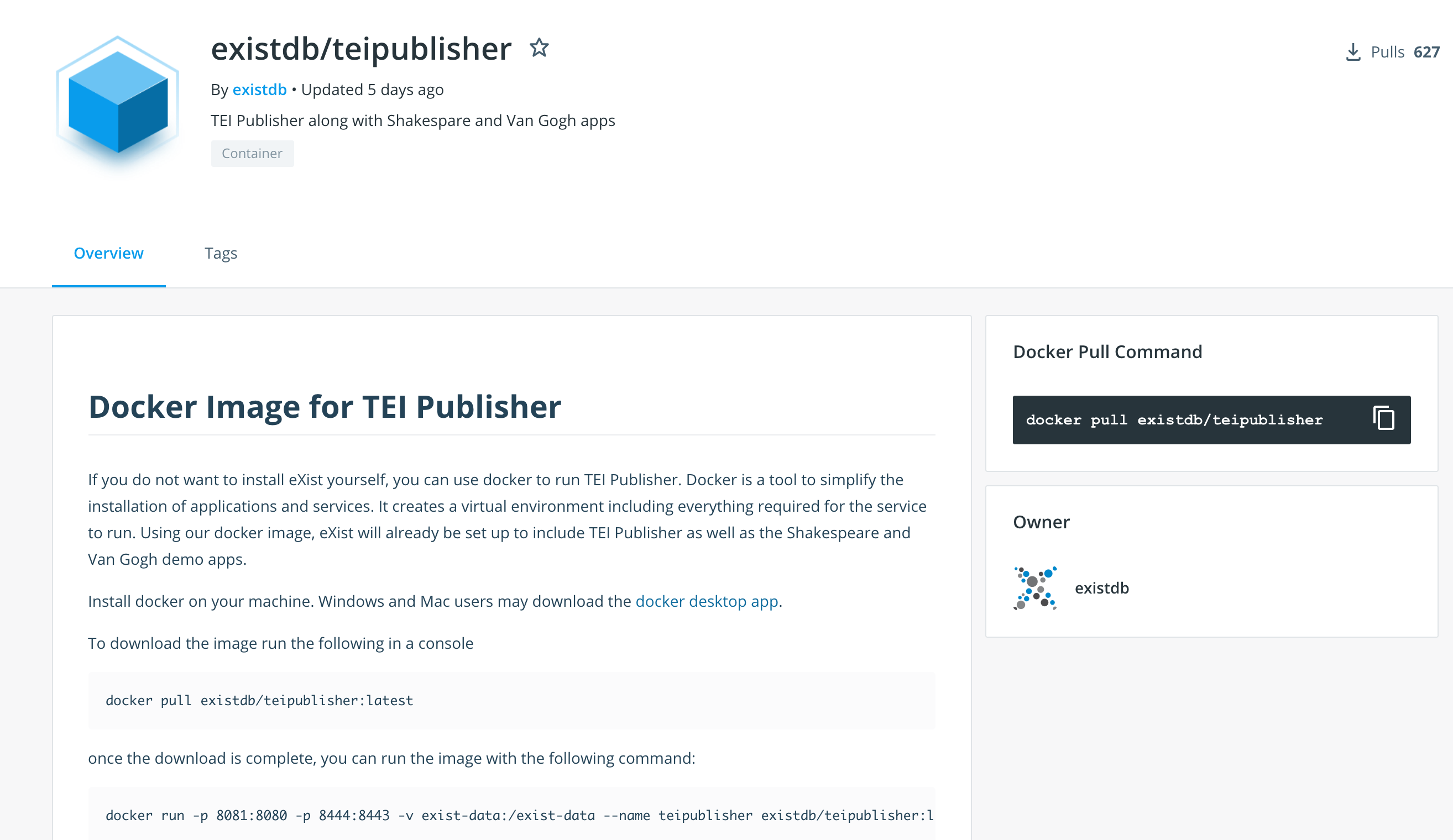
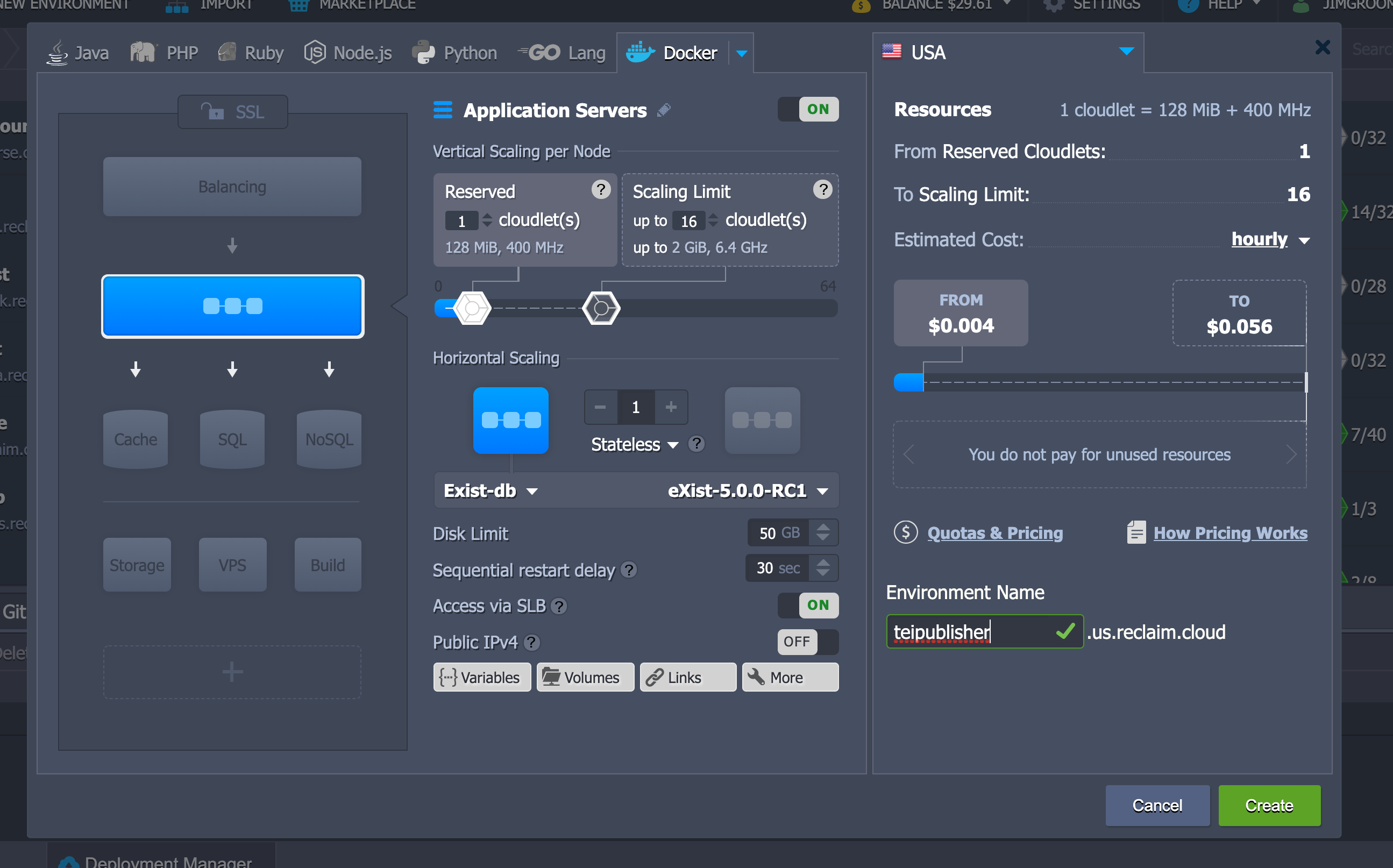
That was all we needed, I simply searched for this container in the Docker area when creating a new environment in Reclaim Cloud:

Click “Next” and add the subdomain of this test environment, in my example teipublisher.us.reclaim.cloud (now deleted), and then clicked “Create.”
And within moments I was able to access the site at at that subdomain:
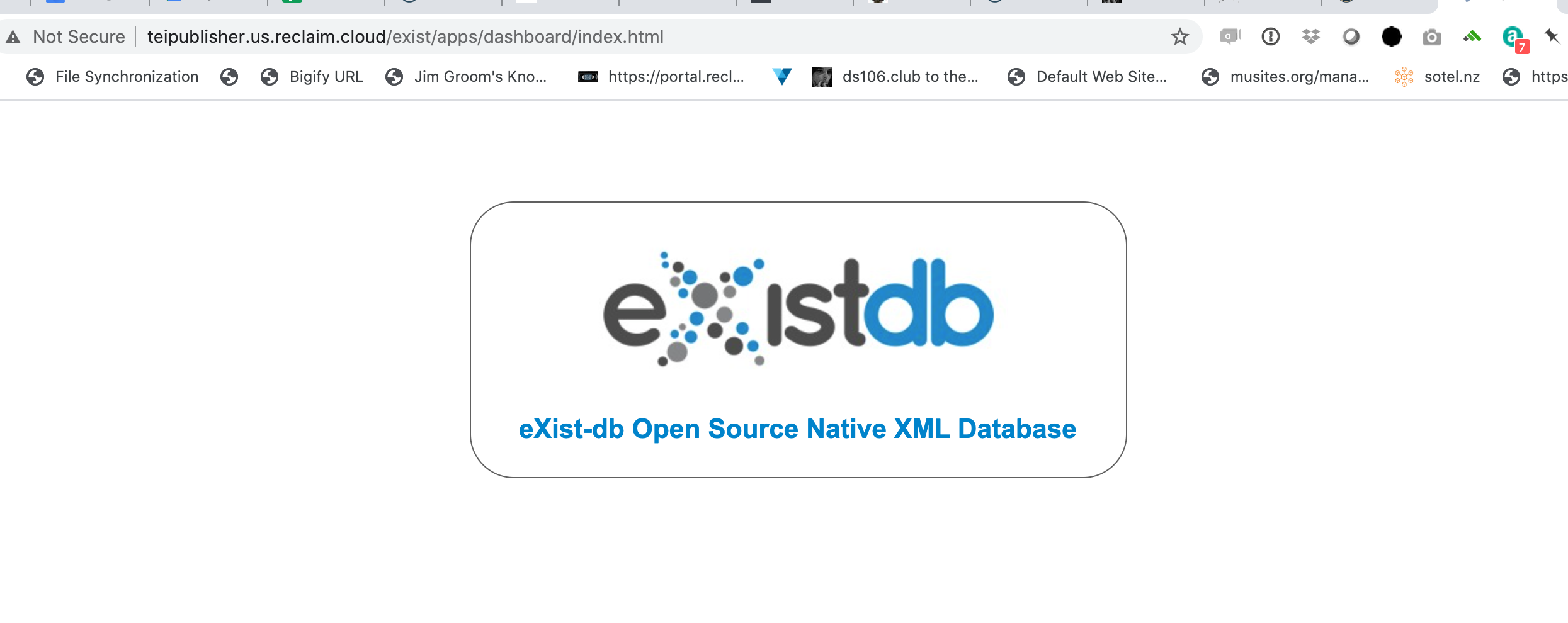
The eXistdb splash page redirects to a suite of tools, including TEI Publisher!
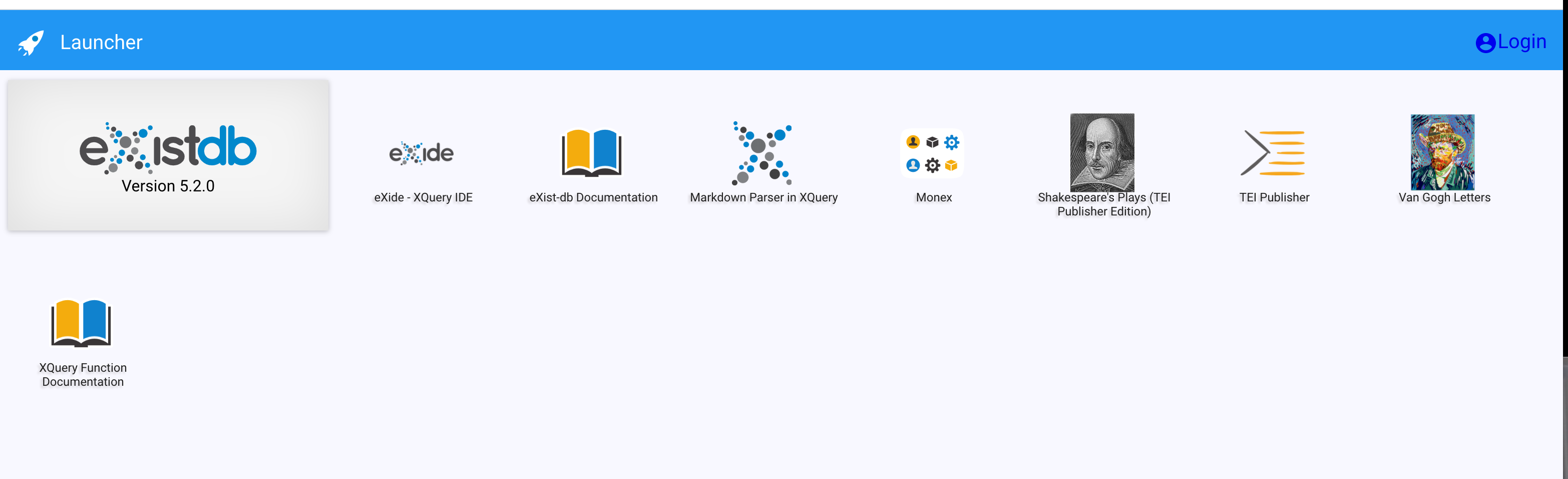
A click on that icon brings us into that application:
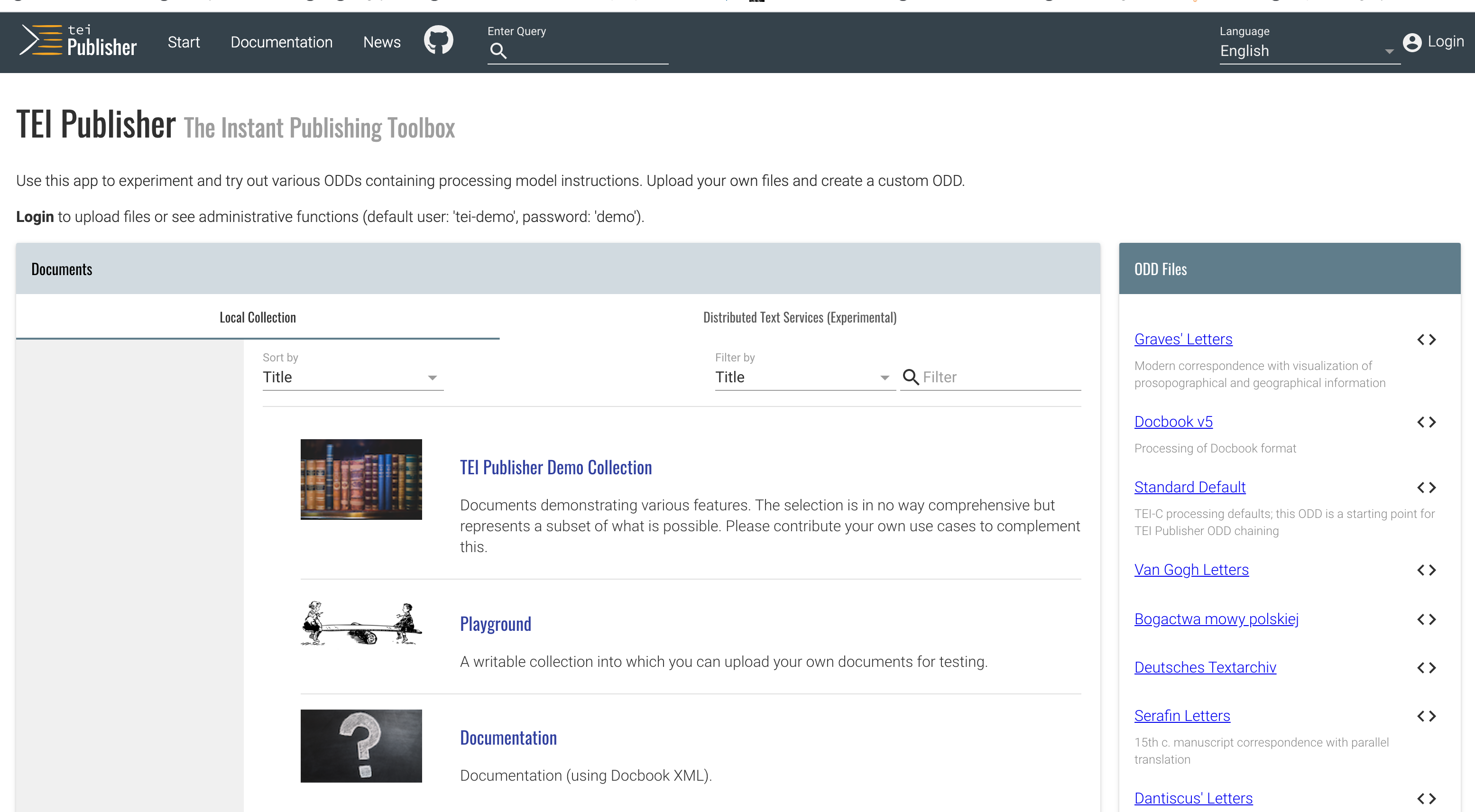
While there are a still few things to work out in regards to user management for the application, it seems like we may have a winner with this Docker container. In fact, Dr. Morreale’s struggle highlights a pain point for many humanities PhDs that need to run an application that demands a bespoke server environment. This is when the value of containers is extremely evident. In this case, running a Java server environment that can provide an application that affords a stable and citable publication venue for a Medievalist’s transcriptions and translations is a perfect case in point. In fact, Dr. Morreale was kind enough to furnish me with some insight of her work, process, and challenges for this post:
Like a growing number of humanities PhDs, I am an independent scholar who maintains relationships with several programs and institutions. I am currently affiliated in an official capacity with Fordham, Georgetown, and Harvard Universities, and am also engaged in ongoing projects with partners at Stanford and Princeton Universities. My medievalist practice has always been characterized by a physical distance from both the repositories that hold sources which I study, and the institutions where my scholarly work finds its home. For this reason, digital methods have offered me a solution for my scholarly work when I had few others.
Some of the most rewarding efforts which have in turn informed much of my traditional analytical work, involve transcribing and translating texts found in medieval manuscripts using online digital facsimiles. Using a tool called FromThePage combined with IIIF image technology, I can now easily choose digitized manuscript images from any online repository, upload them, then immediately begin to transcribe the text from the medieval source. I can also translate my own transcription after it is complete, and I have undertaken both individual and collaborative translation projects using this method. Right now my projects include corpus of early 13th century aristocratic legal codes from Crusader Cyprus, a rarely-cited history of Florence that was buried in a late 14th-century letter from a father to his son, and a little known work by Renaissance Florentine Leon Battista Alberti, found in a larger manuscript that has broken up, with parts of it now housed at Harvard’s Houghton Library.
The one difficulty has been to find a stable and citable publication venue for these transcriptions and translations. I have tried several different programs over the years, but could never easily publish all the work I had done to bring more attention to these texts and manuscripts. Using Reclaim Hosting and a program called TEI Publisher allows me to create the kind of edition I would like, and to allows me to integrate images, notes, and other explanatory materials into my online editions.
In the end, the fact that we could help Dr. Morreale get what she needed fairly seamlessly is a thrill, and it highlights everything we hoped Reclaim Cloud would be. I am planning on turning this Docker container into a one-click application for the Reclaim Cloud marketplace so that other folks can hopefully scratch a similar itch. And special thanks to Dr. Morreale for so generously sharing her process and work to complete this post. Avanti!
Spinning some tunes and testing some shortcut keys on #ds106radio to nail down my workflow, I mean its only been like 10 years doing this…https://t.co/DQNyRE6sLp Also, getting the tubes warmed up for a chock full Sunday of specials
— Jim Groom (@jimgroom) September 27, 2020
I have had a lot of fun playing with #ds106radio over the years, and as lockdown descended upon most of us this past Spring the radio became a refuge. I’ve pretty much got my live broadcasting setup dialed in using Audio Hijack and we’ve overhauled the station to run on Azuracast, so things are good. But listening back to the Fontaines D.C. #vinylcast, I realized how much I click my mouse during any given show, specifically to mute my microphone.
Happy to oblige, and if you hear a mouse click during this broadcast call me out, I am trying to break the habit 🙂 #ds106radio
— Jim Groom (@jimgroom) September 27, 2020
Turns out muting your microphone using keyboard shortcuts on a Mac is not nearly as easy as it should be. I found myself in Automator trying to create a custom application to automatically mute the microphone, but my ineptitude allowed me to quickly avoid that rabbit hole. I then found a $5 application called Mutify that does this one thing. Ridiculous, but disco! The $5 is worth the cost of not getting lost in AppleScript. So, I tested the trial version. Turns out I have two audio inputs (the Audio Technica turntable and Cam Link 4K DSLR) that do not have drivers so when I hit the appropriate shortcut keys (shift+Command+0) I get a pop-up error message that require a mouse click-through ….twice! The one thing I was trying to avoid on-air, namely using the Magic Mouse with its loud-ass click, was necessary not once, but twice. The cruel irony.
I played a bit more with the setup, and turns out if I run the Cam Link through a USB-C cable directly into the Macbook Pro the error message disappears (no idea why) so I was down to one error message from the turntable. As it happens if seems if Mutify (or my Mac) has only one error it does mute the mic and you can click through after the mic is muted avoiding the dreaded on-air click. This kludgy workaround gives you some sense how much time I wasted on this, I should have learned AppleScript after all. I tested this out on ds106radio on Sunday afternoon in anticipation of the Sunday Special show so I might get a listener or two for once.
“Resist the Click” with Jim Groom on #ds106radio (9/27/2020)
The show does have a couple of clicks early on, but I settled in and it was pretty seamless after that. I did make a mistake playing the song “Manic Depressive” by Courtney Barrett assuming it was Courtney Barnett, so that’s on me. The remaining issue with muting via keyboard shortcuts is it takes, on average, about 3 seconds for me to get the next song to play after cutting away from talking. Still need to make that more seamless, but not sure how—so any and all recommendations are welcome.
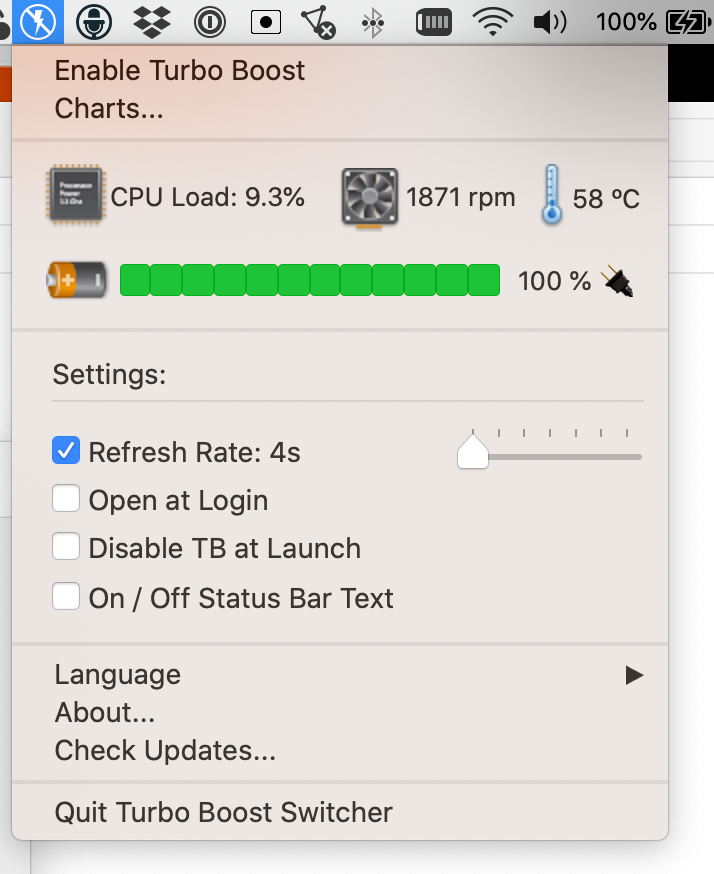
And while I am talking about trying to make the radio broadcasts more seamless, something a did a while back that has worked well is to use an application called Turbo Boost Switcher for my beefy Macbook Pro that effectively dials down how many resources the laptop uses in order to prevent the fan from turning on. I have a pretty beefy 16″ laptop with some serious horsepower, arguably too much for a laptop to cool cleanly. For example, if I have the lid open and use the built-in camera for a video call the fan starts to kick in quite loudly almost immediately—and without fail. Same is true when running Audio Hijack, OBS, or just about any other remotely intensive app. I found using an external webcam, keeping my laptop lid closed, and using Turbo Boost Switcher to disable the CPU boost I could prevent the fan from coming on most times, an issue that drove me even crazier than the clicks.
Anyway, slouching towards good radio is quite a chore, but it’s an opening for a hack like me when the best lack all conviction.
There as not one, but two vinylcasts of Fontaines D.C.’s awesome debut album Dogrel. Primarily because this was my first full blown attempt at x-casting to both #ds106radio and #ds106tv with the new vinylcam, but both times resulted in the streaming software OBS crashing.
I was beginning to lose hope, but realized the ds106radio stream was perfect and I could pull that into iMovie and edit the video to account for the crash and image issues in the second take of the vinylcast. It was fun to get back into iMovie in order to make the show more presentable in post-production, and it was a reminder how much I love tinkering with video.
Anyway, below is a 720p version of the video and below that is the full audio-only cast as well, and Dogrel is absolutely my favorite album these days.

This past Tuesday I attended the second Indie WebCamp generously hosted by Chris Aldrich focused on Domain of One’s Own. The format is a more focused 10-15 minute talk around a specific technology, in this meeting Tim gave folks a walk-though of Reclaim Cloud, and then opens up to the 21 attendees for anyone to share something they are working on. Tim shared the Cloud, and not only was I thrilled to see Jon Udell in attendance, but it’s always nice when one of your tech heroes tweets some love for your new project. Even better when you know they’re not one to offer empty interest and/or praise. Thanks Jon!
https://t.co/6ueOmfk2Li is a huge leap forward. I only just heard of https://t.co/jrJR964WZl today, @timmmmyboy is making excellent use of it to make advanced containerization accessible to edtech. https://t.co/omnjAgIbuR
— Jon Udell (@judell) September 22, 2020
It was also very cool to read Will Monroe write-up of the session, and like him I found it a “very friendly group” and I realized while attending that this kind of low-key chatting and sharing is one of the things I have missed these days. Folks like Will who want to explore what’s possible in their classroom with Domains and beyond is a big part of what I miss about the day-to-day work of an edtech in an institution. And while I’m not necessarily chomping at the bit jump back into that game given the current circumstances, the ability to share and chat with folks who are interested in Domains is always a welcome opportunity.
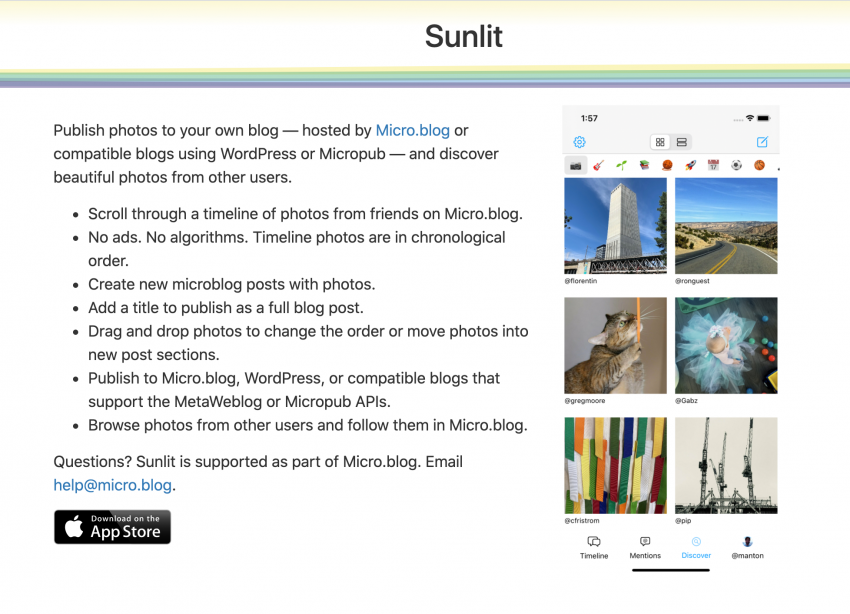
During the sharing portion of the meetup Jean Macdonald, community manager at mico.blog, turned me on to the Sunlit project while I was bemoaning the dearth of open source alternatives to photo sharing apps like Instagram. Soon after I finally took the leap and signed up for a mico.blog to explore that platform. That platform has been a indieweb cornerstone for many folks I respect like John Johnston, Kathleen Fitzpatrick, and Dan Cohen to name just a few. So I wrote my first post:
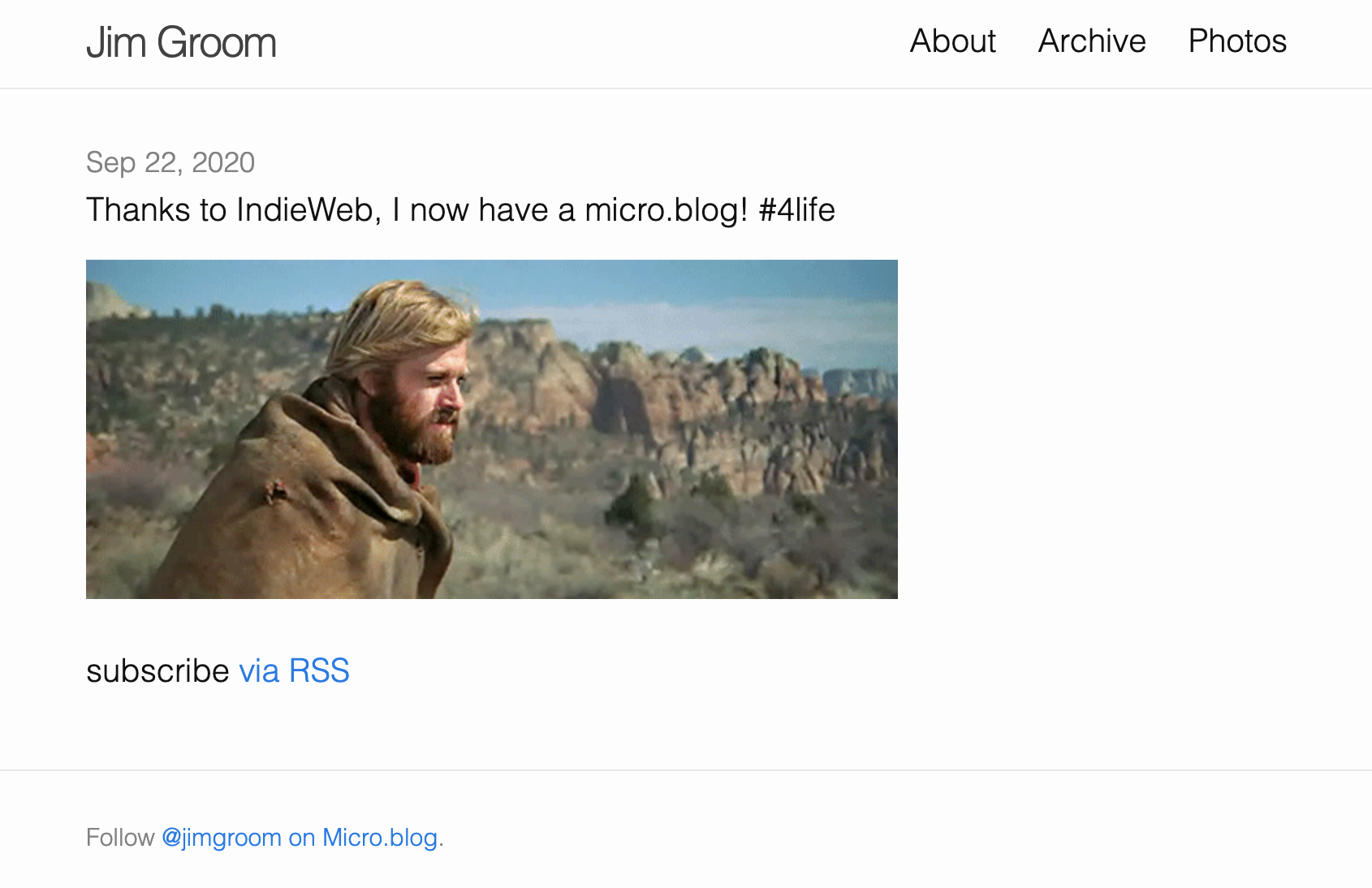 What was even cooler was the fact that while writing this post I logged back into micro.blog and discovered a few folks had welcomed me to the micro.blog community, including Jean Macdonald and Dan Cohen—that makes all the difference.
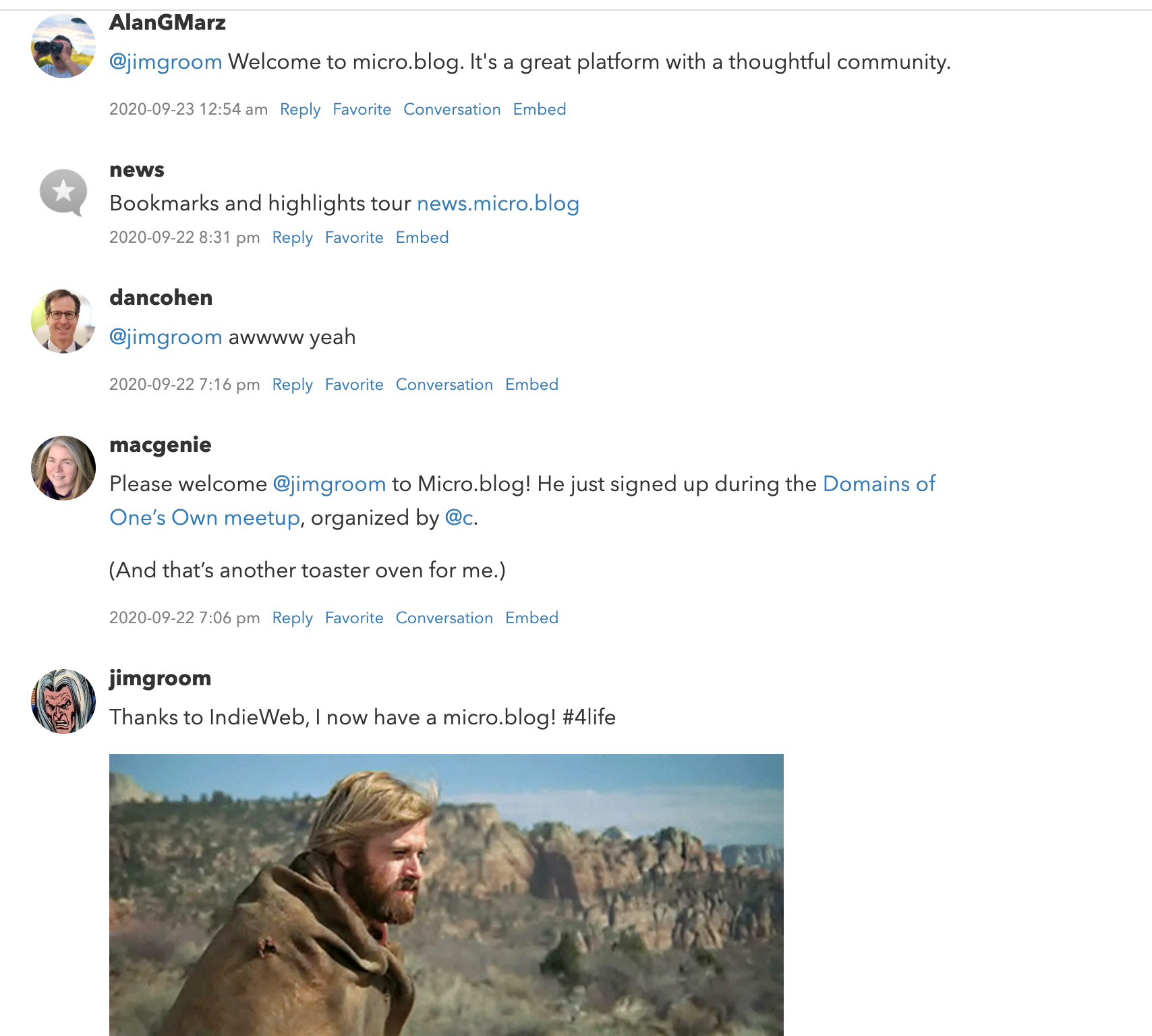
I’m sold, so the IndieWeb meetup was a total win for me, and I look forward to the one next month. I am going to start getting serious about headless WordPress development for my new website at jimgroom.net, inspired by Tom Woodward’s talk for #HeyPresstoConf20
Inspiring, for my new version of https://t.co/bKJeTUAEm3 I am going to try and create something WP headless and play with the wealth of amazing possibilities @twoodwar just casually refers to in his brilliant #HeyPresstoConf20 "talk." Tom has never stopped living the WP dream https://t.co/fNDYzsM6W5
— Jim Groom (@jimgroom) September 25, 2020
So, I’ll have something to share in my journey to learn WordPress headless, which will mean learning javascript, CSS, and some other insanity I am not entirely ready for. I have to give a special thanks to Chris Aldrich for putting this together and working to create a space to talk Domain of One’s Own within the IndieWeb community, and I know Greg McVerry has been pushing hard on this for a while now as well, so it is very much appreciated!
It occurred to me yesterday after finally listening to Terry Greene‘s interview with Bryan Mathers for the Gettin Air podcast that I never blogged about our Reclaim Cloud artwork. That needs to be rectified, and I will share the awesome below, but before I do I just wanted to say how much I enjoyed the interview between these two. Possibly the coolest part was when Bryan started interviewing Terry in order to see if he could “draw” out of him some ideas that he could refactor as a visual for the podcast, and voilà Gettin Air has a new logo!

I dig it, especially given I have returned to snowboarding these last few years, but even better was Bryan getting Terry to talk about his idea behind the name, his articulation of what he’s doing and why—it was all so effortless and real. It was a beautiful demonstration of how the interview can become the thing it wants to share. So genius, well worth a listen if you have some time.
Anyway, that whole process reminded me I have not yet shared the work Reclaim Hosting did with Bryan this summer to get started on the Reclaim Cloud aesthetic. Given Reclaim Cloud is premised on a container-based architecture, we initially explored if we wanted to go down the road of shipping containers, and we have some initial sketches from Bryan that I absolutely love.
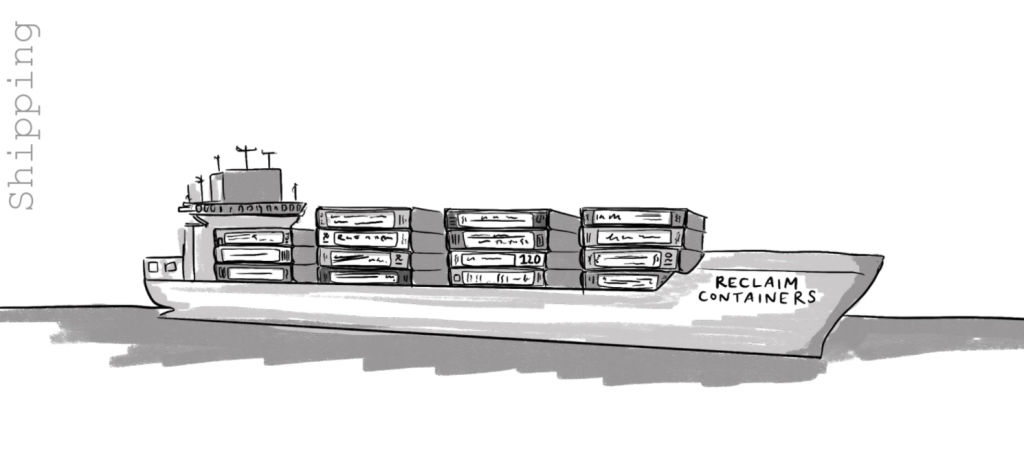
The containers are actually VHS tapes! A point made clearer in the heavy lifting image that follows:
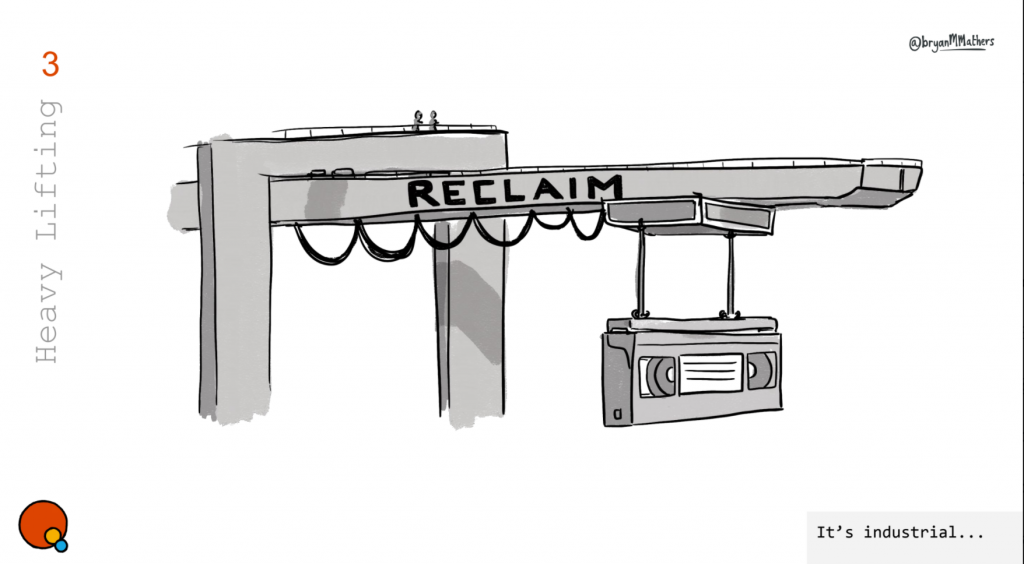
It really is brilliant, it captures the idea of Reclaim Cloud as both container-based and industrial-strength, which it is! But ultimately after talking with Bryan we realized the hard limits of the nautical/container metaphor. So we moved on to Cloud City, an idea Martha Burtis and I came up with for Domain of One’s Own back in the day.

I still love that poster, in fact I have a stamped copy of it framed and hanging on the wall behind me as I write this. So we got to talking a bit about it, although Tim was a bit reluctant given he is not a Star Wars fan, but through conversation the idea of a retro-futurism aesthetic began to emerge a la The Jetsons.
And Bryan’s rough sketches had us very intrigued:
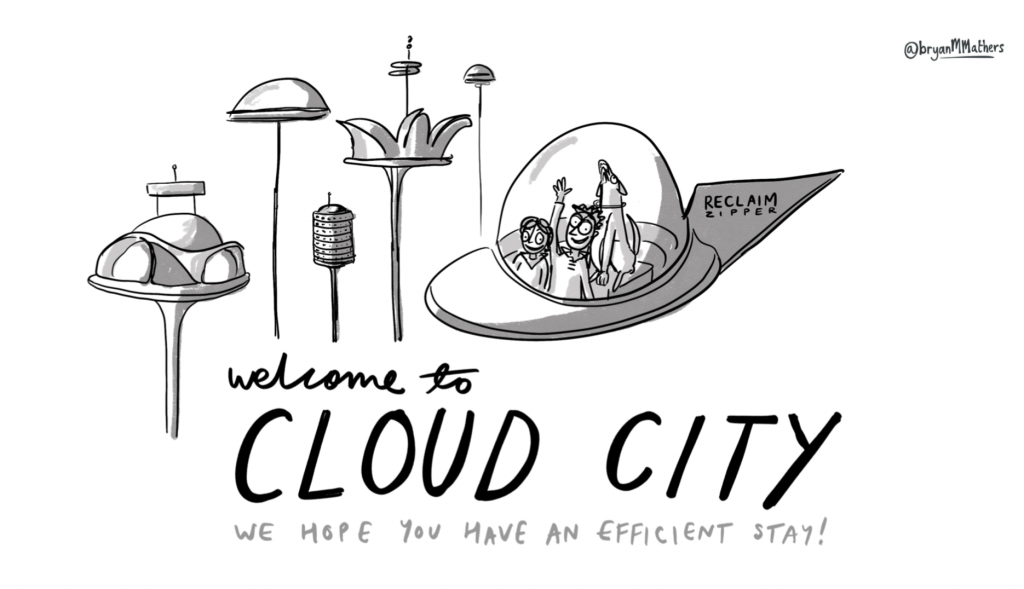
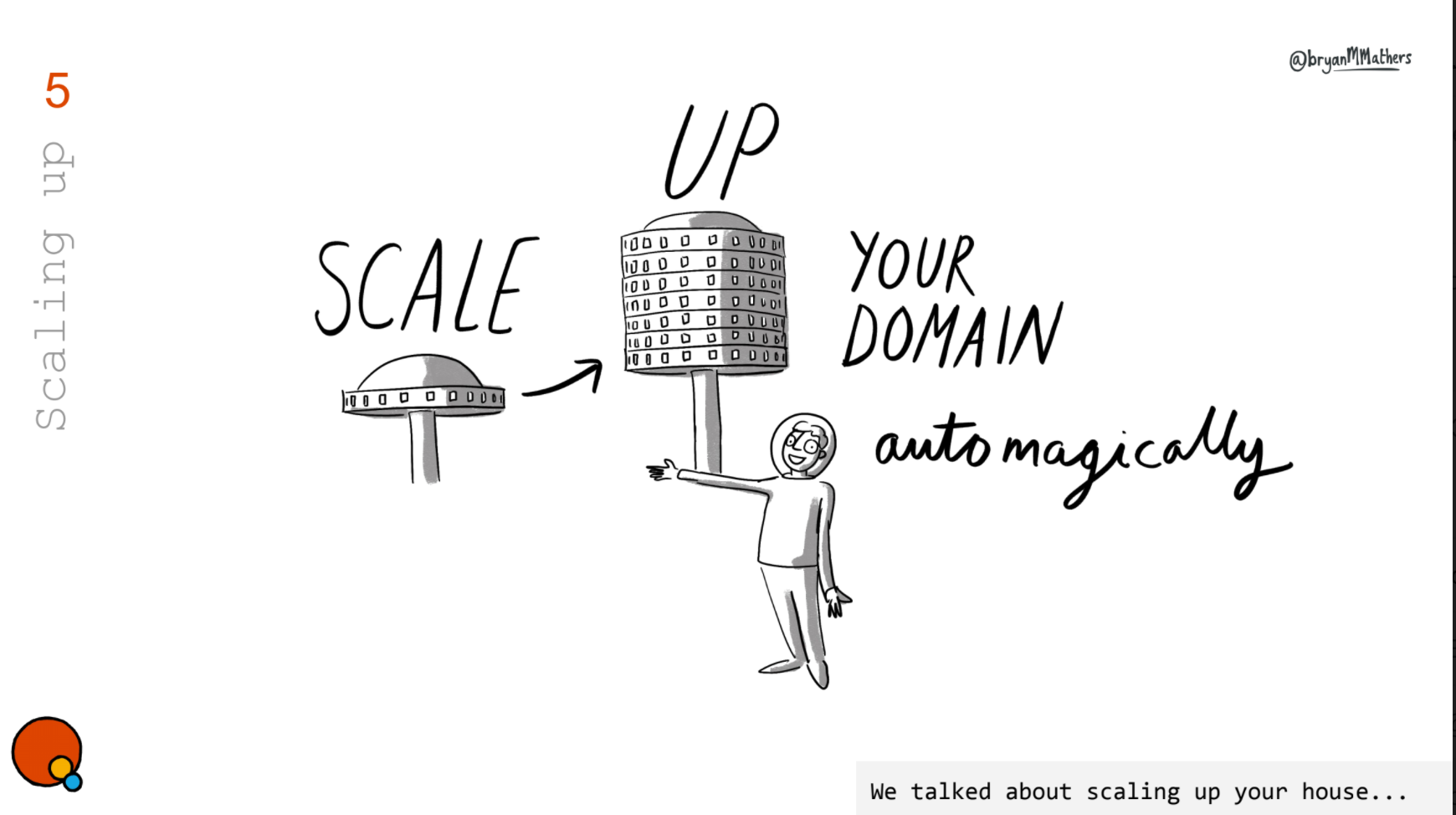
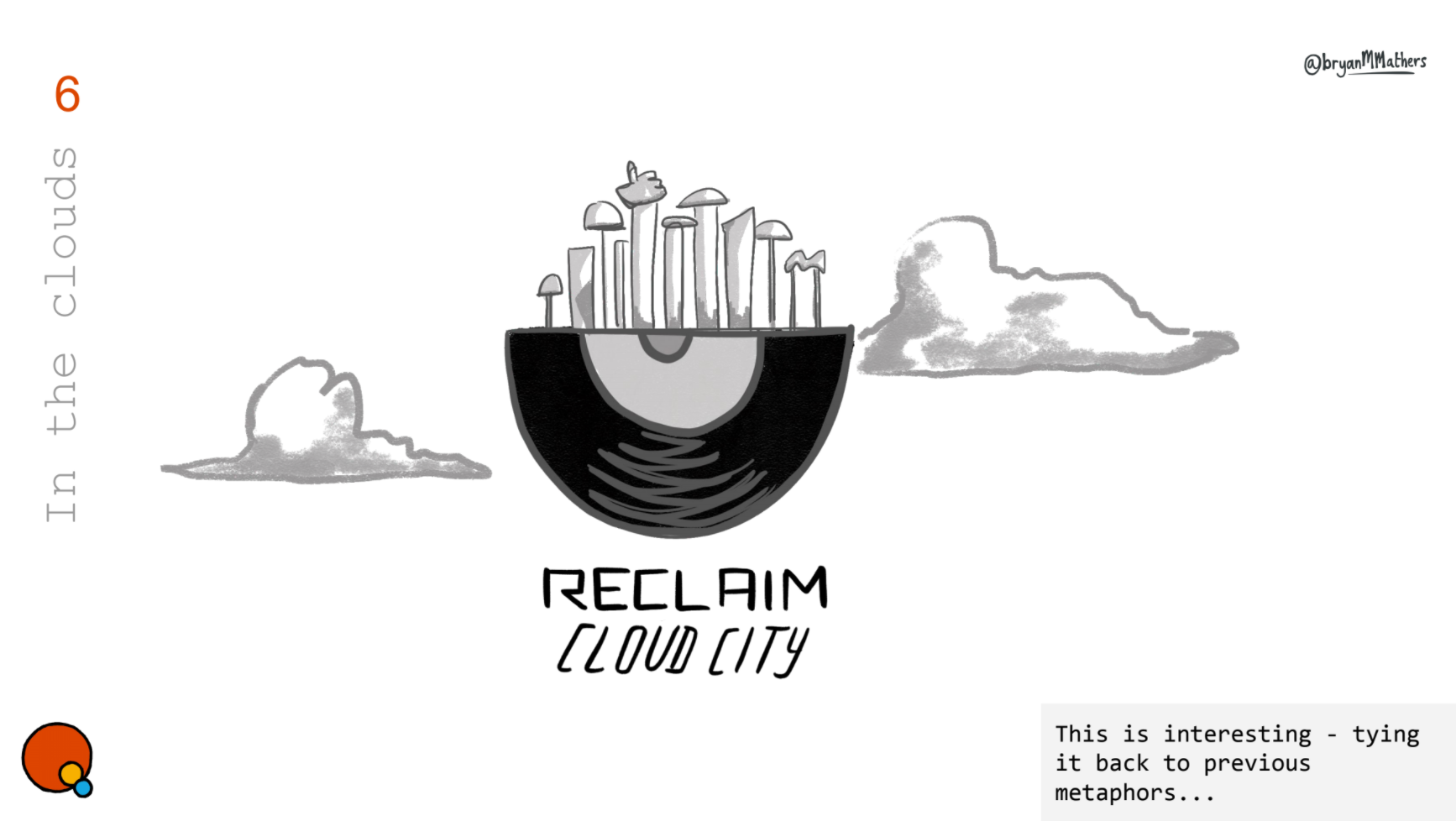
The idea of scaling your domain was fun, and the way Bryan mapped that onto retro-futuristic housing and was brilliant. In the final image the beginnings of a logo/cloudlet begin to take shape already. This was our aesthetic, and we kind of knew it during the discussion, but the seeds of the sketches sealed it.
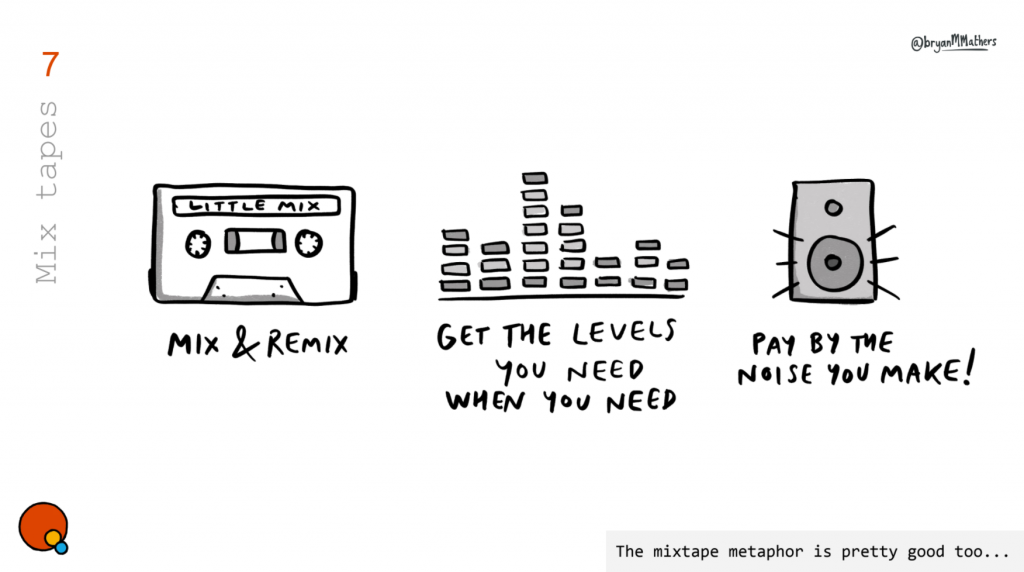
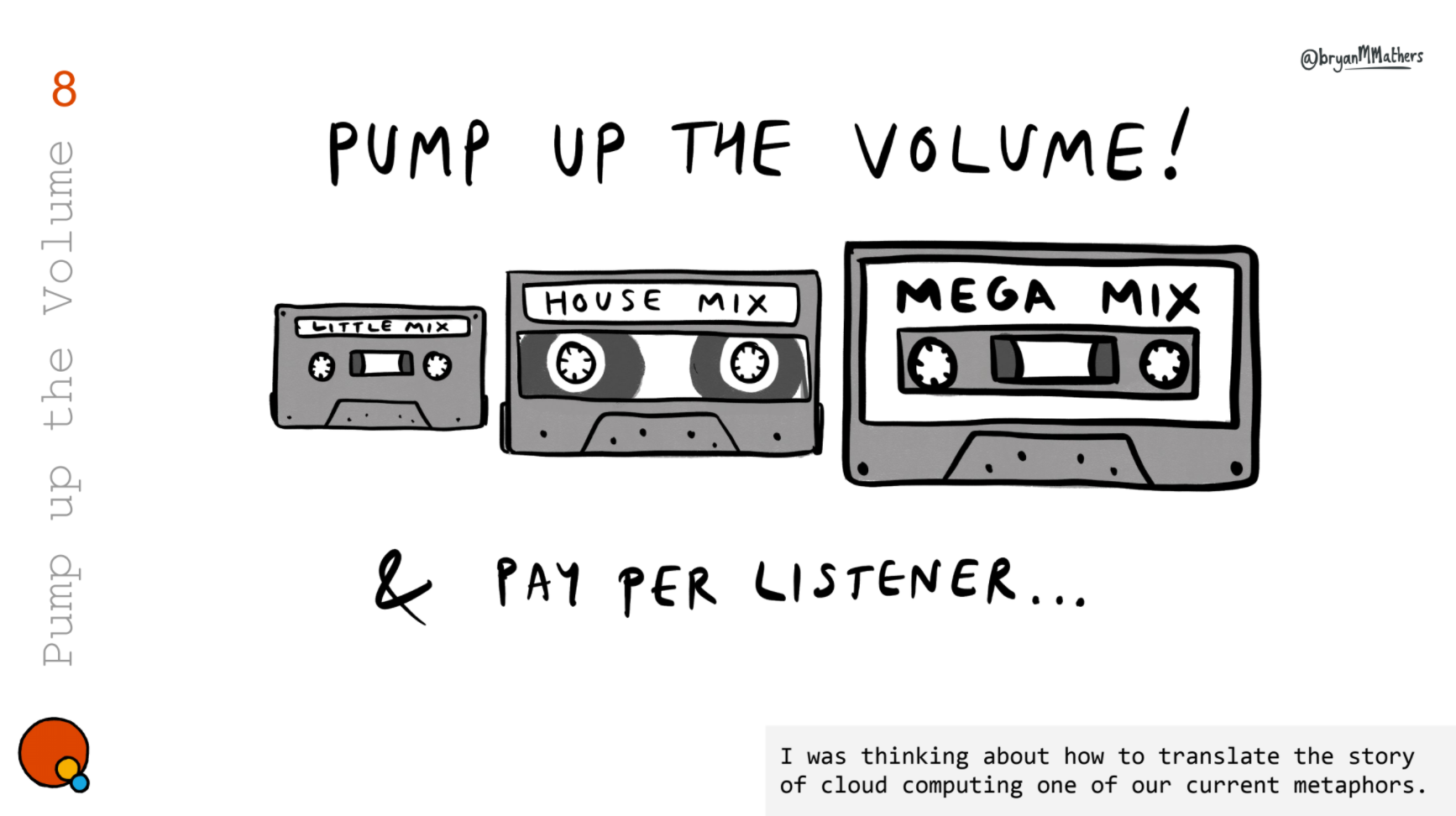
The final option was to stick with the music/video metaphor we already have and push it further with mixed tapes. But it just felt forced, and I think Tim and I both wanted the freedom to jump out of that metaphor and explore something new, and I am really glad we did.
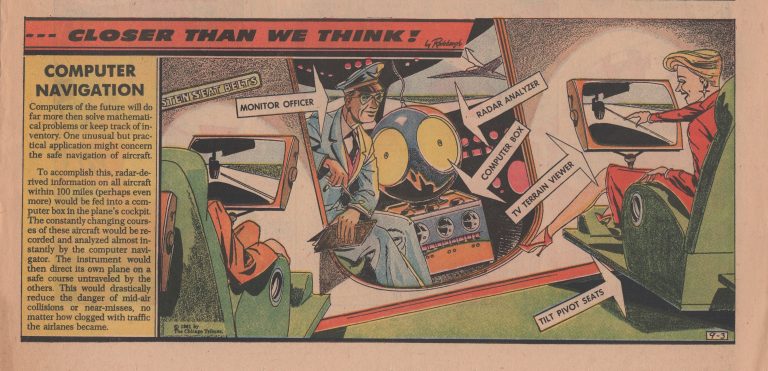
The next conversation after deciding on Cloud City was to scout the internet for some ideas for our next conversations, and that is when Tim landed on industrial designer Arthur Radebough’s Closer than We Think comic strip from the late 1950s through 1963. The way in which the art incorporate an explanatory panel and then the actual art incorporates various explicit arrows illustrating the future gels nicely with our idea of introducing Reclaim Cloud as a way of highlighting for higher ed what’s possible in this new space. So, we got to talking, and the first round of art was amazing:
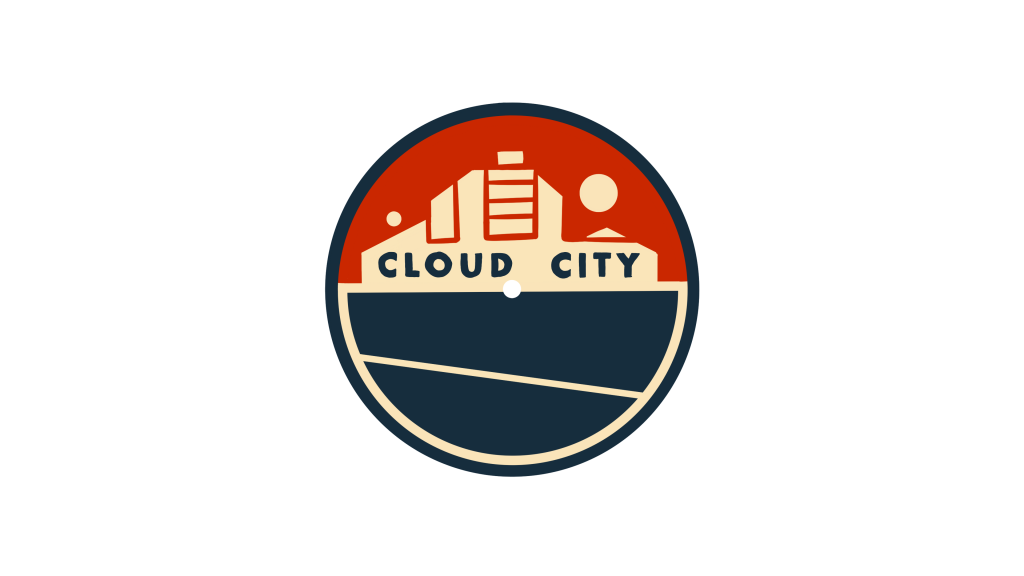
I really love the industrial logo for Reclaim Cloud which is itself an encapsulated container, a cloudlet if you will, and this idea of self-contained cities became a bit part of our aesthetic. And the fact that Bryan Ollendyke said it reminded him of Bioshock on Twitter just sealed it for me 🙂
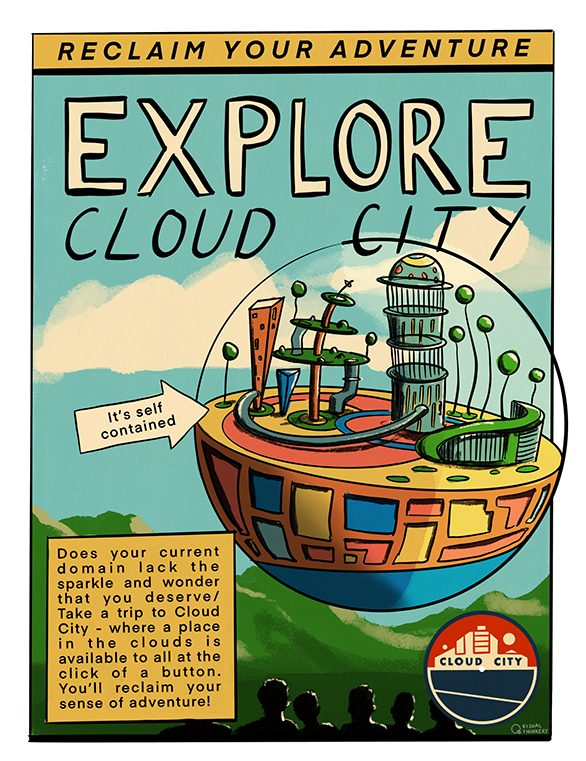
We were sold after this image, a kind of brochure for Cloud City which enabled us to start exploring the idea of what it would mean to try and create a series of vignettes of the different options for anyone interested in moving to the Cloud. It was just too fun, so the follow-up discussion was to explore the Closer than You Think comic strips to highlight some of the one-click applications we have for courses, organizations, and digital scholarship:
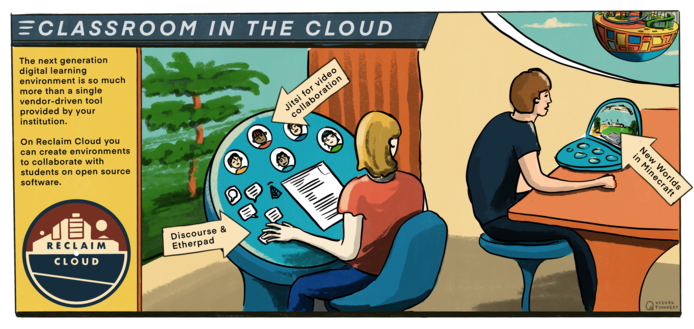
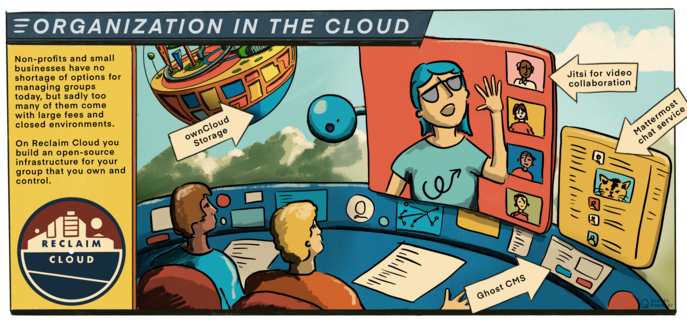
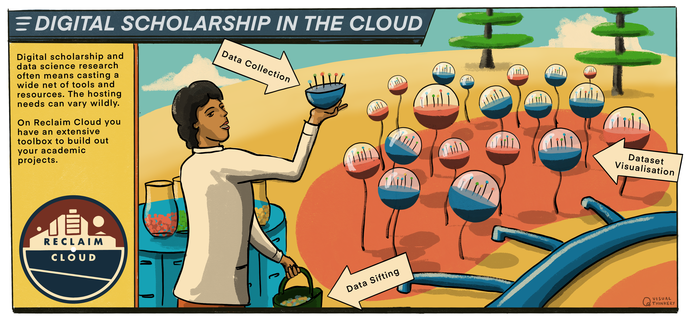
Pure magic! The way in which the container has become an organic part of these images is just so awesome. I love the one outside the window of the home classroom. This idea that it is all connected yet separate is one way to understand the cloud, and Bryan really brought it home. And as amazing as all the art is, I think his breakdown of the various elements of a Reclaim Cloud container that could incur costs in a fullblown masterpiece:
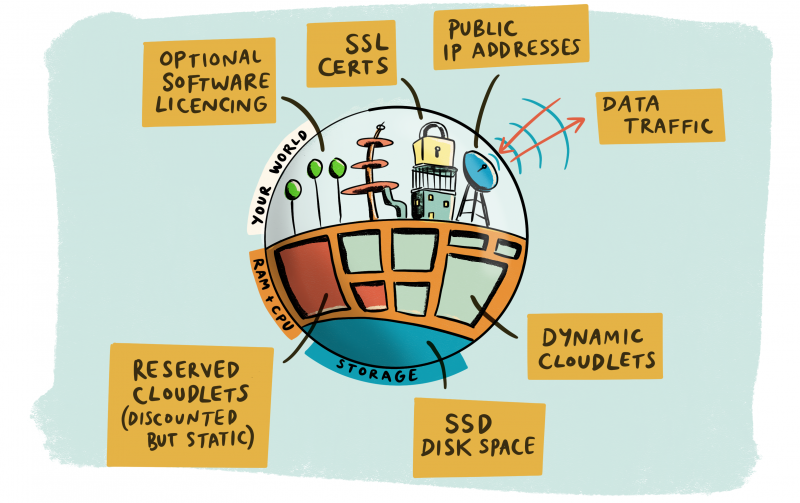
This sphere is everything, literally. I just love the way the aesthetic has evolved and the final bit is thinking through how we’re going to highlight what is happening within each cloud. This led us to the idea of “What’s in your Cloud?” wherein we talk to folks to provide us a peak into their Cloud, what are they running, how, etc. The following image is a placeholder, but we are thinking through ways of trying to capture the individual nature of folks’ cloud for each episode, and Bryan mentioned some kind of comic-like avatar, like my Cotton Mather avatar in a spacesuit hold my Cloud sphere, which would be awesome!

Anyway, I think that brings us up to date, and to be clear this has only just begun. We are thinking of Reclaim Cloud as a long-game. We know it will not replace cPanel hosting; we have plenty of time to experiment with the possibilities; and we can slowly start moving our existing infrastructure over as we become increasingly comfortable with the environment. Not to mention it has forced us to dig in and learn a lot more as a company, and as much as I was kicking myself given I was just start to feel a bit liberated from the day-to-day, in the end I love it. We’ve been dreaming of this kind of infrastructure since we started Reclaim Hosting, and in 3 short months we went from nothing to a pretty full blown product that provides some concrete solutions for academics wanting to host something outside of the LAMP stack. And this retro-future aesthetic is our way to start experimenting in this space without pretending there aren’t also real problems baked into every solution—we’re here to explore right along side you.
 Tim did a great interview in which he talks Reclaim Arcade on the 80-Bit Podsmash podcast with Termite and Penguin. The podcast is about all things gaming, and it was cool to hear the co-hosts dig on the Reclaim Arcade collection of old school cabinets. In fact, they were able to experience the full glory of Reclaim Arcade in-person as Tim gave them a tour of the space prior to the show. It was cool to hear Star Castle get some love—a truly under appreciated vector masterpiece. And the fact that Termite and Penguin were so excited about the potential of the space was a much needed buoy for the project in these uncertain times. As I already mentioned on this blog, we’re still going forward with Reclaim Arcade, and we’ll open when we think the time is right, until then we are dialing in the details.
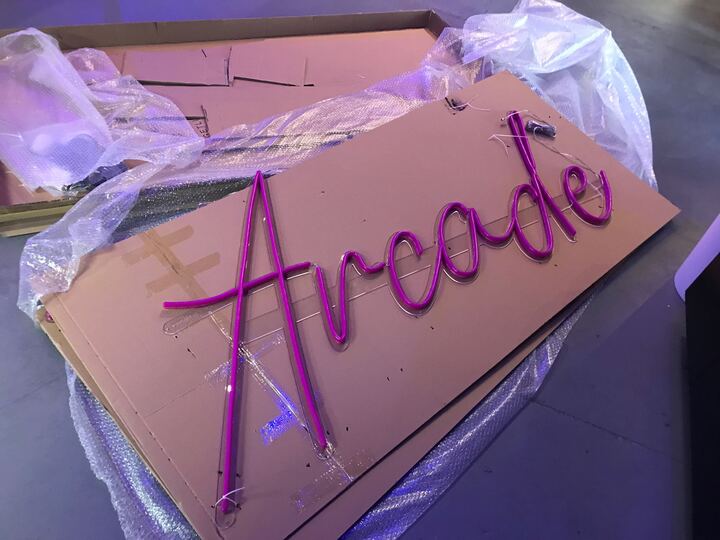
NEON?!
I think my favorite part of the podcast, and it’s chuck full of highlights, was listening to Tim recount the timeline of events leading up to our projected May 2020 opening of Reclaim Arcade. It was non-stop work on this project for Tim as early as November 2019 and by the time we got into late February the construction was already delayed and it looked like late June, early July was the absolute earliest we could open. We were not happy. At the same time, while I’m sitting here in Italy feeling useless I was watching the entire nation start locking-down and within 10 days I was already wondering if and when I’d ever get back for an opening (I was all set to move back to the US come late April). Well the rest is history, but it is a good reminder how insane the whole arcade project was getting as COVID start emerging as a broader global threat.
And while we got lucky that we had not committed to the construction when we put the brakes on the project in mid-March, the idea of walking away from what was a pretty amazing vision was deeply depressing. We put a moratorium on the whole thing for about 3 or 4 months (built Reclaim Cloud in the interim) and then reconvened on the Arcade front in early August and committed to a bit more modest project. It’s a crazy timeline, and hearing Tim talk it through on this podcast was surprisingly intense for me. It’s hard to fully understand the insanity of what we are living through because if we don’t try to normalize it in some way we would go crazy—but remembering the not so distant past and how quickly everything changed is sobering.

Find out more about me here.