Yesterday I had the distinct pleasure of kicking off Fashion Institute of Technology’s Digital Spa run by Sandra Markus and Kurt Vega. They are focusing this year’s week-long faculty development workshop on getting folks up and running with their own domain, and when we talked a few months back I recommended they take a look at the Faculty Initiative resources the we created at UMW for the 6 week introduction to Domains for faculty. It’s cool to see they have integrated elements of that approach into their workshop; caring is sharing. I firmly believe a Domains project is only as strong as the community created around it, let the OU Creaties stand as a testament to that.
For my part of the Digital Spa, I was there to give a sense of the project’s history and raison d’etre, if you will. It’s a story I have shared often, and it’s one I never tire of telling. But given I would be presenting via Hangouts to a fairly small group I dispensed with a slideshow. I did use a visual aides and web sites, but I wanted the tone to be conversational given the shared purpose and focus of the event.
https://www.youtube.com/watch?v=G_FbzKmER60
I think it was fairly successful given it kept my talk relatively short at 35-40 minutes, and allowed the Q&A to run at about the same length, that’s a fairly decent balance if you can manage it. The only issue is I love to talk, and it’s hard to shut me up even during the Q&A.
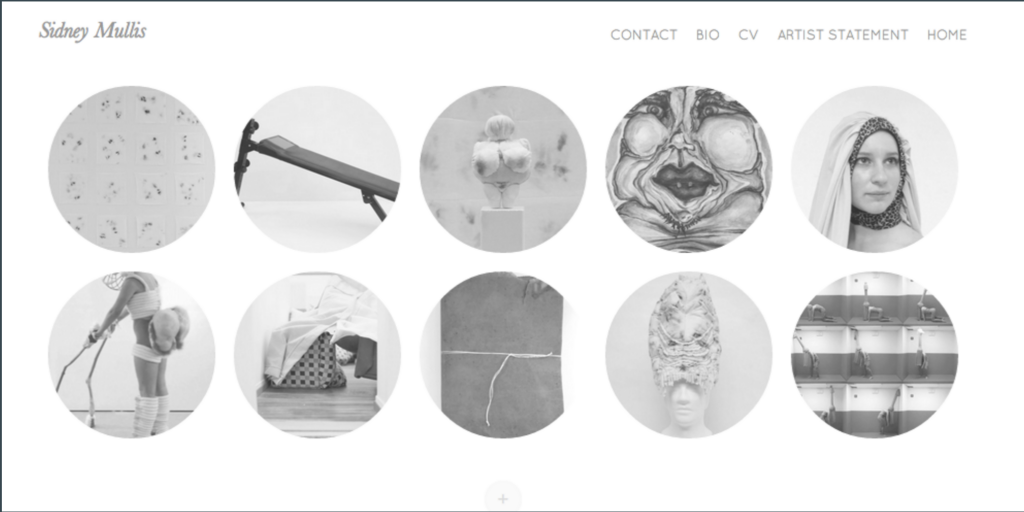
One of the things I discovered while preparing for this talk was that a domain I shared from a couple of years back by then UMW Art major Sidney Mullis was still active, but totally different. The screenshot I took a couple of years ago looked like this:
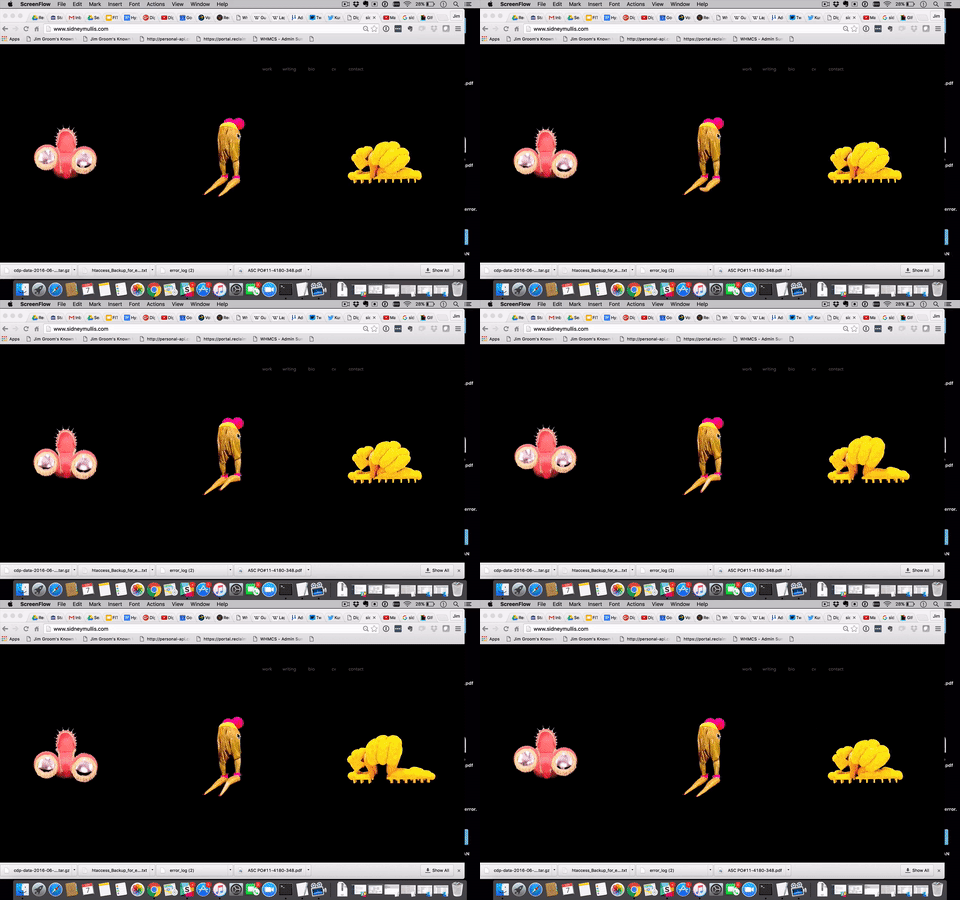
Two years later the domain name is active and working, but it has in many ways become her art. The front page of sidneymullis.com looks like this:
What’s animating there are 3 YouTube videos set to automatically play and repeat that have these crazy creature creations that she designed. I love the whole thing, here is one of the videos:
So the domain itself has transformed as the artist has, while at the same time remaining a pointer to her work and thinking. I couldn’t have found a better demonstration of the power of the domain. And this re-enforces many of the points I lifted from Mark Sample’s post outlining the logic undergirding Davidson Domains:
I really enjoyed this session. It was almost entirely extemporaneous, an approach that often keeps things compelling (at least for me) when presenting remotely. I also loved the questions because they demonstrated that these sessions aren’t about “selling” folks on the value of a domain and web hosting, the value of having a domain is everywhere apparent in 2016. What faculty want from a session like this is inspiration via examples of different ways people have used their domains as well as technical guidance for what’s possible. One question that summed this up for me was a faculty member wondering if she could export her work from Blogger to WordPress. Short answer yes, and a question like that demonstrates folks are already in this space, but hosting and its innumerable affordances represent a new trove of online wonders.
Another question that was spot on was what happens when Reclaim Hosting (or fill in any 3rd party hosting service free or otherwise) goes away? The answer was simple, make sure you can backup/download your data and that it’s portable. No matter what service you use, this is probably very good advice more generally. And it makes the broader point that with a Domains initiative this question undergirds the entire project—take control of your online archive because no one will care more about the work you do online than you.
Thanks to Sandra and Kurt for letting me kick things off yesterday, it was an honor and a privilege, and to all those faculty, staff, and students out there….
https://www.reddit.com/r/funny/comments/2ll7e1/ OER16 happened more than a month ago now and as time and fate would have it I’m just getting around to blogging it. It happened in the gorgeous city of Edinburgh, and let there be no question the Scottish are their own people. They even have their own version of Star Wars as the above Reddit thread can testify. My personal favorite comment is this image!
ds106 is strong with National Library of Scotland, in fact it’s the National Librarian John Scally’s keynote that tipped me off to these Scottish movie posters. Pure gold. In fact, the force was strong with so many attendees at the conference, and I think Catherine Cronin‘s keynote was a major highlight. Her ability to brilliantly return us to some of the pressing questions which brought us to open in the first place was masterful. If you want an intelligent, circumspect, and well written glimpse of the conference, I recommend you go read Catherine’s post on the conference and leave the bava in peace to wallow in its solipsistic, downward spiral.
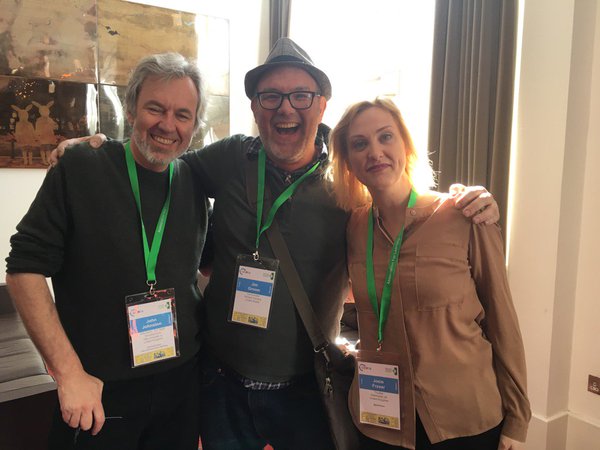
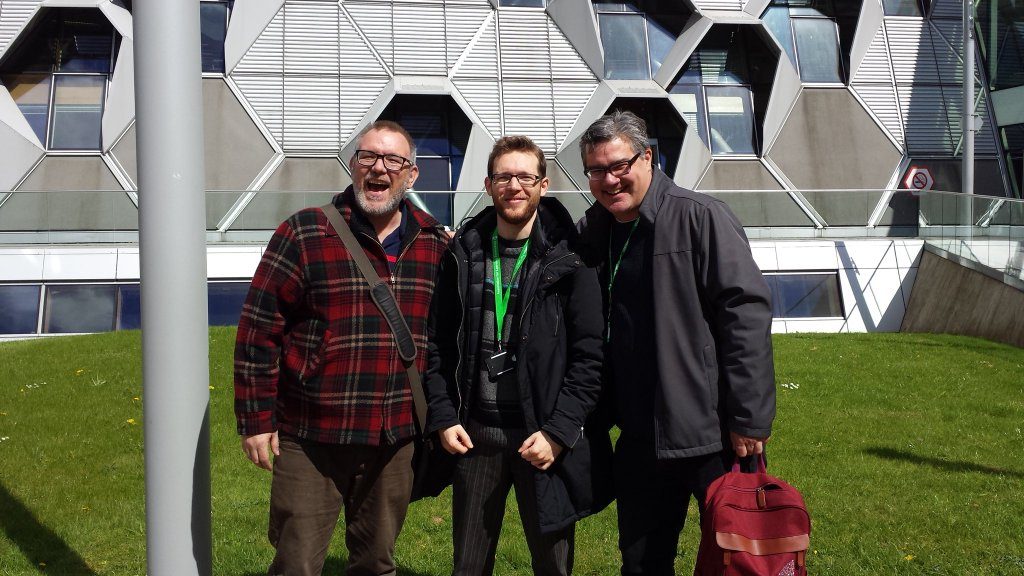
John Johnston and Josie Fraser are much bigger in real life!
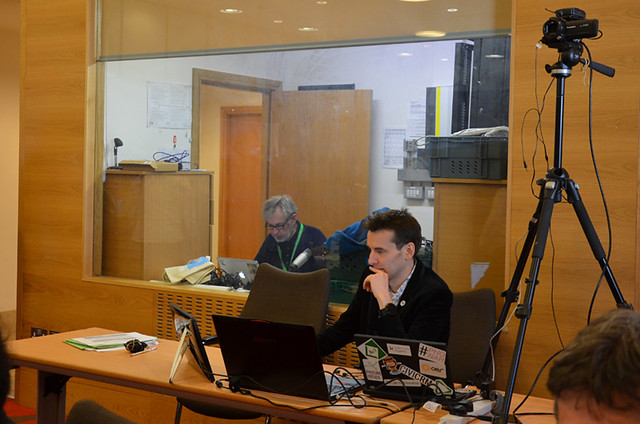
One of the things that was special for me about OER16 was finally getting the opportunity to meet several awesome folks who I’ve followed and admired for years: people like Tony Hirst, Jodie Fraser, Frances Bell, and ds106 legend John Johnston (who, by the way, made up one half of the awesome conference AV team—the other half being the inimitable Martin Hawksey).
OER16 was also my formal introduction to the UK edtech community, and as I mentioned to quite a few folks, I really appreciated the role the Association for Learning Technologies (more commonly known as ALT) played in stewarding the conference alongside the amazing conference co-chairs Lorna Campbell and Melissa Highton. Being outside the UK ed-tech scene, I always had this idea of ALT as some huge, EDUCAUSE-like organization with scores of people running the show. Little did I know that was anything but the case. In fact, they are quite the opposite. ALT is a small organization that seems to have survived the almost decade long reign of austerity in UK’s higher ed funding. From what I understand the lack of funding orphaned UK’s OER conference until it found an organizational home with ALT. And I must say another highlight of the event for me was meeting ALT’s chief executive Maren Deepwell, we connected immediately and I really dig her style.
And then there were the old gold open ed folks like Brian Lamb (my gateway drug to the whole open thing), Grant Potter, Martin Weller, Viv Rolfe, David Kernohan, and many more I am forgetting I’m sure. But this brings me to probably the most important point I wanted to make about OER16. It was for me brought together a bunch of folks who have been, for the most part, marginalized by the ed-tech gold rush for MOOCs, big data, analytics, etc—a push for the last four years that dominated the field’s time, energy and precious few resources. And as the interest wanes and the funding drys up, it actually might be a good time to get back together and re-focus our interests. The highlight for me of the time was talking with Grant Potter, John Johsnton, and Tony Hirst about making SPLOTs using Docker. In particular, I keep thinking about trying to make a supercut SPLOT along the lines of the magic John Johsnton has already done—something that I would love to make a summer project. But that was a good indicator of the conference tone for me: a return to low-key, small, focused, and fun projects. The idea of scale, sustainability, critical mass, etc. was not the focus, it felt like a return to some of the simple, cheap, marginal experiments that made the field fun to me ten years ago.
I think what brought this home was the brilliant panel “Web Today, Gone Tomorrow: How can we ensure continuing access to OERs?” about the issues surrounding centralized repositories for OER versus distributed, smaller models premised on design of the web. Pat Lockley made a persuasive and engaging argument in his video “The Plight of OER” that most of the resources we consider open are not provided by the institutional OER repositories (many of which are shutting down due to lacking of funding), but rather contributed by a few individuals. And Viv Rolfe pointed out that many of the open resources that have been funded by public money are no longer available, there is a crisis of open when it comes to anything resembling a long-term archive. And I would add much of that has to do with the way in which it is tied to large, centralized, and expensive repository solutions rather than remembering the web is made up of small pieces loosely joined. As Brian Lamb mentioned during the panel, “When did open becomes an end rather than a means?”
As for my keynote, well to quote Brian Lamb again, “I played the hits.” I couldn’t help it, I felt like ds106 is what folks want to hear about, and I can point to few better examples of open culture—which was the theme of the conference after all. I think ds106 was new to many folks there, but I still felt a bit guilty at the indulgence. I had originally planned a more protracted critique of how we imagine OER in the US (namely textbooks) and moving into trying to make sense of some of the various technologies that might power more personalized infrastructure like domains, SPLOTs, and alternative applications like Sandstorm, Docker, etc., but I only really touched on the idea. Lorna Campbell’s summary of the keynotes comes highly recommended, and I think she’s far more generous in her description than the reality of this talk, although she does frame nicely the talk I wanted to give 🙂
Jim urged us to turn our attention from open, shareable educational resources, to shared technical infrastructure. Asking what if we focused more on small-scale personal, re-usable software rather than monolithic, institutional solutions? What if we worked towards a collaborative infrastructure for OER that was always framed and scaled at the level of the individual, not unlike the web? With the shift in web infrastructure to the cloud, the advent of APIs and containers, and a burgeoning network of distributed and collaborative ed tech, we may be entering a moment where the open culture of networks is key to a sustainable future for OER.
It’s almost a year and a half later and I still haven’t been able to effectively frame my talk on the cloud, containers, and APIs. Although hope springs eternal, and after my time with Brian Lamb at Coventry the week after OER16 I have a better sense of how this might be done because Brian is doing this very work himself. As for the talk, I think it was fun, but I do think I was relying too much on ds106 and stuff I had already presented and that hurt it a bit. My talk at Coventry the following week covered similar terrain, but started with the UMW Console exhibit I worked on at UMW that made the talk feel a bit fresher. Also, to be totally frank, I was a bit more nervous than usual for this talk, and I’m not sure why. Maybe the ghost of Simon from American Idol set the critical Brit quotient a bit too high 🙂
Anyway, here are the slides and below is the video, brought to you by the good folks of OER16.
You look for a representation of DS106 in the world, and you find something close, but [not] quite it. Find something like that.
Heck today’s tag #tdc1607 is like that. Almost a 106 but not.
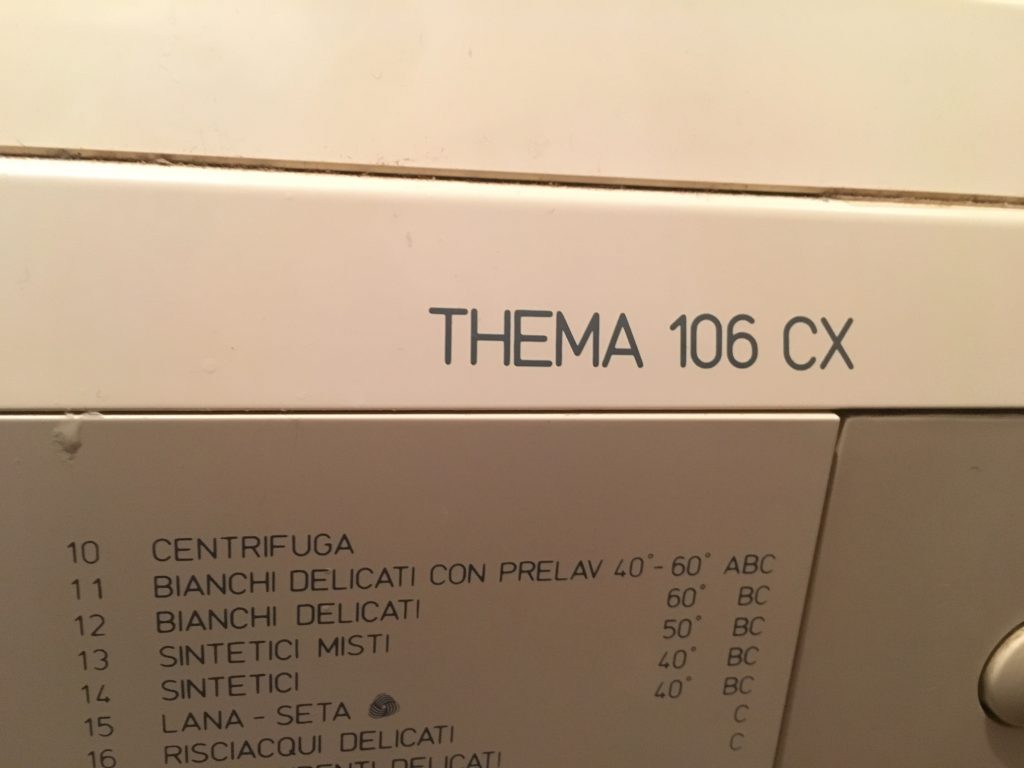
I have been looking at the above 106 for almost 9 months now. It is the model name and number for the San Giorgio washing machine (lavatrice) we have here in Italy. It’s an older model (my guess is late 80s), so not as old as the one in this 1960s ad—though it seems to be a similar make and model.
Every time I see the “thema 106” tag it is a reminder of all the cool themed versions of ds106 we have run, like the Summer of Oblivion, Camp Magic McGuffin, the ds106zone (the course that brought us the inimitably creepy iamtalkytina) wire106, noir106, Tales from ds106, and western106. ds106 has been a regular genre factory of awesome, and it shows no signs of letting up. Just earlier today Paul Bond was talking about the idea of an Internet-themed ds106. I dig it, and it plays on work Paul and I did with the Internet Course. I would even make the theme more specific, like internet meme culture so it doesn’t morph into a coverage course. The idea of the themes have always been fast and loose, so if they begin to hijack the spirit of fun you can jump ship easily and get back to the program 🙂
Anyway, my Daily Create isn’t so much a near miss as an excuse to finally share my ds106 themed washing machine with everyone.
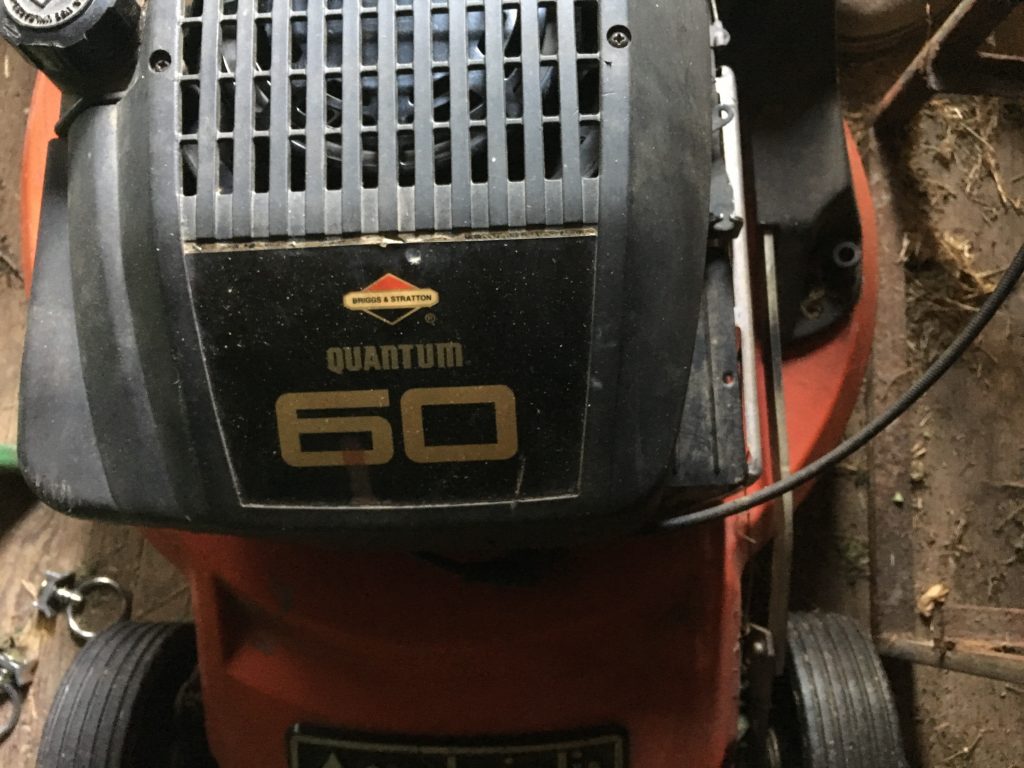
Two weeks ago I took a Briggs & Stratton Quantum 60 lawn mower apart because I couldn’t get it to start. The initial issue was apparent, the pull cord was broken and needed to be replaced, that was easy enough to take care of after watching this YouTube video. And while I fixed the pull cord, the lawn mower was still not starting. I got brave and proceeded to take apart and clean the carburetor with the help of this video. I was able to take it apart and put it back together (which was cool), but the gasket between the air filter and carburetor was shot and did not survive the operation—an issue I’ll return to shortly. Besides that, the carburetor was fairly clean and there were no apparent blockages, so the carburetor itself wasn’t the issue. But after putting it back together and trying it again the gas was not getting to the spark plug and I was stuck. I decided to let it sit because I was wasting time.
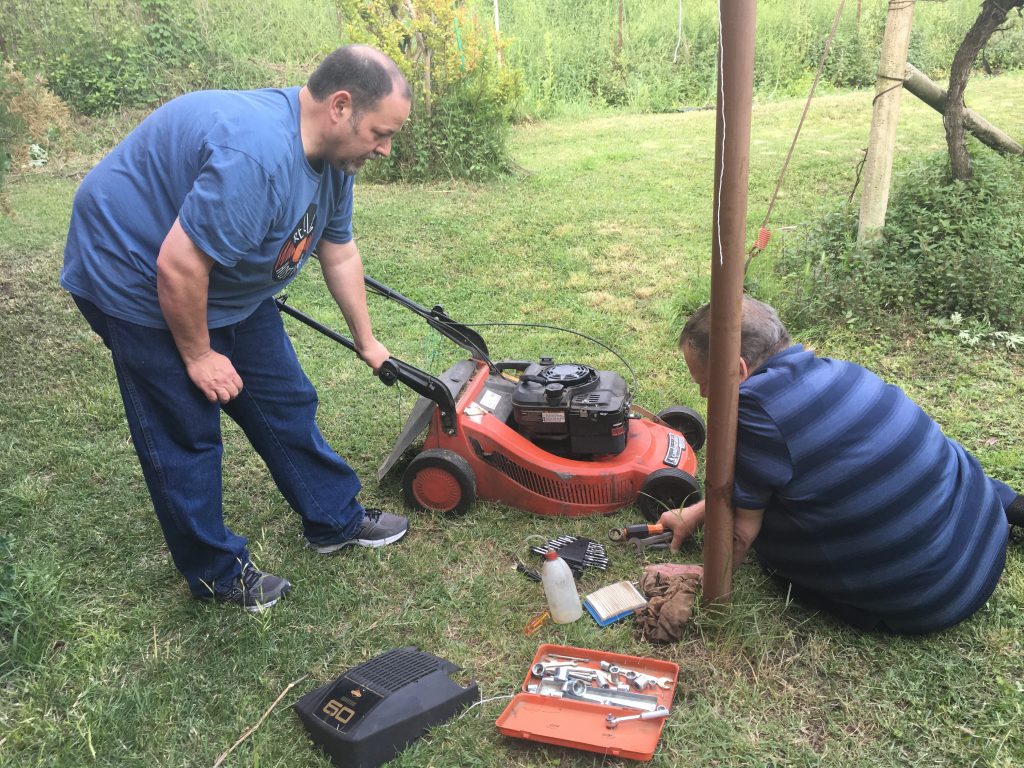
Fast forward two weeks to this past Friday, I was fortunate enough to have Mark Morvant and his awesome family visiting Trento for a couple of days to testify to the posh life I’m living in the Italian Alps 🙂 In fact, I’ve had a couple of amazing visitors already (here’s looking at you Shannon Hauser and Brian Lamb), which has been a total treat. Antonella and I really enjoy showing off Trento, and I’m sure we’ll have many more opportunities in the coming months. While I was showing Mark and his dad Clifton around the house I mentioned in passing my feeble attempt at fixing the lawn mower. Turns out Mark and his dad are no strangers to fixing small engines. In fact, Mark’s dad Clifton taught students how to fix engines for decades, and Mark was his trusty assistant since he was a boy. So crazy and so cool!
Mark and Clifton small engine repair road show in Trento, Italy
Anyway, when they offered to take a quick look I jumped at the chance because I am shameless, and they made short work of diagnosing the issue. Turns out that broken gasket I ignored between the carburetor and air filter was crucial for enabling the primer to spray gas into the combustion chamber so the engine would turn over. Mark also noted the tube going into the carburetor was a bit clogged, so the gasket was not necessarily the only reason it wasn’t working, but definitely a reason. But they didn’t stop there, Clifton quickly took apart the carburetor and checked it over again, and after reassembling it had mark spray gas into the combustion chamber. We then pulled the cord and the engine showed signs of life. Mark sprayed gas into the chamber a couple of more times (effectively manually doing what the primer button does) and we got it running. After that I was amazed how Clifton used his finger as a choke to create the pressure needed to make the fuel flow steadily towards the engine. Clifton went on to tell me this process is known as the Venturi effect, named after the 18th century Italian scientist Giovanni Battista Venturi who published the first treatise on it in 1797. I even found an awesome science GIF on his Wikipedia page that demonstrates this physical principle of hydrodynamics. Educational GIFs FTW!
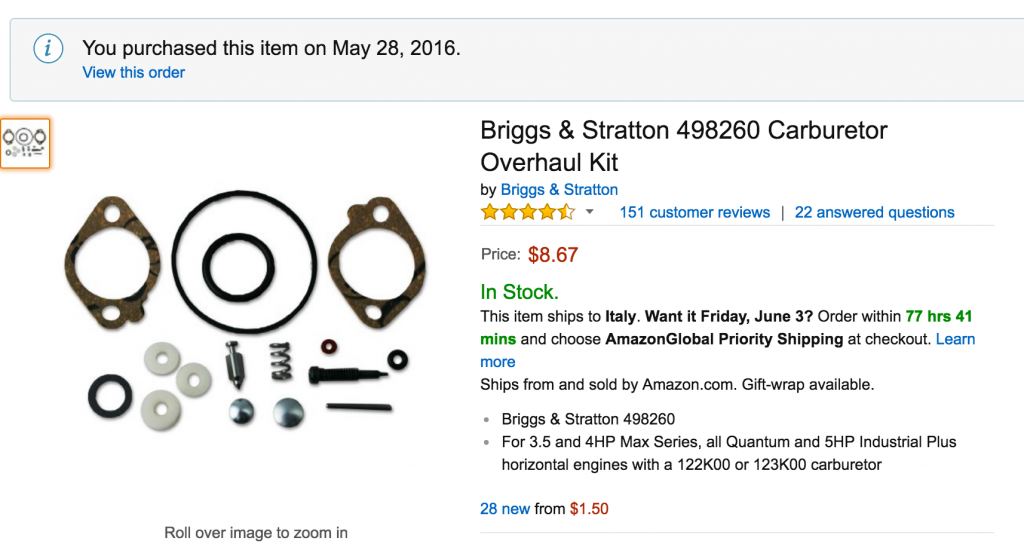
So, in less then 20 minutes they had the mower diagnosed and running. I ordered a carburetor repair kit on Amazon yesterday, and it should be here in another week.
I just need the gasket, but it might be useful to have all the other pieces just in case something goes wrong. So, nothing like bringing some good old fashioned American ingenuity to Trento! A special thanks to them both, and not only for the like-new mower (though I’ll take that), but particularly for the privilege of getting a glimpse into a father-son relationship that is so full of mutual admiration, cooperation, and love—a rare treat, indeed!
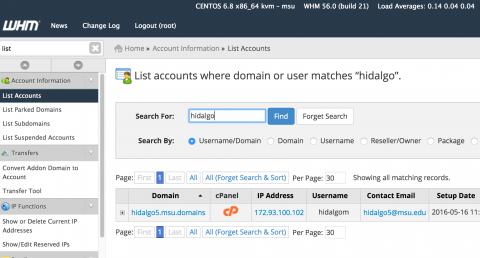
This is a quick and easy tutorial for changing storage space quotas on specific cPanel accounts, perfect for a rainy Sunday morning. I often get this question from someone managing a Domain of One’s Own initiative that needs to modify an account to allow for more storage space.
This process is done in WHM, which is basically the GUI interface for managing all the accounts on cPanel. Once logged in you do a quick find using the word “list” (no quotes) in the left upper hand corner. Then click “List Accounts” which will allow you to search for the account you need. You can search by the username or domain as demonstrated below.
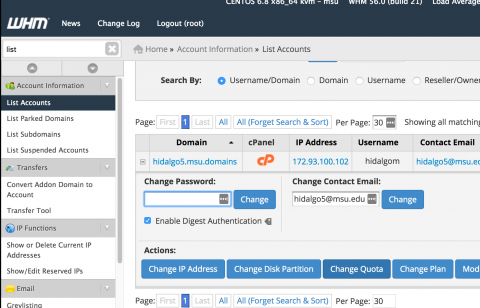
From there click on the + button next to the domain and you will see a series of options, include a blue “Change Quota” button. Click on it.
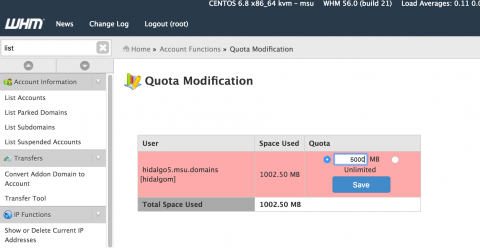
From there you can change the quota to the appropriate size and save it.
Now that account should have enough storage. We often build in a hard cap for storage, something like 1 or 2 GBs to avoid using up a server’s space too quickly. But this feature allows a quick override for special instances, which can be useful when a student, staff, or faculty member simply needs more space.
Thanks to a retweet from Tressie McMillan Cottom (one of the best academic wranglers of the blue bird), I got transported back to my days as a Ph.D. student at the CUNY Grad Center.
Verso Books (which has a very impressive Twitter presence, by the way) had the editors of Policing the Planet share their top 5 books about the broken windows theory of crime. I was intrigued and followed the link—nothing competes with a 90s cover of Time magazine for clickbait—and was struck by the first book on the list:
Neil Smith's THE NEW URBAN FRONTIER is "a peerless primer for understanding 'broken windows policing'" pic.twitter.com/uU9gxrCRnl
The late Neil Smith‘sThe New Urban Frontier: Gentrification and the Revanchist City topped the list! That may have been the most formative book I read during grad school, and if I was smarter I would have taken the work I did with Smith on using 80s and 90s films to analyze the popular representation of gentrification pop culture and turned it into a dissertation. My official focus was on Early American impulses towards Imperialism, but my heart was always stuck in 80s. In fact, long after I dropped out of the CUNY Ph.D. program in English I published my paper on the topic on my vanity press of a blog: “Of Punks, Pimps, and CHUDs: Gentrification in NYC as told by 1980s Film.” I’m still sentimental about that one, and one of these days I need to return to it and replace some of the YouTube clips from the various films they so inconveniently took down.
Not only was it cool to a book near and dear to my heart inform current scholarship and resistance around policing the city. I was also struck by how effectively Verso uses Twitter not only to promote their books, but also share some great related titles. For example, the other four books that inspired the editors of Policing the Planet were (drumroll please)….
Delaney's TIMES SQUARE RED, TIMES SQUARE BLUE "shows how broken windows claimed its most hollow victory" pic.twitter.com/rA9g7ZHnAD
This is a solid list for anyone interested in a critical analysis of the history of policing, and I was struck how Verso made it interesting, accessible, and memorable. As I blog for the CUNY Academic Commons I find myself thinking about how this works. Is there a space where folks are promoting the various scholarship happening at the Grad Center? I mean Neil Smith has a rich history at the Grad Center, and Verso reminded me of that, what is the Academic Commons doing to regularly highlight the scholarship coming out of CUNY’s think tank?
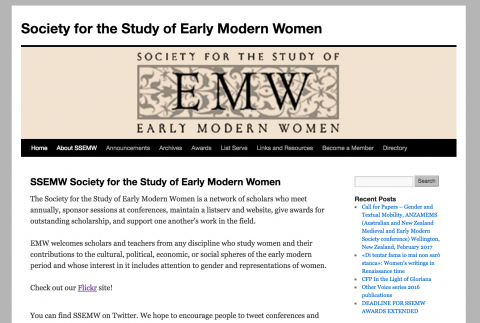
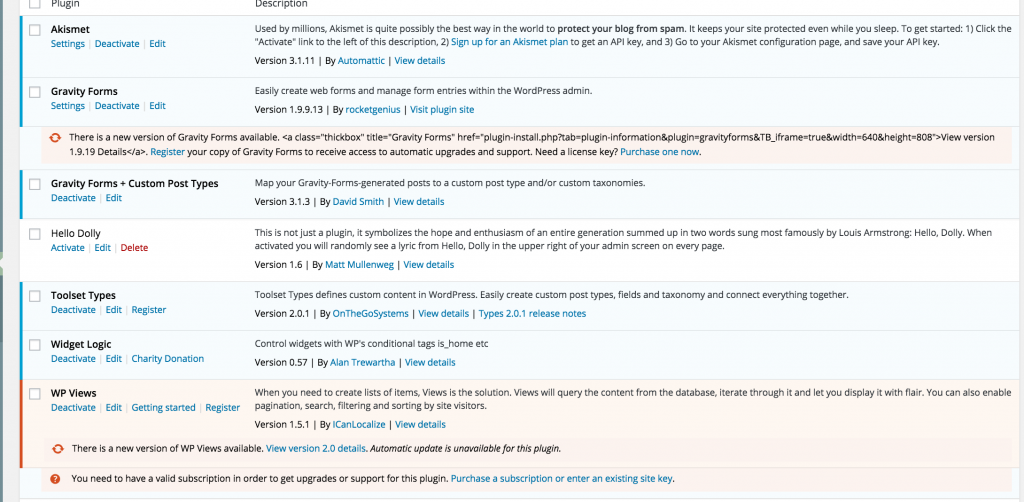
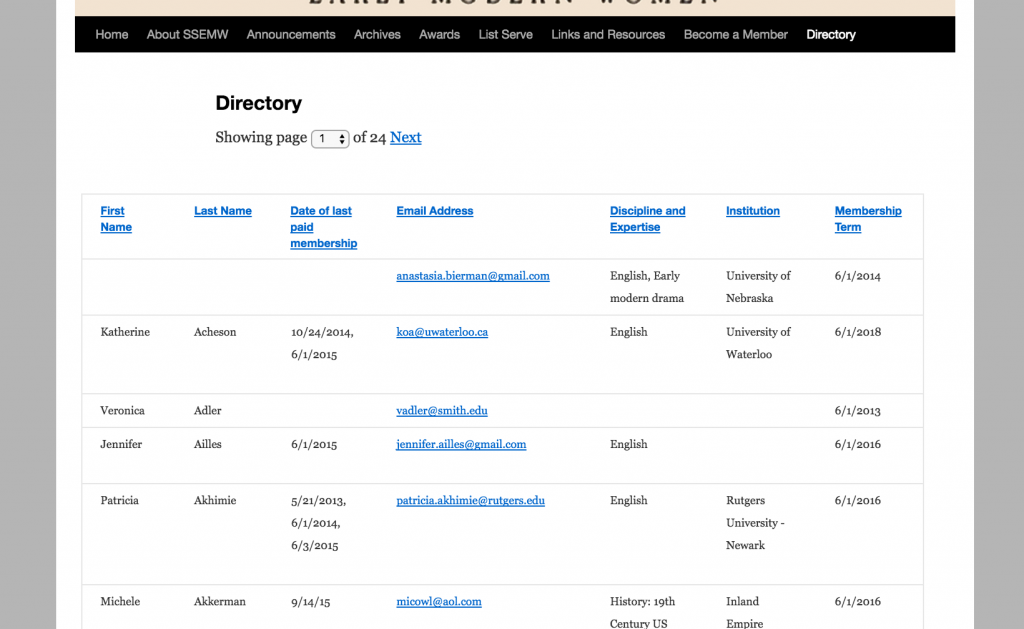
A long while ago I worked with UMW History professor Allyson Poska to migrate the Society of the Study of Early Modern Women‘s (SSEMW) website to WordPress. It was fairly straight forward given it was a small academic organization without too many pages or gimmicks. I can’t fully remember now, but I think it was in straight-up HTML, so there was a little work cleaning up links and formatting before copying them into pages, but nothing crazy. The other thing they asked about was a simple directory of members so they could keep track of who registered when, paid their dues, emails, etc. At the time Martha and Tim had been playing extensively with plugins like Gravity Forms, Views, Types, etc. for project sites, and I knew they had built similar functionality.
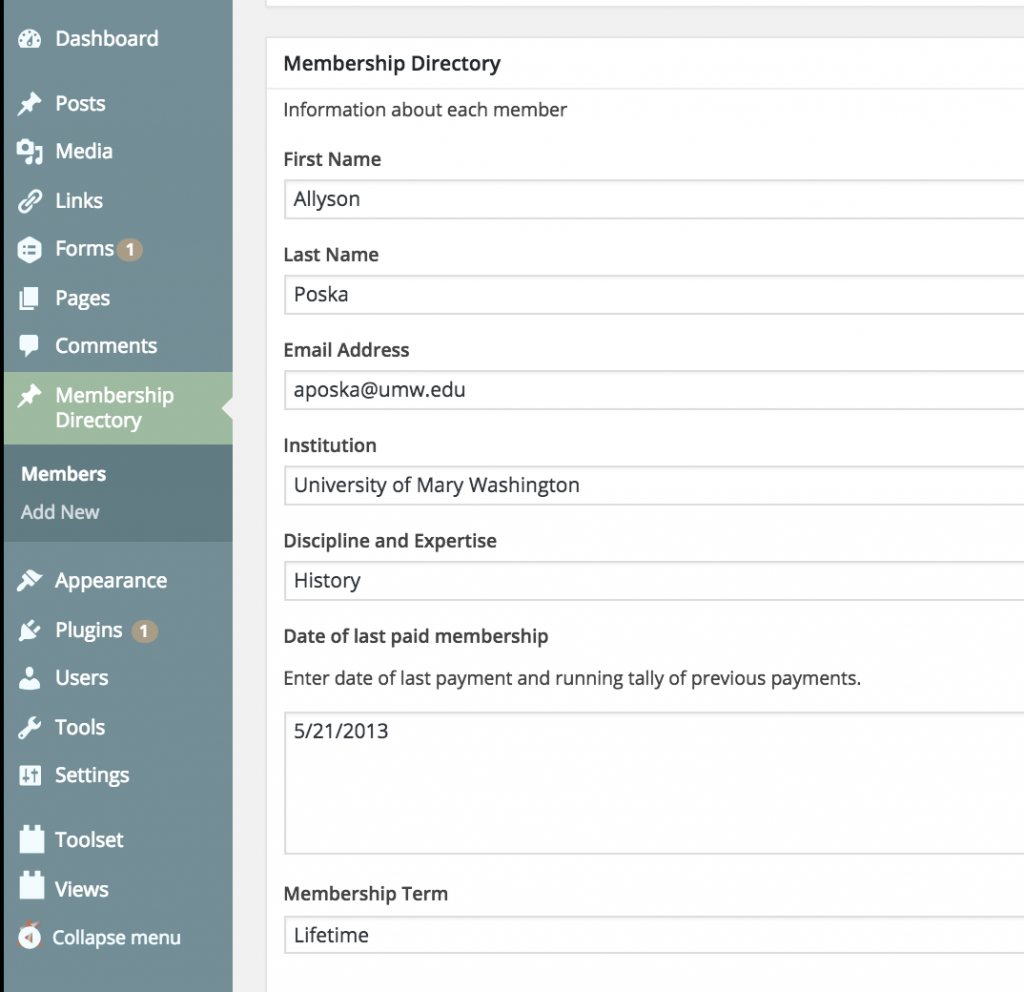
So, as is often the case, I went to the proverbial well. Tim showed me how to work through setting up custom posts types using the Types plugin. You can see the posts for the Membership directory below.
Then I used the Views plugin to display the fields in a directory layout. Views is powerful, but not all that intuitive and I tended to lose my way. It becomes very Drupally very fast, but the final product worked.
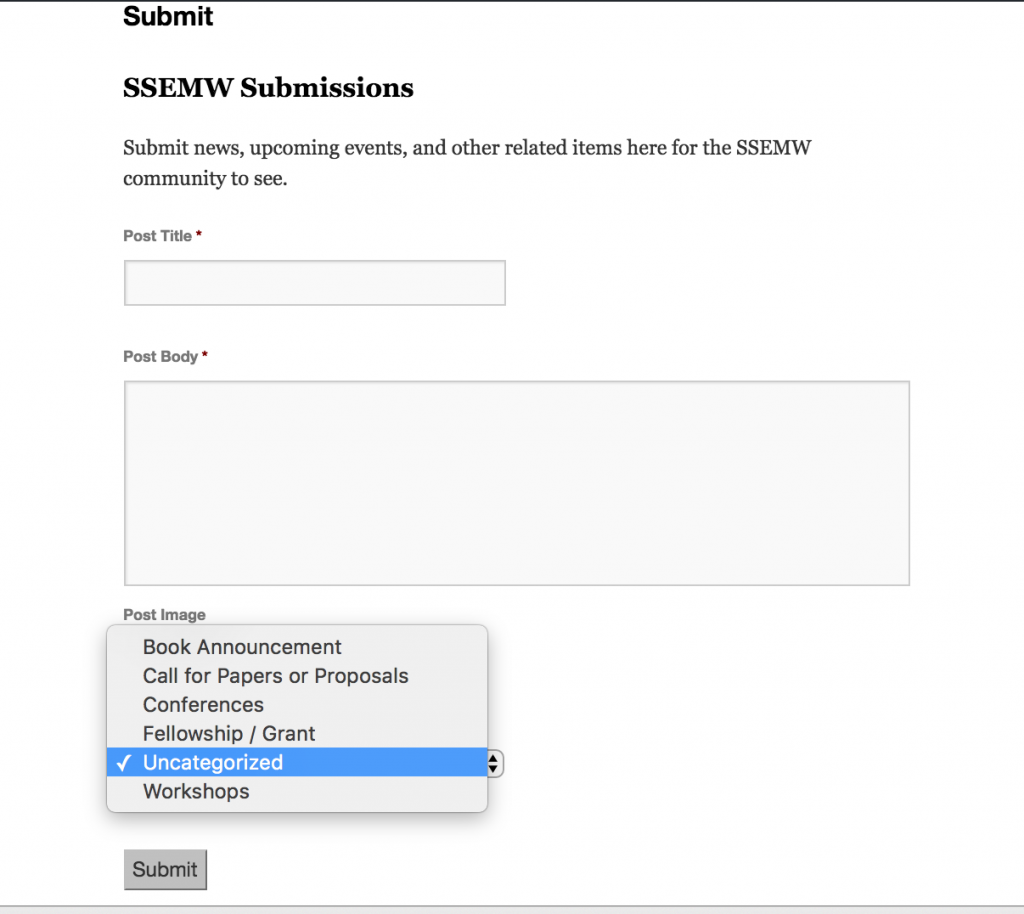
These custom post types contained data people manually entered to manage the membership details, and the directory was a bonus. [I believe we figure out how to do a bulk import of content into the custom post types.] This was not linked to member registration nor membership dues, although we’ll get there. We didn’t use Gravity Forms at all for the directory, but as an excuse to play with them, I built a simple post submission form that anyone in the community could use to add news, calls for papers, fellowships, etc. Dead simple.
I did this almost four years ago now, and really hadn’t thought about it again until this Spring. The officers at SSEMW reach out to me once in a blue moon for something, but it has been basically zero overhead and I was pleasantly surprised to see they’ve been regularly posting—that’s always a good sign. And Allyson Poska has long since moved on as an officer, so it was cool to see it transitioned fairly smoothly.
Anyway, long story short, last year Jodi Campbell reached out to me about a similar site for the academic organization she is web master for, namely the Association for Spanish and Portuguese Historical Studies (ASPHS). I was game for a discussion, but time and work got in the way for both of us so we didn’t reconnect on this project until this February. Before we talked I had to jar my memory of what I did with SSEMW. When I talked with Jodi she was interested in a directory like SSEMW, as well as an announcement/post form. Simple enough, or so I thought. But that changed once we started talking about providing a form the association’s members would use to register new members, renew existing membership, and edit their directory information. Also, they wanted more seamless integration with Paypal. So, in other words, a website that manages most of the membership details, provides a venue for sharing news and announcements, and has a membership directory to connect folks. All makes sense, a manageable hub for your academic organization that stops short of trying to reproduce the creepy treehouse that is Facebook. I agreed to give it a shot, and spent the last few months (in between travel and procrastination) working on it.
To be fair, I had the site migrated and up and running on WordPress in less than a week. It was thinking through the member registration and directory that took a bit more time. The form would be used by members to sign-up, re-new, and update their profile, so a custom post type like the one we used at SSEMW would not work. Looking at Gravity Forms more closely I realized they had at least two pieces of the puzzle worked out: PayPal integration and user registration.* The combination of these two plugins/addons through Gravity Forms solved the new member registration and payment issue. I was very happy with the results, but I ‘m still struggling with enabling simple renewals of membership through PayPal. I’ll be working on that solution over the coming month.
The other issue was getting the data members using the form visualized as part of a member directory. I explored this free plugin for creating a directory using Gravity Forms, but it was limited in it’s visual range and having users edit their entries was not working. The latter fail was a deal breaker, because giving user’s the ability to edit their own data is something we needed. Another issue was I needed to import the data of about 500 existing users and the Gravity Forms Mass Importer plugin was not working, and it hasn’t been updated for a year which is not a good sign.
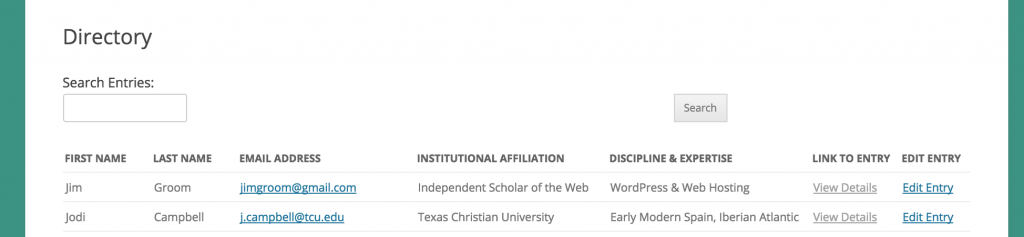
So, I had already bought one plugin suite for $199, which to be fair can be used on a host of other sites should we need it. While looking for alternatives for the directory and import issues, I discovered the Gravity Views plugin. Despite the bizarre video of the guy (plugin author?) in the purple shirt, it promised to solve my directory and import issues. The plugin integrates with Gravity Forms and allows you to create a sophisticated set of views with the data. What’s more, the plugin suite provides an importer, which was a must because I had no intentions of manually entering hundreds of records. That said, the price was steep, $249 for a yearly license, annually renewable at 40% the sticker price. Ouch! I got sticker shock and searched for other alternatives and toyed with manual entry and making the existing directory plugin work, but that was short lived. I had to get something up and running and I was wasting time pretending I was going to will my way to a working alternative. I bit the bullet on Gravity Views earlier this week—after finally returning to the project after a month of travel—and I am pretty happy with the result. Below is a look at the multiple entry directory list (notice the “View Details” and “Edit Entry” buttons):
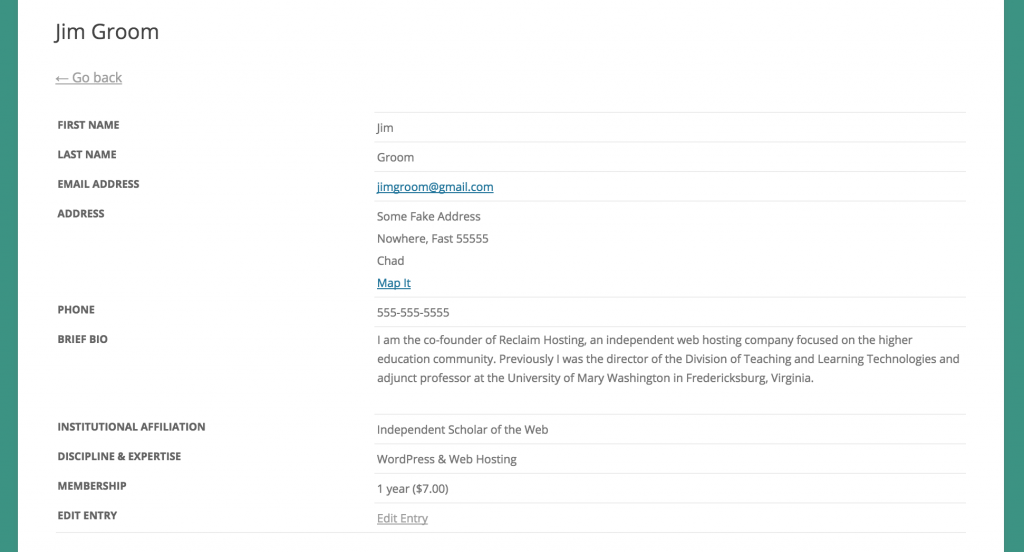
Click on the View Details for any entry you get a single entry directory view like this:
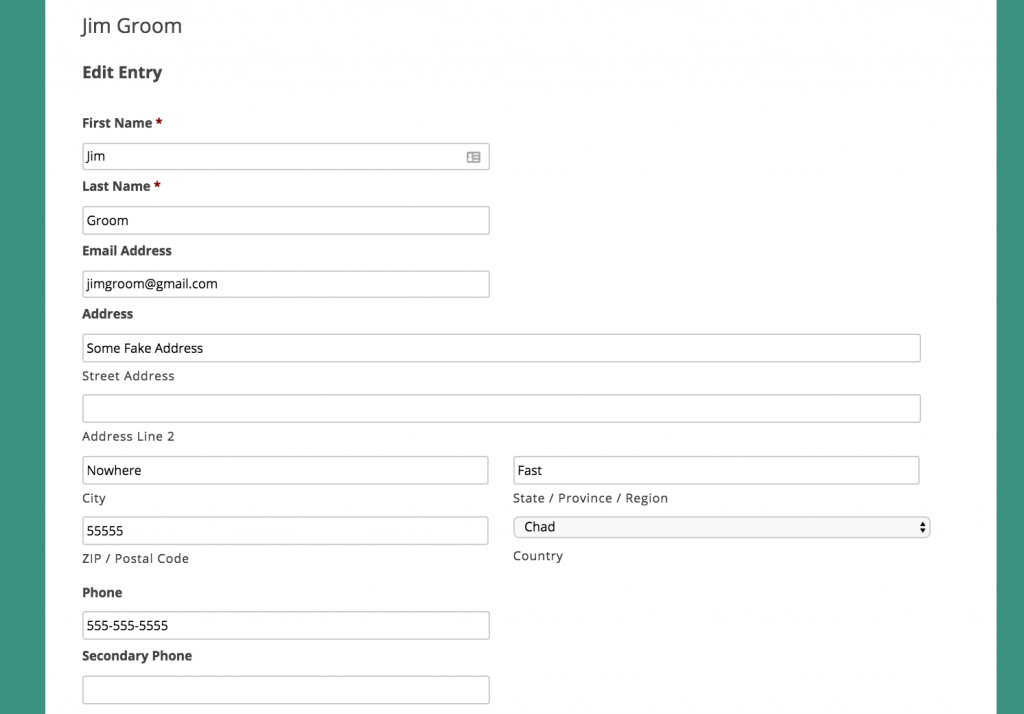
And finally, the ability for individual users and admins to edit their profile info.
Gravity Views made creating these various views as a directory seamless, and they even built an opt-in field for the Gravity Form so folks can decide if they want their info in the directory at sign-up. I could easily show Jodi Campbell how to use Gravity View in a few minutes and feel confident she could manage all of this going forward, that would not be the case with Toolset’s Views and Types. Simplicity is a big factor for me because it’s scalable, not to mention desirable, for me not to manage the details of a site like this. The other piece Gravity Views promised was a clean import of data, and having tested that over the last couple of days I am also happy with the results. I had to clean up the data I got from ASPHS, but after importing scores of test accounts I’m sure it will work for almost 500 records. I did get a PHP offset error which I copied below, and I am still chasing that one down, but the data imported cleanly, and I am not seeing any adverse effects besides some ugly errors during import.
Notice: Undefined offset: 1 in /home/asphsnet/public_html/wp-content/plugins/gravityforms/common.php on line 2886

Notice: ob_end_flush(): failed to delete and flush buffer. No buffer to delete or flush in /home/asphsnet/public_html/wp-content/plugins/gravityview-importer/class-gravityview-entry-importer.php on line 331
Being all but done with this project is a big relief. I dragged it out a bit while struggling with the best way forward, but in the end I think you can create a pretty dynamic, impressive site for your small academic organization at a fairly modest price. If you take into account hosting and the yearly price of the plugins, you could set something like this up for your org for less than $500 a year. And much, much cheaper if you don’t need the premium plugins, but I would be surprised if you could get custom code half as cheap to do any of this without writing it yourself—something I have no pretensions of doing.
We’ll be testing the setup out with some select users at ASPHS over the next few days, and then rolling it out to all users over the coming month. One issue I do have with Gravity Views is I’m having problems enabling users to change their password within the edit entry view. Right now I’m working around this by having all imported users prompted to change or accept their given password at sign-up, but I do need a long-term solution for seamless password changes within the directory/profile edit page for users. Regardless this has been a kind of fun side project, if for nothing else to figure how to take the SSEMW site to the next level. Also, I know some that may read this will have much more experience with Gravity Forms and possible ideas for work arounds or a better approach—consider me all ears.
______________________________________
*The developer license is $199/year, and given Tim and I both had projects that would use it we splurged. I don’t necessarily love buy premium plugins, but at the same time I learned for this project it is far, far cheaper than me actually trying to learn how to code 🙂
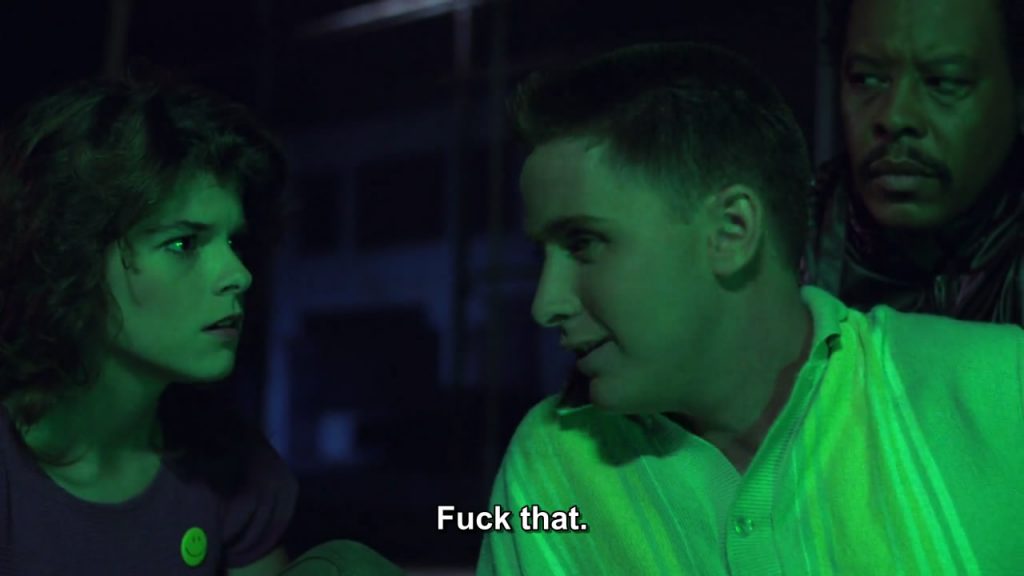
Amen, Harry Dean! All this talk of coding or being coded is besides the point, when push comes to shove most people simply need a code. I come back to Repo Man (1984) a lot when I am thinking about Reclaim Hosting‘s code. In fact, I already played on the idea of a Reclaim Code with the above clip. So when sitting down to talk to Bryan Mathers earlier this week about some artwork I was excited when I found the discussion led us into the territory of this 1980s punk cult classic.
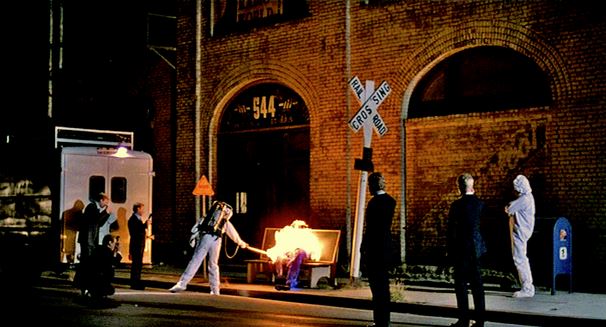
Tim, Lauren and I had been brainstorming what visuals we needed for the website. One of the things Tim mentioned was artwork that might help communicate our migrations service. We provide anyone that signs up free migrations to our hosting service. This is something few, if any, other hosting services provide, and I believe it does go above and beyond. Moving your stuff is stressful, and we make it painless, so the idea was to communicate this. Bryan had the idea of people outside a van with white gloves moving crates of records, which I totally loved. It set me down the road to Repo-perdition. In Repo Man the government agents worked out of a hi-tech industrial bread delivery truck (you can see the back of it in the image above–also what is the technical term for that kind of truck?). This image of movers with white gloves made me think of the government agents in nuclear suits moving the contaminated bodies of the homeless in Repo Man.*
I really do love the play of and on culture in an aesthetic, and I think that’s where most “serious” scholarship and research in edtech failsmiserably—they’re not only by and large rudimentary, but also boring as hell. And the same is true for other hosting companies, who use stock images of a server room and soul-less text to sterilize anything resembling an experience. It tells people you are uninterested in the ideas and simply doing it for the money; an aesthetic to one’s life and work that reinforces your ethos matters. So Bryan Mather was off to watch Repo Man, and I am anxiously awaiting his artistic genius! He already sketched up a scene for the truck that I loved, so I think this is going to be awesome (no pressure, Bryan! 🙂 ). Regardless, it helped me re-connect with a film that I love dearly—and come to find out it supplies and edtech code I can live by:
At the end of April Brian Lamb and I spent three days on the ground at Coventry University. We were cordially invited by the great Daniel Villar-Onrubia given his interest in an EDUCAUSE Review article we wrote back in 2014 titled “Reclaiming Innovation.” I think the polemic Brian started the article with around questions of disruption and innovation are near and dear to a larger vision Coventry University’s Disruptive Media Learning Lab (DMLL) is working through:
Today, innovation is increasingly conflated with hype, disruption for disruption’s sake, and outsourcing laced with a dose of austerity-driven downsizing. If any concept should be seen as an uncomplicated good thing in higher education, it’s innovation. Defined by a common-sense notion of “doing things better” and burnished by the sheen of dazzling technological advances, what’s not to like about innovation?
Yet as 2014 churns on, the glow is wearing off. Today, innovation is increasingly conflated with hype, disruption for disruption’s sake, and outsourcing laced with a dose of austerity-driven downsizing. Call it innovation fatigue.
How did we get here? And if innovation is still something we are interested in fostering, what are the values that should animate it? What goals and strategies should we be pursuing if we want to reclaim innovation as a positive force as higher education continues to engage with digital and networked technologies?
This beautiful framing of the issues thanks to Brian was our ticket to Coventry, and Daniel worked with us for months before the event to try and frame a 3-day residence that would serve the community. The issue with this approach is Brian and I don’t exactly have a healthy working relationship. Don’t get me wrong, we love each other, but we also struggle psychically with one another on some deep levels. And I really felt bad for Daniel given he put himself in the situation of trying to referee and direct this unstable collaborative energy. Usually when Brian and I get together for any extended period of time it proves generative, but at an immediate cost to our individual well-being. We constantly rib each other with deep questions and challenges that undergird the basic assumptions and prevailing logic of the work we do and the people we are—it’s a morbid kind of anti-therapy. A process that often feeds off our insecurities, which at times I think would make us an unstoppable comedy team if this edtech field ever does actually legit-a-demise. That said, there is no question I do my best thinking and feel most deeply attached and responsible for the work I’m doing when I’m with Brian. He feeds a crucial place in my soul, and one that makes me feel alive and scared all at once. I’m not sure exactly how to fully explain it, but I know I am the better for it—despite all the pain 🙂
All this to say, I didn’t envy Daniel’s position of bringing us together for a professional event that he was hoping would make a good impression on folks at Coventry. It was a risk, and I’m not being entirely tongue-in-cheek here. Things can go terribly wrong from an institutional perspective when Brian and I collaborate, it’s happened before many years ago. The plan was fairly simple, we spend two days on the ground talking with various faculty members, ed-tech staff, and the DMLL folks themselves to share various approaches of how we can reclaim small bits of innovation through alternative ideas of ed-tech infrastructure. We even came up with a plan thanks to Brian, and he rolled out a brilliant site that maps our loosely structured workshop that we delivered to 4 different groups of faculty and staff over those two days (we probably met with between 60-80 folks). We talked GIFs, SPLOTs, Sandstorm, Domains, and more. We even setup Coventry with their own Sandstorm sandbox. And while only time will tell, it seems clear to me that Coventry is a university well-positioned to start exploring some of this stuff in more depth. They have curious faculty, folks to support them, and buy-in from the administration, so I’m excited to see what happens.
One of the real delights of these two days of workshops was listening to Brian pitch SPLOTs and Sandstorm. Brian and I fall in that liminal space between rarified thought leader and techie. We are very much technologists, but I like to think we’re equal parts literature, cinema, music, and web. We love the technology of effective and creative communication, and we find ourselves in the historical moment when the web has become both the medium and the form of all of these things. Brian’s workshop was a master class in starting small and simple with the SPLOT as a way to challenge assumptions about collecting data from our students, assuming everything eventually has to become a system, and that any of this has to be complicated to get started. In many ways the SPLOT is as much a small, finely-tuned ed-tech ethos as it is a tool, and Brian laid it down brilliantly in each and every workshop. In fact, I think we had more technologists and faculty interested in SPLOTs than anything else we showed off during our time at Coventry—and that was a direct result of Brian’s ability to make the case.
After an intense two days of workshops, on the third day was the DMLL Expo “Lost in Disruption: Reclaiming Innovation.” This was campus event to showcase the work of DMLL through a wide array of presentations, panel discussions, and informal interactions. It was a great day, and I had a blast. The idea of bringing us in for a couple of days before-hand to meet with folks and get acquainted with the community was probably a big reason why our presentations and contributions might have resonated with folks. We didn’t parachute in to broadcast our infinite wisdom. We were on the ground trying to get a sense of what was happening. Daniel worked us hard for three days, and that’s what you should do when you bring folks in. Expose them to as many people in your community as possible and get conversations happening and ideas brewing.
That’s exactly what happened for my own talk at the Expo. After being in 6 or 7 different conversations over the previous two days I decided to scrap my presentation the morning of the event and start fresh. Brian had noted that my OER16 presentation was pretty ds106 heavy, and it was. He wasn’t necessarily challenging me on that, but it did make me think about Martin Weller’s recent post about the keynote dilemma. My presentations are never necessarily identical, but they do rely on a lot of the core elements of the work I’ve been a part of over the last decade: the early Bluehost experiment, UMW Blogs, ds106, Domain of One’s Own, Reclaim Hosting, etc. There’s an obvious narrative arc to this work, at least for me, and I don’t make any pretensions to being a researcher or academic—so I’m freed up to focus on the shit we did rather than the big ideas. That said, it feels almost like an obligation to talk ds106. And don’t get me wrong, I have no problem doing it and it always feels fresh to me, but at the same time it has become apparent that’s what people associate me with now. So, in a last minute attempt to change up I decided at about 8:30 AM to frame my talk around the work I did with Zach Whalen last year to create the UMW Console.
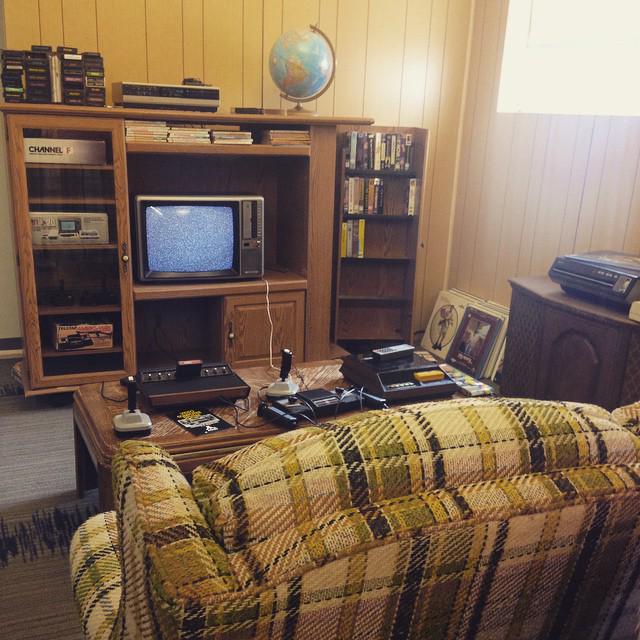
I had blogged the UMW Console pretty regularly last year and folks took tons of photos and videos. We even created a database of all the artifacts, so putting this talk together was fairly easy. [Reason number 78,974 to blog.] I simply linked out to about 4 or 5 blog posts and narrated the thinking behind the UMW Console, how we did it, and what it meant for re-thinking some of the ideas the folks at DMLL were trying to explore, such as flipped classrooms, gaming, etc.. What would it mean to design and build alternative spaces like the an 1980s living room to re-imagine how we program and inhabit learning spaces. I think it fit the spirit of this group well because it opened up innovation and disruption as small, communal, and fairly cheap endeavors. It wasn’t about a system as much as it was about exploring cultural history as mediated and informed by and through technology. I keep going back to Audrey Watters’s brilliant talk about the Discovery Channel and the history of TV and broadcast networks.* The idea that we were re-creating a moment where the political map of networks are very different given the predominance of television and radio, not to mention the material culture of music and video. It opens up a different space to explore this through, and teaching could use that space in some new and exciting ways.
I think the presentation hit home for some, and I may very well be returning to Coventry some time soon to start working with Daniel, Helen Keegan, Luca Morini (whose talk on gaming was brilliant), Kate Green, and many more to start building out some of the small infrastructure Brian and I shared, as well as imagining a teaching and learning space from 1995. Just think of the possibilities. What if we were to re-create a networked computer lab from 1995 and teach HTML classes in it? Full with machines of the era loaded with Windows 95, MS Office, Pegasus Mail, Doom, Duke Nukem, Earthworm Jim, and so much more! How much of the web from Fall of 1995 could we reproduce and build out as an experience? What if we could get .net artist Olia Lialina to give a talk and run a Dr Professor workshop for us as an invited artist? But this all may be wishful thinking, but damn it would be awesome.
So, at the end of the day I left Coventry feel elated, and no small part of that feeling was meeting all the great people at Coventry and a successful collaboration with Brian—none of which would have been possible without the adept guidance of Daniel. It was an intense 3 or 4 days, and when Brian and I came back to Italy after that I think were both physically and mentally exhausted, but as Brian’s own post on the our time in Edinburgh (more on that in another post) and Coventry suggests, it was a much needed winch to lift us out of the slough of despond 🙂
Here are the slides from my talk. I’m not sure how useful they will be given most of it was extemporaneous. Also, one of the things I realized is that I should be building sites with links I discuss in my talks, much like Brian did for his rather than Google slide decks. I have to rectify this in the future if I’m, indeed, still giving talks. I believe there is a video of the talk somewhere, and I know it was live streamed on the day of the conference. That said, I cannot locate it online presently. If and when it surfaces I’ll include the link below.
*She tried to give this talk in Barcelona last year at EDEN15—but too many formalities and long-winded introductions got in the way. The Europeans really need to tone down their formalities because it cost them a great presentation.
While I’m on the topic of domain scams on the bava, I got another good example of how these human cockroaches work. Below is a copy and paste of one of two emails I received via email last week from the scam artists at Domain SEO Service Registration Corp. The other one I got was identical, it was targeting the ds106.us domain rather than . At first glance the email below reads like an expiration notice for the domain. I know this is a scam because I control the vertical and horizontal of this domain through Reclaim Hosting. Another hint for me here is the date is all wrong, I registered bavatuesdays for the first time on October 12th, 2005, I remember the day well. Reading the email I also notice they’re using the public whois data provided by ICANN because I used UMW’s street address as a way of deflecting any personal info from being out there—a cheaper ID protect option 🙂
This notice is interesting because it provides all the fear and loathing warnings of “expiration,” “act immediately,”“cancellation,” etc. And someone who might not be familiar with these scams might actually think their domain is at risk. It isn’t, because these scammers are actually using the front of selling search engine optimization (SEO) software as a way to lure folks in and pretending they are legitimate. They are scum sucking cowards, spamming folks with intentionally confusing and ambiguous emails intended to scare and confuse folks enough to make them click and pay. It’s a thinly veiled attempt to mask a phishing scam. But if you know how to read it you realize fairly quickly they actually pretending to sell you something you need. They pretend they actually care, but you can be sure that is not the case! Don’t get lured in by there intentionally ambivalent rhetoric—just say NO to their lies!
IMPORTANT NOTICE
Domain SEO Service Registration Corp.
Notice#: 678671
Date: 04/26/2016
This important expiration notification offer notifies you about the expiration offer notice of your domain registration for search engine optimization submission. The information in this expiration notification offer may contain confidential and/or legally privileged information from the notification processing department of the Domain SEO Service Registration to purchase our search engine traffic generator. We do not register or renew domain names. We are selling traffic generator software tools. This information is intended only for the use of the individual(s) named above. If you fail to complete your domain name registration search engine optimization service by the expiration date, may result in the cancellation of this search engine optimization domain name notification offer notice.
Failure to complete your seo domain name registration search engine optimization service process may make it difficult for customers to find you on the web.
This domain seo registration for search engine service optimization notification offer will expire 05/04/2016.
Instructions and Unsubscribe Instructions: You have received this message because you elected to receive special notification offers. If you no longer wish to receive our notifications, please unsubscribe here or mail us a written request to Domain SEO Service Registration Corp., 5379 Lyons Rd. 452, Coconut Creek, FL 33073. If you have multiple accounts with us, you must opt out for each one individually in order to stop receiving notifications notices. We are a search engine optimization company. We do not directly register or renew domain names. We are selling traffic generator software tools. This message is CAN-SPAM compliant. THIS IS NOT A BILL. THIS IS A NOTIFICATION OFFER. YOU ARE UNDER NO OBLIGATION TO PAY THE AMOUNT STATED UNLESS YOU ACCEPT THIS NOTIFICATION OFFER. This message, which contains promotional material strictly along the guidelines of the CAN-SPAM act of 2003. We have clearly mentioned the source mail-id of this email, also clearly mentioned our subject lines and they are in no way misleading. Please do not reply to this email, as we are not able to respond to messages sent to this address.
Out of curiosity I clicked on the payment link to see where it leads me. I was taken to this page asking me to pony up $64 for a 1 year term of their software. The “1 year term” is a nice touch here because that’s the common term for domains, and notice they don’t ask for any personal info at all, just your credit card.
I’m not sure how folks who go around exploiting others like this live with themselves, but I’m realizing more and more that all we can do is call out the bullshit so hopefully others will realize it all a scam and get wizened to some of the darker corners of the web.
is an ongoing conversation about media of all kinds ...
Testimonials:
Generations from now, they won't call it the Internet anymore. They'll just say, "I logged on to the Jim Groom this morning.
-Joe McMahon
Everything Jim Groom touches is gold. He's like King Midas, but with the Internet.
-Serena Epstein
My understanding is that an essential requirement of the internet is to do whatever Jim Groom asks of you while you're online.
-James D. Calder
@jimgroom is the Billy Martin of edtech.
-Luke Waltzer
My 3yr old son is VERY intrigued by @jimgroom's avatar. "Is he a superhero?" "Well, yes, son, to many he is."
-Clint Lalonde
Jim Groom is a fiery man.
-Antonella Dalla Torre
“Reverend” Jim “The Bava” Groom, alias “Snake Pliskin” is a charlatan and a fraud, a self-confessed “used car salesman” clawing his way into the glamour of the education technology keynote circuit via the efforts of his oppressed minions at the University of Mary Washington’s DTLT and beyond. The monster behind educational time-sink ds106 and still recovering from his bid for hipster stardom with “Edupunk”, Jim spends his days using his dwindling credibility to sell cheap webhosting to gullible undergraduates and getting banned from YouTube for gross piracy.








 I’m not sure how folks who go around exploiting others like this live with themselves, but I’m realizing more and more that all we can do is call out the bullshit so hopefully others will realize it all a scam and get wizened to some of the darker corners of the web.