Just Say No to Domain Phone Scams

I woke up to an email from a concerned Reclaim Hosting faithful that got my attention immediately:

Thank you for your email! I actually have a concern regarding security issues. I received a call today from someone called John, claiming that he is representing Reclaim Hosting and is calling because I recently purchased a domain at reclaim hosting. He asked me to provide him with my visa card info so he can activate my domain and put it on the server, he claimed. I told him that I did activate my domain, but he asked for me to pay $ 20.99 more to put it on the sever so I can keep it forever! I refused to provide any further information because I want to know what this is about. Is this supposed to happen? I already paid for my domain, and I am already using it. What is this all about? Thank you for your help!

I want to thank this concerned web citizen for letting us know and allowing me to share the details here. I think it is important to note Reclaim Hosting will never call you asking for your credit card information. EVER. In fact, we never see—nor want to see—the entirety of your credit card information. That is a major flag, and John is indeed a scammer that must have access to new domain registrations via the whois information. What’s more, he seems to be part of a sleazy operation that is cold-calling random registrants phone numbers trying to get their credit card information. It is a bad scam, and I can see how folks might fall for it. Luckily, this Reclaimer just said NO! 

image3

What’s even cooler is thanks to some heads up detective work, we have the phone number of this scam shop. It’s 855-554-5570, and we encourage you to give them a call and let them know they’re bottom feeding scum! Although when I tried they weren’t taking calls. Their website is here: http://quicken-support-phone-number.weebly.com/ Not too shady, right?

Now, all of this highlights a big issue with domain registrations at Reclaim Hosting, namely that when you register a domain and don’t select ID Protect these cockroaches can feed off your data. We have had the occasional domain spam email where folks were trying to do this very thing via email, but this is the first time we’ve heard of anyone getting a call the day they signed up for our service.

This event has us thinking seriously about turning ID Protect on by default for all new domain registrations, and upping the price for domains from $12 to $15 to cover the cost. We haven’t done this sooner because we have been very conscious about keeping costs low given how many students we serve. But this event suggests it may be time to bite the bullet.

Making this a reality would mean we would have to separate the bundling of a free domain with the various packages. As an example, student web hosting plans might be $15/year and $15/year for the domain, which would include ID Protect by default. This change would also allow us to offer a wider variety of top level domains, which heretofore we couldn’t given their varying costs. Additionally, folks who don’t buy a domain from us get a year’s worth of hosting for $15 with the student plan. None of this is set,  to be clear, but this event has got us talking about giving everyone that registers a new domain ID Protect by default. The down side is packages would rise in price by about $5 a year, so it’s something we need to consider. What’s more, if you host with us currently we would love to hear your thoughts on this matter.

Update: Just received a very satisfying epilogue from the Reclaimer who shared this story:

I actually wanted to let you know that this John called again yesterday, and luckily enough I was with my professor who asked us to get the domain for his class, so I handed the phone to my professor who I told about the whole story, and he gave him a good lesson and told him that he will report him.

So awesome, a little bit justice served—if only via a good tongue lashing 🙂 What I would do to have a recording of that call!

Posted in reclaim, Uncategorized | Tagged , , , | 2 Comments

Small is Beautiful: A Study of Ed-Tech as if People Mattered

Last week I had the distinct pleasure of presenting at the yearly conference for the consortium of American international liberal arts institutions, also known as AMICAL. This was far an away the most diverse conference I have ever been to. There were folks from Pakistan, Lebanon, Iraq, Kuwait, Morocco, Egypt, Afghanistan, Central Asian, Ghana, and various European countries. They ranged from large, relatively well-funded universities of 8,000+ students, to small colleges of less than 500. What’s more, they faced varying challenges. For example, the folks from the schools in Afghanistan, Iraq, and Ghana noted that even beyond the internet, consistent electricity was an ongoing issue. That’s a humbling realization when you’re preaching the gospel of the web.

But I have to say the program committee made sure I was well prepared. We spent time a couple of months before the presentation talking about the needs of this community. AMICAL is an interesting cross-section of librarians, tech staff, and faculty, although predominantly librarians. The broader theme for the conference was “Libraries and digital initiatives.” What the conference organizing committee was focused on was providing small, manageable projects for people to explore that wouldn’t demand too much in the way of resources. Some fast, cheap, and out of control ed-tech. I had been reading E.F. Schumacher’s book Small is Beautiful, so I decided to run with this conceit for my presentation. I probably should have dug deeper into the book for this talk, but I got waylaid by an Atari 2600 🙂

The talk was introduced by Maha Bali—someone whose intensity and commitment to the work she does is infectious. I’ve been following her online journey for more than two years now, and to finally meet her in person was a real honor. What’s more, I finally got to meet #ds106 #4lifer Dimitris Tzouris, and he was a non-stop joke machine—I loved it. Meeting the people in physical space that you laugh and  learn with online is always a blast.

AMICAL 2016

Image credit: AMICAL Consortium featuring Dimitris Tzouris, Maha Bali, and the bava.

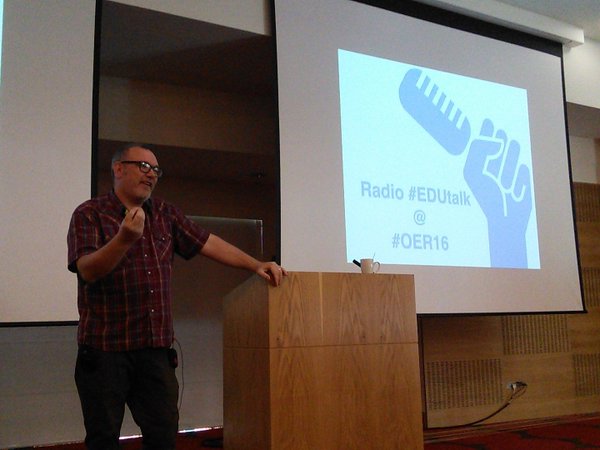
But I hope to talk more about the AMICAL experience in another post, for now let me provide a bit of context for the talk. This was my third talk in roughly a month, and it’s gonna be interesting cause I will be blogging them from last to first. I started at OER16 in mid April, then presented at the DMLL Expo at Coventry University near the end of April, and finished up at AMICAL last week. There is an arc to these presentations,  or rather a learning curve. I was planning on going into OER16 talking about containers, APIs, and open infrastructure, I did some of that—but as it turns out I spent most of the talk talking ds106. Brian Lamb joked I was “playing the hits,” and to a degree that was true, but at the same time I felt strangely obligated, but more on that in the OER16 post.

CgeW7NLWcAEarVl

In Coventry I had a brainstorm moment the day of my talk, in part inspired by the atmosphere and energy of Coventry. I scrapped my planned talk all together and gave the talk on something totally fresh: the UMW Console. I worked on that project last year with Zach Whalen but had yet to present about it, so I took the opportunity to do just that at Coventry.

ChDaTKFWUAIW48U

Image credit: Shaun Hides

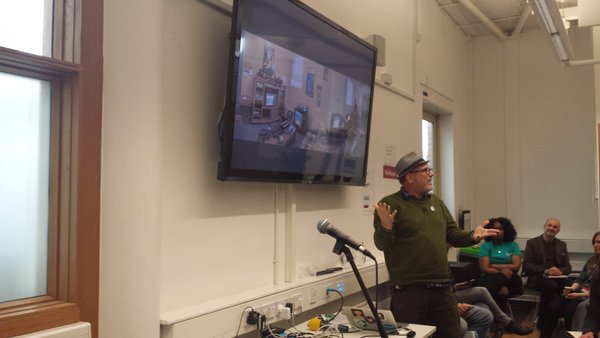
Which brings me to AMICAL, and the presentation in the video above. I opened this talk by grounding the idea of ed-tech as a perspective and interrogation of a moment in time, in this case a living room from 1985. I spent the first 10 minutes of the talk tracing trough blog posts I wrote last year which frame the experience of creating the exhibit that tried to re-create a 1985 living room as a lived, media experience.

AMICAL 2016

Image credit: AMICAL Conference

The cool thing about this exhibit for AMICAL is that it could be done on the cheap. Creating a lived media experience from the recent past can be cheap and quite community focused: have folks donate pieces, rummage for others, and spend countless hours on Ebay. The downside may have been the focus of the exhibit was so expressly based on my experience of American pop culture that some of the references may have been too far afield. From there I moved back to a discussion of how small is beautiful in terms of  IT, experimentation, community, open infrastructure, and individual empowerment. I ended on the note that rather than big companies and governments archiving the web, it’s often small, renegade outfits like Archive Team that have preserved 15 years of Geocities sites before they were deleted by Yahoo! The individual web archivist, the marginal group of distributed “hobbyists,” the small nodes of people that make the web great are the one’s that empower it’s possibilities and fuel the long revolution. The obsession over massive numbers and big data is the opposite of the generative web that builds communities and creates relationships.

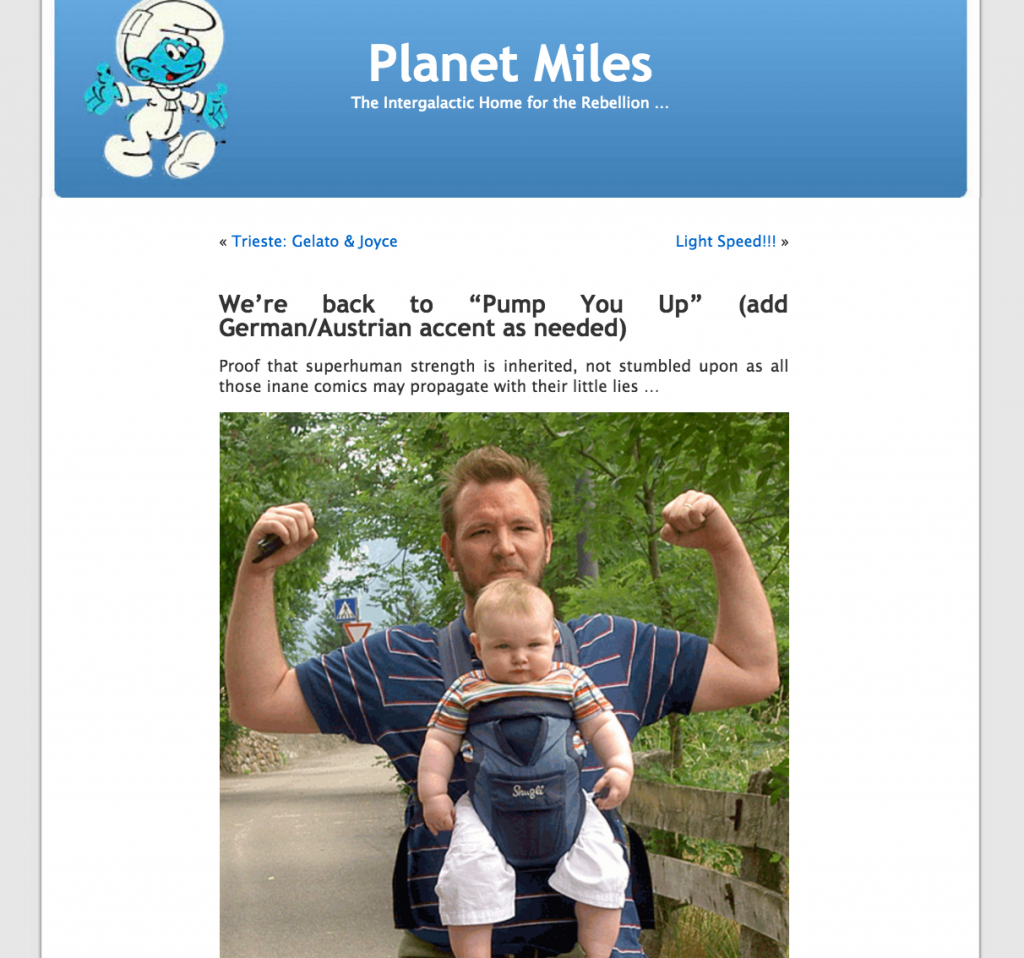
And to end the talk I returned to my origins on the web: Planet Miles.

Screenshot 2016-05-20 00.31.54

The night before I gave this presentation I decided to forego any more prep and actually spend 2 hours resurrecting Planet Miles, the first blog I created with WordPress in early 2005 to chronicle the interstellar travel of my newborn son for Antonella’s family in Italy. The site had been archived for years given some DNS issues I was too lazy to dig into, but after talking about taking ownership of one’s own piece of the web, I thought it my duty to release Planet Miles from its suspended state of slumber. If nothing else, this talk pushed me to actually bring life back to my past. it’s like Alan Levine blogged about recently, this site isn’t about nostalgia, it’s about my life. Pretty much everything I’ve done in this space over the last ten years has been in one way or another a way of documenting my personal and professional life—and I’m not dead yet.

Link to presentations slides.

Posted in presentations, Uncategorized | Tagged , , , , , | 8 Comments

“Anything is Possible in Linux”

I was doing a major migration of various sites for Gary Stanton, a Historic Preservation professor I worked with on and off for a decade at the University of Mary Washington. About the same time I was leaving he was retiring, and we had worked together on a ton of WordPress sites. He is a folklorist by training, and he has an unbelievably eclectic set of interests across all sorts of awesome vernacular American culture. When he creates class sites, they usually weigh-in by the gigabyte given how many audio files, images, and documents he shares with his students. He’s been building sites like that for years, and when he asked if he could move his stuff to Reclaim Hosting after retirement I jumped at the chance. He has so much cool stuff to share, he’s one of those folks that makes the web a better pace by populating it with his closet of curiosities. And to think Reclaim can help make sure it’s online and stays around for the long haul is an honor and a privilege.

Presto_model_A1

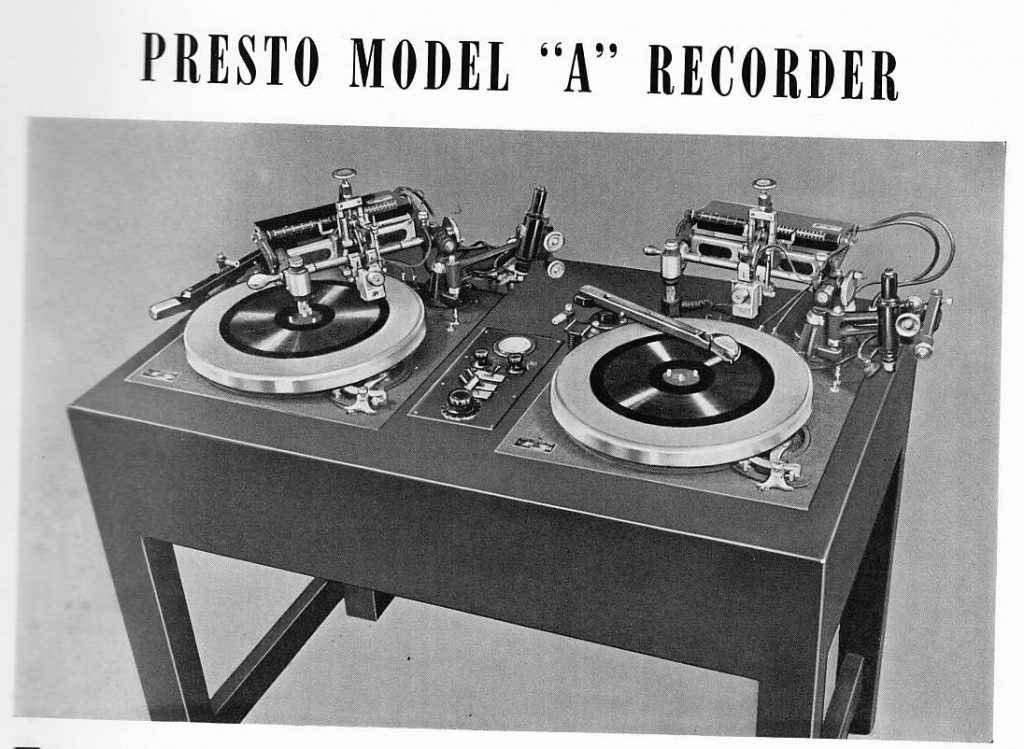
Image: Presto Model “A” Recorder

That said, I also knew there would be some snafus because I helped him architect it. In fact, I put off the migration for the last few weeks while traveling, but today was the day to sort it out. He had sites on UMW Domains, UMW Blogs, and a few other places. What’s more, he was changing URLs for all of the sites. I’m a fairly old hand at WordPress, so most of that worked out fairly cleanly. I did find, however, that a bunch of media files are missing for one site, so we’ll have to dig deeper there, but I’m confident it’s around—and if not, knowing Gary, he probably has local copies.

The one set of files that had me stumped was the massive HTML resources he has hand-coded for decades now. Gary has been doing some really impressive work cataloguing old Fredericksburg newspapers, wills, insurance records, land records, etc. It an impressive legacy, and it needs to be cared for. It’s one of those niche archives that don’t necessarily have wide-spread interest, but tell a particular story of a place through artifacts and data. Anyway, many of the URLs in these HTML files where hardcoded, which could mean a ton of manual labor updating thousands of files. So I asked the oracle Tim Owens if there were any find and replace features on linux. He responded, “anything is possible in linux.” And that is why we are partners, that is the answer you get from real genius 🙂 He pointed me to the following post “Replace a String in Multiple Files in Linux Using Grep and Sed.” And, as it turns out, you can indeed find and replace a string of characters like umwmhisp.org an swap them out with stanton1946.com across thousands of files in a directory within seconds. So amazing.

After reading the post, I used the following code to replace umwhisp.org with stanton1946.com across multiple files:

grep -rl umwhisp.org ./resources | xargs sed -i 's/umwhisp.org/stanton1946.com/g'

And with that line of code tons of historical data about Fredericksburg was preserved for the web. In my mind this is exactly what Reclaim Hosting is about, keeping the vernacular culture of the web up and running one account at a time!

Posted in reclaim, sysadmin | Tagged , | 3 Comments

A New Development in #Sockgate

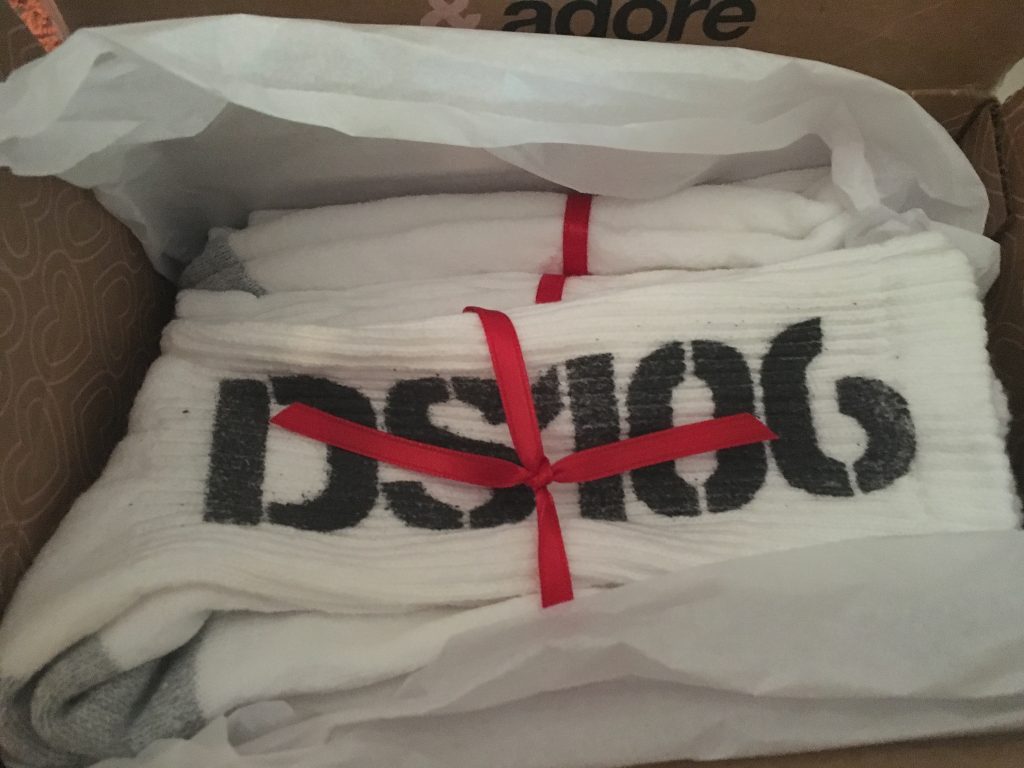
Seems like there is someone who will not be named making bootleg #ds106 socks. What’s more, 4 pair were delivered to my door this afternoon in a neatly packed bundle.

2016-05-19 12.40.51

And given the resulting strife from the perceived notion that certain backers did not get their appropriate socks due, I am prepared to offer a #4life olive branch.

2016-05-19 12.47.05

I am working on a deal with the bootlegger to have socks delivered to all the folks who had them coming. I am hoping this may put an end to #sockgate and allow us to direct our attention to more pressing matters in ed-tech. What’s more, I can guarantee these 100% pure ed-tech socks were not made by underpaid lackey’s in China! These are thought leader socks 🙂

Posted in digital storytelling, fun | Tagged , , | 1 Comment

Divide and Conquer Ed-Tech through Leadership

Fuck-you-Guardians-of-the-Galaxy-GIF

Nothing like waking up on a drizzling morning in Trento to an alert that George Siemens is offering up a thinly veiled accusation of me being a “brash, attention seeking, or self-serving individual.” Why “or”? Why not “and”? I can live with all three! That’s one for bavatuesdays’s sidebar 🙂 I’m no stranger to being called out publicly for my winning personality, so this really isn’t too surprising or upsetting. Been there and done that with EDUPUNK, and oddly enough the person on the other side of that attack was the very “thought leader” Siemens is lionizing in his post. I guess big thinkers have to stick together, especially as they expand their reach to China.

And that, for me, is the most problematic element of Siemens’s post. Not so much that I become a straw man for taking credit for other people’s ideas, but that there’s a pantheon of a few, rarified thinkers in ed-tech that we need to pay homage to. Fuck that. Especially when the list leaves out so many people that do so much great work. I have been clear again and again that my work has been dependent upon engaging and building a community of folks, starting with the collaboration amongst a core group of folks at UMW who worked under the “Godfather.” I don’t see any mention of the contributions of so many folks like Martha Burtis, Jerry Slezak, Andy Rush, or Patrick Murray-John, and that’s just the UMW folks—there are scores more. But that’s no surprise, because that’s how these grand narratives get written—I guess we were just lackeys for the visionaries, huh?

Seems to me Siemens is abusing his role as a “thought leader” by creating such a sharp division in a field he no longer sees any value in. It’s terrible stewardship of his power, why does an encomium of Gardner have to be an attack on everyone else save the select few he’s nominated for genius? Intellectual history at its most self-aggrandizing. Adios George Siemens, hello something else 😉

Posted in Uncategorized | 2 Comments

The Big Sockowski

I don’t know how many ways we can count the genius of Alan Levine on the web, but add this Storify to the mounting evidence. And how about recent ds106 all-star Terry Greene playing some insane Lebowski GIF tennis? I’m more than happy the #sockgate fervor has died down, it was unfounded from the start. That said, I would sacrifice a million socks for awesomeness like this!

Posted in digital storytelling | Tagged , , | 3 Comments

Diss is Open Access

This is cross-posted on the CUNY Academic Commons News blog as part of the Citation Needed series I am writing there.

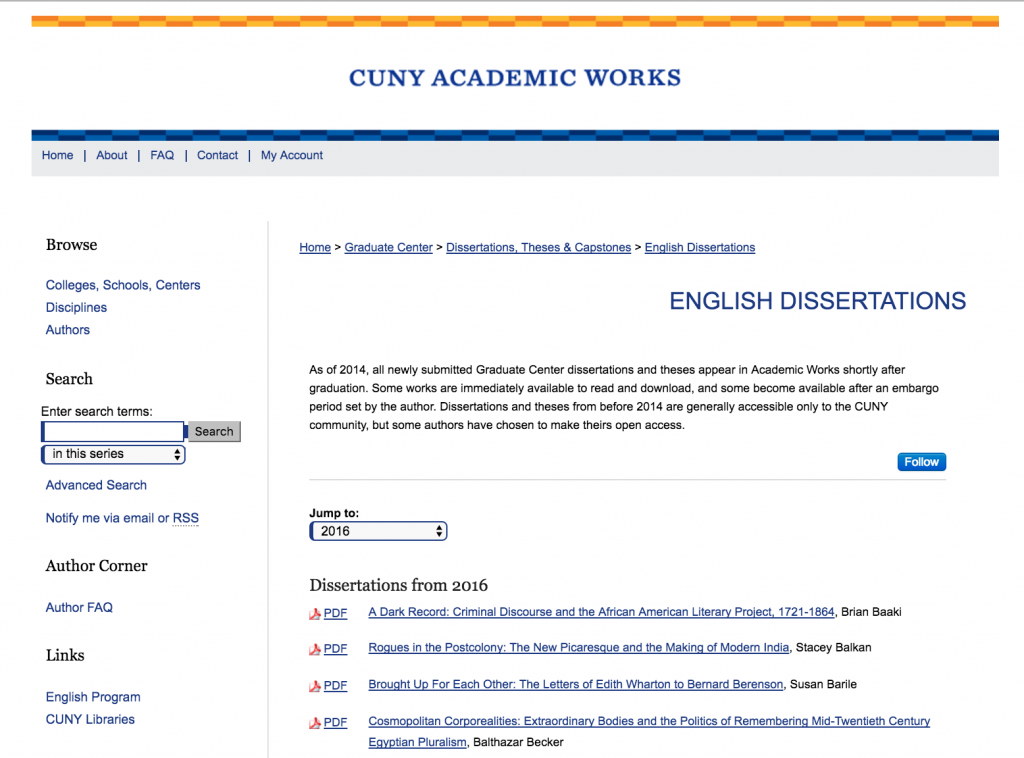
I was trawling through the posts on the CUNY Academic Commons last week and I came across this post celebrating the recently crowned PH.D.’s in the CUNY Grad Center’s English program. This was of particular interest to me because I was once a part of the venerable Ph.D. program in English at the Grad Center. Back in my salad days when I was but green in judgement I was hoping to accomplish the Herculean task of completing a dissertation just as those 31 relieved folks listed in that post have done. Alas, ed-tech got in the way and I became a beauty school drop-out.

I was intrigued by a few of the dissertation titles and did some searching. In particular, I did a search for Amanda Licastro‘s composition and rhetoric research on e-portfolios, a topic I have some vague familiarity with—if only to refute how we blanketly define them in higher ed. And bam, I found that a vast majority of the recent Ph.D.’s in the English program have their dissertations freely available for download through the CUNY Academic Works site. How cool is that? A local case of open access research for the win, now it’s time to explore open formats 🙂  It also made me wonder why the English department post didn’t link to the dissertations given they listed them all and provided the text I needed to discover them via search. That should be a basic requirement, links still make the web the web.

Screenshot 2016-05-11 22.06.34

Fact is, in just the last ten years with the explosion of fairly simple web publishing frameworks we have entered a new age for open access research, and even as the publishing companies try ever harder to control the means of academic research production, a quick search on the web suggests the forces are everywhere against them. But it doesn’t end at research, a quick search for professor Licastro’s dissertation brings up her personal site on the Commons, various presentations, and even a short video about the work she is doing in the classroom at Stevenson University

Fact is access and openness can start with one’s research, dissertation, etc., but it quickly becomes a multi-faceted frame of people working through ideas in time and space. I never cease to find this element of the web compelling, and it always seemed to me to fit so beautifully with the pursuits of scholarship.

Posted in Citation Needed | Tagged , , | Leave a comment

WordPress Italian Style

As Antonella and I were walking into Trento’s train station this afternoon reluctantly preparing to say our goodbyes for the next few days, she pointed out that they sell a WordPress magazine at the news stand. I was like, “What?” And she was like, “Si, e vero. Vieni qua?” And I was like, “What? What did you say? What language is that?” 🙂

WordPress in The Winfow

And, as is all too often the case, she was right. Right next to that doggy in the window was un Manuale Practico di WordPress. In fact, it was not so much a magazine as a guide for folks to learn how to use WordPress. It covers everything from the history of the web hosting to why use WordPress to the user interface to plugins, themes, etc. It’s fairly comprehensive, and as I was looking at it I was struck by just how prevalent WordPress is as a publishing engine. People throw around the figure of 25% of the web is driven by WordPress, and moments like today provide striking offline evidence of just that fact. I was intrigued, so I asked the news stand proprietor how much. €9? The price of a good pizza. Not too bad for a fairly comprehensive translation of all things WordPress in Italian. I couldn’t resist.

Manuale Practico di WordPresd

I cut my edtech teeth on WordPress more than 10 years ago. In those dark days when the sysadmin-type edtech yahoos were screaming Drupal and Joomla, I was preaching the people’s doctrine of ease-of-use, elegance, and simplicity. I effectively MADE WordPress for education. In fact, you can credit WordPress’s meteoric rise to international prominence with this blog. Without me WordPress would have been the next MySpace….I MADE WORDPRESS!!! #NOBODY Well, me and a few thousand other far less bombastic folks 🙂

It’s pretty wild and satisfying to see something you played a small role in pushing out to a community of educators and students in Virginia take on a central role in empowering millions and millions of people to engage in the open web. WordPress most certainly provided me with an ed-tech career,  and 11 years later it’s still the best tool out there for doing open web instructional technology.

WordPress Sommario

I guess this post is just to say how cool it was to see this magazine in a train station in Trento. It reminded me that WordPress may be a portal into new communities here in Italy. I have a goal taking shape in my mind that I want to get fluent enough in Italian to present about edtech to a local audience in their mother tongue, or give a WordPress workshop at my kids’ school. Though, on second thought, my kids would have none of that, they are not big fans of my broken Italian!

One of the best parts of being in an entirely new world is that something I have taken for granted for the last decade, like explaining the value of WordPress to people, becomes a whole new challenge. I can just imagine a whole slew of new and improved bad metaphors in a language I am not comfortable with, how could that go bad? Especially in Italian where every other word has the potential sexual innuendo. This could very well be the career ending move I have been waiting for 🙂 WordPress made me, and now it can break me!

Posted in fun, WordPress | Tagged , , | 4 Comments

Some Hosting Advice for Reclaim

Hosting Advice feature on Reclaim Hosting

Hosting Advice feature on Reclaim Hosting

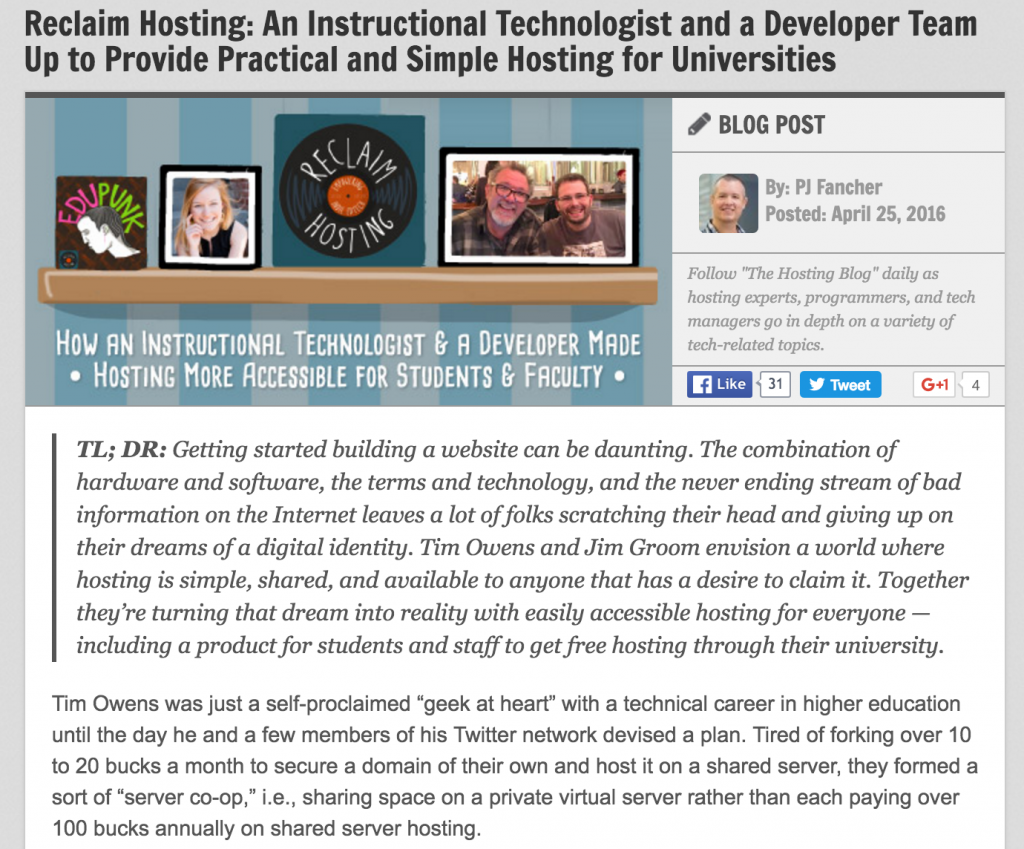
A month or so ago Alexandra Leslie of Hosting Advice reached out to us to find out a bit about who we are (i.e. Reclaim Hosting) and how we got started. Turns out they got wind of this small, niche hosting company that predominantly serves educators and students, and they were intrigued. While I was traveling in the UK they published a feature blog post about Reclaim Hosting that recounts our story—and I have to say it was pretty cool to read it. I think we’ve been so deep in the day-to-day of running Reclaim that it’s easy to forget there is a pretty cool story arc developing around this work, and it includes a broad community of folks that want to take ed-tech back from the venture capitalists, data fascists, and boring ass learning management systems

edu_punk_jim_tim

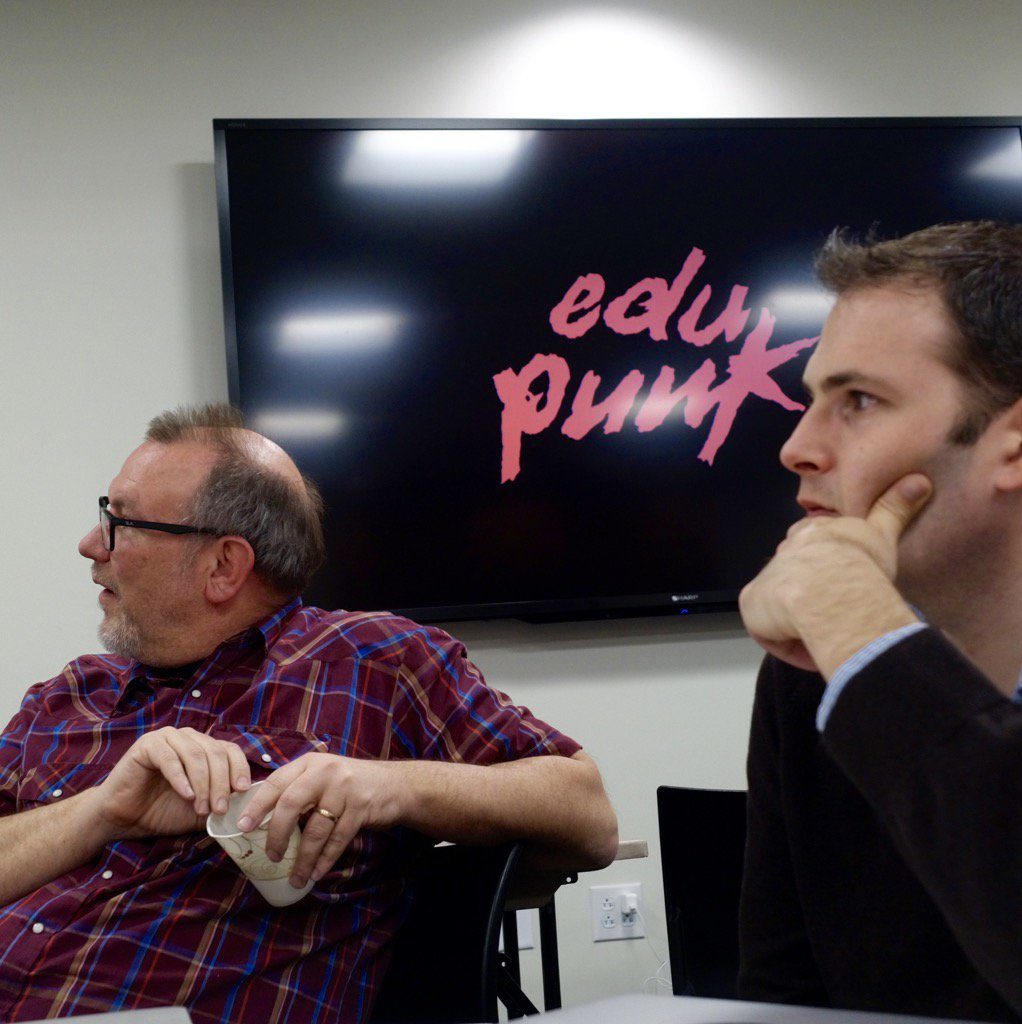
Image credit: Phil Windley’s “edupunk” taken at Domains/PAPI event during the great Audrey Watters brilliant keynote

One of the things I love about the narrative that comes out in this article is the centrality of ds106 to the development of Reclaim Hosting. Let there be no doubt that from the very beginning Tim has been the driving force behind our seamless infrastructure, unparalleled service, and relentless push to constantly make things better. Those three things have made the case for any modicum of broad attention we may receive. But I think the ds106 community is a big reason why any this worked at all. Despite the misguided allegations about imaginary socks, the open, online community of ds106 pointed to a few things for me: 1) we can build our own ed-tech infrastructures that make teaching and learning collaborative and fun; 2) such an infrastructure can make it easy for distributed folks to share both their skills and passion regularly; 3) such creativity is a powerful tool for galvanizing a resilient community. I continue to feel deeply indebted to this committed community for support and encouragement at every turn. #4life not #4socks.

Image credit:  Motionless Voyage blog's awesome Lebowski watercolors

Image credit: Motionless Voyage blog’s awesome Lebowski watercolors

Posted in digital storytelling, reclaim | Tagged , , | 2 Comments

On Approaching the Web

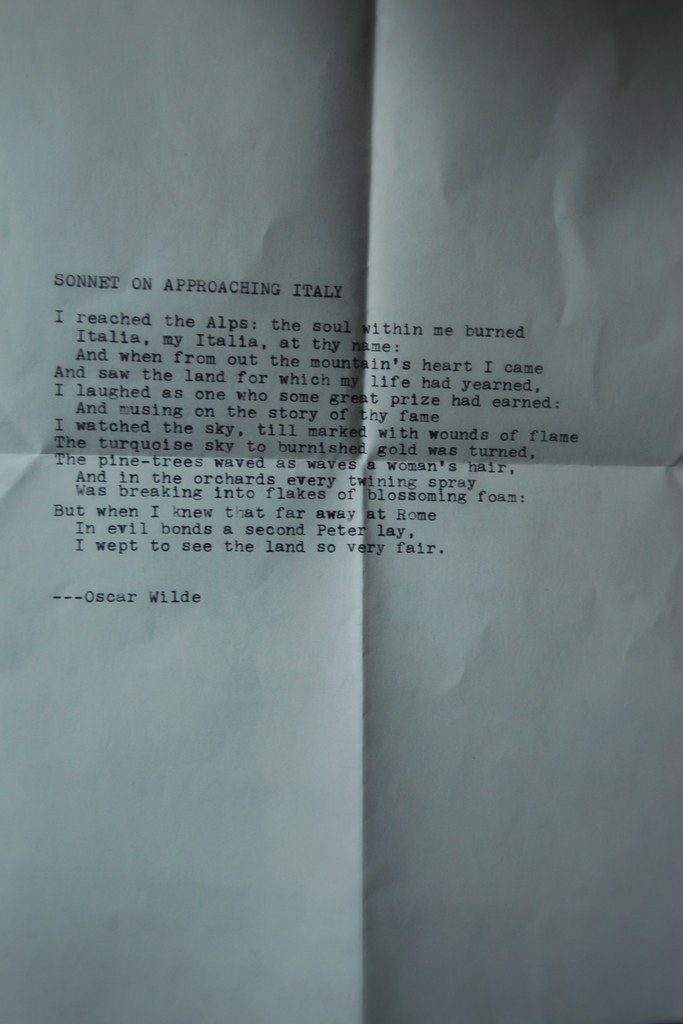
image of a poem by Oscar Wilde

After arriving home from two weeks on the road in the U.K., I found a letter on my desk. When I opened it up I discovered the above photographed Sonnet by Oscar Wilde. He wrote  “Sonnect on Approaching Italy” in 1877 upon entering Italy on his way to Rome to spend Easter.* The poem beautifully captures the spell I’ve been under for the last 8 months. I can truly understand how blown away Wilde must have felt when he was passing through the Italian Alps 140 years ago, and I don’t think they’ve gotten any less stunning since.

What strikes me most of all about this gift from abroad is not only the fact that Chris Lott (purveyor of the brilliant Katexic newsletter) took the time and energy to type out this gem and send it over 5,000 miles to my doorstep, but how perfectly it captures how I’m feeling right now. I’m going to frame this poem and hang it on my office wall. Not only as a momento of one of the happiest times of my life, but also as a constant reminder that at its best the web is made of of really smart, thoughtful, and deeply caring people that want to share the best elements of humanity with one another. The generative web! Thanks Chris, this was really special!

____________________

*The line “In evils bonds a second peter lay” was cryptic for me, so I looked it up. Turns out Pope Pius IX was “imprisoned” in the Vatican because he would not recognize the united kingdom of Italy that was formed in 1870, effectively nullifying the Papal States he ruled over as Sovereign.

Posted in poetry, Reclaim Italy | Tagged , , | Leave a comment