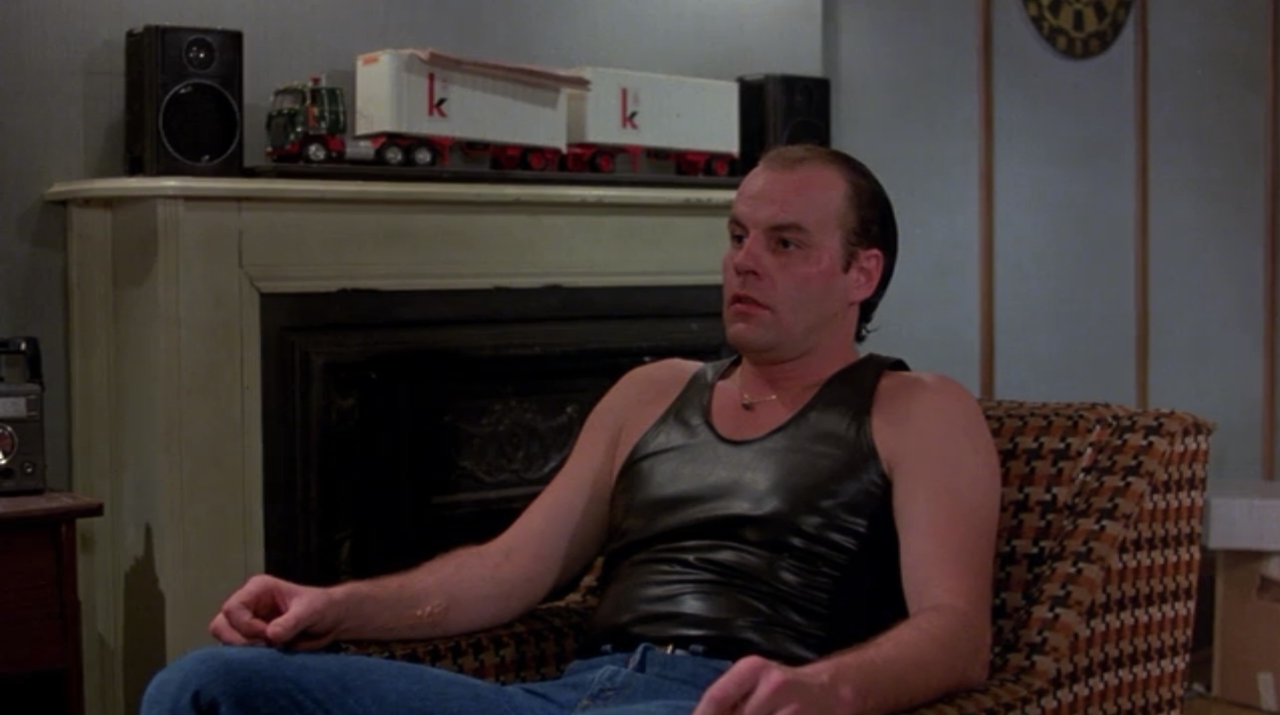
Ferenando Di Leo’s The Boss (1973)

Now this is how you make your point!

Posted in movies, YouTube | Tagged , , , | Leave a comment

1242 Posts on Tumblr in 15 months

bavatumblrThat works out to about 83 posts a month. And that is what I’ve averaged on my jimgroom.tumblr.com site since July 2012. Oddly enough, I’ve had that Tumblr since April 2007, but didn’t start to use it in earnest until more than five years later. That’s kind of crazy to me. In a 15 month span of time I posted 1242 times on tumblr, in that period I’ve published 300 blog posts. But in many ways that’s comparing apples to oranges. Blogging is where I do my own thinking, Tumblr is where I collect awesome images, videos, GIFs, John Carpenter paraphenelia, etc. from other people. On rare occasions I’ll publish my own GIFs to Tumblr, but that has not become part of my workflow in this space as of yet.

?? REST AND RELAXATION ON THE UPPER-CHEST SIDE ?? DISCOVER THE SUPER COZY OINTMENT OF YOU’RE DREAMS!!! WOW ($5200) – Trendy AND topical! – Must see! (Do not use near eyes)

I feel more and more inclined to spend time on Tumblr because I feel I’m part of a relatively anonymous community there, which I kinda like. What’s more, I’m not so concerned about posting on a third-party site given everything I reblog/post is seamlessly archived to this site (I blogged about setting that up a little while ago here and  here). What’s more, I’m getting a better sense of how people understand Tumblr sites, for example here’s a brilliant conceptual site that offers a random screenshot of a Geocities site on a regular basis. I also love the Broker Bodega tumblr (h/t Tim Owens) that mashes up the overstated verbiage of NYC apartment ads with selling various sundries you’d find in a Bodega.

I’m also regularly blown away by how one of my favorite folks on Tumblr, Michael Branson Smith, uses this space to #GIF Fight, create memefridays with his ds106 students, animate the TV shows of my childhood, and more generally make awesome GIFs . In turn, he turned me on to General Howe‘s work, he has a crazy ass animated GIF series going on his Tumblr in which he is animating scenes from the 1980s GI Joe animated series to comment on the post-9/11 era.

I also have discovered kindred spirits like Sarkos, whose Tumblr site really parallels stuff I re-post, and when looking at his/her stuff I regularly find myself saying “Wow, that’s awesome” (I have no real idea who he or she is). I also love the comicbook writer Matt Fraction’s tumblr, a constant source of awesome stuff like Michael Ironside in a GIMP tank top.

UMW’s own Sue Fernsebner has an awesome Tumblr Gulou in which she shares the latest news from China, becoming a filter for a range of happenings in the most interesting country on Earth right now. Or the film Tumblr site Cinephilia and Beyond which probably has the most insanely detailed and comprehensive posts on a given person, film, or theme I’ve ever seen. Case in point, a search on this site for Martin Scorsese’s Goodfellas has got to be one of the most insanely detailed and richest aggregation of resources about the film I’ve seen on the web (I’ll be using this extensively for the week in Truecrime we talk about that film). And this kind of thing is a daily occurrence for Cinephilia, not to mention Mario Popova’s Explore site on Tumblr (all you can say about her is wow).

And that’s just a few of them, what I love about Tumblr is you never really know what you’re gonna get. And the dashboard reader is the best thing since WordPress. Slick, streamlined interface for seeing what other people you’re following are sharing. I love this interface, and really want to imagine how we can start approaching something like that with the work we are doing to re-imagine UMW Domains as an aggregate of posts and resources from around UMW (but more on that soon).

Posted in Tumblr | Tagged | 6 Comments

Barilla’s Family Values

Last night Antonella and I went on a bit of a YouTube tear through Barilla pasta commericals, of all things. Barilla commericals in 1980s Italy are a tremendous source of nostalgia for many an Italain of a particular generation. Their entire ad campaign is centered around the idea of family, and there’s a patina of wholesomeness to many of these ads. Take for example this 1988 gem featuring a father who travels for work but is connected to his family through a single fusili 🙂

Although a few spots were a little more racy, but just a little, for example take this Barilla commercial by the legendary filmmaker Federico Fellini.

More recently, the Barilla pasta company’s chairman made a comment on a radio talkshow suggesting that his company’s commercials will never feature a gay family. It was a pretty stupid comment, and his argument was they don’t represent a “classic” family, which is the idea Barilla is selling. And this is where Anto noted quite acutely that he started to personalize and defend the idea of the classic family as somehow sacred rather than recognizing it’s a social construct his company has decided to buy into, reinforce and sell. When that stops selling, Barilla won’t find it all that sacred in the end, let’s face it. He ultimately apologized, realizing he should probably not be going rogue on the marketing front because he is not smart enough to understand his assumptions are less and less sacred.

But more generally I tend to cringe at the blowback and politics around such topics because it quickly becomes equally annoying to hear news outlets become righteous about a topic they’ve negatively reinforced for more than a century themselves. What I want to see is art, and YouTube didn’t fail Antonella and I. This re-imagined Barilla commercial by Roberto Mancuso re-figuring a gay family into the wholesome vision of their 1980s commercials is brilliant. That’s what I’m talking about, create the vision of the future you want to see! My only criticism is the date of 2215 A.D. The future is now!

Posted in YouTube | Tagged , , , | Leave a comment

Jack Webb’s “The Black Dahlia”

jack-webb-dragnet

Jack Webb in character is Joe Friday on Dragnet

Last night we had a pretty awesome True Crime class. The conversation was deftly led by Sara Akbari, Meredith Fiero, and Jack Harris; they did an awesome job with their presentation, research, and framing othe readings for the class as their wiki article will attest. We talked about two related pieces. The first was Jack Webb’s telling of the “The Black Dahlia” murder from his book The Badge which is a collection of all the episodes of the classic 1950s Radio and TV series Dragnet that he pitched but could never air due to their graphic nature. The other was James Ellroy’s essay “My Mother’s Killer” about his lifelong obession with his mother’s violent murder when he was only ten years old. I wrote a bunch about Ellroy on this blog while reading and discussing his novel Black Dahlia as part of the Hardboiled Freshman Seminar Paul Bond and I taught last Fall.

I have to say it was eye-opening to read the “The Black Dahlia” piece by Webb that got Ellroy hooked on the horrific fate of Betty Short (he recieved the book as a gift on his 11th birthday from his dad) which somehow became his own fate. I had no idea what an amazing writer Webb was,  this short narrative is reminiscent of a hardboiled Hemingway at his best batting out terse, brutally apparent prose. The brevity of this account—something Ellroy couldn’t manage in his novel—coupled with a harrowing nod to emotions that can never  take root in the policemen overseeing the worst humanity has to offer makes this work unbelievably compelling. The following passage that describes the corpse of the Black Dahlia is an excellent, if not painful, example of just that:

It was nude. It showed evidence of slow, deliberate torture. There were neat, deep slashes around the breasts and on them. Rope burns on the wrists and ankles indicated the victim had been spread-eagled to heighten her agony. Her mouth had been deeply gashed from ear to ear so that her face was fixed in a grotesque and leering death smile. Finally, her bosy had been cleanly, surgically cut in two at the wasit.

Brown was glad to turn away to check with Lee Jones of the Crime Lab.

Not only is the description as powerfully horrific as anything I’ve read in Ellroy, but at the same time detective Brown’s horror remains necessarily understated, suggesting that even a verteran like him is “glad to turn away.” This is such a nice touch, and the simultaneously precise and ethereal quality of his recounting of Dahlia’s narrative is captivating. For example, take this description of detective Brown trying to recreate her last moment between being seen at the Biltmore Hotel and showing up in two pieces in an abandoned lot at 39th and Norton.

Once The Dahlia changes a dollar bill at the hotel cigar stand and amde a call, maybe two. The she waited, as though expecting a call back. When none came, she walked out the front door , smiling to the doorman as he tipped his cap. He observed her trim form swinging south on Olive Street toward Sixth, the slim legs stiding easily, the red heels tapping purposefully on the sidewalk.

It was 10 P.M.

And thus Detective Brown traced The Dahlia back to childhood, forward to the brink of eternity. And there the investigation stood still. Five days from the doorman’s last salute to the living, up to the discovery of the mutiliated thing, remained a blank.

For anyone who has read Ellroy’s Black Dahlia, which I’m a huge fan of, filling in the unknowns of these three paragraphs is exactly what Ellroy turns into 400+ page magnum opus of everything he’s done up and until that moment. He tries to fill in the blank, resolve the murder, and put order to an open-ended horror show posing as a suppressed Dragnet episode that Ellroy couldn’t escape. But unlike Ellroy, Webb keeps the case open, from as early as her childhood this short piece pushes you to the “brink of eternity” with Betty Short. At the same time it can neither let you fall or pull you back. More than a few students had a similar reaction to this piece, and for me I was blown away by how remarkably well-written, and precisely crafted it is as both a document of the case as well as a finely-framed piece of literture to capture the horror and effervescent beauty of a moment between knowing and uncertainty, life and death, a smile and the ghastly mutilation of the flesh. Webb’s piece may very well be the best thing we’ve read all semester, but with that said, it’s now time to turn to Truman Capote’s 1966 masterpiece In Cold Blood.

Posted in True Crime | Tagged , , , | Leave a comment

Wanted: the Tri-State Gang

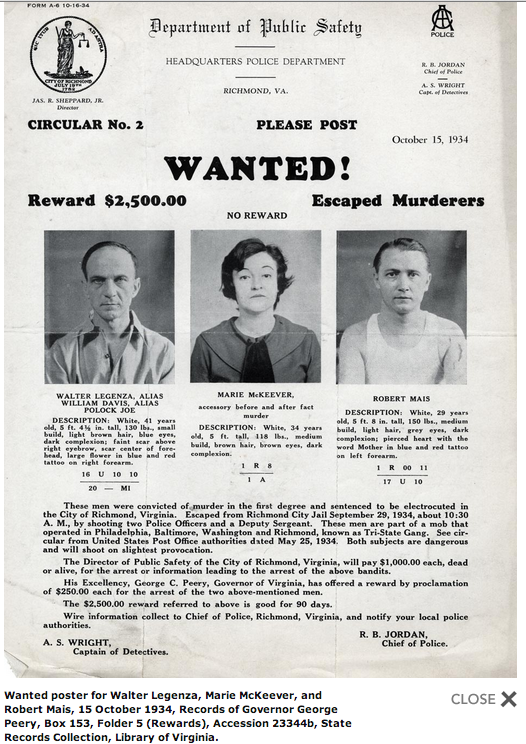
Wanted Poster

Last week in the most awesomest True Crime course ever taught anywhere we talked about H.L.Mencken’s 1934 article for The Baltimore Evening Sun “More and Better Psychopaths.” Mencken’s piece condemns the “New Penology” for being too soft on criminals, while chastising our culture’s romanticizing of gangsters. The following bit of Virginia criminal history is taken from Mencken’s article, which led me on a bit of a web journey.

Some time ago a professional criminal named Mais, wanted for various murders and robberies, went into hiding in Baltimore. The cops, getting his scent, tracked him down promptly, and took him into custody. He was heavily armed, and they risked their lives, but nevertheless they took him. Sent to Richmond to answer for a peculiarly brutal murder, he was convicted and sentenced to death. But in a few weeks he had broken out of jail, and on the way he had killed a policeman. Now he is at large again, and robbing and killing again, and other cops will have to risk death to take him again.

Dr. Mais’ escape was a monument to the sentimentality with which such swine are now treated. Though he was known to be an incorrigible criminal, and all his friends were known to be of the same sort, he was premitted to recieve visists from them in jail. Presently one of them slipped him a pistol, and the next day he was on his way, leaving one man dead and two wounded behind him. Suppose you were a cop, and you met this Mais tomorrow? Would you approach him politely and tap him on the shoulder, and invite him to return to the deathhouse? Or would you shoot him at sight, at the same time giving thanks to God that he didn’t see you first?

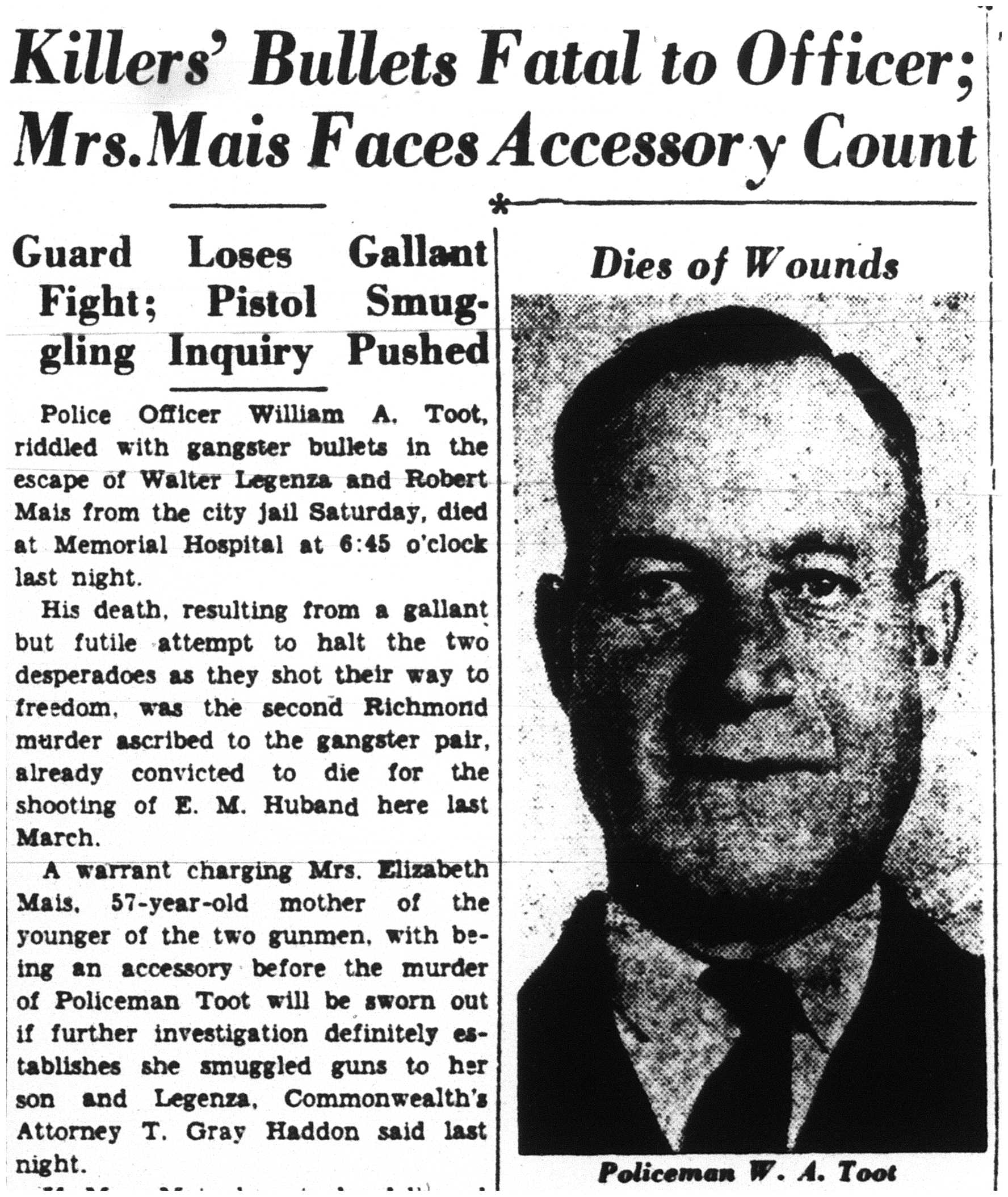
Given I’m comfortably nestled between Washington D.C. and Richmond in beautiful, historic downtown Fredericksburg, I started to wonder about this Robert Mais character. I did a quick Google search and discovered this post on the Virginia Memory site about the book “The Tri-State Gang in Richmond: Murder and Robbery in the Great Depression” which is a history of Mais and his two accomplices Marie McKeever and Walter Legenza (the triumvarite that made up the Tri-State Gang). What’s more, the post on the Virginia Memory site links to a series of primary documents at the Library of Virginia that the author Selden Richarson used in his book, including the wanted poster embedded above as well as a number of newspapaer articles that recount various circumstances surrounding the murdered guard Mencken refers to in his article.

mais_guard

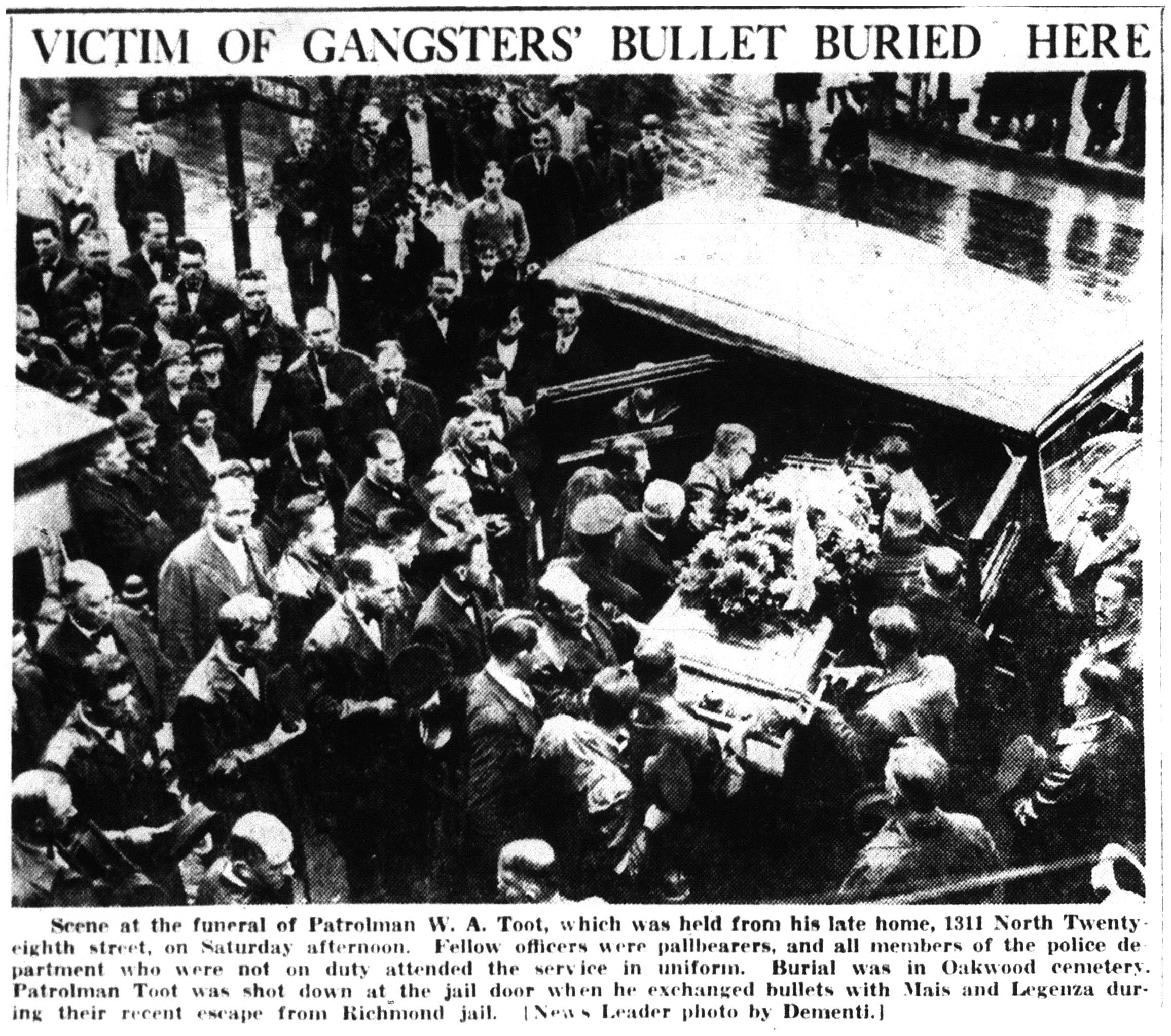
Or this scan from a Richmond newpspaer that had a picture of his funeral:

toot_mais_funeral

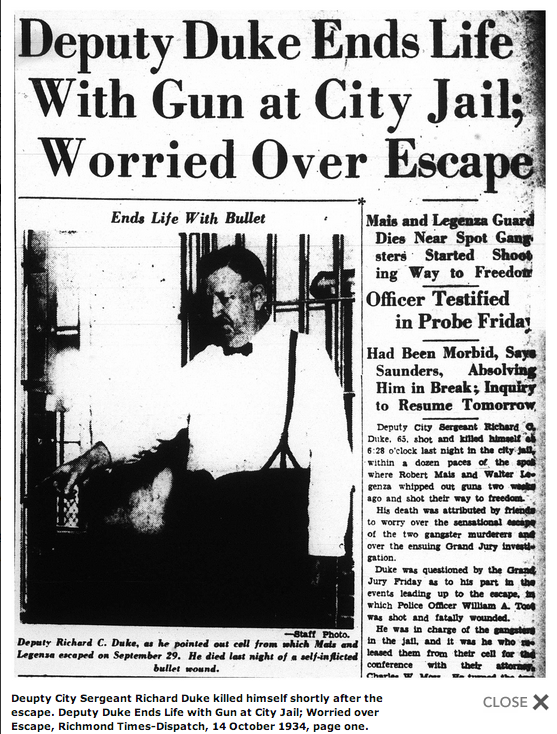
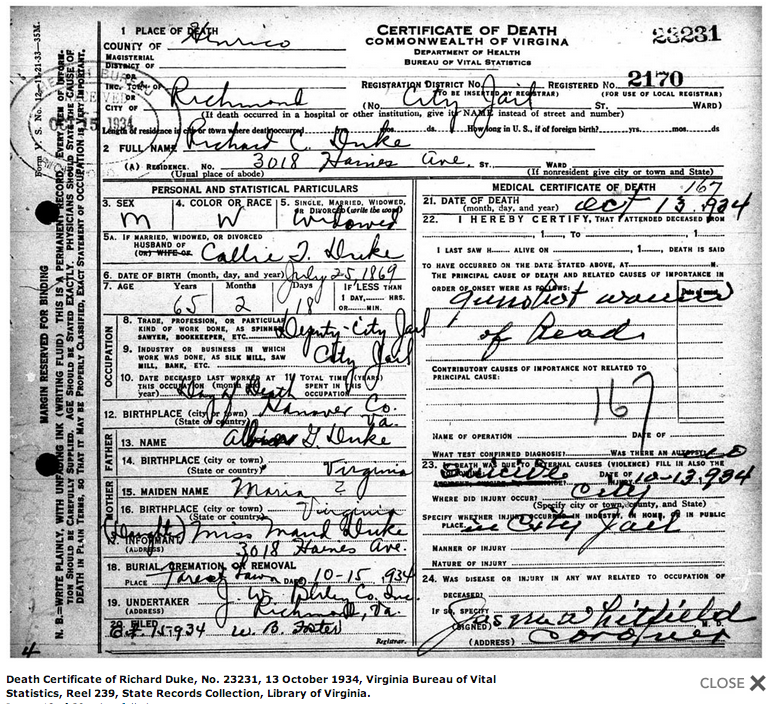
There is also a story about the jailkeeper on duty, Deputy Richard Duke, who commited suicide as a result of the jailbreak, presumably because he felt somehow responsible.

Deputy Duke

You can also see a scan of Richard Duke’s death certificateDeath Certificate II:

Or the death certificate of one of the members of the Tri-State Gang, Walter Legenza, who was ultimately caught and executed in Richmond (as was Robert Mais).

Death Certificate

Have I ever mentioned how awesome the web is and what an amazing resource it is for teaching and learning on this blog before? I had some visions of taking the documentary images and articles and making an abbreviated version of this as a graphic novel á la Brian Michael Bendis’ Torso, which we also read and discussed last week, but that’s fodder for another post.

Posted in True Crime | Tagged , , , , | 4 Comments

Cinco Midi Organizer

What I really want to do with my life is make commercials like the following dream product: the Cinco Midi Organizer. And that is just one part of the entire universe that is Tim and Eric Awesome Show, Great Job! I was turned onto this weekend. I now want to do skits like this as part of my day job—although in some ways I kinda do already. That said, the way Tim and Eric date the aesthetic back to the 1980s for a lot of their Cinco merhcandise, not to mention how insane the  products usually are.  For some reason this Midi Organizer commerical seems like the perfect argument for Reclaim Your Domain.

Posted in fun | Tagged , , , | 1 Comment

Gallows Poll (Rough Cut)

Paul Bond and I collaborated on a fun segment for the first episode of the True Crime class video we’re working on. I’ll be polishing off and tightening up the final version of episode one this week, but I figured I’d share the rough cut lest I start believing this blog is about finished products.

Paul Bond was the genius behind this one. He had the idea for creating a boxing match-themed highlighting the Gallows confessions we read from the colonial period. You see, during the first two weeks of class we focused on Puritan execution narratives from the late 17th and early 18th century New England. Fact is, Gallows literature was a bonafide genre during that time featuring repenting criminals providing a litany of their perfidious crimes. The format was pretty consistent: list your sins, ask for grace, and then be hanged. It’s a pretty trippy genre because in the world of the Puritans God’s grace was never a given, so there would be an endless sense of uncertainty regarding whether you were to receive God’s grace or not. What I love about the Puritans is that despite how wicked or pious you were, who God grants the convenant of grace was unknowable in this world. While such a reality gives everyone hope no matter their lot, it also makes for the ultimate in existential uncertainty. And when you wrap all this up in a neat confession naarative delivered on the gallows immediately before one’s death, it packs a punch.

So, the idea was to setup two of the more intense execution narratives from the colonial period, for our pursposes those of Patience Boston and Esther Rodgers—what Paul terms “Lady’s Night” on the Gallows Poll. These two capital criminals go head-to-head to determine “Who’s more heinous?” Which of these women was more sinful? Whose confession was more steadfast and strong? [The consistency and lack of emotional vicissitudes were often telling for the Puritans because wavering was seen as a sign that God’s grace was not present.] Paul’s wife read from Esther Rodgers’s narrative and Martha Burtis read from Patience Boston’s narrative. We framed both readings with the playful, semi-personas “Pillory” Paul Bond and Jim “Gallows” Groom providing commentary and analysis. It was a blast.

Funny enough, after the students were so high on their own trailers and various segments they talked a certain amount of shit on Paul and I, suggesting it was too long and somewhat boring. Damn milennials! Fact is, we actually dealt with the literature and tried to wrap a fairly focused reading and analysis into a playful frame, they just ran around with pillows under their dresses and polka dot onesies. That is not scholarship in the same way the Gallows Poll is, we are professionals—there’s no real comparison. It’s like lumping Federico Felinni and Michael Bay in the same class of director. Amateurs! The full episode is coming soon, you be the judge!

Posted in True Crime | Tagged | 1 Comment

A Place of One’s Own

hurley_small_2

UMW’s President Rick Hurley

The University of Mary Washington’s President Hurley published another article in the education section of The Huffington Post the week before last titled “A Place of One’s Own — Online.” This article builds on an earlier post published at the beginning of the month (which I already discussed here on the bava) that is part of a larger series about the “intersection of technology and pedagogy at colleges of the liberal arts and sciences.”

This installment frames how UMW is not approaching instructional technologies as an afterthought, but rather is working to integrate it into the very fabric of the teaching and learning experience. This has been the case with UMW Blogs for more than six years, and the rollout of Domain of One’s Own is building upon that. The article frames Domain of One’s Own in the following ways:

The Domain of One’s Own initiative urges and coaches our students to set up their own individual websites. The initiative was propelled by several related ideas: The first was that students could use their sites to host, show, and promote their scholarship and research. The websites could serve as digital portfolios showcasing the students’ resumes and best academic work for potential employers. And students would carry these URLs with them well beyond graduation. Second, the very act of building a website would be a great learning experience – it would allow students to grapple with how things are created on the web. And it would teach students how to create websites for others, an important and marketable skill. Third, for those whose ideas really take flight, the student domains would be the digital presentation of themselves, a way to explore their digital identities. They would not just be a marketing tool but a way for students and graduates to put their ideas, thoughts, writing, poetry, music, and videos, out there for others to contemplate, to respond to, or just enjoy.

I think all of these are true, and the idea of Domain of One’s Own as an e-portfolio is something Stephen Downes notes as well recently, but I think this is only a small part of what it can be. What makes Domain of One’s Own so remarkable is that it also becomes a user innovation toolkit (as Mike Caulfield contextualizes and builds on brilliantly here) that expands well beyond simply showing off what you’ve done, it can also become the future possible of what you can and will do.

What’s even cooler is this isn’t limited to the students, the same has been true for UMW’s Division of Teaching and learning Technologies. Just take a peek over at Tim Owens’s latest post on the work he and Martha Burtis are doing to re-think how we build a community framework from this distributed cosmos of sites to expose the amazing work happening around campus. These ideas are driven by exploring the myriad possibilities of Domain of One’s Own, not simply settling for a new eportfolio system because that kind of limited thinking is what hamstrings most groups.

What’s more, Martha Burtis eloquently frames this process in her most recent post by explaining how Domain of One’s Own pushes the work our group is doing to new levels by helping us let go a little, understand how the technology can and will be used by our community, and then developing around that. As she notes:

I think we actually plan too much and we try to engineer our projects and systems too tightly. I’m not advocating for a completely irresponsible approach to tech innovation in education, but I am advocating for a more natural and organic approach to the project lifecycle.

This is what we have done for UMW Blogs, ds106, and now Domain of One’s Own. And guess what, unlike all the corporate MOOCs we aren’t simply recreating the LMS, we’re designing a new way to build community around distributed nodes within a campus network both for face-to-face and online.

Posted in Domain of One's Own | Tagged , , | Leave a comment

True Crime Trailers

Screen Shot 2013-10-25 at 2.06.23 PMTwo weeks ago the True Crime students finished their video segments for the first episode of the “America’s Most Wanted” series we’re creating as part of the class. I’ve been digging out from last week’s conferences and playing catch up, but I’m finally getting around to creating a cohesive episode out of the various segements the students created. And while I still have a bit of work ahead of me,  I wanted to share two of the trailer videos one of groups did that basically re-imagine two early American true crime stories as contemporary film trailers. They’re fun as hell to watch, and what’s kinda cool is that they deal with relatively obscure texts.

The first is based on Benjamin Franklin’s 1734 article in The Pennsylvania Gazette titled “Murder of a Daughter.”  The gist of the article is that these two negligient parents effectively murdered their daughter by turning her out. Some of the details are shocking, for example Franklin claims they fed the young girl her own excrement after she returned home deathly ill from exposure. One of the themes in this article is the ramifications of alcohol abuse, as Franklin notes, “But this is not the only Instance the present Age has afforded, of the incomprehensible Insensibility Dram-drinking is capable of producing.”

The original article by Franklin is less than a page long, but Katie Koth, Demi Fulcher, Chelsea Irizarry, Shelby Jones, and Bridget Johnson did an awesome job making it a compelling trailer for a film I would pay to see. Too fun. Note that you made need to adjust the volume levels a bit, the still have to be normalized for the final cut of the episode.

This group also decided to make a trailer of another reading we did that was also relatively obscure, focusing on George Swearingen’s murder of his wife in 1823. The murder happened here in Virginia, and it’s odd because Swearingen was an atypical criminal. He was a wealthy, successful lawyer who soon after marrying, took a mistress and then repeatedly plotted to kill his wife. You can find his entire confession online here. The narrative seems particularly contemporary, reading almost like James M. Caine’s Double Indemnity or The Postman Always Rings Twice. You can find a good synopsis of this crime on the Murder by Gaslight site. I love this trailer as well because it focuses on what a bastard Swearingen was, cheating on his wife, having his mistress move in the house, and then plotting her demise. Once again, I would pay to see this film. Full disclosure, I have a cameo or two 😉

Suffice it to say, we’re having some fun with the whole video production thing in the True Crime course , and I have yet to blog the masterpiece Paul and I created. That’s my next post.

Posted in True Crime | Tagged | 1 Comment

Wiki Embed: Telling the True Crime Story

Screen Shot 2013-10-25 at 2.06.23 PM

True Crime WIki

In my last post I talked about how excited I am that students are building a resource using the true crime wiki as part of the course Paul Bond and I are teaching this semester. I wanted to use this separate, follow-up post to talk briefly about how we’re using the Wiki Embed plugin to seamlessly integrate that MediaWiki back into the course site.

The wiki was kind of an afterthought for the class, originally we were planning on having the students post the final results of their research directly to Wikipedia as a way to enrich the commons. This is something I’m a big fan of, and last year the Hardboiled course Paul and I taught did just that. In fact, I’m pretty proud of a few of the articles students in that course created, particularly the one for Chester Himes’s 1965 novel Cotton Comes to Harlem.

But this year we had something different in mind, we shifted from them researching for the articles on Wikipedia (which was a crunch towards the end of the semester) to having them lead the discussions and provide their research on a weekly basis. We originally were going to leave it up to them how they would build, share, and publish those resources, but after week two it made far more sense to a have a common space for this, and I spun up a mediawiki site which has proved awesome. I’ve felt a bit edtech retro this semester given I’ve been going back to my WordPress/MediaWiki mashed up roots (a.k.a. the bliki), and I guess this post is kinda also about that somehow (in fact the videos I made with Howard Rheingold were all about that).

Anyway, part of the genius of having both the WordPress site for aggregating student blog posts, sharing a syllabus etc. along with the MediaWiki site for collaborative editing is I can seamlessly integrate the two with the Wiki Embed plugin developed by Enej at UBC. This plugin basically allows me to add a URL of any page on that wiki and pull it  into a WordPress page. What’s even cooler is it now has option where you can actually make every link on that Wiki page you pulled in show up on that blog page as an embed with a common theme, etc. That’s amazing!

Screen Shot 2013-10-25 at 2.39.17 PM

By selecting the “Internal Wiki Links” in the Settings for the plugin and choosing the option for “WordPress Page,” you can basically have your entire wiki show up embedded as part of your WordPress site. I ‘ve been using this on Dynamic Course Calendar page of the True Crime site. It’s a WordPress page that is pulling in the main page of the True Crime wiki. If you go to the Dynamic Course Calendar and click on those links you’ll realize they’re dynamically created wiki pages that remain embedded within a WordPress page frame. Here’s an example, how sick is that!

Over the next seven weeks the truecrimers will be creating at least ten more articles on the wiki as well as cleaning up the articles they’ve already created. In order to make the  True Crime site a hub of the learning that happening we have two main elements: 1) individual blogs and comments representing the reflection and discourse, and 2) the wiki acts as a collaboratively created document of what we read, discover, and discuss. I love it because it’s truly a two-pronged approach to relfection and ongoing course creation.

Posted in mashup, mediawiki, plugins, True Crime, WordPress | Tagged , , , , , , , | 1 Comment