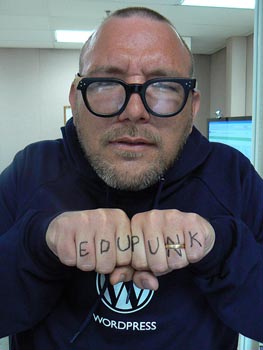
Image credit: This cheesy t-shirt over at neatoshop that I love.
My love affair with domain mapping has been well documented on this blog, and last week, before I went on vacation, UMW quietly took a big leap forward in terms of experimenting with domain mapping as a way to bring some of the more official sites being built on UMW Blogs back into the umw.edu domain. Fact is, we have successfully mapped a site on UMW Blogs for the University Faculty Council on this domain: http://ufc.umw.edu (running all the while on http://umwblogs.org).
It was pretty cool to see how easy and pleasant the whole process was (Deb Hovey in Network Services made it a cinch, and the future of IT at UMW is looking bright for all of us these days 🙂 ), and this marks a really important moment for the larger community on all levels seeing WordPress as a solution for communicating and making distributed publishing to the web easier. Our University Relations folks are framing an information site/newsletter running through UMW Blogs, but also pointed to a umw.edu namespace—which will provide official information for the community, and allow more direct conversation across the environment (more on this as it unfolds). Fact is, UMW is poised right now to make a complete transition from our current website structure (a homemade php template driven CMS on top of Adobe Contribute) to a full blown campus wide adoption of WordPress 3.0 Multisite. Looks like I may be working on the consulting with this, and I am now a proud member of the forming web committee. What’s more, there should be a forthcoming advertisement for a hardcore WordPress developer at UMW to be posted on the bava in the near future 😉 That’s right, UMW is ready to become a WordPress shop for its primary web publishing tool—if all the stars align—and I am just beginning to get excited thinking about the possibilities.
Like why can’t we make UMW’s History and American Studies department site, or the Economics department site, stock for departments. Then start thinking about ways to feed in course content, or aggregate activity through syndication around departments and disciplines—a space where the work on UMW Blogs can be easily featured on umw.edu. And then there are faculty personal sites. Hey, our Novell storage and network space— with the relatively unused www files for hand coded HTML—is going away this November. Why can’t we re-open the discussion of faculty members controlling their own site, and even getting a umw.edu domain to boot if they like, though they could always map their own like Warren Rochelle, to name just one of more than 70 mapped domains on UMW Blogs.
Fact is, this idea is still percolating around campus, and between Zach Whalen’s domain mapping work with his Writing through Media Class, various faculty members simply grabbing their own, and a Digital Storytelling class very much rooted in the idea of one’s domain as a sense of ownership and charge of one’s intellectual presence and online data—a course undergirded by Gardner Campbell’s Personal Cyberinfrastructure epiphany—I would think the conversation and possibilities are just starting to emerge.
And UMW student’s are increasingly realizing the value of creating a domain for framing their experitise. Check out this site created by a UWM student for no class on the fly: hirehassan.com —not a bad way to show off your portfolio work. And to see a beautiful instance of this with student work, check out Rachael Dawn’s Portfolio here, very impressive (and part of Zach Whalen’s aforementioned Writing through Media course).
The domain of one’s own is always fresh to me, and when I see factuly like Jessie Fillerup grabbing and mapping her own domain to blog about Tennis, or Gregg Stull creating his own blog and domain though his own bluehost server, I know it’s a concept we can still go a long way towards cultivating and nurturing a sense of the possibilities throughout the year. And while the actual mapping is not always essential to frame one’s presence, the commitment and notion of conceptual ownership of one’s data and digital identity begins to really matter. And that conceptual shift, whether one chooses it over the long haul or not, is important to a sense of thinking about the deeper questions of digital identity, literacy, and the critical creation of one’s self.
And what’s more, the underlying technology and architecture fueling such a web publishing platform need not be limited to WordPress, it can act as our hub, but it allows us to rethink our use of MediaWiki—which currently runs our documentation, courses lists, and various pages for course sites. How does a well-gardened wiki—as Brian lamb points out here—-help us move both within and beyond the personal to the collaborative with open technologies? Well, if we look to the outstanding work the UBC team has done to document their process with creating a Resource Management Framework on an enterprise scale, as well as the work the CUNY Academic Commons has done integrating MediaWiki seamlessly into the WPMu/BuddyPress flow, we get the roadmap to a real powerful content creation frameowrk that is open and flexible. And just yesterday, Joss Winn articulated the benefits of such a system quite brilliantly in this video on WordPress Beyond Blogging (Winn FTW!):
WordPress beyond blogging from UKOLN on Vimeo.
So, seems to me like certain things in the web publishing domain with open source tools are still around, in fact, they are leading some of the most innovative examples of integrating the idea of fluid publishing, identity, and networked learning into the academy on institutional scales. And while the EDUPUNKS are constantly being counted out, or co-opted as the poster children for the decline of education, and by default Western Civilization —I think we still have a few more concrete examples of why all the hoopla around vertically integrated LMS, standards integration, et cetera, still doesn’t get to the heart of the matter—you can’t innovate in a prison house, no matter how vertically integrated it is (just a more tightly run and designed penitentiary). I mean we can look to other companies within the LMS space, or write love letters to Google, but whether or not the free and open web has been bought and sold already, and we re just a burnt out hippie threat, I can’t help but think reporting the meainstream vision of edtech and the web will ever get us anywhere. We need to promote and support what is happening now that is good. And I have yet to find an example in BlackBoard—got any I can see?
Point is, the open web is not a convenience we need to evolve, it is a public good we need to preserve and foster. You cannot do that when it’s all been accounted for and the gig is up—if “open and free is an ideology” then isn’t “closed and expensive” just as ideological as well—and shouldn’t the two be in deep struggle on a larger stage? Rather, what’s happening, is the one is trying to subsume the other under cloud of night and terminological uncertainty. The LIS standard that’s been announced makes systemwide integration easier perhaps, but does it give people control over their identities and data? Does it promote a sense of one’s space and value on the web in real time? Does it deliver on the idea of a Personal Learning Network on the open web undergirded by syndication and community? These things are integral to teaching and learning on the web right now, and they have little, if anything, to do with an LMS, or so it seems to me.
And that is why I love domain mapping so much—it makes all this so perfectly clear to me.
Updated:
All this said, I forgot to mention one of the projects involving an LMS I am actually excited about, the open LMS being openly developed by Stas Su?cov. Given the trajectory UMW is on right now, we can start experimenting with Stas’s work as soon as this Fall, and start thinking how our setup will take care of all the bloated overhead and insane costs that the dreary LMS provides us at such an insane price. I’m ready to push for a replacement, and if I have to go edtech guerilla, as Matt Gold lays the framework, I will. Remember, that $116 million dollars during these times of austerity came from all the blood that’s been sucked out of institutional coffers through such a deal with the devil. Oepn is not over, it’s just been forgotten because there is so much other cool stuff to report on in edtech, like how the iPad has made everything else irrelevant, and at the same time costlier 🙂