Summer of Love: Keanu Reeves (the nicest guy on the internet)

Image of Keanu Reeves (the nicest guy on the internet)You know, I think this might be my first real break through Summer of Love post, and I say that because part of any real process of cultivating love has to start with owning up, letting go, and letting yourself be vulnerable. I’m about to do all three in one post. In the early 90s I saw about as many movies in the theater as humanly possible. Me and my girlfriend of the time would see two or three movies a day sometimes, and it was a wonderful education, but I still have one regret from those heady days of cinema consumption: I was really hard on Keanu Reeves. I blame my girlfriend of the time, in part, because she was a film student at UCLA, and was being pumped with all these intellectual idea of art and aesthetics, but I have to own up—I trashed Keanu every chance I got. Whether it was him trying to do Shakespeare in My Own Private Idaho (1991) or Kenneth Branagh’s Much Ado About Nothing (1993)—or even a flaccid Johnathan Harker in Bram Stoker’s Dracula (1992). Whatever the film, it didn’t matter, I was unforgiving. I went on and on about how he couldn’t act in my haughty 20 something way, feeling all self-righteous and imperious cause no matter what, I could always lord it over Keanu. And when Speed came out (Keanu’s break through Hollywood A-lister film) I broke all ties with his films, and wrote him off for good. I even forgot that I actually really liked him in River’s Edge (1986), Parenthood(1989) (especially), and Bill & Ted’s Excellent Adventure (1989). I seem to have ignored that he put in an impressive performance in Point Break, (1991) and that he refused to do a lay-up cash money sequel for Speed and varied his filmography, giving as much attention to low-budget, independent films as he did blockbusters.

Now, I still held much of my contempt for Keanu through the 90s, I laughed him off in The Matrix (1999), and held comfortably onto my superiority for almost a decade. But come 2000 I had a scare. I saw Sam Raimi’s The Gift, and while I wasn’t expecting to see Keanu, he showed up nonetheless (as popular actors who vary their roles are apt to do) and his performance as the abusive redneck husband was one of his very best. He was truly haunting, and has come to exemplify the abusive redneck husband for me even more so than Dwight Yoakam in Sling Blade (1996). And while I even tried to fight this realization in the theater seats in 2000 while I was watching The Gift given it was Keanu Reeves, it continued to secretly haunt me. Fast forward ten more years, and it just so happens that The Gift plays just about every night on some premium cable channel (and I have them all!)—and I end up watching it just about every night it’s on. That film is becoming a real favorite of mine, as is A Simple Plan (1998) —long live Raimi!!!

All this said, I had still blocked out my decades of unfair aggression and misplaced contempt of Keanu Reeves until tonight, when it all came clear I had been living a lie, a superficial cover-up of my own deficiencies in my lording it over Keanu’s career. It was a rather accidental series of circumstances that lead me here, but I think it had been brewing for close to a decade, so I am kind of thinking tonight was simply a trigger point. Mike Caulfield’s kitschy advertising for EdCamp Keene brought it on:
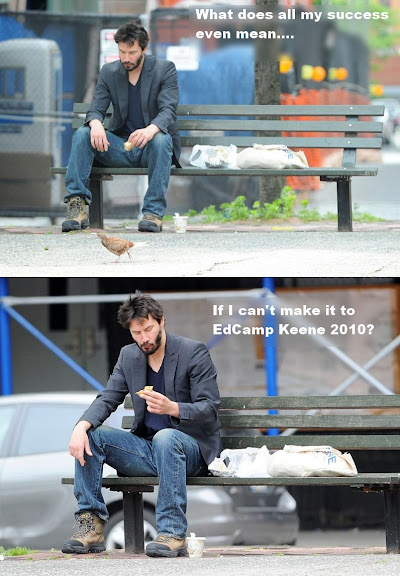
Image of Keanu Reeves (the nicest guy on the internet)

Simple enough image, and joyful in its own way. But when I saw that image I started to wonder about Keanu, where is he now? -how’s he doing? -why did I forsake him? I went to his Wikipedia article for the latest, and realized he’d been working quite consistently over the last 25 years, and unlike most actors and actresses there was no real annoying drama or juicy gossip—it was all pretty straight. Keanu works as an actor, he’s not caught up in all the bullshit, he identifies as a Canadian, was a pretty good goalie in high school, and had a pretty tough childhood growing up—moving from place to place and living with step dad after step dad. I never heard him complain about that, did you? And when he was the butt of all the haters self-satisfied acting jokes throughout the 90s I never saw him lose his cool, did you? He took his super stardom in stride, and kept on going to work, doing his job. But then….then I came across this article on the National Post that made me not only feel bad for being a prick to Keanu for all those years, but actually become a fan—to finally be able to confess my love for him. And, what’s more, it is all too apparent I am not alone as the National Post article makes clear:

A comment thread has started on Reddit in which people from all over the internet have stopped in to share their thoughts about actor Keanu Reeves. The comments paint Reeves as the nicest guy in Hollywood – generous with time and money. And well read. And tough. So tough in fact, that we may be witnessing the genesis of a new Keanu Reeves internet meme. Heads up, Chuck Norris.

Some excerpts:

Back in the late 90s and fresh out of college I got my first job as an assistant prop designer on the set of Chain Reaction (Keanu was a supporting actor with Morgan Freeman). EVERY DAY for the last few weeks of filming, Keanu treated the stage hands and “grunt workers” (including myself) by taking us out for free breakfast and lunch. He was genuinely a very nice guy to work with.

I met Keanu when he was in Australia doing the matrix. I knew who he was, but when I asked him what he did for a living he answered “I’m a struggling musician”. I thought that was sweet.

I had a few friends working special effects jobs on the Matrix movies, he bought all of them fucking HARLEYS for Christmas during the shoot for the second one.

There are no bad stories about Keanu. I live in LA and work in North Hollywood, and everyone I’ve ever heard out here tell a story about Keanu says nothing but great things. Everyone loves that guy. It’s made me love his movies. I don’t care how great they are. I love to see him, because he makes me happy. I like to know there’s someone like that.

Paul also told me that Keanu once explained to him why he was getting so many action roles. He had injured himself at some point and had fused vertebrae in his upper back or neck, so when he turned his head, his shoulders and chest tended to follow, because of his limited flexibility. “It makes me look dynamic, rather than disabled” was his explanation.

Chatted with a feature writer for Details who spent basically a whole day with Keanu for his profile last year or maybe the year before. He went to a bookstore with him and (this is in the story) Keanu is REALLY well-read: Keanu mused enthusiastically about Thomas Pynchon, obscure poets, Norman Mailer, etc. as he bounces around the book store. Keanu is also a lot better read than he seems, apparently.

I love that Keanu Reeves is emerging as the nicest man in Hollywood, and by extension the nicest guy on the internet. And maybe, just maybe, the nicest man who ever lived. Given this, it is clear he will forgive me my sins, and at the same time it lets me come clean, a baptism, a washing away of all the petty concerns and unnecessarily harsh judgments. In some odd way Keanu has freed me, and knowing he is so nice makes me envious in different ways—I wanna be that nice too. So, if you ever read this, Keanu, I’m sorry for being a prick in my early 20s, and I take it all back. Being the nicest guy ever, and going by what a search for “keanu + nice” gets you on Google these days, you have something a little bit more than talent, you have what so many of us need: a nice bone in your body—in fact, it sounds like they’re all nice. And if you are really as nice as the numerous stories on the web suggest, than I have to say there is no greater legacy. Keanu Reeves is the Chuck Norris of nice, and being that nice is even tougher than being that tough.
Posted in bava Summer of Love 2010 | Tagged , , , , | 16 Comments

EDUPUNK or, on becoming a useful idiot

I can only imagine that the greatest supporters of this idea [EDUPUNK] are those conservatives who wish to tear down public education.

Now they have useful idiots carrying their water.

http://thetyee.ca/Life/2010/03/20/EduPunks

I’ve always been an idiot, but I never thought I’d become a “useful idiot,” but it looks like that may be proving to be the case. The above comment on one of the now many, many articles about EDUPUNK has been stinging me for months—and yesterday when I read this article by Glenn Harlan Reyonolds in the Washington Examiner, it seemed that the above comment was absolutely right. Here is a bit from Reynolds’ article that gives you a sense of his vision for Higher Ed:

It may actually make them [students] more economically productive by teaching them skills valued in the workplace: Computer programming, nursing or engineering, say. (Religious and women’s studies, not so much.)
….
Post-bubble, perhaps students — and employers, not to mention parents and lenders — will focus instead on education that fosters economic value. And that is likely to press colleges to focus more on providing useful majors. (That doesn’t necessarily rule out traditional liberal-arts majors, so long as they are rigorous and require a real general education, rather than trendy and easy subjects, but the key word here is “rigorous.”)

Not only does Reynolds want to gut the education system to become a feeding lot for employers and this nebulous vision of productivity and “economic value” (whatever the hell that means) —but he comes up with that lame ass excuse for a good education, “rigor,” as a means to save liberal arts from the neo-liberal imposed gas chamber. I love how the dismissal of women’s studies, religious studies, and by extension philosophy, english, art history, fine arts, music, theater, and on and on, brings into sharp focus what the neo-liberal vision of an unregulated, free market education might look like: service training for the new de-humanized economy (The Wire, anyone?). What we are seeing is the gentrification of higher ed as an impulse to razing public education though the liberatory rhetoric of innovation and efficiency—only to have the process devoured by the wolves of the free market. And this next quote is the kicker from Reynolds—-and another reason why I can’t read DIY U:

My question is whether traditional academic institutions will be able to keep up with the times, or whether — as Anya Kamenetz suggests in her new book, “DIY U” — the real pioneering will be in online education and the work of “edupunks” who are more interested in finding new ways of teaching and learning than in protecting existing interests.

Reynolds understands the “edpunks” as the useful idiots who very well may help bring the public education system down, and that’s all part and parcel of the framing of EDUPUNKS as the romanticized destroyer—or necessary idiots—who pave the way for the eduprenuers, the ultimate heroes of Kamenetz story. It’s a tough narrative for me to swallow, and I don’t need to read the book to follow it’s arc. But when organizations like NCAT get framed as a solution in terms of efficiency at warehousing their services like box stores, you know the solutions aren’t going to end well.

Part of the beauty of a term or idea like EDUPUNK is that it’s protean, and you can’t control its meaning and interpretation—and I think that’s important and necessary. At the same time, I think a personal intervention is in order (at least for my own head) because an EDUPUNK that devastates public education in service to the unregulated promise of free markets and capital is possibly the worst vision one can imagine. Reynolds compares higher education to the housing bubble, but ironically it was the neo-liberal/libertarian push for the lack of regulations on lending, hedge funds, and shadow banking that led us into the global economic mess we’ve been straddled with for the last two years. I have no faith in the free market, and I think I can say that with a certain amount of confidence these days.

And if student loans are the next bubble to burst, how will the privatization of higher ed (and by extension its transformation into service training) help? The public education system in the US (both higher ed and K12) have been steadily dismantled over the last two decades, and just look at the tuition increases in California’s state system at a whopping 43% (the former gem of high quality public education on the cheap) and it quickly becomes apparent the that education as a subsidized public service is what is really under attack. The average tuition for a public college or university is debilitating for most families, not to mention those with less, and this is a deeply entrenched problem. But I’m afraid the rhetoric behind privatizing education, i.e., efficiency, reduced costs, and curricular freedom, will ultimately accelerate the decline of higher ed into a series of feeding lots for the private sector job market—-which is the worst possible scenario in my mind.

All this does not change the fact that the cost of higher ed has gone insane in the US, but rather than positing the entrepreneur, corporation, or free market enthusiast as savior—we need to recognize that their has to be a third space. There has to be a way for people to organize and share freely and openly through a series of trust networks that aren’t necessarily mediated by institutions. But given so many of the demands of accreditation, and the current expectations for the system as it currently operates, given the choice between grief (a public, subsidized higher ed option) and nothing (the rise of privatized workforce factories), I’ll take grief every time. But all the while continuing to work towards the idea that there can and will be another way outside of this debilitating binary we are working through right now.

Anyone who works within higher education understands it’s not a process of efficiency, and the push for clearly definable outcomes through assessments is voodoo metrics at best. What’s more, technology as some cost cutting measure for teaching and learning is one of the most ridiculous arguments ever, the way universities and colleges have saved on teaching and learning over the last twenty years is part-time, benefit-free labor. And that is the direction these online, privatized universities have taken (think Phoenix U) and will continue to take in the near future, and that actually frames the bigger issue of this whole discussion, to what degree is the dream vision of DIY U a means of further gutting the salaries, rights, and benefits of educational professionals? We’ve gotten rid of the high paying, unionized blue collar jobs over the last three decades, and I can’t help but think that the public professional jobs that have some of those same benefits are next on the chopping block. What we have is an economy disinvesting its own workforce from the bottom up in the name of efficiency, cost cutting measures, and productivity—but in the end we’re all just fodder for profit-driven system that depends up the exploitation of the many for the wealth of the few. Last I checked that’s really not what EDUPUNK was all about, but I don’t write books, so you’re gonna have to take my word on this. I’m not really a useful idiot. I’m not…I’m not….

Posted in edupunk | Tagged | 24 Comments

Summer of Love: “Ahhh, los gringos otra vez”

The best scene from a movie ever? I don’t know, but there can be no question that this little bit of magic from Sam Peckinpah’s The Wild Bunch (1969) would have to enter the conversation. I mean this film has it all: the rapidly vanishing west, the emergence of culture changing technologies, and an internecine band of outlaws who have lived past their moment but ultimately refuse to succumb to omnipresent animal logic of mercenaries. And this scenes marks just that moment, making their march to General Mapache all the more beautiful. And while this is an admittedly singular reading, and one that elides the film’s insane misogny, at the same time I can’t think of another scene in film that captures the spirit of how I feel at this moment any better—why not?

Posted in bava Summer of Love 2010, film, movies | Tagged , , , , | 4 Comments

Summer of Love: Evil Meatballs vs. Cat

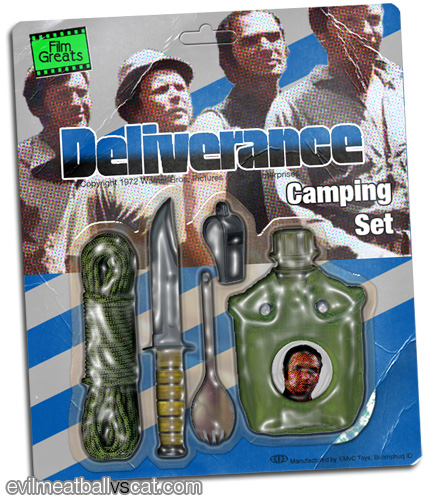
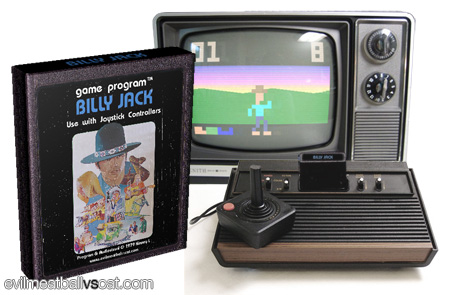
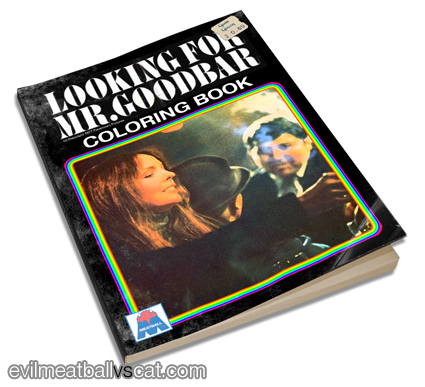
While cruising around Plaid Stallions late at night, as I am wont to do, I discovered a feature of a new retro toy blog Evil Meatballs vs. Cat (I love their blog theme) they were running that is kind of an absurd fantasy of toys that could never be, and I absolutely love it. It is a relatively new blog, and I love what they got going. Here is a sampling from their young, but brilliant, collection.


Just what the Summer of Love needed, some toy fantasies, and this is the best kind of blogging: irreverent, fun, and creative as all hell.

Posted in bava Summer of Love 2010 | Tagged , , , , | 4 Comments

Jimmy Subtitles

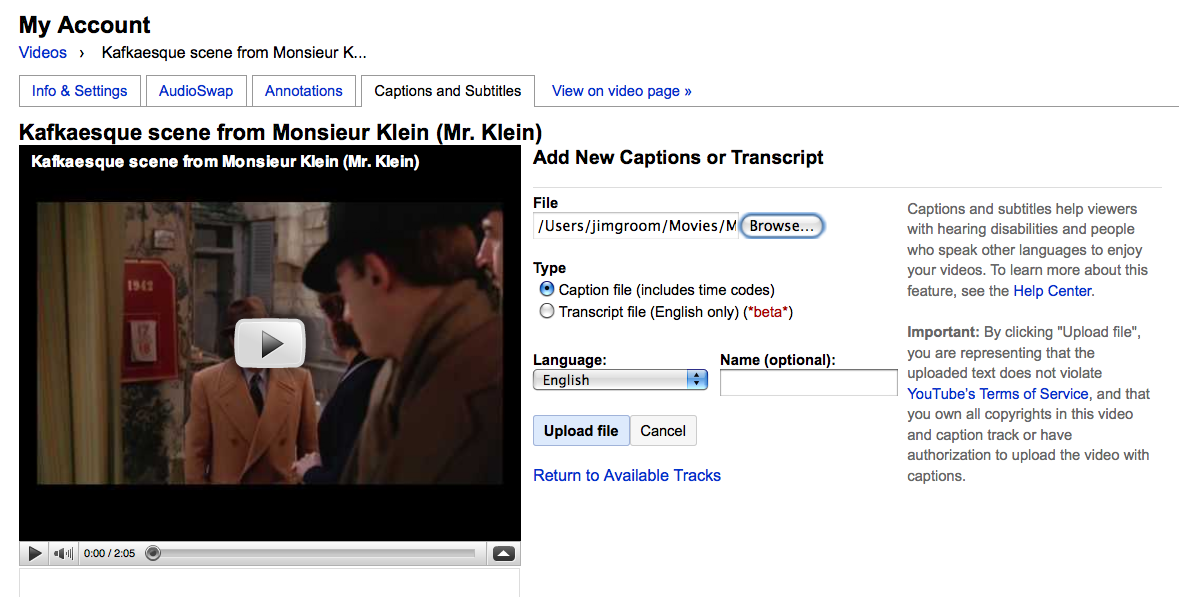
That should be my new nickname after all the playing with subtitles and captioning I did today. I’m officially the best at this process, now let me show you why. After ripping the Monsieur Klein DVD for this brilliant Summer of Love post, I was running into problems converting the Video Object file (.VOB) into a clean MPEG-4 with audio using MPEG Streamclip (a free software I really love for quick video editing and compression —and it works on all the major operating systems to boot). So, I knew the VLC had compression and conversion capabilities, so I actually tried it on VLC’s streaming/exporting transcoder, and it worked quite well. It cleanly took a small bit of a larger VOB file I specified using specific in and out times and compressed it into a tidy MPEG-4 file. It also promised to copy over the subtitles, which was key for Monsieur Klein, which is in French and subtitled in English, but alas that didn’t work which leads me to my experimentation with subtitled the video on YouTube. For the step-by step of my process for transcoding in VLC, see this Flickr set.

So, having converted and compressed by portion of the VOB file to MPEG 4, I still didn’t have subtitles, which I needed for this clip to make any sense in the context I was discussing it. So, I went for a search online and came up with a nice little tool for the Mac called D-Subtitler. What D-Subtitler does is pretty cool, if you have a VOB file of a DVD that has subtitles, but you can’t get them to convert and compress on another format, you can extract the subtitles from that VOB file using D-Subtitler. I tried this out on Monsieur Klein, and I was extremely impressed with how cleanly it pulled out all the subtitles and placed them in a SubRip Subtitle File (or an SRT file) all formatted and ready to go. I had to verify the images of a few letters, but the program captured all the subtitles with very few errors (I think I had to make 4 or 5 grammatical and spelling changes). What’s more, is that it gives you the format with time codes and all for creating subtitles in the SRT file that YouTube ingests cleanly. Now, given I was taken a smaller piece of a much longer file, I had to change the in and out times for each of the subtitles, but that was pretty simple once I found and changed the first timecode—and D-Subtitler gives you an editor to do it in—though it can be done in just about any text editor.

Here is what the SRT file looks like for one of my Monsieur Klein videos:

275
00:00:08,289 --> 00:00:09,299
I know very little about him

276
00:00:10,530 --> 00:00:12,480
I never saw much of him.

277
00:00:12,829 --> 00:00:14,670
The girl took care of everything.

278
00:00:15,000 --> 00:00:16,670
A brunette

279
00:00:16,970 --> 00:00:18,430
pretty sexy.

280
00:00:18,700 --> 00:00:20,750
l think she was a whore

281
00:00:21,109 --> 00:00:22,569
or a dancer.

282
00:00:24,140 --> 00:00:26,750
He only went out at night
when l was in bed.

283
00:00:28,680 --> 00:00:30,170
Around midnight,
after curfew

284
00:00:30,450 --> 00:00:31,970
l'd hear him come down the stairs.

285
00:00:33,519 --> 00:00:35,250
And the morning l saw him,

286
00:00:35,549 --> 00:00:38,950
it was about 5 a.m. ....
l was taking out the trash.

287
00:00:40,220 --> 00:00:41,529
There he is!

288
00:00:45,160 --> 00:00:48,000
You're Mr. Klein, aren't you,
from the second floor?

289
00:00:49,730 --> 00:00:51,190
No, l'm sorry.

290
00:00:52,099 --> 00:00:53,589
I'm not your Mr. Klein.

291
00:00:54,309 --> 00:00:55,619
Pardon me.

292
00:00:57,009 --> 00:00:58,299
l thought you were him.

293
00:00:59,880 --> 00:01:02,400
Same height, same hair, just as slim.

294
00:01:02,809 --> 00:01:04,390
The same look.

295
00:01:04,680 --> 00:01:07,259
Because l never saw
the other one's face.

296
00:01:09,019 --> 00:01:10,720
What do you want?

297
00:01:11,019 --> 00:01:13,890
l've come about the apartment.
Is it still available?

298
00:01:16,160 --> 00:01:18,240
- If you don't mind waiting a minute.
- Not at all.

299
00:01:20,059 --> 00:01:22,309
We're finished.
What about the calling card?

300
00:01:22,700 --> 00:01:23,569
Yes, it's right here.

301
00:01:24,769 --> 00:01:27,170
Wait, l'll write down
the address for his mail.

302
00:01:28,509 --> 00:01:31,289
- Does he still get mail?
- Yes, but not much.

303
00:01:31,740 --> 00:01:33,200
A newspaper, a letter.

304
00:01:33,480 --> 00:01:34,789
Nothing else.

305
00:01:38,650 --> 00:01:40,400
So you want to move in here?

306
00:01:40,720 --> 00:01:42,829
No, it's for a friend
who's coming to Paris.

307
00:01:44,660 --> 00:01:46,240
- Here you are.
-Thank you.

308
00:01:48,230 --> 00:01:49,690
If you hear anything, call us.

309
00:01:49,960 --> 00:01:51,480
Yes, certainly.

310
00:01:57,970 --> 00:01:59,430
Good-bye.

311
00:02:02,539 --> 00:02:04,380
Do you really want
to see the apartment?

Once you save this, and after you have uploaded your video to YouTube, you can simply upload the file in the Captions and Subtitles section of your uploaded video.

And voilà, you have professional looking subtitles on your foreign film clip, which is sure to impress all the sycophantic Europhiles 🙂 Check it out:

That’s right, I did those, and after all the fun from the scene of Hitler going nuts in Downfall—a meme the film’s production company so stupidly clamped down on—I’m thinking of having students captioning and subtitling foreign films with stories of their creation for comic effect might be a fun digital storytelling project for next semester. It was surprisingly pleasurable to be subtitling these clips, possibly because the translation was done for me, and the positioning of the subtitles and how long they appear makes the narrative. I’ll have to come up with something a bit more solid, but it might have legs.

Posted in video | Tagged , , , , , , , | 6 Comments

Summer of Love: Monsieur Klein (1976)

Joseph Losey fascinates me, from his early masterpiece The Boy with Green Hair (1948) to his work with Harold Pinter in the 60s on adaptations like The Servant (1963) to his slumming with Elizabeth Taylor and Richard Burton in Boom!, his career was all over the place. Not to mention the fact he was blacklisted from Hollywood during the Red Scare 50s and as a result had to emigrate to England to keep making films. While reading around before this post, I was rather shocked that Losey’s later films were pretty much panned all told, especially after seeing Monsieur Klein, which in my mind is a masterpiece. So when Don Callahan writes that Monsieur Klein “is a laborious tale of the French Occupation told at a funereal pace,” I figured a Summer of Love post was in order. While I’ll grant Callahan the film is slow, I can’t help but think it’s deliberately so, especially given that the entire film is about the metamorphosis of a gentile into a Jew during the Nazi occupation of France—framing the haunting politics of identity as simultaneously abstract and physical. And this is brought home immediately in the film through one of the most terrifyingly abject opening scenes in cinema, wherein a doctor is physically examining a woman as a vet would a horse to determine whether or not she is a Jew. A scene that hearkens back to the Samuel George Morton school of racial phrenology, and all the more poignant and update given the setting of Nazi occupied Paris.

The violence and sheer disregard for humanity that permeates this scene makes it one of the most frightening I’ve ever seen—and for the last year or so I haven’t been able to shake it. This opening scene of medically diagnosing racial/ethnic identities, a practice which in turn carries devastating persoanal and social consequences, is immediately followed by our introduction to the protagonist Mr. Klein (payed brilliantly by Alain Delon). Klein is an opportunist who buys art from various Jewish families at cut rate prices given their predicament. And the very thing that gives him the power to do this—his tried and true Frenchness—is exactly what is methodically taken away from him throughout the film. His metamorphosis into the other Mr. Klein, a Jew being hunted by the Nazis, is both subtle and haunting. But I think what really blew me away about this film was how both identity and self becomes inextricably caught up in socio-political struggle for power, and watching this process completely strip Klein of any sense of security and privilege takes a radical departure from how most films, novels, histories, etc. have treated the Holocaust. The viewer in many ways becomes caught up in the metamorphosis and much like Kafka novel cannot truly understand the forces working against him. It becomes abstractly and absurdly Biblical. And what makes Losey a master of the highest order in my mind is that he was able to achieve one of the greatest feats of film in the 20th century (with all due respect to Orson Welles) he brought the Kafka themes and aesthetic to film like no one else has to date (granted with the help of Italian screenwriter Franco Solina). What’s more, Losely didn’t simply try and remake Kafka, but rather riffs and intelligently updates Kafka’s writings that in so many ways pre-sage the humanistic void that emerges as a result of the Holocaust, and Losey seems to return to Kafka’s vision to try and deal with that—no matter how impossible it is. The Kafka connection hit me less than twenty minutes into the film while watching the following scene, wherein Klein is searching for his Jewish dobbelgänger, whose presence and similarity to him are bringing him unwelcome attention by the authorities.

Amazing, the sense of distrust, paranoia, perceived guilt, and increasing self doubt are the hallmarks of the best of Kafka’s dreamlike world, and the best of Kafka (maybe save Faulkner) is the best of literature in the 20th century. And to witness a film like Monsieur Klein capture even a bit of that on film in the most convincing and uncontrived of ways generally panned or lazily acknowledged by critics of the day seems a shame. So here’s a little love for Losey’s ignored masterpiece, without question one of the best film discoveries I stumbled across in the past decade, and one that will not let you forget it anytime soon.

Posted in bava Summer of Love 2010, film, movies | Tagged , , , , , , , | 1 Comment

Summer of Love: Yacht Rock

A couple of years back Brian Lamb turned me on to what might be the funniest set of videos I’ve yet to see on the internet: a 12 episode Rockumentary titled Yacht Rock. It’s a brilliantly conceived spoof on the careers of Kenny Loggins, Michael McDonald, Hall & Oates, Toto, and several other smooth rockers from the late 70s and early 80s. The series starts to lose it after the eighth or ninth episode, but the first five or six are nothing short of brilliant (you can find them all here).

My personal favorite is episode two which features the back alley song writing duel of 1978 between Hall & Oates and Loggins & McDonald—I can;t get enough of Oates in this one. And while I know the series is over five years old, and many who might read this are already familiar with it, but on the off chance you haven’t, do yourself a favor and watch at least the first five or six episodes, you won’t be disappointed, especially if you are a child of the era.

Posted in bava Summer of Love 2010, music, video | Tagged , , , , , | Leave a comment

Summer of Love: Don’t Dance her Down

I love The Fiery Furnaces “Don’t Dance Her Down” tune which I discovered via Brad Efford. Which in turn reminds me of how much I loved Brad’s Daily inTune posts, as well as his Play-List experiment on UMW Blogs. In fact, it all just reminds me how much I love and will dearly miss the great now-graduated Brad Efford.

Posted in bava Summer of Love 2010, music | Tagged , , , | Leave a comment

Summer of Love: The Village map

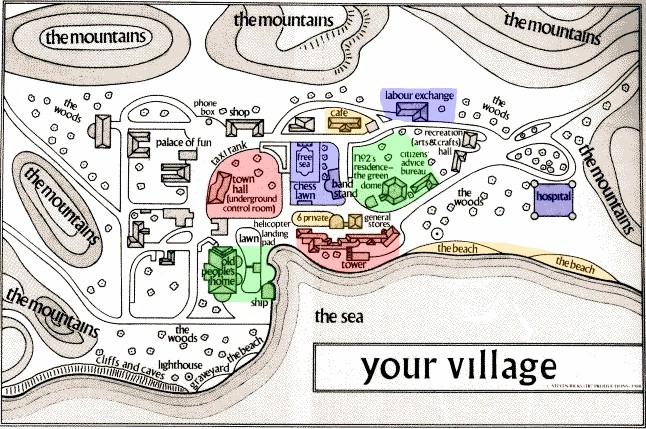
I love that I’ve consistently been able to find and download a map of The Village from the 1960s TV series The Prisoner since 1995.

Posted in bava Summer of Love 2010, television, TV | Tagged , , , | Leave a comment

Summer of Love: Yie Ar Kung-Fu

A Perfect Game on Yie Ar Kung-Fu
I’ve been in the emulator zone as of late after playing around with Dragon’s Lair, so it’s not too surprising the 80s arcade love abounds. And after playing a host of games on MAME tonight, I rediscovered a favorite from back in the day, 1985 to be exact, Yie Ar Kung-Fu. I played this game for the first time during the Summer of 1985 in a huge arcade in Lake George (which is actually the same arcade where I discovered both Discs of Tron and Dragon’s Lair for the first time). What’s so fun about thinking about these games, then playing them on MAME (or some other emulator), and then going out on the web to find out more about them is that the web does what it does best, spits back all kids of goodies from fans of the arcade culture. The Wikipedia article for Yie Ar Kung-Fu links to some great resources, like Hardcore Gaming 101’s breakdown of the game and all its ports on various Japanese home gaming systems. And then there’s the Gaming Strategy wiki, which gives you a breakdown of Yie Ar Kung-Fu’s controls (which are unique), as well as a walk-through of the game in great detail. I mean look at the graphics someone made illustrating how the controls work:
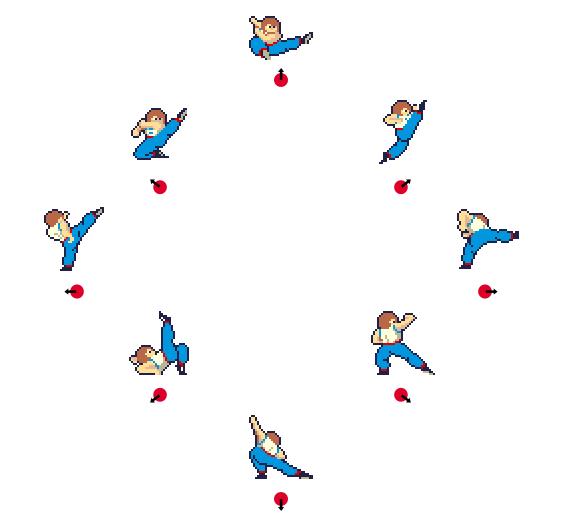
And this graphic is not only beautiful, but key because the actual fighting moves in Yie Ar Kung-Fu are intimately related to the kick or punch buttons and the direction your joystick is pointing. There are over sixteen moves, and what is amazing about this games is how fluidly Oolong (the character controlled by the player) flies through these moves—making it light years beyond Karate Champ (released just a year earlier in 84). What’s even better than finding all these resources, is when the various fans/scholars of the game contextualize the cultural significance of Yie Ar Kung-Fu in terms of its gaming legacy as the article on Hardcore Gaming 101 by ZZZ does quite well:

Created by Konami in the mid 1980’s, Yie Ar Kung-Fu (pronounced YEE ER KUNG FOO, meaning “One, Two, Kung-Fu”) is arguably the peak of pre-Street Fighter II fighters. At the time, little had been done in fighting games and few people, if anyone, had expectations from the genre.

Although Yie Ar Kung-Fu can be a frustrating game, it made great strides for the one-on-one fighting genre. The few fighting games prior to 1985 featured generic karate or warriors guys fighting each other (see: Karate Champ, Urban Champion, many others.) In contrast, Yie Ar Kung-Fu offered a vast array of unique characters. Many of them are simply huge bald guys with apparent distaste for shirts, but many also had weapons such as throwing stars, nunchakus, and chains. A lot of them are simply named after the weapons they wield, which is just a little silly. Many of them were also inspired by characters in old kung fu movies. However, like most pre-Street Fighter II games, you can only play as a single character, a rather standard looking karate guy. Everyone else are unplayable boss characters.

So, thanks to the references on the Wikipedia article, I learned that Yie Ar Kung-fu is the prototype for modern fighting games by bringing a new sense of details and characterization to the fighting genre, and that’s what I certainly remember about it. Yie Ar Kung-Fu was all about the 11 opponents you fight, most of whom are named after their weapons (which I don’t think is silly at all, it metonymically simplifies the whole thing) and the match-up between your character and a nuncha master or pole master is what makes the game so cool—it kinda feels like the fight tournament from the Master of the Flying Guillotine. What’s so memorable about this game is the various characters, you feel like you are taking on a different fighter, and fighting style, with every new opponent—can anyone say Virtual Fighter? Here’s a list of the 11 opponents —two of which are women, which is probably a pretty progressive ratio in video games circa 1985— that I grabbed from the opponents page on the Strategy Wiki entry for Yie Ar Kung-Fu, which, by the way, is using MediaWiki and licensed with Creative Commons—making the inclusion here that much easier-disco!
Buchu

”’Description:”’ Buchu is primarily a large, slow target, making him a relatively easy first opponent. He has a special flying headbutt attack, but he rarely launches it close up, so you should have plenty of time to jump over it when you see it coming. Keep up a steady stream of attacks as he approaches you, and he will walk in to most of them.

Star

Description: Star, like many of your opponents, gets her name from the weapon she uses. In her case, it’s throwing stars. The stars aren’t particularly fast, but she throws them at random intervals, making them hard to predict. They can be jumped over, but if you’re particularly daring, you can punch or kick them, rendering them harmless. Jump back and forth and strike at her when you land.

Nuncha
Description: Nuncha is especially deadly if he gets inside of your strike range. He will continuously attack you with a steady stream of nunchaku strikes. Keep Nuncha at bay and immediately move away if he gets too close. Once he’s inside your strike range, he is particularly hard to hit.

Pole
Description: Pole’s greatest asset is his speed. He rarely holds still, and strikes you with his pole at a rapid pace. It is just as important for you to move continuously. If you can get inside of Pole’s range, he is relatively easy to hit. Until you manage to set yourself up to strike continuously, settle for one strike and jump around the screen until you corner Pole against the sides of the screen.

Feedle
Description: Feedle is an unusual opponent in Yie Ar Kung-Fu in that he actually consists of a team of fighters. The mob of Feedles will approach you from the right or the left. A single strike is enough to send a Feedle running, and you must defeat ten Feedles in order to advance. Feedle is another relatively easy opponent. As long as you strike him before he strikes you, you have little to fear.

Chain
Description: Chain isn’t particularly fast, but what he lacks in speed, he makes up for in reach. Chain’s weapon has the longest reach in the whole game. He will swing the chain at you high and low. The high swings can be ducked, but the low swings must be jumped. Use jumps to get inside his defense and strike him until he is far enough away to attack you again. Then move away and jump towards him again to repeat the process.

Club
Description: Club’s strength does not lie in the attack of his chosen weapon, but rather in the defense he gains by employing a shield. His shield can block your attacks, and he will not be stunned or pushed away if you hit it, leaving you open to his attack. Concentrate on low strikes like crouching kicks that attack his feet.

Fan
Description: Fan is almost entirely like Star, with one exception. When she initially throws her fans, they launch upward slightly, before settling back down towards the ground and flying towards you. This means you should never attempt to jump in front of her. Always make sure that your jumps will clear her fans and attempt to land behind her for a quick strike before repeating the process.

Sword
Description: Sword has particularly good reach. Even though his reach isn’t as good as Chains, Sword is much faster, and therefore, much more deadly. Sword is particularly good at predicting where your jumps will land and moving out of the way, so jumping over him and hitting him from behind is usually ineffective. The trick to beating Sword is timing your strikes so that you hit him before he hits you. Let him walk up to you and strike as early as possible so that you will make contact with him before he swings his sword.

Tonfun
Description: Tonfun is essentially a faster version of Pole. Tonfun seems deadly because of his speed, but he has trouble hitting you up close. You can actually corner Tonfun against the sides of the screen and score successive strikes against him very easily. Setting him up is the hard part.

Blues
Description: Blues is your ultimate opponent. He knows all of your moves. Only wise, judicious use of your moves will allow you to defeat Blues. Unlike most of your opponents, you can trade blows with Blues, but this strategy is unwise, as Blues will connect significantly more often than you will. Blues is particularly vulnerable to jumping punches, since you will frequently avoid many of his attacks by being up in the air. Until he is weaker than you, strike him once and jump away.

A brilliant line-up, and the more I talk about Yie Ar Kung-Fu (and video games more generally) after having spent days finding resources about old school arcade games online, the more I realize why they are dominating the Summer of Love posts right now. Finding and learning more about old school arcade games, ROMs, emulators, and walk-throughs in 1994 or 95 was my education on the web. It’s what made me excited about this space in the first place (that and The Prisoner fan site, which has been up since August 1995), the idea that so many others who loved these games freely shared the work they had done, which was everything from a history of a random game to a walk-through to a technical emulation of the game. It was the first real community for learning online I encountered, and it was informal and driven entirely by passionate fandom. And as a result of that, you find yourself seeking stuff out and trying to make it work on your own machine—but desperately needing help along the way. Much the same process re-inspired me about the web in 2004 when I first discovered WordPress. Simple point is, the Summer of Love is all about exploring the passions that got you interested in this space in the first place, without that spark, the love affair is gone. And I have to say, coming back to the vintage arcade game community online is always an inspiration because there is such great stuff out their created and shared by people who are truly into this stuff, and that kind of dedication and enthusiasm is infectious—and exactly what I need right now.

Posted in bava Summer of Love 2010, video games | Tagged , , , , , , | 8 Comments