A Yawp for Help! Describing Whitman in the World

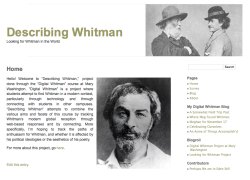
Meghan Edwards is a student in the Digital Whitman class here at UMW, and she has come up with an extremely interesting idea for a final project that takes advantage of the social networking tools we have been using this semester. She is interested in getting as much feedback as possible on how the world reads Whitman. What better way to get a rough sense of a global reception of Whitman than through social media? And while it will be necessarily an incomplete snapshot, I love the idea of attempting a project that uses the new media landscape to get a sense of the international pulse of Whitman’s reception around the world. To this end, I want to plead with anyone reading this to take the survey as well as to republish in your own network as widely as possible.

Describing-whitmanMeghan has created a site for her project that briefly describes the idea behind her project, as well as includes a link to a quick Google form embedded within the Survey page on her site. So, be sure to check out her project, and please, please, please fll out the quick survey and redistribute this as far and wide as possible.

Posted in Uncategorized | Tagged , , , | Leave a comment

Bloggers, as seen by Hollywood

I just saw a part of Made of Honor (2008)—couldn’t stomach the whole thing—which is a derivative romantic comedy that is nothing more than a vehicle for the “dreamy” Patrick Dempsey. I have been musing about the scene and how bloggers are portrayed in Hollywood, and when I searched the phrase “bloggers portrayed in recent films” I was actually taken to a post by Dave Winer that he wrote on the subject just yesterday. Serendipity!

And while he is focusing on bloggers as leading characters in films, the blogger in Made of Honor was a marginal figure who was pretty much a caricature (which goes along with the logic of the film as a whole). The blogger is portrayed as a fanatic woman who was stalking Patrick Dempsey with her blog because he was so beautiful. She was an office worker and basically framed as a geeky, social misfit who was infantile in her crush, and made blogs look like a bad leftover from the years of teenage crushes gone wrong. She was quite a pathetic character, and was interesting for me to see how such a sub-par film can so shamelessly take shots at the image of the blogger.

Adding to that, another film that deals with social media in far more comprehensive ways is George Romero’s Diary of the Dead. Blogs and video uploads are basically the framework for dealing with the zombie holocaust, which is very much in line with the previous Dead series, which always had at their heart a deep subtext about how the media frames the reality in which we live. I didn’t necessarily like Diary of the Dead for a variety of reasons, particularly the acting and aesthetic—it just seemed neither fish nor fowl. And while not a great a gripping film in my estimation, but interesting in the intersection of our cultural zombie fetish and social media.

Anyway, I love the whole idea of tracing bloggers, and even social media more generally, I Hollywood and on TV, and while no one does it better than Infocult for everyday life, I think re-framing blogging and social media in Hollywood would make a great fodder for a pretty fun presentation/mashup. Suggestions of some films besides those being listed in the comments of Winer’s post?

Posted in blogging, movies | Tagged , , , | 7 Comments

MapLib

George Meadows from the Education department here at UMW just turned Martha and I on to MapLib. It’s a tool that basically allows you to add web-based images to the site and lay the Google Maps interface on top of the image so that you can add markers to a customized map. More than that, you can let others collaborate on the map, and when you are done embed it in a post or page as you’ll see below. Very slick, I’ve has numerous requests for adding custom maps/images to Google MyMaps, and now you can do it.

Another tool for your 50+ Ways CogDog?

Posted in experimenting | Tagged , , | Leave a comment

UMW Blogs Traffic Stats—do they mean anything?

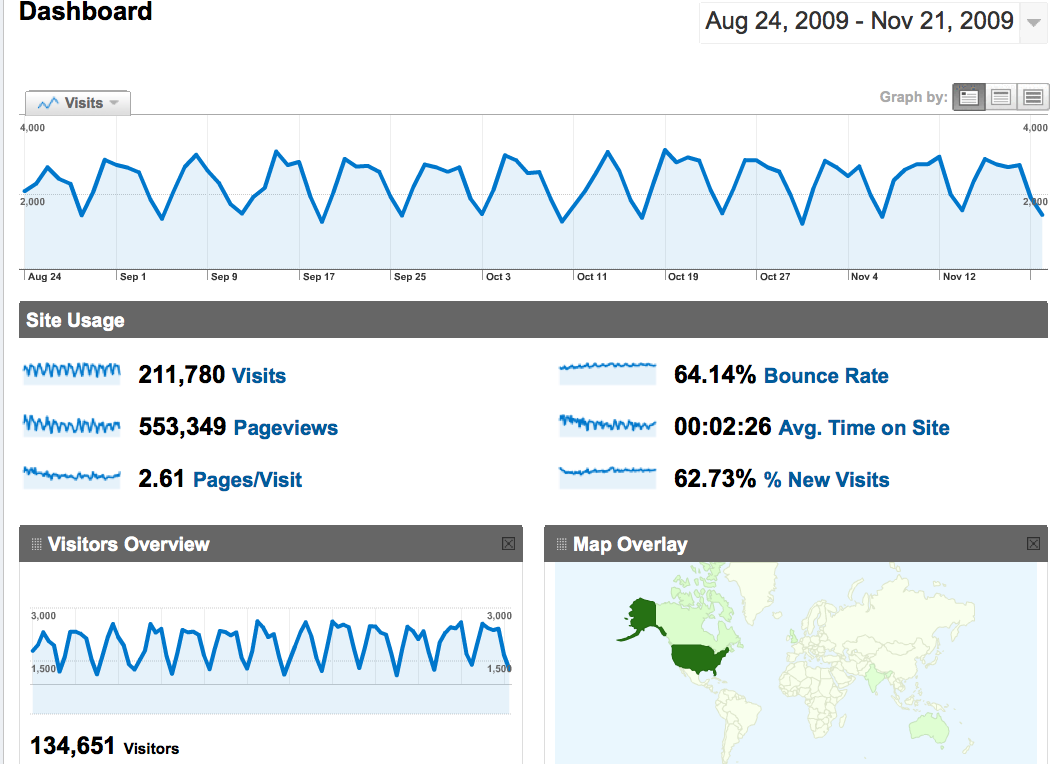
I have been playing around with Google Analytics for UMW Blogs, and I took a snapshot of the traffic thus far this semester. Since August, 24th until today, UMW Blogs has had half a million page views by 211,000 visitors, 135,000 of which were unique. What’s more, we’ve had traffic from just about every country on the globe.

UMW Blogs Stats 11-21-09

I’m still thinking about ways to use some of these stats to actually say something meaningful, and while I am entranced by the numbers at times, I’m not sure if looking for meaning in scales and aggregates makes any sense at all—in fact, I wonder if it simply reproduces a model of data collection and quantification that is eating the heart out of assessment in most institutions. Anyway, there you have it, but what it means is something (if anything) else, I’m afraid.

Posted in UMW Blogs, Uncategorized | Tagged , | 8 Comments

5 Reasons I don’t like ITunesU

Looks like UMW is getting ITunesU. And while I’ve had nothing to do with the decision process, and I really don’t think it is going to make any significant difference in our environment, I would like to lay out a few quick reasons why I think this is a bad (or would irrelevant be more apropos?) move.

1) Don’t trust anything without a URL! ITunesU has no URLs, isn’t that suspect? Matt Gold pointed me to this post recently that does a nice job of suggesting how the disappearance of URLs is killing the web. Here’s a pull quote from the article: “The rise of the ‘app store mentality’ is a direct attack on the web, and on the very nature of free discovery and choice built upon URL-based hyperlinks.” Amen.

2) What’s more, ITunesU is built on the transactional logic of web design. You go somewhere because you want something very specific, usually to buy—like a song or TV episode. What does it say that most of our content delivery systems are framed according to a logic that is being used for selling goods?

3) Building on that, ITunesU is not a place for community, context, or collaboration. What is interesting about the web is not that you can get something, but that you can participate and dialogue around something. We have built a community at UMW with web-based technologies that is not about simply getting something, but about discovering something and following a series of connections and exposing a community of ideas that would otherwise be locked behind a wall. ITunesU is just that kind of wall we are trying to avoid.

4) The nefarious logic that everyone is doing it. What is this compulsion to be “there”? Who cares? People are often wrong, especially at institutions when in comes to content delivery systems. ITunesU on campus is really no different from bringing Taco Bell or Starbucks on campus, another sign of the corporatization of the university space that is running rampant in our moment. Why aren’t we uploading this stuff to the Internet Archive, as Leigh Blackall suggested at OpenEd this Summer? We have no soul or spine when it comes to “just saying no to the gentrification of our campuses.”

5) Finally, and specifically to UMW, we will have so few resources in iTunesU, so now you can add meager to decontextualized. We are a teaching and learning college that has taken on the title of University for appearances sake. Our strength is in the relationships between faculty and students in and out of the classroom. We do not produce video lectures by top researchers, that is not who we are–why pretend? We don’t have a huge ongoing demand for podcasts and/or other media. We have an engaged community centered around an academic space for open praxis around teaching and learning. ITunesU is not a teaching and learning tool, it is a delivery mechanism that is not only overkill for our purposes, but anathema to the open web.

So there you have it. I know I am right, but comments are welcome anyway 🙂

Posted in experimenting | Tagged , , , , | 14 Comments

A Radical Hypno-High

It’s been over 4 years since I’ve had cable, and now that I am back on the smack I can’t imagine how I ever lived without it. It is without question magic, and between a late night fix of Wes Craven’s Shocker (1989) last night and the timeless classic Motel Hell (1980) tonight, I have already gotten my monies worth. And make no bones about it, Motel Hell is absolutely a brilliant film. Need proof? Dig on the following psychedelic execution scene wherein the psychotic cannibal farmer Vincent uses colorful strobe lights to lull his prey into a radical hypno-high before he pulls the plug. More than that, listen to farmer Vincent’s brilliant narration of the process to his victims. Sounds like something out of a Brian Lamb mashup, and this one would absolutely work with his insane vision. In fact, Motel Hell takes the whole Sustainable Living arts movement to the next level, Keira 🙂

As far as cable goes, “I’ll never go hungry again!”

Posted in movies | Tagged , , , | 8 Comments

“My mother is a fish”

As I Lay Dying is one of those insane novels that is absolutely essential for anyone who was wondering why William Faulkner is  still the man. Vardaman’s exclamation “My mother is a fish” is traced so deeply into the hard drive of my imagination that it was wild to see Julie Ruane’s post about names in As I lay Dying that includes some pretty wild images that infuse that preposition with some crazy graphics:

I love when someone takes something near and dear to you like a quote from Faulkner and further accentuates it’s insanity.

Julie is posting as one of a number of students for Mara Scanlon’s Freshman Seminar on Ethics in Literature, and given the number of posts (106) and comments (256), let there be no question that Scanlon is quickly becoming the diva of blogging at UMW. She has been amazing in having her student reflect and share openly about their readings, as well as sharing relevant resources like Julie demonstrates beautifully.

On a Faulkner-related note, I was recently asked to talk about Absalom, absalom! (the greatest American novel ever written) to a book club at a restored African American School in Winchester, VA., which I believe was a Julius Rosenfeld funded school. This is kind of wild for me, because I make no claims to be anything more than a Faulkner fanboy, I am not entrenched in the Faulkner scholarship, which is immense, but rather believe Faulkner and I share one very basic thing—a strong belief in nostalgia as the only way forward. Regardless, despite my attempt to tell them I am probably not the best person for the job, I am still being courted and it looks like in may actually happen sometime in April or May—though I hold out the real possibility that they will come to their senses before then.

But to be honest, I am thrilled at the opportunity to read Absalom, absalom! a couple of times before then and try to frame some kind of vision of why the hell an instructional technologist is talking to a group of folks about Faulkner in a restored African American school. Regardless of the absurdity of the situation, I haven’t been even remotely as excited about anything I’ve been asked to do in the past four years as I have at this opportunity. It may very well be the coolest thing I’ve ever done as an instructional technologist—if that makes any sense.

Posted in literature | Tagged , , , | 8 Comments

Whitman Video Locator

Mara Scanlon recently attended a Google Docs workshop with DTLT’s own Martha Burtis and came away with a pretty impressive idea.  One of the projects the Digital Whitman students at UMW (and elsewhere in the Looking for Whitman project) is a video about where they found Whitman. They are making these videos themselves, and they are composed of a reading of a particular poem in a specific place. The idea of place plays a key role in the Looking for Whitman project, and Mara thought it would be cool to have the students embed their videos on a Google map that we then embed in a webpage (how’s that for professors with cool ideas?).

So here’s the map with all the UMW students’ videos as well as one from a student in NYC— also I highly recommend you check out the videos, particularly this one and this one.

A Quick How-To for the Whitman Video Locator

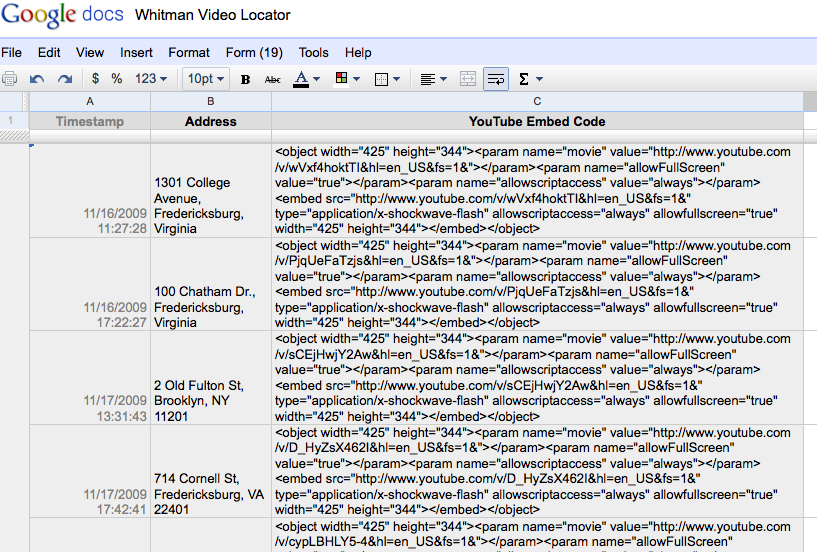
I told Martha Mara’s idea—which, in fact, Martha had given her—and she built the Whitman Video Locator that we are now using on the Digital Whitman blog. You can see both the embedded map and form for entering data here. And while I didn’t build it and don’t have all the details, it appears that Martha created a Google Spreadsheet with three columns: time stamp, address, and embed code, with an associated Google Form that allows users to add the address in one field and the embed code for where ever their video lives (YouTube, Blip.tv, Vimeo, etc.) in another.

Picture 3
After that, there is a gadget you need to add to the Spreadsheet titled “Map,” and from there you can select the appropriate range of data—which is the address and embed code columns, not the time stamp. Afer that, you click on the Gadget and publish out the map.  What’s nice is that the videos get added real time to the map when people add their address and embed code.

Picture 2

I hope Martha will fill in the holes if I missed anything here, because it is a truly slick use of Google Docs for quickly sharing work through a form and aggregating it instantly via a map, and all the crazier that videos of all kind embed within the map.  I love the whole thing.

Posted in Looking for Whitman, maps, mashup, video | Tagged , , , | 6 Comments

L4D on the NES

I have enjoyed playing Left 4 Dead, and when Joe McMahon sent me the following video, it was amazing to see how fans have re-engineered the game for the classic Nintendo Entertainment System (NES). It’s pretty brilliant, particularly if you have played L4D, and I am increasingly fascinated to see how the old school platforms and games continue to hold some real imaginative power over the the video game community. I’m dying to play the NES L4D, which is odd given how our idea of “progress” in video games (and also in movies) has been erroneously dictated by increasingly realistic graphics and CGI. Verisimilitude should not be an end in itself.

Posted in video games | Tagged , , , , | 1 Comment

Spamming all Edublogs

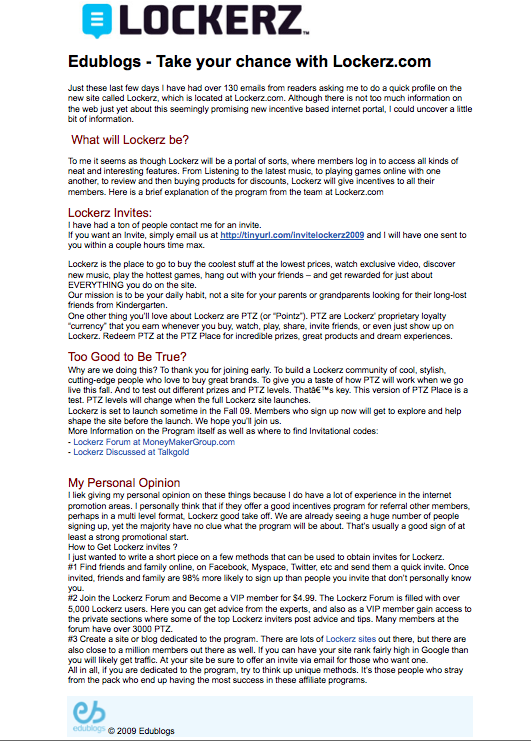
Update: James Farmer has commented below noting that this marketing email was actually spam masquerading as Edublogs, so it looks like my direct marketing theory is off. Sorry if I misrepresented you here, James, my bad.

Looks like the latest venture by Edublogs is to spam the email boxes of its users, I guess content ad links and banners within posts just isn’t making them enough money anymore. Now the Edublogs crew has decided to send out straight up direct marketing spam emails to all its users pushing new services that are framing themselves as the new Facebook for the next generation.

In short, this is the logic of creating a free service for the educational community and doing everything you can to squeeze a buck out of them after the fact. I guess the logic is to take money from a service like the one advertised in the email (see the name below, no link love or Google indexing for this spammer here) in order to help them push their product like crack. Edublogs agrees to this because obviously hundreds of people have been interested, and they just happened to have a stock of emails amassed from educators and students at edublogs. How’s this for a business model? Seems like everything on the internet ultimately leads back to spamming to make a buck. Maybe Edublogs should be renamed Eduspams!

Straight up Eduspam

Posted in Uncategorized | Tagged , , | 5 Comments