This coming semester I’ll be teaching a class titled “Digital Storytelling” in the Computer Science department here at UMW. I haven’t taught through a classroom since the Summer of 2007, and I’m excited about the opportunity to integrate a lot of what I’ve been doing into a course that parallels many of my interests at the moment. And while I will be talking extensively about the design and logic behind this class on the bava, I wanted to take a moment to take a look at the economics behind adjuncting—a position I’ve held on and off for the last 12 years now.
When I received my contract letter for teaching this course, I remembered just why I had taken a break from adjuncting—the salary: $2976. At first it almost seems like a nice round number, but when you break it down, what does this figure really mean in terms of work? Well, I did some calculations with the DTLT crew today and we figured something like this. To design and teach a new course you probably need about 30-40 hours up front for reading, syllabus, general organization, etc. Add to that the time for teaching each week: 6 hours x 15 weeks = 90 hours. And add to that prep time each week: 6 hours x 15 weeks= 90 hours. Finally, add some office hours: 2 hours x 15= 30. Conservatively, you get something like the following in terms of hours spent working.
Pre-semester preparation: 35 hours
Teaching: 90 hours
Prep: 90 hours
Office hours: 30 hours
Total: 240 hours
So, what does the hourly wage work out to be for an adjunct professor at UMW? Well if you divide 2976 by 240 you get a whooping $12.14 an hour.
I know this might seem somewhat crass, and not inline with the “mission” of teaching for the love of passionately sharing and/or inspiring imaginations, but while I do love teaching and I’m rather passionate about the digital landscape right now, I’m also deeply troubled by the blatant inequalities within academia when it comes to part-time teaching labor, not to mention a grossly underpaid staff and facilities crew, which are in many ways keeping the machine running. And while I’m very much a part of that machine in my day job as an instructional technologist, I’m also aware of just how much I’m driven to “profess” by the cultural capital teaching a college-level class affords me. Not to mention the sacrosanct idea of the “mission” of the university—which often works to elide just how labor works within it.
So, why am I writing this? Well, because I don’t want to forget just how much of what we do in higher ed is premised on an economic and institutional stratification of roles and privilege that is all too often deflected by this larger sense of missionary work for the love of teaching and learning. And while a shared goal is not necessarily detrimental, it certainly seems problematic when any sense of negotiation, organization, and reflection on these realities at our institutions of higher learning is so seldomly attended to. For if we did take these issues seriously, and start to think more structurally around the deeper problems of educational institutions throughout the US, one of the conclusions we would soon come to is just how little value is placed on those that do the work, and how much is placed on those that oversee it. A reality which unearths so many of the underlying struggles and stratifications that have been, and continue to be, a fascinatingly hypocritical microcosm of the world education is supposed to save us from.



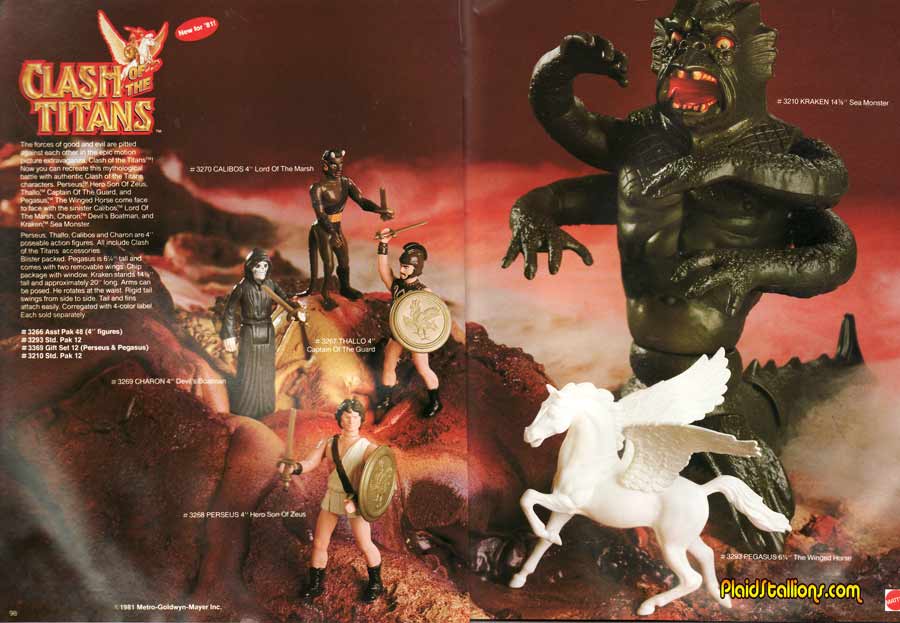
 While talking about the Clash of the Titans action figures, I immediately am reminded of another series of figures based on Raiders of the Lost Ark that were released in 1982 and 1983, but never really took off as the Star Wars mania did. I had Indiana Jones and Toht, and I dug the whip action arm of Indy, and having a figure that had a whip was almost as cool as Chewbacca’s crossbow. That said, the Raiders of the Lost Ark figures were certainly prized by me, but more as an object of my affection for the film, than a real appreciate of the figures. They almost represented 8″ moments of my fandom. And, as is often the case, the fact the figures were ephemeral, the promised free promotional Belloq in Robes figure was never produced, and has become a bit of a Lost Ark of the Covenanat for toy collectors. According to the this page on toyarchive.com: