Soundhax for 3DS

Back in August I wrote a post about bypassing region-lock for the 3DS using a browser hack for the 3DS developed by Smea. It worked well, you loaded the Homebrew Starter kit  (find it here) on a SD card, which in turn was triggered when loading a specific URL in the 3DS browser (hence the name 3dsbrowserhax). Not only did this allow you to unlock your 3Ds to play region-free games, but you could also load old gold ports of games like Doom, Portal, Quake and DukeNuke Em.

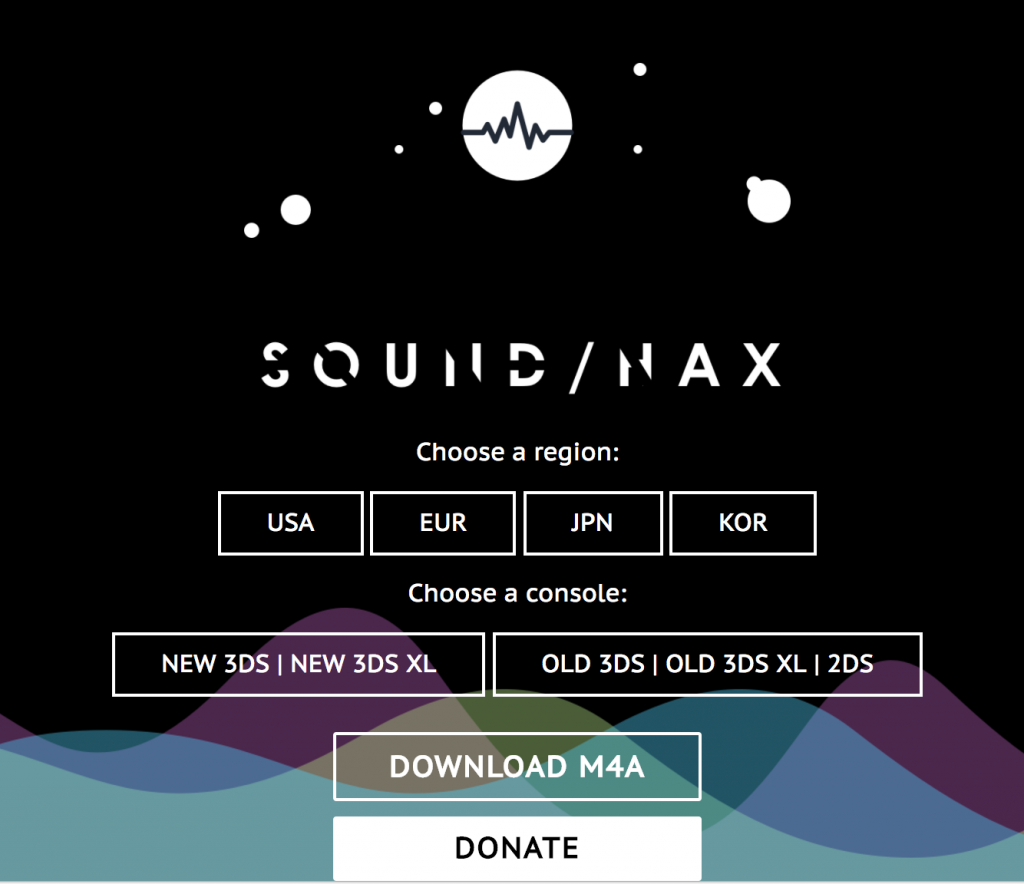
Soundhax

That worked well for a while, but as soon as you update the firmware on your 3DS, all bets are off. Updates often include patches for these hacks, and the cat and mouse game of trying to play the games you bought on the device they were designed for goes on.  So, I updated the firmware back in November or December, and the European games we bought for the 3DS were bricked. I’ve had returning to this on my list of things to do in December, but turns out the firmware version we were on (11.2.0-35) had not yet been hacked. Some folks had left some comments on my previous blog post asking if I knew of any fixes given they were in a similar jam. Last month an anonymous commenter noted there was a new hack for the 3DS called Soundhax, and we should check it out. I finally got around to it today, and it worked beautifully. You can find the guide here. They are using the 3DS Sound application to load Homebrew, and the genius of this hack is that you don’t need internet access to load it, as was the case with browserhax. It seems to be supported through firmware 11.3, but I’ll be testing that shortly.

In fact, Miles was watching me prepare Soundhax on the SD card and try it out, and I think he wants to do a quick how-to video in Italian for his Youtube channel (and maybe even one with me in English). That would be fun, and who knows, maybe folks will “like and subscribe for more…”

Update 3/22/17: I tested this on latest firmware (11.3.0.36U) and it still works swimmingly.

Posted in 3DS | Tagged , | 7 Comments

Domain Sessions

I’m excited to announce that the schedule for Domains 17 is now up and online. It is going to be a pretty awesome two days, and fresh off-the-press is the abstract for Martha Burtis’s keynote “Neither Locked Out Nor Locked In: Finding a Path Through Domain of One’s Own”:

Four years into Domain of One’s Own, I wonder if we are at an inflection point, and, if so, what we will do to respond to this moment. At its onset, Domains offered us paths into the Web that seemed to creatively and adequately address a perception that we weren’t fully inhabiting that space. Our students could carve out digital homes for themselves that were free of the walled gardens of the LMS. Our faculty could begin to think of the Web not as a platform for delivering content but as an ecosystem within which their teaching could live and breathe. In doing so, perhaps we would also engage our communities in deeper conversations about what the Web was and how we could become creators rather than merely consumers of that space. But in those four years, as in any four years, our popular culture, our technical affordances, and our political landscape has continued to march forward. How does Domain of One’s Own grow into and with these changes? Where do we take this project from here so that we continue to push the boundaries or our digital experiences? How do we address the ever-looming tension between building something sustainable while also nurturing new growth?

From there we have a wide variety sessions broken into three tracks: Pedagogy, Domain of One’s Own, and Tools. The categories blur for sure, but they helped us pretend there is some kind of cosmic lattice of coincidence. Sean Michael Morris, Tim Klapdor, and Keegan Long-Wheeler are providing three different lenses on the role of the learning management system on day one. Lora Taub will be framing the Domains project at Muhlenberg as spaces for “transformational resistance.” Brian Lamb, Grant Potter, and Tom Woodward will be running an API audio party, while a cadre of presenters from Michigan State University will be talking about how their digital presence and public scholarship initiative. And did I mention Jon Udell will be joining us too?  And that’s just day one!

Day two will feature Jonathan Poritz and Jonathan Rees talking about integrating simple security practices into your pedagogy, the folks from the University of Oklahoma will be expounding on the non-algorithmic art of community building, while Kate Farley will be running a workshop of the intersection of digital identity and portfolios based on the work she has been doing at University of Wisconsin, Greenbay.

You need more?  We got it. Alan Levine talking syndication engines of freedom ds106-style; Jim Luke framing lessons learned getting up and running with Domains; Lee Skallerup‘s remixing domains as curriculum; and a Family Feud-style showdown of RSS versus APIs featuring a hit parade of ed-tech greats (the Family Feud theme was specifically for Mike Caulfield 🙂 ). And there is more, just head over to the sessions schedule and see for yourself.

I want to say thank you to all the folks who submitted sessions, whether they be presentations, workshops, or domains fair fare—we haven’t even highlighted the Domains fair just yet, but that is fodder for another post. We could not do this without the amazing folks in our community who were ready and willing to share their work when called. And as you can see, the response far exceeded our wildest expectations. The most practical reason I’m so thrilled to be organizing Domains 17 is that I wouldn’t want to miss it for the world.

Finally, I want to note that in additional to the 25 sessions over two days, we made a point of building in a significant amount of time for folks to talk informally with one another about the work they’re doing through various art tours, 80s arcades, dinners, jam sessions, and dance parties. So if you think it will be all work and no play, let me assure you Jack is not a dull boy!

 In short, Domains 17 is on like Donkey Kong. And it’s time for folks to start registering so we can actually afford this thing! 

Posted in Domains 2017, reclaim | Tagged , , , | Leave a comment

A WHMCS Invalid Token Error and the glory of blogging

I woke up this morning to find that our WHMCS portal for Reclaim Hosting was having some issues. WHMCS is software that enables you to manage the business of cPanel, effectively provisioning, invoicing, billing, renewing, etc. without it people can’t sign-up for new accounts, pay their bill, or access their client area. They can still access their sites through theirdomain.com/cpanel, but they would need to use their SFTP credentials to login there, so it would get bad quickly support-wise. So, when I discovered the 503 Service Unavailable error I knew I needed to fix this immediately. It happened at both a good and bad time. Good because it was late night in North America, so the demand was not peak. Bad because my Reclaim partner Tim Owens was fast asleep 🙂 But, in fact, that might have also been good because I tend to lean on him for this stuff given I’m afraid to mess shit up. 

Anyway, the error was there and I went a-Googling, and I found this blog post on Randall Kent’s blog that offers up a resolution. Unfortunately adding session_name("WHMCS"); to the configuration.php file did not resolve the issue for me. I kept looking online, but got nothing. I then returned to the blog post and worked through the comments, and it turns out this comment by Matt was just just the fix I needed:

This should hopefully fix the issue, keeping the sessions managed only by WHMCS.

1. Create a new directory called ‘session’ and make owner/group writable.
2. open configuration.php and add the following:
session_save_path(__DIR__ . “/session”);
ini_set(‘session.gc_probability’, 1);

3. Open /.htaccess and add the below for security:
RewriteRule ^session/(.*)$ /index.php

It worked a treat, the one issue I had was the sessions directory was openly writable and in public_html, which was a no-no, so when Tim awoke he recommended I move it out of the public_html directory and change the path, so mine looks like this:

session_save_path('/home/reclaim/session');
ini_set(‘session.gc_probability’, 1);

And it still works! From what I understand it was a cookie conflicting with other PHP applications on the domain. From Randall Kent’s explanation:

WHMCS by default uses the PHPSESSID cookie to track its session. If there are any other PHP applications on the domain which use the same cookie, it can cause a conflict which in WHMCS results in an “Invalid Token” error. It took us a while to track this down as the other apps on the domain gracefully recovered from the shared cookie.

So, the issue is now resolved and WHMCS is working fine. What’s so cool is that I was able to fix a mission critical issue thanks to some one taking some time to share there own issue, and another kind soul chiming in offering further advice and options. This is a brilliant example of blogging and commenting at its best. So, thank you Randall and Matt, your willingness to openly share your work proved invaluable to me this morning.

Posted in reclaim, sysadmin | Tagged , , , | 1 Comment

On Next Generation Digital Learning Environments

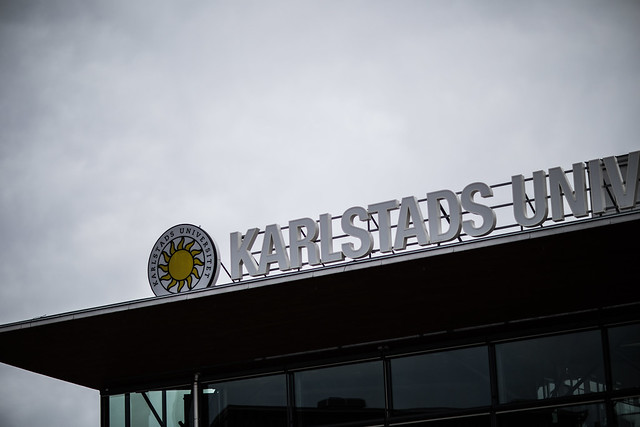
Karlstads

Image credit: Bionic Teaching’s “Karlstads”

Two weeks ago Tom Woodward and I went to Karlstad University in Sweden to help run a two-day workshop. It was a lot of fun, and I have a ton to share about the experience. In fact, so much that I’m afraid any one post trying to encapsulate our time in Sweden could balloon into a novella, therefore I am going to break it into a few pieces. I’ll start with the presentation I gave after the two-day workshop, and then work my way backward and discuss the workshop on Monday and Tuesday in the following post. Finally, I’ll finish with a post on the socialist utopia of Sweden. There it is, I have committed to no less than 3 posts, now to make it so.

IMG_6359.jpg

Image credit: Bionic Teaching’s “IMG_6359.jpg”

This presentation was titled “Next Generation Digital Learning Environments” (NGDLE) inspired by the 2015 ELI white paper on the topic, which is a concept, idea, technology(?) that seems to have made NMC’s 2017 Higher Education Horizon Report* under the name of the Next-Generation LMS. I have a number of issues with classifying Domain of One’s Own as a next-gen LMS, not least of which is it continues to prioritize the necessity of the LMS. In fact, the recent arrival of this concept on the Horizon Report may very well be its kiss of death given Audrey Watters recent takedown that brings its whole reason for the Horizon Report’s being into question.† That said, I have pretty much been promoting one idea for the last 12 years: make the web the learning platform. And with this approach, or so we hoped, there would be a move away from the monolithic, templated systems for teaching and learning to the small pieces loosely joined philosophy. I spent much of 2007 and 2008 slamming the LMS, but that gets tired—not to mention it’s had little to no impact. 

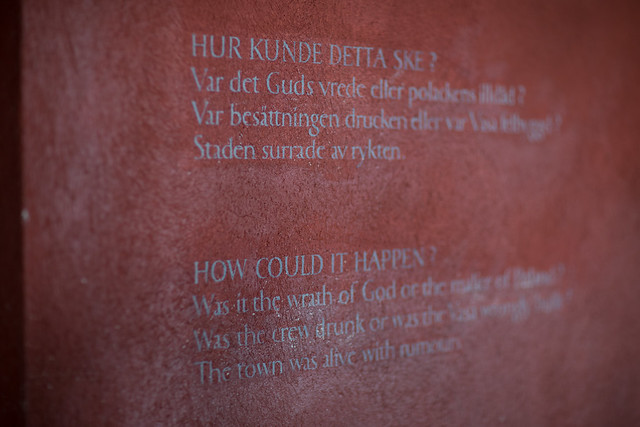
IMG_6740.jpg

Image credit: Bionic Teaching’s “IMG_6740.jpg”

So, this talk in many ways was a recalibration for me. I recently blogged after my NEXA Center talk in Torino that I wanted to change things up a bit with my presentation. I wanted to start with a focus on explaining the concept behind Domain of One’s Own with the venerable Richard Scarry house metaphor, demo how DoOO works using State U, then explore why whatever comes next needs to be much more than just a next generation LMS or Digital Learning Environment, but a complete re-positioning of the way in which we think about people managing and sharing their online world (not to mention an overhauling of DNS as we know it). Although still a work-in-progress, I was able to keep ds106 to a passing mention, which in and of itself is a victory. And while I re-used several slides and media  from previous presentations (I can’t get enough of the 2006 ACLU Pizza video),  the talk felt fairly fresh and spontaneous—which is always a good sign. It will be the basis of a further, more fundamental redesign of the talk that I’ll give this May at THETA 2017 in New Zealand.

I used this quote from the ELI paper on the NGDLE as a point of departure:

What is clear is that the LMS has been highly successful in enabling the administration of learning but less so in enabling learning itself. Tools such as the grade book and mechanisms for distributing materials such as the syllabus are invaluable for the management of a course, but these resources contribute, at best, only indirectly to learning success. Initial LMS designs have been both course- and instructor-centric, which is consonant with the way higher education viewed teaching and learning through the 1990s.

Higher education is moving away from its traditional emphasis on the instructor, however, replacing it with a focus on learning and the learner. Higher education is also moving away from a standard form factor for the course, experimenting with a variety of course models. These developments pose a dilemma for any LMS whose design is still informed by instructor-centric, one-size-fits-all assumptions about teaching and learning. They also account for the love/hate relationship many in higher education have with the LMS. The LMS is both “it” and “not it”—useful in some ways but falling short in others.

The fact of whether higher ed is truly moving away from traditional course structures is arguable, although I understand the propensity for wishful thinking in ed-tech. That said, the reframing of how we imagine personal data and the work we do inside and outside of a particular course does become an interesting moment for re-positioning the faculty or the student as a node within a broader network through which they share with one another. The primary obstacle there being integration between personal spaces and an institution, corporation, government agency, etc. Jon Udell has framed this issue as a lack coherence of the various small pieces versus the ostensible integration of the all-in-one systematic solution that often leaves out and sense of the personal. The NGDLE points to this at various points, but the push for fore-grounding performance-based personalization based on analytics obscures the most important facet of such an user-centered architecture: giving faculty and students more control over their data. An architecture premised on user controlled data shared through API integrations and system federation (ideally built upon open standards) would, indeed, be a new digital learning environment. But what the ELI white paper misses is that this system needs to be approached from a new perspective that humanizes the exchange of data and makes those negotiations everywhere apparent and transparent—that’s not going to happen through a federation of corporate software companies that are mining your personal data for their own profit—and if that’s the case why can’t you say no? —or even decide the terms and get a piece of the action?

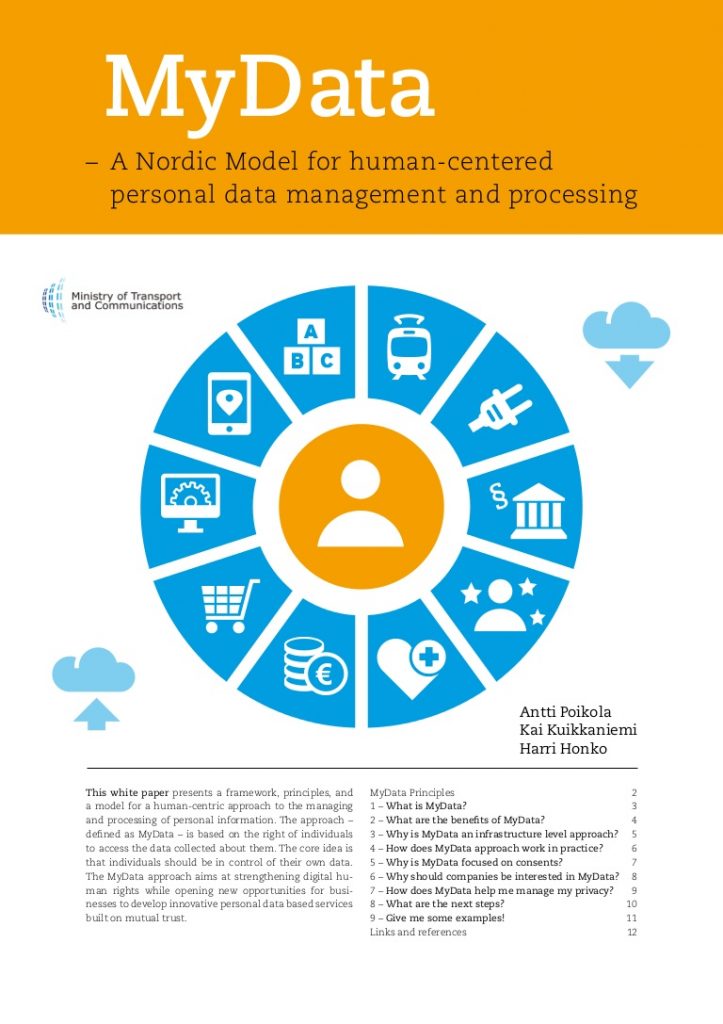
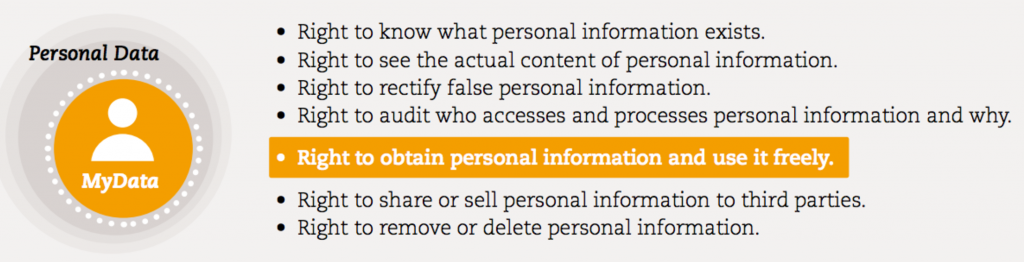
So, it made sense to mash up the architectural vision of the NGDLE with a more explicit and forward thing model for imagining how we could re-think data management at the level of the human when it comes to digital environments. This is where another white paper that came out about the same time as ELI’s NGDLE paper came in handy, namely “MyData: A Nordic Model for human-centered personal data management and proccessing,” This paper was authored by by Finnish researchers that are proffering an approach for various nordic countries to pioneer a new way of reclaiming the humanity of data exchange. The following insert from the MyData paper highlights some of the crucial rights of an individual that should be at the heart of the NGDLE, but are never articulated in the ELI paper. 


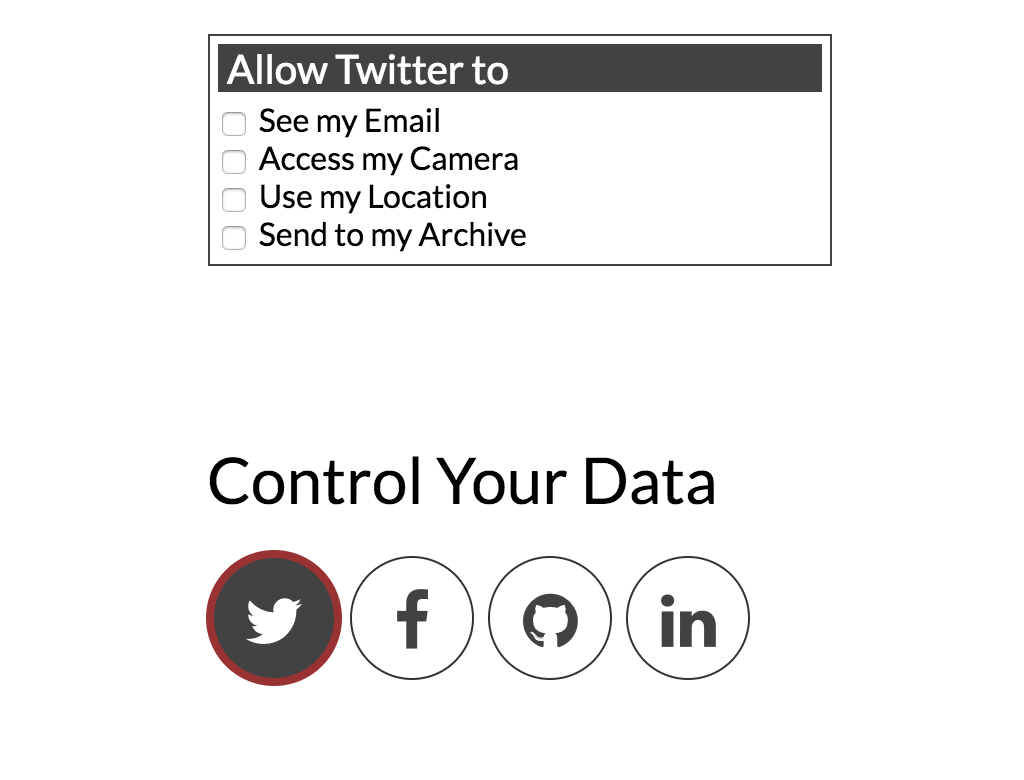
Tom and I got to chatting about just this the night before the presentation, and he quickly came up with a visual demo of dashboard for what it might look like to control various applications. It is a simple beginning, but it returns me to the MIT Hackathon with Audrey and Kin in March of 2013 when we first started imagining what Reclaim Your Domain scenario. This talk helped me refocus Domains on that core concept, and I’m hoping Tom and I can revisit this in more creative detail for the THETA conference.

 It would be interesting to have an operational dashboard that folks can play with at the conference to get a sense of what a human-centered approach to managing their data even means. But for me the real genius of the MyData vision is it is not limited to education, these are questions we need to ask about all the systems we interact with on a regular basis. If Domain of One’s Own is to be at all meaningful, it has to tap into something beyond the narrow idea of a course, a student, an instructor, etc. it has to tap into how we use this technology as people in everyday life, and why it’s valuable to us.  At the same time, the questions highlighted in the MyData document illustrate our lack of agency when it comes to our learning in most applications. It underscores how dangerous the blind push for analytics and personalization can be, which reinforces the ethos around Domains as a means to become better informed and equipped to deal with these digital environments, while at the same time without being constantly surveilled. 

So, that was the basis of this talk, it needs some fine-tuning for sure, but I have to admit I got some assistance from a couple of oddities that helped loosen up the audience a bit. The first was I arrived the morning after Trump’s “Last night in Sweden” comments. The memes were too fun not to start there:

The second and most fortuitous link was from the Commodore USA twitter account I follow. For some reason, mere minutes before my presentation, they linked to a 1984 segment of a Swedish television show wherein a gentleman explains the utter uselessness of personal computers:

https://www.youtube.com/watch?v=5i8ZN1i7xgM

This clip framed beautifully how easy it is to look back and laugh at how wrong he was, but the far harder bit is to try and ethically shape where it should go. I really am compelled by the MyData model in the Scandinavian countries because they may be able to pull it off. It was interesting to talk with folks about Nordic Mobile Telephone: the world’s earliest cellular phone network founded between Sweden and Norway in 1981. All this stuff has to start somewhere, and with the General Data Protection Regulation coming into effect across the EU in 2018, rethinking the way personal data is managed will be an even more pressing issue.

In short, this presentation was a welcome return to some of the core principles that makes managing your own domain compelling. For me it has always been a place to start rethinking how we can manage our online world in relationship to others without necessarily having to be subsumed by them. Kin Lane’s recent post about domain literacy speaks to this, and such an approach overlaps in some powerful ways with a more robust approach to web literacy. Anyway, that’s part 1 of my trip to Sweden, now for 2 and 3 tomorrow and Friday The loneliness of a long distance blogger.

_______________

*I hate to link to anything on the NMC website given how horrible they are at archiving and preserving old links, resources, and media on their site. From 2008-2010 I did quite  a few presentations for them that at the time were hosted on their site, but my broken link checker regularly reminds me those have all but gone away. 

† I still have not seen a response from the NMC, but seems to me ignoring such a full-blown attack on that organization’s very reason for being reinforces what Audrey is arguing: the Horizon Report is meaningless.

Posted in presentations | Tagged , , , | 11 Comments

Reclaiming Europe with Kraftwerk Server

Concert in Zürich, 1976. The photo comes from the collection of Kraftwerk photos made by Ueli Frey.

Last week our newest server went live in Frankfurt, Germany. This is our first shared hosting server in Europe, and we were able to do it thanks to the fact that Digital Ocean has block storage available in their Frankfurt datacenter. We named the server after Germany’s electronic music pioneers Kraftwerk. And if you are new to this band, the song “Computer Love” off their 1981 album Computer World could double as the soundtrack to the story of how computers have re-defined our society over the last 3 decades since its release. 

The Kraftwerk server was spun up on the heels of the Devo server  last month given how quickly the spudboy server was filling up. What’s more, we have been pushing to move our older shared hosting infrastructure to Digital Ocean, which means we needed to spread the now retired Hotrods server across both Devo and Kraftwerk. The Hotrods migration was finished up last week, and Kraftwerk is fully operational with over 300 accounts. 

We figured this might also be a good time to offer anyone living in Europe (or elsewhere outside the U.S.) the option to be transferred to this server. If this is something that interests you just fill out the migration form and be sure to specify you want to move your existing account on Reclaim to the Kraftwerk server.

And for more Kraftwerk goodness, check on this BBC interview with the robots themselves:

Posted in reclaim | Tagged , , , , | 3 Comments

Domains 17 Spinning Closer

We have all of our sessions in for the Domains 17 conference, and we’ll be meeting next week to get a preview of the sessions online, as well as more details about Martha Burtis’s keynote. It’s time to starting getting folks to register given the conference is only 3 months away—which is hard to believe. I’m looking forward to the opportunity of having a bunch of people exploring domains in the same place: an ideal way to share strategies, trade ideas, and articulate desires. This first conference will be fairly experimental, although grounded in the fact we were fortunate enough to get a stellar line-up of presenters and an awesome venue(s). Given this, we have made sure to build in an ample amount of time for socializing and sharing apart from formalized sessions.

The push for this conference was driven by various folks asking to have a place to both showcase and discuss what’s happening at various schools. This does not necessarily have to happen in a physical conference space, but it can help to create some connections, build some relationships, and provide a catalyst for more. At first we were reluctant to run a conference given we’re a company, but partnering with Adam Croom at the University of Oklahoma (whose OU Create has become the model for many schools exploring Domains) helped waylay some of those concerns. Also, it is healthy to remember this is a “pilot” conference. If it turns out a Domains conference doesn’t make sense, or that it’s better left to the various schools to organize and run, we’ll gladly step out of the way. If nothing else, this will be a celebratory occasion to see what happens. And as with just about anything, the people who come will ultimately determine its value which is why the program we’ll be sharing next week will go a long way towards making the case for attending the event.

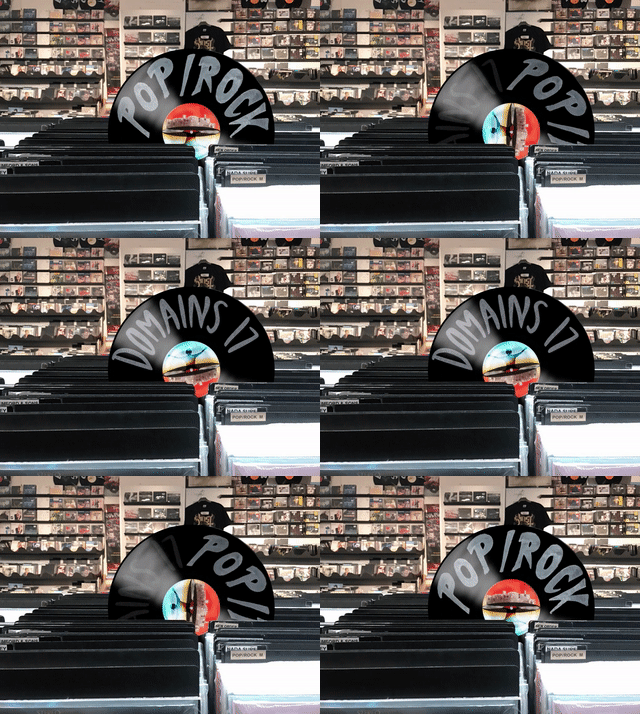
Also, I have to take a moment and thank Bryan Mathers again who has been having an animated field day with the art. I recently posted the above image to Twitter of album art in a Stockholm record store that was remarkably similar to Reclaim’s logo. Bryan made short work of animating it into a promo GIF for the conference. What’s more, it was cool to see Tom Woodward (who will be coming to Domains 17!) selected one of his images from the Stockholm record store for last week’s photo post

hard rock or hÅrdrock

Image credit: Tom Woodward (Bionic Teaching)

As an aside, I picked up a few records to show my support for Swedish record stores, and made a point to honor a few of Reclaim’s servers new, old, and unannounced: Minor Threat’s Out Of Step, Ramones‘s Rocket to Russia, and Kraftwerk’s Computer WorldThat last album is a nice bridge to my next post which will announce Reclaim’s latest shared hosting server which resides in Frankfurt, Germany and is named in honor of electronic music pioneers whose music may far more contemporary than anything else made during the 1970s. Anyway, until then, register for Domains 17!

Posted in Domains 2017 | Tagged , , , | Leave a comment

12 Post Mortem

Yesterday Tommaso discovered 12 on the rug at the bottom of the stairs. Her last few days were rough, she stopped eating, was visibly disorientated, and could no longer jump. That said, that was only the last few days, the previous 19 years (it may have been more given I found her as a stray in the Spring of 1998) she was not only healthy, but actively ornery. It was rough to see her lifeless body after so many years of vitality.  Apart from my childhood family, she may have been the longest consistent daily presence in my life to date: she was my Brooklyn roommate (she didn’t believe in paying rent), came with us down to Virginia, and then took the trip to Italy at the ripe old age of 18. She found one of her many lives here in Trento until just last week. She was thriving so well I was beginning to believe she may very well make it past 20, but that would not be the case. I guess sooner or later we all have to retreat back into the great unknown—but until I do, I’ll miss 12.

I dedicated a Daily Create to her back in 2013 if you are wondering why the hell she was named 12, and Tommaso created a slo-mo video of her just a couple of months ago which you can see above. She took up residence in the boys room the last year, and the loss hit the hard. And while we could tell she was slowing down, she still looked good. Why couldn’t age so well? Nothing gold can stay, not even the bava’s cat.

Posted in family | Tagged , , | 4 Comments

Sharing the Domains Documentation Love

I wanted to make sure Adam Croom gets the appropriate love for helping several schools get up and running with Domains documentation over the last several months. More than a few folks have inquired if we had any recommendations for solid documentation, and it is hard to compete with the new and improved OU Create docs.* Once upon a time, before the Smallest Federated Wiki whisked Mike Caulfield away, we had an idea for federated documentation using DokuWiki, but that never came to be. There was some early momentum to prevent folks from reproducing the documentation wheel—but time, energy, focus, and squirrels got in the way.  

More recently a few schools asked us if the could reproduce Oklahoma’s documentation and then customize it for their school, and it turned out that Adam had already done this for Middlebury’s Middcreate. So, he was kind enough to not only help out a few schools by porting over OU Create’s documentation site whole hog, but even wrote up a tutorial on how to do it

Re-visiting how we re-use and remix documentation resources across schools running Domain of One’s Own will most definitely be on the Domains 17 conference agenda.  I think this is something we need to revisit in order to make this much less arduous. Thanks again Adam, you rule.


David Morgen did some amazing work with Emory’s documentation early and that was the inspiration to try and figure out how to easily share work between schools that wanted to share and re-user Domains documentation.

Posted in Domains 2017, reclaim | Tagged , , , , | Leave a comment

1Password, Airmail 3, and Prompt 2

I’m not much of a productivity tools blogger, and in general I’m a slug when it comes to anything resembling workflow. That said, using a password manager for the couple of years has changed my life. And recently Reclaim Hosting finally jumped to the Teams feature in 1Password to manage our growing empire. Teams allows you to copy, move, and share logins and credentials across vaults, with differing permissions. 

I was so sold on it that I immediately created a family account through 1Password to start consolidating and organizing my family’s digital life.  One of the things that was always painfully clear from teaching ds106, was that the hardest part for many was keeping passwords straight, the rest was just plain fun. For the Previous 15-20 years I dealt with this by using a few variations off one password, but those days are over. I was kind of forced to go all in because it was impossible to run Reclaim Hosting’s server infrastructure securely without it. The added benefit is I now have strong passwords that are almost all different, and a pretty extensive inventory of all the services I use online—a useful reclaim exercise in and of itself.

In fact, I have already written about password management as ground zero for digital literacy. If I were giving workshops on campus right not, I would start there. It’s almost like putting on your seatbelt before you drive the internet highway 🙂 I found it has given me a sense of  comfort and coherence with managing my online life I haven’t had before. As an added bonus, it protects your shit online, the importance of which should be increasingly clearer every day, if it wasn’t already.

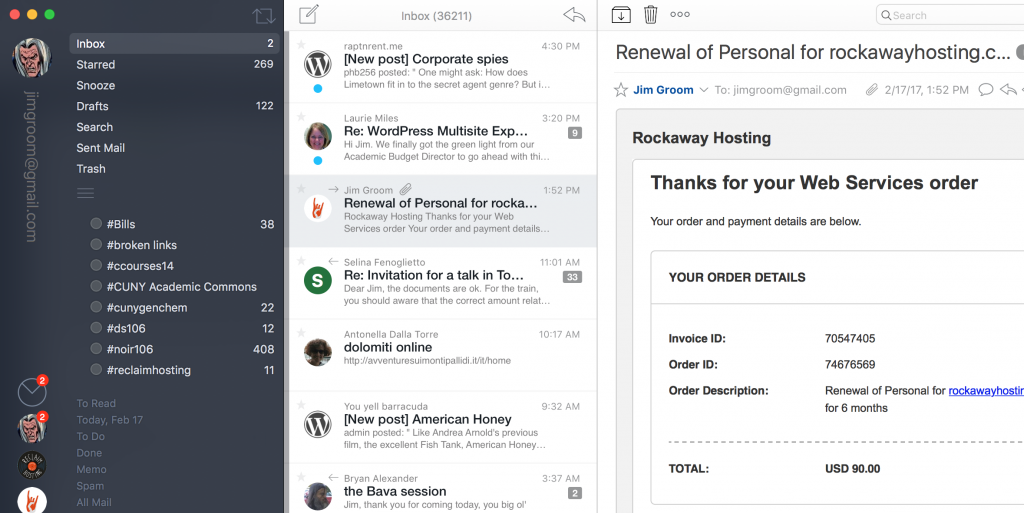
The other big move for me recently has been going back to an email client. I have a few different emails I am using now, [email protected], [email protected], [email protected] (more on that anon), and I want to start pushing my [email protected]  to something like [email protected]. That said, all my accounts are run through Gmail, and until now I’ve forwarded Reclaim’s email to [email protected], using external SMTP servers to reply with the @reclaimhosting.com address. But I’m finding I need some separation between the various accounts. I was missing mail tagged as spam in the original Reclaim email account, plus trying to manage several Gmail accounts through various browser tabs was getting old. So, Tim recommended Airmail 3 because it’s fairly stripped down (no calendar program) and can manage various accounts seamlessly. So far I have been very happy with it.

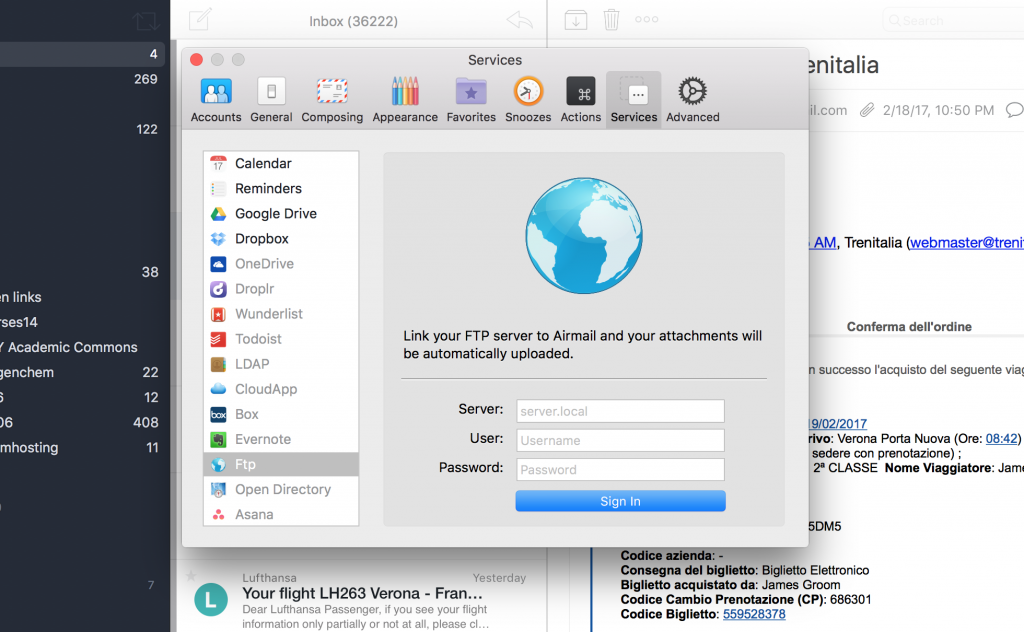
Being able to cleanly separate my various email addresses in one app was crucial, and the on-boarding of a Gmail account was dead simple. I also like that it integrates with all kinds of services. It even looks like you can directly connect your email attachments to your own server via FTP, which is interesting. One of the things that appeals to me about Airmail is it exemplifies the lightweight mail app that uses all kinds of API integrates with other services to enable you to push and pull from a variety of spaces.

Prompt2

The final application I purchased recently* was Panic’s Prompt 2.  This is a bit more geeky then the other two,  but when I was back in Virginia last month, watching Tim mitigate a DDoS attach on one of our servers with his phone over dinner was amazing to me. He was using prompt identify the attacking IPs, block ranges, reboot servers, etc. I was blown away, so I got the app.  I’ve used it once or twice to reboot servers, and trying to train myself to do command line on a phone a bit more efficiently—it’s definitely an acquired skill. But I can see this app being quite useful in a pinch.

https://www.flickr.com/photos/jimgroom/32860859411/sizes/z/

The cool thing about Prompt 2 is that it can integrate with 1Password on your phone to ensure you can get into the server with one-click.  You have to do a bit of work up front to populate all the servers (and there may be an easier way at that), but when you need access for whatever reason, this essentially gives your phone just about everything you can get from a laptop, albeit for me with far more pain.

Well, that’s it for recent applications I’ve been playing with recently. And while nothing particularly groundbreaking here, I find it interestingly to reflect on how my work with Reclaim continually pushes me to change the way I work online. I like that.


*All of these are paid apps, which is remarkable in itself because I avoid buying applications like the plague

Posted in applications | Tagged , , , , | 3 Comments

Nexa Stop, Torino

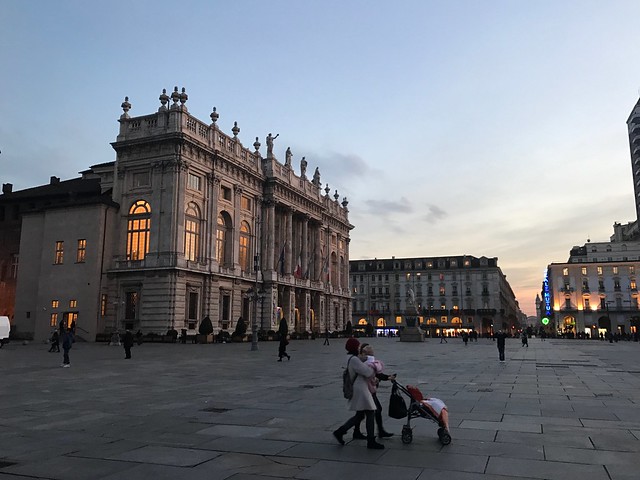
Palazzo Madama

Palazzo Madama at dusk, Torino

Bad accents based on terrible cross-cultural puns are the best blog titles ever, right? Don’t answer that.

Last week at this time I was heading back from a two-day sojourn to Torino. I was invited to talk about Domains at the Nexa Center thanks to an introduction from Fabio Nascimbeni. Fabio has been my one and only open/edtech contact here in Italy, and between last year’s invitation to talk about The Overselling of Open and this recent connection with the Nexa Center, I can’t thank Fabio enough. He’ll be at OER 17 in London this April, so we’ll have yet another opportunity to connect, and maybe even continue to build some momentum around open education in Italy. 

Martini

Martini Signage in Torino, so beautiful

Being invited to speak at the Nexa Center was pretty cool. The center is modeled on Harvard’s Berkman Center for Internet and Society, its reason for being is to cultivate a sustained conversation about the impact of the internet upon Italian culture. There are a long list of impressive folks who have come to talk internet policy at the Nexa Center, so it was an honor. At the same time I’m not much for policy or law, so I was a bit nervous. The time was supposed to be a focused seminar around Domain of One’s Own, but one of the things that became apparent to me while speaking with the folks is that I geared my talk far too much towards a presentation then a seminar (I guess even calling it a “talk” gives that away). I took the usual indulgences of slowly framing the history of domains at UMW, name checking folks, the generative diversion of ds106, etc. But that was the wrong approach. I think it is important to admit it when you suck, and while the talk wasn’t a complete failure, it also was not as tight and focused as it could/should have been.
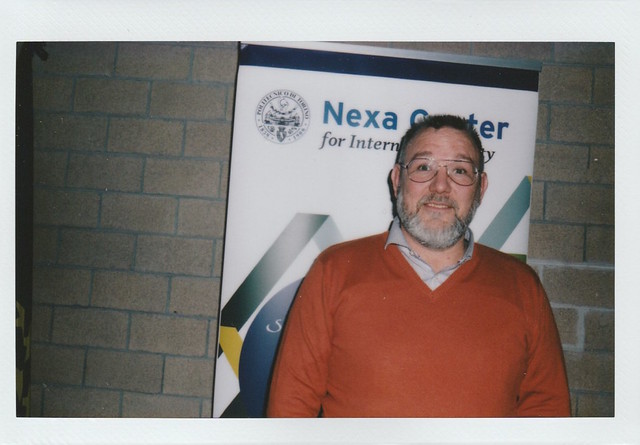
Nexa Center Polaroid

I sucked, my bad

Here are some of the things I would have changed: 

Rather then historicizing the web and using Minority Report and The Glass Bees to explore recent notions of predictive analytics and tech’s inclination towards power rather than progress, I should have started with a demo of Domains. I am operating in a bubble, I tend to assume folks know about cPanel, web hosting, etc. Surely some do, but this was small, but varied, audience, and an approach like Domain of One’s Own in Italy would truly be a radical departure from how they think about anything related to edtech. I should have demoed stateu.org, moved to the beloved house metaphor, then demonstrated with concrete examples how they’re being used as part and parcel of faculty and students’ life (both personal and professional) through course sites, portfolios, archives, etc.
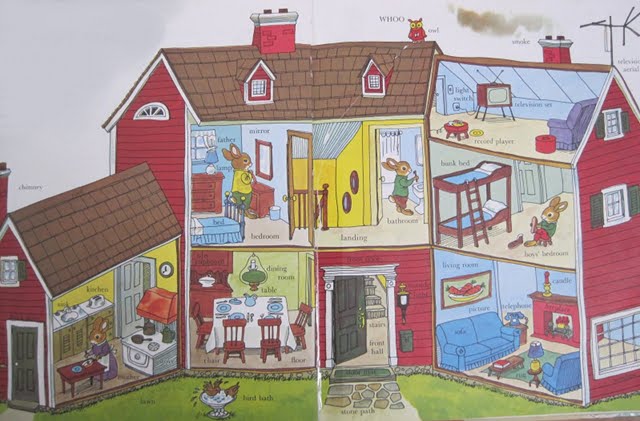
At this point I would have paused, the above could be accomplished in 15-20 minutes, and I would have engaged a more pointed discussion about how and why domains and web hosting might provide a departure from some of our existing systems. If the conversation took off from here for another 30-40 minutes, awesome, everyone is involved and we are starting to go places.

If not, I could then push beyond the idea of web hosting/domains as some kind of isolated edtech swiss army knife. At this point I would want to make the jump beyond just education, and channel Jon Udell’s 2007 “The Disruptive Nature of Technology” talk to think about Hosted Lifebits and the idea that education is only one, albeit crucial, part of a larger digital ecosystem in which we are struggling to find coherence. I played two short audio clips from Udell’s 2007 talk (possibly a bad idea given listening to audio of complex ideas for non-native English speakers could make it more difficult to follow) that frame the idea of Hosted Lifebits as a more generalizable vision of thinking through how we manage our online digital lives, and what the role of corporations, governments, etc. will be in this equation.

This section of the talk I kinda gave (so this is not all an imagined parallel universe of good presentation skills) and it did generate interest, discussion, and ideas, and it began to open up tributaries into the practicality of this idea, the importance of design to make it easier, and the question of whether or not people really care. The last is always a difficult one, but I tend to believe when it comes to the digital lifebits that are meaningful to people (pictures, videos, texts, data, etc.) they will, which ultimately provides a shared opportunity to rethink how we can imagine a personal publishing flow that incorporates the IndieWeb principle of POSSE

There’s enough right there to fill two hours for sure, and that’s about as far as I got, but I did that towards the end while also trying to squeeze in ds106, a brief history of Web 2.0, film metaphors, and the like. The simple point was that my talk was bloated, and it was my own damn fault. I tried to cover everything I’ve been a part of as well as everyone that’s touched it. In short, a lack of focus. I am not totally surprised given my talks have always been based in my personal work in ed-tech, and are often designed around concrete examples, usually ending with a call for more exploration.* So every time I do something else it becomes part of the story. But that makes the story a bit too long, and by extension boring. It’s like the potentially interesting movie that forces you to trudge through all the tedious background and history before anything resembling a point begins to emerge.  

So, to recap: 1) Start with the demo (thank you CogDog), 2) pitch the Domain of One’s Own concept using examples, and then 3) frame hosted lifebits as a generalizable need/good/want for future digital ecosystems.

The other piece I would add, and will for my revised version of this talk I’ll be giving in Sweden next week (more on that in a forthcoming post) is how the idea of hosted lifebits may finally be coming around to the way we think about reclaiming both our learning and our data more generally as evidenced by the relatively recent Next Generation Digital Learning Environment white paper from the folks at ELI as well as the white paper on MyData (a nordic model for human-centered personal data management and processing).  Both of these white papers reinforce a vision of hosted lifebits both inside and outside the context of school, and might actually help re-animate Domains as much more than supplanting the current breed of learning management or portfolio systems. Rather than some marginal alternative to the current educational technologies, an integrated domain helps us imagine what we should expect and demand from every other system.

I think one of the things that I might be downplaying here is that there was some really good conversation from those in attendance. Many of whom noted that what I’m talking about is hard and it requires a lot of diverse factors to align: elegant design, shifting cultural expectations, complex policy decisions, trust, as well as the belief that people actually care. I tend to believe that people care and that breeds trust, both of which make all the other elements surmountable. In fact, I see evidence of it every day online, and I am not daunted by the difficulty because its a long road that will require many different people overcoming a lot of issues. But in the end, at least for me, it’s fun to think about. The idea that living, archiving and representing our digital lives through virtualized data is even a thing we can grapple with still blows my mind.

So, all is never lost, and I was able to be particularly self-reflexive about this talk because it was the first presentation of mine Antonella attended in “real life.” It was awesome having her at the seminar because she is the one I talk to most about all of this stuff. And not only is she deeply insightful and constructive, but she also pulls no punches when providing honest feedback. Few things help you more than some honest criticism as you continue trying to find the best ways to communicate your ideas. 

Anyway, this post is way too long already, but it was also long overdue. Below are some images I took while in Torino that I even put in an album on Flickr (rocking like it’s 2006!).

Detail from Torino's Egyptian Museum

Beyond that, and keeping with the theme of Torino, Paul Bond linked out to this LA Review of Books piece about a 1970s Italian cult classic novel The Twenty Days of Turin, that the author argues “grasps the implications of social media in ways cyberpunk never did.” Very cool, already ordered.


*There is a formula, but the passion is the secret ingredient.

Posted in presentations | Tagged , , , | 5 Comments