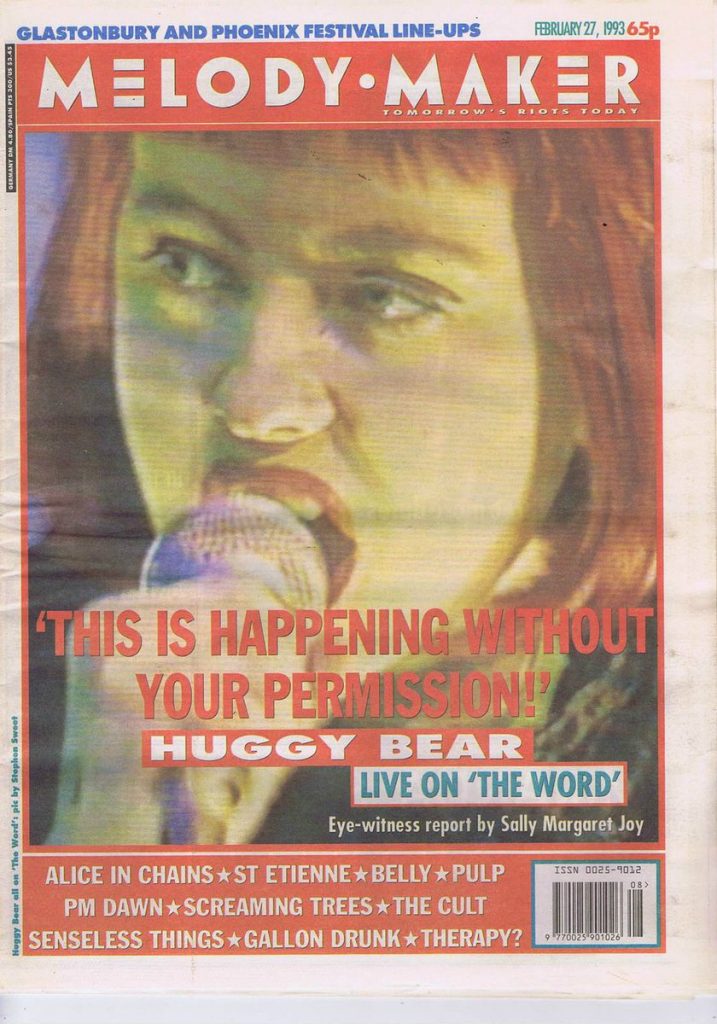
Algorythmic Radio: Episode 1 – “1987”

Earlier this week I started a new radio show titled “Algorythmic Radio” on ds106radio. I plan on doing one or two shows a week until I get tired of it. I have no real reason beyond the fact that I wanted to push myself to get back on the radio more regularly, and given I spent a fair amount of time letting Apple Music tell me what to listen to, I decided to turn that into a show. The concept is simple, take tracks from a recommended playlist Apple Music provides and play selected songs and provide commentary. I was inspired by Audrey’s “I Love My Label”  talk at Davidson College over a year ago wherein she talks about the cultural implications of the move to digital music:

Indeed, the move to digital music provides new opportunities for data collection and data mining. No one – well, except my parents, I guess – knew how many times I played that 45 of Autograph’s “Turn Up the Radio,” how many times I rewound the cassette to replay Guns & Roses’ “Welcome to the Jungle.” But now the software knows – and remember, whether we stream music or download it, we don’t own this music; we’ve just paid for a license to play it. When we sign the Terms of Use for music services, we likely sign away our ability to keep private what we’re listening to, where we’re listening to it. Sometimes we volunteer even more metadata, labeling our playlists things like “breakup songs 2011” or “super productive writing music” or “best bicycling tunes” or “feeling low.”

So given I have been leasing my music and teaching the machine to teach me what I like, I figured it might be interesting to document this over time.  I am starting with the year-based algorythmically recommended lists, but have more than enough space to branch out. I started with 1987 because I was fairly impressed with the list them gave me:
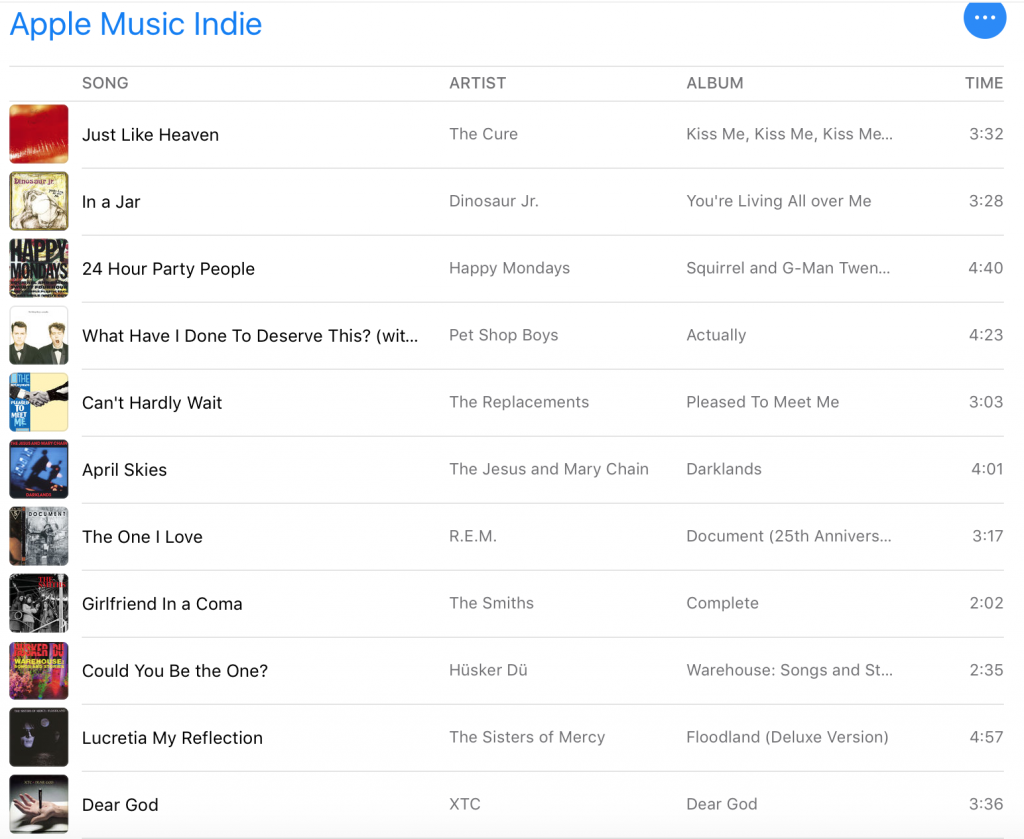
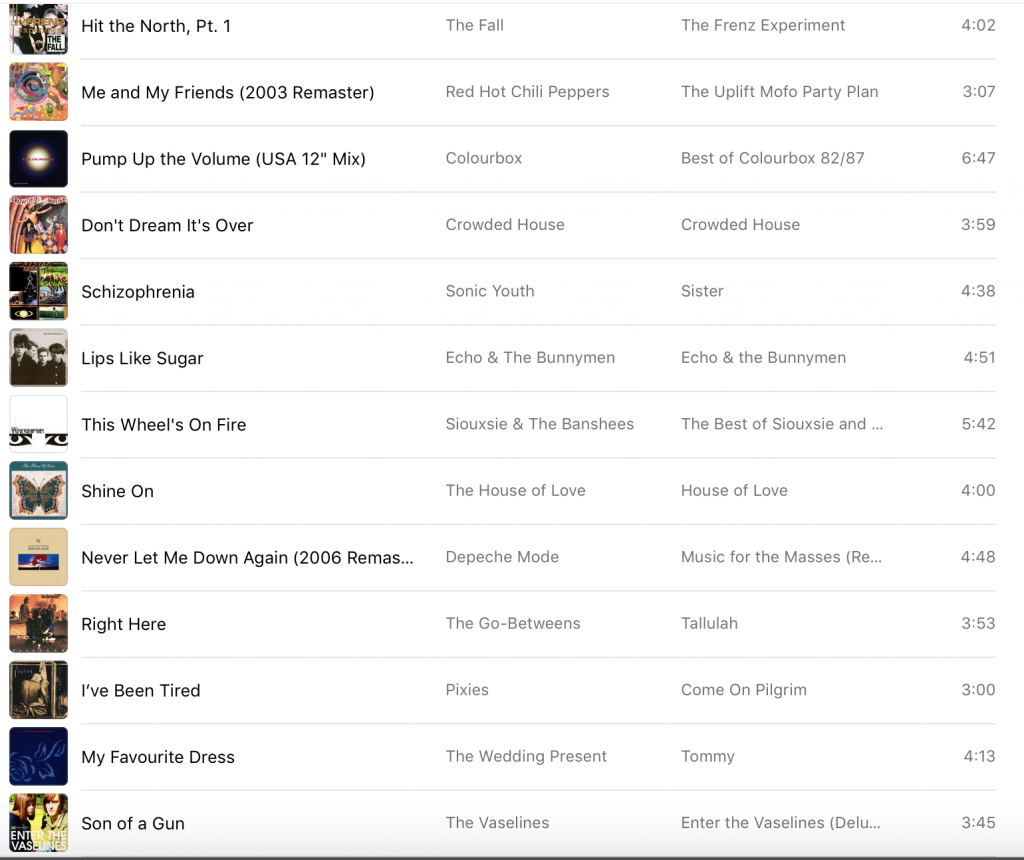
So I spent the ensuing hour playing selected songs from the list, my choices for the show were as follows:

  • “What  Have I Done to Deserve This” Pet Shop Boys
  • “Can’t Hardly Wait” The Replacements
  • “Hit the North Pr. 1” The Fall
  • “Schizophrenia” Sonic Youth
  • “Shine On” House of Love
  • “I’ve Been Tired” Pixies
  • “April Skies” Jesus and the Marychain
  • “Could You be the One?” Hüsker Dü
  • “Son of a Gun” The Vaselines

There are a few gems in there, and I certainly like all of these songs. But, as usual, the coolest part of the show was driven by one of two known listeners, namely David Kernohan and Paul Bond.  As I was playing the songs I clicked over to Wikipedia’s 1987 in Music page and starting reading out some fun facts, such as….

The The Justified Ancients of Mu Mu was new to me, but Kernohan was well aware of this avante-garde electronic music act of the 80s, and turned me on to The KLF. Thanks to the web, the best of online usually happens both because and in spite of the algorythms that everywhere shape our culture. Listen to the whole show weighing in at over an hour below:

Posted in Algorythmic Radio, audio, ds106radio | Tagged , | Leave a comment

The Persistence of Memory

One of the many joys of OER17 was catching up with Bryan Mathers in person. We were chatting before one of the sessions about re-designing the default splash page for new accounts on Reclaim Hosting—the final hold-out from our original design. 

We talked about the possibility of have a few images rotating through in the splash page, but as usually happens the conversation just found its own way and after talking about memory, archiving, and the web Bryan starting talking about a Salvador Dalí-inspired vision of web-based memory and persistence:

Not sure if this will be our new default splash page, but I have no doubts we will find something to do with it. First and foremost a blog post featuring the awesome and soon after framed poster in the new Reclaim offices 🙂

Posted in OER17, reclaim | Tagged , , , | 2 Comments

Towards Open: Counter (Data) Surveillance

I had an amazing two weeks in the UK and Ireland, and this post is one of many that will try t0 chronicle and make sense of my time. I am not necessarily going chronologically. Rather, I will be picking several vignettes of my experience to try and capture my time there because the idea of a comprehensive wrap-up post is way too daunting. I’m still processing all the goodness, but I do now know how happy I am to be working in the European context these days. My trip to Cork and Galway (more on that in future posts) as well as OER17 in London (a workshop from which will be the basis for this post) made me really appreciate the European* ed-tech community.† There’s a lot of excitement here about what’s possible in the wake of the MOOC-inspired VC bubble, and the fact that most of the money has dried up means the conversations are not being driven by start-ups and vendors, or grantors and foundations, but rather the people who still have real skin in the game. OER17 reminded me of a couple of my favorite conferences over the years, namely Northern Voice 2007 and OpenEd 2009—and that’s no faint praise.  There was some seriously good energy, and I think that is evidenced by the growing number of posts from those attending. I have a few posts to add to that growing list, so let’s get on with it.

Running a good workshop is an art form.  I know simply because I failed at it so many times. So, my first post on OER17 will be to give major kudos to Kate Green, Christian Friedrich, and Markus Deimann on their workshop “Towards Openness – Safety in Open Online Learning?” The approach was simple and effective: they showed four short provocations about the state of security and online learning, and asked the participants to break up into groups of four or five and try and design a response. The response should be an intervention of some kind that can be applied directly (or that’s how I remember the charge, I may be wrong). You can see the design of the workshop as well as all four videos at the Towards Openness site, but the one that sparked the discussion that led to our groups intervention was Chris Gilliard’s video framing “surveillance capitalism”:

The provocation frames educational technology as a means of surveillance and appropriation of personal data as part of the inexorable appetite of late capital. Our challenge was to think about how can we counteract the fact that just about everything we do online is collected, monetized, and sold by various actors. I have to come clean and say our group was pretty stacked: Rob Farrow recorded one of the four provocations (he was our ringer!), Brian Lamb invented the internet, Bryan Mathers illustrated it, which leaves me—the only real weak link. That said, our group also had its obvious limitations given it was fairly homogenous when it came to gender, race, and class.

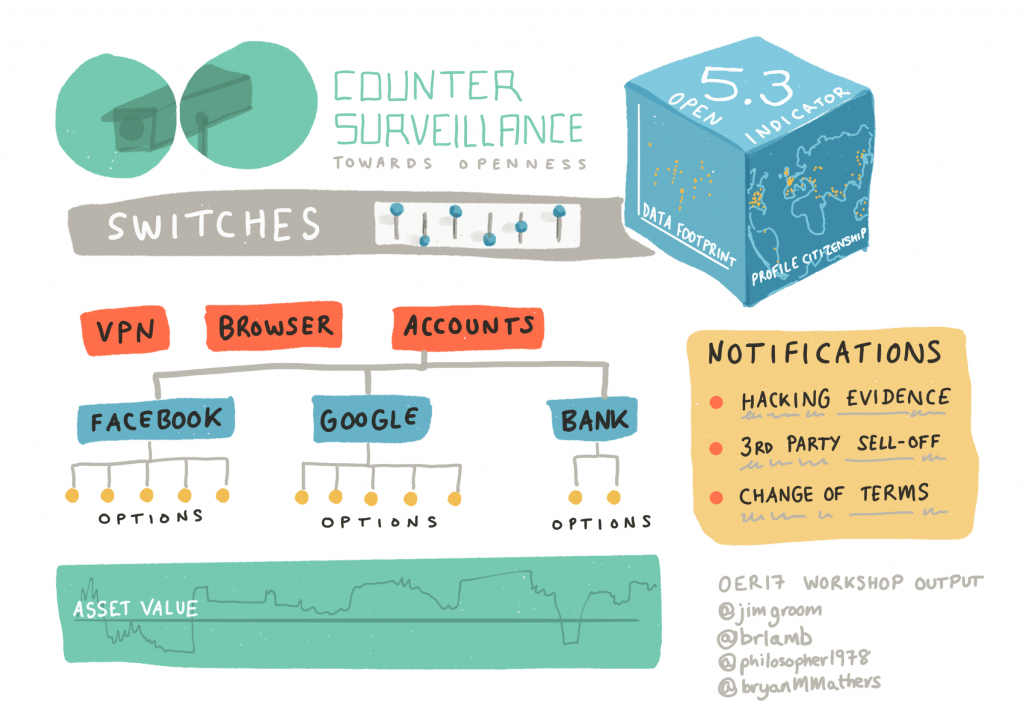
Once we got started, we discussed possible ways of allowing individuals to visualize what personal data sites and services had access to and were collecting. I showed off the prototype above that Tom Woodward created while we were in Sweden in February. The idea there being what would it look like if you could easily see and control the information various apps could access. This led to a conversation about a personal data dashbaord of sorts where you could explore what providing access to certain data (or not) would cost you.  For example, if you do choose to prevent Twitter or Google from tracking your location, what do you give up?  In many ways, the dashboard would be a space where you could make informed decisions about what you decide to share.  We noted that something like this would have to be run by a third-party independent of the major social media silos in order to ensure that when Facebook or Google say they have locked down access to your information, that can be independently verified. As Brian Lamb noted, we are relying on these companies good word, which is not necessarily comforting nor much of a social contract.

From there the question of algorithmic citizenship came up, which visualizes how much information we get and share online is effectively nationalized. Which led to discussions about how we can be understand how privacy works through accessing similar searches and information about us online through various IP address around the world using VPNs and IP proxies. This would be one way to start demonstrating the way our realities are always contextualized by where we are and what we are looking for. What emerged was the idea of this imagined dashboard acting like a personalized “data score” in which the individual can monitor, tweak, and take back some control over their personal data online. This could be a browser or a service, and ultimately it would revolve around regular notifications detailing what services are accessing your personal information, and how it’s being used. Rob Farrow nailed it when he noted the only way to challenge surveillance is through counter-surveillance, hence the “Counter (Data) Surveillance Dashboard” visualized by the seemingly endless genius of Bryan Mathers:

It was a fun group that was set off on a fun mission thanks to an awesome workshop. This is just one example of the many amazing moments I had at OER17. I’ll try and chronicle as many as possible, but I will be recycling this one into my talk in New Zealand next month because I feel like it is completely inline with re-thinking how we manage our online lives. Below is a video wherein we all frame the project, it’s probably much more cogent and succinct than this blog post.  But a blogger gotta blog.


†Although, to be fair, OER17 was quite international, the conference had folks from all over the world: Australia, Egypt, Uruguay, Mexico, Canada, and the US—and those are just the sessions I went to.

*For the sake of this post, as well as the fine people who attended OER17 from the England, Wales, and Scotland, the UK is still part of Europe. Update: I’m just gonna leave Josie Fraser’s corrective to my ignorance here:

https://twitter.com/josiefraser/status/852099343859503108

Posted in OER17 | Tagged , , , | 5 Comments

Corporate Ransomware

Image credit: Blog Ransom Note Sitelock Blog

Last night we got another Reclaimer that was migrating over to us from Bluehost given their site was locked down at because their account reportedly had been hacked. I now understand all to well from the sysadmin side how an infected site can screw up a server. Our plan was to move the account and then do a full scan to quarantine any and all viruses and malware before pointing the DNS.  I ran the scan, and guess what, no viruses, no malware, nada. This person’s site was shutdown for an extended period by Bluehost and then referred to Sitelock because their account was reportedly infected.  Sitelock fixes the problem for a ransom of a fee, and they have to then pay for ongoing protection. It’s literally like the web hosting mob.

What’s more, the site was not infected. This is at least the third time we had a transfer request from a customer who had been referred to Sitelock by Bluehost that had no viruses we could find. How is this acceptable practice?  Is Bluehost cleaning the sites and then shutting down the customer accounts?  These people did not pay Sitelock so it wasn’t them. Something is rotten in Denmark, and I can’t help but think it boils down to one thing: fleecing your customers.  You can promise the world and charge pennies on the dollar because you know in the end you will be collecting those fees in other ways: backups, phony virus protection, etc. When it looks like a scam, and smells like a scam, chances are it is a scam. I just really don’t understand how Bluehost expects to remain relevant when their recent business development seems to be based around cannibalizing their existing clients. When you think about it, this is akin to corporate (a.k.a. legitimatized) ransomware, take down your client’s site, tell them it is infected, push them to make a deal with Sitelock, then sit back and collect your ongoing cut. Some folks have the wherewithal and time to export their stuff and get out, but for many, many others that is far too painful. They are effectively put between a rock and a hard place, like with many ransomware victims who don’t have backups, they are forced to fork out the money.

Posted in reclaim | Tagged , , , | 3 Comments

I Don’t Need Permission to be Open

I made the mistake of mentioning I was a bit struck by David Wiley’s recent post “How is Open Pedagogy Different?” on Twitter. I should have gone right to the blog because the tweet onslaught from David and Mike Caulfield was a bit off-putting. What started off as a concern, quickly turned into a one-sided tweetstorm that felt like a DdOS attack on my brain. Also, part of what I couldn’t capture on Twitter was the fact I had just come off a day at the OER17 conference in London. In fact, for almost two weeks I was traveling around the UK and Ireland talking about a variety of work happening with domains. Now, I would agree if someone said my work tends towards open: I try and openly blog much of my work, I try and share resources (mostly human), and teach with an eye towards the open web. So, when I read Wiley’s post I referred to above, I was fairly struck (and not in a good way) by this bit:

Open pedagogy is the set of teaching and learning practices only possible or practical in the context of the 5R permissions. Or, to operationalize, open pedagogy is the set of teaching and learning practices only possible or practical when you are using OER.

My simple concern is, when did open become boiled down to a strict set of permissions? Seems to me the conflation of David’s vision of OERs, and a broader communities use of open in less orthodox ways has come to heads—but I’m not sure it needed to. Seems the idea of OERs sat comfortably within open as a broader series of relations and approaches in the field of ed-tech. To be clear, I have no doubt Mike and David can (and have) argued circles around me when it comes to the technicalities of what makes something open, but I do have to wonder about the spirit of such a message. In a moment when fences and lines are being drawn all around the world according to ideologies that other and petty definitions that exclude, why would this seem a good time to start drawing lines around open? Frankly, it seems a bit more like fear mongering. I am not afraid to re-use copyrighted work, in fact I enjoyed it deeply during #ds106, and I have been very clear again and again as to why. I don’t feel like I need permission to intervene with or critique the mediated culture being shoved down my throat. That was one of the pillars (a 106 bullet if you will 🙂 ) of #ds106. I never really thought of ds106 as a subtle struggle for permissions, but an outright attack on the copyright regime. In fact, in the various forms we taught it—all of which where abusing copyrighted material—we never heard a peep about copyright save the occasional YouTube takedown. Which if anything, was a good reminder of how little permission we do have when it comes to remixing our culture. And if we did get an onslaught of takedowns across the various blogs, I would be far more interested in talking about Fair Use with our students as a defense than becoming the arbiter of permissions. Or even worse, retreating to a textbook.

In the end, I am not too concerned if #ds106 is understood as open pedagogy or not, because as soon as it is a choice between awesome and open, I will choose awesome every time. I am not interested in the strict rules that define open; open is not the ends, it is one means amongst many. But, I do wonder at the push to consolidate the definition beyond OERs into Open Educational Practices. Seems to me there is an attempt to define it in order to start controlling it, and that is often related to resources, grants, etc. Again, I’m not all that concerned personally given I have never depended on grants for my work, but many people do—and strict definitions of open could be perceived as threat to new approaches and ideas.

I think the locking down of open is dangerous. I think it draws lines where they need not be, and it reconsolidates power for those who define it. More than that, the power around open has been pretty focused on a few people for too long, and I count myself amongst them. More and more on this trip in conversations with others, I think we as a field need to do a better job of bringing the next generation of ed-tech folks to the fore, stepping back, and letting them frame what’s next. Even this post shows my harkening back to work I did 6 years ago, I don’t want to have a corner on open or ed-tech, I want something that gets me excited and passionate. OER17 certainly did that, and I crave more. What I see as hardline definitions of what is and is not OER or open need not police the discussion. I would hate for an edict about what is and is not open pedagogy to get in the way of people “coloring outside the lines” of the 5Rs, to appropriate Brian Lamb’s gorgeous turn of phrase from one of this 3 tweets in response to the avalanche.

Now, this may mean we have to move away from the term open because it has effectively been trademarked, and if that’s the case I am fine with that. EDUPUNK was long overdue for a resurgence 🙂

Posted in open education | Tagged , | 30 Comments

bavaradio show notes for March 27 2017

As promised, I have made a subtle return to ds106rad.io. I always have the hankering, but momentum (or is it inertia?) are powerful things. So i am trying to get more regular these days, and we’ll see how that goes.  I certainly have the time and energy for it in Italy, so if I am disciplined it could become a regular thing. Anyway, I have to put in the work before I start making any manifestos. So, here are the show notes for Monday, March 27th. 

I start with LCD Soundsystem’s  “North American Scum”

I then return to Deerhunter’s Halcyon Digest with “He Would Have Laughed” -can not get enough of this album, a new discovery for me this year.

I then unveiled a new Reclaim/ds106radio bumper called Reclamation based on the Fugazi song. Not all that good, but a start:
Then Lorde’s “Royals,” my favorite new karaoke tune. If you are lucky I’ll do it at Domains 17 🙂

After that I chatted a bit, said hi to my 1 listener Scottlo. I think I was talking shit about Bluetooth, and Scott shared his latest style called Bluetooth Johnson:

https://twitter.com/scottlo/status/846390656423673857

After that, I did a Pacific Northwest set for Scott featuring a of my indie favorites namely:

Unwound‘s  “Corpse Pose”

Bikini Kill’s “Rebel Girl”

Beat Happening’s “Bury the Hammer”

The last part of the show was 3 more songs, this time moving back to the East Coast and then Germany. The finally three songs were selected based on the fact they were all Reclaim Hosting server names. This set pushed the ratio of my playlist to over half Reclaim Hosting server names.

Dinosaur Jr.’s “Forget the Swan”

Sonic Youth’s “Hey Joni”

https://www.youtube.com/watch?v=xEUYK9elJ-s

Kraftwerk’s “Pocket Calculator” (the Italian version)

What a dynamic live act Kraftwerk were back 81, thanks Grant Potter. The last song was disrupted because Ladiocast crashed, but it wouldn’t be a set without a gaff. Also, my system volume was down, as a #ds106 student noted, so things were playing low, which sucks.  I’ll be sure to fix that on the next round, which may even be later today if I can get the bandwidth in Cork.

Posted in ds106radio | Tagged , , | 2 Comments

Domains 17 Interview with Jon Udell: “Digital Polarization and a Web of Evidence”

Last Friday the Domains 17 conference committee interviewed Jon Udell live on ds106rad.io in anticipation of his presentation at the conference in June. (Still haven’t registered? Here’s the link!) If you have read the bava for any amount of time, it will come as no surprise how excited I am Jon will be presenting on his current work around annotating the web. His work has remained a constant beacon for much of our work at UMW’s DTLT and has followed through at Reclaim Hosting. Back in 2011 he wrote a blog post exploring 7 ways to think like the web, something that Doug Belshaw re-framed for Digital Literacies quite astutely. So, I tried to kick the conversation off there, but as often is the case with anything I do, it did not go as planned. But, that’s all right, because that’s when you surround yourself with smarter and more capable people—not to mention interview them—things have a way of working out better than planned. The conversation, as with Martha Burtis the week before, moved almost immediately to the role of the web in our current political moment, which is probably a solid sign of things to come this June. 

After forcing me to explain myself, Udell jumped into an impassioned discussion of the work he is doing now with Mike Caulfield on the Digital Polarization Initaitive (digipo for short). There are more than a fews gems in this discussion, and listening to Udell articulate the moment in relationship to the underlying technology of the web, while acknowledging its limits, is a lesson in thoughtful reflection on the broader frame for everything we’re doing in ed-tech. I was struck by many things he mentioned, but one that I want to explore in more detail here soon is the idea of an API as essentially a personalized, consistent structure to the data you create on the web. And the idea of understanding how to “think like the web” that undergirds so much of his work over the last two decades is again evidenced in his ability to boil down the acronyms and commodities to ideas and practical pedagogical realities. It’s less than an hour, but more than worth your time.

Posted in Domains 2017 | Tagged , , , , , | Leave a comment

Old, New Radio Friends

On Friday Tim, Lauren, Adam, and I interviewed Jon Udell in anticipation of his presentation at Domains 17. He never disappoints, and that discussion should be up and available tomorrow for anyone interested (I’ll be sure to blog and link). A lucky 13 listeners around the globe even got the chance to tune in live on ds106rad.io.

That’s right, the bava got back on the bike. It took a while and I was rusty as a result. I failed getting on the radio for our chat with Martha the previous week, but I returned again to Cogdog’s handy dandy Ladiocast guide (which I like, though Nicecast may be the better option when I am ready to buy it yet again) and I was still not breaking through. I was stuck so I reached out for help on the Twitter.

https://twitter.com/scottlo/status/845268559492251649

Lo and behold, the voice of an angel provided a quick fix for me:

https://twitter.com/scottlo/status/845267099387879425

I had the format as Ogg Vorbis rather than AAC, once I made the switch I was up and running, and pulling in Skype cleanly. Special thanks to Scottlo for the save, I dig that cat. As for the broadcast, it was almost seamless, I had five of us pulling in through Skype, but when I tried to use Audio Hijack to capture the audio, it cut out the stream for a few minutes. Luckily Adam is the backup king, so the show is in tact. I need to test Audio Hijack again and then I have one solid setup—even cooler would be if the wizard Grant Potter is able to get all live broadcasts to automatically archive.

https://twitter.com/grantpotter/status/845327260454453248

Beyond that, I do want to get a similar setup working in Nicecast (thanks for the push John) because I’d love to use ds106radio extensively for Domains 17. Radio is far more lightweight and versatile than video, and if we can get everything broadcast out and archived using our own infrastructure all the better. So, this is a timely and welcome return to the radio. I even played a few tunes and got to laugh a bit on air—which is a drug I have missed. 

Posted in digital storytelling, ds106radio | Tagged , | 2 Comments

Domains 17 Interview with Martha Burtis: “Web literacy is cultural literacy”

Last Friday the Domains 17 organizing committee got to sit down and chat with Martha Burtis, keynote for the Domains 17 conference, to get a preview of what she’ll be presenting in June. There’s a lot to process in this 50 minute gem, a conversation that ranges from everything to how domains got started to the posts tagline “web literacy as cultural literacy” (one of the many gems from the conversation) to the ongoing work of making digital fluency a foundation of higher ed. It’s a great look at what’s in store, and listening to Martha riff on this stuff really made me miss the 10 years we worked together on all these issues and more.  Few people frame it better, and this conversation underscores the fact that NOBODY thinks domains like the Burtis!
The audio was a fun return to audio edit (it had been a while), and the only real enhancement was bookending the discussion with Alan Levine’s “Domains” cover tune/bumper —which worked brilliantly. I wanted to use Paul Bond’s and Mariana Funes’s conference radio bumpers for the conversation, but unfortunately this one was not live on ds106radio. I ran into technical issues with the radio (read I started figuring it all out too late) so we recorded this one to publish post facto. But that will all change this Friday thanks to Adam Croom who had the awesome idea of asking folks that will be presenting at the conference to chat with us every Friday right up and until showtime. So, a conference podcast is born.  This Friday we will be talking with Jon Udell about his recent work with Hypothes.is, as well as web citizenship, RSS, APIs, and more. A little bit intimidating to be interviewed by a host of IT Conversations, but then again, we’re professionals over here at Reclaim 🙂 If you are interested in chatting with us just let us know, and if you are presenting at Domains 17, don;t be surprised if we reach out sooner than later.

Also, have you registered for Domains 17 yet? You really should, and here’s the link to make it easy for you.

Posted in Domain of One's Own, Domains 2017, reclaim | Tagged , , , , | 1 Comment

Shenandoah Abides

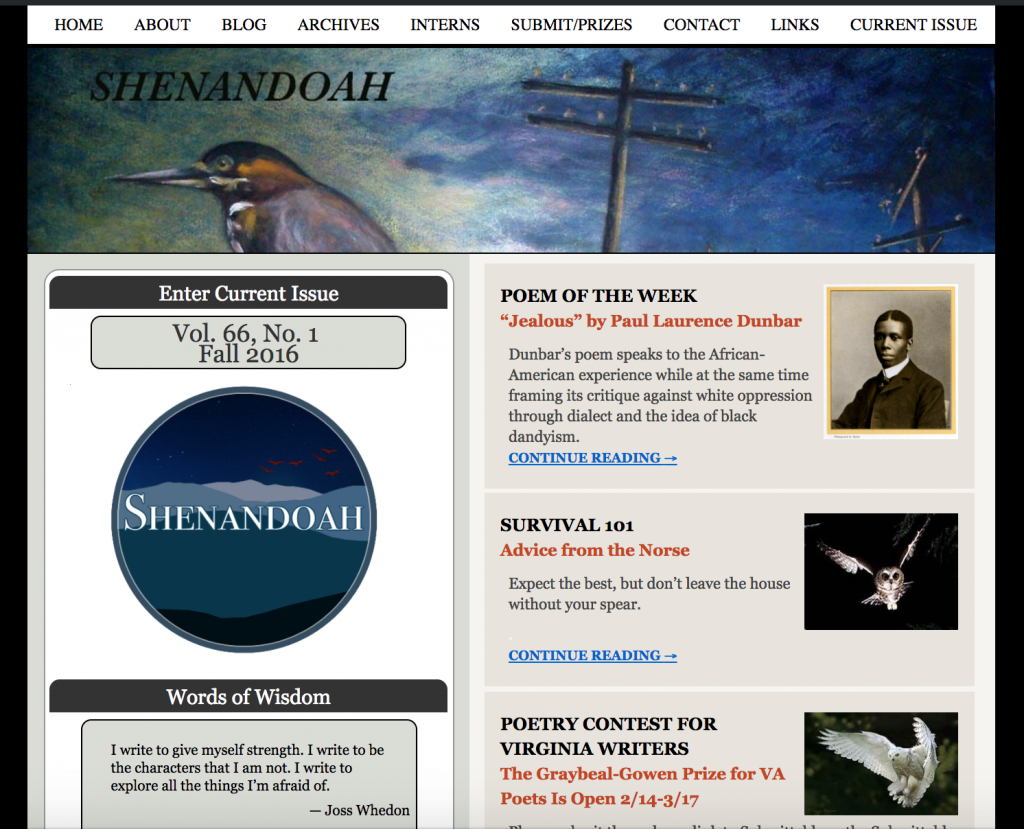
The other day Shenandoah‘s editor, the great R.T. Smith (Rod), reached out to me about preparations for the Spring issue. It struck me then that we have been doing this since the Spring of 2011. Oh how six years flies by.  I track it time-wise in my mind right alongside the semester ds106 went open and online. Martha Burtis helped me code the design for the site, and while it might be high-time for a redesign, I think it’s held up quite well.* It was built on WordPress Multi-Site, and each issue has its own WordPress instance defined by issue issue and number, such as issue 65, volume 2, issue 66, volume 1, etc. The architecture was pretty simple. 

They also got rolling with a blog that has seen, on average, more than 5 posts a month for the last 6 years. Rod has become quite a blogger himself, and the move from print to digital for Shenandoah was quiet and consistent. They regularly produced new issues, blogged about the work, and made the literary offerings from the last 12 issues free and open to anyone with a browser. What’s more, every time I work on Shenandoah it makes me think of Claudia Emerson, the late poet and friend, who got me the gig thanks to the work I did with her literary journals class. Can’t think of too many better people or teachers I have ever met. The recent issue features a powerful reminder how many hearts Claudia lives in.

BEYOND AUTOBIOGRAPHY: Claudia Emerson Through Three Poems on Race

So my work for the Shenandoah gladly continues.  There will be a day when Rod retires and a new crew comes in and rethinks the site, but until then this is one of the projects I’ve been a part of over the last 6 years that has been truly grounding. I am no literary expert, but I like doing my small part to get a little more imaginative thinking and writing out on the web.

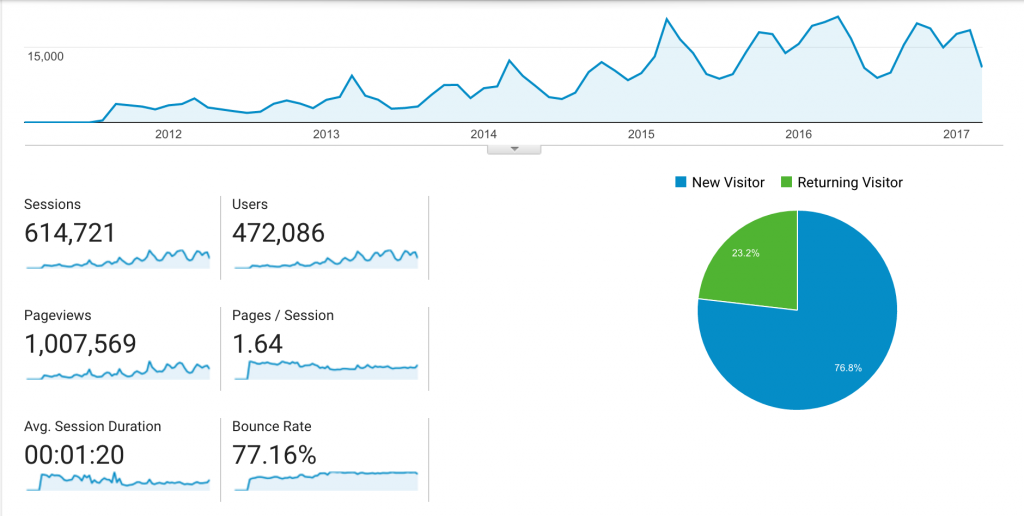
Anyway, after Rod reached out about the upcoming issue I realized this was the sixth year we’ve been doing this, so I got curious about the numbers. I’ve been tracking the site in Google Analytics since the beginning, and just two weeks ago the site hit the 1 million page view mark, with almost half a million visitors, and 600,000 sessions. What’s been most interesting to me about these numbers is the growth over the last two years to get almost 20,000 hits a month during the semester. That is 4x as many as in 2013, and twice as many during 2014. The last half of 2015, all of 2016, and the first few months of 2017 have suggested the journal has grown a pretty significant readership. That said, numbers on the web can be meaningless when you look at how many times Gangham Style was been viewed any given week. But Shenandoah abides, and twice a year you’ll get an outpouring of new literary work to the web, and that’s what I like about it.


  • She was also kind enough to let me pay her in erratic installments given those were the very lean years for the bavas. 
Posted in Shenandoah | Tagged , | Leave a comment