The Un-education of a Technologist: From EDUPUNK to ds106

Below are the slides and a transcript of the text I planned to follow when I delivered my talk this morning at the EDEN Annual Conference in Barcelona. That said, I didn’t keep to the script because I get too excited and just ran with things. Let this be the record of what I wanted to say, not what I said 🙂

Into the Maelstrom

“Amidst the tumult, the academy appears oddly complacent. Open source technology, open access publication, open education have all had their successes, but none of these movements could fairly be described as having transformed practice. Models of publishing, reviewing and assessing research have not fundamentally changed. Innovation in teaching is at the margins, the essential structures of curriculum and assessment wholly unchanged. Educational technology, far from revolutionizing practice, seems primarily dedicated to perpetuating it: ‘clickers’ provide a sheen of interactivity in the cavernous lecture hall; ‘learning management systems’ promise to protect its users from the raging uncertainties of the digital chaos.” – http://unartist.wpmued.org/


This was the opening paragraph of an article Brian Lamb and I wrote for the Universities and Knowledge Societies Journal (RUSC) of the Universitat Oberta de Catalunya in April of 2009. We wrote most of it in late 2008, early 2009 and as the abstract notes in RUSC:

Two educational technologists and webloggers present a series of vignettes, contemplating the effects of modern networked communication on their practice. Recognizing their inability to construct a synthetic theory amidst the maelstrom, they curate a collection of observations and manifestos emphasizing themes of personal publishing, spontaneous collaborations, learning on the open web, and syndication.

The line “recognizing their inability to construct a synthetic theory amidst the maelstrom” is maybe one of my all time favorite research article abstracts ever 🙂 Thank you RUSC! But one of the things that’s interesting as I return to this article almost seven years later (what is that in Web 2.0 tech years?) is how so many of the curated vignettes around personal spaces, the open web, spontaneous connections, distributed collaborations, and syndication still remain core to a vision of what a revolutionary publishing and pedagogical practice might look like on the web.

What’s more, I’m an optimist. I think we are getting closer and closer to realizing that vision, and thanks to folks like Audrey Watters we may even be getting somewhere with a more “synthetic theory amidst the maelstrom,” i.e. the ahistorical, techno-solutionism undergirding Silicon Valley is launching a full frontal assault on the education sector.

In fact, the vignettes we list in that paper are the building blocks of this talk which loosely traces the work I‘ve been doing since writing that paper in December of 2008.

The vignette about “A Space of One’s Own” is a take on a “Domain of One’s Own,” an idea we have been playing with at UMW since 2007 or 2008. Give every student and faculty member their own domain and web hosting, and make them the “sysadmin of their own education,” to quote Gardner Campbell. The idea of building a university’s technical framework around personal cyber infrastructures was really radical just seven years ago, and arguably still is. But we have evidence that is possible, and can be the basis of an entire curriculum around web literacy and fluency.

The over-wrought section on revolutionary syndication buses was the basis of how we would build the Digital Storytelling course at UMW ds106 (#4life). A course that built on the idea of a personal cyberinfrastructre by giving all students their own domain and web hosting, but re-wired the course space as something that bring all that work back together. But not as an example of a creepy treehouse like Facebook or your favorite LMS, but as a distributed network that modeled itself on the web.

And ds106 reinforced, at least for me, two other vignettes from that paper, namely “serendipitous collaboration chains” and “spontaneous connections.” As we noted Stephen Downes note:  “Who cares if a few universities exchange learning content among themselves (not that this really happens a lot anyway)?” The more interesting models is how various individuals and groups forge entirely new collaborations and spontaneous connections that form networks above and beyond the institutional vision of “sharing.” This is where MOOCs began to fall down as a centralized approach to sharing that strayed away from anything resembling the web.

Speaking of MOOCs, our vignette about Massive Open Online Courses (MOOCs) may be one of the very first articles in an academic journal that says the “M” word. This was almost 3 years before the hype, and the logic undergirding MOOCs as they were laid out here was rather different. it wasn’t about marketing, colonial education, or efficiencies, it was about trying to understand how pedagogies of and for the web can be radically different.

EDUPUNK

This was all written and imagined during a moment when EDUPUNK was still a thing. Less than a year earlier Brian Lamb and I had began to articulate our dissatisfaction with how LMS companies like BlackBoard were making claims about being open and innovative when they had done nothing more than start to integrate a few basic practices that were predominant on the web rather badly into their LMS. It was insult to injury, because that company had done little to nothing in terms of innovating on their product for years. Again, with stridency and righteousness:

…if we reduce the conversation to technology, and not really think hard about technology as an instantiation of capital’s will to power, than anything resembling an EdTech movement towards a vision of liberation and relevance is lost. For within those ideas is not a technology, but a group of people, who argue, disagree, and bicker, but also believe that education is fundamentally about the exchange of ideas and possibilities of thinking the world anew again and again, it is not about a corporate mandate to compete—however inanely or nefariously—for market share and/or power. I don’t believe in technology, I believe in people.

-From “The Glass Bees” on bavatuesdays

The only moment either of us presented on EDUPUNK was when Brian Lamb delivered a really compelling talk of these very ideas back in 2010 right here in Barcelona at Zemos98.

EDUPUNK also became a victim of its own very mild success as an idea, and was soon a logic exercised when it comes to neocon logic of dismantling higher ed. Stuff I was very uncomfortable with, and ultimately had to right my Dear John letter in 2011 to an idea I was really smitten with:

DS106

But EDUPUNK and I never really split, we just changed its name to ds106. In the Spring of 2011 ds106 provided a beautiful the moment when so many of the ideas Brian and I were trying to wrap our heads around (personal spaces, spontaneous connections, serendipitous collaborations, syndication hubs, MOOCs, etc.) came together. But not so much as a synthetic theory, but as a practical application of how teaching and learning can be part and parcel of the web. How we can “descend into the Maelstrom” by studying the action of the whirlpool and cooperating with it—the quote from Malcolm McLuhan quoting Edgar Allen Poe that Brian Lamb used to frame the whole idea of working within the chaos.

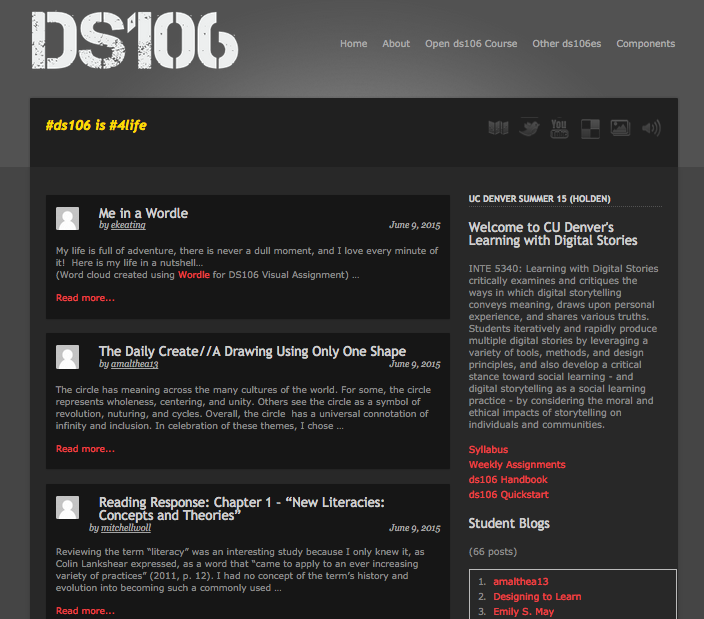
But I am getting ahead of myself, what is ds106? Digital Storytelling (also affectionately known as ds106) is an open, online course that happens at various times throughout the year at the University of Mary Washington and elsewhere… but you can join in whenever you like and leave whenever you need. This course is free to anyone who wants to take it, and the only requirements are a real computer, a hardy internet connection, preferably a domain of your own and some commodity web hosting, and all the creativity you can muster.

ds106 opened up questions about infrastructure, architecture, student agency, pedagogy, and much more all at once. It wasn’t just about technology, it was about how the technology affords new ways for us to collaborate, share, and learn with and from one another.

One of its many great moments of this experiment came during the summer of 2011, during what is now referred to as the “Summer of Oblivion.”

“The idea was to have a daily radio/TV broadcast by Dr. Brian Oblivion (featured in the animate gif above), a character from David Cronenberg’s Videodrome who only ever appears as a mediated pedagogical presence on TV. The idea was to update this for 2011, and have this be an online, mediated pedagogical appearance only on the web. Effectively I took on an alternative teaching identity. I wanted to push myself in this course to not only experiment with and challenge some of the ideas we have about the role of the professor, online learning, and mediated communication…if I am not pushing myself to explore and be consumed by this media then it would run counter to the whole reason for the course in the first place. So, there it is, ds106: The Summer of Oblivion—but this analyzing is paralyzing, let’s play this dang thing!” from http://bavatuesdays.com/ds106-the-summer-of-oblivion/

And it looked something like this the first few days:

The course ran as an alternative reality in some ways, what Ray Land calls a “pedagogy of uncertainty.” By the end of the first week Dr. Oblivion went missing, the TA (jim Groom) came in and became a tyrant banishing students, and the class started to rebel. It was magic. Here is one of the student created videos about the upheaval of course power:

The idea of the class was about sense-making online, taking control of your digital presence, and imbuing a broader range of digital literacies and fluencies across tools, but more importantly managing one’s presence online.

Domain of One’s Own

This gave way to the Domain of One’s Own initiative at UMW that provides every student and faculty member their own domain and web hosting, providing a platform for a broader, institutional wide digital fluency toolkit, not to mention a sandbox for broader web-based exploration for everyone.

This took on a whole different level of thinking when I met up with Audrey Watters and Kin Lane at the Reclaim Hackathon at MIT sponsored by the DML. The ideas there continue to drive the work at UMW and beyond. Thinking in more focused ways about how we provide students and faculty a technical and curricular framework that provides more control over personal data. Ideas of University and personal APIs, virtualized server infrastructure, Docker, and much more. This is the beginning of what has become my new focus—Reclaiming. It’s also why I started with the demo. Based on the work we’ve done at UMW, my partner Tim Owens and I are working on a model that provides individuals, courses, departments, and/or universities with cheap, virtualized infrastructure to run this locally.  A way of decentralizing IT and edtech support. That’s Reclaim Hosting, and that’s the future!
Posted in digital storytelling, edupunk, reclaim, reclaimopen | Tagged , , , , , | 3 Comments

On Maelstroms and Syndication Buses

I am preparing a talk for Thursday that revisits a journal article Brian Lamb and I wrote in late 2008, early 2009 for the Universities and Knowledge Societies Journal (RUSC) titled “The Education of as Un-Artist…or is that the un-education of the technologist?” It’s an unorthodox approach to an article wherein we acknowledge from the outset we have no “synthetic theory” of what we talk about. Rather, we offer a series of vignettes of then current work happening in edtech that we thought was somehow important, while resisting any sense of an organizing theory or principle to wrap it up neatly. The article abstract is pretty awesome:

Two educational technologists and webloggers present a series of vignettes, contemplating the effects of modern networked communication on their practice. Recognizing their inability to construct a synthetic theory amidst the maelstrom, they curate a collection of observations and manifestos emphasizing themes of personal publishing, spontaneous collaborations, learning on the open web, and syndication.

In effect, we were creating a “maelstrom” of examples that we wanted folks to get sucked up into to get a sense of the chaotic nature of learning on the web. We highlighted what turns out to be a pretty interesting collection of examples, and I think we may very well be able to lay claim the first academic journal references to Massive Open Online Courses. Natch, we wrote about MOOCs before they were cool.

But, as I will explore in my talk on Thursday, so many of these vignettes are pieces that started to come together when a community of folks started to architect the online, open version of ds106 in the Spring of 2011. A “space of one’s own†,” class-based mashups, spontaneous connections, serendipitous collaborations, and the ever-venerable syndication bus can all be seen as the building block of ds106. Interesting how so many ideas that were percolating around this time, fueled by the excitement of EDUPUNK, remain exactly the things many of us are still working towards. A Space of One’s Own was instrumental to the personal cyberinfrastruscture at the heart of ds106 that enabled us to imagine a syndication bus we can build around it. A technical means to manage a distributed network of folks that share the work from their own space to a syndicated course hub. Spontaneous connections through Twitter hastags like #ds106 make for serendipitous collaborations and an amazingly distributed course experience.

So, as I am working through this presentation and revisiting some fairly strident language like this on the Syndication Bus:

The very logic of the LMS might be understood as a mausoleum for the internment of any and all possibilities for an individual to control, manage and openly share their own thinking with the community at large—it is within these darkly sealed crypts that you will find the mummified corpses of learning.

Alternatively, syndication buses represent a space through which individuals within a learning community can share their work through personal publishing platforms that they maintain ownership over. Rather than locking information into centralized systems, institutions should be designing a syndication-oriented framework that empowers its members to add their own syndicated voices to a larger, streaming conversation that can be filtered and visualized through semantic tags and categories.

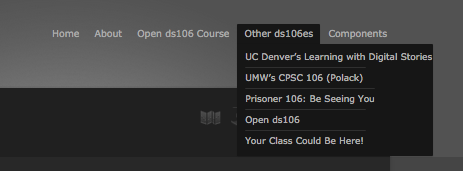
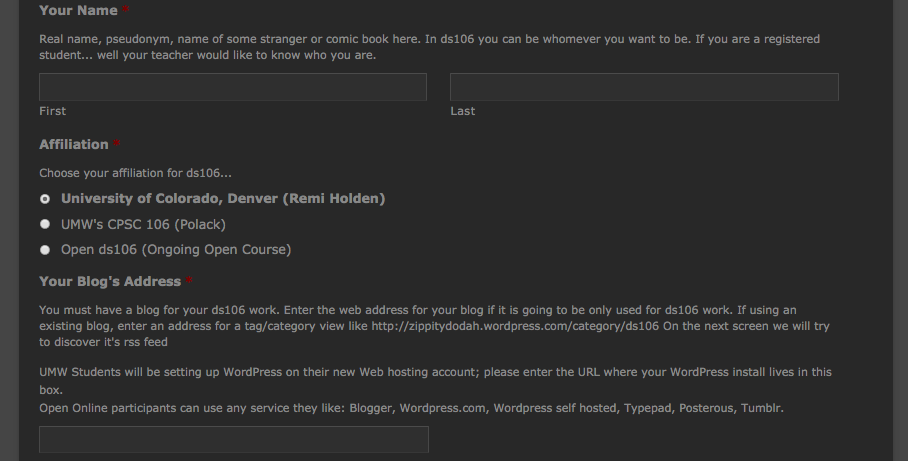
I am reminded just how tightly we have begun to make syndication hubs work fairly seamlessly when it comes to ds106. For example, Remy Holden is having his students at University of Colorado, Denver sign-up for ds106 right now. He’s using the ds106 tag template for his course as an aggregator for students’ posts. And guess what, it’s pretty seamless. They complete a form asking for their name, institutional affiliation, blog URL, feed, and Twitter handle, and it’s all done.

Screen Shot 2015-06-10 at 2.36.57 AM

What’s cool is that for Remi’s students have blogs on everything from Tumblr to Blogger to WordPress.com to Wix to self-hosted sites. Yet, they’re all being added to FeedWordPress and syndicating into the ds106 site without major issues.‡ On top of that, when they select the radio button associating the feed with their course at sign-up, it automatically tags all their posts for that course. Those posts are then aggregated to a tag-based template page with course specific content in the sidebar. This is something Alan Levine figured out, and it’s really cool. All the posts for Remi Holden’s class are now tagged with cudenver15, and they show up at the URL: http://ds106.us/tag/cudenver15

Screen Shot 2015-06-10 at 2.37.45 AM

Alan added context specific code (and short codes) for the class tag which provide a quick, aggregated course page. Links to the syllabus, assignments, list of student blogs, how many posts, random comments, etc. It’s an awesome template that a professor can decide to use, or not. Either way, it acts as an aggregator that they can take the feed for and syndicate the posts where ever they want. The EDUGLU Syndication Bus in full effect aggregating anything that has a working RSS feed. Booya!

Screen Shot 2015-06-10 at 2.38.09 AMI had to do a few backend copy and pastes for the sidebar code to create a dynamic tag-based course page, but I imagine that could be automated so that a faculty member fills out the course information form at ds106.us and much of the tag-based template page is automated.

Alan has created some amazing instantiations of the syndication hub for a few years now. And as I revisit EDUGLU and the syndication bus yet again in preparation for my talk on Thursday, I am blown away by all the amazing progress that has happened in this arena over the last seven years since we wrote that article. ds106 is a model for online course design that is truly on and of the web. And it was built by many people, and tells a story of collaborative, community-based contributions that offers a powerful argument for experience-based design that studies the action of the whirlpool that is the web and cooperates with it rather than putting it back into a box.

The mission has remained clear, despite all the distractions and hype. Create a technical infrastructure that empowers both faculty and students to become the sovereign source of their online presence for teaching and learning. While at the same time, enabling quick, targeted aggregation and syndication of their work within a broader community context so they can explore, discover, feedback, and share. The syndication bus #4life.

_______________________________________________________

† I hadn’t committed to “domain of one’s own” yet, though I already coined the term by this point.

‡ One issue we should look at is allowing folks to edit the information they enter on the form in the event they need to change the feed—which a few do. That said, this introduces usernames and passwords that make the sign-up and barrier to entry a bit more cumbersome.

Posted in digital storytelling | Tagged , , , | 2 Comments

Reclaiming Europe

Barcelona

Image credit: Don McCullough‘s “Barcelona”

I’m sitting in the Toronto Airport right now waiting for a plane to Barcelona, Spain for the European and Distance E-Learning Network (EDEN) conference this week. This will be my first time presenting in Europe, and I am pretty excited about that. I’ve been following a number of people working in edtech across Europe over the last ten years, and it will be a real treat to finally be part of a European-focused edtech conference. What’s more, I’ve never been to Barcelona, and I can’t think of another city that everyone I talk to has been so unequivocally enthusiastic about. That has me excited for other reasons.

Trento-fountain_of_Neptune_and_Torre_Civica_from_southwest

Trento’s City Square

What adds a personal layer to this trip is that it’s a foreshadowing of things to come. As early as this fall, my family and I plan on moving to Antonella’s home town: Trento, Italy. This is something we’ve been talking about for more than a decade, and it looks like the opportunity is finally materializing. I’m pretty excited about the idea of bringing the kids back to Italy so they can get to know Anto’s culture more intimately, master the language, and spend some time with our family and friends there.

Being back on Long Island this weekend and seeing how grown up all my nephews and nieces are getting was a stark reminder how quick it all goes. I’ve been consumed with my work at UMW for the last decade, and in many ways existed almost entirely within that professional universe. I don’t regret it for a moment, but it’s high time take advantage of the wider world out there and begin reclaiming Italia, per bacco!

Posted in reclaim | Tagged , , | 4 Comments

Ordering a Pizza in 2015

In 2004 the ACLU framed a biting critique of the uncontrolled collection of personal data on the web by imagining what ordering a pizza in 2015 might look like. It had a bit of a revival last year, and it makes sense because the vision is deeply disturbing and not that far off. Below is the description of the video on what I am imagining is the original page from 2004:

Government programs and private-sector data collection are destroying our privacy, pushing us towards a 24-hour surveillance society.

We are facing a flood of powerful new technologies that expand the potential for centralized monitoring, an executive branch aggressively seeking new powers to spy on citizens, a docile Congress and courts, as well as a cadre of mega-corporations that are willing to become extensions of the surveillance state. We confront the possibility of a dark future where our every move, our every transaction, our every communication is recorded, compiled, and stored away, ready for access by the authorities whenever they want.

This is situated on the brink of the explosion of Facebook, YouTube, Flickr, etc. More than 10 years later, the implications of the collection of personal data by corporations and governments is finally hitting us culturally. Phil Windley played this video during our discussion of the Personal API when we started exploring the implications of reclaiming this personal data from various services across our personal lives that are capitalizing off our information. This video nails just how vivid a picture of someone’s life a few data points creates, and how they can be commodified and used against us to create all sorts of societal controls. I think I am finally understanding what Audrey Watters and Kin Lane are talking about with this reclaim thing 🙂

Posted in reclaim | Tagged , , , , | Leave a comment

Block chain: “the only workable, distributed key value store in existence”

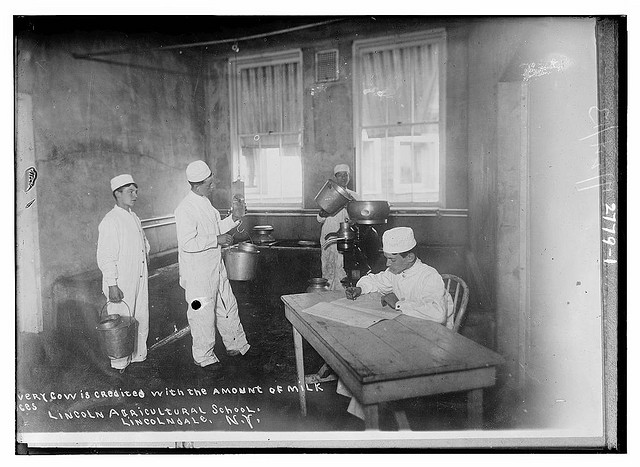
Image credit: Lincoln Agricultural School, Lincolndale, N.Y. (LOC)

Image credit: Lincoln Agricultural School, Lincolndale, N.Y. (LOC)

The subtitle of this post is a direct quote from Phil Windley‘s Block chain session at the University API conference. Phil wrote a short post a couple of months ago about why block chain is important, and I had the good fortune to sit in on a more fleshed out discussion on the topic this past Thursday. I’ll admit right away I am in over my head trying to blog about this because I only partially understand it. That said, I’ll use this post to try and write through my limited understanding to see if I come out any the wiser.

What the hell is block chain? It’s a distributed database that stores transactional information for the cryptocurrency Bitcoin. But what Phil pointed out that I didn’t fully realize is that block chain is simply a ledger system that can anonymously track and record transactions without being centrally controlled. In the event of Bitcoin, that would be used for financial transactions, but there is no reason for it to end there. As he noted, it’s important for us to understand because with block chain we have “the only workable, distributed key value store in existence.” What a quote!

We store and use keys for all sorts of things on the web currently. For example, we use key values to log into all those sites we happen to have an account with. Given Phil is deeply invested in imagining new ways of thinking through digital identity management, he suggested during his session that block chain may be one way at tracking and storing our various personal transactions without giving over our credentials to be recorded and tracked by any given site’s centralized “ledger.” So whereas Daily Dot can’t see beyond imagining Bitcoin as a means of “tipping” folks on the web instead of just liking them, Phil is framing this technology as a way to imagine a truly distributed personal identity management system independent of any one company, state, or nation. Interesting in light of the Federal Government’s recent data breach.

I know it’s not as simple as I’m framing it here, and there are all sorts of complexities in regarding how we preserve the authority of a distributed ledger, but the idea completely blew my mind. It gave me a bit more insight to the technology undergirding Bitcoin, and how that is just one of its many potential applications—distributed DNS be another he mentioned.

The idea of finding new models for helping us manage our personal data is becoming ever increasingly more urgent. Just this morning in my Twitter stream I saw that Doc Searls re-tweeted Edi Immonen’s link to a PDF that describes the Nordic model for managing personal data called MyData.

Interestingly enough, MyData frames itself as…

…infrastructure [that] enables decentralized management of personal data, improves interoperability, makes it easier for companies to comply with tightening data protection regulations, and allows individuals to change service providers without proprietary data lock-ins.

Interesting stuff, these various ideas around managing one’s personal data on the web inform the thinking behind the Personal API.  What’s more they raise some fascinating questions, not least of which the one Tony Hirst surfaced recently in his obituary for Yahoo Pipes!, namely the rise of more tightly control data viz-a-viz the API suggests a broader movement away from anything resembling Nonprogramistan. A healthy reminder lest I get too excited about any future other than the one we lost.

Posted in reclaim | Tagged , , | 5 Comments

A Personal API

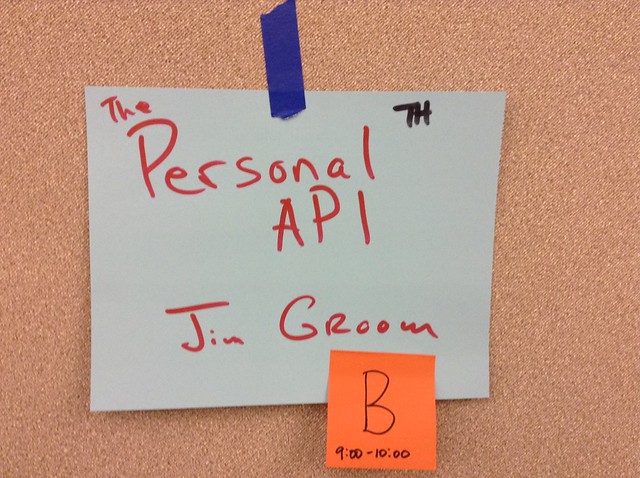
Personal API

Having just blogged about the overall experience of the University API conference I spent the last two days at, and I wanted to get down some of the more focused discussions and thoughts around how the University API might intersect with some of the work we’ve been doing around Domain of One’s Own. First and foremost, what is a University API? Well Phil Windley breaks it down brilliantly in this post on the topic, and this is the pull quote for me.

We’re…designing and implementing a University API. The idea is simple: identify the fundamental resources that make up the business of the university and design a single, consistent API around them. A facade layer will sit between the University API and the underlying systems to do the translation and deal with format, identifier, and other issues.

BYU’s Doug Walker provided an excellent overview of how they’re designing their University API template in terms of URL structures and JSON. I came in and out of the conversation based on my limited understanding (though it’s getting better), but the discussion followed the concepts discussed in this tutorial—a work in progress.

Suggested API Template

This was an important session because it connected with the conversation I had with BYU’s  Troy Martin about the idea of a Personal API after the session I convened around Domain of One’s Own on Wednesday. We got to discussing how domains can be understood within the context of the University API—and this is where things started getting kind of interesting because BYU is running a Domain of One’s Own pilot starting this fall. As Troy said, what if one’s personal domain becomes the space where students can make their own calls to the University API? What if they have a personal API that enables them to decide what they share, with whom, and for how long. For example, what if you had a Portfolio site with a robust API (which was the use case we were discussing) that was installed on student’s personal domain at portfolio.mydomain.com, and enabled them to do a few basic things via API:

Personal API Nuts & Bolts I

  • It called the University API and populated the students classes for that semester.
  • It enabled them to pull in their assignments from a variety of sources (and even version them).
  • it also let them “submit” those assignment to the campus LMS.
  • This would effectively be enabling the instructor to access and provide feedback that the student would now have as metadata on that assignment in their portfolio.
  • It can also track course events, discussions, etc.

The Personal API, through a very focused use-case of the personal portfolio, provides the means for students to have greater control over their data. A de-coupled application running on their own server yet seamlessly connecting to the University’s various services. A scenario wherein students can manage their learning in relationship to a broader University API. And the portfolio is just one use case, you can imagine a blog, resume, financial aid, transcripts, university applications and forms, etc.

Personal API Nuts & Bolts III

The idea of controlling one’s personal data as well as providing a platform for literacy became the prevailing “why” of a personal API during the conversations, and that was very cool. The how is to start small with a simple portfolio program that connects to some of BYU’s  APIs to see how it works. Doug Walker noted it might be a bit hairy because the idea of personal API in some ways resists any set structure imposed on a student’s domain. I agree with that, and I think that’s why you wrap some of that structure and basic framework for the API in a single application, like a portfolio, before trying to map out some kind of Personal API spec that every student must adhere to.

In some ways I am blurring two sessions we had on Thursday around the Personal API. The first was a broad discussion of what it means, it was focused around questions of how we control the permissions of our data, rather than hand that power over to others. There’s  a pretty free range set of notes from the session, but I think this was the groundwork for the session in the afternoon when a handful of us sat down and tried to imagine the basics of this portfolio.  We pulled Tim Owens into that discussion, and I think we have a rough idea of what a very small piece of a Personal API might look like.

What’s more, Kelly, Phil, Troy, hopefully Kin, and any other interested party are going to form a loose working group to hammer on this before the next University API conference in January 2016. I’m really looking forward to this idea. Not only does it deal with questions of student empowerment when it comes to their data, but it could also mean a whole knew way of allowing us, and anyone else with access to the data via the API, to imagine new ways of aggregating, visualizing, and mashing up the data.

Posted in reclaim | Tagged , | 5 Comments

The University API: an (un)conference

The University API & Domains (UAD) workshop covers topics on developing API’s, implementing DevOps practices, deploying Domain of One’s Own projects, improving the use of digital identity technologies, and framing digital fluency on University campuses, This workshop is focused on addressing current issues and best practices experienced in building out conceptual models and example real-life use cases. Attendees include IT architects, educational technologists, faculty, and software engineers from many universities. – From Phil Windley’s post about the event.

I spent the last two days in Salt Lake City at the University API inaugural conference. This conference is so fresh it doesn’t even have a website yet, but it does have a Twitter account. I had an awesome experience, and spent some serious time locking in and thinking about APIs, which is something I’ve been trying to do for a while. I’ll share some thoughts about this (un)conference in this post before I explore some of the ideas that surfaced and my thoughts about how APIs intersect with the work we’ve been doing with Domain of One’s Own in my next. Capiche?

The conference was relaxed, intimate, and intense all at once–is that possible? There were only 40 people, but we had 33 sessions over two days. We got to know each other fairly well, and spent a lot of time thinking and talking about APIs, but in a low-key environment. Major props to Heidi Nobantu Saul for framing and facilitating the unconference approach beautifully. It reminded me of the 2007 Northern Voice Moose Camp, just with fewer people. A lot of serendipitous discussions, in-betweeness, and conversational sessions. I also have to give major props to Kelly Flanagan, BYU’s CIO, for creating a truly convivial and comfortable atmosphere. He’s a remarkable person, bringing a sense of humor to everything he does. But don’t let that lull you, he’s spearheading what might be the single most important development in Higher Ed IT: BYU’s thinking through and building of a University API for their campus, and beyond.

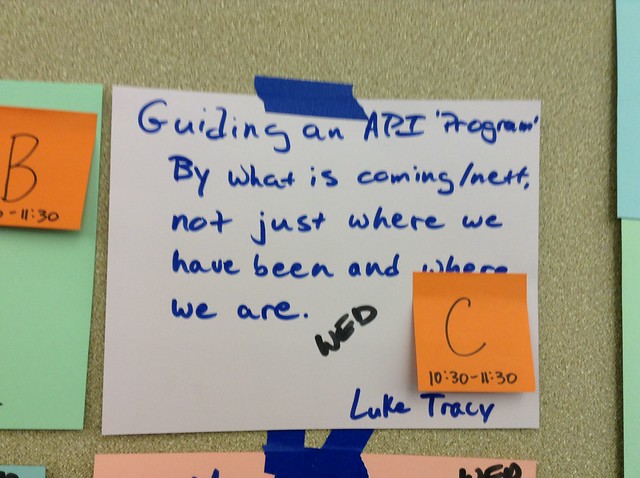
Guiding API Programs

This conference was BYU’s first attempt to articulate and share the vision undergirding the heads down work they’ve been doing over the last year to architect this conceptual shift. No small undertaking for what is a very large Higher Ed IT organization. For all the talk about “disruption” and “innovation” at EDUCAUSE and their IT organizational ilk, you’re always gonna find the most compelling work on the fringes. If you’re looking, I would train your eye on the work BYU is doing around the University API—it’s amazing on many levels. How do I know they’re serious about APIs and doing this the right way? Well, look who they brought to keynote….

Kin lane at University API

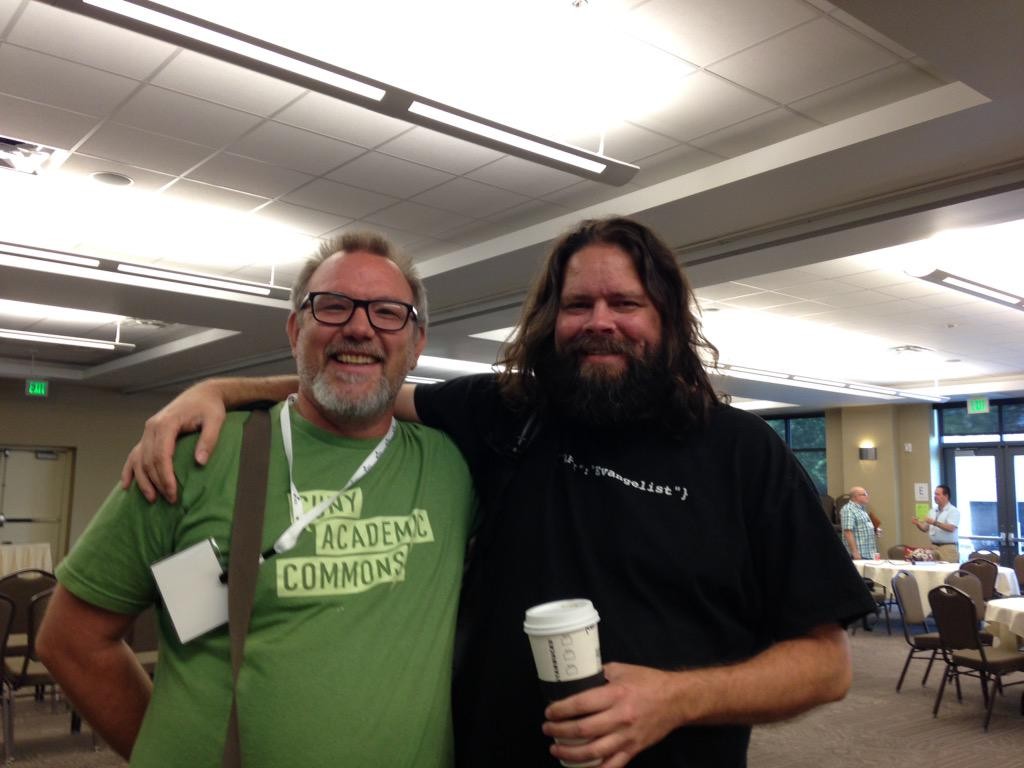
No, not me! The API Evangelist, Kin Lane, a Mather amongst evangelists (Increase to my Cotton?). He brought the fire and brimstone Wednesday morning, inspiring hearts and blowing minds. He is legend. I could listen to him talk for days on end. SO. MUCH. KNOWLEDGE. He opened up with an overview of APIs, and why they’re the building blocks for re-imagining the ways we can collectively build the web, not to mention their implications for sharing, managing, and reclaiming one’s personal data. He then spent the rest of the morning running sessions about the future of APIs, giving an overview of Swagger, and generally being a force of good. I feel better knowing he’s out there. What’s more, he set a tone that talking about APIs is not only technical, it’s social, political, economic, educational, etc.

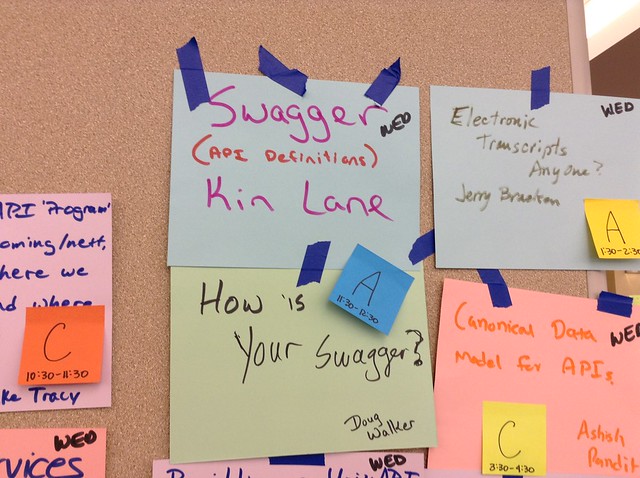
Swagger

The fact that Kelly and Phil Windley brought Kin in to frame this event speaks volumes about their approach. They have been working with Kin for a while now to help them work through the shift to making BYU’s data more accessible, malleable, and easily shared across campus via the University API. What could be more important for an IT organization? The University API conference is a space to interrogate how we create, share, and manipulate data across an institution, which means its relevant for just about anyone on campus. The problem is most people can’t get beyond the acronym API, and I totally understand that obstacle. I would love it if in the next iteration we ran an API 101 track that helped folks both understand and wrap their heads around how APIs effect the whole university.

I also have to take moment to mention how much I admire and respect the thinking Phil Windley is doing more generally in the space of technology as a domain (his session on Blockchain and decentralized identity management was truly amazing), but specifically in thinking through the complex architecture of what this means for BYU both technically and culturally. I’ll write more about Phil, Kelly, and several other amazing BYU folks in my next post on the Personal API, but for now let me stop here and simply say I’m truly thrilled that a high-profile institution like BYU is leading the conversation around APIs in higher ed in a thoughtful, engaged, and open way. I’m fired up for the next University API (un)conference that will be happening, tentatively, in January of 2016. I guess we’ll know more once they get a website—Mormon hippies! 🙂

Posted in reclaim | Tagged , | 1 Comment

SAVE THE #UMWCONSOLE

Screen Shot 2015-06-03 at 9.59.29 PM

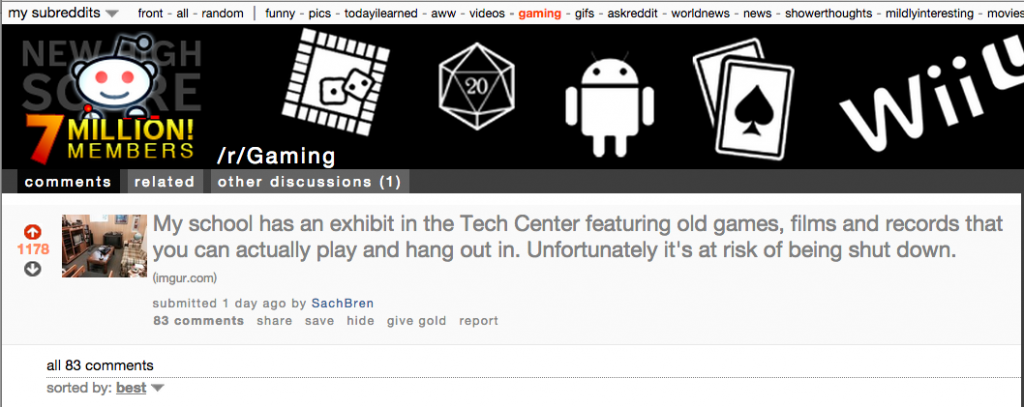
Zach Whalen pointed me to this Reddit thread a UMW student started about the UMW Console Living Room exhibit. It comes in the form of a plea to preserve the installation from SHUTDOWN!!! While there has been no direct threat of shutting us down just yet, we all know it’s coming. So I really enjoyed this pre-emptive strike on Reddit to let everyone know how much UMW students love their 1980s living room. Over 1100 up-votes, and almost 57K views of the image set. There can be no mistake the people have spoken. They love the 80s, and UMW needs to commit to keeping this decade alive on campus 🙂

https://imgur.com/a/GCR3u

For a project that has already been one of the coolest things I’ve been a part of, this Reddit post just made it that much better. I love you, SachBren, whoever you are! As for the future of the Console Living Room, we’re gonna have to fight for the past we want. Remember Seaco!!!

Posted in Console Living Room | Tagged | 1 Comment

Changing File Permissions for a cPanel User

As I am getting my feet wet with more and more sysadmin stuff, which is pretty fun for me, I’m gonna take a second and record the tricks that I know are going to be useful long term, like the “Auto fix for file permissions and ownership” script. Tim pointed out that often the errors you get after moving over someone’s files are related to ownership and permissions on that specific user’s account. He showed me a quick way to automatically re-write the permissions for all files to be 644 and folders 755 (the standard, as I have come to learn) for just that account.

Through terminal, you wget the script from Github:

wget https://raw.githubusercontent.com/PeachFlame/cPanel-fixperms/master/fixperms.sh

Then run the following command where USER-NAME is the username for the account you are changing file permissions for.

sh ./fixperms.sh -a USER-NAME

It worked a charm, and now I have blogged it here and tagged it sysadmin, which will be where I start to store some of these tricks until they become more familiar.

Posted in sysadmin | Tagged | 7 Comments

Free for All GIFs

free_for_all 6

I had some downtime while traveling today, so I did my Prisoner106 homework and went on a watching spree. I got through the first five episodes, and I am totally locked in. I might finish the whole season my week’s end, and revisit it a few times for some close readings. In the interim the above GIF from the “Free for All” episode featuring the No. 58. This shot was almost too perfect not to GIF. It’s as if I had masked her silhouette to isolate the moving background for this GIF, but I didn’t. That’s the way it was shot. Which makes me wonder if they had to do something similar themselves to get that background to show up cleanly behind her.

I also think the moment when No. 58 gives No. 6 a slap in this episode makes a nice reaction GIF:

no58_slap

Another moment I knew I wanted to try and capture was No. 2 banging his gavel during the mock debate. gavel

Posted in digital storytelling | Tagged , , , , , , | 8 Comments