Grounds…for Horror!

While in L.A. last week, my good friend Mikhail and I made a stop at the comic shop Meltdown. It’s a great store. They have everything from comics to graphic novels to figurines to video games—and the folks who work there are both knowledgable and helpful. I’m a big fan. I could spend hours on end there, but we only had a little bit of time, and luckily I knew exactly what I wanted. And they had it:
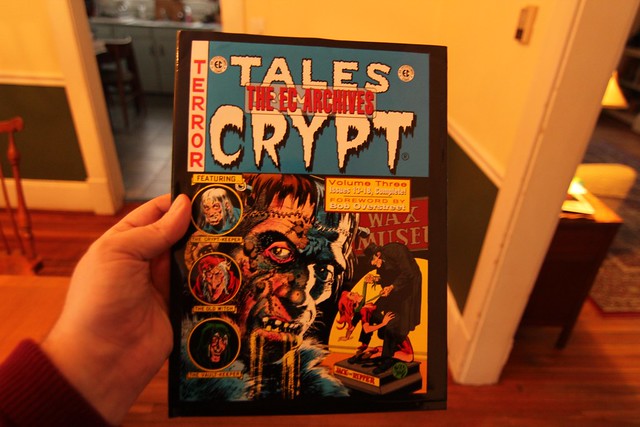
The Ec Archives: Tales from the Crypt, Volume 3

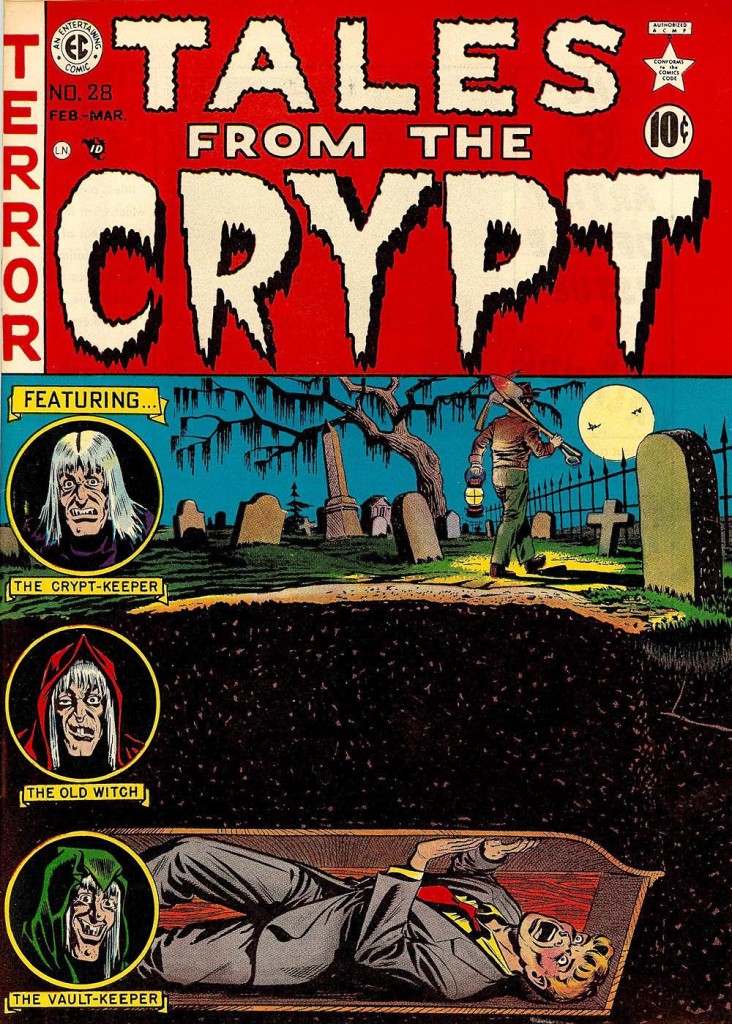
I’ve been wanting to get my hands on the EC Comics archives of Tales from the Crypt because I’m toying with the idea of doing a future ds106 course around these 1950s comics. I think it would be a blast, not to mention I love to look at them. More importantly though, I needed a gift for each of my kids before heading home from L.A., and I figured Miles was ready for some of the most awesome horror comics ever created. So, I picked up volume 3.
ibechorror02-big

When I started reading the first story of this volume to Tess and Miles, “Grounds…for Horror!” I was struck my how insane it was. Let me explain. The first story is about an abusive step-father who locks his disobedient son, Artie, in a dark closet in spite of his mother’s protest. The step-father is a butcher by trade, and their apartment adjoins with his shop. Can you see it coming yet? Artie’s mother overhears her son talking to someone named Hozir, whom she takes for an imaginary friend he created to help him deal with the abuse. Well, Hozir is not imaginary, he’s just invisible. And as the step-father ramps up his attacks on the child, Hozir promises retribution. And, he delivers on that promise in a fairly spectacular way:
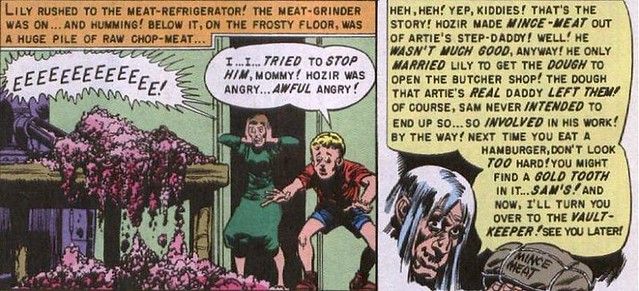
Scene from “Grounds…for Horror!”

Miles and Tess were like WTF, daddy? And I was like, that is awesome! A comic book for kids that truly disturbs. Who said things were normal during the 50s? In fact, the 1990s re-working of Tales from the Crypt as an animated cartoon called Tales from the Cryptkeeper is just depressing in comparison. Not only does the art suck, but the stories are completely toothless. Look at this adapted version of “Grounds for Horror” and tell me I’m wrong.

I just ordered the DVDs for the first two seasons of the late 80s, early 90s HBO series Tales from the Crypt. While I saw a few episodes at the time they came out, I don’t remember too much. But after reading up on it, seems they had a decent number of good actors and directors working on that series. My yardstick for all interpretations of this aesthetic is still George Romero’s Creepshow (1982), so we’ll see how that goes. If for no other reason, it will be useful given my kids are constantly asking me to tell them scary stories before they go to bed, and I’m running out of ideas.

Posted in pop culture | Tagged , , , , , , | 10 Comments

Back to the Future: Console Living Room Exhibit at UMW

playing_atari_2600-e1389555711895

Image Credit: “Home Gaming Archive Puts Classics at Your Fingertips”

After Spring Break, I’ll be working with professor Zach Whalen to create an interactive installation on the 4th Floor of UMW’s Information Technology & Convergence Center (ITCC). The installation will feature a replica of a living room circa 1985, think of it as a cultural time capsule within UMW’s  brand new state-of-the-art digital convergence building. This installation is Zach’s brainchild, and it’s both fun—who doesn’t want to play Atari 2600 games on an old school tube TV or surf cable channels from 30 years ago?—- because it both frames and highlights the evolution of “convergence” around digital media over the last thirty years. The epicenter of which, one might argue, is the 1980s archetypal living room/den. And that’s what we’re gonna build!

Thanks to Michael Branson Smith for the ongoing GIF isnpiration.

Right now we are in the building stage, we just put a call out to the UMW community to see if anyone would be willing to loan or donate furniture, art, accessories, etc., from that era. I figured a quick cross-list on the bava might be useful just in case anyone stumbles on this post and has books, magazines, catalogs, posters, audio visual equipment (including personal computers), and furniture (lazy boys, couches, tables, etc.) from that era they might willing to contribute to the cause. In particular, we are trying to get an oversized TV set with a cathode ray tube—that is gonna be the centerpiece of this installation. Screw all the flat screens—it’s all about that bulk, ’bout that bulk —no ipads!

Posted in Console Living Room, digital storytelling, TV, video games | Tagged , , , , | 5 Comments

Dope on the Damn Table

The title of this post is actually the epigraph to Season 1, Episode 11 of The Wire: “The Hunt.” It’s spoken incredulously by Lieutenant Daniels when learning the brass wants to make a show of seized drugs, guns, and money, without any real interest in following any of it back to a real source for fear of what they might find. It’s just one of the many ways the show critiques the display of law and order that often masks some fundamental institutional dysfunction, and preserves a broken status quo.
Anyway, as Wire106 was wrapping up this past Fall, I discovered the Baltimore Police Department maintains a rather active presence on Twitter. They tweet out a variety of tips, resources, community outreach, news, as well as crime details. In fact, on more than a few occasions reports of homicides cross my Twitter stream:

It’s an extremely sobering and human Twitter account. At the same time, I can’t help but follow it through the lens of The Wire, and it’s remarkable how many times I see a “Dope on the table” tweet with accompanying image. Below are just a few:

It’s remarkable how much this Twitter stream demonstrates some of the profound accuracies of the HBO series. At the same time, I find that there’s an actual person behind the Twitter stream oddly reassuring. In fact, he or she responded to Paul Bond when he replied about the insignia on one the guns on the table tweets (can’t seem to track that back and forth down right now—any help, Paul?).

After following the account for over a month, I’m noticing an interesting sense of virtual community policing that gets captured on a platform like twitter. Now, I have to acknowledge this might simply be more “dope on the damned table” publicity. Simply a public relations show that elides the deeper structural and institutional issues. At the same time, I would be lying if I didn’t acknowledge that such a portal into the criminal world through a virtual space like Twitter remains a mesmerizing look at the digital storytelling of law and order in urban cities. The archives we are creating astound me!

Posted in digital storytelling | Tagged , , | 2 Comments

Noir 106: ds106’s Dark Turn

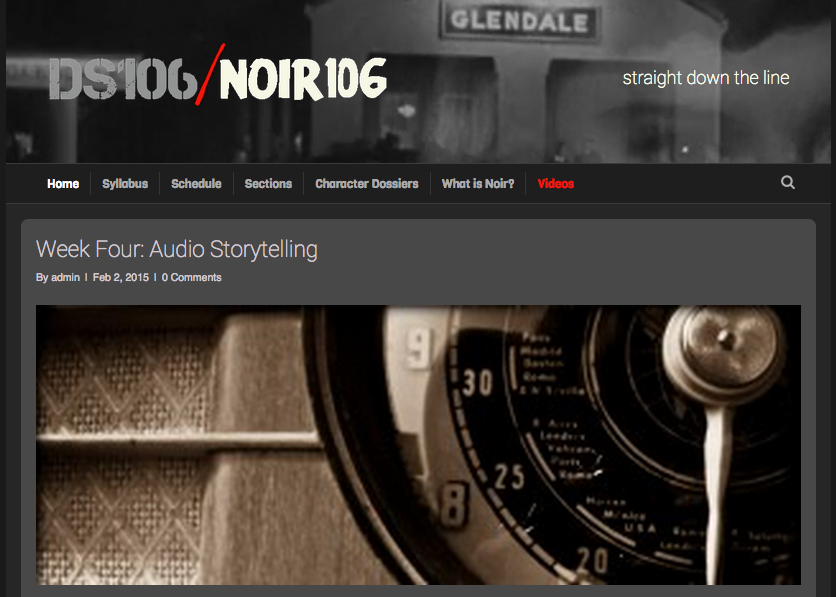
Screen Shot 2015-02-04 at 10.47.19 PMWe’re already well into week 4 of Noir 106 and I am just realizing I haven’t officially blogged about this iteration of the multi-faceted cultural chameleon that is ds106 (#4life).  Coming off the focused, intense tour de force that was wire106 (a 15 week exploration of The Wire via digital storytelling), this semester we switched it up a bit. We went broad, and decided to use the theme of noir as the creative catch-all through which we approached the class. The move to noir more generally is born out of some of the classes Paul Bond and I have co-taught over the last three years, namely Hardboiled and True Crime. More importantly though, this class is also the brain child of a former student from wire106 (who will remain nameless at the moment for narrative concerns) who pushed me beyond a narrow focus on 1980s TechNoir, as well as the ever-brilliant Martha Burtis who tied the whole thing together—as she is wont to do.

So, we have three sections of ds106 running at UMW this semester all of which are effectively being taught by all four of us. We are treating the class as a larger noir narrative, and the weekly assignment videos are also the frame for an evolving plot—which is about to get a bit nutty. What I am really enjoying about this class so far is the fact we have a cadre of 70+ UMW students who are taking this course online with four distributed docents—each having both an instructional and narrative role in the course as it unfolds. Very fun! It is yet another example of how collaborative, coordinated teaching has become a given for me these days.

I could go on and on, but let me quickly point out three quick elements of the course right now that I think rule:

1) The work Mariana Funes has been doing with the Daily Creates is amazing. UMW students consistently refer to this part of the course as their favorite. Just take a look at today’s Cute Puppy Alert, and tell me they aren’t having fun. Quick, creative exercises to keep everyone engaged and connected. Mariana wrote a post about her approach and thinking behind all the time and energy she has freely volunteered to this work. She embodies the best of the web: open, thoughtful, and generative.

Ellen O’Brien’s TDC


2) The online, distributed approach to communal activities continues to be one of the most compelling elements of ds106. Paul Bond has been scheduling old school noir radio programs on ds106rad.io from 8-9 PM (Eastern Time). The last three nights we have had listen-alongs wherein students are asked to listen and tweet about the show using the #noir106 hashtag on Twitter. I tuned into last night’s show featuring Edward G. Robinson as Sam Spade in the 1943 radio production of The Maltese Falcon. Tonight was Fred MacMurray and Barbara Stanwyck reprising their roles from the 1944 film version of Double Indemnity for Lux Radio in 1950.

The response thus far has been encouraging:

Paul wrote about the first two listen-alongs here and here. I recommend those two posts for more context and insight to the process. I love that ds106radio continues to provide a space where we can build community as part of an online course in fairly distinct, compelling ways that seem somehow more germane to the web than locked away discussion boards in an LMS. Call me crazy.

3) Last, but certainly not least, is the work Martha Burtis has been doing with UMW’s Digital Knowledge Center (DKC), which has effectively changed the game for teaching ds106. Over the last five months Martha has conceptualized and built out a peer-tutoring center for digital projects. We have been sending our students to these tutors (many of whom are ds106 alumni—all of whom are awesome) for help setting up their domains, using WordPress, editing images, using audacity, and various other tasks as they come up. We can scale ds106 at the level of the individual student in ways that we never could before. And ds106 is just one of the many courses the DKC tutors support. What’s so rad is that we aren’t just saying “Domains are awesome.” “We’re the digital liberal arts.” “I’ll flip your burgers.” We are backing it up.

We have built the capacity to support our community as we continue to rollout an increasingly robust curricular push to integrate some broader vision of digital fluency across the disciplines. As an instructional technologist, consider how different your collaboration with faculty members can be if you’re able to provide targeted support for an entire class of students? It’s changing the way we work, and has the potential to dramatically augment our impact on the academic mission at large. And Martha’s long-held vision and execution of this center has proven to be as precise as poetry.

So, it’s been a good start to the course thus far. And I even haven’t started talking about all the awesome work the #ds106 internauts are doing, but I’ll save that for another post.

Posted in digital storytelling, ds106radio | Tagged , , , , , , | 1 Comment

Graphic Gift: Bodiless Starched Jeans on a Desert Road with Animated Back Pockets

I finished up my second visual assignment of the week last night, but things got too crazy for me to post it earlier. Michael Branson Smith‘s “Graphic Gift” assignment is one I really appreciated because it forced me to dig in a bit on my image editing skills.

Find or scan an old advertisement (high resolution) and create a piece of cool clip art by extracting and cleaning up a particular element. Be sure to use a PNG file type to preserve transparencies, and try to make a high and medium resolution version. Inspired by Phil A Go’s awesome Toyota Corona Graphic Gift.

Smith writes about the value of assignment on his own blog, and I think he’s right on:

This exercise would be a great ds106 assignment for a couple reasons. One it’s a great for working on digital imaging skills. A good graphic gift would require a student to work with selections, the eraser tool, image touch ups (via contrast, sharpening, and possibly the clone stamp to remove scratches), and image resizing to create different versions. Also to maintain transparency and post to the web the image should likely be a PNG file.

Given we’ll be doing some more image editing intensive work during the design week of noir106 soon enough, I figured this would be a good assignment to help me shake off some of the dust. I’m a total hack when it comes to GIMP, but as a result of teaching this class for five years my skills are almost passable….almost.

On a related note, I refuse to use Photoshop for ds106 assignments on principle. First, it’s costly, and while you can get a free trial, why use something that you won’t be willing or able to afford long term? Second, and more importantly, ds106 is not about a specific tool, but about wrapping your head around certain elements crucial to digital media editing, such as layering, scaling, cloning. recombining, distorting, etc. If you want to use Photoshop, you can. Although providing free, open source options that teach you these basic image editing concepts, such as GIMP, helps level the playing field and lighten the financial burden. That said, we never tell students what tool they should use, that’s not ds106—we teach freedom!

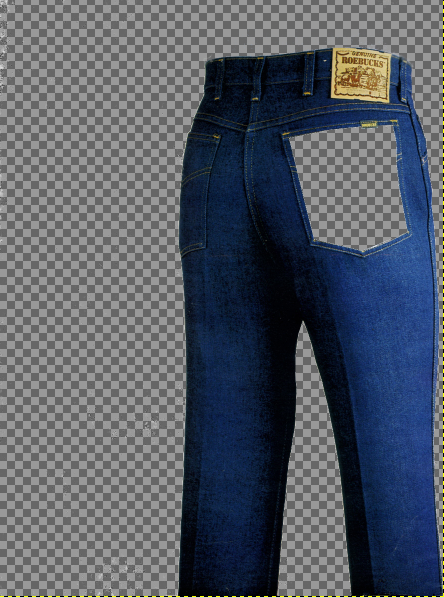
Anyway, I started looking for catalogue products to make a graphic gift, and I consulted the Flickr WishBook account, which has scans of the old school Sears Christmas Wishbooks. I chose a mid-1980s catalog thinking I would grab a toy, but it didn’t work out that way. I got stuck on this image of Roebucks men’s jeans.

https://www.flickr.com/photos/wishbook/173484120/

I don’t think I have ever seen such beautifully starched jeans. I got inspired to not only cut out the jeans, but also one of the back pockets. I needed to employ all the tools Smith suggested, selections (lasso and magic wand), the eraser, clone, blur, and more. It was a workout, and my final product is far from perfect.

Screen Shot 2015-01-29 at 4.28.07 PM

My idea was to have a new background image, and then something animated in the back pocket for fun. Then, like a diamond through my forehead, I remembered a dream I had long ago wherein a pair of bodiless, well-starched jeans were standing on a desert road with Jack Nicholson’s character from The Shining animated in the back pocket. I then knew this is what I had to do. Think of it as therapy.

I found the following image of Jack Nicholson animated:

jack-nicholson-gif-7-1

And this image of a desert road on Wikipedia:

Desert_road_UAE

I spent some time combining these layers, pushing some to the front, and others to the back. The transparency of my graphic gift—which I accomplished thanks to the eraser— made these other elements of my Dali-esque dream possible.

desert_pants_scaled

I don’t know how I feel about the actual creation, but I do feel better that I finally got this monstrosity out of my psyche for the low, low cost of 3 stars. That’s 6 down, and 4 more to go.

Posted in digital storytelling | Tagged , , , | 6 Comments

Dark Night Selfie

I decided to get started early on the visual assignments for week 3 of noir106. I took some time this evening to work on the Chimeratic Composition assignment submitted by the great Tom Woodward. The instructions are as follows:

Take at least three pictures (your own or someone else’s) mash them together into something that makes them more than the sum of their parts, something that would have been impossible in real life. Include the original images so we can see how they build on one another to make your final composition.

I love the example Tom provides:

Chimeratic Composition by Tom Woodward

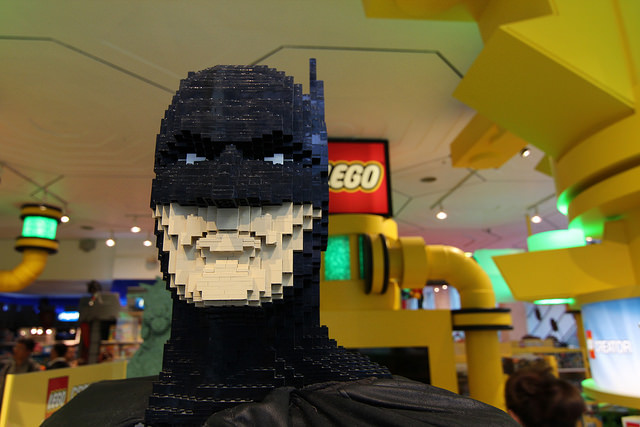
He used four of his own images to create this supernatural, gothic moment. So I got inspired to try my hand at this assignment. First up was finding some of the images I had taken recently to mash together. I came across the following images I took while on a trip to NYC with my family. After browsing I got the idea of doing something with the life-size lego Batman and the shot of downtown Manhattan from the top of the Empire State Building.

Lego Batman

Life-size Lego Batman at FAO Schwartz

NYC City scape

View of downtown from Empire State Building

I also found this shot I took while on the Staten Island Ferry of what looked like a helicopter size drone. Flickr user Bill VanderMolen commented on the shot to say it’s actually a “V22 Osprey. Tilt-rotor aircraft that the military plans to use to replace troop transport helicopters.”

V22 Osprey. Tilt-rotor aircraft that the military plans to use to replace troop transport helicopters.

This got me thinking, wow, that’s very Batman. State of the art, military-level artillery. I now had my third image. I opened each image as a layer in GIMP and started playing around. I cut out the parts I wanted use with the magic wand and lasso tools. I then scaled each layer to the proper size, and changed the colors. I made the city black and white, kept a bit of color on Batman. The Osprey was already black, so that was easy. I probably spent more time futzing than I need to, but I kinda like how it came out.

Batman atop the Empire State Building

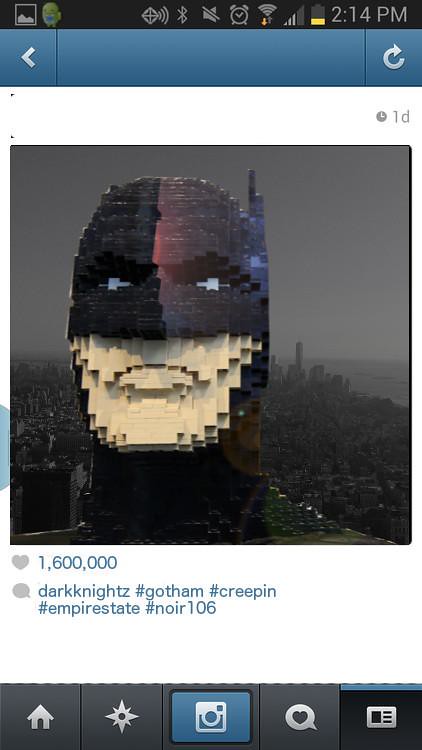
After realizing that Batman’s positioning made it look like he was posing for a selfie, I decided to double up on this one. I returned to yet another Tom Woodward visual assignment: “Historical Selfies.” Gyeore Lee had done this assignment earlier in the day-–reminding me how  much I love it—so I decided to actually illustrate Batman’s selfie on a smart phone thanks to this template made available. It has all the layers, I just pulled my Batman selfie image in as a layer and cropped it for the phone screen. After that I added likes and tags.

And with that I have my first visual assignment of the week. I am only giving myself 3 stars for this one because I am committed to only doing assignments I haven’t tried before. I took a stab at the Historical Selfie last semester, which was fun. But I have to admit I think this one is much better, although not very historical at all.

Posted in digital storytelling | Tagged , , , , , | 5 Comments

Savage Quotes

1953 Cover of Savage Night

Given we are focusing on writing in noir106 this week, I wanted to share some of the gems I have come across in Jim Thompson‘s 1953 novel Savage Night. And given I still have 8 stars of assignments to complete, I created a new writing assignment so I could kill two birds with one post. I’m only thirty pages into the book, but I was totally sold after the first paragraph:

I’d caught a slight cold when I changed trains at Chicago; and three days in New York — three days of babes and booze while I waited to see The Man — hadn’t helped it any. I felt lousy by the time I arrived in Peardale. For the first time in years, there was a faint trace of blood in my spit.

Babes and booze, tuberculosis, and some nebulous “The Man” all in the first three sentences. And then followed upon soon with this:

I started coughing a little, and lighted a cigarette to quiet it. I wondered whether I could risk a few drinks to pull me out of my hangover. I needed them. I picked up my two suitcases and headed up the street.

Nothing like curing your cough with a cigarette, and chasing away your hangover with a few more drinks. By the 1950s hardboiled fiction (and film) were starting to congeal around a number of tropes. What I like about Thompson’s writing is he doesn’t shy away from the genre as pulp. He embraces it, and turns it into a kind of popular poetry. Take the following analogy when describing the sadness of the decayed, lifeless town of Peardale:

There was something sad about it, something that reminded me of bald-headed men who comb their side hair across the top.

This calling out of the dreaded combover as a way to describe a rundown town is not purple prose, it’s a refreshing, quotidian example of the pathetic. What’s more, it’s quite funny. And by the end of the first page we have a bit of out main character’s history, as well as glimpse at the job ahead:

I’d have given everything I had just to be back at the filling station in Arizona.

But it couldn’t be that way. It was either me and The Man’s thirty grand, or no me, no nothing.

Despite the tropes and seemingly formulaic approach to the genre, solid hardboiled fiction immediately pulls you into a depraved world of violence, moral ambiguity, personal loss, and some awesome moments. Like, for example, when the main character (hard to call him a protagonist) gets into it with the shoe salesman for calling him Sonny:

“Sure,” I grinned. “It just kind of gets my goat to be called sonny. You probably feel the same way when people call you fatty.”

And there’s the sexual innuendo that characterize the prose. When talking about his target—a bookee who agreed to testify against The Man to get out of jail—he comments on his washed up affairs, particularly those with his wife:

All the jack he’d made in the rackets was gone. The state had latched onto part of it and the federal government had taken another big bite, and lawyers had eaten up the rest. All he had was his wife, and the dope was that he couldn’t get a kind word out of her, let alone anything else.

It’s all in there, and we didn’t need to go past page 5.  If you are into hardboiled fiction, Jim Thompson comes highly recommended, and I would actually recommend you start with The Killer Inside Me, possibly his best book.


Posted in digital storytelling | Tagged , , , | 3 Comments

It’s Chinatown GIFs, Jack

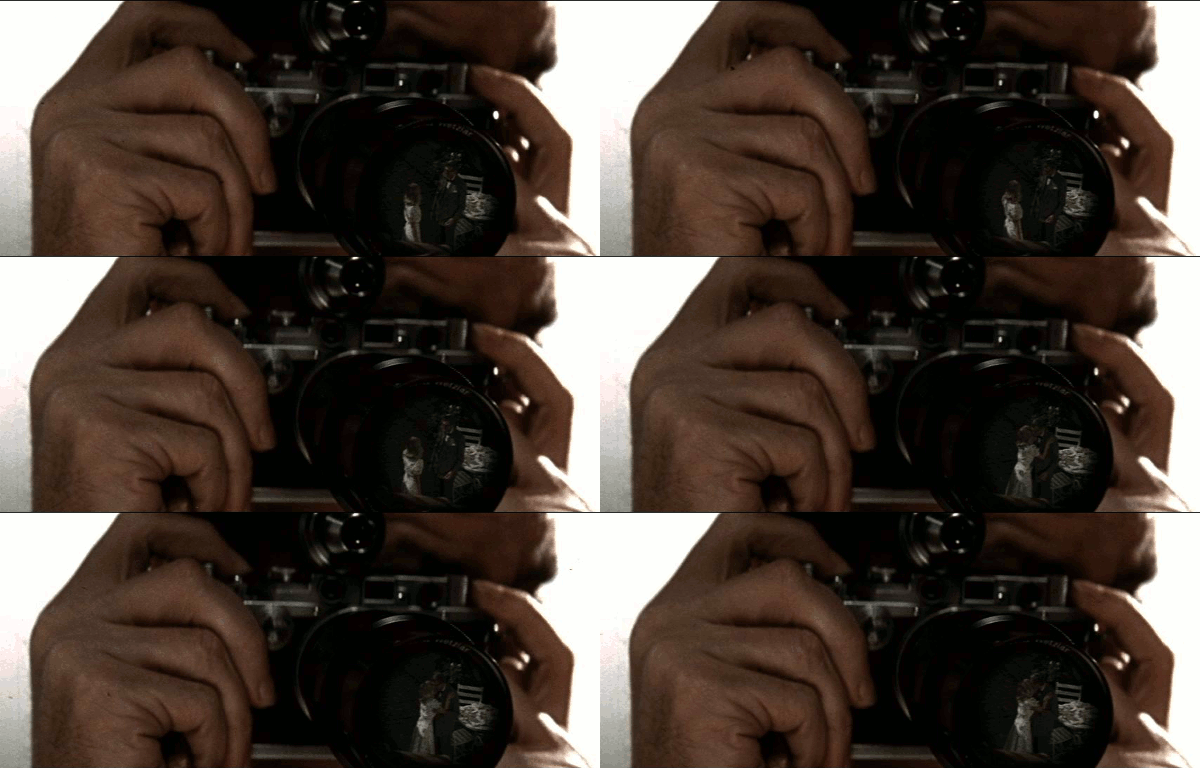
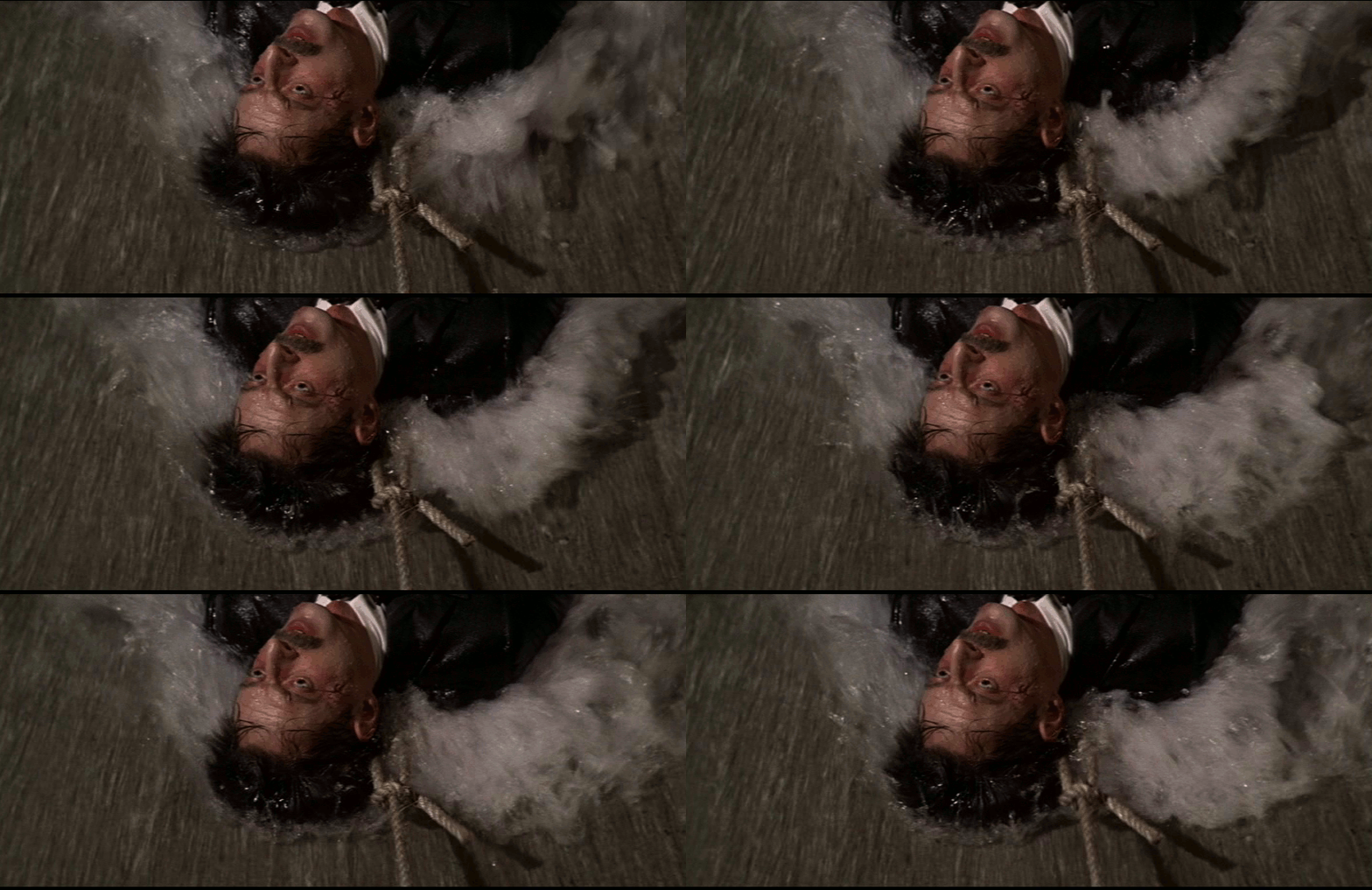
I spent some time making Chinatown GIFs this morning, and I think the shot of Mulwray’s dead body might be one of my better attempts in a long while. GIFs are not only fun to make, they are awesome for slowing down a film and really looking at what’s happening in a shot.

chinatwon_camera 01

I particularly like Mulwray’s dead body GIF because the camera pauses on the face for just a fraction of a second before pulling him up through the shot (one of the most memorable in the film for me). The GIF freezes that moment, and allows you to examine the body that sets the beautifully convoluted plot into second gear.

mulwray_dead 072

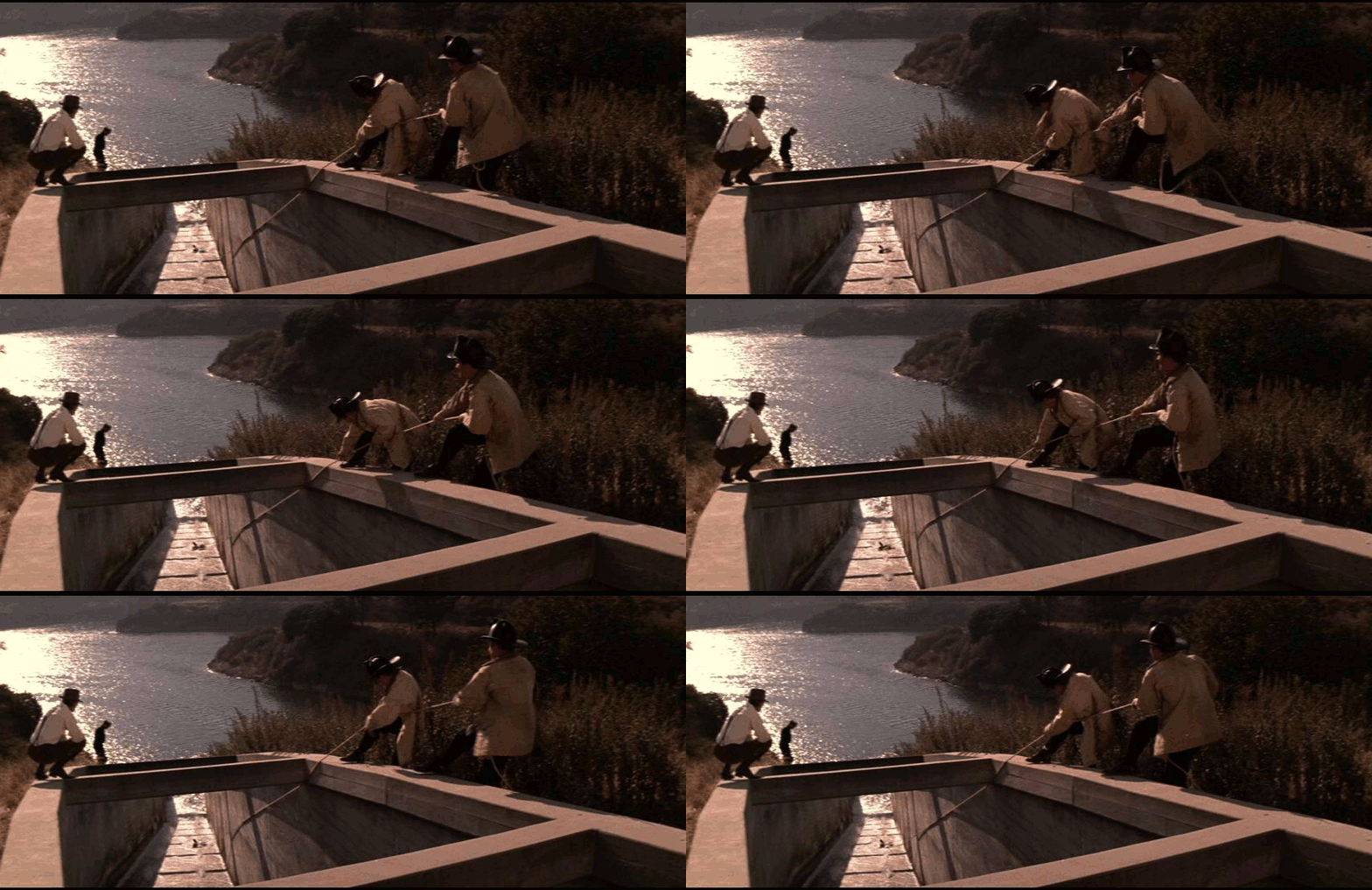
I also used a mask in the following GIF of the men pulling Mulwray’s body up the conduit to brush up on some of those skills, but I know I could have done a better job. Can you find the mask?

chinatwon_body1 01

Posted in digital storytelling | Tagged , , , | 3 Comments

Former Ventura County Sheriff Claude Mulvihill

I read Robert Towne’s script and watched Roman Polanski’s classic neo-noir Chinatown (1974) this week for noir106. This class is becoming an excuse for all kinds of fun things. We’re focusing on writing out of the gate this time around, and Paul Bond added the script of Chinatown as one example. I’ve seen the film several times, but never read the script. Doing the two in concert, I was struck by how few changes to the script (including the stage direction and shots) where made.

ChinaYelburtonMulvihill

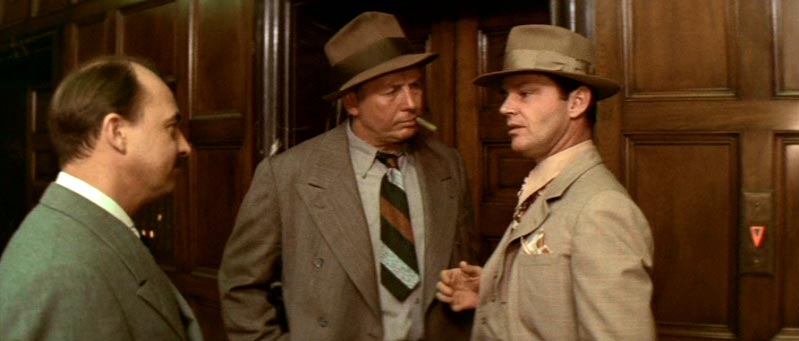
Rather than going through all the differences, I wanted to focus on one relatively small, but interesting one. In the scene where Gittes first goes to the L.A. Department of Water & Power to find Mulwray, he runs into an old acquaintance: hired thug Claude Mulvihill. In the script (page 24-25), Gittes talks some smack on Mulvihill:

He goes out the door, nearly running into a man who is standing by the Secretary’s desk – about GITTES’ age only a head taller and a foot wider, dressed in a plain suit that fits him about as well as a brown paper bag.

                              GITTES
Mulvihlll, what are you doing here?

OUTER OFFICE – YELBURTON, MULVIHILL AND GITTES
MULVIHILL stares at Gittes with unblinking eyes, remains by
the desk.
MULVIHILL
They shut my water off, what’s it to you?

                              GITTES
How’d you find out? You don’t drink it, you don’t take a bath in it, maybe they sent you a letter. Ah, but then you’d have to be able to read.

The two face-off, but that’s the end of it in the script. In the scene from the film, however, there’s a bit more. Yelburton explains to Gittes that Mulvihill was hired to guard against the desperate farmers in the valley who have become dangerous given the drought. Setting up what’s to come. In response, Gittes provides a little backstory about Mulvihill that I found interesting. While Ventura Country Sheriff during prohibition, he let rumrunners run tons of alcohol into the country. He was a corrupt cop, and in many ways hearkens back to the gangster era of prohibition that informs some of the earlier noir of Dashiell Hammett, in particular his 1929 novel Red Harvest. You can see the entire scene below.

I liked this bit because it provided some backstory to an otherwise laconic and purely violent character. Admittedly, it only serves to reinforce his brutality, but I liked the way it situated these two characters’ histories within a long line of corruption and greed. There is a whole story there between the two that makes the tension between them that much more compelling. It also highlights two of the major themes of the film: 1) power and money outstrip any broader sense of law and order, 2) in this film everything revolves around water, even this small detail about Mulvihill.

Fun fact: Looking at Towne’s Wikipedia page, I learned he met with writer John Fante to talk about 1930s LA while researching Chinatown.Which is interesting because Paul and I included Fante’s Ask the Dust (which Towne made into a film in 2006) on our Hardboiled fiction syllabus back in 2012—knowing it was a stretch. At the same time, it’s a book I come back to again and again when I read novella’s like The Postman Always Rings Twice or watch Chinatown. Now I know why 🙂

Posted in digital storytelling | Tagged , , , , | 5 Comments

Moral Endings in Cain’s Postman Always Rings Twice

Postman-Always-Rings-Twice-3

Image from 1946 film Adaptation of Postman Always Rings Twice

Picking up on my last post about the broader crisis of existential meaning in Hemingway’s “The Killers” for noir 106, it might be be interesting to look  at James M. Cain’s 1934 novella The Postman Always Rings Twice. I this reading I was struck by the deeply perverse relationship the main characters had with religious morality. There are a few moments when their intimacy is marked by an overt religious profanity. For example, when Cora tries to defend the suggestion that murdering her husband is all right, she says:

“Who’s going to know if it’s all right or not, but you and me?”
“You and me?”
“That’s it Frank, that’s all that matters, isn’t it? Not you and me and the road, or anything else but you and me.”
“You must be a hellcat, though. You couldn’t make me feel this way if you weren’t.” (17)

This solipsistic relativism is the moral fabric of their relationship. The two spend most of the novella trying to figure out how avoid suspicion by the authorities, all the while remaining completely unconcerned with what they’ve done. Despite the fact their victim, Cora’s husband Nick, is a good guy by both their accounts. Cora refuses to acknowledge a moral universe outside the two of them, which leads Frank to call her a “hellcat.” [Paul Bond has a great reading of the significance/symbolism of cats in this novella that I highly recommend.] And after that, without ever articulating  it, murder becomes the only option for the couple. The final passage of that scene ends on an particularly interesting note:

“That’s what we are going to do. Kiss me, Frank. On the mouth.”
I kissed her. Her eyes were shining up at me like two blue stars. It was like being in church. (17)

This reference to “being in church” at the moment they consummate the plan to kill Nick is a pretty ungodly simile conflating religious communion with the act of murder. This might be one of the reasons this book was banned in Boston, and could explain why it was the inspiration for Albert Camus’s The Stranger.  Ultimately, they break their pact and betray each other—“like wild animals” (a recurring theme in the novella)— when they are tried for Nick’s murder. They’re ultimately exonerated thanks to the greed of a few insurance companies, but that has nothing to do with Cora’s moral order. They were on some kind of untouchable “mountain” accordingly to her:

“…look at us now. We were up on a mountain. We were up so high, Frank. We had it all, out there, that night. I didn’t know I could feel anything like that. And we kissed and sealed it so it would be there forever, no matter what happened. We had more than any two people in the world. And then we fell down. First you, and then me. Yes, it makes it even. We’re down here together. But we’re not up high any more. Our beautiful mountain is gone.”

This idea of sticking together is far more important to Cora than any of the repercussions from the  actual murder. In fact, she was at the height of her happiness just after they had murdered Nick and sealed that bond sexually. She goes on:

“We’re just two punks, Frank. God kissed us on the brow that night. He gave us all that two people can ever have. And we just weren’t the kind that could have it. We had all that love, and we just cracked up under it. It’s a big airplane engine, that takes you through the sky, right up to the top of the mountain. But when you put it in a Ford, it just shakes it to pieces. That’s what we are, Frank, a couple of Fords. God is up there laughing at us.”

This moment wherein God becomes the source of their happiness and love in the immediate aftermath of the murder suggests a pretty skewed vision of Cora’s moral order. Their turn to the devil is equated with their personal betrayal of one another during the trial, it has nothing to do with Nick’s death. For most narratives murder would be the source of psychological torments like guilt, shame, and self-loathing. There is none of that here. The ability for Frank and Cora to divorce themselves from these emotions represents the most harrowing element of this novel. Which, for me, highlights the deeper, darker existential themes undergirding noir.

The last few pages of the novella wherein Frank and Cora realize they are having a child and seemingly shed their evil ways seems tacked on at best. This shoddy resolution can’t begin with explain or deal with the moral relativism unleashed by these murderous lovers. And while they both ultimately meet their untimely end—Cora in a accident (not on purpose) and Frank in the gas chamber— the novella seems to almost force a fatalism that is at odds with the world Cain created. It’s as if they had to die for what they did because morality demands it—but not the morality we have been subject to for the previous 110 pages.

In short, it’s not a believable ending. What would be more believable is they do live, have their baby, and carry on as if they did nothing wrong—as long as they stay together. The ending tries to right the depravity which became normalized throughout the tale. As hard as Cain might try, killing them won’t reverse the effects of having immersed us in their moral universe for the length of the book. It’s as if he’s as bad as Frank and Cora in some ways 🙂

Posted in digital storytelling, film, film noir, Uncategorized | Tagged , , , | 1 Comment