Taking Over the Means of Connected Production

The thing that excites me most about the web is the idea of taking back the means of cultural production, even if only for a moment. That’s probably why ds106 still remains the higlight of my time as an edtech. I felt like a group of people coordinated their energy in order to take over the means of both production and distribution. They created in a variety of ways, often times as an interactive critique of the media culture within which they exist. I had joked quite a bit when ds106radio and ds106tv were emerging that we controlled the “vertical and the horizontal” —the “outter limits” of cultural production. For a moment it felt like we truly were the network—and that was sublime.

Now there are limits to the time and energy any given group of people can devote to something so intense, and you can’t force it. It comes when it comes, and goes when it goes. That said, there are some conditions you can create to make the soil more fertile, and I that’s what I see as the real value of the Connected Courses experience running this fall. A whole bunch of people will be workig together to frame the conditions of possibility that might engender magic in a connected course, acknowledging that networked magic is often tied to a whole lot of labor.

I like the way Laura Hilliger frames the class in her post about it earlier today:

The coursework will help you understand how we work in the digital space by demystifying the tools and trade of openness. We’ll explore why you might run a Connectivist learning experience, how to get started, how to connect online and offline participants, and how to MAKE things that support this kind of learning.

We’ll talk about building networks, maintaining networks, diversifying networks and living and working in a connected space. We’ll learn together, share ideas and start making action plans for our own connected courses.

A course like this is all about demistifying the means of production to lay bear how one might run a connected course. She also alludes to the intense work it takes to build and maintain networks, diversify your connections, and work collaboratively to build your online identity.  There’s a lot of labor involved, but that can be rewarded with the sense of real accomplishment and empowerment that results from building not only your own connected course hub—but your online networks.

But the real reason to do it doesn’t have nearly as much to do with laying bear the materialism of the web or raging against institutional siloes or building your network—though all of those would get you a passing grade on the test. The real reason is there’s possibility of magic in such an approach. There’s a point where the time, energy, and faith in a seed of networked learning could transform into an experience of taking over the means of cultural production for even a moment—creating a networked space where you’re course transforms into a community of people become producers, distributors, and consumers simulataneosuly. The vertical and the horizontal. That’s become the high watermark of online, open, connected learning for me, and my paltry contribution to Connected Courses is trying to share and model how a group of us built the infrastrcuture, communtiy, and ethos around ds106.

Posted in Connected Courses, digital storytelling | Tagged , | 2 Comments

S3 Commando (Line)

Image credit: Screenshot of Hulk Hogan in Suburban Commando

Image crdit: Screenshot of Hulk Hogan in Suburban Commando

In my last post I wrote about moving bavatuesdays (and the rest of my personal, server based online life) to Reclaim Hosting. It was long overdue, and it might be appropriate to recognize that my partner in all things Reclaim, Tim Owens, has breathed new life into just about everything I do these days. Not only did he architect the Reclaim Hosting infrastructure from the ground up, but he’s also a ticket support guru. More than that, he’s got me installing and playing with new open source applications like Known, imagining possibilities for virtualized servers environments, and even pushing myself to wrap my head around services like Amazon S3, which I’ll get to shortly.

He’s inspired new life into the work we do at DTLT, in fact he’s really helped us return to the experimental spirit and fun that defined this group from 2004 through 2008. I would wager I’m not the only one at DTLT who feels this way, because on top of all the awesome he brings to bear on what we do, Tim’s a complete pleasure to work with—sharp sense of humor, no ego, and all about pushing on the edge of edtech ferociously. En fuego.

I wrote that so I can write this, Tim has been coaching me though my move from my old host to Reclaim, and we’ve been in a holding pattern for a few months. The obvious reason is time, another is I suck at passwords, and a third is I have some crazy DNS, subdomain, wildcard apache redirects happening on the multi-network WordPress site I have been hacking on since 2007. It’s a house of cards, and after this move I’m going to revisit how it’s setup, but in the meantime making sure the various domains and subdomains mapped onto my multi-network site worked took a bit of courage.

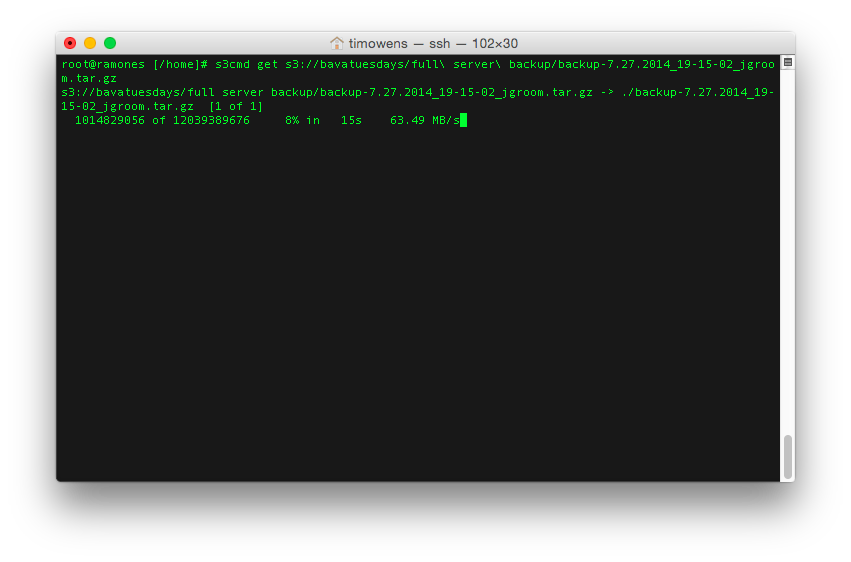
I finally committed to moving my online life this weekend. After doing a full backup of my cPanel, I tried uploading it via FTP to the Reclaim Hosting server I would be moving to. Unfortunately the 12 GB compressed file failed to transfer to the new server via both FTP and the File Manager in cPanel. The only other way I thought I could get this fairly large file to Tim was uploading it directly to Amazon S3, which I did. Turns out, that was a great solution because Tim showed me how I could use S3 command line ( s3cmd ) to actually transfer that file to the server in a matter of seconds (the download from my old server took over four hours, and the upload to S3 took over an hour at least).  So, below is a tutorial Tim created for me explaining how I could use s3cmd to transfer my full backup from Amazon S3 to the Reclaim Hosting server. So cool!*

The tutorial below was written by Tim Owens, I am stealing it for posterity. I blurred out various credentials for Amazon s3, but the commands he employs to make this happen are all there. I’m beginning to understand why the hardcore geeks prrfer command line, more custom control!

____________________

Using s3cmd to work with Amazon S3

s3cmd is a command line tool that will allow you to interact directly with Amazon S3 buckets that you have access to. You can do a variety of things from downloading or uploading files/folders to syncing a folder’s contents to a bucket. Here’s a quick tutorial to download a specific file (you can view all available s3cmd commands here).

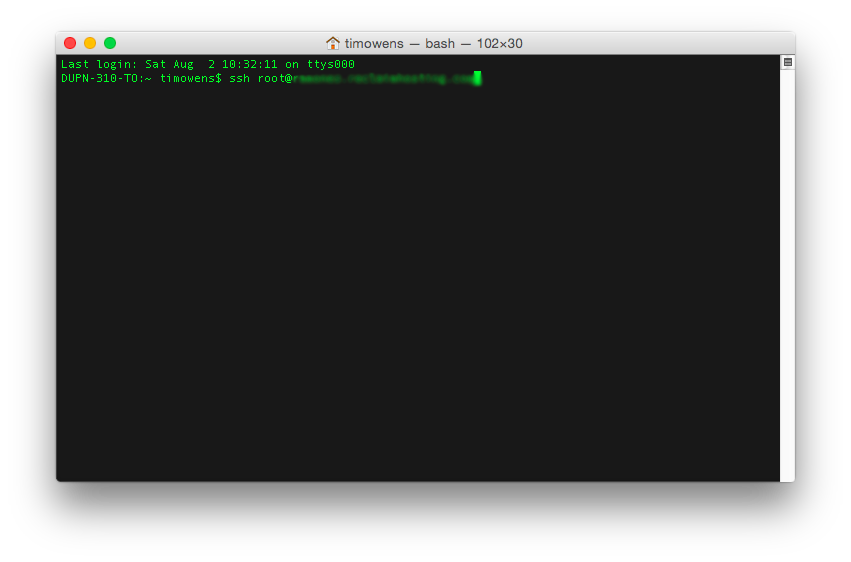
1. Log in to a server via ssh
s3_commando1

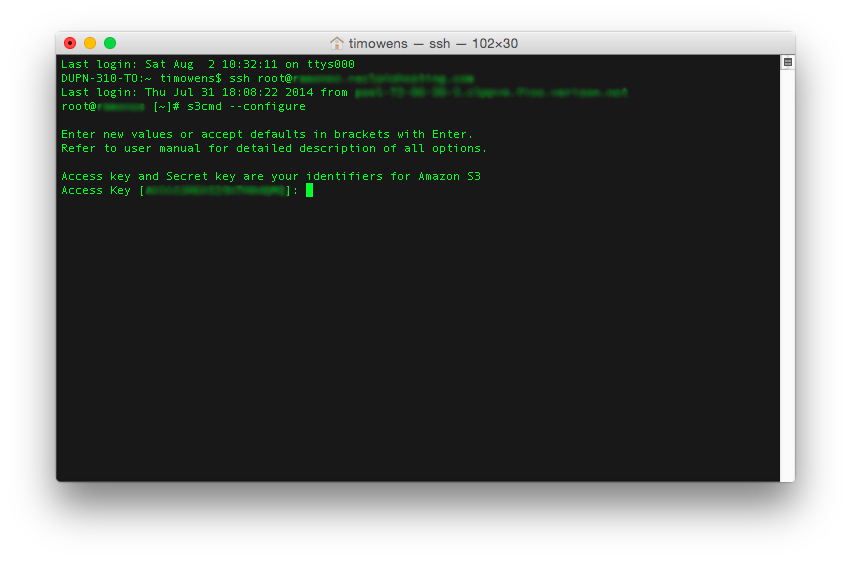
2. You will use the command s3cmd –configure to setup your access to S3. It asks for the Access Key ID and Secret Access Key. I don’t currently put anything in for encryption or SSL.
s3_commando2

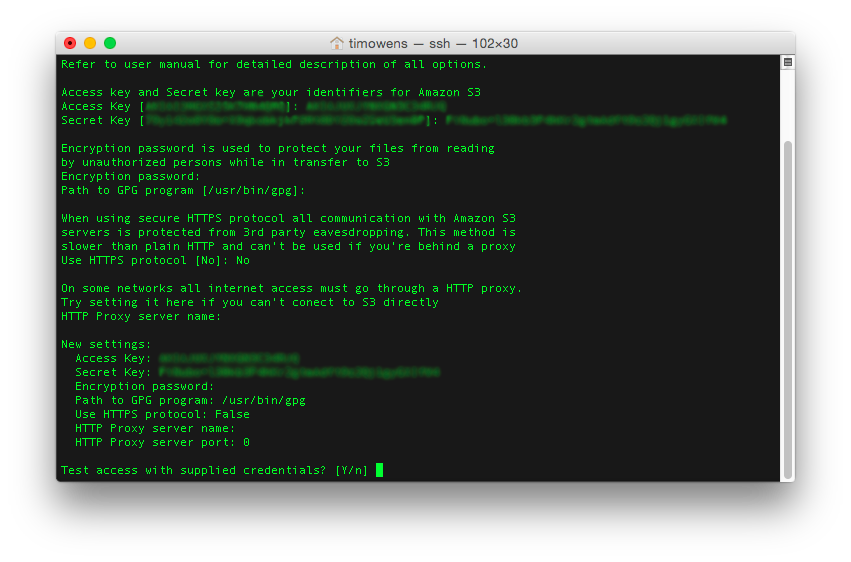
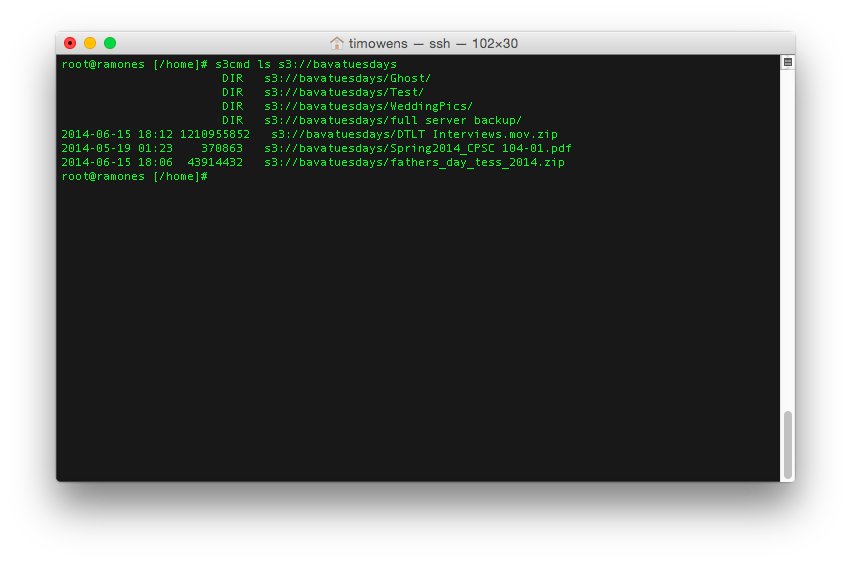
3. You can test the credentials to confirm s3cmd can communicate with Amazon S3. Then navigate to where you want to download the file to. You can list the files in a bucket by typing s3cmd ls s3://bucketname
s3_commando3

4. Downloading a file is as easy as typing s3cmd get s3://bucketname/filename and it will start downloading. Transfer is really fast since it’s a direct connection between the server and Amazon S3.
s3_commando4

5. You’re done! The file will now be stored locally on the server.
s3_commando5

*Tim’s tutorial is so good, particularly because he did the transfer to reclaim while writing it, saving me an extra step of actually using the s3cmd 🙂 Although, I spent the next hour transfering random large files to the Reclaim server just to be blown away by a 1 GB file being transfered in 15 seconds.

Posted in Archiving, AWS, bavatuesdays, s3 | Tagged , , , , , | 1 Comment

I’m a Reclaimer Now

Imae Credit: Kin Lane’s Reclaiming Fist

The work I’ve been part of with Domain of One’s Own encouraging faculty and students to get their own domain and web hosting has a pretty long history that pre-dates my time at UMW. Almost twelve years ago now, my friend Zach Davis turned me on to the world of commodity web hosting.* He spun up a server and encouraged me—and a bunch of his friend around the country—to get a domain. What’s more, he helped us point those domains to his server and gave a bunch of us cPanel accounts so we could actually use it. He created a hosting co-operative, similar to what Tim Owens did with Hippie Hosting two years ago, and what we’re doing together with Reclaim Hosting.  I had no idea how important that offer of a domain and web hosting would be to my career more than a decade later.

When I talk about web hosting in regards to a platform for understanding of how the web works,  I speak from experience. The technical stuff has never been intuitive for me, I’ve spent a lot of time trying to grok how domains, servers, code, databases, etc. work together to make the web. I’m still struggling with that, and the work with WordPress and other open source applications on a LAMP server stack has proven invaluable for wrapping my head around this stuff.

So, why the nostaglic look back in time? Because for near on twleve years I have remained hosted with Zach. I spent years on the hosting co-operative he started, and then moved with him to Cast Iron Coding‘s servers, which is his successful Portland-based business. He’s provided a home on his servers for all my web work, not to mention ongoing advice and support for my experiments with WordPress over the years. Zach’s been a huge influence and inspiration for the work I’ve done up and until now, and while he’s ready to kick my ass out the door of Cast Iron Coding’s servers—I’m a little sad to go. I consider myself a loyal person.

That said, I guess it was high time I move all my web stuff to the bitchin’ hosting company that I’m helping to run. Tim Owens has Reclaim Hosting running like a top, and with the new backup system—just to name one recent feature—I’d be crazy not to move. I see the role of Reclaim Hosting as similar to what Zach did for many of us back in the early oughts, we’re providing as many faculty and students as possible with a hands-on platform for understanding of how the web works.

I’m now officially a reclaimer, and all my domains are finally off Godaddy. It’s almost like I am getting my digital life in order, and it feels pretty damn good!

______________________

*Zach also turned me onto instructional technology while I was at CUNY, and introduced me to Downes’s the OL Daily.

Posted in reclaim | Tagged , , , , , , | 3 Comments

Hollywood Forever

Both before and after my time working on Connected Courses at UC Irvine, I had the privilege of hanging out in Los Angeles proper—the city of angels. LA is near and dear to me, I spent my formative years there from 1990 to 1997, and much of who I became as an adult was forged in that smoggy furnace of film culture. I plan on spending more time in LA in 2015, and given that my good friend Mikhail Gershovich and his family recently moved there—I now have a family to impose on!

Jonah and Eli enjoying a slice in Larchmont

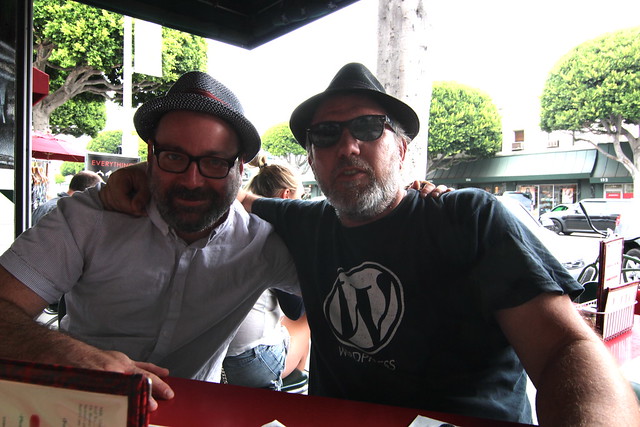
In fact, I already have, and as usual Jennie and Mikhail—as well their two sons—were awesome. In fact, after being picked up from the airport by Mikhail and seeing his fetching hat, getting my own was one of the first things I did, right after eating Cactus tacos (yum) and seeing Dawn of the Planet of the Apes (suck).

Men with Hats

Once I secured the hat and we ate some pizza we went on a tour de force trip from Larchmont to Highland Park to Simi Valley and back again to Hollywood Forever Cemetery. It was an awesome day. We visited Galco’s, an old school soda pop shop that is “dedicated to the art of soda pop.” They sell a variety of sodas, but only ever in the bottle. The proprietor is a soda evangelist, and he was a truly compelling man. He has a convincing argument as to why plastic and aluminum packaging have effectively eroded good tasting soda, responsible for the limited selection of mediocre pop we have access to today. It’s as if he were talking about Learning Management Systems. Who Knew?

Galco’s Soda Pop Stop

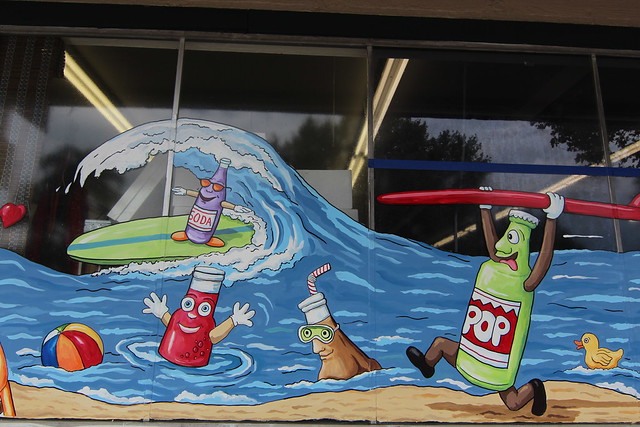
Galco’s window mural featuring soda pop art was being painted while we visited.

Scenes from a soda pop mural at Galco’s

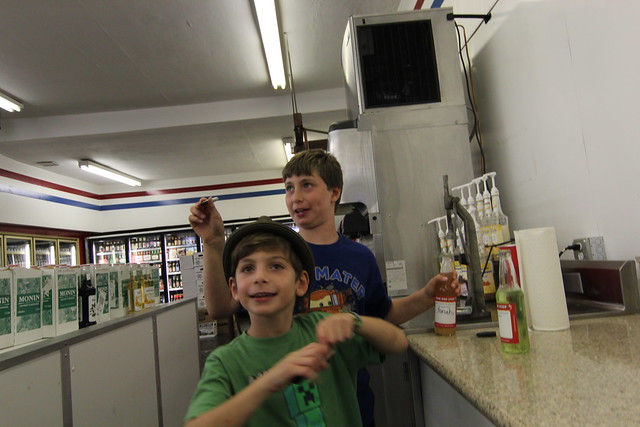
Jonah and Eli DIY their soda pop at Galco’s

It wasn’t just soda either, Galco’s had an awesome selection of old gold candy

After our stop in Highland Park at Galco’s, we headed to Simi Valley to drop off the kids at the grandparents,  which provided me the opportunity to see Mikhail’s boyhood home. It’s a sign of age when you’ve had a friend for over 15 years but have no idea of where and how they grew up. It felt like I was filling in the details, and there is no greater satisfaction than having friends long enough to get a broader and deeper sense of where they came from.

Mikhail in front of his boyhood home in Simi Valley

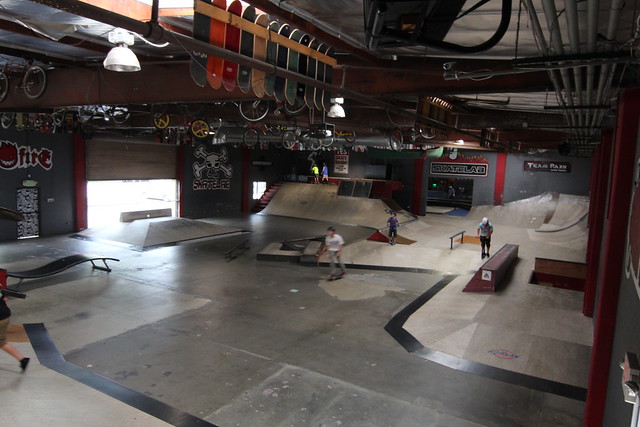
After talking with Mikhail’s parents about his patio—he really needs to pave up to the garage—he showed me a pretty awesome skatepark in Simi Valley called SkateLab. It was founded by Scott Radinsky, who is not only a skater and Nardcore punk rocker, but also an accomplished Major League pitcher. Skatelab was the first of its kind indoor park, and is also the home of a Skateboard museum as well as the Skateboarding Hall of Fame—how could Rodney Mullen not be part of the inaugural class of inductees?

Skate rat at Skatelab

Skateboarding museum at Skatelab

Skateboarding Museum at Skatelab

Skateboarding museum featuring some toys

I was a skater in the late 70s through the 80s, and so the wall of decks broken down by decades was a nice walk down nostalgia lane. Neil Blender, Kevin Staab, Christian Hosoi, Gator Rogowski, and many more.

1980s decks at Skatelab

Close-up on skate decks from the 1980s

1980s decks

The scene at Skatelab

The bowl at Skatelab

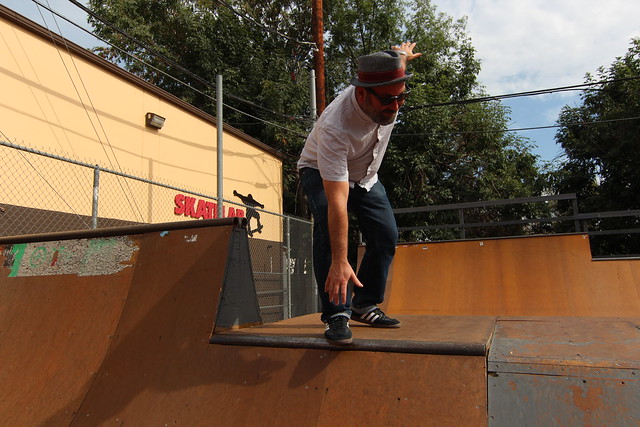
Mikhail drops in on the half pipe at Skatelab

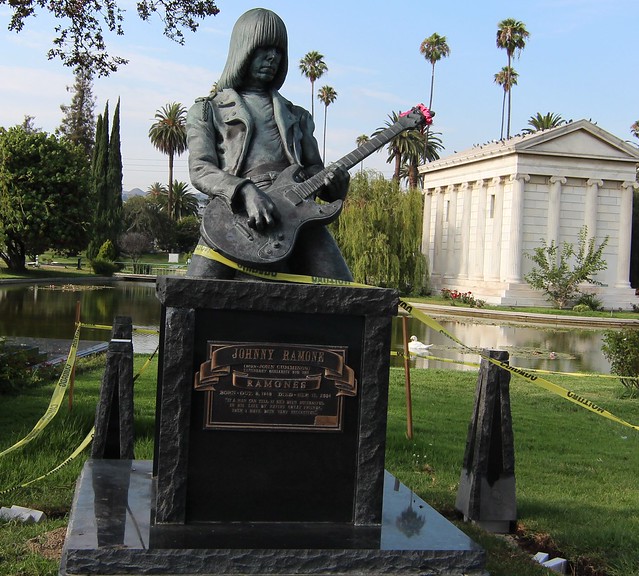
After I took in about as much as I could take of 1980s skating nostalgia, we headed back to Hollywood Cemetery for a reminder of where we are all headed 🙂 Including 1970s and 80s punk icons Johnny  and Dee Dee Ramone. My camera ran out of juice before I could capture Dee Dee’s headstone, which was far less ostentatious than Johnny’s.

Johnny Ramone plays at Hollywood Forever

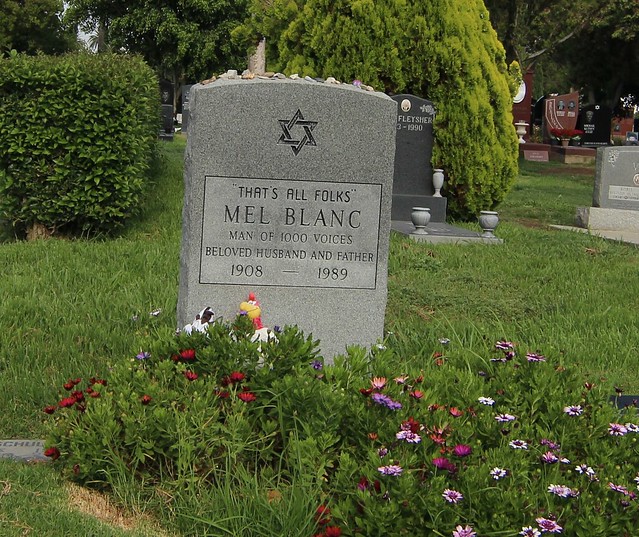
There was also Mel Blanc’s grave, the man of 1000 voices from my childhood.

Mel Blanc at Hollywood Forever cemetery

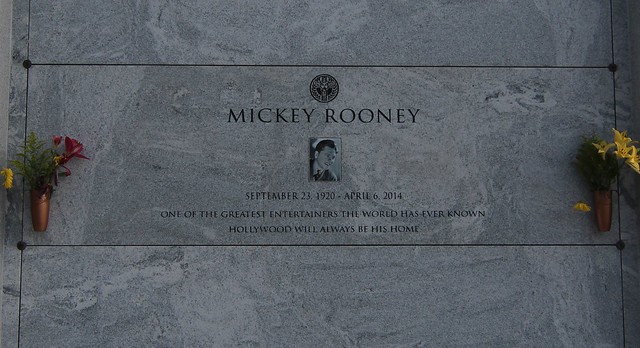
There were a ton of other people buried here, but one of the more recent tenants is Mickey Rooney, who died in April.

Mickey Rooney’s eternal home in Hollywood Forever

And that was just one day! I have much more to share about my trip including the detials of the Connected Courses bootcamp, the Reclaim Your Domain Hackathon, my trip to CSU Channel ISlands, as well as my return to UCLA. But I have to accept I’m gonna need a bigger boat, or at least a few more posts.

Posted in LA: The Potent Years | Tagged , , , , , , | 2 Comments

Connected Courses

It’s been a long while since I posted on the bavablog, but I have a few good reasons as to why. I’ll be blogging about each of them over the next week or so (I’m back in the blog game!), but let me start with the first reason of many: Connected Courses. The official announcement will be coming will becoming next week, but I have been promising Howard Rheingold, my co-conspirator in this experiment, a post trying to explain what the hell Connected Courses is for some time now. I have failed at my charge thus far, but he’s a hippie so hope springs eternal for him 🙂
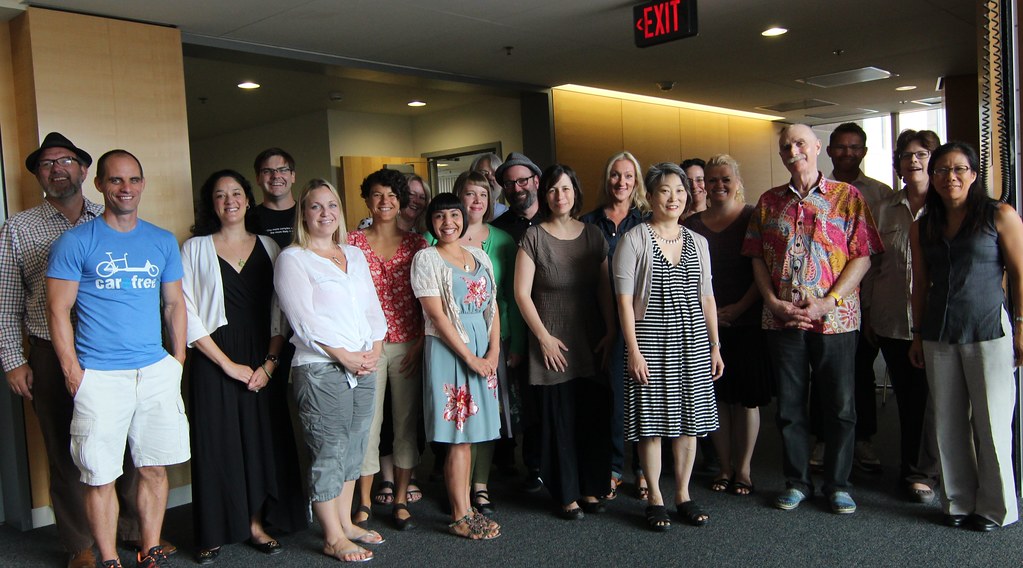
Connected Courses Crew at UC Irvine for Course Design Bootcamp
Below is my peripatetic attempt to explain Connected Courses, which I’ll be a part of alongside an amazing cadre of educators that I’ll do my best to namecheck after I take a stab at a description. But one more thing before that, the road towards designing Connected Courses consisted of six months of planning, numerous calls, and a three day intensive bootcamp at UC Irvine that took place two weeks ago. I’ll try to write more about the details of that experience, but I think framing the road to perdition might help contextualize what’s to follow. Now let me try and explain the genesis and raison d’etre for Connected Courses and what shape it may be taking over the Fall 2014 semester.

After being interviewed by Howard Rheingold for a Digital Media & Learning (DML) video about connected learning last summer, he somehow caught the ds106 bug. As some of you fine readers may know, it’s a very dangerous condition. The ds106 bug occurs when you get exposed to the awesome community that undergirds the digital storytelling course that started—and is still happening—at the University of Mary Washington (UMW).  As a result of this infection, Howard wanted to explore how we might get DML to help provide some resources for getting educators exposed and interested in possibilities for creating a similar course. As we started to think about it, we imagined a series of web-based resources that would help interested educators get up and running with their own domain and web hosting so they could explore the various options available to them with such a powerful open source toolbox. This was modeled on what we do with participants in ds106 as well as an initiative we’re running out of UMW called Domain of One’s Own—which Howard and I explored in depth this Fall with a  three-part video series dedicated to demosntrating how we built the aggregated hub for his Stanford course.

When Howard went to Mimi Ito with the idea, she not only dug it, she wanted more. Her idea was to try and bring together a group of educators who have taught courses that embody the principles of connected learning and the values of the open web. Some examples of such courses are Alec Couros‘s ETMOOC, Jonathan Worth‘s Phonar, Anne Balsamo‘s cooperative FemTechNet, the National Writing Project’s  CLMOOC, and Gardner Campbell‘s Thought Vectors to name just a few. In fact, as part of DML’s Reclaim Open Learning Symposium last Fall, a few of these courses were recognized for their respective approaches to open, web-based teaching and learning.*

Our goal is to build an inclusive and expansive network of teachers, students, and educational offerings that makes high quality, meaningful, and socially connected learning available to everyone.

So, as timing and luck would have it, we were able to bring folks from each of these courses to UC Irvine two weeks ago to spend an intensive three days designing an open, online course that will be launching in September. The idea is relatively simple, we’ll be providing a framework and support for educators who want to explore what it means to teach a connected course. The dream is that it becomes a broader, inclusive community that fosters and supports ongoing collaboration and exploration.

The course will be broken down into seven major parts, and they will happen from September 2nd through the middle of December. It will cover a wide swath of topics related to connected learning.

Sept 2 -Move-in/Orientation: The first two weeks are being consider a pre-course orientation. I’ll be working with Alan Levine and Howard Rheingold to get any interested faculty their own domain and web hosting. We will provide support for folks who want to get their own domain up and running, as well as an overview of what’s possible in such a space.

September 17th – Why We Need a Why?: The course officially starts with the why.  What is, or should be, the future of higher education?  What do we stand to lose or gain in pursuing the possibilities opened up by the Web?  What are the underlying logics and effects of different approaches to teaching with technology/online? This two week unit will be led by  Michael Wesch, Mimi Ito, and Helen Keegan.

September 29th – Trust and Network Fluency: This unit will be led by Jonathan Worth and Kira Baker-Doyle, and they will explore a range of questions including: In the quantum learning space where interest is a key driver, how do we employ the same dynamics in our teaching? How do we maintain trust and a sense of security in open networks? How do we build our networks? How do we enable at-large learners to engage in our courses? Where should we teach our classes?

October 13th – The World Wide Web: From Concept to Platform to Cultures:  Gardner CampbellKim Jaxon, Chris Mattia, Howard Rheingold, and Laura Hilliger will lead an exploration of the web, exploring the following issues:  What is this thing called the World Wide Web? What are the values and ambitions that gave rise to its design? If “the medium is the message,” what is the message of the web? What are some threshold concepts that help us to understand what is meant by “the web”? How is it reframing learning and education?

October 27th –  Diversity, Equity, Access: Facilitators Lisa Nakamura, Anne Balsamo, Liz Losh and Veronica Paredes will examine the assertion that wisdom is created through discussions over differences. This unit will explore the implications of race, gender, and sexuality on networked culture by employing a feminist pedagogy that demonstrates a praxis of networking and mentoring.

November 10th – About Co-learning: Facilitators Howard Rheingold, Mia Zamora,and Alec Couros will explore how self empowerment emerges within classrooms that embrace co-learning. And by extension, how networked learning contributes to self empowerment as students take more charge of their own learning outcomes and share their interest-driven knowledge. This unit will explore how this pedagogy differs from traditional methods of teaching & learning? As well as how instructors can support a co-learning environment?

December 1st – Putting it all into practice: Planning the connected course: For the final unit I’ll be joined by Lisa M. Lane, Jaime Hannans, Jaimie Hoffman, Mikhail Gershovich, and Alan Levine to help people focus on practical issues like building their course site, creating a syndicated site, digging into specific issues that arise when teaching an open online class, reflections on previous weeks’ activities, as well as feedback on specific assignments and projects while building a connected course. Like the orientation week, this will be on the ground support and feedback to help faculty practically employ some of the ideas explored on their own technical platform.

It’s a pretty intense cast of characters that will be providing a fourteen week, top-notch professional development opportunity for anyone who wants to explore the various technical, social, and cultural implications of teaching on and through the web. I’m working on coupling this experience with a focused cohort on the ground here at UMW. And I am aware of several others campuses that are doing the same thing. The idea is to get faculty up and running with their own space so that they can explore the web as a portal to imagining possibilities for their own courses. The various topics over the course will allow folks to dip in and interrogate a variety of issues they’re interested in, yet the experience starts with a technical primer on setting up your domain and webhosting and is bookended with specific, practical applications that provides hands-on technical guidance and course design feedback to help anyone interested design their own connected course.

I think that’s pretty cool, using the a connected course to scale connected courses, it’s very reflexive 😉 The site and registration will be up and running next Friday, so consider this long, meandering post a preview, if you even made it this far.

____________________________

*In fact, that event was born out of the DML sponsored Reclaim Open Hackathon that gave birth to the Reclaim Your Domain work I’ve been part of this past year, which is gaining some momentum and a broader community thanks to the recent Reclaim Your Domain Hackathon in LA.

Posted in Connected Courses, Uncategorized | Tagged , , | 7 Comments

The Stump Speech for Higher Ed’s Relevance that Wasn’t

Image source: 1859

Image source: 1859

I already wrote a bit about my experience at the symposium for Framing the Future of Higher Education I attended on Friday in Austin, Texas. I was part of an opening discussion around the changing role of faculty in the future of higher education. While I am not a professor, the work I did with ds106 has suggested to many that I might be some demented, cyborgian vision of what’s to come.  I can only hope they’re wrong.

I really liked the format of the conversational featured session, and it was a pleasure responding to Sally Johnstone’s ideas. The plan was to have a quick 8-10 minute intro where we talk about our vision of the future of higher ed. As an exercise I wrote up my position, and for a minute I though I might use it. But I abandoned it at the last moment because it didn’t feel right. I ended up talking specifically about what UMW’s doing with Domain of One’s Own, and the vision of a community inspired to interrogate the digital landscape as part of a broader interdisciplinary approach to the liberal arts.

I’m including what I wrote up for the initial speech below with hopes I might come back to it and make it better (or someone out there will 🙂 ). It’s too preachy and not nuanced enough on the issues of cost, privilege, and ackowledging and exploring the wide-range of alternatives on the landscape. That said, the idea that higher ed (not vocational training and certification) at it’s heart should be a place that cultivates alternative ways of imagining the world we live in would not get cut. I truly believe it should be a place of stark critique, creative possibilities,  and boundless hope, but that’s probably why I am ever more useless going forward. My ideals and the reality couldn’t be more divergent in the aggregate. I’m trying to be honest with myself on that count, but it still hurts.

What’s the role of higher education?

This is a question we could probably dedicate a series of conferences to, and I’m well aware it’s a far broader question than we can cover in this discussion. But it’s an important anchor for my position within this discussion. I think the role of higher ed is not just to teach and certify students, but also challenge some of our most sacred cultural assumptions.

The discussion around access to an education is often limited to the political keywords of lowers costs and equal opportunity, and while they’re both crucial, there’s a third element of access associated with the university that’s eroding: access to truly alternative ways of thinking. An educated community that is given the freedom and power to critique who we are and what we do. I would argue it’s not only crucial for students to have access to these ideas, but also for our culture at large.

[Aside: a large part of this erosion is brought on by the tenured class of academics themselves–welcoming in a wave of adjunct labor to work for a fraction of the cost that often enabled less teaching and more freedom, but without any mind to the longterm implications of this reality. ]

We’ve become increasingly polarized as a nation when it comes to politics (#theteaparty), religion (#hobbylobby), and wealth (#occupy), and there’s little question anymore, at least legally, that corporations are increasingly the people we aspire to be. But for me, and I can only speak for myself in this, education provided a space for us to move beyond these extremes. A space to cultivate a more nuanced, historicized understanding of the ideas that shape who we are as a society. A meta-level of cognition to begin to think about how we think, a space to commune with people who have spent a lifetime thinking about thinking.

Now don’t get me wrong, I’m not suggesting this is the only model for learning or becoming accredited or qualified, but rather a moment wherein we are all encouraged  to dig deeply and critically into who we are, a historical context for the moment we exist in, and an interrogation of the prejudices and promises of our cultural moment. That requires both agency and academic freedom. It requires funding and protections. It requires time for both faculty and students. And, ultimately, it requires an investment in higher education as a perceived need for the health of our culture. Given the tale of state funding for higher education across the US over the last thirty years, one could easily argue that has not been a percieved need by anyone in power for a long while.

That said, one of the reasons we are here today is to talk about the fact that skyrocketing college costs aren’t necessarily equated with better quality—and better compensated—faculty. According to the article in The Atlantic, “The Ever Shrinking role of Tenured College Professors,” since 1975 the number of full-time tenured and tenure-track professors have gone from roughly 45 percent of all teaching staff to less than a quarter. What’s more, the reverse is true for adjunct faculty. The number of part-time faculty has gone from less than 25% of all faculty in 1975 to more than 40% in 2011.

That’s the story, and one of my roles in this is to imagine how ed-tech can honor the mission of access to alternative ideas while at the same time navigate the shark-laden waters of the politics of defunding higher education. It’s a tricky game, especially for an ed-tech like me from a public liberal arts college in Virginia who palys a professor on TV. That said, I am not without ideas….and hopefully I’ll hit on a few of them during our discussion today.

Posted in presentations | Tagged , , | 6 Comments

The Bloody Waters of Higher Ed

https://www.flickr.com/photos/doobybrain/475576450/

Image credit: Herman Yung’s Great White Shark, South Africa

When the waters get bloody and they’re red, it’s time to move on to bluer oceans.
—Chris Bustamente, President of Rio Salado College

I spent yesterday at Framing the Future of Higher Ed, a conference that consisted of working policy groups, faculty, and business leaders trying to wrestle with how Texas is going to realize Governor Perry’s call for a $10,000 bachelor’s degree in the state of Texas. It is a topic of particular interest to me (and perhaps Virginia more broadly) given state Senator Bryce E. Reeves—whom DTLT sat down with recently—had this initiative on his radar. Doing more with less is a pretty popular sentiment amongst politicians when it comes to higher ed currently, and there seems to be a general consensus that funding for higher ed is not coming back—still a hard pill for me to swallow.

I was invited to engage in a dialogue with Sally Johnstone of Western Governor’s University, moderated by Katie Mangan of the Chronicle of Higher Education, about the changing role of faculty in relationship to the 21st Century given the rapidly changing technology landscape. While I play a professor on television, it’s interesting that a liminal figure like me that stands between teaching and technology should find himself defending such fiscally and politically outdated notions as full-time tenure-track faculty, greater faculty governance, academic freedom, labor organization, and increased funding to subsidize education locally and nationally. Despite my arcane ideas, I really want to be relevant.

That said, I don’t say all this without recognizing that erosion of tenure-track jobs, state/federal funding, and academic freedom has as much to do with decades of faculty being sitting idly by while the growing underclass of adjunct labor made that privilege possible. The  intense struggle around questions of labor (increased pay, fair treatment to adjuncts, increased governance, etc.) between administration and tenure-track faculty that needed to happen in higher ed never materialized on a national scale. The erosion that’s been happening over the last thirty years is far from an offhanded  conspiracy on my part, by this point it’s a fairly well established fact our current reality is the result of a long, slow era of political neglect.

Sally Johnstone is a pragmatist, and she’s genuinely outraged about the state of adjunct labor in higher ed. And to her credit she’s working hard to make sure Western Governors University does not become and adjunct mill. Their competency-based accreditation program allows them to hire a certain amount of full-time faculty and many more full-time (with benefits) positions for an emerging class of faculty that are moderately compensated, work 12-month contracts, and don’t have tenure. These instructors, or tutors as Western Governors calls them, also have little to no pwoer in terms of faculty governance.

As much as I might decry the deprofessionalization of the faculty, Western Governors University is at least doing something for the underclass of highly educated instructors than most other colleges and university. They’re also providing opportunities for students to move more quickly through college at a relatively affordable price (though not a $10,000 Bachelors, they’re cheaper than most public and private 4-year universities).

I found myself a bit turned around, as you might guess. I’m not about to abandon advocacy of a protected, well-paid, and empowered professorate, but at the same time there’s been a perceived—and arguably real—abdication by faculty of their role as leaders in a broader struggle to protect their centrality to the mission of universities. I think for far too long that’s been taken for granted, and the realization these institutions can operate with a contingent workforce makes the case for their centrality that much more fragile. Add a Silicon Valley inspired techno-utopianism and bad politics to the mix and you begin to get a sense of why so many folks close to the political realities of higher ed funding are so sure it’s not coming back.

After the panel discussion with Sally, Chris Bustamente, president of Rio Salado College, framed how his campus serves it’s diverse student body. Part of the Maricopa Community College system, Rio Salado is dedicated to adult education, and offers fully online, asynchronous courses with new classes starting 48 Mondays a year—that’s an insane amount of institutional coordination! That said, his discussion underscored some of the stark labor realities driving the proposed solutions for increased access to higher ed. Rio Salado educates 60,000 students with 22 full time faculty and 1500 adjuncts. Let me say that again, Rio Salado educates 60,000 students with 22 full time faculty and 1500 adjuncts. And while a small percentage of these part-time faculty may do it for the love of teaching as Bustamente suggested, it’s all but certain the vast majority are teaching on subsistence wages to eke out a living, much like many of the students they serve. Such a mixed message about the power of a college education to set you free, at least financially, hasn;t been lost on me since my first adjuncting gig in 1997.

But the real moment from president Bustamente’s talk that hit me like a bullet through a diver’s oxygen tank was his reference to the book Blue Ocean Strategy. When noting many of the Maricopa Community College campuses are moving  into the waters of online education and serving the same population Rio Salado traditionally has, he noted that, “when the waters get bloody and they’re red, it’s time to move on to bluer oceans.” My shark light went off, and it’s pretty timely given Kate Bowles turned one of my recent ramblings about shark survival into a deeper mediation on the current state of online education—she’s an alchemist of ideas and her potion is the beautiful way she mixes her words. Her reminder to resist being pulled too deeply into the MOOC histrionics, so that we “keep one eye on the ocean where the real sharks are” perfectly described my experience listening to the undergirding philosophy of disruption driving the shifts in higher ed, outlined by Bustamente, has everything to do with imagining new markets and moving away from the blood-filled waters we find ourselves in.

This metaphor is not just me being creative because of my love of sharks, this is taken directly from a 2005 business strategy dreamed up by Harvard Business School faculty, and subsequently celebrated as a brave new approach to innovation. Disruption as re-imagining the very terms of how we do business, creating new, uncontested market spaces—in many ways that was the “value innovation” that George Siemens provided as a Blue Ocean when he termed the Artificial Intelligence massive course a MOOC. They had a name and a philosophy for a whole new space of radical innovation—even if it was more like the LMS at scale than anything resembling connected learning. What’s more, it helped distract higher from some of the deeper, structural issues that stll remain after the MOOC hype cycle has waned. Adjunct armies, dissipated funding, compromised academic freedom, etc. Despite the seemingly limitless possibilities, MOOCs have done little or nothing to deal with any of these core issues.

Finally, the idea of value innovation at the heart of Blue Ocean Strategy grafts on pretty well to the disruption of higher ed as codename for a series of new business models for unbundling the services higher ed provides. This was apparent yesterday with the focus not ony on a new class of faculty, but alos the push towards personalized learning and analytics as a way to provide automated feedback that sharpens the relationship between student’s data and their progress in a course that’s framed as both cheaper than traditional faculty and more valuable (for something to be a value innovation according to Blue Ocrean Strategy it needs to be both cost effective and a unique value add, if you well). I might be crazy, and I’m sure there are some big holes here, so feel free to drive a truck through them. But for a second while writing this post I got a small glimpse of how clearly Audrey Watters seems to see the entire field at a glance—a kind of god-like view of all of our sins 😉

Posted in politics | Tagged , | 5 Comments

RVA Photo Safari

On Wednesday I spent the day in Richmond working from Virginia Commonwealth University. I’ve been itching to catch up with the great Tom Woodward for a while now, and I finally took the initiative. As an added bonus, I got to sit in on a Gardner Campbell staff seminar, which brought back some memories and gave me a lot to think about.

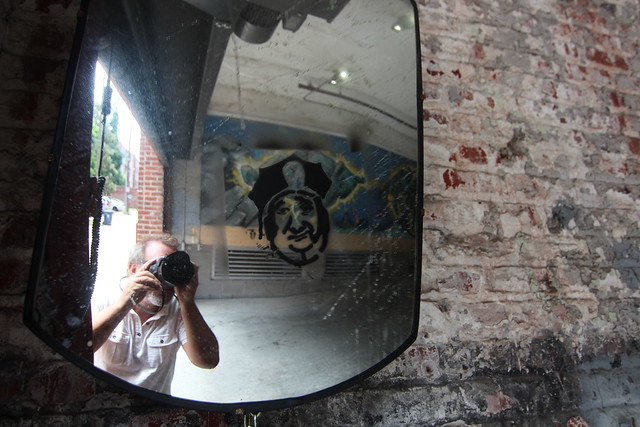
But this post isn’t about that, it’s about the photo safari I went on with Tom at lunch to get out and about in downtown Richmond. I’ve also been closely watching the photo walks he’s been sharing on his blog, and I think they are just beautiful. I mean this picture of a guy walking against the camel mural is nothing short of magic. I wanted to accompany Tom on one of these walks, and he was kind enough to oblige.

Image credit; Tom Woodward

I spent the walk asking him about his approach. He has such a good eye, and I  wanted to get a sense of his technique. Try and figure out how he goes about looking for things. It was fun to accompany him, and that’s already acknowledging I love hanging out with Tom. On the walk he got into sharing his thinking with me, there was no ego around the process, and he’s a damn good teacher. He also talked about a photo safari he’ll be taking some VCU faculty on to get them to see the space they live in anew, and also think about their own discipline through the lens of the city.  A great creative and fun community building exercise for the transition to teaching and learning online—this is an idea I will be stealing.

During the final part of the safari our discussion moved to metaphor as we trailed through alleys and studied 19th century architecture. The photos help draw the connections between the built environment we exist within and the ways in which we refuse to see it. The design of how we live is everywhere, the world we’ve engineered leaves the traces of the people who exist within it—and sometimes even the people themselves. But what occurred to me on that walk is just how much of the world I refuse to see on a  regular basis. Tom is looking at the world close and hard, which might explain some of his deep concerns about the state of our culture more generally. That might be what happens when you gaze longer than most, while remaining honest. In the land of the blind, the one-eyed man is king.

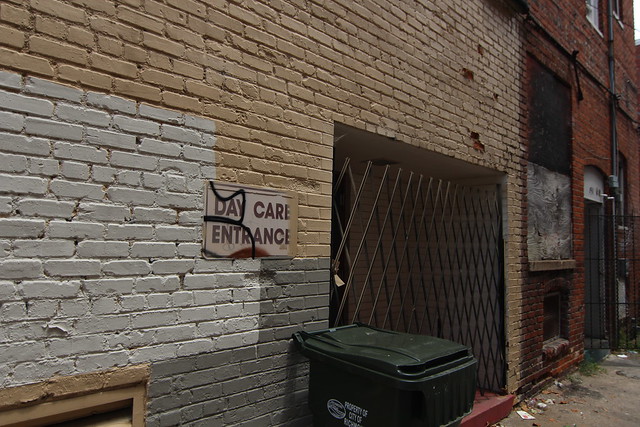
By taking that walk with him I have an even greater respect for his art, and it makes me want to try that much harder to look harder. That said, I have a long way to go. But here’s my first safari attempt, and I’ll be trying to get at least one safari a week in different locations in order to push myself to study my environment more closely, but also try and capture the poetry that’s everywhere around us.

Posted in images, pictures, Uncategorized | Tagged , , | 8 Comments

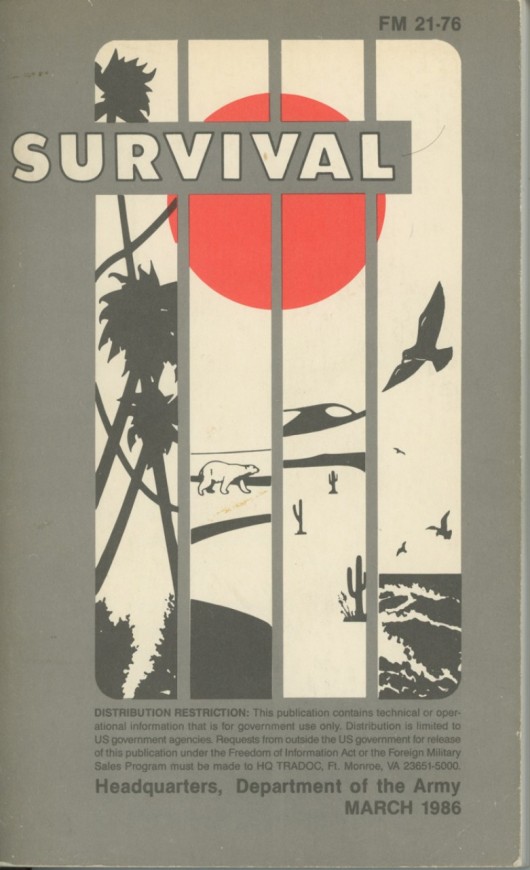
Survival: the Manual

1986 edition of the US Army FM 21-76: Survival

This mornign i ebcame the proud new owner of a 1986 Army field manual dedicated to survival in numerous situations across a variety of terrains. It’s referred to by some as FM 21-76, and it’s considered by many to be the bible of survival guides. You can find free versions online, but the book form gives the whole thing some off-the-grid gravity you just can’t emualte online.

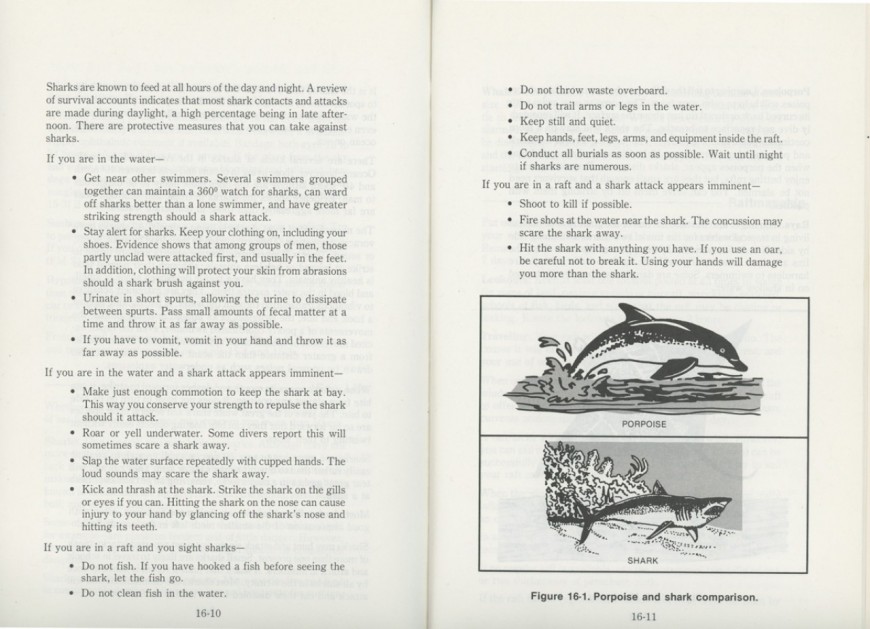
In a bizarre coincidence, when I opened the book to scane the contents I found myself looking at the section about sharks. In particular, “surviving if you are in a raft and you sight sharks—”

  • Do not fish. If you have hooked a fish before seeing the shark, let the fish go.
  • Do not clean fish in water.
  • Do not throw waste overboard
  • Do not trail arms or legs in the water.
  • Keep still and quiet.
  • Keep hands, feet, legs, arms adn equipment inside the raft.
  • Conduct all burials as soon as possible. Wait until night if sharks are numerous.

Shark Survival tips (click for larger version)

WTF! The list was pretty palatable until that last bullet point about night burials. Jesus, survival is some macabre shit. The illustrations in this guide are priceless, and I wonder if anyone would be interested in using this as a model for an edtech field manual for surviving the Higher Ed apocalypse 🙂 THis is now officially part of my sumemr reading list.

Posted in reading | Tagged , , , , , | 15 Comments

Mine it Out

So Minecraft fever has hit the bava household hard over the last month or so. All three of my kids are pretty deep in, including my 4 1/2 year-old Tommaso. He does some basic mining and battling, but more than anything Tommy’s into the seemingly endless Minecraft user-created music videos. In fact, those videos are what started the Minecraft rage we’re currently living through at my house. Miles came home from school talking about Minecraft music videos like “Don’t Mine at Night” (playing off Katy Perry’s “Last Friday Night”), “Like an Enderman” (playing off Psy’s “Gangnam Style”), and “Fallen Kindgom” (playing off Coldplay’s “Viva la Vida”) to name just a few of the early endless refeshes. My personal favorite music video is “Mine it Out” (playing off will.i.am’s “Scream and Shout”).

The videos refer to themselves as Minecraft parodies, and I guess that makes some sense. But having watched and heard a fair number of them now, many of them don’t really feel like parodies at all. They’re often catchy and tongue-in-cheek reworkings of the original, but they don’t seem to be trivializing Minecraft or the song—-rather they’re often a creative celebration of both. I’ve come to love these music videos, the amount of creative energy invested in each of them is mindblowing. And that’s just a small indication of just how amazing the Minecraft moment has been more globally for an outpouring of shared creativity. It’s gotta be one of the most hopeful elements of the internet I’ve seen over the last three or four years. And if my kids are any indication, it’s got some life left yet.

Posted in fun | Tagged , , | 12 Comments