With the recently peaked interest in open online learning, the conversation seems to have moved immediately towards the shock and awe of scaling an architecture for 30 thousand to 1 million students. I signed up for a Coursera course more than a month ago. The sign-up was both streamlined and relatively elegant (or at least simple), as was the course space. It was easy: the materials were clearly labelled, people were introducing themselves on the hosted discussion boards, the weekly assignments were front and center, and the entire enterprise was packaged quite well. It takes on the feeling of a process that has become utilitarian to a degree we could never have imagined. It reminds me of the beginning of Don Delillo‘s Mao II when they’re conducting a mass wedding of thousands of couples at Yankee Stadium: “They take a time honored event and repeat it, repeat it, repeat it until something new enters the world.” Yet, six weeks later I have not done anything in the course for many of the reasons Tim Owens nicely outlines in his post “Failing Coursera.”

Moonie Mass Wedding
I don’t want to discount the potentially transformative effect of massification for either marriage or learning (the buzz around Massive Open Online Courses, or MOOCs, has been pervasive), but I also can’t help but feel we’re in a very similar situation as we were five or six years ago when we were imagining and designing spaces for teaching and learning. Coursera’s proprietary environment was created for scale and simplicity, a tool intended to perpetuate its own framing of course design. As with Blackboard before Coursera, not only is learning design limited by the environment, but learning interactions are shackled within them, too. Where is the space for aggregation, for owning your work? All your work exists on Coursera’s servers and is attached to a license scheme that makes it far from open and easily re-usable. This is not incidental, but rather supports another pervasive recent trend: ANALYTICS–as Michael Crow puts it there are “NO MORE EXCUSES” (the July/August 2012 issue of EDUCAUSE Review is scary in this regard).
Point being, you have no real control over the work you do in these spaces, and there is no sense of creating a distributed network wherein people can utilize their own, existing online identity as part of the course. For this reason alone I’ve been surprised just how little has been said about how the technology might in some ways reflect the values of a particular approach to teaching and learning.
Martin Hawksey’s blog post “Notes on technology behind cMOOCs: Show me your aggregation architecture and I’ll show you mine” does a brilliant job of breaking down some of the conceptual ideas behind the syndication/aggregation based course that enables people to own and control their distributed work. Where the challenge for MOOCs is how to scale a single course for many users—with little or no regard for interaction—a more interesting challenge for an open learning architecture is how to scale this approach across and amongst many courses. Or even better, across several institutions! I would love to scale a university, a discipline, or a community like Jon Udell is trying to do with his aggregated calendar project Elm City. This works towards a “a network of networks,” to quote Gardner Campbell. MOOCs, as they are being imagined currently by a few startups, are far too monolithic for the web; they’ve become the arena rock of the classroom, and I’m not so so sure they’ll have an encore. Rather than booking arenas for someone else’s tour, institutions should be innovating in the future of this space. To quote Brian Lamb’s recent post “No Content”:
…the focus on venture-capitalized MOOCs distracts us from better-developed strategies that promise to do more to reduce the costs and increase the reach of higher education: open platforms and open access….Think about the efficiencies an open source, searchable, syndicated, collaborative authoring system can provide when publishing to multiple environments.
This is particularly pressing when you consider that control over how faculty and students share and re-use content should ultimately belong to them. The architecture referred to in the above quote starts to get us there. A number of folks in higher ed have been working with open source architecture to create online communities wherein sharing and creating resources becomes an integral part of the very life’s blood of an institution. The idea that we can collaboratively build a platform that will help frame the discourse and sharing, which an architecture like this would reflect, seems the most pressing issue from the whole MOOC explosion, at least for me.
The open source ecosystem at the University of Mary Washington has enabled us to do some pretty innovative things locally, as has Baruch College, CUNY’s Academic Commons, and the University of British Columbia. Yet, these localized experiments remain surprisingly uninteresting to most universities. How can open architecture through open source applications not begin to represent a re-investment in innovative people, process, and possibility at universities rather than off-loading our vision to a venture capital-inspired “solution” for education? It seems to me that a tremendous amount of teaching and learning design is currently being abdicated by universities, and businesses have no problem filling the void. Pearson’s contract with the California State College system is a very alarming example of just that.
What should be a matter of leading the field into the 21st century has become little more than a consideration of global branding. No students in these corporate-wrapped course spaces are asked to take any ownership of the work they do. There is no aggregation or syndication, and even if there was—given that scaling is at the heart of this business model—how much of the architecture will be freely shared? Those of us who wanted to independently experiment with these ideas would be none the richer; the idea of enriching the commons through such a scaled, global model of the classroom is ultimately a sham. And the irony in all this is how many elite universities have freely given away their expertise to startups with no revenue stream, no foreseeable market, and no true understanding of how such a move might dilute their brand. Where is Cordelia when you need her?
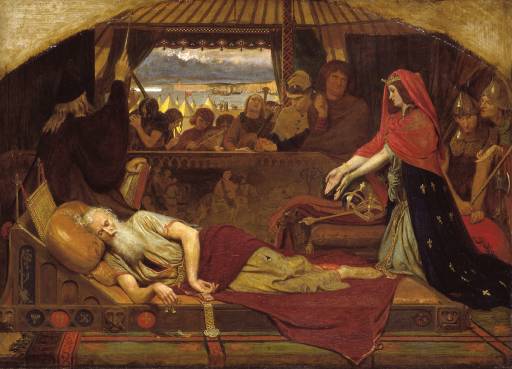
Lear and Cordelia
Rather than yelling and screaming about the state of open online courses as of late, I’ve turned back to Jon Udell‘s ideas from a 2007 talk he gave titled “The Disruptive Nature of Technology.” Udell lays out a vision wherein K-12, universities, and open source programmers are encouraged to help learners create “coherent personal digital archives” that seamlessly integrate with a wide range of institution’s necessary systems.
Jon Udell argues this is an issue that is necessarily bigger than just a student’s school work—because that’s not enough. It also has to encompass their personal photos, videos, transcripts, X-rays, dental records, police records, and a million other digital lifebits: a much larger, abstracted digital space in which people manage and maintain all their records and decide how to push them out appropriately to various destinations, a space we own and the university architecture can plug into securely and efficiently.
I understand we’re currently nowhere near this, but when we think about an architecture going forward, how can businesses, institutions, and governments alike not consider the importance of giving individuals control over their digital archives? Archives that as of now are anything but coherent, and that is the problem. RSS has opened the door, but it’s just the first step in a solution that will require our insistence and a commitment to imagining coherent aggregated hubs of content that we can each own and manage.
The idea isn’t to pretend that everyone and everything should be open source, rather to understand the issue is one of coherence, and right now coherence is often offered at the price of ownership and control. At this point, some kind of digital coherence can only be had if you work within someone else’s application. I want to be part of a movement that provides the beginning steps to building and imagining an architecture that makes the coherence of one’s online archive something that can be seamlessly syndicated, individually-owned and controlled, all while providing the greatest amount of privacy we can imagine in a networked world.
We have to broadly experiment with and come to terms with how we design an open architecture that provides for a coherent personal digital archive. UMW’s Domain of One’s Own pilot is just one early experiment in this regard, but I do think it is extremely important that higher ed takes on this challenge rather than offloading it to the sexiest start-up, a process that has given very few of us any more control over the online work we have done over the past ten years.


 Today I got an email asking if a small, local movie theater that’s been around since 1911 could use



Displaying Distributed Comments on the Hardboiled Blog
One of the nuts of aggregating mother blogs that was tough to crack for a long while was showing the number of comments on posts that were syndicated in. Almost two years ago Martha Burtis cracked that nut for ds106. I’ve been using a similar spoke/hub model of syndication for the Hardboiled fiction class I’m teaching this semester, so I asked Martha to take me through the process yesterday. She did, and what was awesome is how easy she has made the process. It’s really pretty seamless to hack your theme to show distributed comments. In this example I’m doing it with the old gold Twenty Ten WordPress theme because despite what Tim Owens says Twenty Eleven has always been butt ugly.
A couple of things upfront, there is still a bug that requires those blogs that are syndicating in to have pretty permalinks turned on to show the correct number of comments. Otherwise the comment count will resort to the number of posts on that blog up and until 10. In other words, if the blog has 6 posts only the comment count will be 6 if it has ten or more posts the comment count will always be ten until pretty permalinks are enabled. Don’t ask me why, I am just the messenger 🙂 I still have to get my students to turn on pretty permalinks, so the comment count you see on the Hardboiled aggregator blog might be off for a few more days.
The other thing to keep in mind is that this will only show comments for WordPress blogs that are syndicating in. Showing comments for Blogger, Tumblr, Posterous, etc., is not an option with this method as of yet.
Ok, with all of that said, here is how we did it for the Hardboiled course blog which is hosted on UMW Blogs.
First, we created a child theme for the default Twenty Ten theme and but it in a theme folder called hardboiled. We then add a style.css file to the theme folder with the following code:
/*Theme Name: Twenty Ten -- Hardboiled Child Theme
Description: Child theme for the Jim's Hardboiled Lit Class
Author: Jim Groom
Template: default
Version: 0.1.0
*/
@import url(“../default/style.css”);
This is pretty simple, and the one line of code basically tells the theme to import all the styles from the default theme on UMW Blogs. What’s more, any custom styles added beneath that line will take precedence over any styles in the default theme. That’s just a basic overview of how child themes work, nice to be reminded of this—I’m so WordPress remedial these days 🙂
Next, Martha included a custom Twenty Ten loop.php file that she hacked that actually does all the work. She dropped this in the child theme folder and it worked a charm. You can find the loop.php file here if you are interested in looking at Martha’s code and adapting it for other themes. Ideally this would be a plugin, but I really don’t know how that would work across themes or if it is even practical. And that’s that for showing distributed comment comment on the posts themselves.
Google Reader is powerful, but strangely unintuitive when it comes to creating new folders or finding this RSS feed, so let me do a quick howto, fully understanding the rules for doing this could change at any moment in the future.
First, create a new folder in Google Reader in which you will add all the feeds for comments on the blogs to be aggregated and syndicated. To do this you need to go to Reader Settings and then the Subscriptions tab. After that you need to click on any of the “Change Folder” or “Add to a Folder” tabs and go to the very bottom option to add a new folder and do as much. See the screenshots below for details because this process is unnecessarily buried in the Google Reader interface:
After you have created a new folder now you have to add the feeds to it. This is pretty straight forward, just subscribe to the blog or blog comment feed and add it to the folder you just created. After that, you’ll have a folder full of feeds that you can then turn into a bundle and grab the ATOM feed for. To create a bundle just select the downward facing arrow next to the folder and look for the Create a Bundle option.
After you select create a bundle you will see the following screen:
Name it and after that you’ll have it as one of your existing bundle which will provide you with a series of options. You can email it, create a clip (which is basically code that allows you to add the OPML file to your sidebar), Add a link (which is where you find the ATOM feed), and a straight-up OPML file. All pretty powerful options, but I used the Add a link option to grab the ATOM feed of all the latest comments across the 16 blogs.
Once I click the Add a link option I’m given the ATOM RSS feed that I can then add to a WordPress RSS widget in the Hardboiled sidebar. After that, I can display distributed recent comments on the mother blog to give any and all visitors a better sense of where the conversation is happening.