Integrating FeedWordPress with BuddyPress

I am writing a larger post about open architectures and the implications of what appears to be a more general move away from a focus on open as in sharing, collaboratively building, and collectively designing a space for teaching and learning others can use freely and build upon liberally. No where in the raging discussion around MOOCs is there anyone talking about sharing the infrastructural/architectural work they’ve done freely with others.  CUNY’s Commons-In-a-Box project makes the innovative development work they have been doing for years freely available for others to experiment with. That is the spirit of sharing that seems to me should characterize the groundswell for open, online education—localizing the means of production for as many people as possible rather than turning to more taylorized broadcasting methods that deliver content—we’ve been there and done that. When did scaling the LMS become the next frontier of innovation?

Anyway, more on that in another post. What this post brings together is the thinking Martha Burtis, Alan Levine, Tim Owens, and I have done about integrating BuddyPress with FeedWordPress to allow the signup process to seamlessly load feeds, filter tags, and bring posts in without any manual intervention—of which there is all too much currently.

We actually virtually met with the designer of FeedWordPress, Charles Johnson, and ran all these ideas by him and he was up to the task. He’ll hopefully begin work on these elements for integration shortly, and we are hoping he can lean on Boone Gorges if he has any BuddyPress questions 🙂 (Poor Boone, I am always bothering him—HE’S A FAMILY MAN NOW, BACK OFF GROOM!) So, for anyone interested in the specifics of what we are trying to accomplish with this integration, the details (some of which are a bit technical) are listed below. Recommendations, feedback, and praise are all welcome 😉

  • Automatic registering of ds106 feeds from BuddyPress profiles
    • Someone enters a URL for the blog they want to use (Note, pre-explanation need; e.g if the entire blog is for ds1o6, enter that; if they have a blog used for other purpose, they need to add URL for a ds106 tag or category (e.g. http://somewordpressblog.com/category/ds106 or http://somewordpressblog.com/tag/ds106
    • Internal function looks for possible feed from site (prob an internal function in FWP as used for admin interface), also some test code at http://lab.cogdogblog.com/feedfinder.php this should pop an ajax window with options to set blog, and it should populate a new buddypress ds106 feed field
    • If no feed is found, it goes into moderation and an email is sent to admin
  • Widget to generate list of blogs associated with a particular FWP applied  tag (or all) – I [Alan Levine] just hacked one for magic macguffin http://magicmacguffin.info/subscribed/ documented at http://cogdogblog.com/2012/06/03/dynamic-opml-feedwordpress/
    • widget to generate list of blogs syndicated on a site (might have to have option for scrolling list in case it is long)
    • Function to generat OPML file based in tag
  • Automatic tagging of feeds based on buddypress profile options  (e.g. default tag for all, others based on affiliation)
  • Way to get data we can display or use from feed activity- e.g. frequency of posts, time of posts, etc. or at least some hooks into the database so we can more easily roll our own. e.g. API or functions to call on FWP for information
    • return array of blogs subscribed for whole site (and meta info), or by tag
    • function to test if blog is subscribed
  • Advice about cron jobs for feed updating, perhaps a means to spread into batches for large numbers of crons. Two uses cases:
    • Site like ds106, where we just have a lot feeds syndicating into a single site.
    • Site like UMW Blogs, where a bunch of sites have smaller numbers of feeds syndicating
  • Better  admin interface for managing tags/categories associated with syndicated posts; search to find feeds by url, title, tag?
  • Interface for grouping syndicated feeds and working with them. (sort of related to the previous idea)- mass tagging or unsubscribing
  • cron for all ds106 sites is now running as update mode (6/1/2011)
    The warning when feeds are set to cron is confusing  since feeds do update.Note: Automatic updates are currently turned off. New posts from your feeds will not be syndicated until you manually check for them here. You can turn on automatic updates under Feed & Update Settings.There should be separate settings for cron versus manual?
  • Another point is making sure that users who sign-up in BuddyPress have the FWP settings using the BP username and associated it with the Feed. As of now associating feeds with usernames is manual, and a major PITA

Posted in BuddyPress, WordPress | Tagged , , , , , , | 7 Comments

Refocusing and Refueling: Keene, Caulfield, and Udell

Downtown Keene, NH

 Image credit: Dougton’s  “Keene, New Hampshire”

Almost a month ago I spent four days up in Keene, New Hampshire thanks to a generous offer to present at the New Hampshire state college system’s Academic Technology Institute (can anyone point me to the official conference website?). I presented a version of a talk that has been evolving for the last year (ever since Maricopa), and you can see my slides for this one here. The talk was received by a very kind and engaged room of faculty and instructional technologists who were there to think about how they can integrate new media into their courses. But I would be lying if I didn’t acknowledge that the presentation was only part of the reason I was there. The other driving motivation for me to get to Keene, NH was to have some quality conversational time with Jon Udell and Mike Caulfield. And that I did, not to mention I killed quite a few zombies along the way  🙂

Jon and Mike may be two of the most simultaneously precise and abstract thinkers in educational technology I’ve met, although Jon might rightfully resist that categorization given his reach is far larger than just education. What’s so powerful about these two is that they both operate from a vast technical understanding that is filtered through a deeply abstract knowledge of the philosophical ideas that underpin the web as virtual phenomenon we’re still trying to get our collective heads around. More than 6 years ago Jon came to UMW as the keynote speaker at Faculty Academy in 2006 to talk about 21st Literacy Century, and since then he’s been somewhat of a guiding light for our work. His ideas of aggregation, web thinking, the professional uses of blogging, a domain of one’s own, and archiving have driven much of the spirit of our work at UMW since. In just about every project we have done there is a deep debt of conceptual thinking to Udell. He’s kinda like the patron saint of DTLT 🙂 My own intellectual lineage of ds106, A Personal Cyberinfrastructure, a Domain of One’s Own, etc., can be traced back to a recommendation by Gardner to listen to a podcast by Jon that I blogged about back in 2008 (while I was at University of Richmond no less) that was titled “Imagining Cyberinfrastructure.”

So being able to talk to him at length about A Domain of One’s Own, UMW Blogs, the future of UMW’s website, and more general plans for syndication, aggregation, and  archiving UMW’s work was an absolute treat. We actually spent 9 innings of a Keene Swamp Bats baseball game talking about all of this, and I couldn’t have imagined a better backdrop for two red-blooded Americans 🙂 One of the issues we talked about extensively is the ability for individuals to manage their own data across a wide variety of social spaces that enables them to truly control their contexts and build a sense of who they are, what’s more it begins to disrupt the idea of content as currency for profit-driven systems that only understand you as a commodity, ideas very much in line with Brian Lamb’s recent post about the limits of content. A topic which reminds me of deep problems Jon had back in 2006 at Faculty Academy with technologists referring to people as users.

Talking at length with Udell was inspiring because so much of these questions also start to lead back to personal archiving, some basic ideas of how the web works, and a sense of ownership and participation in the process—in many ways the time just further reinforced just how important and vital the work so many of us are doing on the margins of the corporate parades of massive online learning. Bringing it back to the individual, because as Gardner Campbell has said again and again—and his thinking and metaphors and connecting is absolutely integral to all this—the individual scales on the web, it’s the only thing that can! So talking at length with Jon has re-inspired my work here at UMW—he really charged me up to take the Domain of One’s Own pilot by storm. I think some localized experimentation is the best tonic for the hype and mechanization that everywhere surrounds us.

Mike and I ate pizza here

Image credit: Dougton’s “Keene, New Hampshire”

But that’s only the half of it because when I return from baseball with Jon (not unlike Fishing with Jon), I come face-to-face with madman Mike Caulfield. If he’s not killing zombies he is talking about the deep problems with our approach to online learning more generally. One of the things Mike and I have in common is that we both do basically the same thing at very similar schools. Keene State is a public, liberal arts college like UMW. Keene State has 5000 students like UMW. Keene State is trying to understand where it fits in the online learning world like UMW. So Mike and I have a lot to talk about on these accounts, and from the moment he picked me up at the airport until the moment I left that’s most of what we did, save killing some zombies. One of the many things I picked up from Mike along the way was the refocusing of the online education away from “the end of the liberal arts, campus-based experience” rhetoric and towards the idea of how online learning at schools like UMW and Keene can actually reinforce what the campus-based, liberal arts experience. Mike sys it brilliantly here:

When it comes to online education boosterism, I’m pretty hardcore. You can do a ton with online as well as (or better) than you can face-to-face. But I can’t imagine anything like my undergrad experience online, anything as powerful as it without the residential element. The big face-to-face experience that online has trouble replacing isn’t the absence of the physical teacher, it’s the face-to-face experience of students meeting other students and re-envisioning who they are in the process.

This idea of congregating in space as part of the experience is crucial, and often overlooked because it is somewhat intangible, it is the interstitial experiences that are often the most powerful part of the process. Mike understands this intuitively, he is subtle in his critique, and exacting with his facts and details—he’s the best friend you could have if you want someone to really challenge you on your thinking. What’s more, he is an invaluable asset for Keene State as they start to negotiate the reality of online learning as part and parcel of the future of public liberal arts colleges like ours. And every school needs someone who will call them on all the bullshit associated with online learning right now, it is essential!

Another deep affinity I have with Mike is that over the last two years or so we’ve both been experimenting wildly in the classroom. In parallel with the work we’ve done at UMW with ds106, Mike has been building an awesome course around Statistics and Quantitative Reasoning on a site call “Making Fair Comparisons” that is doubling as an open textbook that he will be feeding his future classes through. It’s a brilliant project designed in WordPress, and he’s working on how to integrate infographics, daily creates, assignments, etc. into the mix. This is the stuff that we should be talking about, this is someone pouring their heart into a process of teaching that isn’t offloading it to the next vendor driven system, it’s a process is made up of his blood, sweat, and tears. It’s a way he can help students at Keene State and beyond think creatively and critically about the information they are being fed. It is a life’s mission to educate that is open and free to all, where has that sentiment gone lately in all the hoopla around massive? Seems like we ware exchanging the open and free for the massive and profitable.

I can’t thank Mike and Jon nealy enough for helping me refocus and refuel during my four days in Keene, NH. It’s a little-known New England mecca for creative thinking about the future of the web and education, and I’m honored to have experienced even a little of it. I feel safer knowing you are both doing what you are doing—keep on rocking in a free state 🙂

Posted in Uncategorized | Tagged , , , | Leave a comment

Metal Mushrooms in Stereo

I have been dying to do the Wiggly Stereoscopy assignment by Bill Genereux—it basically uses the animated GIF method to create a 3D effect with just two images. It sounds easier than it really is—nailing it is all in the images you choose—though I must say Norm makes it look easy. Once I had two images I believed would work I wanted to see if I could find some useful tips from folks in ds106 who already did the assignment. Turns out I could, Katie Girard wrote this helpful post that introduced me to the animation filter in GIMP, something I knew nothing about.

Not only can you use the Animation filter to view the image moving through the layers, but you can also change the speed using this helpful tidbit from Katie:

….under Filters >  Animation, I chose Playback….you can see your .gif in action as it rotates between layers. To change the delay between the two frames, select the layer and add a time written in milliseconds using this format: [imagename (nms)] where n = the number of milliseconds. I chose to use 750ms.

The default speed worked well for my stereoscopy, but here is a more specific tutorial for changing the speed at which layers switch in GIMP for anyone interested.

One thing this reinforces for me is how amazing the ds106 assignments repository is. It not only has a ton of great assignments but lists everyone who has done that assignment. Sure some links to example posts will break in time, but the bottom line is it gives other people thinking about what to do ideas, inspiration and even helps them learn some technical details they might not have known otherwise. As time goes on I’m convinced we’ll see more and more tutorials in the assignment repository as well, and to that end this post is the change I want to see 😉

Posted in digital storytelling | Tagged , , , , | 2 Comments

UMW’s Website Poised to become Syndication Hub, and by Extension Relevant

More than a week ago Cathy Derecki and Curtiss Grymala took me through some of the work they have been doing on umw.edu—which has been a multi-network WordPress install for almost a year now. The ideas here build upon this post I wrote over the weekend about aggregating into umw.edu from my personal blog. Now that the campus is getting used to WordPress as the campus-wide publishing platform for our  website, it seems high time to start pushing the envelope a bit to see if we can’t finally realize a aggregated and distributedly authored web site that truly exposes the work happening around campus for all to see.

To that end, I think we’re ready to move umw.edu beyond the brochure that has come to characterize university and college websites more generally. How relevant is that approach in the web-based ecosystem of dynamic information we all exist within? Here at UMW we want to integrate the life’s blood of course blogging, social media, and distributed publishing into the fabric of our university’s website. And based on the development Cathy and Curtiss have been doing we are all but ready to start.  You can see an example of what they are ready to roll-out this Fall below. Notice the links to UMW Blogs courses, YouTube, Twitter, blog posts, Flickr, etc.

What’s nice about this is that it’s all being automatically aggregated together based on an individual user’s profile page.  It is a self-service approach that  gives each user control over what social media they want to share, if any.

What’s more, Cathy and Curtiss are also working on aggregated discipline-specific pages that will feature the work happening across various courses in a discipline on UMW Blogs (or whatever platform they use),Facebook, Twitter, etc. What’s powerful here is that we can actually create a series of aggregated landing pages for departments automatically and then re-syndicate that into an uber-aggregation piece of the work happening across all the disciplines at UMW—how would that be for a university homepage?! 

I think this is truly groundbreaking stuff for a university website, why no one is talking about it has to be they just don’t fully understand how awesome it is. We’ve been proto-typing distributed authorship across campus with the Faculty-Staff Newsletter site Eagle Eye and it has worked brilliantly—1857 posts in just about two years and a 125 different authors.

Another thing is that we couldn’t be doing this at a better time because we have started a Domain of One’s Own pilot wherein  anywhere from 300-400 faculty and students will have their own domains and web hosting. We will finally be doing what George Siemens, via Brian Lamb, suggested universities do:

…schools should be in the business of managing data flows rather than in supporting an end to end user experience. We can only dream what might result if the energy going into the campus-wide LMS’s would go into creating flexible and easy to use “syndication buses” or to addressing pragmatic instructor challenges to using the “small pieces” approach — things like student management tools, gradebooks etc. And what about providing the service of institutional archiving and data backups to mitigate the risks of using third party tools?

That remains a montra for us here at UMW, and we are getting closer and closer!

Posted in umw, UMW Blogs, umw.edu | Tagged , , , , | 7 Comments

A Ghost in the WordPress Machine: the Self-Referential RSS Feed

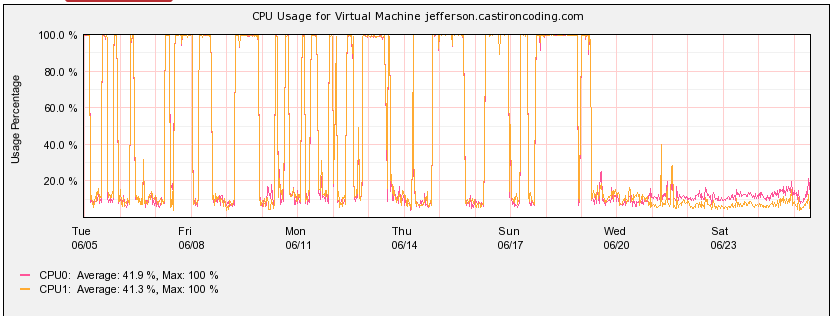
I’ve been meaning to write about this for a while now, but I guess the pure absurdity of it has stopped me again and again. But it is time to move beyond that. We’ve been running two major WordPress Multi-Site installs (what was WPMu) since 2007. In the five years we have been doing it, a vast majority of our performance issues have been linked back to  self referential RSS Feed that basically infinitely loop and crash the server because it becomes so resource intensive.  This brought down UMW Blogs several times during the 2010-2011 academic year, and it recently has been making the ds106 server spin out of control.

What the hell am I talking about? Well it’s simple, you call your own feed in an RSS Widget or whatever. For example I would call http://bavatuesdays.com/feed in my sidebar and this site would infinitely loop once it called make the server go batshit. You can see a graph of the ds106 server regularly going batshit until we realized there was a self-referntial feed in on the sidebar pages on ds106.us.

So, given this is a real simple way to pull down an entire multi-site installation, why can’t we find any info about it? Has anyone else had this issue? is there a way WordPress might actually disallowing self-referencing feeds so that sites don’t crash and burn? This seems like a ridiculous issue to have gone on unresolved for so long, but maybe part of the issue is no one;s talking. perhaps there’s a ring of silence around this one 🙂 But more seriously, anyone have ideas of how to prevent it? And if so, anyone interested lobbying the core WP developers to see if we can’t get it committed to future releases to stop the madness once and for all?!

Posted in WordPress, wordpress multi-user, wpmu | Tagged , , | 3 Comments

Aggregating straight to UMW.EDU from bavatuesdays

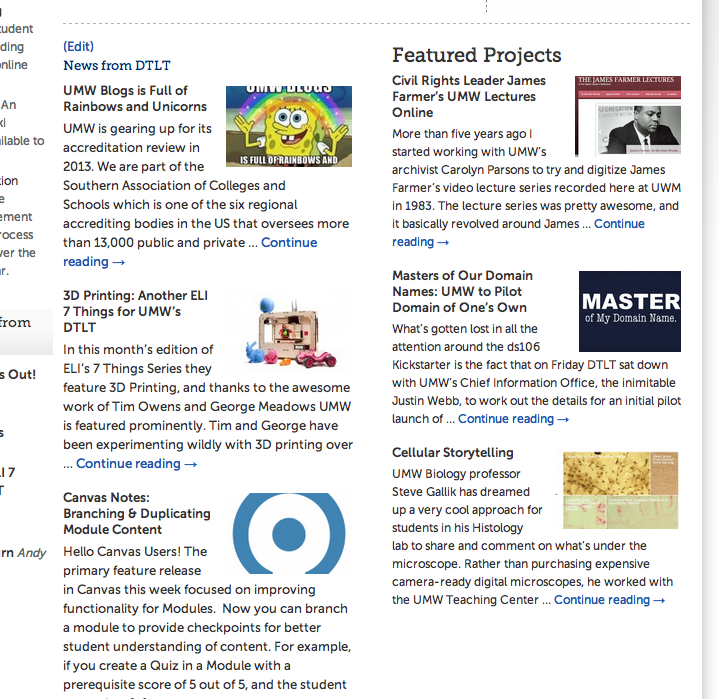
The great Cathy Derecki gave us the ability to syndicate into umw.edu using FeedWordPress a while ago, I just haven’t played with it until tonight 🙂 And let me tell you, it’s pretty rad to have a department site on a .edu doubling as a WordPress syndication hub! All I’m doing is pulling any post tagged dtlt from bavatuesdays and republishing it on DTLT’s official UMW.EDU page (http://academics.umw.edu/dtlt). And did I say it’s pretty awesome? Not only can I filter off from my blog using a tag like dtlt, but I can also determine where the post shows up by using a tag like “Featured” (which will feature it as DTLT News in the central column) or use the tag “Featured Project” which will feature it in the right column under projects.

Additionally, I can tag the post according to the subject, for example does it deal with UMW Blogs or Faculty Academy or Canvas, etc., (each of which have their own category). When tagged correctly it will show up in the appropriate category across the UMW DTLT site’s navigation bar. [FeedWordPress pro tip: this works because FeedWordPress automatically converts tags to cagegories when it syndicates, which in this instance works out beautifully.]

This semester I’m gonna make a push for everyone in DTLT to blog their work more regularly, while at the same time syndicating it into any number of appropriate spaces on DTLT’s official UMW page so that we have a rich, dynamic archive of the work we do on a regular basis, as well as a bi-weekly or monthly newsletter that simply repackages this stuff in an email with links and shoots it out to all faculty and staff. What’s more, this can quickly become a model to share with departmental sites with the idea that faculty and students from a given department can seamlessly feature work. And an amazing side effect of this would be to make blogging an integral part of everyone’s workflow for sharing.

Beyond the departmental scale, Cathy Derecki and Curtiss Grymala are working on individualized faculty and staff  pages that act as individual syndication points that aggregate all an individual’s social presence from around the web (kind of like about.me) as well as the posts from their various classes if they have course blogs on UWM Blogs—which is really awesome for me. But I have to wait on that because the details of that are a whole ‘nother post I’ve been dying to write.

As of now there are just three issues with the syndication from bavatuesdays into DTLT’s UMW page:

  1. The continue reading excerpt on the front page of UMW’s DTLT page for the UMW News and Featured Projects excerpts links back to the original blog, not the post on umw.edu. I changed the setting in FeedWordPress, but as of now you have to manually edit the link in the excerpt, that needs to be fixed—and I have a sneaking suspicion Martha, Alan, Cathy, or Curtiss will know how 🙂
  2. When my posts syndicate over they don’t have paragraph breaks. This is a formatting issue, and I wonder if I don’t have to add paragraph tags on my bavatuesdays posts for this to work seamlessly.
  3. We need to find a way to make the first image in the post automatically the featured image for syndicated posts. I thinks this is possible, but then again I have to defer to the experts.
Posted in umw, umw.edu | Tagged , , , | 7 Comments

The Thing about Transparency

This is an awesome post by Stephen Downes about transparency and blogging.

So – this is the thing about transparency. It requires a lot of courage on the part of the person being transparent, but it requires more that the people observing understand that they are viewing a real person, with real faults, real opinions, real ideas and real fears. We harm ourselves and each other by assuming that everybody must conform to some sort of magazine-perfection.

The role of the audience in understanding blogging is about real people struggling with evolving ideas is well said, and quite useful for understanding why this process is so different from publishing as we have understood it heretofore. As a wise man said to me recently: “writing books is just an excuse for a book tour.”

And for the record, not all Americans cower at the idea of speaking their mind out in the open, as I imagine not all Canadians are as bold as Downes.

Posted in blogging | Tagged , , | 9 Comments

ds106 Breakfast Club Edition Post-Mortem

Teacup Pigs

And now for something totally tiny, as opposed to massive.

Yesterday I finished up a two-week whirlwind class of ds106 (which I fondly refer to as the Breakfast Club edition) with five local high schoolers. To be more specific they consisted of two rising freshman, two rising sophomores and one rising senior. What I found after this most enjoyable two weeks (it was really only 8 days cause we had Fridays off, which made me sad) was that ds106 travels well from college to high school age kids, and I bet even elementary age kids as well. I wrote about this already to some degree here, so I won’t rehash it, but suffice it to say I think this model is brilliant for K12, and we may soon get to see something like it unleashed on a nearby middle school—put more on that anon.

Anyway, over the last two weeks I did an abbreviated, slightly pared down version of ds106 and had students in week 1 do 10 visual stars and 10 design stars. In week two they did 10 audio stars, 10 video stars, and 1 mashup trailer. It’s very quick, and I thought it might be too intense for them, and what I found out is that it really wasn’t too bad. They rose to the challenge beautifully, and seemed to have a blast doing it all the while. And once again, I really didn’t have to get bogged down in teaching a particular tool. I usually modeled one assignment for them that I thought would introduce them to a larger concept like working with audio (I—well actually Andy Rush—used the sound effects story assignment for that intro) that we all work on together for the first part of class, and then they’re pushed to complete as many different assignments as they can in the remaining 2 hours.

As we moved into video, however, I just let them do whatever they wanted and would show them tips in a one-off fashion as they needed to do them—it seemed to work well. Learning something you need to do is very different than learning something you may eventually need to do. In my mind this is where the assignment bank has proved revolutionary– it’s a fun way for them to pick and choose what they want to do and for me to help them accomplish it in the time we had together. This was by far the most enjoyable class I have taught to date: awesome students; no grades to worry about; very intense and very quick—all an amazing combination of factors. But add into that mix the now robust ds106 site framework and assignments and my job becomes a million times easier, and the experience a million times better for everyone involved.

As for the students, well they were all awesome to a person—and I’m still marvelling about the work they did. But rather than writing extensively here about it, I’m gonna just showcase some of their best stuff over this past week.

Tristan did some amazing video work this last week, but her mashup of Clueless and HBO’s Game Change was brilliant. Check it out:
[media id=22]

What is interesting to me is that the Breakfast Club edition of ds106 was far more political than any of my college classes have been. The Pallin video above is one example, and I mentioned the Obama art in my previous post, but this 1 Second Video story about 9/11 is one I can never get comfortable with:

[media id=23]

What struck me about this story was the horrific image moment it captures—one I personally saw unfold in real time from Long Island—but when I think about it these students don’t even remember 9/11. They were 2 or 3 years old when it happened. But it has shaped them, they’ve grown up in the wake of this historical event. In many ways they have been shaped by something they can’t even remember, and for me this 1 second video had that much more power coming from them. It was a testament to what it must be like to become cognizant of the world in a post-9/11 reality. A horrific reality on many levels. What’s interesting is that this student had also recently saw the film Extremely Loud and Incredibly Close (based on the 2005 novel by Jonathan Saffron Foer) which seemed to have made an indelible mark on her given she based several of her assignments on it, like this 4 icon challenge:

And that’s just the tip of the iceberg. We had another awesome mashup wherein Anna took Bedknobs and Broomsticks (1971) and remixed it to be a horror film:

[media id=24]

Or her trailer of Prehistoric Women which focuses on the truly stronger sex—yet another politicized video in all its b-movie glory!

[media id=26]

What’s amazing about all of this is they finished all their stars during class. The lab approach was fun, and I got to see and comment on their work in person right away. Check out Emma’s Easy A in stereo assignment:

[media id=27]

The 30-Second documentary as well as the 5 Archetypes in 5 Seconds were picked up y KC, and they were fun. below is 5 animal archetype in five seconds followed by a 30 second documentary of killer pit bulls:

[media id=28]

[media id=29]

What’s more I didn’t even get to all the audio assignments. These were extremely impressive projects done in very little time. The Breakfast Club edition of ds106 showed me just how much more is possible with this class, and how useful the assignment framework can be for freeing up time to work with each of the 5 students one-on-one to hone skills. Say what you will about massive, small and intimate groups for getting stuff done and honing skills does not suck.

Note: I used the plugin WordTube to upload and link all the students videos. I did’;t feel like I could ask any of them to start YouTube accounts (no one had one, and given my recent issues with YouTUbe I wasn’t about to push it). I had 4 of 5 on UWM Blogs, so I had everything set to go there, we just activated WordTube and they were off. One other student already had her own Blogger blog, so she uploaded it to YouTUbe as a private video, and embedded it on her site. All-in-all the posting and technology concerns for the students to tag, embed, etc where seamless, next to no issues and I think this course will become more and more fundamental as the shift in the familiarity with media production itself becomes another assumed literacy.

Well, that’s all for now, but let it be know I was miss the Breakfast Club version of #ds106, you all were very much 4life.

Posted in digital storytelling, Uncategorized | Tagged , , | 6 Comments

Hardboiled Syllabus


Over the next month or so I am locking into reading a whole bunch of hardboiled fiction from the 20th century. I’ll be blogging it regularly, but releasing those posts over the course of the Fall semester because I have the distinct pleasure of teaching a Freshman Seminar on US detective fiction. My plan is to blog all my discussion material and thoughts as I go, and regularly release all the resources I will be talking about in the class. What’s more, I will have all their blog reactions pingback to the original and have it all syndicated into some space I am still imagining—I hope it starts to capture the dicussion both textually and visually.

What’s more, for the final research paper we’ll be modeling that project on Jon Beasley Murray’s radical Wikipedia experiment in Spring of 2008. I’m excited to have the opportunity to experiment with something like that, and I think for this class it is going to work well. It is only 15 students, they are all new to college, and they’ll have no idea of what to expect. Scar them #4life! When I finally design the class site I’ll have more details there, but in the mean time it is time to read and get in touch with Jon and Brian Lamb to figure out how deep I am in when it comes Wikipedia 🙂

Make the jump for full syllabus. Continue reading

Posted in Hardboiled | Tagged , , | 3 Comments

We’ve been MOOCed


Image credit: http://grettajohnson.com/perez.html

I’ve been following the explosion of all things MOOC over the last few weeks somewhat quietly, the hype has even come home to roost at UMW in some odd ways. It’s been at once exciting and disquieting to watch. I’m excited for the folks like Siemens, Downes, and Cormier who framed the concepts and ideas behind the term and experimented wildly with its possibilities ever since. On the other side, I am pretty spooked by how denatured the term and its various meanings have become. And whether or not you try and break it up into categories, subsets, etc., the term MOOC—along with whatever ills or benefits people assign to it—has created a dramatic impact. Most of that impact right now is still based in media reaction, but it’s fascinating to see how quickly that translates into real decisions by major elite institutions.

I’m pretty excited about the possibilities for online education in the future, I’m just not so sure if the packaging of this idea by companies like Coursera partnered with elite universities is a solid, sustainable approach. I’m still not entirely sure, either is Coursera it seems, but kudos to Jeff Young for his recent College 2.0 article “Inside the Coursera Contract: How an Upstart Company Might Profit From Free Courses”. The article focuses on the contractual elements of the deal between the University of Michigan and Coursera (thank god for public institutions and the FOIA!). It’s the best article I’ve read yet on the venture capital, wholesale model MOOCs because it breaks down what is at the bottom of this movement: false profits and fear. Read the article, but below are some pull quotes for me—some priceless stuff. If you are not afraid of the ideas and basic lack of imagination steering the elite universities vision for online learning you should be! [All emphasis mine]

The contract reveals that even Coursera isn’t yet sure how it will bring in revenue. A section at the end of the agreement, titled “Possible Company Monetization Strategies,” lists eight potential business models, including having companies sponsor courses. That means students taking a free course from Stanford University may eventually be barraged by banner ads or promotional messages.

Kinda like #ds106 brought to you by Halliburton, making stories that touch everyone with a Kevlar vest!

“We have a lot of white boards up around the office where these ideas are being written down and erased and written down and erased,” he says. Still, that brainstorm list has some surprises, including the idea of selling course content from universities to companies to use for internal training.

Coursera is not open education, please repeat that 3x. Also, they are selling the universities work in the form of delivered courses, but of course they claim no ownership as you’ll read later on.

Coursera is following an approach popular among Silicon Valley start-ups: Build fast and worry about money later. Venture capitalists—and even two universities—have invested more than $22-million in the effort already. “Our VC’s keep telling us that if you build a Web site that is changing the lives of millions of people, then the money will follow,” says Daphne Koller, the company’s other co-founder, who is also a professor at Stanford.

That previous quote truly scared me. Basically Daphne Koller has conceded all agency to Venture Capitalists. When your business plan sounds like the catch phrase of a bad Kevin Costner movie that should raise some red flags.

Officials at the University of Michigan were not immediately available for comment about their contract.

I can’t imagine why not, maybe because they realized they jumped on the bandwagon a bit too early and people are starting to realize there is no there there.

When and if money does come in, the universities will get 6 to 15 percent of the revenue, depending on how long they offer the course (and thus how long Coursera has to profit from it). The institutions will also get 20 percent of the gross profits, after accounting for costs and previous revenue paid. That means the company gets the vast majority of the cash flow.

So the universities provide the brand (and in these contracts that is exactly what it is!) and the professor (and as a result I would hope the content), in return they get a small fraction of the profit. What’s more…

Another detail that seems unresolved in the rush to offer free online courses is whether professors should share in the spoils. Peter Rodriguez, an associate professor and senior associate dean for degree programs at the University of Virginia’s Darden School of Business, was involved in the university’s contract negotiations with Coursera. He says that, as it stands, professors do not get a royalty from the courses, but that, “in the long run, that’s possible.”

Teach 100,000 people but don’t ask for more money you spineless cretin. You are the brains, that’s all, now shut up and teach!

When I showed the Coursera contract to Trace A. Urdan, an analyst at Wells Fargo Securities who focuses on education-related companies, he found it “ironic” that major universities are embracing online education when they have been dismissive of earlier efforts by for-profit companies like the University of Phoenix.

“These are two of the most arrogant types of institutions—Silicon Valley companies intersecting with these elite academic programs,” he says. “Neither of them considers that anyone else has come to this place before they’ve arrived. They say, We’re here now, so now it’s sort of legitimate and for real.”

And he argues that the plan relies heavily on all of the money colleges are already spending on professors and facilities. “It’s a way to carve out some extra money on the top of the existing program, but it’s not an alternative system that is going to solve the cost crisis of higher education,” he says. “It’s being subsidized by incredibly high-priced education.”

I never thought I would like quotes from a financial securities analyst as much as I liked those above. Public and private educational institutions will ultimately be subsidizing a model that will evaporate as soon as they stop investing in it—how is that sustainable again? There’s no structure outside of the existing one in this model. The myth that this model will somehow replace institutions couldn’t be more evident from this set of quotes. But could it result in professors teaching leagues of students for no more money, and as a result fewer full-time tenured faculty positions in an already dismal pool of jobs? Yes. Is that good? No. I truly believe dismantling research and teaching institutions by ending tenured positions for the professorate poses deep risks to any nation’s freedom.

Ms. Koller insists that the courses the company is offering differ fundamentally from those at the University of Phoenix. “Their online effort is really traditional teaching mediated by the computer as opposed to using the tech in a fundamental way,” [what does this even mean?] she argues. “There’s no economies of scale there. What we’re doing is one instructor, 50,000 students. This is the way to bend the cost curves.”

How is what Coursera is doing different in terms of design from what the University of Phoenix is doing beyond scale? The scale of MOOCs is all they have been reduced to, the massive has taken over, the rest is always already secondary. Ms. Koller sounds like a politician in all the worst ways here, how did she and Ng let themselves be quoted like this so regularly? I think that is what scares me most, they actually believe what they are doing is some form of liberation for anyone.

College officials, for their part, seem more motivated by fear than by the promise of riches. “Most of us are thinking this could be a loss of revenue source if we don’t learn how to do it well,” says Mr. Rodriguez, of the University of Virginia. “These are high-quality potential substitutes for some of what universities do.”

UVa? Isn’t that the school that was just liberated from all this? 😉 Say what you will, I can’t help but agree with Jeff Young’s final assessment: the headlong jump into the idea of MOOCs is all about fear. But in this case I hope it won’t last longer than thoughtful, imaginative approaches to online learning.

Posted in Uncategorized | Tagged | 25 Comments