UMW’s Website Showcased by WordPress

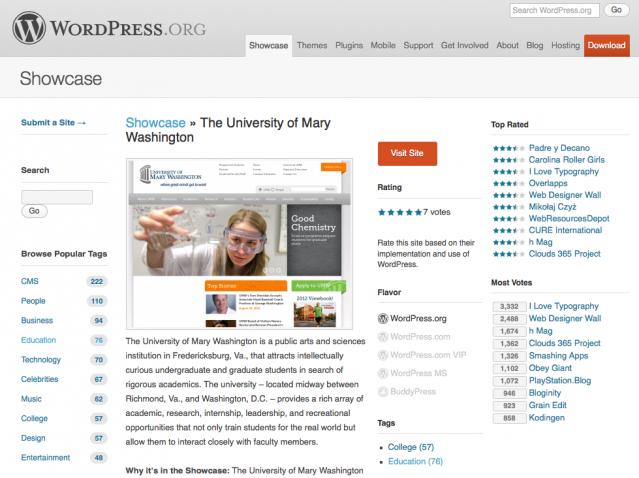
I just discovered that UMW’s website is showcased on WordPress.org. UMW has been running WordPress for it’s entire website for almost a year now, and it’s pretty sweet and Cathy Derecki and Curtiss Grymala deserve all the credit. To get a sense of how slick a departmental site can look, check out DTLT’s homepage. What’s more, we have FeedWordPress running on umw.edu, and we are about to let the syndication from UMW Blogs, personal sites, etc. begin throughout the website, allowing departmental sites to have featured, syndicated content from a variety of sources such as course sites, personal sites, research sites, news sites, etc.

According to the showcase site the reason UMW’s site is featured is because…

The University of Mary Washington site uses a WordPress Multisite installation with plugins created specifically to adapt to a multisite environment, custom post types to manage a document organization system and custom user roles for faculty and staff.

But the real reason it should be showcased is that it has the potential to become a distributed publishing hub that actually features the work happening around campus through intelligent syndication and aggregation rather than acting like a digital brochure. I have the feeling that this will be the year we start pushing those boundaries.

Posted in umw, umw.edu, WordPress | Tagged , | 4 Comments

From the Archive: ELS Blogs

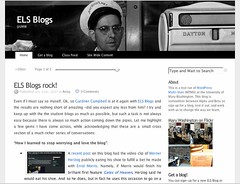
This time 5 years ago we were closing down ELS Blogs, UMW’s first multi-user WordPress experiment (well actually the second if you count Lyceum), to make way for the campus-wide blogging platform that would be known as UMW Blogs. Five years ago at UMW’s DTLT were heady times, there was still a lot of promise and possibility around the ideas of open publishing through open source applications—much of which has dissipated lately. The ability to deliver an open source publishing platform for an entire campus in-house with no coding experience and even less time is a little heralded marvel of the open web.

ELS Blogs had a bunch of amazing blogs on it, with the majority of them being students of Gardner Campbell, whose vision was the reason behind the platform. In fact, part of the push to get ELS Blogs back online came after I recieved an email from one of his students asking about her blog:

 I graduated from UMW in 2008. I had a blog through this site for a film class back in 2007 and for years have not been able to login to it but I have been able to view it. Recently I was searching for it, to possibly have one of my posts published, and I can’t seem to find it anywhere….

The name of my article was Fast, Cheap and in Control?

Please let me know if there is anyway to recover this! I really hope to get the piece published. Thank you very much!

What was lost is now found! This isn’t the first email I’ve gotten like this, in fact I get many like it, but usually it is to export their work. This was a rare occasion in that the post was, indeed, offline. The issue was that ELS Blogs was offline for a year and a half (since December 2010) because of deeply annoying Bluehost issues—they started limiting the number and size of database tables threatening to suspend your account if you went over. (As an aside, I am very glad to note DTLT will very shortly be free of supporting any and all Bluehost accounts for departments.) We pride ourselves with archiving everything, and even back in 2007 we pushed students to take ownership of their work—but it’s only now that we can transform that ethos until a full blown pilot project in the form of A Domain of One’s Own.

Fact is, the Domain of One’s Own project has allowed us to archive so much of the work we’ve done in DTLT since 2004-2005. We’re moving all of the domains and webhosting accounts we had strewn all over campus to our own MediaTemple server and reclaiming and cleaning up a ton of work—and saving some money as well. All the while we’re archiving old, one-off WordPress blogs to UMW Blogs and mapping the domains where appropriate (but more on this process in another post). In many ways A Domain of One’s Own is born out of an extremely fertile seven year period of experimentation that has gradually become more centralized and scalable. The Domain of One’s Own pilot helps us manage that reality while at the same time opening up an entirely new period of experimentation at UMW. I feel like UMW is moving from one moment of experimentation to another, and it is doing it cleanly with an archive to show for it.

Finally, let me add that none of this could have been possible without Tim Owens’ undying dedication and genius to making the conception that was A Domain of One’s Own into a hard and fast reality. He has been a godsend for DTLT specifically, and UMW more generally. Tim is nothing short of amazing, I challenge you to show me one better!

Posted in Domain of One's Own, dtlt, WordPress, wordpress multi-user, wpmu | Tagged , , , , , , | 3 Comments

Domain of One’s Own as Educational Pilot of Federated Web

Special thanks to George Kroner for pointing me to the article “The Federated Web Should Be Easier Than It Sounds” which nicely frames some of the larger implications of taking control of your own domain:

If you had your own domain name and kept good backups you could move from host to host and even to entirely different blogging systems (though you might mess up your permalinks). E-mail can work the same way, if you use your own domain name instead of your host’s. These are what some people call “federated systems.”

I’m interested in plans to build federated versions of the internet, including “darknets” like FreenetCrptosphere or wireless internet alternatives like Project Meshnet and the many many other project like it. But for those of us living in relatively free countries, just having an internet where everyone owns their own portable identity is good enough. Owning a domain name is a bit on the geeky side, but it’s not like asking people to learn to program or configure their own Linux servers. We can still rely on hosted services – as long as we can pack up and move out of them when the time comes.

This framework is important for me because part of thinking through a Domain of One’s Own at UMW has to be about architectures of empowerment for students and faculty alike. A long-view of our increasingly mediated realities that allows us to enable individual control over our digital artifacts. What is awesome about this project is it is at once architectural, technical, philosophical, and liberatory. I’m increasingly of the mindset that what’s happening at UMW with a Domain of One’s Own (all work born out of UMW Blogs and ds106) is yet another powerful and forward-thinking approach to federating the web and empowering our students and faculty who use it—which is all of them!

Posted in Domain of One's Own | Tagged | 3 Comments

The Uses and Limits of Tumblr

I’ve had a tumblr blog since 2007—well before it was cool :)—but never really used it. As I got more into ds106 and creating stuff on the web the design culture coming out of tumblr kept coming on my radar through blogs I follow, links on twitter, student work, etc. Not to mention the PSU blog creation crew of Brak Kozlek and Cole Camplese went all-in on tumblr, seeing WordPress as a bit bloated for quickly posting lifebits.

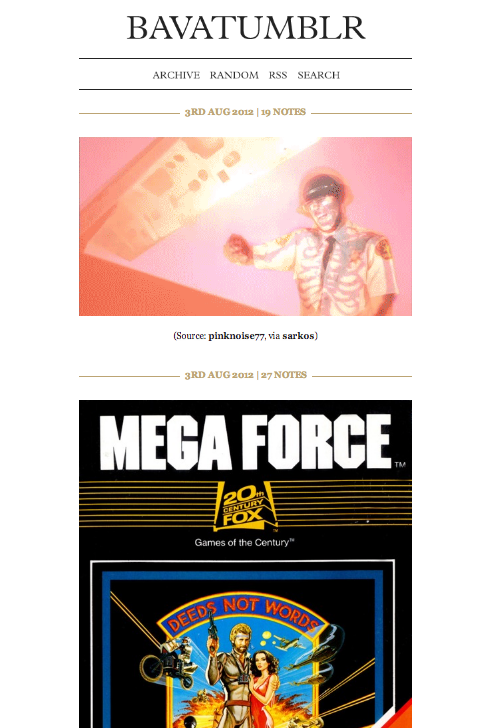
I think Bryan Alexander turned me onto a blogger on tumblr called Sarkos who is exceptionally good, with constant flow of compelling and interesting stuff. And of course the amazing De La Soul’s First Serve tumblr. Long story short, I recently starting using tumblr as a space where I post images, video, animated GIFs that I see on the web and want to save somewhere. And while my uses is somewhat pedestrian, I love how the dashboard is designed to simply show you what the people you follow post. That’s a feature that I think would be amazing for a course, especially if the aggregation was that seamlessly filtered and streamlined. In fact, streamlining syndicating is one of the course elements to making aggregation models like this smoother when approaching faculty and students.

But all that said the problem with tumblr—or maybe its the genius, I don’t know—is the context. You never really know who posted what, who re-blogged what, who is sharing what. I love this platform for promotion, but it gets tricky for attribution. What’s more, the simplified interface makes adding titles, tags, categories and other assorted metadata less likely. I imported 60 posts from my Tumblr blog into a WordPress blog on UMW Blogs to see how that works (the Stumblr theme is nice, thanks D’Arcy!), and it’s interesting how there’s no information available about any of the posts in the WP interface. Take a look at the last 20 posts I imported:

Absolutely nothing to search for or organize by when I import it from tumblr, which is distressing. Add to that, at least on UMW Blogs, the video links get lost in the import, leaving me with about 10 dead posts with no trace of the original YouTube link. I like a lot of things about tumblr—particularly the way it creates loose community and allows for quick promotion—but I also feel like my stuff is so fragile there, just like the thousands of links languishing on my Delicious account. After almost seven years of intensive blogging it really doesn’t make sense for me to go down a tumblr hole—it’s not open source, the importer is only decent at best, and the quick and easy nature may prove more work over time when it comes to archiving. That said, I would love to start thinking about how we might design an aggregation hub/space that allows people to follow, promote, and feature recent work like what’s going on in tumblr. I don’t necessarily want to put my data there, I just want something I can use to read, subscribe, discover, and promote stuff in a more compelling way than through an RSS reader. And for me this is kind of where the culture around RSS has been kinda lame, there haven’t been easy and creative ways to aggregate, explore and reframe the various feeds to make them attractive, accessible, and discoverable.

Posted in UMW Blogs, WordPress | Tagged , , | 7 Comments

Opening Up Virginia or, Faith in a System of People

Stolen from the State of Virginia arts campaign

Funny that I should find myself as excited as I’ve been in a long while writing a post about a state-level higher education council committee meeting I attended. Who gets excited about committee work?! Well, today I did. Because I spent three stimulating hours with a bunch of committed and passionate people talking about what open education could mean for the Virginia public higher education system. The discussion instilled a sense of faith that good people and powerful ideas (like opening up education across institutions in Virginia) is not only possible, but feasible. What’s more, this conversations is happening in on a level where wide-scale change could happen on the level of a state system. I mean the idea isn’t too outlandish, right? David Wiley has been at this for years, and Tom Caswell and company did it in Washington more recently! Why not Virginia?  I truly believe this, and I am not alone—a lot of other people like Richard Sebastian (who deserves a ton of credit for orchestrating this) of VCCS, VCU’s own Jeff Nugent, Nicolle Parsons-Pollard from Virginia State University, M’Hammed Abdous from ODU, Radford’s Steve Helm, Lorraine Hall from CNU, and Tidewater Community College’s Diane Ryan, to name just a few, are bringing their a-game to the table to ensure that Virginia’s public education system remains vital to the state’s future. A committee where you feel like you have the possibility to make a real difference is an awesome thing!

The committee originated this Spring as a Digital Learning Resources (DLR) planning group whose original mandate was framed around “producing a report to articulate policy and process recommendations regarding incentives, funding, and measurement of progress in the improved use of DLR at Virginia public institutions.” The idea of what DLRs encompassed was a bit hazy. From the outset it seemed as if they were being defined as etexts that would produce immediate cost savings through deals with publishers—an idea, no doubt, born in some vendor’s boardroom somewhere. But at the first physical meeting of the committee back in April or May the idea of what, in fact, a digital learning resource is started to broaden the scope of the committee through vigorous conversation. Was it open courses? -open software development? -open publishing platforms? open access?  -open texts locally created? etc.

The conversation took a broader, philosophical view of resources and almost from the start was marrying that notion to something freely accessible and shareable—almost the diametric opposite of etexts as they were presented to the planning group. I found the first conversation exhilarating, but I was afraid it was beginners luck. A thoughtful, discursive state committee meeting by self-described bureaucrats was sure to be a mistake, right?  Surely at all subsequent committee meetings the group would come to its senses and rule out any real innovative alternative. It had to…

But it didn’t. Today’s conversation was even better than the first—conducted on a simultaneously philopsophical and practical plane of what the conceptual impact of open publishing systems could mean for sharing resources across state institutions of higher ed. We talked about everything from Massive Open Online Courses to a state wide open access journal to shared open classes and distributed campus resources—-and it was more than apparent, at least to me, that SHEV’s Academic Affairs and Planning Director,  Joe Defillipo and Policy Analyst Beverly Covington were not simply playing the part of  bureaucrats, they were groking the implications of what an open and connected state-wide higher education system could do “to promote the development of an educationally and economically sound, vigorous, progressive, and coordinated system of higher education.” That’s right out of  SCHEV’s mission, and that’s what we were all doing today on the 9th floor of the James Monroe Building in Richmond. Of this I am proud.

What’s even better than that is it won’t simply stop at today’s conversation. And while I can’t say with any certainty that the Virginia state system of higher education will usher in an era of open resources, I do believe that we have the ideas, people, and passion in place to make this much more than a conversation. We are in the midst of polishing off a Request for Proposals for a state-wide conference that will bring teams from every Virginia state institution together to feature the innovative teaching and learning work happening at their campus.  The conference is in many ways the beginning of the conversation around articulating how a statewide approach to creating and sharing Digital Learning Resources (and their concomitant interaction) can inform both the present and future of higher ed in Virginia. And that is not about committees and institutions, it is ultimately about people who honestly believe we can use the current cultural realities to, forgive the repetition here, “promote the development of an educationally and economically sound, vigorous, progressive, and coordinated system of higher education.” I am a believer!

Posted in DLR | Tagged , , , , , | 2 Comments

The Credit She Never Gets

Earlier today I posted a quick video about using the ds106 assignments repository to create engagement in an online learning experience. To be clear there are many things that go into such an experience, but I’ve found the ds106 assignment repository has allowed me to re-think ds106 over the last year and a half. The ability to syndicate filtered assignment posts, rate the difficulty level,  relate tutorials, and create new assignments puts the course in the unique position to allow students to shape the experience. The simple act that has proven powerful, fun, and created a sense of community.

The current state of the assignment repository came out of an experimental model Martha Burtis has been iterating on since December 2010. It’s pretty amazing because that was the beginning of the idea of ds106 as open architecture, a space that others can build sites onto, like Alan Levine’s Remix site, Tim Owens’ Daily Create, and Linda McKenna and Rachel McGuirk’s Inspire site.

What’s more, when you think about MOOCs, and ds106 more specifically—which isn’t all that MOOCy—Martha is rarely mentioned. Credit is a tricky thing, and I think Martha would be the last person to really care about all that. That said, she was in Spring 2011 building and teaching an open online course that would be massive in its conception 🙂

Soon after I became director of DTLT I’ve depended on Martha for advice, guidance, and direction—and she regularly abides. She shares her vast experience freely despite the fact she doesn’t get credit for her work as director of DTLT from 2006 to 2008, her seminal role in ds106 (she made the Summer of Oblivion; I failed the Magic MacGuffin), her deft WordPress coding skills, and her strategic acumen that has kept DTLT relevant and on the edge for years she refuses to be phased. She’s been the organizational and strategic mind running DTLT , and her leadership has been all too often overlooked. So here is a little know secret about the truth on the ground here at DTLT: Martha Burtis is the brains of the organization.

Just the other day while we were figuring out how to help UMW’s current Quality Enhancement Plan (a.k.a. QEP) figure out why they were going to pay a contractor way too much money to transform pre-packaged content in to three online modules (not sure how this idea emerged) covering speaking, writing, and library search skills respectively. The pre-fabricated modules would have a definitive lifespan, there would be no space for iteration, and it would ultimately be resources wasted. Within 10 minutes Martha adeptly refocused the conversation to experimenting with a publishing platform. And rather than rushing to get everything done as soon as possible, we test out one or two individual “lessons” online to see what works. Once we learn how faculty use this in their curriculum, and what would be most useful going forward we’ll make recommendations for developing a platform over the Summer. Hopefully that will be something we can build out from WordPress or MediaWiki or some other similar application, adding to the open ecosystem of options. That’s exactly how you want to run a meeting like this. This is the best possible outcome: experimentation, iteration, and open. Thanks to Martha (and Jerry after her) DTLT has been doing that for years, but this is only just a little of the credit she never gets. I guess we have to start somewhere.

Posted in digital storytelling, Uncategorized | Tagged , , | 13 Comments

ds106 Assignments: Designing for Engagement in Online Learning

ds106 Assignments: Effective Engagement in Online Classes from Jim Groom on Vimeo.

Alexandra Pickett, who’s having students create an engaging online course space, asked if I would share some quick advice for thinking about how one might approach designing engagement into an online course experience. I can only steal from the best, and Martha Burtis‘ design of the ds106 assignments is probably the coolest thing I’ve seen in this regard. What’s more, it changed the very notion of engagement for the high school ds106ers I taught two weeks ago. As a technical framework it fundamentally changed the way I teach the class. It allows me to personalize instruction, abstract the tools, and let the students choose and create what they want. That’s amazing in my mind. I would write more, but I have a post I am writing hailing Martha Burtis for the genius she is when it comes to ds106.

Posted in digital storytelling | Tagged , , | 4 Comments

Got My Head in the Cloud: Udell on Domain of One’s Own

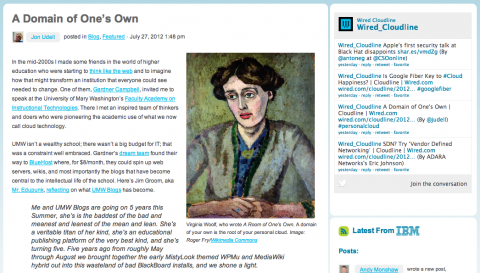
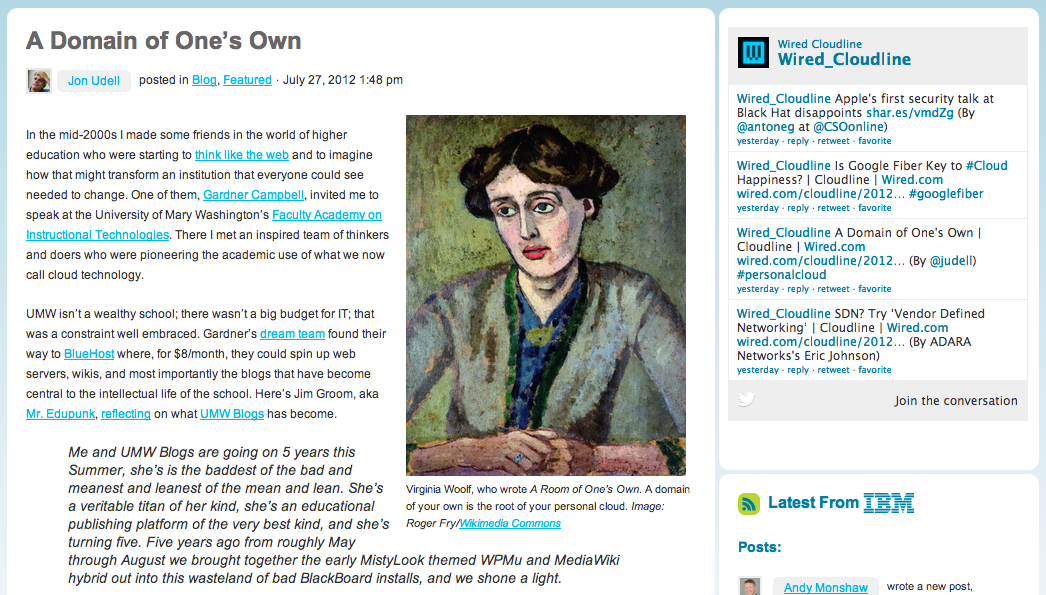
Jon Udell blogged about the history of an experiment that is finally taking root here at UMW. The pilot is the dry run for giving every Freshman their own domain and web hosting space by Fall 2013 in order to embrace and encourage students to becomes master’s of their own spaces, and get in the habit of maintaining their own personal archive of work. It will be built into the curriculum of a number of courses, and it’s a model of that ask students to take responsibility of their digital presence. To manage their online identities and build it so that they can take it with them when they go. Also, it pushes courses to acknowledge and embrace the open web as an integral part of the of the process of teaching and learning in a classroom or online.

What this means is that universities have to start thinking more like the web, but not in the catastrophic terms of MOOCs and the end of institutions, but rather in terms of understanding how networks and networked culture can change our understanding of sharing, transparency, privacy, and building collaborative infrastructure (Jon Udell’s talk back in 2009, The Disruptive Nature of Technology, is a brilliant framework to oeprate from here if you’re looking for more). How can IT organizations like UMW’s DoIT, head up by CIO Justin Webb be on board with something like Domain of One’s Own? I don’t know, but UMW’s IT organization is! This is not a radical, subversive pilot behind IT’s back, this is a pilot the CIO not only sees promise in, but also funded it outright. DTLT and the Department of Information Technologies are partners in  pretty powerful ways—that is an amazing thing to be writing on this blog! It’s actually a great day in that regard. So major kudos to Justin Webb.

What’s more, Tim Owens came to UMW little over a year ago and rebooted the whole pilot (talk about a shot of adrenaline!), got the server up an running, learned how to be a sysadmin for 300-400 people, groked the tech immediately and made it transparent for every one. This is one guy? And moving into this semester—nevermind him blogging on the Makerbot blog about UMW’s Maker Space—he’s got the Domain of One’s Own project well in hand. We are working on documentation and a introductory video as we speak.

I got my head in the clouds right now, Domain of One’s Own is more than a dream and Jon Udell is blogging about it! That’s a good omen, and one that I hope frames the long and distributed life of an idea that UMW’s current perfect storm has been able to make official and legit. This is very good.

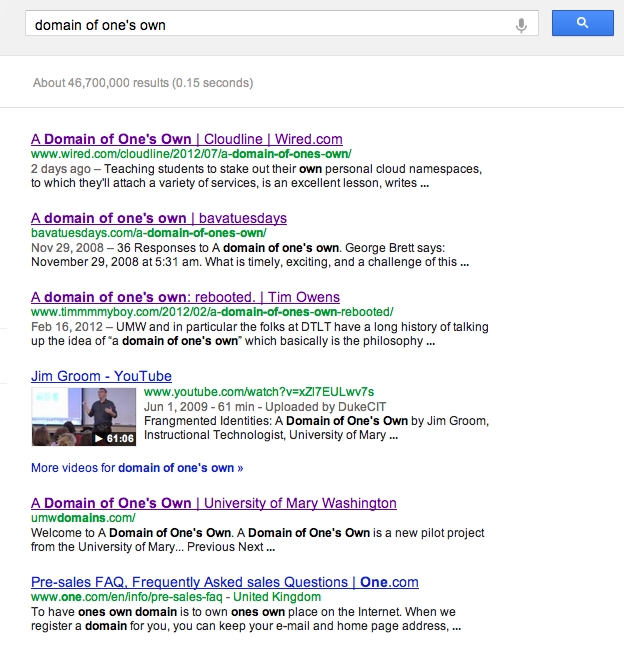
What’s more, do a quick google search for Domain of One’s Own (no quotes).  We also are the top 5 out of 47 million possible hits. Google juice.


Posted in dtlt, experimenting | Tagged , , , , , | Leave a comment

Collectively Innovating from Within or, Notes from the “I Love Me” Wall

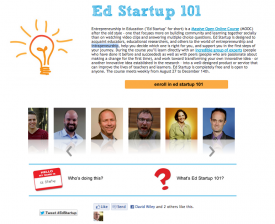
David Wiley is teaching a MOOC this coming Fall titled Ed Startup 101 and oddly enough I’ve been asked to facilitate one of the sessions talking about some of the work I’ve done at UMW over the years. I’m not an entrepreneur and I have no desire to ever be part of a startup. So I’m the one who is going to talk the students down from the slippery ledge of finance capital 🙂

I’m going to talk about innovating within an existing institution, but not so much in terms of greater profits—as the term “intrapreneur” is commonly defined—but for the benefit of the culture of an organization.  None of the work we’ve done at UMW can be directly tied to increased revenues for the university. What we’ve done is help make the culture around teaching and learning that much more relevant and innovative within the national conversation—and that, as a result, may have implications for UMW’s national reputation at some point.

And that’s interesting to me because reputation remains the currency for higher ed institutions, and by experimenting and remaining open to a wide array of possibilities I want to believe UMW becomes that much more valuable to people who want to get a unique education at a relatively reasonable price. A system of currency, all the same, but I want to believe—and will try and argue—that it’s anchored in people and experiences rather than ledgers and profits. I’m looking forward to this session, and I am honored David asked me to facilitate a week, I really look forward to it.

On a different, but related, note, The Chronicle of Higher Education published an E-Book with a collection of essays and writings from the infamous “12 Tech Innovators.” I wrote a piece for that ebook that challenged the way in which innovation is defined as a singular, monolithic act of the individual in response to the piece they wrote about me. It was an attempt to frame the work that has happened at UMW more generally, and ds106 more specifically, as a process of intensely collaborative and collective innovation. It is easy to hang the name Jim Groom on UMW Blogs or ds106, but the fact is people like Martha Burtis, Tom Woodward, Alan Levine, Andy Rush, Tim Owens, and so many more, all made this class community what it is. I wasn’t sure they would publish my short essay, so when I found out a few weeks ago they were planning to I was pleasantly surprised. However, I was not so thrilled to see it actually costs money to buy the ebook, so here is a link to my piece “Innovation as Communal Act” that I blogged a few months ago if you have any interest.

What becomes increasingly clear to me over the years is just how dependent any real and lasting innovation is upon a community of people that trust one another and work together to scale that reality. But we don’t necessarily work together in lockstep—we disagree with one another, challenge one another, and have regular fallouts—but we do have a shared vision and mission of what we think education should be. We think the teaching and learning at UMW should be shared freely and augmented wildly through networks of engagement, respect, and thoughtfulness, and I’m afraid we are not alone 🙂

Posted in Uncategorized | Tagged , , , , | 4 Comments

Domain of One’s Own as Legacy Archival Project

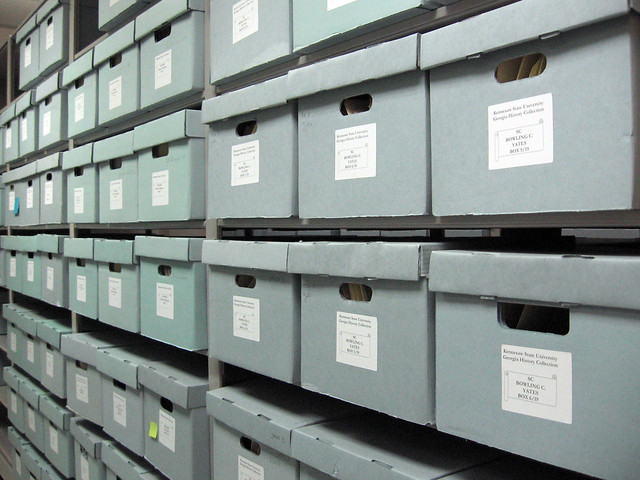
Image credit dolescum’s Archives’ stacks

In the seven years I have been at UMW’s Division of Teaching and Learning Technologies we’ve done a fair bit of experimentation. Most of that has been centered around commodity web hosting, domains, and one-click install open source applications. That method has paid off for us beautifully, so much so that the experimentation we did early on resulted in a successful blogging platform, a cutting-edge university website run on WordPress, and even an extensible framework for a course like ds106. Our experimentation has resulted in grassroots projects that have become official platforms that the campus interfaces with on a daily basis. None of this happened because it was forced on people, but rather because people found the various services we provided useful. This, for me, is the ultimate sign of success for an outfit like ours.

The other, uglier  side of the early experimentation is that it can be messy. Early on there was the exciting and chaotic proliferation of sites, domains, and web hosting accounts as we were exploring. That momentum slowly began to shift as we built more scalable models like UMW Blogs and umw.edu on WordPress. Turns out folks around campus were more than willing to stop using their externally hosted sites and return to the fold once they had an easy, powerful publishing platform like WordPress to work with.

So for the last week or two Tim Owens, Andy Rush, and I have been trying to clean up the vestiges of the web hosting and domain diaspora that has been languishing for several years now. The Domain of One’s Own pilot provided us a perfect occasion to transfer all the various domains and web hosting files from the disparate accounts to our own dedicated server for the project so that we can consolidate and manage all these files. What’s more, we can give any individual and/or department their own web hosting access because that is what this pilot is all about. After we consolidate all the web hosting accounts and domains to the Domain of One’s Own server we’ll have saved the university anywhere from $1000-$2000 per year in ongoing domain and hosting costs which means the cost of the pilot is closer to $8000 or $9000 this year—now that’s an innovative bargain!

What’s interesting is that the diaspora of sites has slowly consolidated to the point where we can both manage and archive all of the legacy work we have done over the last seven years while getting rid of the chafe and making sure the sites don’t become overgrown with web kipple, or even worse just disappear. It feels really good to be working through this process this Summer to make sure the work students and faculty have done on a wide range of sites over a long period of time is archived, consolidated, and available for the foreseeable future. I may even get the pre-cursor to UMW blogs, ELS Blogs, back up and running over the next week or two—which would be awesome, not to mention it would fix a lot of broken links from a large number of bava posts from 2007.

Posted in Archiving | Tagged , , , | 4 Comments