
A ds106 wish list

Image credit: Bionic Teaching's Michael Chasen sits on edupunk Santa's lap and hopes not to suck so much this Xmas
Image credit: Bionicteaching’s “Michael Chasen sits on edupunk Santa’s lap and hopes not to suck so much this Xmas

As I mentioned in my last post, a number of folks have offered to help with the design and execution of ds106. In fact a few have already publicly pledged their undying loyalty—and that’s a party right there! I’m eternally grateful, and the only way to show true gratitude is to actually give folks some more work for no pay—the neo-liberal way! So below is a quick Santa Claus Wish List, very much in the spirit of the season. You give, I take. That said, I plan on adding to this list regularly, and please feel free to do the same via your own blog or the comments.

  • The syndication and republishing of comments represents a particular issue, part of which is solved. All posts tagged ds106 from the contributing blogs will republish on the ds106.us site using FeedWordPress. And as Cogdog notes here, we can use FeedWordPress and the way it turns tags into categories as a way to come up with a more structured tag taxonomy for each assignment so we can represent all the different projects/assignments visually and contextually using tags and categories Given that, each post will be syndicated and categorized, but the permalink and “leave comment” link will both point back to the original post so people can comment on the source.Image of Lego Death StarWhat we need is a way to represent the number of comments on the actual blog on the syndicated post showing up in ds106.us. Moreover, we need a way to feed out comments from all the different blogs to a recent comments widget (or something like it) in the ds106.us sidebar. So, in short, the same old issue of syndicating and aggregating comments like we do posts. This is kinda like getting the Lego Death Star for Xmas, probably not gonna happen, but why not dream big. or at least let folks tackle one aspect of this problem—like maybe Slave 1?
  • I would love to see some idea around integrating Wikipedia into this course effectively. My initial idea was to open up discussing the Wikipedia article on Digital storytelling, which I have each time I started this class, and for the first week try and generate so ideas around making the article better. Or at least dealing with some of the issue Wikipedians have pointed out exist. There are a lot of missing sources and citations. Can we come up with some? Can we read through the article and tighten it up as a way to get a sense on how one of the most powerful sites on the internet works—all the while highlighting that we make it so. So, in short, a little help on editing Wikipedia, Jon Beasley-Murray and Brian Lamb taught us this years ago, and I would love to see some resources, citations, sources etc (and I need to get on this) so that we can keep this as a distributed, ongoing project over the course of the semester. And it can obviously branch out. The other idea I had was everyone take one an article, or adopt one and just track the process of editing Wikipedia. In every Wikipedia article their is a cultural story, and no one has made this clearer than Jon Udell in his Heavy Metal Umlaut screencast.
  • Image of Boba Fett InvoiceIdeas for assignments of all kinds. What comes to my mind immediately is the need for a graphic design assignment. I talked abut the Megashark infographic and the Boba Fett invoice during this semester, are more than a few students bemoaned the fact we didn;t play more with graphic design in the space between images/photography and audio. I think we could do that this time around, and I would love ideas/assignments. Tom Woodward introduced me to the Superpunch blog, and I think this might need be the “text” for this section of the course 😉 You are required to follow that blog regularly all week —all 400 weekly posts!
  • Tutorials for setting up a web hosting service, a WordPress blog, subdomains, etc. I have some of this already, but I am thinking that perhaps turning the ds106.us/wiki into a more comprehensive space to document the process of setting up your own web host, mapping your domain, and generally managing and manipulating the options in CPanel might serve many an educator, student, and everyday web citizen well in the future. And while I don;t want to reinvent the wheel, I think such documentation is something I will be working on anyway for those coming on with no experience in these matters, and I would love to work with others on this. I am one of the odd people that really enjoys writing support documentation, and of you other nuts out there?
  • Image of Tom WoodwardSome recommendations for plugins and ways to make the ds106.us site more user friendly and perhaps a plugin I can use to send registered members of that blog email updates using a specific category or tag only. Like announcement. Also, what sucks about the site, how would you do it different? Ideas for using the wiki more powerfully? Some general ideas, thoughts, visions I am not seeing? The syllabus is up and kinda raw, it’s from my last two semesters, and hasn’t changed much. Any ideas for that—feel free to edit it, just register on the ds106.us log and you can edit away? I put < a href=”http://ds106.us/category/assignments/”>6 or 7 assignments up, which were voted the best from this past semester, any ideas, thoughts, or recommendations for those? Better ideas to replace them? Tom Woodward mentioned the idea of having folks submit assignments at a given time and let people choose what they want to do, a kind of real life choose your own assignment/adventure based upon the particular theme we ar covering, i.e. video, audio, images, design, fan fiction, etc. How would this work? What would allow for this to be integrated into the experience?

That’s all I got for now, but I know there is much, much more. And if you wanna help there is no better time than now. Whadya got? 😉
Posted in digital storytelling | Tagged | 11 Comments

ds106 as an open and online experiment

Well, I am wrapping up the second iteration of the Digital Storytelling course (ds106) I’ve been teaching this semester, and I have to say it has been a lot of fun. i think I have honed my approach to the course a bit more tightly this semester, and while this run through was still pretty loose, I think I’m ready for the Spring courses. Plural because I’ll be teaching two come January. One which will be offered on UMW’s campus Tuesdays and Thursdays from 6-7:15 in an actual classroom–a physical space. The other is an entirely online course. I’m pretty excited about that, and as much as I talk all sorts of smack about edtech and online learning, this will be my first foray teaching an entirely online course. I’m a bit nervous, but at the same time I am lucky to be part of a network that has been doing some pretty awesome experimentation with bringing the social, networked experience into the totally online course.

Alec Couros has been blazing a path with this for years, and his recent EC&1 831 course is a model I will be shamelessly aping in terms of featuring work and allowing for an open platform for one and all. And then there’s the fearless Canadian triumvirate Dave Cormier, George Siemens and Stephen Downes that are now working on their third iteration of a totally open and online course—not to mention massive! But lest you think all the innovation in edtech is coming from Canada, David Wiley had some fun with this back in the day (so not all just 99.9% of the innovation—damn Canadians! ). And even closer to home, Gardner Campbell has been experimenting with a model for his New Media developmental seminar that he frames brilliantly here—it’s an exciting time for imagining new ways of using social media to rethink online education, and there are no shortage of great examples. I point to a few here, but I am sure I’m missing many, many more.

So what I want to do with ds106 is by no means new, and I have the examples to steal from and hopefully build on. That said, I’m still a bit nervous because I’m totally unorganized, and I don’t really see myself as a leader of such a class. I don’t necessarily want people to sign-up and then be like, “Hey. what’s next?”—though I know there will be some of that. I’d rather people get into the idea of creating and sharing narratives using digital media as a way to interrogate this space, while all the while producing something on a regular (or irregular) basis. I’m not thinking of this so much as a course as I am a series of prompts, possibilities, and people sharing their process within a specific period of time.

I think the “break through” I had—if you can call it that at all—happened when I used Alan Levine’s idea (isn’t everything an Alan Levine idea?) to build the Daily Shoot assignments/prompts as an entire week of my class this term. It was an amazing week of learning and sharing in that it all had so little to do with me, but everything with having a guy like Alan in my network recommending stuff to me on a daily basis. I loosely organized the assignment by saying:

You have to take a different picture everyday for the next 8 days, and you will find the prompts here. Be sure to post the photos on Flickr, use these tags, and then blog it. Also, you need to comment on each others work you philistines!

Or something to that effect, the whole thing simply piggybacked on the dailyshoot assignments that other people created—none of which was mine, but at the same time it was the favorite week of the semester for so many students—and was generative in helping them decide on their digital story project for the semester. Even if I wanted to pretend I had something to do with it, I can’t, and what’s more I didn’t. I went ahead and took the daily photos just like them, and I shared my process just like them. And it worked beautifully!

Being part of the creative act and the ongoing distributed commentary between and amongst the class on each others photos for that week changed the way I approached the course for the rest of the semester, and in many ways continues to inform my idea for the totally online and open version of this course. The Daily Shoot is the model I want to use for the online course for each and every assignment—I think it is brilliant, and there is no question that it uses the best elements at the heart of the generative, distributed and collaborative web, in other words the social web. This class will try and marry the social to the creative in an entirely online environment, and Daily Shoot is the model. But here is my plea, who wants to help run/develop this? I can offer no money, and to be clear I am being paid by UMW to teach this course as an online course. What I am looking for is people who want to set aside a protracted period of time to create, explore, and comment on the work of others, and hopefully help me design from this course shell something that looks like this for each of the assignments:

I am fortunate enough to have Martha Burtis teaching her own section of ds106 this semester, and she has already given me a ton of ideas. More than that, she is building a site that will aggregate examples of digital stories based on a given assignment using tags, etc. It will become a resource for featuring the examples students are finding of any given examples/theme we might be talking about. Now what we need is a way to provide a space like Daily Shoot so that we can see the work of all participants for a particular assignment on a given day. I want it to be visual like DailyShoot, and I know a bunch of people have offered their expertise with this, so I am now calling those offers in. Who wants to form a working group and see how we might do this in about one month?

Finally, I know what it is like to get excited about an open course and not actually do it. I did that for all three open course I signed up for. That said, I followed along at my own pace and did my own thinking and blogging as a direct, or at times indirect, response to those courses. So I am not looking for anything in the way of commitment, just the willingness to create things you might be interested in.

I’m obviously not done thinking this through, and I need all the help I can get, but this is a good beginning, and given I have but a brief “About” page and 6 or 7 assignments up on the new ds106 home (not to mention I themed MediaWiki for the TwentyTen theme) I believe it is a good start. It can be done, and it can be done in a way that is creative, part of our daily work flow, and, most of all, a way to bring together a community of folks to encourage the act of producing stories in all kinds of forms. I hope you can help.

Posted in Uncategorized | Tagged | 40 Comments

“Listen Terencino” —Fellini as Maniac

Anto watched a documentary on RAI recently titled Fellini: I’m a Big Liar, which has a series of interviews of people sharing tales about the great Federico Fellini, and what a maniac he was. And no story captures this better than Terence Stamp narrating his experience working with Fellini for the first time, it just puts Fellini on a whole another level in my mind.

In the following clip Stamp talks about his experience acting for Fellini in “Toby Dammit”, which was one of several short macabre films in the Histoires extraordinaires (1968) omnibus film. Give it a little bit, it gets insane pretty quickly, and please note that this has all sorts of narcotically lewd and lascivious descriptions—and may offend you deeply. Enjoy!

Posted in film, movies | Tagged , , , , | 3 Comments

Scientific Proof ds106 Rocks

During the course of this semester I met with all the ds106 internauts individually at least three times to gauge their progress and generally carve out sometime to make sure everything we are doing makes sense—a way to make up for my complete disorganization. So during my final meeting with Karen Strat this afternoon she actually surprised me by bringing in an experiment for our final meting and “evaluation.” The experiment played off of her obsession with sports science (though she claimed she wasn’t obsessed with anything—which proved falsch). Now I’m not sure what this particular experiment has to do with sports, but I do know it scientifically proves ds106 rocks!

Posted in digital storytelling | Tagged , , , , | 4 Comments

A Mashedup ds106 Xmas Card

Have a happy holiday ds106 inernauts!

Now looking for some hanukkah and Kwanzaa mashups 🙂

Discovered via this post on BoingBoing.

Posted in fun, mashup | Tagged , , | Leave a comment

Silent Star Wars


Thanks to the great Claire Cecil (a soon-to-be ds106 alum *sniff*) for the link to this awesome bit of fan fiction featuring the epic light saber duel fight between Darth Vader and Luke in The Empire Strikes Back as a silent film. Needed to post this because it represents everything great about the net, and I don’t want to forget this as an example for next semester. I love the way they make Empire look old. Classic.

Posted in Uncategorized | 4 Comments

Fixing the bava dryer

I have a 1983 Whirlpool dryer (the LE5790XM model to be precise) that came with my new house. I’m partial to anything that came of age in the 80s given that’s when I came of age, so when it broke I decided to try and save it. Having never worked on a major appliance before I put it off for a while, forcing the family to hang dry everything. But I’d heard dryers were pretty simple to work on. After scouring forums on the web I was pretty sure I had to replace the rear felt seal on the dryer given all the diagnoses I read online of the sounds my dryer was making.

So I did a search for Whirlpool and rear felt seal and up came the following video from repairclinic.com on YouTube.

After watching this I was pretty sure this was the easiest of jobs. And as an aside think about how much better this video is in terms of teaching me than any textual document could be. I wish some folks on the NMC list-serve would think a bit about all the things video does offer us that text can’t—texts undying position of ongoing privilege is a condition of academia (and tradition)—not the world at large.

Once I opened the dryer to check everything out I realized I had let the bad felt seal go too long and the rollers that spin the dryer were also shot. And, as it turns out, repairclinic.com had a video for that too:

So, I ordered a new rear felt seal and new rollers for about $60 and spent an hour or so yesterday fixing my dryer. And you know what—it works!! And I have the video to prove it 😉

Finally, take a look at the links above to the repairclinic.com’s replacement pieces. Not only do they include all the parts and details about them, but each one is accompanied by a YouTube video showing you how to install them. You better believe I bought my parts from repairclinic.com, what a cool service, and what a boon for repairing your stuff using the web as a resource. This post may seem divorced from my edtech stuf, but for me it is at the heart of it. This is more than video learning, this is video learning through context and a particular need—how do we do that online at instituions? Do we? Well, repairclinic has got it figured out, and I can attest their model works.

Posted in Uncategorized | Tagged , , | 11 Comments

Multimedia Projects: A Blog/Wiki Mashup

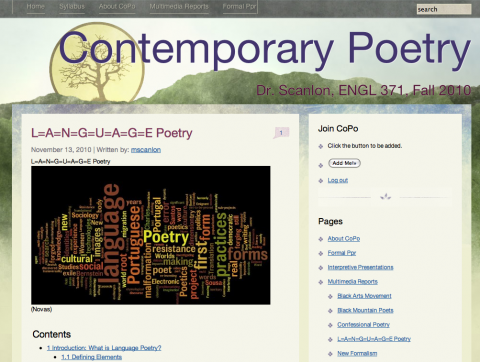
This semester professor Mara Scanlon and I decided at the very last minute to experiment a bit with the multimedia projects she had assigned the students in her Contemporary Poetry and Asian American Literature courses.

Here is the multimedia project description for the Contemporary Poetry class:

Collaborative Multimedia Report on Poetic Movements
For this assignment, you will work in groups of about three, which will be established within the first weeks of class. Each group will be charged with becoming our resident experts on a certain contemporary poetic movement, using outside resources (poetry, websites, manifestos and essays by participants, histories of literature, criticism, appropriate cultural or sociopolitical background, perhaps bios of major figures, etc.). I strongly encourage you to focus less on the biographies of individual poets, except where the information is germane, and more on the poetry and aesthetic values of the group and the cultural/artistic contexts for their work.

Rather than being submitted in traditional paper format, the projects will be posted to the class blog. The purpose here is twofold: to make the information easily available to all classmates in the spirit of collaborative learning, and to make use of the blog’s multimedia capabilities. Though the reports will include substantial (about 1000 words) explanatory text, they must also use images, video, audio, links, or other methods to enrich and support the traditional scholarship. College-level, appropriate research is the heart of your project.

So that’s the assignment, but as Mara and I were talking about this assignment in the 12th hour it occurred to us that doing collaborative projects like this in the course blog is a pain in the ass. Having many authors on a blog page or post is really not that convenient. Being pushed by Brian Lamb’s post about the Wiki not being dead yet, suggested we try to run these projects in the UMW Wiki, which is a MediaWiki isntallation that is running alongside UMW Blogs, and thanks to the CUNY Academic Commons and Cast Iron Coding, all UMW Blogs users are immediately authenticated to edit the UMW Wiki—I love me some CUNY. Give that, we figured having students edit their multimedia projects in the UMW Wiki would be a cinch in terms of headache and overhead—and that generally proved true.

What’s more, creating a new article in the UMW Wiki is as easy as wrapping any word or phrase in double square brackets like so:

A leftover from some earlier experiments Patrick Murray-John, Andy Rush, and I did with the “bliki” in 2007 (you can find the hacked plugin in the post I linked to).

What’s more, the UBC plugin Wiki Append allows us to pull the various multimedia projects created in the UMW Wiki directly into a blog page or post. The bliki has been here for years, it just took me that long to get over my blog crush. So, in short, some of the coolest projects I’ve seen this semester on UMW Blogs have been utilizing MediaWiki as a collaborative tool and the blog as an attractive and coherent way to present it.

Check out the projects on the Black Mountain Poets or L=A=N=G=U=A=G=E Poetry which are awesome, and then look at their corresponding pages in the UMW Wiki: Black Mountain poets and L=A=N=G=U=A=G=E Poetry. This is a really powerful way to work in terms of collaboration for a few reasons: 1) organizing information for a project like this is easier in a wiki than a blog, 2) collaboration is much easier on a wiki, and 3) the history feature of MediaWiki gives Scanlon a solid idea of who did what when. What’s more, we can incorporate/embed all the same media in MediaWiki as we can in WordPress and thanks to Wiki Append it can pull into a blog page or post seamlessly. One of the drawbacks that Chris Lott pointed out—and he’s right—is that you can’t search the MediaWiki article from the blog search field. We need a way to deal with this, and I’m sure the crack crew at UBC is working on this (or some other force of open source nature), because they have been building out their Resource Management Framework for a while now, and I am convinced it’s the way forward with all these “loosely joined” publishing technologies in an institutional setting.

Anyway, loved getting re-acquianted with the wiki this semester, and this project became the basis of a few more we did across a number of classes, but I’ll save that for a later post.

Posted in blogging, mashup, mediawiki, UMW Blogs, WordPress, wpmu | Tagged , , , , | 6 Comments

Felix the Cat, I love you but you’re bringing my site down

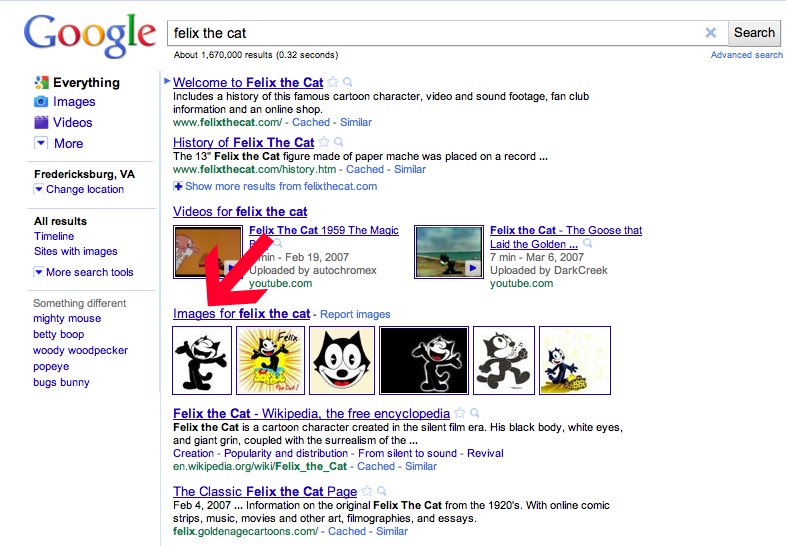
So bava traffic has been experiencing an enormous spike over the last two days. 2000+ visits in 24 hours as of now to just this post. I know that “Felix the Cat is a socialist?” post was awesome and everything, but I wrote it more than four years ago. Ands while it has consistently been the most popular post on the bava, it has never been this crazy in terms of traffic. Well, in turns out the image of Felix the Cat I have on my blog (included below) is now the top hit for a search for “Felix the Cat” in a Google web search. Seems like my remembering to fill out the alt text field for this image four years ago has finally paid off in bandwidth cost on my site.

Image of Felix the Cat

And here is the Google proof of my cat prowess:

I’m always glad to give back to the world, and given I’m one of the top providers of Felix the Cat images on the web makes me proud, and seems quite appropriate.

Posted in fun | Tagged , | 3 Comments

UMW Blogs in Berlin?

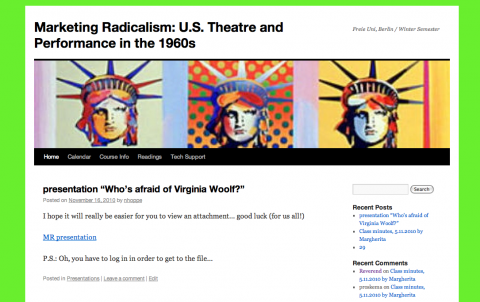
That’s right sports fans, UMW Blogs is now an international teaching tool. UMW professor James Harding of the English, Linguistics, and Communication department has been running two course blogs for classes he is teaching this semester at the Freie Universität Berlin. Harding is in Berlin for the year as a visiting scholar as part of a grant, and his research in Avant-Garde theater as well as the commodification of radicalism in 60s culture makes for some fascinating and rich course sites. You can see his blog for American Avant-Garde Performance here, and the marketing Radicalism course blog here.

What’s so cool about all this to me is that he is introducing blogging to graduate seminars in Germany, and as far as he knows—this kind of approach is truly a fringe experiment at the Freie Universität Berlin. It’s both rewarding and exciting to see UMW’s finest sharing what they do so well with students and faculty abroad, and to have almost 30 students from the Freie Universität Berlin using UMW Blogs this semester without a glitch is a testament to how god damned good it is.

Posted in UMW Blogs | Tagged | Leave a comment