
Click image for full size.
This work of art inspired by a return to Brady Bunch 2.0.
The ITC 2010 annual conference was a revelation for me, and in many ways exactly what I needed to re-light my fire for instructional technology. I first heard of the conference last year when I saw that the Briyans were presenting there, and when I saw that I was wondering why I wasn’t attending. Listening to either one of these cats is a treat, but both is a veritable feast. So when I had the opportunity to come to ITC this year I jumped at the chance, and I’m ever so glad I did. What I have to say first and foremost about this conference is that it attracts some of the nicest, fun, and open people I’ve yet to meet in EdTech. Everybody is genuinely excited to be there, to learn from one another, and to share what they’ve learned. It’s truly a learning community in the best sense of that word, and being a part of that for too short a time—I could only stay a day and a half—almost made me regret having a third child 🙂 If you don’t have ITC on your radar, I think it’s high-time that changed.
The conference started out with an opening session by Jared Stein and Marc Hugentobler titled “Late Night Learning LIVE!” (link to full presentation on Mediasite here). The amount of time, energy, and work that went into this presentation is belied by the the brilliance with which it was pulled off, this presentation was superb. The format of a late night talk show eases everyone into the conference, makes it relaxed and fun all at once, while at the same time throwing bomb after bomb at the audience. When I realized how mercilessly Marc and Jared were dogging the LMS and pushing for alternatives like the loosely coupled approach characterized by Personal Learning Networks, I felt like a chump. They had hit almost every point I wanted to make, but using a format that was not only more entertaining, but framed in a style that allows for the audience to laugh at an important critique. An approach that is, in my mind, the best way to effectively get people to consider your ideas—comedy is still the hardest and highest of art forms. And, truth be told, most people would prefer a comedy skit to a sermon any day of the week, and therein lies the importance of an experimental presentation like this one that pushes the bounds of how we communicate a series of new ideas at a conference. This presentation was a masterful example of engaging the audience while at the same time challenging them on just about every assumption we approach the LMS with. So, in short….Bravo! And kudos to John Krutsch who both Jared and Marc recognize as the originator of this format, you can see him doing the original “Late Night Learning Live!” here.
Also, I would be remiss if I didn’t detail some of the highlights of the session (and there were many):
Jared Stein’s interview with Jon Mott was brilliant. Jon, as usual, eloquently discusses the power and possibility of decoupling the management elements of the LMS from that system in order to afford his campus the ability to explore learning across a variety of domains and tools. Jon really does frame his argument beautifully, and as much as I scream and yell, what he is doing at BYU right now along with David Wiley (and I’m sure many others I don’t know) is nothing short of revolutionary, primarily because they can frame their approach as moderate in relationship to the “LMS is dead” crowd while at the same time realizing a very powerful initiative towards encouraging, enabling, and supporting faculty and students who want to pursue and cultivate their own personal learning networks on the open web at BYU. As for this video, I think it is my favorite of the presentation because Jared’s subtle use of a BlackBoard mug while interviewing Jon is the best kinda of on-camera gag you can imagine—simple and brilliant. You must see this one, it comes at about 11:00 minutes into the presentation.

And then there were the commercials, the brainchildren of John Krutsch, and oh how good they are. I can’t find direct links to them online, so be sure to just watch the whole presentation, the commercials are brilliant.
Up next was Diego Leal discussing how he ran an entirely online course using an aggregated approach with blogs and wikis. He blogged about his setup here—which is impressive—and hearing him talk about the class and the challenges and triumphs was heartening. Being an educator in Columbia, the back and forth about the LMS is not really of issue, from what I understand they don’t have a major, all-encompassing system like BlackBoard, which makes the dependence on a small pieces approach that much more vital. And when done right, like Diego does it, it becomes apparent that our institutional dependence on the LMS for distributed, online learning is most clearly linked to the bottom line: scaling, efficiency and limited effort and investment in the learning design for both faculty and students—all of which comes at a price, on several levels.
And finally, you had an interview with Tom Woodward and I acting like survivalist lunatics offering tips for preparing for the rampant “zombification” of higher ed. This was fun to do, but a bit hard to watch while at the session because it simply re-enforced what I already knew, namely just how much funnier Tom Woodward is than me. We filmed these clips one evening from our respective garages—it was a blast to do and just further proves that their are few more willing to go bat shit nuts for a presentation than Tom Woodward.
I could go on and on about this presentation, but let me stop here to say it was one of the best I’ve yet to see at an EdTech conference, and Jared and Marc set the bar extremely high for my presentation the next morning, and I can’t say I answered the call. But, if I came even remotely close—which I didn’t—it was because of the people at this conference. In particular, busynessgirl, A.J. Williams, Dr. Donagee, Howard Beattie, Hannah, and several others whom I hope someone helps me fill in the details for in the comments. I’d like to give everyone credit because these folks made my presentation. In short, the night before my presentation busynessgirl approached me and asked if I would be interested in having a choir for my Sunday morning sermon. I initially thought she was kidding, but it turns out she was dead serious. She recruited more than 10 people to actually march through the ballroom during my presentation and sing “I saw the light.” And for me, that made my talk (it as all downhill from there) and it captures what was so excellent about the ITC conference, the participants were not afraid to have a lot of fun. I talked about the coming reality of an educations based on small pieces loosely joined, and as usual built my presentation on the back of UMW’s finest faculty. Here’s a clip Barry Dahl took of the first 8 minutes of the presentation, which is pretty much all you need, and for an even more abbreviated version go to minute 4 for the stars of this talk: the EdTech choir.
As I mentioned already, it was depressing to leave the conference as soon as I did, and I really only got to see the grand debate and bits and pieces of various presentations on Sunday. I spent most of the time talking with folks in the hallways and finally sitting down and rapping at some length with Nancy White, who is a complete gem and has an uncanny ability to make you look closer at yourself and think hard about what it is we are doing in the field of edtech—even though she wouldn’t call it that. I finally got to see first-hand Nancy work her magic, and it’s no surprise why she is valued so dearly by so many. We talked about a range of things, but one of the issues that came up that has me thinking about things is the “massification” of education (Nancy’s term), the idea that increasingly we are seeing a push for open access to content across wide regions of the world without necessarily considering the ways in which the resources can be facilitated around specific, localized networks of learning. I think this is where Nancy’s ideas and practice with facilitation and community begin to dovetail nicely with Siemens and Downes‘ example of the Massively Open Online Course (MOOC) on Connectivism and Connective Knowledge Course. I’m beginning to connect more dots in this field after finally “connecting” with Nancy, and I’m feeling re-invigorated as a result. We all share concerns about turning open access to open educational resources into feeding lots of taylorized education (thank you for the metaphor, Gardner) rather than powerful examples of how we might harness complex networks of connections to start re-imagining the future of education that is open, affordable (if not free), and provides a sense of quality that is not germane to a resource as much as to a series of relationships around a resource, therein repositioning the idea of quality that all to often is associated with a material rather than the thought and ideas around it.
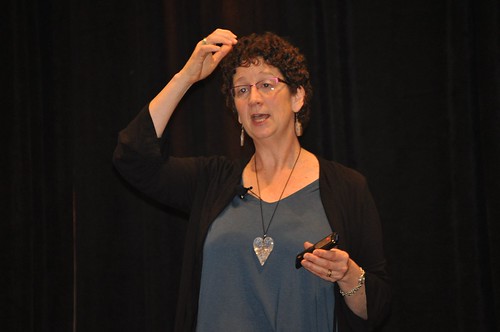
Image credit: Barry D’s “ITC10 FtWorth 010”
And while I didn’t see Nancy’s presentation in-person, I did watch it soon after it was published and her presentation beautifully models the introduction and facilitation of a new tool, watch how she masterfully and gently introduces Twitter in the first 10 minutes of her presentation at ITC10—so much to learn from her. And the way she uses Twitter to consciously break the wall between presenter and audience is extremely impressive, refocusing the idea of the speaker to a facilitator of a group of 300 attendees through a distributed tool such as Twitter—which becomes a lens through which to talk about and at the same time visualize the changing nature of networks using what she calls a “safe-fail experiment”—small experiments like a presentation that allows us to see what works and what doesn’t work. And more than that, she pushes back on the blogo-centric logic of my discussion, suggesting the “me” and the “we” need to dance between old and new structures, and experiment and explore the “me” associated with blogs as well as the “we” associated with wikis, forums, and even twitter. A discussion that links me back to John Maxwell‘s talk at OpenEd 09, wherein he brings into question the blogo-centric logic I’ve been promoting for a few years now—as have many others—by thinking about how the social creation of knowledge through wikis is a skill that in many ways challenges some of our assumptions about the primacy of the individual in all modes of writing and learning.
As you can see, this conference was as powerful for me as it was because I cam away questioning and re-thinking a number of my assumptions, and I have to thank Barry Dahl particularly for recommending me to speak at ITC 10, and Christina Mullins for being so cool in making the trip possible for me. Until Florida next year for ITC 11….
Yesterday morning I went to visit a faculty member—Andy Smith in Historic Preservation—who has been using Google sites for a project she is working on called Fred Buildings. It is actually one of the nicer sites I’ve seen built with Google Sites, and her question for me was about mapping a domain onto Google sites. Any long time reader of the bava knows I am obsessed with domain mapping so being given the opportunity to experiment with domain mapping on Google Sites was a total treat.
Let me start by saying that I didn’t know you could map a domain on a Google Site until yesterday, and they’ve had this service available for over a year and a half. While I tend to avoid Google Sites cause I find the service way too limited, realizing they have domain mapping available made me wish we were a Google School once again so I could experiment more with this across campus, particularly after realizing yesterday that you can map your root domain to one service, and various subdomains to other services without even having a webhosting account. This was a revelation to me, and something I figured out while experimenting with mapping a root domain to a Google Site and a subdomain to a blog on UMW Blogs (which could just as well be wordpress.com, blogger, typepad, etc.). If you think about it, this provides a way of having a namespace independent of a specific service while at the same time building a unique identity online that will allow you to move from service to service if necessary, yet keep a consistent presence. Something I wish Leigh Blackall had, because when I search his stuff I am spread across three different blogs, and while I like the fact that he moves services regularly (he is a badass in that regard—I could never leave the bava blog), I just wonder how he can stand all his awesome ideas remaining web service vagrants on the open web without a steady URL to call home.
OK, so, that said Leigh (or Big Papa), here’s the tutorial to get you started 😉
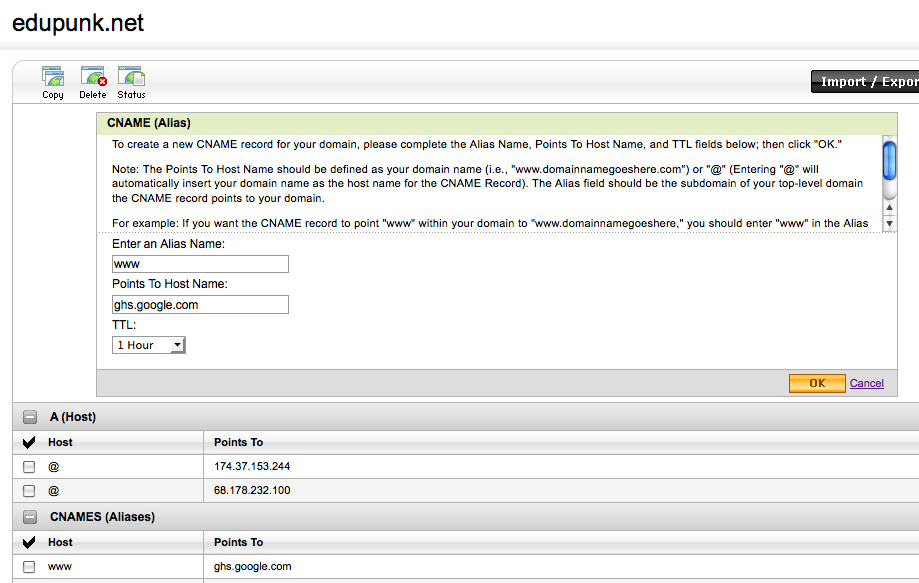
First things first, mapping your main domain to Google Sites. One of the limitations of Google Sites is if you map your main domain it has to be www.yourdomain.com, it can’t be just yourdomain.com. So, in order to map you main domain you have to do the following (this assumes you already have a domain name purchased through a service like Godaddy and have created a Google site). First, you need to point your main domain to to Google Sites. You do this in the Total DNS control panel on the service where you registered the domain, in this example I use Godaddy because I have an extra domain there laying around collecting dust.
As illustrated above, edit the CNAME field (or alias) for the www alias and point that to the host name ghs.google.com and save the changes.
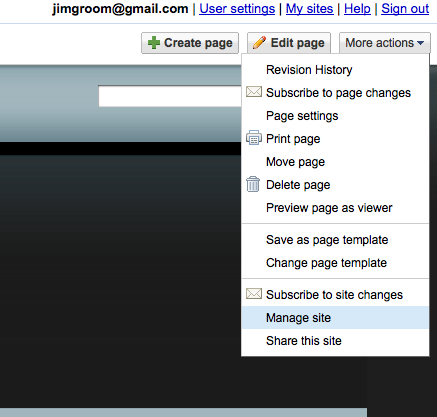
Then I jump over to my Google sites account and go to Manage Site and then look for the Wed Address setting pictured below:
 And add the main domain, in this case www.edupunk.net (keep in mind you need to add the www. prefix). After that click add web address, and your domain should map like mine did: http://www.edupunk.net
Now that in and of itself may not be so amazing, because I’ve been talking about domain mapping for a while with WPMu, and the idea that Google would have it makes sense. What is cool, and is a new discovery for me, is that while the m ain domain points to a Google site, I can have a subdomain like blog.edupunk.net point to another service like wordpress.com, blogger, or the ever great UMW Blogs without having a hosting account. It’s actually quite simple, all I did was add an A Record for the UMW Blogs IP address (174.37.153.244) in the Total DNS control panel at Godaddy:
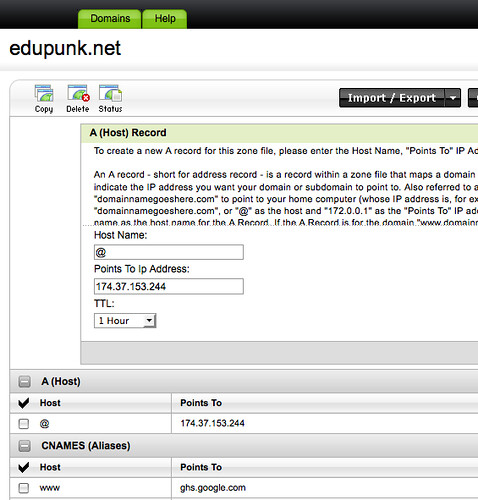
And then, I created a CNAME (Alias) titled blog and pointed that to the umwblogs.org domain:
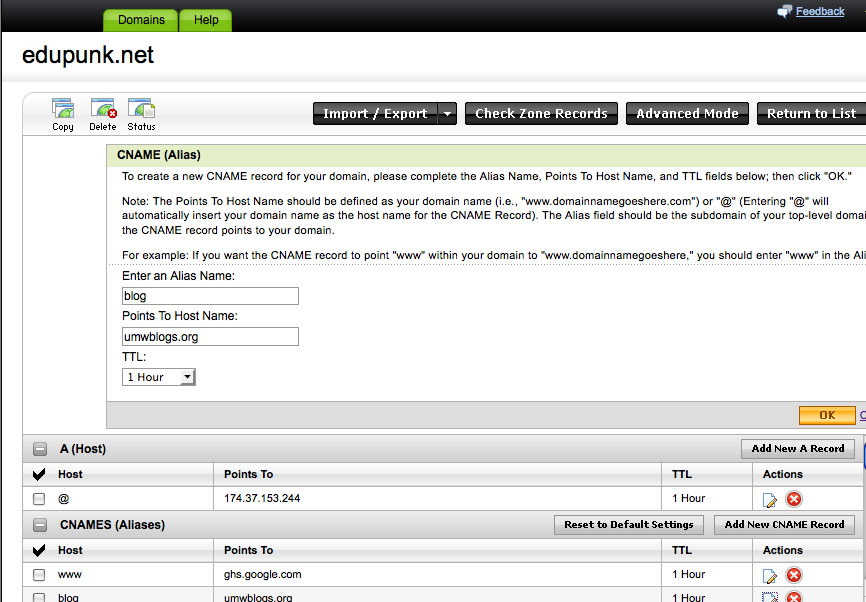 Click image for larger version
After that, I can go to a new blog I created on UMW Blogs (which has Domain mapping enabled for any blog on the system) such as edupunk.umwblogs.org and go to Tools—>Domain Mapping and simply add blog.edupunk.net.
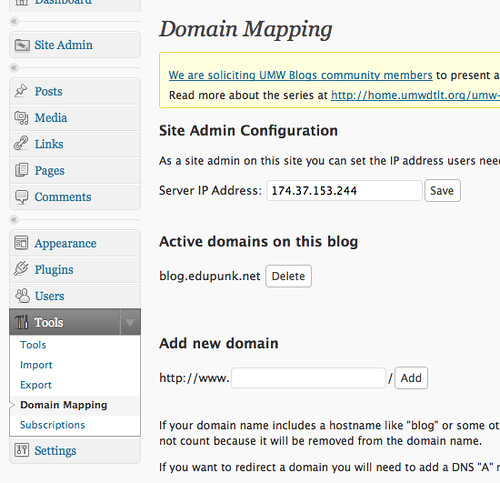
And voila, main site on Google Sites here, blog on UMW Blogs here, and potentially several other subdomains mapped to several other services.
Now, to get back to my original example, Andy Smith now has her Fred Buildings project on Google sites here and a blog for announcements and the like here. More proof that no faculty member at UMW can meet with me without getting a UMW Blog, it is impossible, and that’s why I’m the rightest Reverend ever.
Shannon Hauser put together a nice tutorial for creating a rotating header for your WordPress blog.
Playing around with the Drive-In Movie Ads at Internet Archive, oh what a joy. Via “What’s New at the Internet Archive.“
One of the formative 10 is being remade, and it looks to be another favorite of my destroyed by CGI. Where have you gone, Ray Harryhausen? A nation turns its starving eyes to you (woo hoo hoo).
Mara Scanlon’s “Women in Modernism” (aka as “Gynomod,” or more recently “the womb”) course blog is on fire, and having had first-hand experience of her teaching for all of last semester, it is really no surprise. She is able to bring her energy and passion for poetry—and literature more generally—into every facet of her teaching, and it is brilliantly reflected in the engaged and regularly inspired work of her students for the past three or four years (and while I’m sure that was the case well before that, now we have evidence 🙂 ). It’s an absolute privilege to work with her, and I think she, along with many others at UMW, present the best argument for the importance of focusing a liberal arts education on the art and craft of teaching and learning. She’s a master, and it pains me to say it because she is responsible for all kinds of shots at my ever fragile ego, most recently during the Digital Whitman seminar was the “TBJG,” or spelled out “That Bastard Jim Groom.”
Ok, now that I got that necessary, even if difficult, encomium out of the way, check out some of the work her students are doing in the Women of Modernism course. Sarah Lawless, when talking about H.D.’s autobiographical novel HERmion in this post, uses Flickr to create a gallery of images that feature the various plants that are mentioned in this work, along with the specific quotations from the novel in which they are referenced:
HERmione is extremely dense with botanical references, as you may have noticed, many of which are names of local flowers and trees that you non-gardening people might not recognize. Therefore, I’ve gone to the effort of making a gallery in flickr of some of the plants mentioned. The ways in which these flowers and plants are mentioned is also important to understanding the novel (or getting closer to understanding it?).
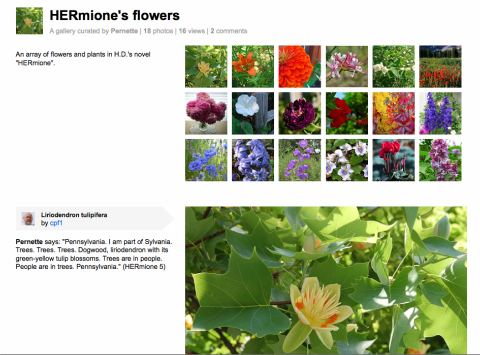
Amazing! What an awesome use of images for thinking about the imagistic style of H.D. Brava, lawless, brava (and I really wish I had Sarah’s last name).
But that’s not all that’s happening on the Gynomod, there’s also been a recent development called “Gynopod,” which is something various students have started experimenting with that relates the books they’re reading to the music they listen to—check out the inimitable Sam Protich’s inaugural gynopod that got the ball rolling in which he relates Jens Lekman’s “The Opposite of Hallelujah” to H.D.’s HERmione. And make no mistake about it, there is some serious literary analysis happening through these comparisons, check out the other three Ggynopods that have emerged since here, or subscribe to this sure to be regularly updating phenomenon here.
Yep, UMW Blogs, changing the game is our only name!!!
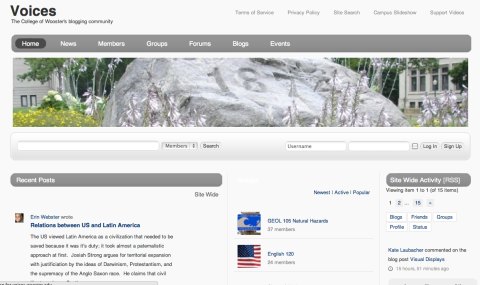
I was looking at the posts on WPMu Development for Education earlier this morning, and I came across this post from The College of Wooster’s (or should I saw WOOT!ster’s) WPMu/BuddyPress install Voices. The post was about new themes added to their system, something I am always interested in, but it also gave me the opportunity to check out the hard work Jon Breitenbucher has been doing on Wooster’s blog-based publishing platform, and I am extremely impressed. What I am really blown away by is how he is using BuddyPress Groups as course instances, and the way they’ve set it up, courses are linked to groups, and through those groups course pages you get access to the latest blog posts, wire comment activity, group members, and a link to the course blog. Additionally, there’s also a fourm integrated through an integrated bbPress. The whole design gives the course a really nice landing page and overview for anyone coming in from the outside, I love this setup.
And what’s more, the group course blogs have the option of being public or private enables the option of privacy that so often gets misunderstood in this platform as non-existent. People do have the choice in such a environment to make a decision about open or closed, most LMSs do not give the average course instance. One of the public blogs, Geology 105 is an open course that is blogging about Natural Hazards. As it turns out, professor Gallagher’s Geography 240 course is also dealing with the topic Natural Hazards. And the fact that these two courses are following a similar topic openly might allow Jon and to actually put in place something we were talking about at WordCamp NYC, namely a sharing of ideas across our two campuses. The platform provides a means for us to do this easily, and if eaither of these courses were in an LMS, would we have the same options? Would I have been able to discover the work at Wooster so easily? And while some say we need to rethink the LMS and work within that space to make in do these things more readily, I for one feel none of that compulsion. Working in an open source platform that provides the means to share and converse so readily precludes the need for reinventing the wheel with proprietary software. Why waste our time, now let’s get his party started right, Jonny B:)
For some reason I started thinking about Ranier Werner Fassbinder films this evening. I had nothing on tap, so I went to YouTube and got a different kind of experience—interviews. I love this one he gives about what Berlin Alexanderplatz has to say about contemporary Gemany in the 1970s:
And this interview is crazy, it’s like the interviewer is psychoanalyzing Fassbinder, and rather than being outraged at the personal nature of the questions, he simply struggles with answering him. A kind of guarded honesty you rarely see in interviews any more.

Find out more about me here.
 Click for larger image