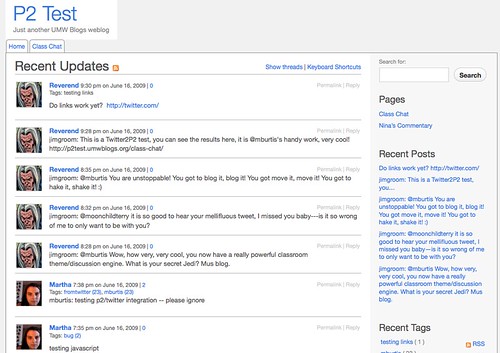
I’ve been dying to blog this, but I’ve been in beautiful Camden, NJ, piling up more work to do for Digital Whitman, a project which will shortly become the center of my life. But before that happens, I wanted to draw attention to work Martha Burtis has been doing with the P2 theme on UMW Blogs, which is both a Twitter knock-off for WordPress as well as a more traditional blog. She explains her process hacking this theme in detail here.
I find this really cool because it provides a really powerful way to marry the possibilities of both a blog and a twitteresque, free-flowing conversation all in one site. In addition, you can use the plugin FeedWordPress to aggregate tweets into the twitter-like conversation space so that students who might be on Twitter can contribute to the conversation from where they are. Now, I don’t mean to suggest that a vast majority of students at UMW are on Twitter, because I’m sure they are not just yet. However, this does provide us an interesting opportunity to frame some discussions about the Twitter model for communication which has literally proved revolutionary for communication on the web over the last six months. I have always had a difficult time broaching Twitter with faculty and students at UMW because it might at first glance seem too unwieldy, immediate, and irrelevant for the tasks at hand in a course. I think a P2/Twitter mashup might help change that perception, and if we can figure out how to filter and feed Tweets by hastags we would be golden—is that a job for Yahoo! Pipes?
What is so cool about a theme like P2 is that it allows UMW to adapt the form and function of a tool like Twitter to a course site on UMW Blogs quickly and with relative ease. And rather than resisting the ever changing landscape of the new web because our system sucks and is too expensive, we can once again quickly embrace and experiment within it. You gotta love these open source applications, especially when they have a community that just keeps on modeling their development on what’s going on around the web. Moreover, it usually takes but a fraction of the time it would take most other “learning” applications.
I started reading James Ellroy’sDestination: Morgue! (2004) this weekend, and I really can’t imagine a better author to lift your spirits when you are feeling down 🙂 I actually started this book of stories from the end, and then worked my way back to the beginning. Don’t ask me why, I just was taken with the title of the final story/novella “Jungletown Jihad,” which may be one of his most sinister pieces ever. It’s weird to read Ellroy’s fiction post-9/11, because he seems simultaneously hyper-relevant and out-dated. I’m so used to him chronicling the underworld of the 50s and 60s in masterpieces like the LA Quartet and The American Underworld Trilogy (the third novel, Blood’s a Rover, is due out in September—one of the few books I have ever looked forward to being published) that reading about Arab terrorist cells in LA in 2004 is surreal. His own explanation for writing The American Underworld trilogy is what originally lured me in to this series:
The essential contention of the Underworld USA trilogy … is that America was never innocent. Here’s the lineage: America was founded on a bedrock of racism, slaughter of the indigenous people, slavery, religious lunacy … and nations are never innocent. Let alone nations as powerful as our beloved fatherland. What you have in The Cold Six Thousand — which covers the years ’63 to ’68 — is that last gasp of pre-public-accountability America where the anti-communist mandate justified virtually any action. And it wasn’t Kennedy’s death that engendered mass skepticism. It was the protracted horror of the Vietnamese war.¹
Yet, what is so striking is that this idea of “innocence” in regards to America’s domestic and international policy has never seemed so distant and illusory as it has over the past eight years or so. Interestingly enough, “Jungle Jihad” draws some close parallels with the impunity of power in its unfettered violence that is the core of Ellroy’s frame for the 1950s and 60s, but somehow when this is updated for the ’00s, when there can be little pretense to innocence in a state ruled by fear of terrorism, it makes for a radically different reading experience. It’s a really strange to read “Jungletown Jihad” in light of Ellroy’s earlier stuff, and I don’t know what to make of it entirely. I mean he’s always good for the sick sexual hang-ups, hopped-up psycho energy, and the insane prejudices of the law—but somehow they seem more frightening to me without pretense of another world that is somehow outside that universe, somehow quieter or safer. In fact, that is the essence of the Noir, right? There’s an underworld that is all around us, yet invisible and somehow outside of our purview. It all takes place in the back alleys, dive bars and boarding houses, the suburbs are safe from this world—the two clearly and necessarily distinct. And while one can be sucked into this world, it remains more a matter of fate than accident. It’s odd to be how these distinctions are eroding, and everyone is a suspect, and no one is safe—is that the necessary fallout of a loss of innocence—even if always already a myth?
But actually I wasn’t intending to write about “Jungletown Jihad,” particularly because it seems like the most problematic and illicit literature written given it’s outright attack on the pretense to civil liberties and some kind of weak-ass liberal sentiment that seems compromised and silly given what we already know. Just reading it I was like, “He didn’t just have his character say that about Arabs, did he? Jesus! What a nut!” Ellroy’s a maniac, there’s no two ways about it—he isn’t called the “Demon Dog” without reason. But the story that really took me—and I think is the best of the bunch—is the very first one in the collection: “Balls to the Wall.” It’s actually a framing and re-telling of an actual boxing match back in 2000 between Érik Morales and Marco Antonio Barrera.
[openbook booknumber=”0060874503″]
Now I know there is a rich journalistic/literary tradition surrounding boxing, and while I’m not a student of the genre, Joyce Carol Oates’s On Boxing (1987) is a masterpiece in this vein. Her ideas of boxing move from “a celebration of the lost religion of masculinity” to boxing as pornography (and the next quote is a must) is astoundingly rich and accurate:
The spectacle of human beings fighting each other for whatever reason, including, at certain well-publicized times, staggering sums of money, is enormously disturbing because it violates a taboo of our civilization. Many men and women, however they steel themselves, cannot watch a boxing match because they cannot allow themselves to see what it is they are seeing. One thinks helplessly, This can’t be happening, even as, and usually quite routinely, it is happening. In this way boxing as a public spectacle is akin to pornography: in each case the spectator is made a voyeur, distanced, yet presumably intimately involved, in an event that is not supposed to happening as it is happening. The pornographic “drama,” though as fraudulent as professional wrestling, makes a claim for being about something absolutely serious, if not humanly profound: it is not so much about itself as about the violation of a taboo. That the taboo is spiritual rather than physical, or sexual — that our most valuable human experience, love, is being is being desecrated, parodied, mocked — is surely at the core of our culture’s fascination with pornography.
I just love the idea of boxing as a form of spiritual pornography that frames a culture’s own fascination with the desecration of the values it holds up as most sacred. I think Oates really gets at the power and allure of mass culture over the past forty or fifty years, and no where is the spectacle more apparent than boxing in the 80s and 90s for a whole host of reasons—particularly this wider sense of its fraudulence, or it’s loss of innocence, particularly with the transparent antics of Don King and Mike Tyson. So, I found it interesting that in “Balls to the Wall” Ellroy should return boxing to a literary character that rivals even Papa. Although his debt to Hemingway is undeniable when describing this match between two elite Mexican fighters in 2000, there is much of the Spanish bullfighters from The Sun Also Rises as there is of the prose of Men Without Women. His description of his father’s complex promotion/demotion system for understanding boxers according to race and ethnicity, which is both prejudiced and fluid based upon his father’s particular feelings about a fighter’s talents.
He liked white fighters best. He liked Mexicans next. He liked Negroes last.
Heart eclipsed race. Heart mitigated race. Heart gave Mexicans White Man status.
Mexican meant all Latins. Mexican meant some Italians. Mexican meant the Cuban Negro Kid Gavilan.
I particularly like the way Ellroy describes Mexican boxing:
MEXICAN BOXING IS WORKMANLIKE. Mexican boxing is inspired.
It’s savage emphasis. It’s basic boxing retuned to short range.
You move in. You stalk. You cut the ring off. You intimidate with forward momentum.
You crowd your man. You eat right-hand leads. You counter and left-hook to the body.
You instigate exchanges. You trade in close.
You take to give. You forfeit your odds for survival. You eat shots. You absorb pain. You absorb pain to exhaust your man and exploit his openings. You absorb pain to assert your bravado.
You clinch when desperate. You backpedal when stunned or insensate. You fight coy to avert the brink and buy moments.
The body shots sap wind. The momentum saps will. The absorbed pain saps brain cells. The absorbed pain builds character and fatuous ideals.
Mexican boxing is lore.
Mexican fighters chew steaks. They drink the blood and spit out the meat.
Mexican fighters slurp mescal. They gargle and swallow the worm.
Mexican fighters do roadwork at 10,000 feet. Mexican fighters train in bordellos.
Mexican boxing is memory.
Fights in bullrings. Fights at weigh-ins. Fights at victory balls. Fights.
And in many ways that is a perfect description of the Morales/Barrera fight. But it is Ellroy’s subtle lead-up to the story makes it for me. In his characteristic fore-shortened prose he briefly describes encounters and discussions with waiters and bartenders about the Morales/Barrera fight—everyone tagged Barrera as washed up. He had been 43-0 before losing twice to Brooklyn’s own Junior Jones (in 1996 and 1997), after which many had wrote him off, especially when pitted against the emerging brilliance of Erik “El Terrible” Morales (who had a perfect record of 35-0-0) was an all-around boxer and fighter who had easily handled Junior Jones with a fourth round knock-out in 1998. But then the fight, a fight that was described with so much love and hope that it almost seemed like Ellroy had lost his voice. It was staccato, it was lean and mean, but there was hope in that fight. It was as if the fraud that was all too apparent, the end of innocence apathetically accepted has for a second been broken in the riung. It was a real fight, Morales choose to fight, not box, and the two went at it for what many refer to as one of boxing classic matches. Who won was insignificant, it was the moment, the idea that even in pornography there may be a trace of love.
You can find the full fight on YouTube—which, btw, is an amazing boxing archive—it comes in eight parts, and the this video which starts with the 5th round may be one of the best rounds ever fought.
(As an aside, I just discovered Rope Burns while writing this, which is my next read for sure.)
With over 7 million users on WordPress.com, chances are that a number of faculty and students are bound to be familiar with the application at your campus. Case in point, a faculty member new to blogging at UMW just came in for a consultation, and while she was new to UMW Blogs and hasn’t used blogs for her classes before, she does blog on her own and is using—that’s right, you guessed it!—WordPress. So, my job was easy, all I had to do is explain and show her the plugins we use to make syndication hum, pointing out some advantages of using these re-publishing tools for tracking her students’ work all from one course blog. Man, the dividends are really starting to pay off with this stuff, and it truly does change the support model.
Update: The following error was caused by wp-cache.php. I disabled the file and WP-Super-Cache for the moment, and we’ll see if an upgrade of WP-Super-Cache doesn’t solve this error.
Every user that is not an admin on UMW Blogs seemed to be getting the following error in the header of the administrative backend:
Warning: Invalid argument supplied for foreach() in /home/umwblogs/public_html/wp-admin/includes/template.php on line 3169
It was highly annoying for me because I didn’t know how to fix it. But thanks to my main man Zach Davis, it is now fixed hidden by adding the following line of code after line 3169 in the wp-admin/includes/template.php, still working on a fix:
if(!is_array($actions)) $actions = array();
The other error I ran into today was related to a PHP allowed memory size within the adminstrative backend of the http://tags.umwblogs.org site (which is the place where every post in UMW Blogs is being republished using Donncha’s Sitewide Tags Pages plugin). Specifically, whenever I hit quickedit on a post in the backend, I would get this error where the categories and other metadata would show up, and when I clicked edit, the post text data would not show up at all.
Fatal error: Allowed memory size of 33554432 bytes exhausted (tried to allocate 524286 bytes) in /home/umwblogs/public_html/wp-admin/includes/template.php on line 419
The blog is huge, with thousands and thousands of posts, and I have a sneaking suspicion it is bursting at the seams. We have to find another way to archive and store this stuff once it reaches over 20 or 30,000 posts 🙂 In the mean time we upped the memory quota, but this is a shot-term fix— I think a long term solution might be something we may have to think through. Anyone have any ideas?
I’m thrilled to see the great Tom Woodward is uploading the interviews he did with random folks at SXSW about EDUPUNK and zombies. They’re a blast, and it’s awesome to finally see them. It’s also refreshing to see that no one at the EDUPUNK SXSW panel actually knew anything about EDUPUNK, despite how “viral” it seemed to have become. Just goes to show how small our little corner of the internet truly is. Anyway, I’m excited to watch these short clips, many of which will be for the first time. I think we will ultimately try to make something out of all the footage collected, but until then check out the clips as they come in with the RSS feed, and be sure to find out more about quantum physics zombies here.
Man, does the Open Education Conference lineup of presentations ever look good! And while some fragile souls might be find Dave Cormier’s session off-putting, I find it absolutely refreshing. And from what I understand it is not simply about shock value (which I have no issue with, mind you), but actually framing the imperialistic approaches of some to open educational resources on the wider wide, often characterized by little or no consideration or recognition of the existing communities in these open spaces. A message and tone that I think is deeply embedded in this line-up, check out Bryan Alexander’s presentation title which deals with a topic near and dear to my heart 🙂
But beyond that, and even more exciting, is the fact that some many amazing folks within the edtech field will be converging on Vancouver this August to set what I believe will be an entirely different tone for the future direction of the open education movement. If the folks who have committed to this party can be thought of as a barometer, I would have to venture that this conference will be intelligent, irreverent, possibly raucous, certainly refreshing, and downright fun. And while I’m no clairvoyant, I also have a sneaking suspicion that the institution as definer, provider, and benefactor of open ed will play a far lesser than it has traditionally in this field, rather framing the individuals and ad hoc communities that have been working around the world to re-imagine open education as a nuanced and personal relationship, rather than a sterile and outmoded model of exchange for resources.
I can dig that! And I can also dig re-connecting with a ton of cool folks and finally meeting a bunch more like Leigh Blackall, Philipp Schmidt, Jon Mott, and Grant Potter to name just a few. Let there be no mistake, this is a moment to redefine the open education movement, and but the talk of repository and suppositories to rest, and get on with the future. I can’t even begin to think about what it would mean to not be there, can you?
OK, I need some help here. I am trying to make sure everything we do on UMW Blogs is covered under SSL, and while we have the SSL certificate for UMW Blogs, we don’t have the dynamic subdomain certificate. So, in short, is there some http, .htaccess voodoo we can do that would force everyone to sign-in through the main umwblogs.org domain, which would then kick them back to the administrative backend of their own blog once they’re in? I imagine this might even work for mapped domains, and it seems similar to what wordpress.com is doing. Any hints or tips would be greatly appreciated, because I have to get this solved right quick 🙂
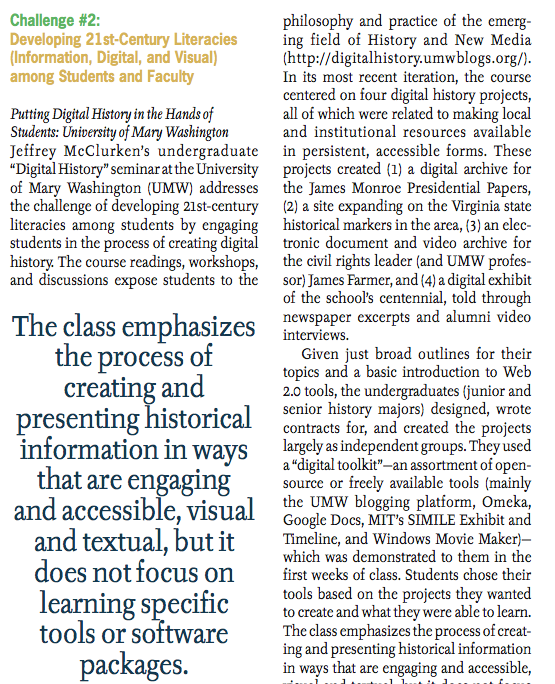
In the most recent issue of EDUCAUSE Review, Jeff McCLurken’s Digital History course has been featured as an example of “Developing 21st-Century Literacies among Students and Faculty.” The course is an excellent example of framing an experience wherein the students are asked to imagine their approach and then examine and choose their own tools based upon the nature of their projects. A methodology that challenges the idea of limiting the projects by any one pre-determined tool or approach. It’s truly an EDUPUNK approach that included all of DTLT, not simply one-tool-fits-all—against my WPMU advice, mind you— and the resulting projects exemplify this beautifully, using tools as diverse as Omeka, Simile Exhibit and Timeline, Google Docs, and, of course, WordPress.
Anyway, don’t waste your time on the bava, go read Jeff’s portion of the article here. But I must say this is particularly cool for those of us at UMW’s DTLT because Jeff has been in the situation over the last year to be one of our biggest advocates and champions during the change in leadership that has left us all a bit uncertain as to the future of our little experimental cadre. It’s not hard to imagine much of what we do may not make sense to someone who hasn’t spent some serious time thinking about the implications of the changing web on teaching and learning, and higher ed more specifically. But with faculty like Jeff (and Steve Greenlaw and Mara Scanlon and Claudia Emerson and so many others, whom I’m sorry to omit here) who constantly have our backs, I think we won’t only continue on here at DTLT, but we’ll move forward with both the trust and freedom that has made this group so uniquely situated to play at the bleeding edge of educational technology. So, in short, congratulations Jeff, and thank you!
Tom Woodward is at it again, his recent rash (does 2 constitute a rash?) of mock Chronicle articles are downright hilarious. Be sure to check out “Student Brainwashing Proves Effective” and “Colleges Consider Using Human Skin Instead of BlackBoard.” What I particularly like is Tom attack on the Ph.D. is the guiding logic for all authority in higher-ed, questioning those three letters is akin to heresy and insubordination at academic institutions like the university, and that’s why I love Tom so god damned much, he ain’t afraid of no suckers. And when we talk about diversity in higher-ed, the diversity of degrees and experience isn’t something that can be raised without great trepidation, in fact. it’s a degree-based caste system. There, I said it!
And while I’m republishing the first few paragraphs of Tom’s re-writing of the Chronicle article on the CUNY WordCampEd conference that came out last week, I highly recommend you check out Mikhail Gershovich’s “BlackBoard, This Song is Not About You: More on CUNY WordCampEd,” which provides an inspired and crucial corrective to the Chronicle article.
Colleges Consider Using Human Skin Instead of Blackboard
By Tom | June 5, 2009
—Another mock Chronicle article – or Chronicle mocking article. If it weren’t so easy I’d try to get it declared an Olympic sport.
original article here by JEFFREY R. YOUNG
footnotes, italics and a few minor deletions by me below
New York
Jim Groom sounded like a preacher at a religious revival when he spoke to professors and administrators at the City University of New York last month. “For the love of God, open up, CUNY,” he said, raising his voice and his arms. “It’s time!” But his topic was technology, not theology. A number of studies have correlated religious zealotry of this type with insanity and anti-social behavior.
Mr. Groom is an instructional technologist at the University of Mary Washington, and he was the keynote speaker at an event here on how to better run CUNY’s online classrooms. The meeting’s focus was an idea that is catching on at a handful of colleges and universities around the country: Instead of using a course-management system to distribute materials and run class discussions, why not use free blogging software — the same kind that popular gadflies use for entertainment sites? I’ll answer my own question. Because it’s for gadflies and entertainment sites, damn it. Trusting your course to something so common, so un-academic would be like settling for a non-terminal degree.
While reading and writing about an article on early 3-D cinema in Filmfax, I was taken by one particular bullet point in a sidebar time capsule about 1952:
Returning from Ne York from Copenhagen on Dec. 15, after undergoing some 2,000 hormonal injections and six operations to transform a slender former G.I. name [sic] George into a statuesque Christine Jorgenson. Ms. Jorgenson was the first transexual to make her gender conversion public. She subsequently sold her life story to the American Weekly for a reported $50,000.
I was immediately struck by this factoid from the time capsule of 1952, and immediately when online to see if i could find out more. And lo and behold I found two surprisingly interesting videos on YouTube that actually show Ms. Jorgenson at two very different moments in her life. The first is a short newsreel of her return to New York City from Copenhagen soon after her “sex change.”
The second is a mature Ms. Jorgensen talking about adoption, both are extremely fascinating. But one thing I find so uncanny is the way in which the older Jorgenson seems so much more like a woman than the younger. It might seem obvious given how close she was to her recent conversion, but I wonder if this also might be a way to understand how we learn to play at our gender roles through the perception of others, experience, and daily practice.
And, of course, there is the cultural backlash that surrounded this media event. In 1953 this Calypso-inspired song titled “Shame” by none other than Louis Farrakhan offered up a not-so0-subtle attack on this “freak of nature.”What’s interesting about the song is it suggests just how much money and acclaim she was getting for publicizing her sex change (the punchline of the song suggesting we are all being duped because we have no “real” proof) suggesting that Jorgenson was actually accepted and celebrated, although I imagine it was probably more like a Native American coming to Europe to be paraded around the continent in a cage.
is an ongoing conversation about media of all kinds ...
Testimonials:
Generations from now, they won't call it the Internet anymore. They'll just say, "I logged on to the Jim Groom this morning.
-Joe McMahon
Everything Jim Groom touches is gold. He's like King Midas, but with the Internet.
-Serena Epstein
My understanding is that an essential requirement of the internet is to do whatever Jim Groom asks of you while you're online.
-James D. Calder
@jimgroom is the Billy Martin of edtech.
-Luke Waltzer
My 3yr old son is VERY intrigued by @jimgroom's avatar. "Is he a superhero?" "Well, yes, son, to many he is."
-Clint Lalonde
Jim Groom is a fiery man.
-Antonella Dalla Torre
“Reverend” Jim “The Bava” Groom, alias “Snake Pliskin” is a charlatan and a fraud, a self-confessed “used car salesman” clawing his way into the glamour of the education technology keynote circuit via the efforts of his oppressed minions at the University of Mary Washington’s DTLT and beyond. The monster behind educational time-sink ds106 and still recovering from his bid for hipster stardom with “Edupunk”, Jim spends his days using his dwindling credibility to sell cheap webhosting to gullible undergraduates and getting banned from YouTube for gross piracy.