
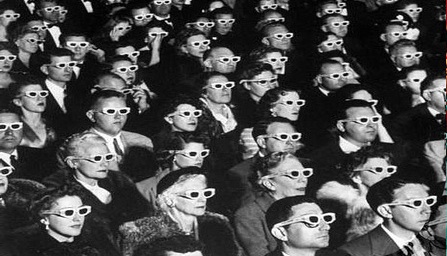
Dreaming in 3-D

3-d-dream1
I’m getting deeper and deeper into this issue of Filmfax, and I have to say it’s a gem. I just finished the first installment of Vincent Di Fate’s “3-D Cinema: Yesterday, Today, and Tomorrow” which gave a nice overview of the technical details behind the emergence of 3-D cinema during the 1950s. I love this kind of stuff, replete with cool sidebars detailing the history of stereoscopic film-making pre-1952 as well as the time capsules listing the significant historical events of 1952—the year 3-D broke wide open. (Did you know 1952 was the year news of (Christine Jorgenson)’s “sex-change” in Copenhagen, Denmark took the US media by storm? This will be my next post šŸ™‚ ) And the article ends with a comprehensive list of the 28 3-D films that were released from December 1952 through December 1953. I love films lists, and this one backs a bunch I would have loved to have seen in cinematic 3-D: Bwana Devil, the John Wayne vehicle Hondo, House of Wax, It Came from Outer Space, and I, the Jury, and truth be told I would have seen every last one, but the the 1954 Creature from the Black Lagoon would be highest on the list—those underwater shots remain some of the most magic in all of film for me.

And it’s the magic of film where this post is trying to go. As you can tell this article is the whole enchilada, historical overview, technical detail, film list, historical time capsule, etc., but what utterly blew my mind in this article was the four or five paragraphs of pure poetry which the author stuck right in the middle when trying to explain how the already dream-like state of sitting in a cinema watching a film is further augmented by the experience of 3-D, and while framing his discussion he captures and articulates the real power of watching film in a real theater on a real screen in real 3-D:

But there was another dimension to all of it [3-D cinema], if you’ll pardon the expression; something surreal and deeply rooted in the human psyche…..a lucid dream is most unlike a common dream, for it is an experience wherein the dreamer is self-aware, is conscious of the fact that she or he is dreaming, and in which the dreamer often has the power to control the events of the dreaming experience. Film passes through the “gate” of a motion picture projector at a rate of 24 frames per second. With video, this frame rate is 30 frames per second. Thus, watching a film in a movie theater, as opposed to viewing it on a TV Screen or a computer monitor, allows the view to see more “black”—or more correctly—to see less image….In the particular case of a 3-D film, however, if polarizing filters are added at two locations to the projection process—at the exit point of the projector, and at the polarizing lenses of the glasses one wears while viewing 3-D film—the viewer has seen even more “black” than when watching a conventional film. To my point, watching a movie in a theater is more like being asleep and dreaming, thus creating a deeper, more intimate, and more involving experience. And watching a 3-D movie, because of its vivid, though not entirely natural simulation of the three-dimensional universe, is more unusual and dreamlike still….the many tip-offs that this is real yet not real is another way in which 3-D movies are like lucid dreams that we fully recognize as dreams while we’re dreaming them, even though we are asleep.

This is an abusively long and hacked quote I know, and it doesn’t do the original justice to be sure, but I had to write it here because it so beautifully nails so many of the most powerfully seductive elements of cinema, in the true sense of that word, as an almost immediate slip into another state of being. A space between consciousness and unconsciousness, this in-between and fecund ( šŸ˜‰ ) space of visual and mental immersion in a narrative that you are constantly aware is both real and unreal—so akin to that dreamlike state, and 3-D just heightens that whole experience.

Now I know so many film theorists have written about film and dreams, and the idea is nothing new per se. But what I love about this article, and Filmfax more generally, is the way these ideas are brought to you from a diversity that is so hard to find amongst film scholars and academics. Rather than a defined and impregnable vocabulary surrounding film and theory (which I admittedly love) this article strikes right at the intersection of our shared experiences with dreams as humans, the material conditions of the technology, as well as—and most importantly—the sheer and utter wonder of watching a film in a movie theater. That is such a unique and powerful was to address this deep and continued nostalgia I have for the single screen, movie houses that shotgunned light through celluloid in a cavernous auditorium. There is no real theory for that feeling, there is no real way one way or vocabulary hrough which we understand dreams, or film for that matter.

Posted in film, films, movies | Tagged , , , , , , , , | 1 Comment

A Return to Kustom Kulture

Image of Rat FinkI finally got around to picking up the latest issue of Filmfax, and I just happened to open up to Michael Stein’s “Confessions of a Rat Fink!”—an interview with Ed “Big Daddy” Roth who was an icon of the Kustom Kulture movement in the 1950s and 60s.Ā  I knew little or nothing about this movement before I read the interview—which means I know only a tad bit more than nothing now—and I was fascinated with the way Roth framed the impact and import of imagining, designing and building custom cars from scratch during the 1950s and 60s. He wasn’t so much a mechanic as he was an artist—and I don’t necessarily mean the Rat Fink logo he became most famous for, though there is that—but the very idea of building something unique from scratch that is otherwise mass produced—creating a model of one that has no real precedent in the automobile industry.

What strikes me even more is how this idea of designing and building something for yourself gave birth to a long line of car subcultures from hot rods to dragsters to low riders over several decades, but was by no means limited to this sphere. It effected clothes, hair styles, comic art, movies, novels, and on and on and on. It was not so much the object of what was being created, though that was vital, but the act of creating it, the decision to build it. From the act is born an aesthetic that embodies an approach to the world—the relationship to design that is as key to galvanizing a cultural movement as it is to transforming a culture’s vision of cars.

Ed Roth with the Orbitron

Roth’s discussion of what he was doing and why seems to capture the power of tinkering as a means through which to design, rather than consume, the world we inhabit: “fiddling with the brackets and the grinder and the welding machine has always produced things that were better than what Detroit was building.” I love the way Roth understands his work as in many ways diametrically opposed to that of Detroit, and no so much to exalt himself as an individual designer, but more to suggest what is possible.

His final quote of the interview seals the deal for me:

I don’t know id I’d describe it as “art.” We were setting an example for what could be accomplished. What Von Dutch, Robert Williams, myself, and other customizers were saying was, “Hey guys, why build led sleds in Detroit when it is possible to build stuff like this?” There was a whole culture thing in America [in the 1950s and ’60s] that’s come and gone, and it’s sad. We supplied ideas for kids: the cruising, the dancing, the good times. And I can remember going out at night, and looking around the city–you could see al the guys had their garage doors open and they were building cars. Now all those garage doors are closed….”

I just love the whole idea of a culture around building stuff and sharing it, and I wonder if that isn’t the impetus behind what we do, the reason for getting excited about doing it. In just about every aspect of our daily life we have been removed from the process of designing or building anything, we have been left simply to consume what’s been made for us. Perhaps the time has come to move away from the spaces created for us by Detroit and reclaim a space that ours, and create a culture around building and making—rather than consuming and repeating.

And, as is always the case now, there is fan video of Ed Roth’s work (focusing predominantly on his Rat Fink artwork) , I particularly like the soundtrack on this one:

The Rat Fink toy:

And even what seems to be a post-humous Ed Roth clothing line, which is what happened to Von Dutch after he died, his daughters sold his name and art to the highest corporate bidder, despite his own rare and respectable views about money:

I make a point of staying right at the edge of poverty. I don’t have a pair of pants without a hole in them, and the only pair of boots I have are on my feet. I don’t mess around with unnecessary stuff, so I don’t need much money. I believe it’s meant to be that way. There’s a ‘struggle’ you have to go through, and if you make a lot of money it doesn’t make the ‘struggle’ go away. It just makes it more complicated. If you keep poor, the struggle is simple.

Posted in americana, pop culture | Tagged , , , , , | 1 Comment

Was Wonder Woman a librarian?

This may be one of the worst cartoons ever made, but it does a few interesting things: 1) it suggests that Wonder Woman was a librarian—is there any other precedent for this?, 2) it captures just how conflicted Wonder Woman was about her identities as Ms. prince and Wonder Woman along some pretty heavily “mediated gendered lines” (thanks to Zach Whalen for that insight šŸ™‚ ), and 3) it animates The Brady Bunch kids, which is a huge win for every child of the 70s no matter how you slice it.

Wonder Woman & The Brady Kids (1972)

Thanks to Kliph Nesteroff for sharing this “Crap of the Highest Order” on the ever great WFMU blog.

Posted in television, TV | Tagged , , , , , | 4 Comments

The End of the American Empire

I recently came across three videos on YouTube wherein David Simon (of “The Wire” fame) is speaking at Loyola University about “unencumbered Capitalism” which has resulted in an “existential crisis” of epic proportions, namely the reality that “people matter less.” As he notes within the opening minute of part 1 of the video:

I am wholly pessimistic about American society, I believe that The Wire is a show about the end of the American empire. I believe that we all—or our kids—are going to live that event. And how we end up at the end of it and where we end up and whether or not we can survive it on what terms is going to be the question….The great conceit of The Wire…[is that] every single moment on this planet from here on out human beings are worth less…human beings have lost some of their value.

“End of the American Empire, Part 1”:

That is some serious shit, and the whole question of devaluing individuals is directly related to post-industrial malaise of the US wherein semi-skilled labor in the Western world is no longer a viable means of survival has created two drastically different Americas, and the America no on e sees or talks about is what he terms “the other America,” and is framing o our particular moment and the complete amnesia when it comes to the dignity of the individual and the core value of a society being how it treats it’s most abject and disenfranchised members gets to the heart of the sinking feeling I often struggle with when watching this country go deeper and deeper into the corporate sponsored abyss.

Simon’s point is so beautifully backed-up and reported by Greg Palast yesterday in his piece “Grand Theft Auto: How Stevie the Rat bankrupted GM”which lays out quite specifically how the vultures have not only helped to expedite the fall of the American working class, but now plan on picking all the meat of their bones by stripping the workers of their rightful funds (think pension benefits, etc.) in order to pay back “privileged GM lenders – led by Morgan and Citibank.” It’s just remarkable to me how one can simply look to any current event to bear witness to everything Simon talks about in the three videos below (and on The Wire, for that matter). And according to Palast our President and media darling Barak Obama is in on the big kill taker. So, do we value human beings less and less everyday in this country? Well, I’ll leave that to you, but it is certainly a stroke of horrifying genius that Simon’s next series Treme will focus on New Orleans and Katrina—he’s the Melville of our moment, and his The Confidence-Man took us down the Mississippi
River to new Orleans by way of Baltimore.

“End of the American Empire, Part 2”

“End of the American Empire, Part 3”

Posted in television, TV | Tagged , , , , , , , , , , , , , , | 18 Comments

Spider-man 1967, Epsiode 9

This week’s Spider-man features two episodes with two all-new villains:

“The One-Eyed Idol” Someone has sent a one-eyed idol to Jonah Jameson. Jameson is hypnotised by the idol to steal his own cash. Spiderman finds the assailant the following night but gets captured. Cliventon [a Crocodile Dundee prototype] and his Aborigine friend have been swindling Jameson. Spiderman escapes and catches the both of them.

“Fifth Avenue Phantom” Spiderman attempts to halt the Phantom’s activities only to be set up by him and his henchwoman Marie. The Phantom has hired women to shrink valuable items to steal and sell. In the factory Spiderman finds that the Phantom’s henchwomen are robots [femmebots!] and captures them with the Phantom.

Above descriptions take from Spider-man 1967 TV series article on Wikipedia here.

Posted in pop culture, TV | Tagged , , , | Leave a comment

A Google Wave to the LMS Haters

I steered clear of the Google Wave hype until David Wiley posted a short, resounding “things with the potential to completely transform the way we teach and learn come along so rarely I had to share.” I joked at CUNY WordCampEd that Google had all the makings of the killer LMS already they just needed to tie it together and re-imagine the flow (and I got this from a conversation in the wee hours of the night after Faculty Academy with Cole Camplese and Brad Kozlek), well Wave is in many ways that. In fact, it goes a step further and makes online conference/meeting tools like Eluminate, Adobe Connect, etc. all but irrelevant, for live video and voice can’t be far behind the instantaneous chat, document editing, map embedding, video watching, presentation sharing, and on and on and on.

And while I have to admit that watching the Google zombies present this app scared the hell out of me, the incessant call for applause sickened me, and the general sense that the open web has become the Google web deeply alarmed me—I still have no doubt that David Wiley’s assessment is right on, especially given the API will soon be unleashed upon an open web full of developers. I know that Google didn’t re-invent the LMS quite as I joked, but what they did is actually make it all but irrelevant by re-imagining email and integrating just about every functionality you could possibly need to communicate and manage a series of course conversations through an application as familiar and intimate as email. Genius, horrifying, but genius. And just to think UMW signed its students on to Microsoft Live this past fall! “Ah, Bartleby! Ah, humanity!”

Posted in Uncategorized | Tagged , , , , | 22 Comments

“When there’s no underbrush, the tree looks taller”

I really don’t know how to even begin and try and introduce this one, save that it just proves that the 70s was a far superior decade šŸ™‚

Via Cartoon Brew

Posted in fun | Tagged | 3 Comments

“Jimi’s gonna take ’em higher than that!”

After watching this clip from the 1973 documentary about Jimi Hendrix (appropriately titled Jimi Hendrix), I simply have to say that Little Richard may very well be the single greatest individual ever. Don’t believe me? Well, then watch the above clip, sucker!

Special thanks to Sid Hillman, Greg Vincent, and Thom Arredondo for showing me this clip back in the awesome days at UCLA’s Audio Visual Services (AVS). It has been stuck in my mind for a solid 15 years.

Posted in fun, movies | Tagged , , , , | 9 Comments

Instructional Technology is not Information Technology

Wow! Luke Waltzer just nailed a strategic plan outlining the future of instructional technology at CUNY. Honest, fair, and to the point, an amazing post about why instructional technology needs to be taken ever more seriously as an integral part of any educational institution. I also think it highlights just how eloquent and precise a thinker/write Luke is.

Here is my pull quote:

For too long, instructional technology has been enveloped within the broader notion of information technology. We need to drive a permanent wedge between those two areas of university life in the understandings of our communities. Information technology makes our phones and networks and computers and smart boards work, and collects and protects student, staff, and faculty data so that we can get credits and get paid. This is crucial stuff. But it doesn’t foreground teaching and learning.

Instructional technology is about pedagogy, about building community, about collaboration and helping each other imagine and realize teaching and learning goals with the assistance of technology.

Amen, reverend! šŸ™‚

Posted in experimenting | Tagged , , , , , , | 13 Comments

My tractor for a wiki farm

Image credit: gem66’s “Farm Tractor and Family”

The recent annoucnement and sharing of the various extensions and code that enables user integration between WPMu and MediaWiki, I have once again returned to the idea of make the UMW Blogs Wiki a MediaWiki farm. The blog needs a new theme, I know, but more importantly, we need to be able to propagate new wiki installs for any faculty or student who may want to experiment more with this application.Ā  We have slowed down the development around MediaWiki for a number of reasons: the absence of a WYSIWYG editor, spam hordes, and growing belief that anything you can do in a wiki you can do in a blog better—-which is an idea I continually flirt with, even though the applications are radically different in conception and design and I am most likely blinded by my WordPress habit. I’m also of the opinion that the wiki is best used by a very few people or many, many people, the middle-space seems to be where wikis go to die, but once again this is more a feeling than a theory.

With all that said, I know the wiki isn’t dead.Ā And the integration of MediaWiki and WPMu at UMW Blogs may be the first step along the route of my rehabilitation. I installed the extensions and got the integration up and running without a hitch, save the re-direct issue back to the article after signing in from MediaWiki—an issue that is being worked on currently. The realization of integration has prompted me to experiment more with wiki farms which I am committing to this Summer (and may actually happen give n that Joss Winn is also interested, and he actually knows what he is doing), but in the interim, here are a couple of extra quick hacks that allowed me to shut down editing for un-authenticated users (read spam control), as well as preventing anyone from creating a new account through the MediaWiki install, mainly because all registrations are now handled through WPMu.

And when I say simple hacks I mean simple hacks:

To prevent editing by un-authenticated users add this line to the LocalSettings.php file:

$wgGroupPermissions[‘*’][‘edit’] = false;

To prevent users from creatingĀ  accounts on the MediaWiki install add this line to the LocalSettings.php file:

$wgGroupPermissions[‘*’][‘createaccount’] = false;

That’s it, it ain’t much, I know, but now whenever anyone logs into UMW Blogs, they can simply head over the UMW Wiki and have full editing rights.Ā  Now, if we could just allow anyone within the UMW Blogs community to quickly and easily create their own wiki within this wiki….that’s the real trick and hopefully I’ll have something to blog about as I experiment more and more with this possibility.

Posted in mediawiki | Tagged , , , , , , , , , | 4 Comments