
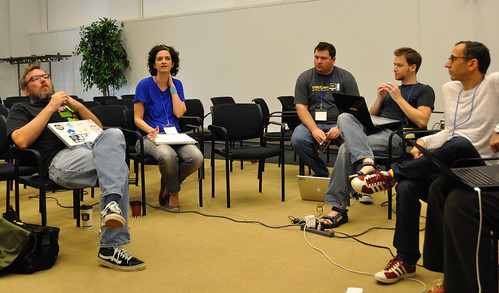
THATCamp: Kickback and Conversate

Image from THATCamp 2009

Image credit: GHBrett’s “THATcamp”

I’m just unwinding from a full day at THATCamp 09 hosted by GMU’s CHNM, and I truly find it odd how much I have been mentally gushing about this event.  In fact, it’s really not my style, I usually have some crack or other to make about a conference or event, but I’m coming up empty after THATCamp—what’s up with me? Am I getting soft? Has the edge dulled?  Am I just a lackey for the man? Maybe, but I’ll let you be the judge of that. I guess why I’m riding so high on this event is that it was the first real unconference I ever attended that lived up to that term. It truly was “a participant-driven conference centered around a theme”—in this case digital history. The entire day was loosely focused on what this term—and its related practice, theory, methodology, community, etc.—might mean, if anything at all.

I won’t try a play-by-play because I’m exhausted and it might erroneously suggest I’ve actually digested even a fraction of what went on today. Rather, I’m going to say that from the very beginning of the event when Tom Schienfeldt laid out the ground rules (which were simple and effective: no presentations, no grandstanding, and no petty bullshit—my paraphrase) until the end of dinner over 10 hours later I was comfortable. Let me say that again, I was comfortable. It may not seem like much, but for me this is a rare occurrence at events like this. At a lion’s share of the conferences I attend I’m downright awkward, I feel oddly removed and out-of-place. But that was not the case at all with THATCamp, as soon as the first break-out session started—adroitly framed by the ever-capable Jeff McClurken around the topic of archiving social media—it seemed like the ground rules established were already in full effect and I could just kickback and talk about things related to specific topics within digital humanities as part of a larger, free-wheeling conversation. No full-featured presentations, no sense of the distinction between presenter and audience—simply a space to talk. A spontaneous seminar with protean possibilities and shifting topics every hour and half or so, but framed by the over-arching question of what is this digital humanities we speak of.

It was liberating. No laboring through 60 minute presentations, and no shamefully tip-toeing out to have a smoke. It left me both relaxed and as intellectually engaged as I’ve been in a long time. I was digging on what others had to say, and was excited to throw out an idea here or there and then sink back into a form of thoughtful listening and imagining as the conversation unrolled in real time all around me amongst embodied people in true proximity—which is both welcome and wild. It was exciting to think hard for short, intense, and focused periods of time about anything from the nature of power to the self-propelling logic of capital to the question of revolutionary rhetoric to the future design of academic publishing to the problematic hierarchies and divisions that stultify institutions of higher ed. I love this stuff, this is the conceptual manna that undergirds everything that is important about the field of edtech in my mind, and THATCamp not only provides the occasion for such intimate and convivial conversation, but somehow made it look easy—even natural. And let’s face it, naturalizing the process of engagement, excitement, and collegiality at an academic conference is no small feat—in fact it may be a miracle!

So, in short, kudos to the CHNM crew (Dan Cohen, Tom Schienfeldt, Jeremy Boggs, Dave Lester and anyone else I am neglecting) for providing an occasion that’s cheap free, open, friendly, and deeply thoughtful.


Posted in Uncategorized | Tagged , , , , , , , , | 3 Comments

“Disco hippies gone wild in the forest”

When searching for an image for my last post, I came across this image which led me to this video. What we have here is Tommy Seebach’s rendition of “Apache,” an artefact that confirms my belief that nothing good ever came out of the cross breeding of disco and hippies, particularly in Europe.

Posted in fun | Tagged , , | 3 Comments

UMW Blogs and BuddyPress is disco a go-go!

Image by Alan(ator)
Image Credit: Alan(ator)’s “Solar System Disco Ball Mobile”

That’s right, UMW Blogs now has all the BuddyPress features fully operational, take a look for yourself at the blogs directory, members directory, groups directory and profiles. This is very eciting for a wide range of reasons, and we couldn’t have done it without the great, potentate D’Arcy “Bike Pants” Norman, particularly his post here which illustrates how to get BuddyPress working with the Multi-DB setup—which had been holding us up for a couple of weeks now. Now, I’m sure this issue will be updated in the forthcoming version of Multi-DB, but this fix allows us to push ahead with our development plans for BuddyPress on a much quicker timeline. So, once again the folks in the edtech network prove to be invaluable in the clutch. I’d share a foxhole with D’Arcy, and I just might at OpenEd 🙂

OK, but for documenting purposes I am going to explain the issues I had with getting this working—which should illustrate my ignorance clearly. In the Multi-DB environment he BuddyPress tables where actually installed in a database other than the Global DB, which is where they belong, but I had no idea where. Well once I searched them out I finally found them in database d (which is one of 18 possible databases) and followed D’Arcy’s directions from there and everything went smoothly.

Now, once I set everything up it worked like charm except for the blogs directory which was throwing this error:

Fatal error: Unsupported operand types in /home/umwblogs/public_html/wp-content/plugins/buddypress/bp-core.php on line 985

We thought it might be linked to plugins or themes, but it is probably related to older blogs problem “that don’t have a ‘last_updated’ blogmeta entry” according to Andy Peatling—whose word I trust 🙂 So, I submitted a bug report, and I imagine this will only effect blog communities that have been established for a while and have a number of blogs that haven;t been updated for a while. So, in the meantime, Martha had the idea to go into the bp-themes/bpmember/directories/blogs/blogs-loop.php and bp-themes/bpmember/directories/blog/index.php and comment out the line of code calling for last_updated around line 21 of blogs-loop.php and roughly on line 79 of the index.php file in the same directory, if not just look for the line of code with this call bp_the_site_blog_last_active()

OK, now to hack and integrate BuddyPress into UMW Blogs like it was my job!

Posted in BuddyPress, wordpress multi-user, wpmu | Tagged , , , , , , , , | Leave a comment

DUKE CIT Presentation: “Do you believe in magic?”

Looks like the good folks at Duke University’s Center for Instructional Technology put my presentation “Fragmented Identities: A Domain of One’s Own” up on YouTube. Quite frankly, I was afraid to watch the video because I have fond memories of the talk, and on a partial viewing my fears were confirmed—-I was all over the place, a complete mess really. The one thing I do like about it, however, is just how vernacular my style is. It’s such a long way from the days of presenting my grad school papers, and while it make be dreadfully imprecise and off-the-cuff, I also feel like it is far more intimate and personal—just like so many of these technologies we are trying to think through.

The magic trick comes at the 11:30 mark, and my early discussion of Twitter is kind of fun, although the Twitter stream during my session never really took off. Anyway, here it is, another presentation experiment that was in many ways a failure, but at the same time an attempt.

Posted in experimenting, presentations | Tagged , , , , | 5 Comments

I knew he’d find me sooner or later….

adolph_hitler

Posted in fun | Tagged | 5 Comments

That’s so gay!

I was watching a collection of 1970s cartoons recently with the maniacs, and when we got to a 1977 episode of Batman and Robin titled “The Pest.” I was pretty struck by the homoerotic undertones overtones.  Now, my time as a grad student at the CUNY Grad Center may have tainted me for life, and I must confess I was always jealous of the folks who so intelligently queered Douglas Sirk’s films. Add to this the fact by the 1990s queering Batman and Robin was popularized by the animated shorts of The Ambiguously Gay Duo on Saturday Night Live. So, I guess this is nothing new, save for the fact that I haven’t seen an older episode of Batman and Robin since I was a kid. And after watching “The Pest,” I have to wonder whether my immediate reading of their interactions as queer is part of a shifting cultural/critical perception or a more intentionally inscribed frame by the writers of this cartoon in 1977.  See for yourself:

But, if you begin to scratch the surface online it becomes quickly apparent that the rumor that Batman and Robin were gay comes well before the 70s, and well, well before the 90s. The popularization of this idea can be traced back to the 1955 bestseller Seduction of the Innocent by Dr. Fredric Wertham, a book which argued that comics were linked to juvenile delinquency. He details the homoerotic relationship between Batman and Robin in the following passage:

Sometimes Batman ends up in bed injured and young Robin is shown sitting next to him. At home they lead an idyllic life. They are Bruce Wayne and ‘Dick’ Grayson. Bruce is described as a ’socialite’ and the official relationship is that Dick is Bruce’s ward. They live in sumptuous quarters, with beautiful flowers in large vases, and have a butler, Alfred. Batman is sometimes shown in a dressing gown. … [I]t is like a wish dream of two homosexuals living together. Only someone ignorant of the fundamentals of psychiatry and psychopathology of sex can fail to realize the subtle atmosphere of homoeroticism which pervades the adventures of the mature ‘Batman’ and his younger friend ‘Robin.’¹

The post Batman and Robin: Just friends? by Jeet Heer on the Sans Everything blog suggests that Batman and Robin’s uncertain relationship might account for the camp of the 1960s TV show.  And while Heer works through the intellectual genealogy of this rumor, I’m fascinated with how the rumor might have begun writing itself into 1970s animated series. In this animated run the the homoerotic frame seems so overtly re-enforced, and is in many ways even more over-the-top given it’s a bizarrely schizophrenic hybrid of campy homoeroticism and moral wind-bagging, with the unfortunate addition of the  downright unbearable Bat-Mite.

What’s even stranger is that it is obviously catering to the juvenile audience Wertham was so concerned would have their innocence subverted. In fact, every episode is punctuated with a didactic recounting of the preceding events by our heroes to hammer home a painfully clear moral to the story. For example:

What is the moral of this story?  I really have no idea, but I think what becomes immediately clear is that what’s important often has little or nothing to do with a canned moral. Rather, it has everything to do with what you’re looking for. And what’s striking to me is that I have been trained to watch Batman and Robin so differently then I did back in 1977, which just reinforces for me that texts are always read through the cultural sediments of a moment. A process of acculturation that is as sinister as it is subversive. Moreover, there is a crucial importance to tracing a “gay history” of our popular culture even if it’s only a “rumor” in the text, for the cultural canvas will ultimately write it large on our psyches despite the rumor. And for me that’s the power of popular culture, both it’s great seduction, promise, and delivery, we are what we watch, but what we watch is by no means stable or clearly defined—it’s a variable that is constantly changing within streams of thought and interaction. Why are we so sure that TV and film are such passive forms of consumption compared to our social media now? I’m not at all convinced of this, in fact Twitter often suggests quite the opposite in my mind as of late.

Image credit: from Sans Everything Batman and Robin enjoy some downtime: a panel from World’s Finest Comics #59 (1952)

Posted in pop culture | Tagged , , , , , , | 7 Comments

Tripping on Twitter by way of the Election in Iran

I spent the last hour or so following the #iranelection hastag on Twitter. It is really unbelievable how much stuff is streaming through on a second-by-second basis. I tried to lock in to the flow of information for a bit to see if I could start making a modicum of sense of what’s going on at this very moment In Iran. I can’t say I did necessarily, but that stems from the larger fact that I have only a very vague idea of what is happening in Iran. In fact, I will not pretend to any thing resembling analysis of that situation—such things are best left to people who are very much embedded in the experience and the history of that country.

Rather, I am tripped out by the fact that the very delivery and design of news is changing right before our eyes.  Cole Campelese said it at Faculty Academy, and he seems quite the prophet to me this evening, “Twitter will be where you get your breaking news and up to the minute reports, the blogs and networks may be where you look to make some sense of it.” [I am loosely paraphrasing here, I’m sure Cole will correct me for what he said was far more precise.]

So, as I said before, I locked in for a little bit and the experience was fascinating.  You have the emergence of survivalist/guerilla types that are giving folks tips for slowing down or defending against the Basij and Police, for example: “DEFENSE TIP: SPRAYPAINT GOVT VEHICLES WINDSCREENS, MIRRORS,” or  linking to recipes for making homemade smoke bombs, or even “burning tires obscure vision of aerial surveillance.”

Then there are the strident quotes for liberty and revolution, such as “I Prefer Liberty With Danger To Peace With Slavery,” or even this solid Kiergegaard quote, The tyrant dies and his rule is over; the martyr dies and his rule begins”—this seemingly in reference to the shooting of #Neda, whose horrifying death was captured on video, which was framing her as a martyr of the revolution. Seen clearly in tweets like this one: “It took just one bullet to kill Neda. It will take just one Neda to bring an end to Iranian tyranny.”

And then there is a whole strain of conflicted, guilt-ridden American tweets, like this one: “Do the brave Iranian freedom-fighters make you ashamed to be an American?” And another tweet linking the outbreak of violence, terror and uncertainty in Iran to September 11th: “After 9/11 the world said we are all Americans. Tonight we are all Iranians.”

And there is, of course, the immediate, essential information for people on the street in and around Tehran: “CONFIRMED Reports that Basij outside all embassies. DO NOT GO TO EMBASSIES #iranelection RT as much as possible”. The question of what is confirmed and not is fascinating to me, because there seems to be a whole other strain of people asking for confirmation. For example: “Are there *any* photos or videos of tanks? Please post. Otherwise doubt. Watch sources!”

There are also the trolls introducing porn links, which the community around the #iranelection hashtag quickly combats: “View your links before you retweet. We don’t need porn here! Take it seriously.” And then again, “@universalmusic @lordghost sending out updates with VERY GRAPHIC adult images using #iranelection”. And there is even a kid troll spewing hate speech against Iranians for kicks. Right next to that is a link to an article about the Canadian tech firm Psiphon Inc. that is working non-stop to introduce unfiltered internet connections into Iran, against the wishes of the Iranian government (which the Canadian government seems to support according to the article).

I really don’t know what to say about it all, the links to the 60 or so tweets I marked as favorites over the course of a half-hour are below, and what is striking to me as I write this is how the emergence of the Twitter syntax of short, declarative statements coupled with tinyurls and filtering mechanisms like RTs, @users, and #hastags made so much of this phenomenally succinct and streamlined mode of communication possible during such an event.

[cetsEmbedRSS id=’http://twitter.com/favorites/3362981.rss’ itemcount=’0′]

See more here.

Posted in twitter, Uncategorized | Tagged , , | 5 Comments

WPMu and BuddyPress Integration with bbPress 1.0 RC3

bbPress is finally moving towards 1.0, and it looks like it may get there quickly. The tutorial that I wrote up about integrating WPMU, BuddyPress, and bbPress was actually for bbPress Alpha, so I took the time to update today. The cookie integration details changed slightly for me for WPMu 2.7.1, so I figured I would update the tutorial. Particularly because it has gotten almost 10,000 views in six months, something that reminds me that people read the bava for WPMu How-Tos far more than my navel gazing film and theory posts—though I would argue the latter are far superior 🙂

Anyway, below is a link to the updated tutorial, if you are still working with the Alpha I recommend you update because RC3 seems pretty stable and the cookie integration is almost there, which will make this tutorial obsolete so very soon.

Link to tutorial for Integrating WPMu, BuddyPress, and bbPress updated for bbPress 1.0-rc3

Posted in wordpress multi-user, wpmu | Tagged , , , | 4 Comments

UMW Blogs To-Do List

Well, we are swinging back into full development mode at DTLT, and UMW Blogs looms large on the agenda. I’ve been playing around with BuddyPress for the last week or so, and I finally got it installed and the integration working between BuddyPress, WPMu 2.7.1, and bbPress, but there is one big fail: the Multi-DB setup. We switched to Multi-DB about five months ago or so in order to breakup the databases given running one with 2900 blogs was probably not advisable. What has happened though is that despite BuddyPress 1.0 being released for a few months, the multi-db plugin has still not been updated to work with BuddyPress for WPMu 2.7.1, which effectively means you can’t see all the blogs and members in the BuddyPress directories—making it virtually useless.

So, the first thing on my list is to figure out the HyperDB setup, because from all accounts that works and may be a far better solution than Mulit-DB (never did see much of a performance difference with Multi-DB). I think I would highly recommend anyone use the HyperDB setup, and I have to apologize to D’Arcy for suggesting the Multi-DB, that’s my bad (have you figured out HyperDB yet?).

The second thing is to get BuddyPress up and running in its full functionality. Martha Burtis and I have been talking a lot about BuddyPress and it’s potential, and one of the things Martha keep saying—and I totally agree with—is that all the BuddyPress functionality is not being thought about very creatively when it comes to the blogs. UMW Blogs comes at BuddyPress in an interesting fashion, we already have a solid community of blogs and bloggers, what BuddyPress afford us is some new ways to visualize and augment the community, as well as integrate connections onto the blogs themselves. So, for example, Martha figured out how to get the BuddyPress profile data to show up on a blog sidebar, now there is a smart and seemingly simple widget/plugin. Same goes for all that user’s other blogs, friends, recent sitewide posts, etc. Why not make them quick widgets that can integrate into the blog sidebars for specific users rather than global stuff?

Along these same lines, as Martha also pointed out, the BuddyPress profile page is hideous. It is one of the most complicated and downright unfriendly lists of options that immediately confuses. The profile pages have to be integrated into the visual design of the site as a whole. As it stands now they look like part of the backend, which seems odd because they by their very conception they are public profiles. What’s more, there needs to be a simple plugin, field, or whatever, where people can continually add links to their various identities into their profile. Right now that is handled at sign-up, but this needs to be dynamic and ongoing. And while I like the YouTube and Flickr plugins for BuddyPress, I am beginning to think they may be overkill. Make it streamlined, concise, and easy to frame for the users. Martha and I were looking at the pro.gigaom.com site, and the contributors’ pages are done with BuddyPress. They make sense visually, and the integration into the site makes for far less cluttered and confusing experience. The CUNY Academic Commons does this very well, and we will be taking pointers from their design which marries WPMU, BuddyPress, and MediaWiki beautifully.

And while we are talking about design, I also think UMW Blogs needs a facelift of sorts. We need to frame a new homepage that works with BuddyPress and maybe integrates the P2/Twitter hack Martha Worked on—or at least a part of it—on the front page. I would like to see the recent posts come up through a P2 interface that also allowed the UMW Community on campus to foreground specific stuff by hashtag. I really want to both make the front page far more streamlined, and yet dynamic and representative of all the work going on around the community—once again the CUNY Academic Commons provides a nice model for thinking through this.

A MediaWiki Farm, I don’t know if it is possible with our setup, but I really want to give this a go. I have talked enough about it though, so suffice it to say it will be at least attempted.

Sitewide related posts plugin by tags or categories? I want this functionality, and I know it’s possible, and it will dovetail beautifully into another project I will be blogging about shortly. So I will be on the hunt for that, which can really help us make the case for pusing tagging and categorizing more.

Finally, I want to get a media server up to test out the WordPress Video Solutions Framwork. I’m really fascinated with how this might integrate with UMW Blogs for those select videos that we need to archive, protect, etc. It may be overkill and building our own YouTube, etc., but I want to play with it. Anyone got a media server setup we can borrow?

All this makes me feel like I really want to cancel my presentations and gigs for the next five or six months and get back in the space that makes me happy and productive. I’m getting burnt on the travel and talks, I did over 20 this year and quite frankly they just end up costing me a ton of money, which I don’t have, and a whole lot of diverted energy. The whole thing is just becoming a physical and emotional drain these days. I’ve been talking about the same things for far too long now, I want to actually do something—I want to work with Martha, Andy, Patrick, and Jerry to take UMW Blogs (and by extension UMW) to the next level. And more than that I just want to read the posts and engage the community there that I have pretty much abandoned given my time restraints. I’ve missed my job these last months, but I think I’m through being cool, I just want to work.

Posted in UMW Blogs | Tagged , , , , , | 3 Comments

What book would you embed?

I’m probably late to this development, but I just read over the at the DUKE CIT blog that you can embed select works from the Google Books collection right into a blog post or webpage. How wild! So, I asked myself the question, what book would I embed in the bava? And I thought and searched hard, and then it hit me like a diamond through the forehead: Herman Melville’s Piazza Tales, but even more specifically: “Benito Cereno.”

Posted in books | Tagged , , , , | 3 Comments