I am currently embarking on the journey of reading Marshall McLuhan’s The Medium is the Massage for the first time. I have set up a distributed reading group here after discussing with Rafael Alvarado and Ed Webb the idea of a distributed, open space for aggregating our reading reflections. Keep in mind anyone can join the fray by adding their tagged feed to the site here, what’s nice is that the feed for this site will act as an instant aggregator that will link you back to the original blog posts by the various folks involved.
I’m personally not ready to post about the book just yet, having only started it, but doing a preliminary search I discovered the audio version of The Medium is the Massage via Ubuweb here, and it is a total lambian treat. Ubuweb has both sides of the album (or at last I imagine it was an album) and interviews with McLuhan from the Dick Cavett Show in December 1970 as well as on Speaking Freely from Jan 4th, 1971.
Sometimes I miss the classroom, but I find that is becoming less and less a concern these days. I’m beginning to realize more and more that you teach from where you are, and I’m deep in the blog right now. I received the following note today, and it went a long way towards confirming these feelings. What is even cooler is that it was focused on of my nostalgic post about Clash of the Titans of all things, how perfect!
Subject: Just thanks
Message: Hi Mr. Groom –
I read your essay on *Clash of the Titans*, part of which (the iconic
Medusa scene) I intend to show my college class in Greek and Roman
Myth this afternoon. I wanted some ideas for ways to discuss the
scene that will bring the students beyond blasting the special
effects, and your essay was really helpful. Nice analysis, and thanks
from a fellow fan!
Best wishes to you,
The inaugural WordCampEd in DC has come and gone, and it was a total blast to be a part of this unconference. Hats off to Dave Lester for organizing this event, which was a huge success and is already being reproduced around North America. I plan on making the Vancouver event, which dovetails nicely with Northern Voice this year (good thinking D’Arcy), and I hope there’s a WordCampEd in NYC sometime soon so I have an excuse to go home 🙂
One of the key issues for me about such an event is the balancing of the application with the very serious issues we face as educators and educational institutions when it comes to the radically changing nature of publishing more generally. That is why it was such a pleasure to meet Cole Camplese and Brad Kozlek from Penn State University at this WordPress-centered event. Cole runs one of the most impressive instructional technology groups around, and his and Brad’s work with PSU Blogs (which runs on Movable Type) is unbelievable. Speaking with Cole helped me focus even more on what is key—as so many of his blog posts already have—the most important aspect of what we do is conceptual and needs to be supported by a platform of openness, regardless of the application, that makes the possibilities for sharing resources easy, transparent, flexible, and continuous….the permanent revolution! Cole is a foremost mind in this field, and after speaking with him on Saturday I now know first-hand why—he is insanely attuned to the instructional technology space and its crucial intersection with the changing state of publishing at large. Just hearing him talk about how the work the New York Times is doing to relate readers to one another can be imagined for a university blogging system is exciting to say the least. He is doing phenomenal stuff at a school with 80,000+ students and has integrated his platform at all levels of the IT organization, which in my mind answers any and all questions about whether this stuff scales. Sure it does, if you have the right kind of visionary thinkers involved in the administration, and PSU (along with UBC) is a “City Upon a Hill” when it comes to this. I look forward to an ongoing relationship with Cole and his group, UMW needs to learn from their incorporation of innovation into the daily work they do, for it has been continually mind blowing.
The morning sessions were nicely distributed. Jeremy Boggspresentation framed how to think of a single blog space as a way to re-imagine a course site using plugins such as ScholarPress Coureswre and WPBook. Jeff McClurken framed a whole bunch of the work (links here) he is doing with WordPress in his courses, and reflected quite pwoerfully on how it is changing his conceptualization of how he approaches teaching and learning with his students more generally—amazing stuff. Jane Wells from Automattic presented on the new layout and features of WordPress 2.7—which looks to pretty impressive—and I have to say Jane is herself quite passionate about the educational space and the impact an application like WordPress can make on it. And i have to say it was both a pleasure and relief to speak with her about how irrational educational folks can sometimes be 😉 Finally, Rob Pongsajapan from Georgetown’s CNDLS framed the road for universities to actually get up and running with WordPress Multi-User in his presentation, which was an important talk that lead to some great conversation afterwards about Ponies and the like.
And then there was the reverend! 🙂 I spent a good amount of time leading up to this presentation working with Tom Woodward, who is far too patient and indulgent with his genius, on ideas. We came up with a full-on sermon in the preacher’s regalia, dressing up as Thomas Jefferson to deliver the EDUPUNK “Declaration of Independence,” and even a BavaMan superhero with the appropriate black tights and silver cape. But, when push came to shove, I just didn’t have the time and energy to make it as crazy as we both knew it should have been, it was my fourth presentation in three weeks and I was running out of stamina. Nonetheless, we holed up on Friday night and Tom painstakingly listened to my ideas and helped me build something I am proud of, and I really can’t over-emphasize how key Tom Woodward has become to my thinking and creative process over the last 10 months. He is an amazing collaborator, friend, and thinker, and I value his help tremendously, which he gives far too freely. In many ways, this presentation reflects his thinking as much as it does mine—yet I take responsibility for all its problems, irrationality, and inconsistencies given my last minute approach. One thing that I learned from this presentation is that a good idea, and a philosophical trace is really all you need. It’s easier for me to talk about ideas extemporaneously than try and work with a script. I wrote up much of what I talked about for WordCampEd, and tried to stay to the script at moments to be sure I didn’t go over my time or jettison on one of my unwieldy tangents. The downside of this was that the script also was responsible for a bit of its uneven delivery, I freely admit and apologize for that, but thinking about the very act of presenting and performing is a great learning experience I have had the good fortune to experiment with recently. Moreover, it was a really rewarding presentation for me because I think it starts to marry the ideas of the “Permament Revolution” I am imagining in regards to Jefferson’s thinking with Brian Lamb’s framing of Radical Reuse. I think these two conceptual approaches work really well together, and I will be pursuing these ideas with more vigor over the next couple of months.
OK, but enough of that, below is an embedded version of my slides (which should have notes) and below that is my presentation script. The audio has arrived (thanks Jerry) and video will be coming shortly thanks to George Brett. Also, I want to thank everyone for the encouragement with what is kind of a departure for me into a bit more of a radical logic. To quote Luke Waltzer, who was quoting Saul Alinsky, I find myself intentionally “rubbing raw the sores of discontent” in the educational realm. For as Luke notes, “when a system is unjust or broken, you must put as much pressure as possible upon it to reveal and proclaim its inadequacies.” Exactly, our system is broke in relationship to the moment we live in and we have to face it and put pressure on that fact to effect some radical change in institutions that are laboring under several generations of doing business that are increasingly outmoded and have reached a point of crisis!
Download “Permanent Revolution” presentation at WordCampEd, Nov 22, 2008
Slides (I have a whole bunch of CC attribution to give, and will be doing that shortly–sorry 🙁 )
Script (this is not necessarily how the presentation went, and there are some real differences between what I said and what I wrote, but the way the two relate is very interesting to me right now):
Permanent Revolution: Jefferson’s idea of the permanent revolution from John Adams series on HBO
Can we relate to this idea today? In fact I think it is germane to what we are currently undergoing when it comes to the intersection of teaching, learning, and technology.
LMS and the question of generational Edtech
Our moment might be characterized by the inconsistent, continuous, and ever-changing flow/nature of publishing. We live at a time where the ability to share one’s ideas with the world at large is unprecedented. How can this not have a dramatic effect not only on the existing archive (and I really do feel bad for any living or future historians), but the way in which we learn, for learning at its core is an exchange, is a means of sharing information freely that (when internalized, reflected upon, and re-worked) might even be understood as knowledge.
Yet, our moment is also chimerical, and it may very well be dangerous to stand here and talk about a single technology. For at the rate of change and innovation our culture is currently undergoing in relationship to technology. We can only truly speak of “the moment” when we refer to technology because we really can’t entirely fathom what’s next, we can hint at it, prophesize, and imagine—but that is all very difficult and limiting if we were simply focusing on an application like WordPress. Yet, such a task becomes easier if we together are dreaming of the future in terms of teaching and learning, while playing with the tools we currently have at our disposal.
WordPress as an application is an important metaphor for this particular moment in publishing. We can think of the WP community as kind of a revolutionary movement that is by no means unified or organized, but rather consists of a larger number of disparate splinter groups: you have your plugin developers theme developers, forum helpers, evangelists, etc. All of whom have individually and collectively developed an application that is increasingly making it trivial for anyone to publish and syndicate text, images, audio, video, and dynamic media of all kinds to the world. Moreover, everyone who publishes now has a personal archive of their work which can be searched an discovered easily with tools like Google. The fact is that the culture surrounding publishing has radically changed in the last 5 years, and one group it impacts dramatically is educators. In many ways their understanding of the very institutions they work within is changing before their eyes, questions about how information is created, interacted with, and disseminated have never been more rich for the re-thinking.
But Why revolutionary? Why this terminology? (I’m channeling my good friend and mentor Gardner Campbell here.) Why am I such an inciteful son-of-bitch (incite not insight), well because educational institutions have for too long been under the boot of fear.
We are afraid of the new paradigms for publishing, and have let the administrators, lawyers and legislators beat us into a kind of cowardly submission.
Take for example the University system of Tennessee’s recent implementation of a $10 million P2P filtering system….
Or K-12 school like No. VA example that are going to whitelists, they’ve gotten so over the top that they no longer filter sites, but exclude everything by default! How insane is this?
Quote Henry Jenkins here.
But lest we lose hope, there are spaces of resistance. In fact, we are “occupying” one now. The open source project Zotero, developed by GMU’s Center for History and New Media, has recently been accused or “reverse engineering” Thompson Reuters’ Endnote product, and rather than cowering at the claim that a university could “steal” a formatting style, they challenged this preposterous accusation, which are an example of the culture of fear that accompanies a moment of radical change and openness like the one we are currently within.
So, using WordPress as the operating metaphor of revolution here, how do we share our fearlessness? How do we impact this moment for good! Well, here is one example that is particularly near and dear to my heart right now. That highlights the symbiotic relationship between the revolutionary philosophy and the technology.
UMW Blogs –> Longwood Blogs example. What it costs, what it enables, and why it is key!
If it is a real revolution it spreads, when you touch, it is ready to explode, and I felt that recently at Longwood University.
The hardest part of a permanent revolution is sustaining it! And that is what WordCampEd is all about. I applaud David Lester for organizing this event, and applaud each and everyone of you for coming here today and being part of a change that is desperately needed in both K-12 and higher ed.
I will be posting at length about WordCampEd soon (which was a great event), but I want to throw a link to an absolutely amazing video I saw this afternoon at the Hirshhorn Museum called Magnetic Movie, created by Ruth Jarman and Joe Gerhardt of Semiconductor. Remarkable, but not surprising, that artists are leading the way for thinking about visualizing unrepresentable concepts such as magnetic fields through digital art. This vision is made up of some wild effects and put to a series of recorded talks with professors from UC Berkeley, all framed in an empty lab which is a familiar setting they animated beautifully. What’s amazing about this short film is the way the scientists’ descriptions of these magnetic fields are visualized by the artists. There is a great confluence and tension happening in this video all at once, which makes for a fascinating meditation on representing the unrepresentable both visually and orally. This film incorporates such a cool mix of art, education, technology, and magic. Do yourself a favor and watch it.
Video Description:
The secret lives of invisible magnetic fields are revealed as chaotic ever-changing geometries. All action takes place around NASA’s Space Sciences Laboratories, UC Berkeley, to recordings of space scientists describing their discoveries. Actual VLF audio recordings control the evolution of the fields as they delve into our inaudible surroundings, revealing recurrent ‘whistlers’ produced by fleeting electrons . Are we observing a series of scientific experiments, the universe in flux, or a documentary of a fictional world?
Additionally, I got to see part of the Panza Collection that is currently on exhibit at the Hirshhorn Museum. An installation that was curated by Giuseppe and Rosa Panza–two Italian art collectors who have one of the most impressive collections of contemporary art in the world. This was a show featuring art from the minimalist movement of the 1960s and 1970s. I will be thinking about this work for a long time to come, and there is one piece in particular I can’t get out of my mind, and will be talking (and presenting) it at length soon.
But for now, I had a weird moment of Déjà vu yesterday afternoon in the Hirshhorn. While walking through the exhibit I saw a piece (which is pictured below) that I immediately knew I had seen before, but where?
I guess I should have known it would be here. The Panza exhibit was one of the best I’ve ever seen, and what’s so cool about it is when you start it you’re reaction is like, “What, are you kidding me? This isn’t art!” But by the end, the cumulative effect brings you truly out of yourself in some very powerful and magical ways!
I have been moonlighting around campus this semester as a Dog, CogDog, introducing students and faculty to Alan’s 50 Ways to Tell a Digital Story. Well, there have been a number of good projects that I promise I will add to his wiki and tag in delicious accordingly. But one in particular for Judith Parker’s Psycholinguistics class is pretty wild. Justin Toney created his science poster for the class with Glogster, and I think he did so to some great effect—I dig the aesthetics of it. Imagine that, a web-based science poster that isn’t a progeny of PowerPoint! You can see the full version here.
I have recently posted about a WordPress education email list I joined and was pretty excited about. Well, less than two weeks later I am a bit confused by what exactly Automattic is thinking with this list. It’s moderated by Douglass Hanna, and he just sent out the following message to the list talking about creating an “Implementation Guide” for using WordPress in education. I’ll reproduce it below:
Hi everyone,
Thanks for coming up with such great discussions and contributing so much to this list. As part of my role helping with WordPress for Education, I’m creating an “Implementation Guide” that we will make available to educators and administrators. The idea is to have a nice downloadable/printable PDF that will explain WordPress, why it’s good for education, and how to make it happen.
Here is the tentative (and still incomplete outline) for what we’re
going to include:
Welcome to WordPress for Education
Table of Contents
What is WordPress?
Who uses WordPress?
Cost
WordPress for Education Overview
How WordPress Can Be Used at Your School
WordPress on the Campus
WordPress in the Classroom
Getting Stated With WordPress
Where to Get Additional Information
I’d really love to hear your ideas and suggestions. You are the people who have tried to convince administrators (hopefully successfully!) that WordPress is the way to go and is a great option and then tried to make it all happen. What would have been helpful to you initially?
(Keep in mind your suggestions don’t have to fit within the confines on this document. We’re also going to have a web site at
edu.wordpress.com (under construction) that will have additional information.)
Thanks so much.
Douglas Hanna
Automattic | WordPress.com
Now, I don’t particularly have a problem with this, put I was hoping the list would be about sharing ideas and possibilities between people and a community, not building a brochure for Automattic. I mean, many people are already having this discussion in a distributed environment, why push for a captured email audience to so quickly do it for them. Maybe I am wrong, maybe that is exactly what they should do. Maybe I am way too deep into all this crap to have any perspective. I have no problem with them reaching out to the education community—that’s what they should do—but as a means to push their product for the product’s sake, rather than the transformation a tool like WordPress affords is missing the boat for me, and that is how the message came off to me. I like WordPress only so far as it enables me to do something with teaching and learning in higher ed, and the space is important, and design is crucial, and flexibility is a necessity–I admit all this. But, the thing that has made this application special for me is the conversations about and around it between people who see it as a means to end, not the end in and of itself.
So, anyway, here was my response:
Not to be a stick in the mud, but this conversation has been going on throughout the education/edtech blogosphere for a while. And WordPress is usually just a touchstone. Is this list intended to be a space for warehousing that information and then re-packaging it to push WordPress as a product rather than a process for thinking through the implications of the new state of publishing for education?
I mean WordPress is great and all, and many have used it to some great advantage, but it seems like you are suggesting we participate in the creation of an Automattic brochure devoid of the personal relations that foster the community that has made WordPress what it is. All of which kind of seems strange to me. The conversation is in progress, why not follow and join it where it is happening if you are the education evangelist for WordPress. That seems more relevant then creating a pdf for a mass mailer?
I don’t know, just seems that once we formalize the discussion around WordPress as product too much, the joy of thinking through possibilities kind of evaporates.
Best,
Jim
So, I don’t know, I’m feeling off these days any way, but am I wrong? AM I WRONG?!
Martha Burtis is back in action at UMW, and she returns to us with a project that I am following with great anticipation: blogging WordPress as a CMS. As she notes in her introductory post on the topic:
It often seemed…that when push came to shove, there was always something that prevented WP from being the right CMS solution. Although I think I’ve always suspected that with the right mix of plugins and the right theme, the problems could be surmounted.
And what she will be doing is going through her conceptualization of WP as CMS including, though not limited to, creating an array of different content types, re-imagining the uses of tags and categories, re-structuring custom templates, and tackling variegated subscription models. It is an awesome project, and there is no question in my mind that Martha hacking WordPress allow us to really start considering this application as a far more comprehensive web-based solution for a more dynamic, yet simple, way at content management than just throwing a static frontpage on a blog.
I mean she already has a solid list of plugins that I have never heard of before, that promise to go a long way towards making things we would have had to hack, program, or simply dream about previously as simple as a click of an “activate” button. Here is the list she frames, and I quote her descriptions:
Flutter (formerly Fresh Post) allows you to create custom Write Panels that make use of WP custom fields (I’ve always thought custom fields must be part of the key to turning WP into a CMS
dTabs is a pretty slick plugin for creating custom tabbed navigation. It allows you to link a tab to a page, a post, a category, a URL, etc. The styling can be a bit tricky.
Idealian Category Enhancements allows you to designate a particular template to be used for a particular category, automatically.
AStickyPostOrderER lets you manually order posts within a category, bypassing the automatic reverse chronological ordering.
This is exciting work, and while many have thrown out a list of plugins that can help you create a CMS with WordPress, far, far fewer have actually meticulously blogged there process along with their conceptual thinking behind that process. And if you know Martha, then you you already know she will do both these things in spades. “Brava!,” says the bava 🙂
This Thursday I’ll be heading down to Longwood University to do a workshop on Web 2.0, blogging, and the like. Liz Kocevar-Weidinger of the Greenwood library at Longwood saw a few of us from UMW present last year on the work we’ve doing, and she invited us down. I caught up with her at the EDUCAUSE conference, and I inquired whether they have a blogging platform of any kind they are working from currently, and they don’t. So, as Gardner and I charged during our presentation, why can’t we do this together?! Why can’t UMW help Longwood? We are both public universities in Virginia, a state that is quickly descending into one of its worst budget crises in years decades (and that will be the case most everywhere). Given this, why shouldn’t we share our work freely and pool resources so that we not only reap the benefit of innovation on one particular campus, but share that work out to other universities and colleges throughout Virginia? —and why stop there 😉
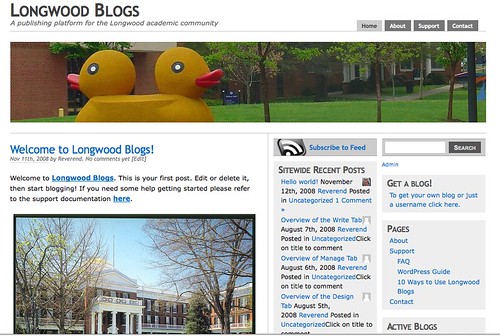
So, leading up to this workshop I took 45 minutes out of my day and did something that I think may very well be the culmination of what I have been working towards over the last two years. After asking Liz to go out and purchase a domain for $8.95 a year, I was able to use the Multi-Site Manager plugin to clone the settings of UMW Blogs within our install (think of it as a WPMu within a WPMu) and voilà, Longwood Blogs was created—it took all of two minutes! The other 43 minutes I spent playing with the theme and reproducing all of UMW’s customized support documentation for Longwood with the wonderful Wiki INC plugin—which allows us to not only reproduce our installation and host it for them, but also reproduce all of our documentation using a Mediawiki –>WordPress plugin! Not bad for a two hour training session, eh? Two years worth of iteration and development given to Longwood in less than an hour.
Now, if that’s not an economical solution for the hard times that lay ahead, I really don’t know what is! And the most important part about this experiment is that it’s easy, and there is no excuse for universities not to do this! It is imperative that we liberate ourselves from silos of campuses and schools, and start sharing our work freely with one another so that we can all benefit.
Think about it, all the time and energy Longwood saves on framing, designing, and building their own publishing platform can now be dedicated to finding money to support faculty in imagining the possibilities of such a space. That is the real power of this model, the technology is both simple and simply a means, the fact that we are able to reproduce and share what we have done for others illustrates we chose the right platform—so now we can all reap the benefits! That is the point, we need to open this stuff up (and I mean open in its truest sense, not the Bb ad speak) so that universities can quickly harness and use the unbelievable power of the wide open web for teaching and learning. On top of that, since we can share these resources amongst several schools using the multiple databases to make the load easier, we can actually share posts and course resources across campuses that much easier. A truly inter-campus publishing platform.
The question for me is: how can we afford not to do this?
Ok, so here is my rational in the about page in Longwood Blogs, I think it more rationally and succinctly makes the case I am trying to frame here.
This is an experiment to see how easy it would be for one university to clone their WordPress Multi-User installation for another. The impetus behind this project is that the University of Mary Washington already has a state of the art publishing platform that they designed and piloted over the last two years. This site is a full-featured instance of UMW Blogs, which is actually running off the same installation. It literally took minutes to clone UMW Blogs’ settings and get this site up and running for Longwood University’s Greenwood Library. These two installations run off of the same base code, and hence the upgrades, backups, and additional functionality for both sites can be accomplished simultaneously.
So, all the time and energy spent at Mary Washington to develop this environment can be quickly and easily reproduced and shared with Longwood at the low, low cost of a domain name, or $8.95 a year. What this does, in effect, is frees up time, money, and energy that would be otherwise earmarked for servers and web development, and allows universities to invest in people who will work closely with faculty to think about how they might harness the power of the internet for teaching and learning. During these hard economic times doesn’t it make sense to focus our attention to the human resources that truly augment teaching and learning rather than throwing money at vendors and proprietary black boxes?
Re-visiting my overflowing WFMU feed is always a pleasure, and last night I actually spent some time listening to The J’s with Jamie’s “Hey, Look Us Over!”, and while I wasn’t a huge fan of the whole album–the first song, “Hey Look Me Over,” seemed like a perfect, upbeat anthem for these tough times.
And an earlier post on The J’s with Jamie actually has a song, “The Sound of Money,” which goes a long way to explain why we got into this whole mess to begin with.
is an ongoing conversation about media of all kinds ...
Testimonials:
Generations from now, they won't call it the Internet anymore. They'll just say, "I logged on to the Jim Groom this morning.
-Joe McMahon
Everything Jim Groom touches is gold. He's like King Midas, but with the Internet.
-Serena Epstein
My understanding is that an essential requirement of the internet is to do whatever Jim Groom asks of you while you're online.
-James D. Calder
@jimgroom is the Billy Martin of edtech.
-Luke Waltzer
My 3yr old son is VERY intrigued by @jimgroom's avatar. "Is he a superhero?" "Well, yes, son, to many he is."
-Clint Lalonde
Jim Groom is a fiery man.
-Antonella Dalla Torre
“Reverend” Jim “The Bava” Groom, alias “Snake Pliskin” is a charlatan and a fraud, a self-confessed “used car salesman” clawing his way into the glamour of the education technology keynote circuit via the efforts of his oppressed minions at the University of Mary Washington’s DTLT and beyond. The monster behind educational time-sink ds106 and still recovering from his bid for hipster stardom with “Edupunk”, Jim spends his days using his dwindling credibility to sell cheap webhosting to gullible undergraduates and getting banned from YouTube for gross piracy.

 I am currently embarking on the journey of reading Marshall McLuhan’s The Medium is the Massage for the first time. I have set up a distributed reading group here after discussing with Rafael Alvarado and Ed Webb the idea of a distributed, open space for aggregating our reading reflections. Keep in mind anyone can join the fray by adding their tagged feed to the site here, what’s nice is that the feed for this site will act as an instant aggregator that will link you back to the original blog posts by the various folks involved.
 One of the key issues for me about such an event is the balancing of the application with the very serious issues we face as educators and educational institutions when it comes to the radically changing nature of publishing more generally. That is why it was such a pleasure to meet
  The morning sessions were nicely distributed.
  And then there was the reverend! 🙂 I spent a good amount of time leading up to this presentation working with