Aggregating Google Calendars

One of the biggest complaints on campus right now is that many of us really don’t know what is going on. I don’t mean this in an abstract way, but quite literally what events are happening at what time and where. Most of this information is being delivered via email, any I would gather—given the changing nature of communication–that there are a lot of people at UMW who don’t read email like they used to—and some who rarely did and others who rarely will. Now, I am not trying to discount email all told, I understand its value. At the same time I’m also convinced that an events calendar needs to be as flexible and mobile as content on the web is becoming. The more folks can both easily contribute and republish freely the events going on around campus, the more likely it is we will now what is going on.

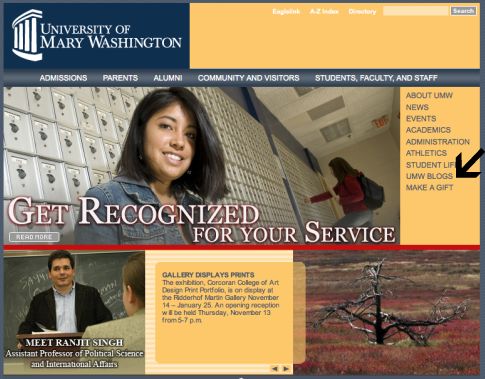
So, while I was admiring the new link to UMW Blogs on the UMW homepage, I clicked on the Events link, and to my surprise it was a Google calendar. Wow! Who knew? When looking at the source code, I released it was actually an aggregation of 10 different Google Calendars–all the more fascinating. So, then I started to wonder, “how many UMW related Google calendars are there?” I did a search for the term “UMW” through Google’s public calendars and found over 40. Insane, right? And many of them are dealing with lectures, public events, museum exhibits, registration info, recreation, admissions info, career services, the multi-cultural center, the bookstore, etc. Most of which is important information for students, staff, and faculty, yet only ten of them are aggregated into the calendar on the UMW site. So, I subscribed to all of them to see what it would look like, here is a view of this weeks events in my aggregated calendar:
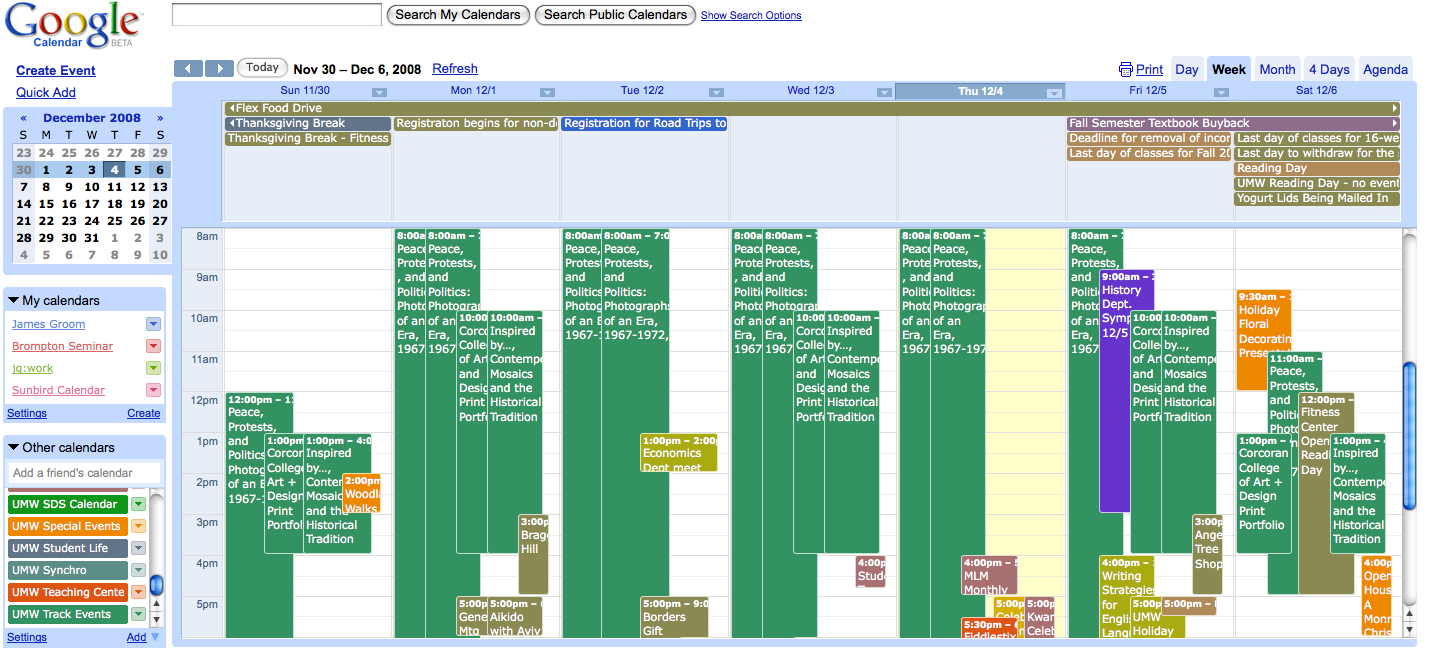
Click on image for larger view

What’s amazing about this is to find less than half of these events I would have look in three or four different places on our campus website and my email inbox. With this kind of personal aggregation of Google calendars its all in one place, and I have a much better sense of what’s happening on any given day. But, there’s is the rub, this kind of aggregation of Google Calendars works perfects on an individual basis, but it is much harder to share out publicly on a web site or through a widget of some kind. What we have here is 40 different calendars (think of it as kinda like 40 different blogs for a class) with no really good way to aggregate them into a public calendar. Now, each of these Calendars has an RSS feed, but that won’t work in this regard because that feed will show the most recently added event in a calendar, which won’t necessarily match a chronological lists of events by day, week, or month. So RSS fails us here, and that is the engine we have used to publish and synchronize blog posts and the like.

So, how do we do it? Google won’t given me an embed code for the aggregation of all of the public calendars I subsrcribed to around UMW, for that might be one easy solution. But the issue is bigger, and thanks to Jon Udell, wh ahs been working through this issue for a while now, I have a much better conceptual understanding of the issues surrounding aggregating events which has been relatively forgotten with all the focus being on RSS. And, given where we are at UMW and with UMW Blogs, his forethought on this issue has finally come to bear in helping us think it through. The excerpt below is from his post “Celebrating iCalendar’s 10th Anniversary: The best is yet to come”:

Although iCalendar has been around for a decade, I argue that the confluence of syndication and personal publishing, in the calendar domain, requires three enablers.

First, you need a workable syndication format, and we have that: RSS for blogs, ICS for calendars.

Second, you need what we used to call one-button personal publishing. Bloggers have had that capability for a long time. Calendar users have it too, but it’s emerged relatively recently, and many aren’t aware of it.

Third, you need feed aggregators. These proliferate in blogspace but, I argue, are conspicously absent from calendar space. Services like Eventful and Upcoming produce calendar feeds. But because they do not consume them, they don’t encourage individuals and groups to publish feeds, and to think and act in a syndication-oriented way. I’ve prototyped a calendar aggregator at http://elmcity.info/events/, but the category isn’t yet well-established.

If my analysis is correct, one or more well-known services that both consume and produce calendar feeds would unlock the latent potential of iCalendar and help us jumpstart a calendar syndication ecosystem.

As a side-note, the aggregation work Jon has been doing with the elmcity.info site is pretty awesome, and reminds me so much of the work Barabra Ganley has turned her focus to with community digital initiatives.

So, we have the RSS for Calendars which is ICS (or the green ICAL button in Google Calendars), we can publish events easily with something like Google Calendars or Eventful, but the third point remains the obstacle for me at this point–I don’t know of a good way to aggregate the ICAL feeds from these 40 calendars into one calendar on UMW Blogs or anywhere else folks want to put it. Moreover, if you created an aggregator where departments, clubs, and organizations all over campus could add their ICAL feed to such an aggregator, the idea of event management and communication would change dramatically on campus.

And for a larger vision, a recent post by Cole Camplese about Wall Streams and Jon’s Internet Feeds to TV experiments has me thinking about ways to visualize calendar events, alongside what people on campus are blogging, tweeting, uploading to Flickr, YouTube. etc. all around campus with a few well-placed plasma screens.

Until smarter folks than me figure this out, I’ll keep searching for ways to easily aggregate 40 Google Calendars into one public calendar on UMW Blogs, though I do think the issues emerging around aggregating an re-visualizing all kinds of events and actiity is really exciting.

By the way anyone have a quick fix for my problem? Tony, Patrick suggested Yahoo Pipes!, you ever experiment with this? 😉

Update: Thanks to the great Tony Hirst, who I imposed upon in this post, I realized that the solution was right before my eyes in two ways:  a) I had the source code for the aggregation already discovered and b) Google Calendars allows you to do this easily already. Here’s the rescue post from Tony, and below is my quote from his solution c/o commenter Steve Boneham (thanks Steve):

Aren’t comments wonderful (thanks Steve:-) – it seems thaqt you can generate the combined embed code within Google Calendar… Subscribe to the calenders you want to display, then go to the calendar settings:

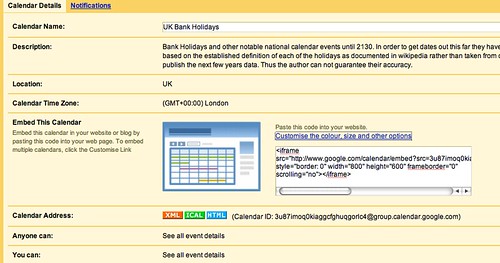
Select the “Customise the color, size and other options”:

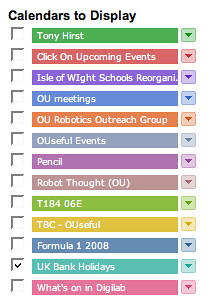
And then select the calendars you want to include:

Simple:-)


Posted in Uncategorized | Tagged , , , , , , , , , | 22 Comments

Facebook Hazing

I was talking with a faculty member about social networking Tuesday, and while she was giving me some tips on my Facebook profile I switched my relationship status from single to married, something I didn’t think twice about at the moment. Well, at least before the messages started streaming in. A couple were heartfelt wishes from people who couldn’t have known that I’ve been married for years (and I appreciate them), but the vast majority constitute what I consider downright internet hazing! These people knew I was married, but that didn’t stop them from sending their funny little comments to make me rue the day I ever tied the knot. I know who you are, people, and when you make one belated slip on Facebook, I’ll be there with my comment paddle in hand, and you will then pay the bava in flesh!

More seriously, I think this might be some kind of emergent social networking ritual that underlines the fun that a constantly running status feed like Facebook’s makes possible. A playfulness that does, indeed, make this space compelling given that people are creating and defining the social codes and practices for networked space all around you. I think the changed marital status is one of the first I have noticed where there is joy in getting your licks in. And this particular form of hazing might be more pronounced as of late given the relatively recent explosion in 30 and 40 year olds storming the gates of Facebook which, as Anand Rao pointed out in a Social Networking meeting we had recently, might very well mean it’s on its last leg 🙂

Posted in Uncategorized | Tagged , , , , | 5 Comments

Wiki Inc plugin changes the labor of documentation

I don’t think I have made this clear enough, so let me repeat it. The WIKI Inc plugin, developed by Enej Bajgoric at UBC, may very well change the way you look at publishing support documentation.

I just remembered that all of WordPress’s documentation is published in a MediaWiki. Think about the implications if I were to use this documentation by way of the Wiki Inc. plugin. It invests me directly in both monitoring and contributing to the community generated WordPress documentation, while at the same time I reap the benefits of that community which constantly updates the documentation to reflect any new features and changes for new versions. Now, with this comes some potential issues, particularly the fact that if you don’t upgrade to the next version immediately the documentation might be wrong. That said, I’m increasingly becoming persuaded to use the Codex documentation—thanks in large part to this plugin. It’s not only that Wiki Inc re-publishes the documentation in a page on our WordPress Mu site, but it instantly incorporates any changes made to the WordPress Codex.

Anyway, everything that follows will allow you to behold the power of this beautiful development in the conceptualization of the bliki.
Continue reading

Posted in mediawiki, plugins | Tagged , , , , , , , , , | 3 Comments

Bio Blogs, an experiment in mass syndication

Cross-posted as a UMW Blogs feature as well.

Professor Michael Killian’s “The Bio Blog” is a pretty impressive endeavor that collects and categorizes the posts of over 70 students in his Introduction to Biological Concepts course (Biol 121). Every student maintained his or her own blog and their posts were tagged according to the section they were part of, which allowed for re-publication, aggregation and categorization of posts in the main blog by section number, student, as well as most recent posts. But, more importantly, the experiment provided a space where students could actually work through the biological concepts they were learning about using the innumerable resources all over the web.

An excellent example is the “Bio Tech Rap” song titled “Transformation” performed by the Notorious GFP (available below) which was linked to by a student in order to illustrate the process of transforming DNA. The ways in which students are re-framing and performing these complex biological concepts within a pop culture context is truly fascinating. Also, don’t miss the myriad bio jokes, here is my favorite.

[kml_flashembed movie="http://www.youtube.com/v/cFeNlM1gJoo" width="425" height="350" wmode="transparent" /]

Posted in UMW Blogs | Tagged , , | Leave a comment

Rick Wakeman eat your heart out!

Well, Stephen Downes has pointed to Lorna Campbell’s “The Dawn of Eduprog” post, a kind of code concept rock semantified at the recent CETIS08 conference. And make no mistake about it, this genre of edtech promises to challenge EDUPUNK at its very core. And given my own weakness for capes and complex synthesizer solos, I see the writing on the wall– “mene, mene.” I’m jumping on this ship quick and early!

Image credit: Scott Leslie Jim Mercurie? freddie Groom?
Image Credit: Scott Leslie’s Jim Mercury? Freddy Groom?

Posted in fun | Tagged | 2 Comments

A chat on ego

me: see those guys scare me with all the ego talk
they are so down on ego
but my blog is all ego
as is my persona
so I feel out of place when they start talking that way
i’m fucking Jim groom, damn it
they owe me

bionicteaching: the davey crockett of the blog world

me: exactly i want some fucking respect,
not some self effacing lie
i command and deserve it damn it

bionicteaching: call in your chips

me: it’s time
see you’d love those guys because you’re like that too
all I’m nothing, I could die and the world would be better off, etc.,
you know, zombie shit
not me, the world would suck if I died
i know that, first hand
look at it before I came

bionicteaching:
well you’re a player

me: fucking hitler and stalin and shit like that

bionicteaching: I’m a backstage guy
true true
you did fix hitler
I appreciate that

me: hahaahah
thanks dude, no one ever gives me love for that
it kinda pisses me off

bionicteaching: I bet

Posted in fun | Tagged | 4 Comments

UMW Blogs: It’s official?!

Well, after almost a year and a half of solid publishing and more than 30,000 posts, UMW Blogs has finally got frontpage link real estate on the UMW Homepage. I guess we’re kind of official, now if we could just get the homepage to feed in posts from the UMW Blogs community so that it wouldn’t be so painful to look at. A recent post on Reefer Madness on UMW Blogs would provide a much needed boost for the brochure logic of our site.

Posted in UMW Blogs | Tagged , , , , | 15 Comments

A childhood without proof

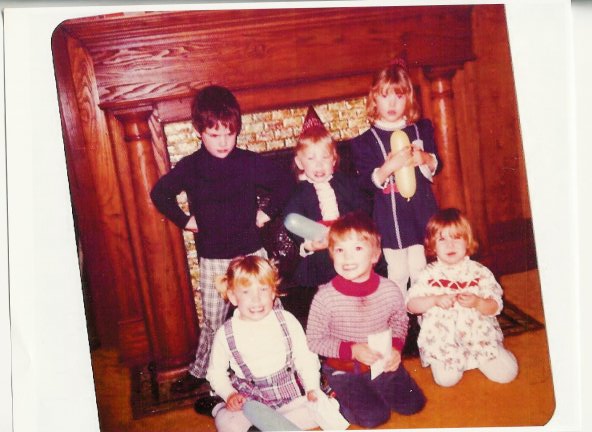
I’m the sixth kid of a family of seven. So, by the time I came along the idea of some kind of a photo archive for me was pretty much out the window. When I turned either eleven or twelve years old I went on a mad hunt tearing apart our attic looking for baby images of myself—searching for any physical proof that I was once a child. I turned up only one solitary image of me at the age of two. So, for the first half of my life at that time I had only one image of myself as a child…one! At least until this evening when my next-door neighbor from Baldwin, Long Island tagged me in an image she posted on Facebook. She figured I was about 4 years old— the same age my son is now—and it’s wildly fun to impose the resemblance in appearance and mannerism interpreted from this artifact upon Miles.

The baby bava can be found in the bottom row, middle

Here’s to you Facebook, I don’t know if I love you, but a twelve year old I once knew hadn’t counted on you twenty five years ago, and my mother sure as hell would have been spared some adolescent angst had we known you would be so damn good at connecting people with their past.

Posted in fun | Tagged , , , , , , , | 19 Comments

A domain of one’s own

Olianders Identity Crisis #4

Image credit: Olivander’s Identity Crisis #4

It was recently announced by Mary Washington’s new president that the next academic year (2009/2010) will be “The Year of the Digital Campus” at UMW. While I think we are uniquely positioned to make the most of this idea, I also wonder what it means exactly. But, in all fairness, I don’t think anyone is entirely sure what it means just yet. Nonetheless, the Division of Teaching and Learning—never short on ideas!—recently sat down with UMW’s new CIO to talk a bit about what it is we do, and during this discussion some possibilities were floated about next year’s “digital campus” theme.

What we talked about was the idea of drawing attention to the importance of framing one’s online identity in the 21st century. What could be more important for our moment than devoting a year to think about how we integrate the importance of a digital identity into the raison d’être of a university? Not only to engage what it means for individuals within an academic community to both create and cultivate their online identity, but also how we might be able to actually help 4,000+ community members actually do it with relative ease?

Well, as you might have guessed, this is where UMW Blogs comes in 🙂 And while this is all thinking out loud at the moment, the idea of a campus wide campaign to think about the importance of a digital identity has me intrigued. Let’s think about the question of digital identity on campuses presently, they are often associated with a campus email address or maybe a shared network space with some room for storing files and perhaps a meager webspace, the URL of which might look something like this:

myschool.edu/community/people/~jdoe

And while the idea behind the above web space for its community members might have been marginally useful for a while, I would argue that such space is completely useless for thinking about digital identities for our moment. How does this space enable easy authoring and integrating the various identities so many of us have around the web? Well, given the limitations of such a space, it can’t provide much more than a hand-written HTML page with a few links and a flashing mail box 😉

Moreover, the above URL is premised upon an individual’s enrollment in a university or college, and when they leave that school this space will often disappear. A digital identity should be an online address one can have no matter where they are, a space where you can track that person as they move not only from being a freshman to a sophomore, but from an undergraduate to a graduate and beyond. An online home where they consciously integrate their professional profile through a streaming set of resources and spaces they inhabit online. To steal a concept from a recent comment by Gardner Campbell (who was quoting Doug Engelbart), an “integrated domain” flowing with traces of the work one does and the ideas they are exploring.

Now, in the case of UMW, we are in a situation where many of our students and faculty are using tools like blogs and wikis to trace the work they are doing, both as part of a course as well as independent thinkers. But, the URLs can often be dependent on a students fancy and remain couched within the domain umwblogs.org (such as jimgroom.umwblogs.org) which raises many of the same questions about persistence as the web space I maligned in the previous paragraphs 🙂

So, how might all this change if we actually purchased everyone* on campus a domain for one year (at the tune of roughly $36,000) and framed the experience in such a way that all students, staff, and professors were able to easily setup and control their online identity through their own domain (something like jimgroom.net). One which they could take ownership of, maintain, and perhaps continue on with in some kind of perpetuity. I think UMW Blogs would be key to such an experiment because mapping a domain onto a blog is trivial (everyone could do it for themselves) and WordPress is an application that is ideally suited for syndicating fragmented resources from various spaces into a more comprehensive whole. Not to mention that this is a platform many within our community are already familiar with, which would allow us to bypass many of the technical and training concerns and enable us to focus on the conceptual importance of framing one’s digital identity. As Brad Kozlek suggested recently in this post, “[the] blog is a tool for students to craft their digital identity with intention.” The key here is the crafting of an identity with a purpose, the conscious consideration and creation of one’s professional/academic identity online: a domain of one’s own!

Jeff McClurken brought up some excellent concerns at our meeting last week, namely that if we are going to pursue such an all-encompassing enterprise, we had better be sure we have something to work towards academically so that it isn’t interesting in idea alone, but actually is carried out in relationship to the work students are doing at UMW. I couldn’t agree with him more in this, and I think that is where the planning and thinking comes into play, and the way I figure it we only have three or four months to make this a reality before the window of opportunity passes, so my thinking aloud here is to raise the questions and concerns so a model might present itself so that we can actually try what I think would be a pretty fascinating experiment.

*If giving the entire campus a domain is too unwieldy, which I don’t think it is given the omnipresence of UMW Blogs 🙂 , how about we focus on the incoming Freshman, and using this as a space where first year student’s frame their academic lives at the university which I imagine would be centered around their research in the required freshman seminar.

Posted in digital identity | Tagged , , , , , , , , , , , , | 39 Comments

UMW Blogs is breaking down the walls!

I have been remiss on my UMW Blogs postings lately, I have been too absorbed with flaming conference attendees (not to mention email lists) that I have lost my center, my home, my love!  But, like any good companion, as soon as I return to UMW Blogs it fills me up with joy and strength—even I know this intro is nuts 🙂

Image by Vèronique CotèSo upon catching upon on my UMW Blogs reading and commenting I discovered that more and more the outside world is entering the conversation on these blogs. The mysterious Uncle Lumpy blog is a perfect example of this.  The authors are highlighting contemporary artists and artworks from all over the place, and recently posted about Véronique Côté’s fascinating art explorations into women’s identity in fairy tale myths. Well, Vèronique was not beyond commenting on this feature article about her work, and sharing a bit about her future projects. For me the model of Uncle Lumpy really is a game changer for UMW Blogs, these students are doing it of their own volition and quickly amassing attention (with a following and all) by regularly using this blog space to reflect and feature the work in the art world (not to mention the pancake kitchen) that they are intrigued with. This blog defies the limits of the traditional classroom blog, for it always already has its eye towards the outside world!

Image of ad on building in veniceAnother wild conversation happening on UMW Blogs comes from Professor Marjorie Och’s Venice Seminar blog, where she recently posed a question about whether “advertisers [should] be allowed to post ads on monuments that are covered with scaffolding and under restoration?” A few students where talking about the economic and culture implications of huge ads on scaffolding that hides historic landmarks, and the potential necessity of compromising, while others found it to be an outrage. What is even cooler, is that the British company that was responsible for the ads referred to in the article professor Och referred the students to also chimed into the discussion with his perspective:

As the Managing Director of the UK company responsible for these temporary adverts in St Mark’s Square in Venice I would like to say the following.

Without sponsorship of the restoration project through tempoary advertising these wonderful, historic buildings would not survive for future generations to enjoy as you are doing now. Have any of your readers personally contributed to the up keep of Venice and its buildings?

Without our massive financial commitment to the project these buildings would be left to crumble until they have to be covered in a scaffold for many more years just to keep them from falling on you when you visit Venice.

We have been restoring the Marcian Library for 2 years now without adverse comment but now the editor of Arts Newspaper has taken a personal dislike to the adverts she is pumping these rumours and half truths to anybody who will listen

This is a short term issue for the long term good of Venice but we don’t expect to be persecuted for doing something positive rather than just talking about it.

How sick is that?! People are reading what we do, and are joining the conversation. Our ideas are not isolated from the world in which they are circulated, the work of UMW’s finest is part of the endless river of opinions and ideas that inform this moment, and serve to shape it in some real and lasting way. So, yes indeedy, a publishing model like UMW Blogs is breaking down the walls that our institutional fears and trusty vendor partners would like to hide us behind!

Posted in UMW Blogs | Tagged , , , , , , , | 2 Comments