True Crime: Abortion Clinics in Virginia

I’ve been working through the thousands and thousands of posts in my feed reader as a kind of therapy this weekend, and as usual I come across a lot of amazing stuff. One blog that consistently blows my mind is Tom Sutpen’s  “If Charles Parker was a Gunslinger, there’d be a whole lot of dead copycats,” which features a ton of awesome series like When Legends GatherBehind the Scenes, Friends and Families, and the Cool Hall of Fame to name just a few. It’s amazing stuff, mostly photographs of cool people, but somehow much more than that too.

Anyway, as I was going through the blog this afternoon I came across this “Annals of Crime #117” post. I am reproducing it below:

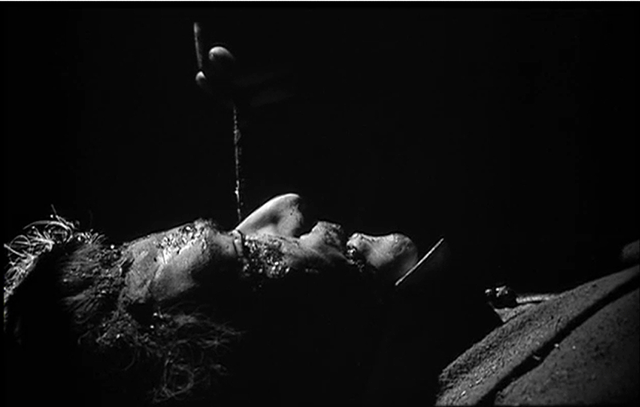
Virginia — An elaborate layout of surgical instruments, narcotic supplies and other medical equipment was seized from a farm house in Faquier County by police who arrested seven persons on charges of operating an abortion ring. Authorities said the ring took in $600,000 a year. Among those arrested was Dr. George T. Strother, surgeon, of Brunswick, Maryland, who is shown at right with a patient. The man with his back to the camera is a doctor who accompanied the police on the raid. (1954)

Crazy, things were so barbaric back in the 1950s when people were forced to create makeshift, unsafe clinics because choice was not a recognized choice. I’m so glad we live half a century later in 2013—an enlightened age of…. Attorney General Ken Cuchinelli urging Virginia’s Board of Health to enforce new rules for abortion clinics that could effectively close the 20 operating clinics in the state. The rules will place requirements on these clinics that will force them to do costly upgrades and renovations that could potentially force them out of business. According to the New York Times article linked to above:

…abortion rights groups called the building requirements a thinly disguised attempt to cripple or bankrupt the state’s 20 private abortion clinics and said that some clinics may be forced to close.

“We’re being targeted because there is a political difference of opinion about what a woman deserves for her health care,” said Rosemary Codding, director of patient services and co-owner of the Falls Church Healthcare Center, which performs about 1,200 abortions a year along with gynecological services.

There is no question Cuchinelli is using the Virginia Board of Health to play politics with abortion, and just think what’s possible if he is elected Governor this Fall. Man, I can’t get out of Virginia fast enough.

Posted in True Crime | Tagged , , , , | 1 Comment

Reclaim Open Learning

Reclaim Open Learning – Not Anti-MOOC. But pro open. from Jöran und Konsorten on Vimeo.

This past weekend I had the real privilege of going to MIT’s Media Lab to join a group of diverse international thinkers for a hackathon around the idea of learning on the open web thanks to Philipp Schmidt—I can’t believe he still has faith in me, does anyone any more? The theme that emerged is reclaim, as in reclaim the web, reclaim your data, reclaim open learning, etc. This is a topic very much in line with (and at least for me inspired by) Boone Gorges and D’Arcy Norman‘s Reclaim Project. The theme of “reclaiming” the digital bits of one’s online self is an interesting one, and I like how it conceptually dovetails with the work UMW is doing with Domain of One’s Own. Even more than that, I like how it might be taken as a call for people to take an active part in considering and reclaiming their own stuff on the web. No need for a manifesto, the process and thinking behind it is actually pretty practical, relevant, and extremely important. What’s more, it requires us all to learn and share along the way to make it matter. Therein lies the communal vision around such an idea, the emergence of affinity networks of people who more and more feel that controlling some part of themselves on the web might be important (Audrey Watters made this last point brilliantly in the video above).

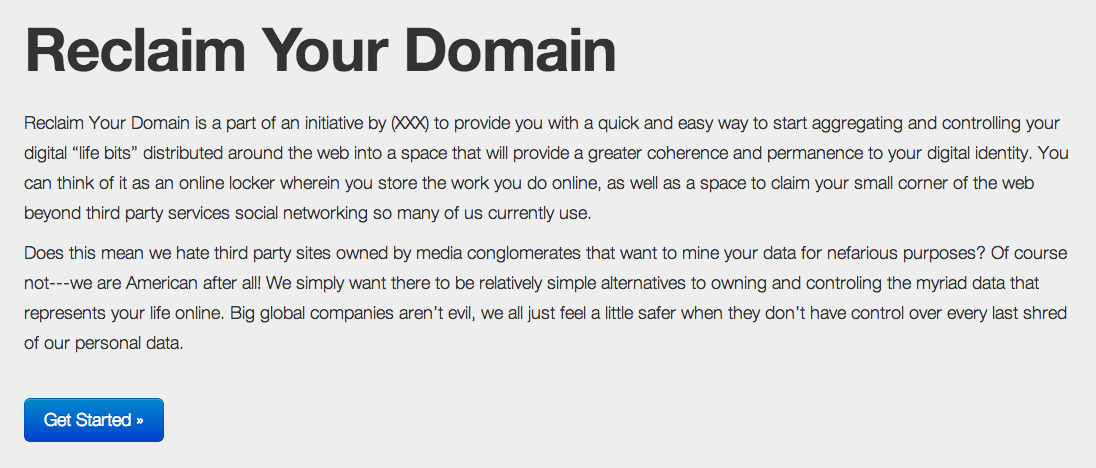
And while I have to write a longer post (or ten) about my thinking, I can’t right now given my headspace—and probably won’t any time soon. So, in the meantime, I want to quickly note that my small piece of the weekend at the MIT Media Lab was working with the very awesome Kin Lane, the “API (and IPA) Evangelist,” who many, many people need to get on their radar because his thinking and execution in this space is nothing short of brilliant (and he keeps good company too 🙂 ). He is working this stuff out on a conceptual level for the federal government’s digital strategy using open APIs, and it is remarkable how much our visions of this stuff align as an approach to the web. He worked with me on hacking out a wizard for what a “Reclaim Your Domain” project might look like. A big part of it is helping people get up and running with their own domain, and use some contextual help within the wizard to get at explaining the thinking around why and how (for us ease of use, explanation, and design are all equally crucial).

Screen Shot 2013-04-11 at 3.44.31 PM

This is, in part, based on the immediate needs of UMW for our Domain of One’s Own project launching in the Fall, but what was essential about the Reclaim Your Domain project was that it needs to abstract itself out beyond UMW’s vision (which can often be simplified to “install your blog”) and Kin and Audrey were awesome in pushing this aspect. Reclaim Your Domain has to be about a variety of hosting options, services, resources, and possibilities to manage your identities online across a variety of services, this is not necessarily “give up all social networks, drop offline, and feed the rabbits” —rather it’s about controlling (to the extent you can), backing up, and syndicating the work you do on the web. A home for your data that can be as distributed and decentralized as the platform it’s designed for. What’s more, we will be using PubSubHub as a hook to establish more sophisticated directories of feeds across services for a given community that signs up through a wizard that also can start aggregating much more than just blog posts (think images, videos, etc.).

Reclaim Your Domain also builds on the amazing recent work Martin Hawksey’s been doing with designing a (M)OOC with open source software that is light, relatively easy, and freely available. The way we were talking about it, a version of Hawksey’s open courseware would be an option in the resources part of the wizard to allow any domain (or node)  to also become a hub by installing a push-button (M)OOC-in-a-Box (which can also become its own hub) or push a button and have a ds106 framework, Commons-in-a-Box, etc, and a community there to support you as well. How sick would that be? And with the possibilities of collaboratively creating, coding, and forking on GitHub, we could actually manage all this well. Think about it, a service that actually empowered people to experiment with various technologies created within a specific context on their own domain for the price of a url and cheap hosting—this is UMW’s BlueHost experiment writ large, and it has legs.

Given I will be offline for the next month or more, I spent a bit of time today sharing with Martha Burtis and Tim Owens as much as I can of my weekend at MIT and my take on the project to carry on the work with Kin Lane, Audrey Watters, and Philipp Schmidt so that we can push the Reclaim Your Domain project (and its various possibilities) forward to a larger community of folks. UMW obviously has a vested interest in this, but it makes sense that we make the frame for Reclaim Your Domain as accessible to as many people as we possibly can. So I hope you will join us in this endeavor. I believe Kin Lane is putting the project on GitHub, which will be one place to get involved, and I also imagine Audrey (whose blog even challenges the bava for greatness [cue meek sniveling] “#nobody?”)  will frame this out far more articulately than I ever could.

As for the Open Learning Hackathon at MIT, it was a complete blast. I want to give a shout out to everyone there over the weekend, Tara Tiger Brown, Ari Bader Natal, The GERMANS! (Friederike, Adrian, Jöran), Mimi Ito, Dirk CuysVanessa Genarelli,  Emily Zeamer, and David Theo Goldberg that made the weekend truly inspiring. And, I would be remiss if I didn’t note how awesome it was to connect with Jonathan Worth, whose work with open teaching and learning demonstrated in classes like #picbod and #phonar is mind blowing and remains an inspiration. Thank you all for a great weekend.

Posted in reclaimopen | Tagged , , , | 26 Comments

bavatuesdays Episode 2: Hercules in the Haunted World

Paul Bond and I got together for another awesome talk about Mario Bava’s second feature Hercules in the Haunted World (1961). The discussion ranges from points about Bava’s brilliant use of color in this film, the Sword and Sandal genre, the rise of body builders in cinema (Reg Park being mentor and proto-type for Arnold Schwarzenegger’s career), and much more. As always, Paul Bond is a true professional, and I love doing this stuff with him, it makes for a great discussion.

There is some popping in the mic that I need to attend to, and there is also a bit of a delay with Paul. This is part of the process, and I’ll be sure to work through these details for our next episode.

Posted in bavatuesdays, movies | Tagged , , , , | Leave a comment

bavateusdays Film Fest Site Up and Running and we have Hercules on Tap

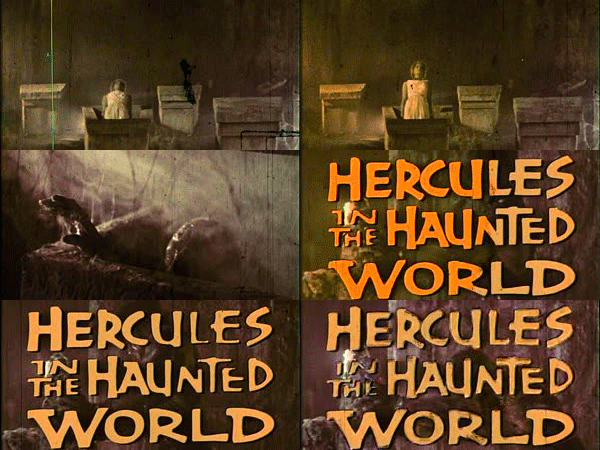
hercules-in-the-haunted-world-fuck-off-and-die-cult-movies-download

Image credit: http://cultmoviesblog.blogspot.com/2012/03/hercules-in-haunted-world-1961.html

So we are in week two of the bavatuesdays film festival. I had a blast doing the first show on Black Sunday (1960) with Paul Bond, and I am preparing for round two this Tuesday at 2:30 PM on Hercules in the Haunted World (1961).  You can watch this film on Netflix, or find an even better version on YouTube (thanks Paul Bond!). I finally took time to get the festival site up and running: http://festival./

hercules-in-the-haunted-world-action-cult-movies-download

Image credit: http://cultmoviesblog.blogspot.com/2012/03/hercules-in-haunted-world-1961.html

The site is a basic spaces for aggregating people’s posts (drop off your link in the sidebar), submit via the fuckyeahmariobava tumblr, the #bavatuesdays hashtag, etc.  You can find more information on ways to submit to the festiva here.

hercules-in-the-haunted-world-heroism-cult-movies-download

Image credit: http://cultmoviesblog.blogspot.com/2012/03/hercules-in-haunted-world-1961.html

More than anything, though, this class is a space to push myself to blog about Mario Bava, make animated GIFs, think about film, continue to experiment with live streaming video, and to prepare for two classes I’ll be part of over the next six months. That said, this is NOT A COURSE, but rather a festival. So do what you do. Check out Mario Bava’s films if you are so inclined, and don’t sweat the details.

Posted in bavatuesdays, movies, YouTube | Tagged , , , | 6 Comments

Milan Caliber 9: Italian Hardboiled

Milan Calibre 9 Pigeon

A few weeks ago I watched Fernando Di Leo’s Milan caliber 9 (1972) and loved it. Unfortunately I’ve been too crazy to write about it sooner, so not all the details are fresh with me. That said, there are a number of things that stick with me from this 1970s Poliziotteschi that I can’t stop thinking about, so this is my attempt to get it out. Milan Caliber 9 is the first part of a trilogy—I still need to see the other two: Manhunt (1972) and The Boss (1973)—and it focuses in on the extreme violence that was a reality in Milan during the early 70s between a variety of forces, namely the mafia, left-wing radical groups, right-wing fascist groups, and the police. It was a time of political insanity in Italy, a period nick-named “The Years of Lead” for the number of bullets that flew. To get a sense of how entrenched these extreme, paramilitary forces were in street violence, check out this chronology.

There are two things I particularly liked about Milan Calber 9 in this regard. The first was that the “hero” of the film, Ugo Piazza ,is a small-time criminal that comes in the form of a middle-aged, stocky, and balding tough guy. Given my own lot in life currently, it’s encouraging to see that this type had some play in Italy during the 70s. The part was played brilliantly by Gastone Moschin whose probably most famous in the U.S. for his role as Don Fanucci in Coppola’s Godfather Part II.

Milan Caliber 9: Gastone Moschin

The second thing I loved about this film was the role of the police commissioner played by Frank Wolff, an American character actor that spent more than a decade acting in a wide range of italian b-movies. He killed himself soon after completing this picture, and he gives a pretty entertaining and compelling performance as the old school, jaded police commissioner who discounts the social justice rhetoric of his deputy commissioner (played by Luigi Pistilli) who links the social problems in Italy at the time to the exploitation of labor from the South. The back and forth between the two happens at several moments in the film, and below I share them all in chronological order.

What I love about these scenes is how they frame a back and forth about the underlying social ills of Italy during these violent years. And while it’s arguably pedantic, at the same time I find the dynamic interesting given how inclined the police commissioner is to shut it all down. Rather than engaging the argument directly, he’ll reply with answers that I find funny, fascinating, and complex all at once, things like “Why do you hate the rich?”  I’m not sure I am doing the whole thing justice, but I can’t help but share these clips, they aren’t representative of the numerous scenes of street violence, bombings, and sadistic murders throughout the film,  but for me the following clips seem to be the pulse of the film, the struggle with a question Italian audiences most have wanted answered at the time-“what the hell is happening in Italy right now?” And the “right now” is important because this film was made during the height of the violence in Milan. For me it’s a new twist on an old standard of the hardboiled genre that hearkens back to the brutal violence and politic of Hammett in some really interesting ways.

Posted in Hardboiled | Tagged , , , | 6 Comments

The Awareness Network: the Web as Context Engine and the Issue of Coherence

While preparing the Domain of One’s Own/Open Educational Experiences talk I’ve given at SUNY’s Open Learn, ACCS, and THE Ohio State’s innovateOSu conference I listened to two talks and one IT Conversations interview by Jon Udell.  More specifically, I spent the 7 1/2 hour drives to both Syracuse, NY and Columbus, OH listening again and again to “The Disruptive Nature of Technology”  in early 2007, his conversation with Rohit Khare from UC Irvine about syndication frameworks in Fall 2007, and a talk he gave at the Kynetix conference in 2010 called “Architectures of Context.” I listened to these three  in that order because it helps me map some of the larger, conceptual visions of the aggregation/syndication bus as both a shift in the culture of sharing online as well as a technical innovation. It’s taken me too long a time to realize just how brilliant Gardner Campbell’s alignment with Jon Udell’s thinking was early on in 2005 for highered, but I remain eternally grateful.

I think one of the things I am learning from Udell’s talks and discussions is how he is constantly trying to explain and re-explain his ideas using new metaphors, stories, and examples. He’s all class, his examples are richly complex, and the work he has been painstakingly doing over the last decade or more to help people understand that the web is first and foremost a collaboration engine predicated on heretofore unimaginable scales of both awareness and context is truly powerful, and brilliantly pares down the power of the web. What’s more, Gardner Campbell has picked up this thread in his own blog recently, which has been on fire, taking the time to differentiate the web from the internet:

The Internet transmits information. The Web enables (stimulates, encourages) a set of connections that, from the first link to the enormous set of links we now experience, symbolize ideas about relationship.

The web provides context through relationships and builds a distributed sense of awareness that through the basic power of linking (not only in terms of an href, but in terms of linking ideas, people, and possibilities). I love this frame, and one of the points Jon Udell was making in his “Disruptive Nature of Technology” talk back in 2007 that I find really pwoerful in this regard was that Web 2.0 was not so much an evolution of the web as it was a reclaiming of the web to the read/write medium in had originally been imagined as. Here is a quote from Udell’s 1999 Practical Internet Groupware (I’ve also been reading that!) which is actually just an earlier version of Udell’s quote from the 2007 talk:

The inventors of the World Wide Web were scientists who wanted a better way to collaborate with far-flung colleagues. The intended HTTP to work as a read/write protocol. Users of the web wouldn;t just consume hypertextual content, they would also contribute and aggregate it. As the web went mainstraim, though, it became more like television than groupware. (34)

If collaboration and context is the foundation of the web, than how do we start imagining that for education and beyond. I feel like the work I have been doing over the last seven years has been reclaiming education for the web, making the process of teaching and learning visible, at the same time building “groupware” that aggregates this process and makes it discoverable. This is exactly what I want to keep pushing with the syndication framework I’ll be discussing today at MIT (and which I quickly framed here a couple of days ago). For me, the Rohit Khare discussion (which I understand conceptually, though struggle to some degree with technically)  frames the fact that what syndication and aggregation provide us is not dissimilar from the affordances a system like Facebook or Twitter provide, the difference being, at least for me,  there is a way to control and own your words if you maintain your own domain. This is why the vision of Diaspora was interesting a couple of years ago, but also why Alan Levine’s vision that social spaces online like Twitter, Flickr, etc. are important for congregating still resonates.

The completely distributed,  independent model has its issues, but the biggest issue—and this is what Udell frames brilliantly in the Kynetix talk, is an issue of coherence online. How do we allow people to both own their words and also have a coherence that frames them within an academic community like UMW? This is what syndication and aggregation can solve seamlessly, and it’s the thing I want to see the syndication bus deal with, i.e. the issue of online coherence for one’s sense of identity, a space that helps us contextualize what we do in the academic context as part of a larger community. The challenges of Udell’s practical internet groupware still face us today, and the solutions are still practical, relatively cheap, and seem to look a lot like the web.

Posted in Uncategorized | 4 Comments

bavatuesdays episode 1: Black Sunday

A day late (but not necessarily a dollar short), we got the first of ten bavatuesdays film festival episodes in the bag, and I was joined by the great Paul Bond for a discussion about Mario Bava’s 1960 black and white masterpiece Black Sunday (a.k.a. The Mask of Satan). We spent an hour discussing everything from Tim Lucas’s massive tome on Mario Bava: All the Colors of the Dark (particularly the color shots from that book featuring the making of the film—all of which made me want it even more) to the aesthetic from the 1930s classic monster films to Bava’s influence on subsequent horror filmmakers to Barbara Steele as archetype of goth in this film. It was a far-ranging conversation, and that’s made the episode quite fun for me.

What’s cool is that Paul and I are just getting our feet wet with this broadcasting model, and this current experimenting with a mini-bava film festival is preparation not only for the ds106zone coming this Summer, but specifically for the True Crime class we are preparing for the Fall. The push to force myself to keep experimenting and exploring stuff like this is what keeps me interested. And while I hate it when I over commit to projects like this that no one is making me do—I always love it when its done. And talking about Mario Bava while sharing clips, images, and conversation while juggling on-the-fly production is a great way to explore with pressure 🙂 It also makes me wonder how soon it will be before pretty much anyone can do this seamlessly.

As for this episodes issues, the audio is not synched in the clips, and that is my fault, but the rest of the show plays through rather well regardless. The mic Paul was hearing me through went robotic at some point, so we need to fiddle with that because it results in a delay towards the end. That said,  for the first episode I’m thrilled at the result, and Paul remains an awesome researcher and respondent in all things literary and movie culture–I can’t thank him enough for his willingness to play along. Now it’s time to prepare for Mario Bava’s Hercules in the Haunted World (1961) —which I referred to wrongly as Hercules in the Underworld in this episode—my bad.

Anyways, all masochists should enjoy, and be sure to give us feedback, we will be experimenting with bringing in more voices as we continue to playover the next ten weeks.

Posted in 106movies, bavatuesdays | Tagged , , , , | 5 Comments

Bearing Witness to Transformation: innovateOSU

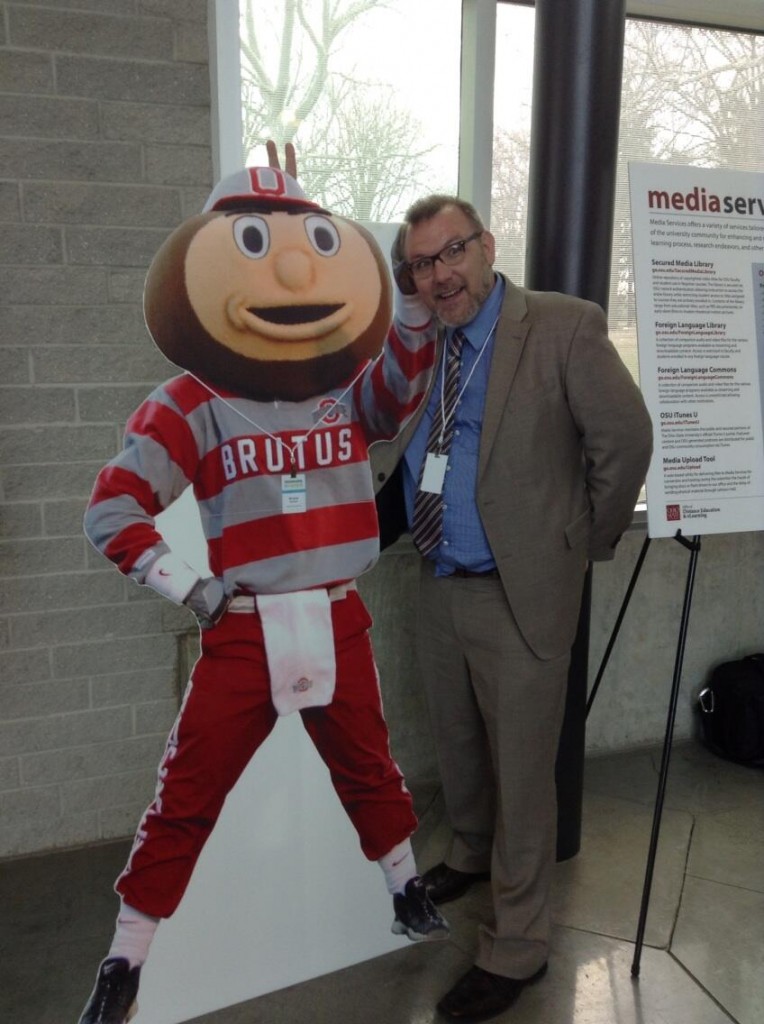
ohio_state_pic Last week at this time I was locked into the 4th annual innovateOSU conference which showcases the work  happening in educational technology at THE Ohio State State University. I was honored to have been invited to kick off the conference, and what I realized in my short time on campus was how engaged and focused group of administration and faculty at OSU is having the right conversations about the possibilities of online education—something that’s been bubbling up globally over the last 18 months. In fact, the great Barbara Sawhill came down from Oberlin, and we talked about just that, and then she blogged about it 😉

The night before my presentation I was breaking bread with OSU’s Provost Joe Allutto, Social Work Dean Tom Gregoire,  Undergraduate Dean Wayne Carlson, math professor James Fowler, Chemistry professor Matthew Stoltzfus, Communications professor Nicole Kraft, and English professor Kay Halasek—and all of them to a person were deeply engaged in the questions of how OSU as a learning community will engage the world of online learning. And while they are experimenting with Coursera, that is just one avenue they are imagining—and Jim Fowler who is currently teaching Calculus 1 through Coursera has been programming  his own online course platform—which is exciting. What’s more, a community of faculty is thinking hard about what this means for a school that operates on the scale of OSU—and the experimentation is happening.
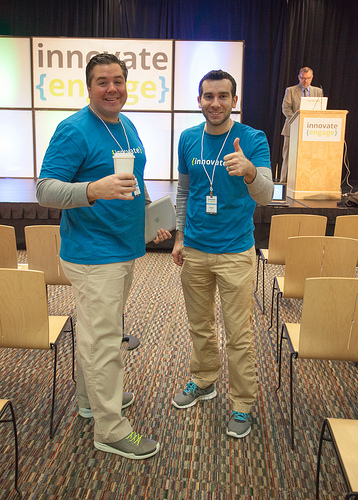
Mike Hofher and Steve Lieb setting up for innovateOSu

I guess this is where I am feeling buoyed by this trip, a big 10 university like OSU is actually investing a significant amount of resources in people like Mike Hofherr (the newly minted Associate Vice President of Distance Education and eLearning), Liv Gjstvang (the Digital First Director) and Steve Lieb to name just a few. And the leadership Mike Hofher has provided this group over the last two years is remarkable, he has a staff that is ready to re-imagine the work they do—-and everyone to a person I talked to was genuinely excited about the direction they are heading in. That is no small thing.

I think what is happening at OSU right now, will soon be happening in a lot of places, re-aligning resources and making a push to develop and work with faculty to engage online learning head-on. The fact that OSU is being proactive about this is smart, and, at least for me, that might be the silver lining of the MOOC craze as of late. Universities and colleges start to take the possibilities or engaging online learning seriously, we invest in experimenting wildly in this space, and ultimately realize we’ve only just begun and universities can build and design these spaces better than the venture-capital driven companies out of Silicon Valley (but that’s just me 🙂 ). A new movement to invest in people not gamble on futures and shares.
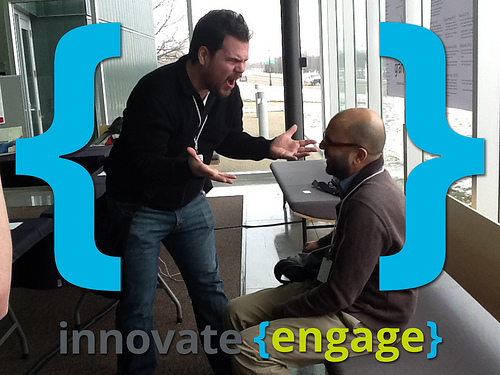
Chris and Anand at innovateOSU

An educational community that is locked in can really make a difference in this space right now, and OSU is on the way to demonstrating that in spades. Not only do they have the centralized learning technologies support, but folks like Chris Hill represent a grass roots movement of edtech happening on campus, and seemed to me the two were working together to make the transformation that much more of a cultural shift.  It’s really exciting to go to a community in which you can actually see the community transformation occurring, and it’s funny how often that is coupled with an educational technology conference. There’s something to that. In fact, E. Gordon Gee was even tweeting at me! That is pretty amazing, and as someone in this field to have a president of such a high-profile institution reach out and give you a virtual high five is powerful! He is doing something very right.

I had a the pleasure of meeting with folks, sharing what I thought (always surprised to find folks listening 🙂 ), and always honored to represent the work we are doing at the University of mary Washington. There is something really exciting about a big, public research university like OSU being deeply interested in what a small, public liberal arts college is doing with online teaching and learning communities. UMW is the little school that does.

Anyway, I had nothing short of a blast, I was injected into a community that is firing on all cylinders, and I shared the culture of experimentation we’ve been cultivating here at UMW for years as a means to hopefully inspire the folks at OSU to keep doing the awesome stuff they’ve started, experiment wildly, shave their heads :), and not be afraid to take the amazing work they do as a teaching, learning, and research community and open up what they can to the public. An ethos of open that I ‘ve been pushing in my last three presentations.
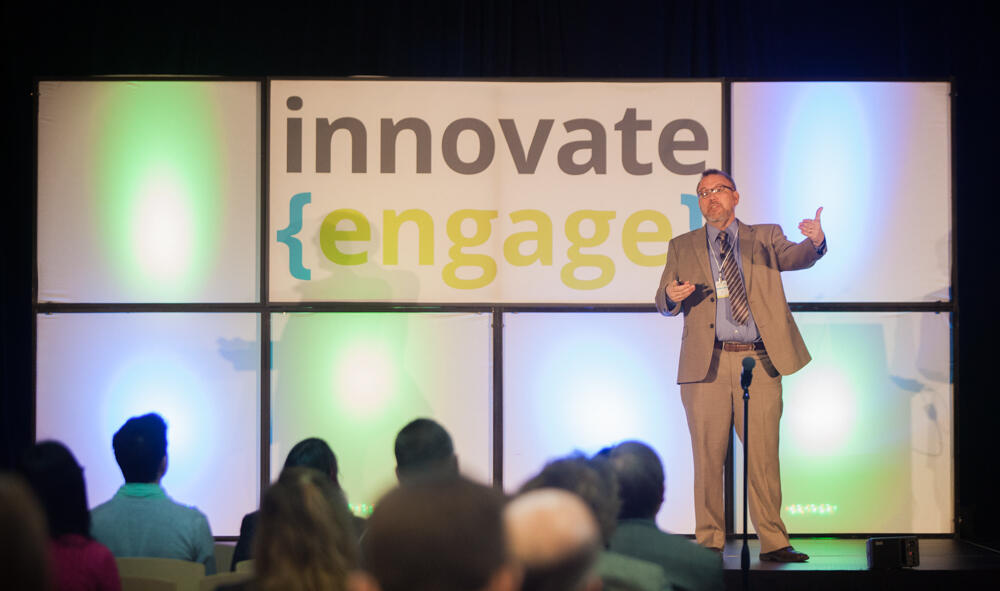
BGSsSgYCYAECBt8

On that note, I have been working through a presentation over the last two months, since SUNY’s Online Learning Summit Conference to be exact, wherein I have been trying to spell out what the field of “open” looks like currently, how I understand UMW’s approach to that has been, and what this means for truly rethinking teaching, learning, and IT infrastructure. It’s been a real pleasure to start fresh with a brand new presentation two months ago, and fine tune it at Virginia’s ACCS conference in mid-March, and then present my finalized version at innovateOSU. I’ll now move on to a new conceit, otherwise my talks tend to get routinized and uninspired (which I never let happen 😉 ), I kinda liked this new method. Focus in on a talk for an intense period of time, try and fine tune it, and then try something new after two or three passes. Anyway, I’m happy where this one ended. You can see the slides below and an archived video of the entire presentation here:

And, at the end of my time when I was back in Fredericksburg what do I get? A follow-up tweet from President Gee!

I most certainly enjoyed my visit, and in no small part thanks to an engaged community that understands online learning is here to stay, MOOCs are one small part of that, and the experimentation within institutions needs to start now!


Posted in presentations | Tagged , , , , , , | 6 Comments

A Domain of One’s Own to Community Syndication Hubs

I will be heading up to Boston this weekend thanks to Philipp Schmidt and Claudia Caro Sullivan who are hosting an open learning hackathon at MIT. Below is the proposal I submitted for an idea I would like to pursue conceptually and actually—what do you think? Tim Owens has already been working at some of this with Installatron, and I wonder if there is a better time than now to start figuring out how you create a community out of a variety of distributed, loosely connected domains.

How do we start thinking of information architecture that allows students and faculty to control their work (a la UMW’s Domain of One’s Own) and feed it cleanly into a distributed campus publishing environment? I hope to talk and work with people around an idea of revisiting and framing a suite of tools that might be bundled (like Commons-in-a-Box)  to make syndication hubs for online courses, communities, and even institutions that much more porous, open, and affordable. A perect example of this can be seen in ds106 or Alec Couros’ etmooc, thanks to the work of Martha Burtis and Alan Levine.

What’s more, I think the time is right to examine what it might mean if universities invest in open frameworks that they can customize and share as part of designing learning environments that meet the needs of a wide range of schools that are experimenting with digitally enhanced, hybrid, and online learning as a result of the recent push towards exploring these spaces. I still think their is gold in the hills of Jon Udell’s ongoing vision of a loosely coupled web of professional identities that we can link together and make discoverable as an engaged communities through aggregation, and I want to see if I am alone or not.

Now what say you?

Update: I was totally remiss in my first go round for not mentioning the recent, awesome work martin Hawksey is doing with syndication, aggregation, and a syndication-driven MOOC platform. He deserves a lot of credit for getting us that much closer!


Posted in Domain of One's Own | Tagged , , , , , | 3 Comments

The Great Wall of bava

The Great Wall of bava

I’ve got about 10 posts to write on uwmdomains faculty initiative, ds106zone, the bava film festival starting this Tuesday, and much, much more. But the family from Long Island has descended on Fredericksburg, and I am losing ground every moment 🙂 My kids are loving all the cousin action, and there are many! So, nice to see I can be so many places at once given John Johnston’s “awesome dancing all over the world” GIF—like I said the internet is stupid and fun, and that’s why it is so amazing! Also, dancing over an image with Mao reinforces a lot of the focus I’ve had on animated GIFs and Chinese Culture thanks to Sue Fernsebner’s awesome course. I still have a post in me about howe we are using the media server at media.umw.edu to serve films for student to re-watch, hack, and create GIFs from. That is your fair use at work to make readings of our culture. And Alan Levine‘s recent Google Hangout for ds106 was all about reading movies and using animated GIFs for that analysis. I love this stuff, and as usual Alan is all over it having them think critically about film scenes they love through GIFs. Brilliant. So much good stuff it is almost paralyzing. Must work through it, and never think of New Orleans 🙂

Posted in fun | Tagged , , , , , | 4 Comments