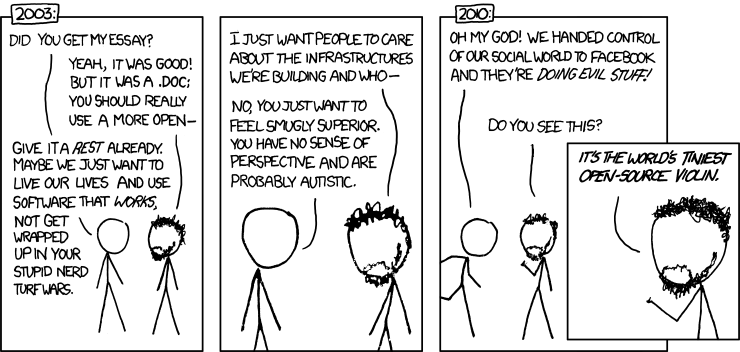
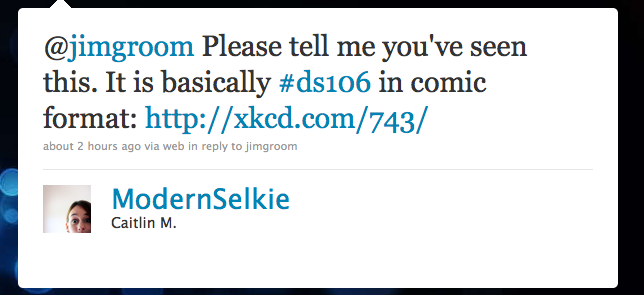
Is this tweet about that comic:
Go here to see part one of this series.
Jesse Fillerup’s Fredericskburg’s Musician Marketplace
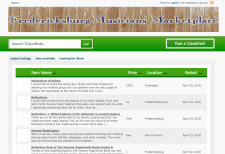 This course blog for the History of American Music experiments on several levels, and I think it hearkens back to an off-handed comment Brian Lamb made a few years ago: “What we need is a Craig’s List for education.” This isn’t that, but Jesse Fillerup’s vision for designing a space where each student creates a historical persona and then uses the course site as a means to exchange wares and services, as well as seek them out, provided an opportunity to explore the idea. Each of the classified ads comes from a specific historical period, and each student was tasked with posting to the central site either a job they have available, or a job they’re looking for. These requests were to include a link back to a profile of the historical persona they created on anything from MySpace to Twitter to Facebook to a blog. It was a brilliant idea, and from the student reflections I think it was received with some enthusiasm.
Here’s a good example of a profile created for a historical persona through Facebook (also, here is the original ad on the course site) and another historical organization created with a blog.
Zach Whalen’s Writing through Media
From the course objectives:
The key, two-fold premise of this seminar: that new media technologies offer new literacies and that these literacies depend to some extent on using media technology to communicate effectively. In this advanced writing course, the successful student will balance theory with practice, and the successful student will leave with technical, working knowledge of some New Media technology and a deeper fluency in media culture. She will also be familiar with what it means to think critically with and through these technologies. The final output of the seminar will be a portfolio-style website – built on the UMWBlogs platform – around which students will build their digital identities.
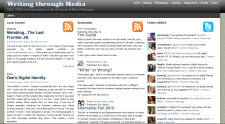
And this is exactly what this course does, frames writing through media as a space in which students imagine, build, and design their own online presence. At the heart of this course is the building of one’s digital identity, and the results have been pretty amazing. Take a look at Kay Bechtold’s and Rachael Wonderlin’s portfolio sites for two excellent examples of what students are building through this course—a quick look illustrates they are mapping their domains on UMW Blogs and redesigning their space through CSS and more custom code—a domain of one’s own come to fruition at UMW 🙂 What’s more, students are not only cultivating their own spaces, but also blogging about this experience on the course blog, and also maintaining a twitter stream. The way Zach designed the course blog in Drupal to catch all three of these different streams of writing on the frontpage is an absolutely brilliant design, and one I will be stealing for my course next semester.
Sue Fernsebner’s Gender in Chinese History
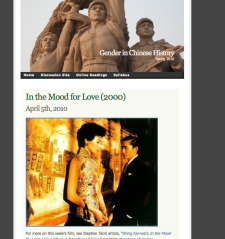 Not only does Sue Fernsebner use a blog as a quick and easy way to disseminate announcements, post the syllabus, provide access to readings, and point to useful resources, she also created a second online discussion space for experimenting with using a re-themed blog as a discussion space premised more on the design and logic of Twitter. I love this kind of experimentation (which I believe is germane to the space given its relative ease and flexibility), and her use of the P2 theme for WordPress illustrates how this kind of thing can be quite simple to implement. Not only does this format make posting rather simple for students, it also provides feeds for each discussion topic (via tags), and organizes conversations along the lines of the chronology of the course—which allows you to always foreground the most recent discussions.
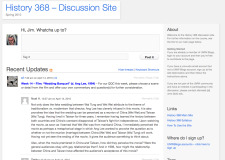 I’d love to hear more about how this approach worked for discussion in this course—because it appears from the site it was rather lively. Fact is, I always want to hear the details from those constantly experimenting, because such an example of deeply thoughtful approach to the intersection of teaching practice and digital space is exactly what we should be promoting. What works and what doesn’t? More than that–why?
Allyson Poska’s History of Latin America II

In this upper-level course on Latin American History, the course blog became the center of student research for their research papers. Over the course of the semester, the blog was used to develop a particular topic in the field, fill out their bibliography, and make connections among different ideas and types of materials. To get the process started at the beginning of the semester, each student read at least one article about Latin America or Latino culture in the US in a major US newspaper, either in print or on-line. Once blogging US news about various countries in latin America was underway, they then switched the focus to specific stories/journal articles dealing with their particular research topic. You can see the guidelines laid out for the students here, which are quite thorough.
It is also interesting, and quite useful, how the posts where broken down into categories on a country-by-country basis, filtering posts by nation might prove both helpful and useful. Not surprisingly, Venezuela (the Chavez factor?) and Haitii (the disastrous earthquake) were the most popular topics, and the posts cover a wide range of issues from over 16 Latin American countries. What is useful about this example is that the blog assignment is so clearly structured that it may prove useful when working with faculty who favor a more structured approach to introducing blogging into the classroom.
Joseph DiBella’s Arts 492: Individual Study
 From the course description:
ARTS 492 Individual Study is an advanced course for studio art majors who are prepared both with technical experience and conceptual basis to pursue focused work that is based upon a proposal that the artist generates and develops during the semester. Although the emphasis is on individual problem solving, the group as a whole will hold critiques (online and in person) that will review the progress of their work and discuss reading assignments.
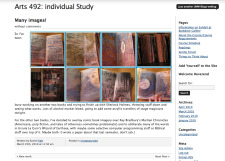
And given the limitations of transporting the works-in-progress back and forth for critique, the class depended heavily on this online course discussion space for posting images of their works-in-progress and sharing the conceptualization and presentation of their art. There are some excellent examples of this here, here, here, and here.

Thanks to Luchas RUM and so many good folks from Puerto Rico in my Twitter stream, I’m starting to get an inkling of what’s going down at the University of Puerto Rico (UPR). Last week, in response to the announcement of more than $100 million in budget cuts to UPR, the students went on strike at all 11 campuses. The strike is an attempt by the students to get the government to come to the table and negotiate those cuts, which will effectively make the Caribbean’s largest public university unaffordable for working class students. The cuts would potentially eliminate the tuition waivers that allows the neediest students to attend a system that is Puerto Rico’s cultural and intellectual epicenter. And according to Christopher Powers, a professor of Comparative Literature at UPR Mayaguez, the university remains one of the most important institutions that stands in resistance to the country’s continued colonial status. To quote Powers at length:
University of Puerto RIco has 64,000 students…and is the premier institution of higher learning in Puerto Rico, it is considered part of the cultural patrimony of the island, and has produced the island’s best and brightest. In the context of the colonial status of the island in which historically so much of Puerto Rico’s resources have been sold out to foreigners, the University of Puerto Rico is widely considered the last best resource the nation has to keep, so the attack on the integrity of the institution, the restrictions to working class students, and the fears of privatization of the university have sparked very wide public support.
Additionally, Giovanni Roberto, who is a student at the University of Puerto Rico and a spokesperson for the striking students, notes that the solidarity of people throughout Puerto Rico and he notes that “We have the right to do this, we are defending our right to a public university, and that is not a crime.” Amen to that. And I think this is something we here in the US have forgotten, it feels like we lost the war to the privatization of our universities and the chronic underfunding of aid and waivers in the 80s, so this fight seems long over to us. But it’s not over in Puerto Rico, and I really hope the students win this battle, because it is well worth fighting for. We are right now paying dearly for our refusal to fight the privatization and our cultural patrimony has been bought and sold as we can see with the UC system raising tuition 43%.
As the video below notes, there has been little or no discussion of this in the US and it is not surprising given how news of strikes in California barely made headlines on the East Coast. These are struggles most people in power would rather have people ignore so public support goes away and the slow, painful siege on thousands of students can continue as long as necessary. And while we talk about acces, freedom, and the possibility for a a new way of imagining education, the students at UPR have hit the streets to save some thos basic rights of access that are currently being threatened, and I have to say it is heartening to see they refuse what we have settled, and are willing to fight for more. In solidarity to all the good people of Puerto Rico, I hope you save your University systems from the conservative wolves that will bleed it of any of its value, and make it yet another reflection of a neoliberal world gone mad.
Below is a excellent video overview of the situation, the cultural context, and the student perspective. And the original post linking to this video can be found here.
Also, fine job by Democracy Now getting in touch with both Powers and Roberto to give such a powerful overview of what’s happening at UPR currently, this is not easy news to find here.

This morning Jon Udell tweeted a quote from this post by Doc Searls:
Branding is jumping the shark now because the Net favors reality over bullshit.
And it’s inline with a lot of how I’ve been thinking about the idea of branding online lately, particularly as it pertains to higher ed. Soon after I retweeted the link, a few folks responded via twitter:
Heidi Hass Gable (@HHG) immediately noted: “Have never felt the need to push it. To me, ur “brand” is a byproduct of your interactions, the impression that u make on ppl…I sometimes need a way to describe that “what ppl say when you’re not in the room” idea…“
And Bonnie Stewart (@cribchronicles) noted, in succession, that
…brands aren’t people, but i think the discourse of the web increasingly posits ppl as brands. not just in corporate sense. The term itself is beginning to be used in more complex ways, as relational…which interests me b/c i’m wary of the corporate carry-over of values into relational sphere.
As I noted on Twitter, I’m sure the term branding is more complex than I give it credit for, but one of my problems with the use of this term more generally, but in education praxis more specifically, is that it predisposes us to approach issues of online identity through a corporate laden lens of trademarks. It tacitly suggests what we’re doing is, as Bonnie notes above, positing people as brands by buying into a fraught corporate vocabulary. Seems to me like branding and reputation is increasingly being conflated, and I’m not sure this relational space can be usefully understood in the same way we buy and sell products. It seems to me in education we should be focusing on having people think, create, and reflect on the trace of themselves online, and essential to that process is examining the implications of creating both a presence and shaping an identity. This process takes time and energy, and depends upon a real investment of one’s self over the time—it can’t simply be bought as a service—and that time and energy is what builds reputation in this space. I think the idea of a individual branding is quite often a post-facto reality others project on someone’s presence after they’ve gone through the work. As D’Arcy Norman noted earlier today: “at a conference recently, someone said that I’d developed a significant ‘brand’ – I was stunned. no. I just do stuff openly. ish.”
The problem with this is that by framing of each of us as a brand in this way suggests that from the beginning one should be working towards building some kind of product that necessarily appeals to others, rather than writing about what you care about and working through a reflective process of being online. And that “being online” is an existential state that most be understood in all its complexity, rather than boiled down to a surface concept of selling one’s self. This is not to say that being online may doesn’t need to appeal to others for it to prove both satisfying and dynamic, but the dehumanizing connotations of such marketing speak as branding as a stand-in for being seems to demonstrate that the dictates of the market are increasingly invading every aspect of our culture, and shaping the language of social interaction—and language is at any given moment a representation of what a culture values—in terms of an economic exchange. That for me is what I ultimately think of when I hear terms like branding, leverage, and synergy when applied to people and relationships in this space, and I guess it isn’t too surprising given how much of the business of social networks right now is an attempt to figure out how to monetize these relationships—so maybe these terms affect me so because my under lying fear that so much of what happening in this space is made possible by the attempts of corporations to make money on our relationships. And framing who we are using terms like brand kind of completes the circle, doesn’t it? It’s like we are all sitting on top of one another in some grocery store shelf (personally, I can be found on the top shelf to the left in the education bloggers section in aisle 12) crying out for attention, hoping the next advertiser or corporate entity will buy us. The languge lends itself to such horrifying dream visions, and I guess that’s what scares me about it.
Mike Bogle sent a tweet last week asking for some examples of educational blogging on UMW Blogs. I didn’t respond, and he probably thought I was ignoring him, but the bava never ignores, rather it absorbs. And given that one of the things I came away from this year’s Faculty Academy with is a renewed commitment to featuring the work happening around UMW Blogs, Mike’s request provides the perfect opportunity to get that project underway—and I hope it proves both timely and useful. Here is part 1 of a 4 part series, each featuring five blogs from around UMW Blogs.
Jeff McClurken’s “Adventures in Digital History”
This seminar is the second iteration of an experiment in integrating History and New Media at the undergraduate level (see the first here),  and McClurken’s work stands as a flagship example of developing and integrating digital fluency into the curriculum at UMW that provides a powerful example of collaborative, undergraduate-fueled digital scholarship that speaks directly to the immediate community of Fredericksburg and beyond. And such an example also goes to illustrate how public funds can provide an open and available public good.
The students work in groups focusing on the creation of digital history projects, all of which are related to making local resources available online. For some examples of student projects see here, here, here, and here.
Mara Scanlon’s Women in Modern Literature, or Gynomod
To quote Tom Woodward, Gynomod seems as much like a rock concert as a course, and I really don’t think there is any better way to put it.  Not only does the course have its own t-shirts (pictured right), but the work students are doing on this group blog is phenomenal. Scanlon frames this course blog as follows:
How would our understanding of a college course change if, instead of taking individual performance and competitive practice as paradigmatic, we were to conceive of our learning instead primarily collaboratively? And what if collaborative knowledge-building, often seen as having secondary or marginal status, were given a central role in our study of the literary works of modernist women? We must think of this site as a vital piece of that collaborative practice, a fluid record of our accumulating knowledge and a place for the active exchange of ideas.
Be sure to check out the experiment Sarah Lawless did with HD’s HERmione and Flickr as well as the Gynopod experiment. So much great stuff here.
Melanie Szulczewski’s Examination of Global Environmental Problems
This is an aggregated course blog that is pulling in all the students’ posts from their various individual blogs using a consistent tag (which is “envproblems” in this case).  So the course blog really acts as hub for all the posts, and a click on any title leads you back to a student’s post on their own blog. What is remarkable about this course, which Szulczewski made beautifully apparent in her presentation at Faculty Academy, was how the blogs became sites of action for her students, becoming spaces where they increasingly focused their concerns about the environment—through extended comment conversations with one another about their views, ideas, and ultimately choices—into action. Their blogs were not only places for reflection, but an active engagement with the immediacy of the problems facing the environment and what they can do about it. Check out some excellent example of this here and here.
Steve Greenlaw’s Finanical Crisis
I’ll let Martha Burtis’s write-up of this one do the talking:
During the spring 2009 semester, Steve Greenlaw’s international finance students did more than just study the current financial crisis — they created a persistent online resource about the global recession.
Students carefully studied and analyzed the international crisis and decided they wanted to build a Web site that shed light on the reasons behind the meltdown and the ongoing events surrounding it. Greenlaw and the students developed a structure for their analysis and presentation and then spent the spring and summer publishing and updating their findings. In addition to sections on the site that examine the intricacies of everything from the subprime mortgage market to the government bailout, students created a timeline of events and developed a robust bibliography of references.
Claudia Emerson’s Ethershop
Ethershop is actually a super-blog, meaning it is an aggregation of four different class blogs over the course of four years, dating back to 2006. 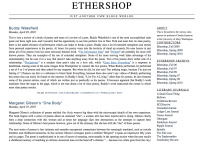 You can find the original course blogs in the sidebar, and this site actually brings in two reviews of a book of poetry each student was asked to write as part of their Poetry Workshop course. The assignment asks each of them to write about a book of poetry they enjoyed, and layout why in the form of a review. What has happened, 140 reviews later, is that this site has become a popular destination in the open web for people searching for various books of poetry, and more times than not this site provides review for rather obscure books, and the authors of these books have on several occasion let Prof. Emerson know how much they appreciate this project. What’s also cool about this is that it isn’t the “whole course online” idea (which often becomes an either/or formulation), but rather one particular assignment made public as a wider resource for the world of poetry.
Nightmare on Elm Street (1984) remains one of the great films of the slasher genre, I actually taught it back in the Summer of 2000 as part of a discussion of recent Horror film cycles. Not only does it pick up on all the sins of the landmark slasher film Halloween (1978) as a more generalized suburban malaise of alcoholism, alienation, and divorce—all of which is back storied by a group of vigilante, murdering parents—but the real impact and horror of this film is located in the brilliant blurring of the real and imaginary—sleep and waking—with a believable and deadly push towards the interpenetration of the two. When I first saw this film at the age of 13 it truly horrified me, and it had everything to do with a Freddy Krueger flirting with camp, but never committing. Fact is, Freddy’s jokes, like “Hey, Nancy, no running in the hallways” or the kiss through the phone can’t be considered camp when they so deeply scare the shit out of you—yet at the same time they add a significant amount of depraved depth to his monstrosity.
They remade and re-released Nightmare on Elm Street just last month, and the last two years has seen a long line of 1980s, b-movie slasher re-makes: Prom Night (2008), My Bloody Valentine (2009), Friday the 13th (2009), and Last House on the Left (2009). I’m sure there are at least a few I am forgetting, but the whole re-make culture right now for these films fascinates me, and I want to spend this Summer re-watching each of the originals and re-makes back to back, it might make for an interesting series about the idea of the re-make, our current sense of culture, and whether the sneaking suspicion I have that Hollywood is shamelessly cannibalizing itself by pushing out brand film names in hopes of quick profit, with very little thought and imagination behind the product, might be the case. Could be, but until then, enjoy the old gold Freddy.
“No Running in the Hallways” scene
So, I am a little late to the mobile revolution (and frankly I still think it’s ridiculously over-hyped for education), but I finally got an iPod Touch through work in order to test out the interface of WordPress on a handheld. I’ve actually never owned a cellphone or mobile device of any kind, save the one Anto and I got temporarily when we moved to Virginia five years ago—and that was only until our LAN line was installed. I still don’t see much of a need for a cellphone—I work by a phone and have a cordless in my house, what else does a guy need?—but it has been kinda fun tweaking WordPress sites to work well with mobile devices. And frankly, when I go to sites on the web that aren’t optimized for a mobile when I’m on one, I find them unusable. Am I right that the homepage of the New York Times doesn’t automatically detect you’re on a mobile and re-present itself accordingly? If so, that’s pretty lame. I’m sure they have some app somewhere, but I’ve steered clear of that nonsense, I like my web with URLs.
But, I digress, to the point of this post. We’ve had WPTouch installed on UMW Blogs for well over a year now, and I know in theory it has been working, but I finally got the chance to play with it in earnest over the last day or so. And I have to say that this plugin does a fine job of representing your blog on a mobile device. What I like about it is there isn’t much you need to do for it if you have a straight forward blog site, and right now we have it activated site wide across all blogs. When you got to a blog on an iPhone, Touch, Android, Palm Pre, Blackberry, etc., you should see something like this:
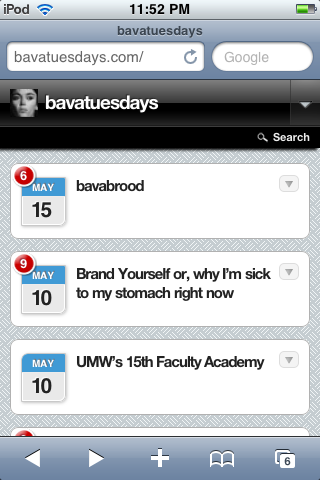
Really not too much for me to do to bavatuesdays for mobile devices, there aren’t really any pages to speak of (save the bavads 🙂 ), it’s pretty much latest posts and a meager search function. I could have included categories and tags, but they’re all pretty much arbitrary and more confusing than helpful, so I hide them from the mobile interface. I figure the mobile interface is for folks who might see a new post or are being referred by Twitter or some other site, I can’t imagine too many folks are going directly to the bava on a handheld, though I may be wrong. So the blog theme for a mobile device is fairly straightforward in this case.
However, I started checking out how a more traditional website/portfolio/resume built in a WordPress site might be experienced on a mobile, and I actually tested out the website of local artist Bruce Day. I helped him get it up and running to feature his artwork, and it’s a relatively simple site based on the portfolio site I created for myself a while back. What was cool about WPTouch was that I could actually tweak this site to have the About page with information about the artist be the default landing page—necessary given the homepage is just a single image with four sidebar links you can’t see in a mobile view. And what’s more, the four pages of the site pull down from the header area, and WPTouch automatically adds an email button that is linked to the admin email for that blog.

All making for a pretty slick interface, and what’s more is that this site is using the NextGen Gallery plugin in order to organize and present his artwork. This is all under the Gallery page, and if you go there you can a pretty clean page featuring various collections.
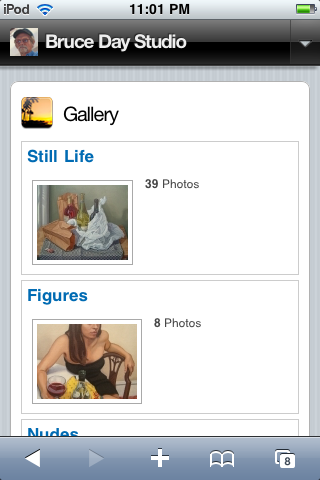
And when you click on a collection you can see thumbnails of the images, and when you click on an individual thumbnail you get a rather clean, AJAX-inspired pop-up thanks to NextGen gallery that works quite well on the iPod Touch:

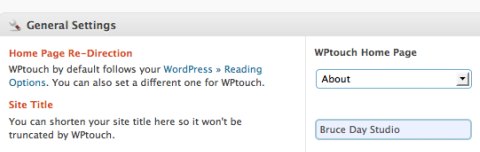
Which makes it pretty amazing how well you can navigate and browse art on a WP site through a mobile device with a couple of simple plugins. And, as for WPTouch, I love the fact that you can choose what page you want to be the default for the mobile version (what they call homepage re-direction):
Another key feature is it allows you to disable the RSS Menu item (this is a site that doesn’t really depend on RSS) as well as the Home Menu item which is particularly useful if you redirect the homepage to the about page, as I did here. Additionally, WPTouch let’s you choose which pages you do and do not want to show up on the mobile menu, and you can upload custom images and make them the icons for each page. All these features made tweaking a more traditional website on WordPress for a mobile device both simple and powerful.

Finally, you can exclude categories, tags, login, or a searchbar from the header on the mobile device. All of which often helps make the experience that much cleaner for a WordPress site that isn’t a blog.
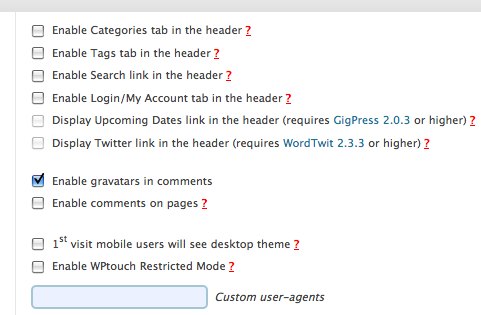
Now, I have only tested this site ( http://brucestudio.com ) on an iPod Touch, so if anyone out there with an Android, Palm Pre, Blackberry, etc. can give me an idea how it looks on their device, I’d love to see how it looks. One thing I’m a bit bummed about is that I can’t really change the background beyond the few options they provide. I’m sure I could change this on previous versions, but haven’t found it just yet on the latest one.
I’m still decompressing from Faculty Academy, it was a very interesting conference this year with a lot to unpack. I’ll be posting a number of my afterthoughts here over the next week, but in the meantime I have to say it is nice to have a kickass photographer stay at your house, especially when he decides to capture a morning in casa bava. Thanks Tom, Anto loves them.
Originals here.
On Twitter earlier today I came across a link for a new startup called Brand-Yourself, an online reputation management service, which has recently entered a deal with Syracuse University that will give all graduates a six month free subscription to the service to help give them “an edge in one of the most competitive job markets since the Great Depression.” What it promises to be, in short, is a one-stop-shop for building and managing an online identity for those coming onto the job market. Here is the press release of the deal with Syracuse University, and I’ll quote from it a bit below.
Syracuse, NY, May 5 2010 – Syracuse University has entered into an agreement with Brand-Yourself.com, an online reputation management platform that helps individuals tap the web to maximize job opportunities. Under the initiative, all students graduating in December 2009, May 2010, and August 2010, will have access to a six month free subscription to Brand-Yourself.com – giving them an edge in one of the most competitive job markets since the Great Depression.
“We’re committed to helping students achieve success even after they leave the classroom,” explained Bruce Kingma, SU’s associate provost for entrepreneurship. “This initiative ensures our students maximize their career opportunities after college.”
The deal reflects how the web is fundamentally changing the hiring process, said Mike Cahill, director of Syracuse University Career Services.
“The internet is changing the way that employers are finding and evaluating job candidates. Students should not only be aware of what employers can find out about them on the Internet, they should be actively managing their online profiles.” Cahill explained. ” Through this partnership with Brand-Yourself, Syracuse University is making a commitment to prepare graduates for success in today’s digital environment.”
What strikes me about this whole thing is rather than rethinking or changing the curriculum to deal with how “the internet is changing the way that employers are finding and evaluating job candidates,” Syracuse seems to be tacking on a subscription service on top of the thousands and thousands of dollars their students are already paying for an education. As if shaping a digital identity over the course of four or more years at a university is not something deeply embedded in the teaching, learning, and research process but rather a subscription-based afterthought. The whole thing captures, at least for me, just how idiotically institutions are approaching what they produce as an easily packaged “brand” that students can simply wrap up and take with them on the way out. This development of a digital self should be part and parcel of the very experience of higher ed. How hypocritical for institutions to become sites of privacy-inspired fear mongering around social media more generally, only to be giving students their neat little subscription-based service on their way out with seemingly little or no guidance in what the process really entails. Is Brand-Yourself going to be the difference in getting Syracuse University students the job that so many of them presumably came there for in the first place? If so, then the crisis of the academy has never been clearer. And higher education’s continued refusal to take social media and digital fluency more seriously in the teaching and learning process, while at the same time promoting turnkey branding solutions that belie so much of what is at the heart of the educational process (i.e., a deep, critical engagement with the foundations of identity and communication) demonstrates the deeply schizophrenic, and I would argue outmoded, logic that is so loosely holding together the place of the academy in the 21st century.
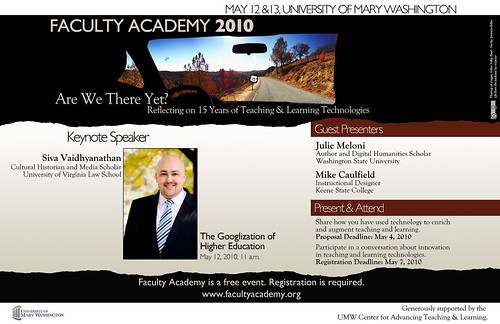
All of us here at DTLT are currently preparing for UMW’s 15th Annual Faculty Academy which will be happening this Wednesday and Thursday—May 12th and 13th. It’s my favorite event of the year at UMW, and it is both inspiring and downright fun. This year, as we have the last four years thanks to Andy Rush’s video prowess, we’ll be live streaming the plenary and keynote presentations here: http://ustream.tv/channel/facultyacademy
Additionally, you can follow the conference Twitter account, which is @umwfa10, or just search for the conference hashtag: #umwfa10 Additionally, you can browse session titles and abstracts using the online program here.
What’s more, seems Inside HigherEd‘s Josh Kim has picked up on the event, and had the following to say:
The list of ways that the University of Mary Washington sets the example in learning and technology is indeed long. UMW is at the forefront of a movement to provide open access to course material and faculty and student contributions through its pioneering UMW Blogs platform. Check out the “Courses” section of UMW blogs for an aggregated view of the most recent semester’s classes available for viewing on this open platform.
While this is certainly flattering to all of us at UMW, I’m also happy to say it is true to some large degree 🙂 Fact is, Faculty Academy is an open, free, and an extremely collegial event wherein the unbelievable work of faculty and students at UMW is not only showcased, but also serves as the means for thinking and discussing the most important ideas and issues facing teaching, learning, and scholarship in the 21st century. And to push that envelope, we invite a number of guest speakers—this year we are lucky enough to have Julie Meloni, Mike Caulfield and Siva Vaidhyanathan—to inject the atmosphere with generative ideas, challenges, and a whole range of ideas to cross-pollinate the conversations. And I have no doubts that this year’s conference will do just that.
NB: It is no coincidence that UMW’s Faculty Academy is just about as old as the World Wide Web, these two transformative technologies are coeval!

Find out more about me here.