I see this audio file as the greatest of tributes, and want to thank Dave Cormier for pointing me to it. An evening at Casa Lamb/McPhee is one of life’s great social, emotional, and psychic pleasures. I was sorry to miss the actual Northern Voice conference, but missing the hanging out around and after that event is what really kills me. I missed you freaks, and I am deeply honored that I could be the fodder for your b-music entertainment. Thanks for the ego stroke set to music, it bottles just a little of the magic that has become the edtech presence at Northern Voice.
Continuing on my Treme theme, there is another rant by Creighton Bernette inspired by a memo from Tulane University announcing the cutting of the Computer Science department as well as various Engineering departments. What follows is a great rant on what survives, which is basically the various “useless” identity politics departments. The irony, as the great Luke Waltzer points out, is that not but two episodes later Creighton himself becomes part of the most formidable identity politics movement in history: YouTube.
in which we attempt a brief critique of ‘sharing’ in Higher Education
and issue a statement on ‘Common Sense, Mass Intellectuality and the
General Intellect’.
If you would like printed copies of the leaflet for yourself or to
share with others, we will send them to you:
The students and faculty of The University of Utopia
When you follow the links you get a full-blown manifesto for sharing that speaks directly against so many of the issues of the prevailing, compromised logic by which we have accepted a corporate-driven, bowlderized, and hand-cuffed version of how the internet can truly radicalize the idea of sharing. We’re still working off a broken paradigm, and the more we try and fit a radical idea of sharing into a broken model of profiteering the sooner the radical possibilities of the web will be relegated to the status of subscribtion television.
Here are a couple of gems from the manifesto:
We have been objectified as Teachers and Learners. These are illusory concepts. Sharing is to resist the commodification of our lives and escape the measures of Capital, its controls of ‘quality’ and its life-support machine of ‘efficiency’.
Sharing brings curricula to life as a flow of ideas, an unstoppable, irrepressible mass intellectuality that recognises no disciplines and responds to every act of discipline.
The institutionalisation of sharing is the absorption of sharing into the alienating processes of the institution. As a flight for freedom, it is in vain. The Crisis remains.
The locus of struggle is not exchange but production. In the sphere of production, sharing as a revolutionary act becomes a recognition of what is common. There is nothing revolutionary about acts of exchange.
The desire for communism is a productive desire that finds nothing lacking. We express this desire by sharing, understood as a social force, or a curricula of action against a world that is being destroyed.
I love the idea of “finding nothing lacking,” it brings the most revolutionary idea of the Whitman-inspired act of creating and sharing to life, just as a new undersanding of sharing in the most radical ways brings curricula to life as “a flow of ideas, an unstoppable, irrepressible mass intellectuality.”
And the other section of this manifesto, termed “the outside” defines terms like “mass intellectuality” as follows:
As intellectual workers we prefer to share our work with others inside and outside of the university. As intellectual workers we refuse the fetishised concept of widening participation, and engage with teaching, learning and research only so far as we are able to dissolve the institutional boundaries of the university. Not mass education or education for the masses but mass intellectuality. Mass education is based on the assumption that people are stupid and must be made not-stupid (i.e. Educated). Mass intellectuality recognises that education maintains the population in a condition of stupidity (i.e. Intelligence Quotient) regulated through examinations and other forms of humiliations (i.e. Grades and Assessments). Mass intellectuality is based on our common ability to do, based on our needs and capacities and what needs to be done. What needs to be done raises doing from the level of the individual to the level of society. In the society of doing, based on what needs to be done, my own needs are subsumed with the needs of others and I become invisible (i.e. Free).
I want to be part of a society that recognizes the value of doing; a culture that recognizes the various “forms of humiliations” we have brokered our idea of education through as anathema to any sense of a community. A vision wherein education is central to community and society more generally, and is not understood as a space wherein to alienate a population from one another through a series of tests, castes, and pre-determined rules which mentally shape the perceived impossibility of changing anything.
When did it come to pass that we all increasingly accept the ostensibly undeniable reality that we can change nothing?
It heartens me that someone refuses that logic, and continues along a course of action.
So, I have been religiously watching the first four episodes of Treme. I’m a bit conflicted about the series overall so far. There is a lot to like so far, but also a lot that leaves me kinda wondering why they’re pushing the insider/outsider theme so hard. It almost feels like a play on Bush’s motto: “You’re either from New Orleans, or a sycophantic parasite.” I’m sure there’s a number of ways to imagine this, and given how early it is I have to believe the series is still trying to find its legs and establish a variety of characters within the world it portrays. A world dominated by the almost instantaneous urban blight left in the wake of Hurricane Katrina. Whenever the series starts talking about details of the city’s mismanagement, FEMA’s fuck-ups, or how various Louisiana parishes have been exploiting federal funds, it makes for interesting, even if morbid, watching, but at the same time I’m wondering why I’m compelled to watch a train wreck. As Rick Prelinger notes about the coverage of Detroit over the last 10 years, is this just more “ruins porn” in which you bring your audience in knowing they want to find out more about the devastation of Katrina only to give them the dirty details bit-by-bit, and concomitantly make them feel guilty all the while for being a voyeuristic outsider—the very one whom you count on for the success of your narrative. It is, after all, for the outsider that they are retelling this tale, isn’t it?
One of the things that struck me in the first two episodes of Treme was that it seemed surprisingly hopeful given the subject matter it was dealing with, and I found that refreshing. As I finished episode four I’m finding it increasingly hard to stomach the pain-in-the-ass dude from Amsterdam who guilts everyone into not being from New Orleans, or at least going there. How annoying is he? By far the worst character in the show thus far, and his whole line of some kind of essentialized/romaticized vision of New Orleans may be just what this series will have to struggle through for a while yet. Authenticity is the driving logic thus far, and in my mind it seems a bit circular. My favorite way out of this tautology in the series is the simple line in episode 2, “There’s pride on Bourbon street.” Even if no one really believes it, it still frames the predicament faced by the characters—who can afford pride? A far more interesting and complicated way of approaching the situation than suggesting everyone in the series can—which right now is what they all have in common and is what makes them all special in their own way. I guess this is part of the hopefulness, but also part of the struggle, at least for me, with seeing beyond the idea of the assumed “real” New Orleans.
All that said, the music so far has been awesome to listen to, and I’m following The Sound of Treme blog as a guide to the music—which is all pretty new to me and I am enjoying it thoroughly, particularly Fuck Katrina. Which, by the way, allows me to segue way into the very reason I started this post, namely to talk about YouTube, citizen rants, the reincarnation of The Big Lebowski‘s Walter Sobchak as Treme‘s Creighton Bernette, and a missed opportunity. I have to admit I loved Creighton Bernette’s YouTube video in episode 4 in which he rants about the abandonment of New Orleans by the rest of the country. John Goodman is without question channeling Walter Sobchak for this role, and it’s interesting that while Creighton won’t work on his novel or leave the house, he will rant for the rest of the world to hear on a rather young, albeit very popular, video sharing site in December of 2005 called YouTube 🙂 In fact, the idea of the new web and blogging really hit home for me personally in August of 2005 when I was just beginning to wrap my head around the concepts and was regularly following and commenting on the Philadelphia blog The Tattered Coat, which provided a remarkable, almost minute-by-minute update, of what was happening in New Orleans during Katrina. Matt of Tattered Coat did some amazing reporting/updating of the crisis, and I was both impressed and suspicious of how very different this means of communicating such an event was. In fact, the networking around a catastrophic event like that is something we almost take for granted just four years later, just think of the earthquake in Haiti and how quickly folks mobilized relief and various news channels for information so that people could be immediately updated and also have the ability to send money, food, general support, etc. Blogging was not nearly as commonplace in August 2005, but I remember being blown away by how quickly so many people mobilized to share information about Hurricane Katrina. In particular, I remember this post on Tattered Coat titled “On Looking at Photographs of the New Orleans Dead” as a swift kick-in-the-ass in regards to the truly transgressive and disturbing power of social media, it could circumvent mass media’s attempt to censor and simplify a nightmare scenario like Katrina—and seeing the macabre images of the dead littering the streets in the wake of Hurricane Katrina still haunts my imagination. Not since I was a rogue 12 year old guiltily partaking in the illicit cult pseudo-snuff video Faces of Death (1978) had I felt anything as viscerally as when I saw the images in that post. Only difference being I was 21 years older and still had great difficulty parsing the medium through which I was trying to piece the various fragments of this whole thing together.
So seeing Creighton Bernette launch his tirade on YouTube suggested the means through which social media like YouTube, both during and after the hurricane, might be one way of providing an alternative narrative to what the mainstream media is canning for the rest of the country, if not the world. What you have is a series of pissed off folks that are done being pushed around, and this becomes an outlet for frustration, grief, and communicating a narrative through an alternative channel. Something I think we have lost some sight of four years later. So, I’ve included the YouTube video rant below, but my question to the folks creating Treme is why did I have to upload this clip? Why wouldn’t you actually film Creighton’s rant via YouTube and upload it to YouTube yourself? And potentially spark a whole series of rant videos about the aftermath of Katrina? Why not experiment with the very medium you are chronicling? –even if fictionally. It actually once again begs the question who is Treme for? The outsider or the insider? —or some third, socially mediated space between? Why not imagine elements of the show as some kind of ARG that allows us to rethink media and the delivery mechanisms for rants, because much of Treme right now is a rant, and it seems like the show is aimed at drawing attention to that fact, and providing a kind of awareness that New Orleans is still very much recovering 4 years later, but at the same time wants to be left alone. Who will know if everything is locked up behind an HBO paywall (even if only imaginary)? I guess the word will leak out if and when the show catches fire, but why not experiment with the very channels that made Katrina one of the first major events mediated through an assortment of social media channels? It just seems like a missed opportunity to me not to experiment a bit with making the show something more than another HBO series, as amazing as many of them have proven to be over the years. But the fact is, social media informed many of us about Hurricane Katrina in some powerful ways, through a variety of different channels—can a show dealing with an historic event like this use these very tools to make the conversation that much more distributed, dynamic, and open? Rick Prelinger seems to be trying to do something very similar with his documentary “The Lost Landscapes of Detroit” is, as Prelinger notes,
A collection of amazing and almost-all-lost footage that celebrates a vibrant, busy and productive Detroit from 1917 through the 1970s. The idea is to bring these images back to Detroiters for their contemplation and use as they rebuild their city for the future.
Footage to both contemplate and use in the rebuilding of a city, isn’t that what the people of New Orleans need right now as well? Isn’t it what we all need? Prelinger’s work is in many ways a starting point to get more footage out there from citizen archivists to both share and create with, and I wonder if Treme might be thinking along the same lines? A means to get the rants, stories, and images out there for everyone to continue to share as the rebuilding continues. If that were the case, how exactly can TV do this alone?
OK, anyway, here is the rant 🙂 And to be clear the following video is a rather long, extended f-bomb. You’ve been warned.
Three presentations about it today: http://bit.ly/9cv2Wn We’re up to 800+ users in ‘pilot’
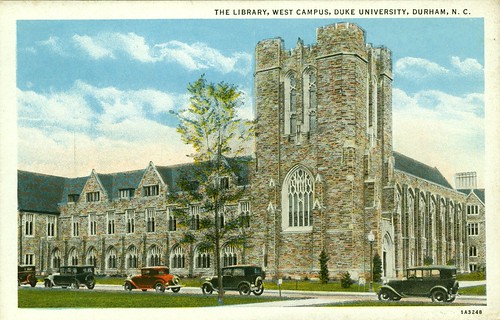
Over eight hundred users in the first year is, indeed, more than a pilot, and part of me was excited and wanted to take some small amount of credit for the success, but that would make little sense. Reason being is that my nostalgia for Duke University’s CIT Showcase today is tied up with the fact that this is a university that not only has money, prestige, a championship basketball team, as well as some of the nation’s top scholars and researchers, but they also approach things like a WPMu pilot (and just about anything else they seem to do in the edtech field) very intelligently. They brought me in last year because they knew they wanted to start experimenting with “flexible publishing platforms,” and they brought Joel Theirstein of Rice Univesity’s Connexions project and Micahel Boezi of Flat World Knowledge in as plenary speakers this year to ramp up their exploration of Open Access publishing at Duke.
Fact is, they are right on the mark, by exploring how open and flexible publishing platforms made available to their faculty and students can impact the larger ideas of open access, open content, and open education more generally through a process of capturing and remixing learning content from around an institution like Duke is an extremely powerful, two-pronged approach. Of all the elite schools and Ivies in the US right now, they are the one’s to watch. Paolo Mangiafico has been one of the leading forces for an open access policy, and he is working out of the Provost’s office—he gets the conception and importance of the open education movement from both the highly technical to the abstractly ethical, all the while practicing a necessary pragmatism to see it through. Fact is, we can harp on the failure of institutions all the time—and I often have no problem doing so because the vast majority of them are simply running in Sisyphean circles—but I also think it is important to point out when an institution is doing it right. And from what I have seen and experienced at Duke, I would say they are in the cat bird’s seat.
Why? Well, because their ideas of IT, digital humanities, open education, instructional technology, and research cuts across the campus—they are not segregated into separate spaces to the degree I have seen at other institutions. IT and ICT cross pollinate employees and ideas, and while they have a hardcore group of server admins and security folk, they use that to enable innovation rather than rule it out (which is the whole idea!). What’s more the meetings I had with them at a consulting session included folks from a wide range of disparate departments: Students Affairs, the library, ICT, and IT (an integration across the domain). All the while, the conversations about the technology were informed by its potential for teaching, learning, and publishing. And while the meetings were far more formal than I’m used to (I am a philistine after all), they were thorough, and what’s more—they followed through! A rarity in so many places.
And seeing the groundwork set for a solid, open publishing platform like WPMu at Duke, and then taking the next logical step to promote and push for open licensed and open access publications makes the intersection of teaching, scholarship, and access a more fluid vision of institutional praxis that cuts across so much of the nonsense we see stifling these same attempts elsewhere right now. And all that said, I’m sure Duke is far from perfect, and folks who work there may be saying to themselves as they read this, “If you only knew…” But we can all say that about our given institutions, and what strikes me is that from the outside looking in, Duke is going through a pretty dramatic transformation right now, and I have to believe it can only bolster their reputation that much more. From my dealings with Duke they are a class act, and what’s more they’re smart with their resources and they are using them to some good effect right now. I really wish more schools would take note of the fact that real planning, strategy, and commitment amongst a solid group of coworkers makes all the difference, rather than simply aping an idea. So that’s what I like about Duke, they are really trying to integrate all these ideas through out the institution, and I have to applaud them for the way they are going about it.
Remember when the gas pumps moved from attended to self service? Well, if you’re not from dirty Jersey and you happen to be old enough you might remember this transition, and for me it was a special one. I always wanted to be able to pump gas into the big blue Suburban my mom drove around in circa 1980 or 1981, but it wasn’t until the mid to late 80s that I got my wish. And I have to say, pumping my own gas remains one of life’s little pleasures, as does cleaning my own windshield with a squeegee. A pleasure right up there with the first time my mom let me use her tellerbeam card in 1982 (a tellerbeam card is what we called ATM cards when they first came out on account of our bank’s nickname for them)—it was nothing short of magic. Pure at utter magic!
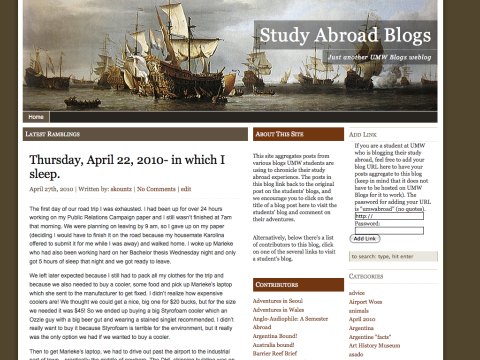
So, all this to prepare you for a little bit of modern day magic on UMW Blogs. Back in January I started to notice a few study abroad blogs on UMW Blogs, so I decided to quietly set up a UMW Study Abroad aggregating blog space that would actually pull the posts from a couple of the blogs I noticed into a centralized aggregator blog using the FeedWordPress plugin. I emailed the three students whose blogs I had seen and told them my plan. They were cool with it, so off we went.
When setting up the space I decided to add UBC OLT’s “Add Link” widget to the sidebar* (a brilliant plugin that allows users to add the URL of their site from the sidebar, which in turn is added to the FeedWordPress syndication queue) with a little blurb telling folks who happened upon the site that anyone at UMW blogging their study abroad experience could feel free to add the URL of their blog. In fact, here is the actual wording:
If you are a student at UMW who is blogging their study abroad, feel free to add your blog URL here to have your posts aggregate to this blog (keep in mind that it does not have to be hosted on UMW Blogs for it to work). The password for adding your URL is “umwabroad” (no quotes).
Finally, I added a link to the Study Abroad blogs on the frontpage of UMW Blogs, and kinda forgot about it for a little bit. Over the next four or five weeks, the number of blogs aggregating into this space went from three to fourteen. Almost 5x as many students at UMW Blogs found the site and must have been seduced, much like I was as a child, with the novel idea of self service technology. They added their URL, and as a result the Study Abroad aggregated blog site has been one of the most active spaces on UMW Blogs, with over 275 posts from 14 students in less than four months (that’s on average 20 posts per student, and keep in mind this was not only optional—but unofficial and downright obscure). And the posts are long and candid documents about these students experience in countries ranging anywhere from Argentina to Australia to Scotland to South Korea. They are all over the map, and what they are writing and sharing is really quite good.
Which reminds me of another piece of the UMW phenomenon that I really don’t pay as much attention to as I once did when the whole blogs experiment was getting started a few years back: the students. UMW’s students are a special bunch, they are gritty, unpretentious, and they demand a lot from their education—more specifically their professors. I have had literally thousands of interactions with them over the last four or five years, and this semester I am seeing many of whom I “digitally made” getting ready to graduate. It’s a weird experience because for the majority of them I was not their professor, but rather a gadfly who kept invading their classrooms for an hour or so talking about anything from blogs to digital identity to open education to copyright, etc., and not only did they refrain from being rude or outright stoning me, but many of them got excited by the ideas and consistently blew my mind with the work they did, and continue to do.
My ode to this graduating class (many of whom I realized today I’ve made some very solid relationships with) may have to be the next thing I write. I constantly show my love to the professors (even when they fail me), but now it’s student time. And seeing the Study Abroad blog aggregator run over with great stuff and truly remarkable experiences reminds me that there is no one or two people making this thing work, it’s a distributed, campus wide push for expression and sharing that cannot so easily be located. All we are doing here is creating the opportunities for those connections, and as has consistently been the case, the students not only rise to the occasion, but exceed just about all expectations.
___________________________
*I had problems with version 1.1 of the Add Link widget pulling the URL directly into FeedWordPress on UMW Blogs. I need to tell Enej as much. I’m sticking with the 1.01 version for the time being, but please keep in mind this issue could only be cause the UMW Blogs setup is so bizarre.
Image credit: Early ATM, courtesy of time.com (found via http://yoretown.wordpress.com/2009/09/02/titanic-found-atm-invented-both-today/)
Erland Van Lidth is in my mind the b-movie equivalent to a John Cazale. Cazale has one of the most remarkable, and tragically short, film careers in history. He was in five films before his untimely death, all of which were nominated for the Academy Award for Best Picture, and three of which won. Those films in order: The Godfather (1972) The Conversation (1974) The Godfather: Part II (1974) Dog Day Afternoon (1975) The Deer Hunter (1978)
That is an insane list, and I will leave Godfather III out of that list because he had no say whether or not he could be recut into that mess. Cazale in many ways embodies everything great about 1970s Hollywood, an emotionally reactive force tied up in slender, intense frame—a character actor for the ages and one whose short career rivals the longest and most accomplished of any actor of his time.
Cazale is in a place by himself in my mind, right up there with Harry Dean Stanton. So it might seem odd that I always associate Erland Van Lidth, a relative unknown to many, to Cazale, who by all accounts was an artist of the first order. But van Lidth is an interesting story in his own right, and he in many ways stumbled into acting on account of his rather unique physique. Van Lidth studied computer science at MIT during the 1970s, was a world-class heavyweight wrestler, and all the while was working towards becoming a heldenbaritone (or an opera singer whose particular voice is associated with the works of Wagner). How do you like that crazy combination of abilities and talents? What’s more, Van Lidth was discovered by a casting director in NYC during the late 70s, and started his own very short, but at the same time quite remarkable, movie career, becoming the face of some of my favorite films of the late 70s and early 80s.
His first film was Philip Kaufman’s The Wanderers (1979), and he played one of the most memorable characters I have yet to encounter in all of film: “Terror” —the leader of the Fordham Baldies. And when you watch the following clips (both of which feature Terror towards the end—the first shows him inhaling a slice of pizza and the second features him in a gang faceoff) you’ll now exactly why I feel this way about him.
“Walk like a man”
“Leave the kid alone”
The visage of Terror was forever burnt on my mind after watching The Wanderers for the first time, and it is a face I still can’t shake—not unlike Jaws from Moonraker (1979). He is one of the wildest looking cats ever!
Soon after I saw Van Lidth as Terror in Wanderers he showed up again in one of my favorite movies of the early 80s, Stir Crazy (1980). How can you help but love the comic pairing of Gene Wilder and Richard Pryor? Add to that the character actor Van Lidth as the golden voiced homicidal maniac Grossberger, and you have one of the most memorable, but all too forgotten, comic scenes from 80s film:
After Stir Crazy Van Lidth teamed up with what might be the greatest cast 80s slasher film of all time, acting alongside Jack Palance, Martin Landou, and Donald Pleasance in a little known gem of a movie called Alone in the Dark (1982). It is one of the most underrated slasher films of the 80s, but has a solid cult following amongst b-slasher fans, and this one is up there with the original Halloween in my mind. Not only that, but it is absolutely hysterical at the same time, take for example this scene with Martin Landou (that also features Van Lidth and Jack Palance) going nuts over stealing a mailman’s hat.
This is 80s direct to VHS cinema at its finest!
And last, but not least, Van Lidth starred as Dynamo, the electrically charged opera-singing stalker in the Schwarzenegger vehicle The Running Man (1985). He actually does the opera singing—which is the second time his voice talent is featured on film—but he, like everyone else in the film, is a victim of one of the coolest ideas from a King novella sacrificed to a terrible adaptation. But with all that said, it was his film swan song, and being an electrocuting opera singer that zooms around in a miniaturized bat mobile is pretty cool gig no matter how you cut it.
And there Van Lidth’s career is tragically foreshortened by heart failure at the age of 34, leaving behind a wife and newly born child. I don’t know why this actor speaks so deeply to me about the idea of a career, being many things at once, and leaving some kind of record of ones very being—but he does, not unlike the great John Cazale.
The tale of the tape, 1.6 million page views over the last nine moths, with over 600,000 visitors and 400,000 unique visits.
I still don’t know how to parse this data effectively, but I agree with David Wiley that making sense of these analytics for open education projects will be crucial moving forward. That said, I wonder how we use narrative to illustrate trends rather than simply stats, I don’t know, still trying to make sense of this.
is an ongoing conversation about media of all kinds ...
Testimonials:
Generations from now, they won't call it the Internet anymore. They'll just say, "I logged on to the Jim Groom this morning.
-Joe McMahon
Everything Jim Groom touches is gold. He's like King Midas, but with the Internet.
-Serena Epstein
My understanding is that an essential requirement of the internet is to do whatever Jim Groom asks of you while you're online.
-James D. Calder
@jimgroom is the Billy Martin of edtech.
-Luke Waltzer
My 3yr old son is VERY intrigued by @jimgroom's avatar. "Is he a superhero?" "Well, yes, son, to many he is."
-Clint Lalonde
Jim Groom is a fiery man.
-Antonella Dalla Torre
“Reverend” Jim “The Bava” Groom, alias “Snake Pliskin” is a charlatan and a fraud, a self-confessed “used car salesman” clawing his way into the glamour of the education technology keynote circuit via the efforts of his oppressed minions at the University of Mary Washington’s DTLT and beyond. The monster behind educational time-sink ds106 and still recovering from his bid for hipster stardom with “Edupunk”, Jim spends his days using his dwindling credibility to sell cheap webhosting to gullible undergraduates and getting banned from YouTube for gross piracy.