The Motley Management System

Mike Caulfield’s post “Enterprise Learning Systems Considered Harmful to Learning” reminds me of some important questions that still remain unsettled with me. Why am I such a big advocate for a WordPress Mulit-User installation at UMW? I do believe that blogs can be an out-of-the-box e-portfolio solution. I also believe that WPMU builds in some interesting possibilities for aggregation, tagging, and cross-pollinating ideas for a particular community. Yet, despite these advantages, potential disadvantages such as becoming application specific and making a personal learning environment that is fostered by and hosted through the university are important for us to hear right now because we are currently working on taking WPMU to the next level (one step closer to enterprise) for our university.

The question Mike is posing here (and which Jerry and Martha ask often) of whether or not we should host enterprise solutions (blogging or otherwise) still needles me on occasion when I read a post like this. Almost as if I am convinced that everyone will, and should feel the same way about WordPress as I do. When I notice someone using a Moveable Type or blogger blog I find myself scoffing at them, and do far worse for anyone who has chosen the bloated blog system of Drupal to publish their thoughts. In general I pity their lack of vision. This might all be part of the psychology of fanboys, but regardless it is getting pretty bad -I barely recognize myself anymore.

So here is an important, if rare, interlude for reflection. Do we need to create this space for students? Do we need to provide their “spiral notebooks” for them? Why not simply let them sign-up for their own blog at WordPress.com, blogger, or some other service, and concentrate our efforts on hacking the space for aggregating these variegated resources and devising ways to use these tools in courses more effectively?

Well, in short, here’s your answer: I secretly want a community in training of homogeneous WordPressers who will go on after their four year indoctrination to use this tool to take over the world! (I bet you all thought I was ready to capitulate -NEVER!)

But in all seriousness, can you think of some major disadvantages to providing a Mutli-User blogging service through the auspices of a University -even if it is hosted for 6.95 a month?

Posted in WordPress, wordpress multi-user | Tagged , , , , | 10 Comments

Mad Max: The Art of the Stunt

Mad Max is an amazing movie for many, many reasons (read a fun review here). And having seen the 2000 re-release at the Film Forum in NYC with Australian accents and slang restored, I can safely say that I have truly experienced this monumental offering of Australian culture. Whenever I think about Mad Max, two things immediately jump out at me: 1) is the Knightrider yelling out AC/DC lyrics on the CB, 2) all the amazing chases and stunts. Now, here’s a film that with a shoestring budget ($400,000 which in turn grossed over $100,000,000) re-engineered the cinematic car chase by bolting cameras inside the vehicles and making the viewer part of the action (eat your heart out Steve McQueen). More importantly, the stunts in this film are simply out of this world -whether intended or not. I would really be interested to know if anyone has seen another “stunt”* that matches the visceral and emotional grip of the following scene from Mad Max:

No one was injured during the generation of this short film clip.* Stunt is in quotes because the above scene was not intentional but all the more effective because of this and a little slow motion.

Posted in film, films, movies | Tagged , , , | 5 Comments

Freud, der unheimlich, and the importance of aesthetics

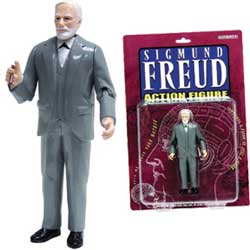
Freud Action FigureI have been following twitter as a late night activity these days because I just haven’t had time to play along -to my great detriment. Gardner posted a really interesting question: “what if we approached pedagogy as a design problem?” (I believe he was referring to (or quoting?) a book he referenced titled Emotional Design: Why We Love (Or Hate) Everyday Things by Donald A. Norman. I saw this, silently del.icio.us’d it my brain, and then headed over to Abject Learning so I could read the comments (see, when I read a blog -and admittedly do not read nearly enough- I don’t just RSS it, I drop physically in on a consistently irregular basis -kinda like a parole officer). I had a moment of convergence with one of Brian’s post and was remarking on the fact that he had his finger on the pulse of the web to such a degree that it was uncanny -and for good measure I threw in Freud’s notion of the unheimlich. Brian’s remark about this term made me think about it in relationship to Gardner’s tweet (the circle is complete).

Unheimlich is often translated as the English word uncanny. However, the German term according to Freud has two competing meanings in relationship to its root heimlich, which means homey, comfortable, and friendly and a competing, less common, meaning of the root is concealed, secret, and deceitful. Unheimlich can mean unfamiliar, uncomfortable, and eerie. Or, it can also mean (less commonly) what is supposed to be kept hidden but is inadvertently revealed (take a look at some class notes for a Washington University lecture on Freud’s essay for an interesting framing of this essay here).

Why all this? Well, first to let Brian know I really don’t know exactly what unheimlich means, or if it is even translatable. Second, I think Freud’s reading of this concept as a space where a perceived lack of connection between the discipline of psychoanalysis and the philosophical questions of aesthetics comes together in generative ways, which in turn makes me think of the often distinct relationships between pedagogy and aesthetics that Gardner often refers to (recognizing fully that I am now conflating design with aesthetics here for my own purposes). Here’s is a quote from Freud’s essay on the Unheimlich:

It is only rarely that a psycho-analyst feels impelled to investigate the subject of aesthetics, even when aesthetics is understood to mean not merely the theory of beauty but the theory of the qualities of feeling. He works in other strata of mental life and has little to do with the subdued emotional impulses which, inhibited in their aims and dependent on a host of concurrent factors, usually furnish the material for the study of aesthetics. But it does occasionally happen that he has to interest himself in some particular province of that subject; and this province usually proves to be a rather remote one, and one which has been neglected in the specialist literature of aesthetics.

The subject of the ‘unheimlich’ is a province of this kind. It is undoubtedly related to what is frightening — to what arouses dread and horror; equally certainly, too, the word is not always used in a clearly definable sense, so that it tends to coincide with what excites fear in general. Yet we may expect that a special core of feeling is present which justifies the use of a special conceptual term. One is curious to know what this common core is which allows us to distinguish as ‘unheimlich’; certain things which lie within the field of what is frightening.

As good as nothing is to be found upon this subject in comprehensive treatises on aesthetics, which in general prefer to concern themselves with what is beautiful, attractive and sublime; that is, with feelings of a positive nature; and with the circumstances and the objects that call them forth, rather than with the opposite feelings of repulsion and distress. I know of only one attempt in medico-psychological literature, a fertile but not exhaustive paper by Jentsch (1906). But I must confess that I have not made a very thorough examination of the literature, especially the foreign literature, relating to this present modest contribution of mine, for reasons which, as may easily be guessed, lie in the times in which we live; so that my paper is presented to the reader without any claim to priority.

Online source for quote here.

Aesthetics as a theory of “the quality of feeling”? How often is an instructor asked to investigate this subject in relationship to their course design, the built environment for teaching, as well as the framing of the experience that fosters the possibilities for an aesthetic experience. Moreover, might this open up larger questions surrounding an aesthetics of pedagogy that reinvokes the vital importance of the nature by which we feel in relationship to the ideas we are examining in detail. Does this transform the classroom into an opinion-based therapy session? On the contrary, it cultivates the idea of feeling in relationship to this term quality that is important on two crucial levels: first, as a specific, well-articulated kind of feeling, and secondly as a specific, well-defined and articulated examination of the critical relationship between an understanding of feeling and the aesthetic concepts of taste, judgment, and value.

The best part of all of this is that Freud’s work goes on to frame the term unheimlich by offering a close reading of E.T.A. Hoffman’s story “The Sandman” (Der Sandmann). Providing a model for one such approach to reading literature through the aesthetic lens of what was, as evidenced by Freud, an ostensibly disconnected discipline such as psychoanalysis (interesting how students of literary studies might take this way of reading for granted today).

Posted in Uncategorized | Tagged , , | 6 Comments

YouTube is mixing it up

All things video could get even more interesting very, very quickly! YouTube has officially released remixer, allowing users to mash it up in-house! Here is the blurb on their site:

Sometimes, instant gratification video is just the thing you need.

If you’ve ever uploaded from your cell phone, wished for an easy way to add titles and transitions, or just wanted to remix your own videos, Remixer is a great place to play. It lets you assemble your new video in an easy drag-and-drop timeline, and then publish it right back to YouTube. Your original videos will stay exactly the same.

Read more details about the new service here via TechCrunch.

YouTube Remixer

P.S. -is this YouTube’s way of saying happy Father’s day? I know at least one other father I work with who will be all fired up!

Posted in video, YouTube | Tagged , | 6 Comments

The Big Lebowski: MENE, MENE, TEKEL, PARSIN

[MEDIA=14]

Was the writing on the wall? I’m not a numerologist, nor do I necessarily believe in signs. But I noticed a few years back that there was a strange convergence of political, social, and tragic factors in the opening scene of the greatest of all films from the 1990s, The Big Lebowski (1998). The opening scene frames the dude as the man for his time and place, which is Los Angeles in 1991. Throughout this scene in the supermarket we are continually reminded of the first war in Iraq. The Stranger’s voice over frames the moment by mentioning the “conflict with Saddam and the Iraqis” purely as a way of introducing the character of Lebowski, not as a hero, but as a man who perfectly suits his time and place. The importance of time and place is essential to this film, and I think Lebowski’s persistent place in the popular imagination (well, at least my popular imagination) has so much to do with a vision of an antediluvian nation. An outer body look at a time and a place before the devastating losses of the twin towers. A lazy instant before Bush compounded this international tragedy with a phantom war.

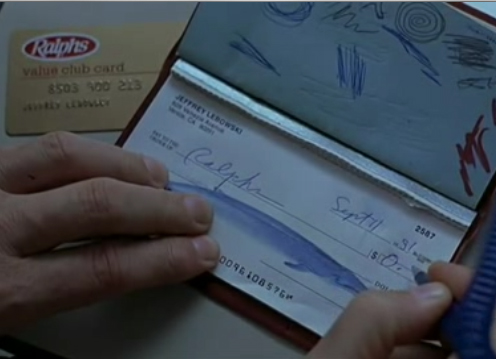
I don’t know precisely why The Big Lebowski has always struck me as the most profound statement upon the events of September 11th, 2001 -intentional or not. This is not to suggest that Bush senior’s stilted declaration that “This aggression will not stand” or the bizarre coincidence that the Dude dates his check for 0.69 cents Sept. 11, 1991 (precisely one decade prior) marks some occult foreshadowing. Rather, more importantly, this scene represents a moment that I lived through (in Los Angeles no less) marking that strange passage of time that movies always do for me. Yet, unlike so many other movies, this movie (well, actually, this scene) has been branded on my mind whenever I think about the even more recent history of New York City during September 11th -and the ongoing political maneuvering for geo-political power that was this government’s feeble attempt towards national solace. Where are we as a culture? Are we capable of dealing with tragedy or loss? What are we doing in Iraq once again? And why, for god’s sakes, are our super markets so shiny while our foreign policy is so messy?

Lebowski Check

In Don DeLillo’s novel White Noise, Murray Jay Siskind points out that a supermarket “is sealed off, self-contained. It is timeless.” This moment in The Big Lebowski captures this vision, at least for me, of a nation that is endlessly self-referring and finds it almost impossible to position itself in the world in some meaningful relationship to others as well as its citizens. The writing is on the wall -mene, mene…

Posted in film, film noir, movies | Tagged , , , | 6 Comments

WordTube Security Update

Hacked If you are using the extremely powerful and flexible WordTube plugin for WordPress, consider updating to the latest version (1.44). bavatuesdays was hacked through a critical backdoor in the code of version 1.33 which caused a little bit of concern for the humble proprietor. That being said, I’d like to thank Alex Rabe for fixing this issue so quickly, kick myself for not knowing about this fix sooner, and praise Elliot Kendall from Brandeis University, who drew my attention to the fact that bavatuesdays was spawning hellfire in the form of malicious code.

Read more about the security update for WordTube here.

Posted in WordPress | Tagged | 4 Comments

Tales from the Teaching Crypt: American Film Genres syllabus from Summer 2000

Movie Poster for ShaftFrom another lifetime, here is class I taught at SUNY Old Westbury that was a total blast. A recent post on Film Noirs inspired me to start putting my old syllabi on bavawiki in order to begin archiving and making available some of the work I have done over the last ten years (has it been that long!). I’ll be blogging particular syllabus as I find them relevant, but one in particular that I couldn’t resist was an American Film Genres class I taught in the Summer of 2000. Primarily because it is so far out there. I have all sorts of deep seated issues with adjuncting at a University that I may get into in more detail in later posts, but one of the few benefits (and it is a huge one in my opinion) is the ability to experiment with subject matter, approaches, and arguments for a class you are teaching (with the understanding that every syllabus is in fact an argument). This particular class used the text Refiguring American Film Genres to approach the ways in which genres are much dynamically formed, re-shaped, and re-imagined over time. Below is the course description:

This course will examine a number of films through the classification tool of genre. Genre, in its traditional sense, designates a kind or type of film that can easily be delimited with such common labels as melodrama, horror, science fiction, musical, romance, etc. This understanding of the term genre immediately exemplifies its usefulness for categorizing films into specific groups, potentially satisfying particular viewer’s expectations. Such overarching film genres, such as those listed above, are often thought in terms of static, unchanging conventional forms that continually apply a particular formula for a familiar result. Such an understanding of film genres does little to suggest how and why these groups are formed, and what might account for a particular genre’s success in a particular historical moment. This class will look at four relatively distinct genres of American film (The World War II film, Film Noir, Blaxploitation, and Horror) in order to understand how film genres come about. This exploration will hopefully lead to questions about the role of genre films in marketing, selling, sustaining, and reinvigorating particular “kinds or types” of films. Genre is first and foremost a classifying structure, yet we will try and examine how this seemingly static structure depends upon rupture and deviation in order to keep film genres in circulation for any prolonged period of time. Finally, we will attempt to suggest how newer cycles of films (Slasher films, B-movies, Cult films, the Woman’s film, etc.) might use a different criteria to decide what constitutes a genre film, hence casting doubt on any entirely stable, universal definition of generic formations.

The class obviously is framing an argument, one which I believe opens up alternative ways to approach how we read film as a series of relations that tell us as much about the ways in which we categorize and understand films as it does about a particular moment in which these relations emerge. One quick anecdote in relationship to this particular class. Through week two the class was going pretty well, I had them on the ropes with the WWII and Noir films, once we got to Blaxploitation, more specifically the opening scene of Sweet Sweetback’s Baadasssss Song, an uproarious protest in the class amongst a few students broke out. In particular, some older, retired folks who were auditing this class were visibly shaken by the scenes of a young black man being introduced to the world of sexuality so vividly. When we had our discussion they were pretty vocal about the explicit nature of the film, and when they spoke with Mikhail Gershovich, a friend, benefactor (he got me this formative gig), and fellow professor at Old Westbury, one student remarked to him the following paraphrase: “The class was going well until that ‘Sweetback Sweet Ass’ came on the screen.” Experimentation has its casualties! The class was a lot of fun and generative (or at least I think so given the papers I received) for many of the students primarily because of these risks. How often are students asked to thinking critically about all the movies that are thrown their way on a regular basis?

Section 1: World War II Combat Films

Image of Wake Island Movie PosterRequired outside viewing: Saving Private Ryan (1998) and Thin Red Line (1998). Recommended outside viewing: The Big Red One (1980), Guadacanal Diary (1943), The Story of GI Joe (1944), 1941 (1979), and Why We Fight (Documentary Series 1942-1945), Triumph of the Will (1935), and The Olympia (1938).

* Tue, May 30th – Class Introduction (read Rick Altaman’s “Reusable Packaging” in RAFG for 5/31)
* Wed, May 31st — Wake Island
* Thu, June 1st – Bataan (read Thomas Schatz “World War II and The Hollywood War Film” in RAFG for 6/5)
* Mon, June 5th – They Were Expendable
* Tue, June 6th – Paths of Glory (I know this is a WWI movie, but I had to work it in!)
* Wed, June 7th – Class discussion AV

Section 2: Film Noir

Mildred Pierce Movie PosterRequired outside viewing: Out of the Past, Chinatown, Body Double, Blue Velvet, and Devil in a Blue Dress. Recommended Outside Viewing: The Third Man, Touch of Evil, The Lady from Shanghai, Pick-up on South Street, Double Indemnity, Key Largo, Casablanca and One False Move.
* Thu, June 8th – Shadow of a Doubt (read Vivian Sobchack’s “Lounge Time: Post-war Crises and the Chronotope of Film Noir” in RAFG)
* Mon, June 11th – The Killers
* Tue, June 12th – Mildred Pierce
* Wed, June 13th –The Postman Always Rings Twice

Section 3: Blaxploitation

Dolemite (the movie poster)Required Outside Viewing: Shaft (2000) [if possible], Dirty Harry, I’m Gonna Git You Sucka, Foxy Brown, and Jackie Browne. Recommended Outside Viewing: Foxy Brown, Black Caesar, Shaft in Africa, Car Wash, Buck and the Preacher, Cleopatra Jones, Superfly, Shaft’s Big Score, Coffy, Friday Foster, and Slaughter.

* Mon, June 18th – Sweet Sweetback’s Badassss Song (read George Lipsitz’s “Genre Anxiety and Racial Representation” in RAFG)
* Tue, June 19th – Blacula
* Wed, June 20th – Shaft (1971 version)
* Thu, June 21st – Dolemite

Section 4: Recent Horror Cycles

Nightmare on Elm StreetRequired Outside Viewing: Night of the Living Dead, Dawn of the Dead, Texas Chainsaw Massacre, and Stepfather. Recommended Outside Viewing: Psycho, Dressed to Kill, Friday the 13th, The Birds, Day of the Dead, Creepshow, The Exorcist, Child’s Play, Silence of the Lambs, and Henry: Portrait of a Serial Killer, Wes Craven’s New Nightmare, and Scream (I&II).

* Mon, June 25th — Martin (Read David J. Russell’s “Monster Roundup” in RAFG for 6/26) ML
* Tue, June 26th – Halloween
* Wed, June 27th – Evil Dead 2
* Thu, June 28th – Nightmare on Elm Street
Posted in film, film noir, films, movies | Tagged , , , , , , , | 10 Comments

Star Wars Anti-Smoking PSA from 1982

Here is a healthy counter to a previous set of posts here and here.

[youtube]YTE–6zTs2E[/youtube]

Posted in star wars, video, YouTube | Tagged , | 1 Comment

Movie List #2: Film Noir please…

I just finished an IM chat with Shannon, the Web 2.0 poster student who has been nothing short of mind blowing as I trace the connections she is making with these tools in all sorts of mediums, realms, and spaces. As much as I need to go to bed, I will not until I finish this post. It is part of a larger thought I have been having, but I am afraid I’ll only scratch the surface in this post.

Movies, films, motion pictures, etc., are my first and true love. As I said to Shannon, I’m a junky for many things, but nothing makes me feel as engaged, excited, and alive as a great movie does -except for perhaps sharing my own passion for these fleeting moments of visual poetry with others. I’ve been lucky these days, folks have been willing to talk with me about movies, and some are even daring enough to take my suggestions to heart and go out and watch a few. So, with that in mind, here is a list of some of the movies in the Film Noir genre I have been recommending lately that, in turn, others have generously recommended to me:

The Killers Movie 1946The Killers (of course the 1946 version with Burt Lancaster and Ava Gardner directed by Richard Siodmak): If you haven’t seen it then you haven’t really walked through the darkest scene in noir that seems to have inspired much of David Lynch’s latest work. The first fifteen minutes of this film is based on Hemingway’s short story of the same name, and the film goes on to imagine a noirish back story for this magical opening. I can’t say enough good things about this film. Maybe not the best noir, but certainly the most near and dear to my heart.

1946 The Killers trailer
[youtube]1R7tzpi9aCc[/youtube]

Out of the Past Out of the Past (1947): Wow! Jacques Tourneur turns in arguably the most precise and powerful film of the Noir genre (save Double Indemnity, of course -can I assume you’ve seen this?). This is Robert Mitchum’s first leading role, and he’s a tour de force. Jane Greer makes you wonder why you don’t hear more about here more often, and Kirk Douglas is one of the most subtly memorable villains of the Noir genre. The story line is next to impossible to follow at times, and the ways the characters travel through spaces and countries in this film (Mexico is essential to the internal logic of this film) is extremely intriguing for many reasons and on many levels. Suffice it to say, that Out of the Past frames the idea of history as haunting, secretive and an extremely violent force that cannot be submerged, but perhaps more broadly as a space for engaging the horror of a world that has just barely survived the most brutal and savage acts of an epoch. Is the retreat to mass consumption, reinforced gender roles, and national isolation a collective strategy for displacing realizations this horrifying? (Robert Albrich’s Kiss Me Deadly is a wonderful companion piece to this film, by the way.) Like most great Noir, Out of the Past is an intense look at a national imagination in confounded convulsions.

Double Indemnity (1944) trailer
[youtube]S3wjJcuGsVE[/youtube]

Criss Cross Film 1949Criss Cross (1949): Once again this is starring Burt Lancaster and directed by Richard Siodmak and was remade by Steven Soderbergh in his 1995 film Underneath. Yvonne DeCarlo is spellbinding in this film, and it deals with nothing less than an armored car heist -hasn’t been done successfully in a long time! The scenes I always return to in this film, and Film Noir more generally, are the bar and club scenes. The seedy, shady, alive spaces that define the post-war moment for the American imagination. Not only the a staged threat of the new woman’s power and prowess, but the more general concentration upon the darker side of the dream. Criss Cross has one of the most compelling dance scenes in film (which features the film debut of none other than Tony Curtis) I have ever seen. The music, the passion, the energy, the space, the people, the whole thing is just beautiful cinema at its best. Film Noir may get better than this, but I haven’t witnessed a scene that has etched itself on my brain quite like that one.

Night of the Hunter 1955 movieNight of the Hunter (1955): What can I say? It may not get any better than this. It may not even be a Film Noir! Robert Mitchum (again) is nothing short of awesome -keep in mind that I am using that word in its original, ineffable sense. The evil preacher has never come of the screen like this before or since. This is acting at its finest, scripting at its tightest (thank you James Agee), and a moment where Charles Laughton (an actor turned director) was afforded at least this one opportunity to put a masterpiece together. Unfortunately, the film was lost on the audiences of its day and he never directed another. In our current moment when the movie-going public has to suffer through just about any two-bit actor’s whimsy that they can and should (and all too often do) direct a film, such a feat on the part of Laughton seems all the more remarkable. I mean come on, what is it with these actors today? When did being spoon fed their mediocre lines and techniques for three or four “hit” movies in a row become the rite of passage to conduct the orchestra that is a full-fledged film crew? Come on, stop already! You’re killing any semblance of an art form that has been leftover from the scraps of nonsense that they have been passing over as a film industry these days (this is both a national and global critique mind you). It is nice to return to a film where the actor was not only legendary, but his only foray into directing proved far more memorable than any one of his acting performances. If you haven’t seen this film, then beat yourself up on the way to the nearest movie store and rent, buy, steal borrow it, do whatever you have to -but this film is far too great to be laying around in some queue for two or three days. It needs to be watched now!

The Night of the Hunter trailer
[youtube]KIZalK35L2w[/youtube]

Scene from Night of the Hunter in which “the Preacher” sings. Watch it!
[youtube]-N9LnkKQfuc[/youtube]

Next up from me, a version of the Billy Wilder recommendation list I gave to Shannon earlier -with a detailed examination of why there have been few, if any writers, in the history of 20th century film who have matched his sword-like pen.

But now for you, what other Film Noirs have I glaringly left out that someone taking a crash course in Noir needs to see? And more importantly, why?

Please note that I’m taking a page out of tattered Matt’s inspired calls for film input from his friends on the inimitable Tattered Coat.

Posted in films, movies | Tagged , | 9 Comments

I Am Legend Trailer

I have written about Richard Matheson’s amazing long story I am Legend at length on this blog before, referring to several film adaptations of this masterpiece (read it here). Well here is a trailer from the latest film adaptation starring Will Smith:

[youtube]hX773fMkS90[/youtube]

It may not be The Last Man on Earth or Omega Man (in fact the trailer suggests it may be terrible), but I love the fact that they have relocated the story from LA to NYC and, terrible or not, I have to see it!

Posted in movies, YouTube | 3 Comments