Monogamous Book Club, Episode 3: The Iron Heel

A couple of weeks ago Paul Bond reached out asking if I wanted to discuss Jack London’s 1908 dystopian novel The Iron Heel. I had recently read White Fang with my kids, so I was definitely game. I had heard the novel described as a kind of pedantic socialist manifesto thinly masked as a romance, and it pretty much lives up to that description. Paul already did a good job of discussing the limits of the novel, so I’ll pull a London from chapters 3 and 7 of The Iron Heel and basically lift and copy what he wrote here 🙂

Which brings up the question: Is it a good book? It feels like an odd question to ask, since we both invested time in reading it, thinking about it, and discussing it. It makes for interesting discussion, as a product of its time, as a vision (sometimes eerily accurate) of the near future, and for how it is relevant to today’s world. It is also tedious, sometimes pedantic, often unreflective, and lacking in nuance or subtlety. I wondered if London might be making a comment on the vacuousness of the newly-minted True Believer, but apparently he was one himself. As Jim pointed out, the most compelling parts of the story, the Red Virgin and the terrorist organizations, are only mentioned in passing, when they could be worth a novel in themselves.

In fact, the novel’s most interesting character is Anna Roylston, or “The Red Virgin,” but she is only mentioned in passing a few times. I would have loved an entire novel about her life. She is basically an assassin for the Socialists that targets the oligarchs and their henchmen, here is a bit about her:

Despite continual and almost inconceivable hazards, Anna Roylston lived to the royal age of ninety-one. As the Pococks defied the executioners of the Fighting Groups, so she defied the executioners of the Iron Heel. She bore a charmed life and prospered amid dangers and alarms. She herself was an executioner for the Fighting Groups, and, known as the Red Virgin, she became one of the inspired figures of the Revolution. When she was an old woman of sixty-nine she shot “Bloody” Halcliffe down in the midst of his armed escort and got away unscathed. In the end she died peaceably of old age in a secret refuge of the revolutionists in the Ozark mountains.

And she is mentioned about 3 or 4 other times. Rather than listening to Ernest Everhard (how about that name?!) go on and on about socialism at dinner party after dinner party, or lecture after lecture, I would much rather follow a character like Anna Roylston through the corridors of the Socialist underground. In fact, here character made me think about the character and plot-line of Wolfenstein II: The New Colossus. In fact, the 15-20 pages of description in Chapter XXIV when the Socialist uprising actually happens (known as The Chicago Commune) may be the best part of the book. The intense description of the abysmal horde rising from the beneath the city like the Mole people in Escape from New York was intense. Paul captured a great audio clip of that moment:

And the ways in which the people of the abyss were brutally mowed down by the mercenary army funded by the plutocracy was the moment the book lives up to its classification as dystopian. But again, it was the passing details that I found most interesting. For example, in the final chapter in the wake of the total failure of the socialist uprising in Chicago, various terrorists organizations emerge in response. The description of these groups seems like something out of The Warriors:

The annals of this short-lived era of despair make bloody reading. Revenge was the ruling motive, and the members of the terroristic organizations were careless of their own lives and hopeless about the future. The Danites, taking their name from the avenging angels of the Mormon mythology, sprang up in the mountains of the Great West and spread over the Pacific Coast from Panama to Alaska. The Valkyries were women. They were the most terrible of all. No woman was eligible for membership who had not lost near relatives at the hands of the Oligarchy. They were guilty of torturing their prisoners to death. Another famous organization of women was The Widows of War. A companion organization to the Valkyries was the Berserkers. These men placed no value whatever upon their own lives, and it was they who totally destroyed the great Mercenary city of Bellona along with its population of over a hundred thousand souls. The Bedlamites and the Helldamites were twin slave organizations, while a new religious sect that did not flourish long was called The Wrath of God. Among others, to show the whimsicality of their deadly seriousness, may be mentioned the following: The Bleeding Hearts, Sons of the Morning, the Morning Stars, The Flamingoes, The Triple Triangles, The Three Bars, The Rubonics, The Vindicators, The Comanches, and the Erebusites.

This whole bit on the terrorist organizations seems far more relevant today than anything resembling an international Socialist movement—which may be a good sign the plutocrats are winning. This text is a footnote in the novel that is delivered from 700 years in the future. And for me these messages from the future were often the most compelling parts. The novel is a framed narrative in which we are reading the manuscript of Avis Everhard which was discovered 700 years after she had written it, so basically the 26th century. The footnotes pepper the texts, and makes for a dialogue between realities that are framed inline as footnotes. It was off-putting at first, but I came to appreciate how London was experimenting with this back and forth in an attempt to denature the reader from their present reality, not to mention couching political and personal jabs as post facto realities. That said, I would rather  read a novel about the Valkeries or the Widows of War and their counterparts the Beserkers—complex human stories based on the tragedy of living beneath the Iron Heel—the book delivers very little of that in the end. 

One more thing worth noting about the text I used. Given I’m still attached to paper, I ordered my version through Amazon and I have to say I got a pretty bad edition. The cover is pictured to the right, and as you can see it’s graphics are playing on the current political atmosphere which I stupidly fell for. When I got the book there was no mention of an editor or anyone behind the edition, and what’s more I noticed immediately the spacing was kinda crazy. Worse, some of those footnotes from the future were missing. I confirmed this when I compared the final chapter to the version of the novel on Gutenberg,  my version completely left out the final footnote telling the reader the novel ends abruptly:

*This is the end of the Everhard Manuscript. It breaks off abruptly in the middle of a sentence. She must have received warning of the coming of the Mercenaries, for she had time safely to hide the Manuscript before she fled or was captured. It is to be regretted that she did not live to complete her narrative, for then, undoubtedly, would have been cleared away the mystery that has shrouded for seven centuries the execution of Ernest Everhard.

Kind of a major omission in my mind. Given the novel is in the public domain anyone can make a copy, and I admittedly bought this one for the cover, not the edition. I regret it. I would recommend against this edition given it is pretty much a hackjob to make a quick buck—and what a book to do that with! 🙂

Posted in digital storytelling, ds106radio, Monogamous Book Club | Tagged , , , , | 1 Comment

Reclaiming Jekyll (Two Years Later)

Two years ago Tim wrote a great post detailing how you can get Jekyll up and running in shared hosting on Reclaim Hosting.* I’m late to this party, obviously, but playing with Grav recently led me back into Github thanks to the Github Sync plugin. I had explored Jekyll back in 2014 briefly (almost 4 years ago now, really?!), but I forgot most everything. I wanted to see if my Grav repository in Github (synced with my Grav install on Reclaim) would allow me to run the Grav files through Github pages (which is powered by Jekyll). Is this all crystal clear now? Good.

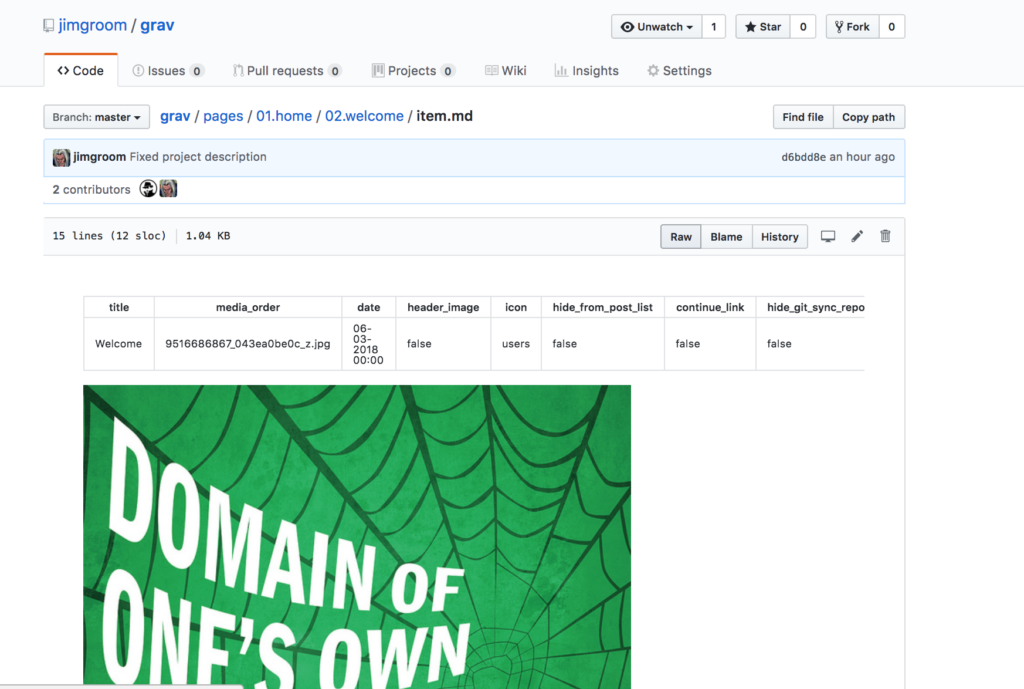
Turns out I was on a fool’s errand. Grav is a flat-file CMS, but it needs PHP to dynamically those pages as a site—which I should have understood. So it will not run on Github Pages.  Grav Sync is first and foremost for forking and collaborating on specific Grav instances (which I did understand), but I was trying to understand if those files could be seamlessly archived/translated into Jekyll given it was a repository, but I see my foolish ways now. Thank you, Tim 🙂 So while you can bring up individual pages from my Grav repository on Github, like the Welcome page:

But the site functionality of my Grav instance could not be reproduced. Lesson learned. But this did peak my interest in synching my locally installed Jekyll on Reclaim Hosting with my Jekyll on Github. So, I asked Tim and he suggested the following:

I’m not sure the exact steps but it would involve setting up the repo in Github and cloning it to your hosting account and > then you could use git commands like git pull to grab the latest from git (even setup a cron every 10-15 min to do that piece).

Turns out that was the exact approach—I wish I was that good. I took the Github repo I have at jimgroom.github.io (which maps to jimgroom.me) and clone it into the jekyll folder on my Reclaim Hosting account. I made sure to run jekyll build in the jimgroom.github.io folder so that it would build the site files in the _site directory. After that I pointed the DNS of the subdomain jekyll.murderinc.biz to the new directory, i.e. jekyll/jimgroom.github.io/_site and the same site at jimgroom.me on Github is cloned and also resolving through my shared hosting account at jekyll.murderinc.biz. The two things needed to sync changes made on Github is running the following commands in the jekyll/jimgroom.github.io folder on my shared hosting (making sure you are logged into command line through your virtual Ruby environment):

git pull

and then

jekyll build

Pull in any changes and then rebuilds the site so those changes are published to _site. None of this is new by any means, I am just playing catch up. Adam Croom went down this road two years ago in order to stick a fork in the LMS using Github, and I can say from firsthand experience that wrapping your head around Github can be intense, but that’s no excuse for an ed-tech to give up:

“An Ed-Tech spends her life getting into tense situations!”
-A Github Repo Man


*This setup requires CloudLinux, which we have installed on all our shared hosting servers. 

Posted in reclaim | Tagged , , , | 3 Comments

Reclaim Video Progress

Since February progress on Reclaim Video has been moving at light speed. Things are really starting to come along, and the idea we’ve been throwing around for a year now is quickly becoming a reality. Here are a few of the accomplishments since mid-February:

Lauren secured some period appropriate posters for the Reclaim Video walls.

From the swag department:

Reclaim Video Sticker Template

The actual stickers

Reclaim Video T-shirts

But lest you think we’re all swag and no swarm, there has also been real progress on the storefront:

Tim has been building custom shelves

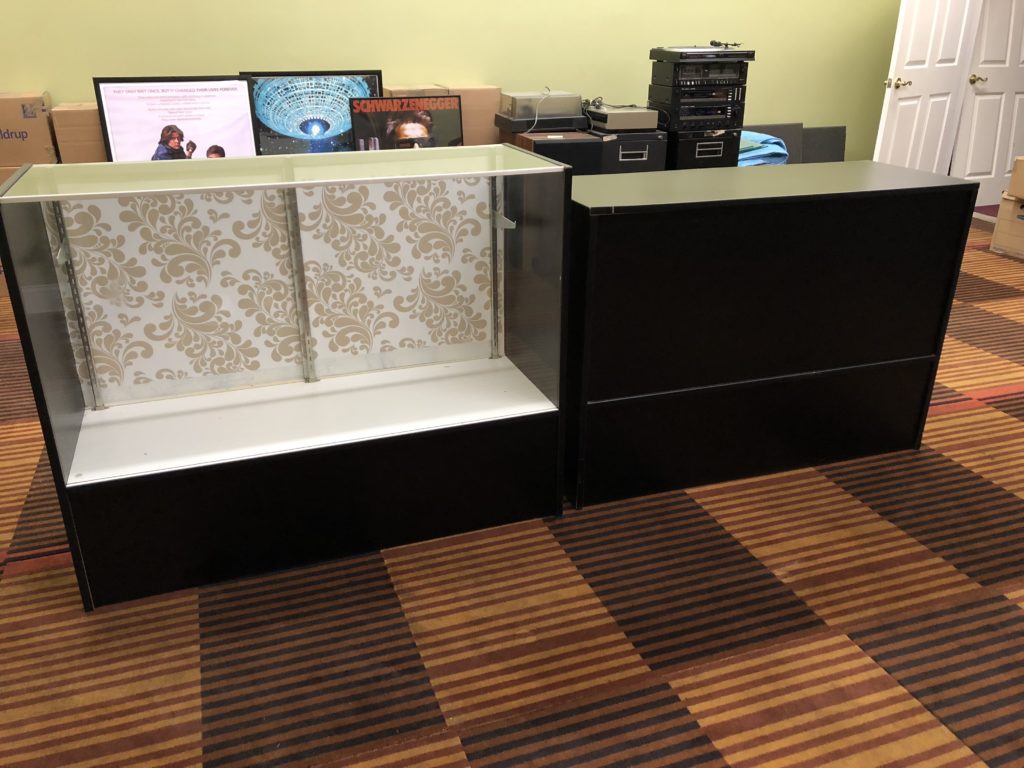
Yesterday Tim and Lauren secured the showcase and desk thanks to Craig’s List

And this morning Meredith shared this gem!

The Reclaim Video Storefront sign!

Beyond that, we are expecting the carpet today, which will be installed next week. What’s more, we’ve also been in discussions with the great Michael Branson Smith about the website. So, let it be know, Reclaim Video is happening!

Posted in reclaim, Reclaim Video | Tagged | 6 Comments

A Ride on the Grav-y Train

This week I am trying to prepare some resources for our second workshop for folks running a Domain of One’s Own on their campus (i.e., Workshop of One’s Own).  We had a great response the second time around, and we’re continuing to fine-tune the offerings, to some large degree based on the workshop Lauren and I did at Colgate last Fall. One of the big changes is dialing back a bit of the sysadmin focus which took up much of the two days the first time around. We will be focusing on the technical elements of running and supporting Domain of One’s Own for much of Day 1, but Day 2 will be dedicated towards approaches to Domains with faculty and student s as well as showcasing applications like Omeka, Grav, and Scalar (in addition to the rock all our work is built upon: WordPress). What’s more, we are bringing in some Stray Dog from Strawberry, Arizona to talk SPLOTs with Lauren. It will be interesting to see how things go with the new approach, which seems a bit more balanced between managing the system and promoting the options across campus.
As part of this new approach to the workshop I volunteered to do a quick session to highlight the open source, flat-file content management system Grav. It’s one of the applications we feature through Domain of One’s Own, and I have been closely following Paul Hibbitts tireless work to promote Grav in higher ed for some time now—he is a wonderful ambassador for the app. I can deeply relate to his work around Grav given I have an intimate understanding of what it means to try and convince faculty to adopt a new tools for teaching and learning.

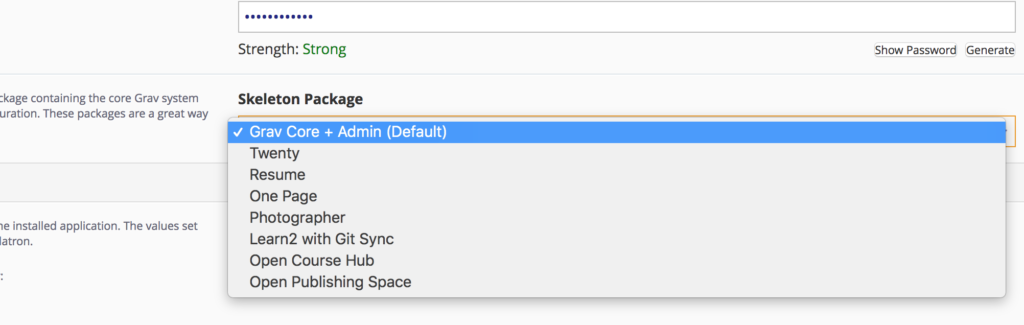
So, all this to say I wanted to finally dig into Grav so that I could actually talk about it intelligently. I decided to install a Grav as a package, this is something Paul worked with Tim Owens to make available through Reclaim Hosting. So, rather than just a vanilla Grav install, you can choose from several packages of Grav, each of which comes with a pre-defined theme, plugins, pages, etc. 

Skeleton Packages for Grav

I decided to install the Open Course Hub, which is a packagePaul developed. Here is how he explains it:

Grav Open Course Hub with Git Sync is designed to give tech-savvy instructors an open, collaborative and flexible platform that they can partner with their current Learning Management System (LMS).

One or more Open Course Hub pages can also be seamlessly embedded into another system (i.e. LMS) with the ‘chromeless’ feature. For example, view a Open Course Hub site and then view the same open and collaborative content embedded within a Canvas LMS site.

A couple of things about this description are interesting. First, Grav is definitely for faculty who are pretty familiar with markdown and want to start playing with something a bit more experimental. What I think is pretty cool about Grav is the fact that it provides an  platform to start wrapping one’s head around technologies like Git via Github. It provides a fairly straightforward framework for creating pages and inserting media, and the Git Sync plugin wizard Paul setup for the Open Course Hub makes getting your Grav site into a Github repository quite easy. I dig that, and if you did want others to fork parts of your course (whether weekly assignments, syllabus, etc.) you immediately have Github as a platform for accomplishing this. I am going to see if I can get the Grav site I created to work as a Jekyl site on Github, and if it can there is a pretty good argument there for archiving and exporting—though all of this would require someone who wants to get their hands dirty a bit.

The other thing that I’m interested in is the possibility of seamlessly embedding a Grav site into an LMS. The example he cites is this Simon Fraser University course. I need to get a clearer sense of how this is working—but the idea of embedding a course you created on the open web seamlessly into an LMS might have some appeal. The Chromeless idea is interesting as well, it’s an inactive project from the now defunct MozillaLabs that was trying to re-imagine the web browser interface as a simple HTML, CSS, Javascript app:

Instead [of] building a whole new platform, we suggest that the web itself should be the platform. That a developer could design the browser using standard web technologies combined with a minimal set of new APIs to interact with the underlying operating system and control the application’s user interface.

It seems to be related to the idea of creating headless sites and increasingly decoupling data from architecture. In this vein, Chromeless is a headless browser, only dependent on the basic web standards and “a new set of APIs.”  The idea of headless is everywhere I look now, Bryan Ollendyke’s blog post for EDUCAUSE talks about the headless authoring experience (HAX) he is working on with his ELMS Project.* I’m still afraid to ask if this is all built on top of Drupal though 🙂

Anyway, the idea that Paul is pointing to with Grav that is most appealing to me is that it can provide a means for sharing content both inside and outside the LMS. How seamless that is still remains a question. As for outside the LMS, Github is a fairly steep conceptual and technical learning curve for many, so that would not qualify. As for embedding from Grav to Canvas, I guess that is something I need to learn more about. 

I’ll blog more about Grav here shortly as I work on a site in Grav for the workshop, but I really appreciate the opportunity to play around in something other than WordPress—as much as I love it. It puts me back in the position of starting from scratch with a technology and trying to figure out how the hell it works and pushes up against many of the frustrations people I support have with this stuff. It helps me not only explain it, but extend a bit of empathy with those who might have similar experiences with technologies that I take for granted. 


*Bryan’s blog post is the first concrete example of the NGDLE I’ve actually read through EDUCAUSE. Until now it was increasingly seeming the NGDLE was little more than vaporware despite all the ink shed in its promotion.


Posted in Workshop of One's Own | Tagged , | 4 Comments

Marching through a Photo-A-Day

We’re into March now and I just did a catch-up for the 2018/365 group on Flickr. I’m pretty happy with the first two months of photos, but even more so with the impetus to keep on top of my Flickr archive so that things get made public, titled, and even shared. It’s been worth it for that alone. As for the photos, 80s media, Americana, and Trentino/Alto-Adige remain my muses. I got a few shots I am pretty happy with, and all-in-all this was just what the doctor ordered to provide a very loose structure to my growing photo addiction 🙂

2018/365/032: My Alien Mouth

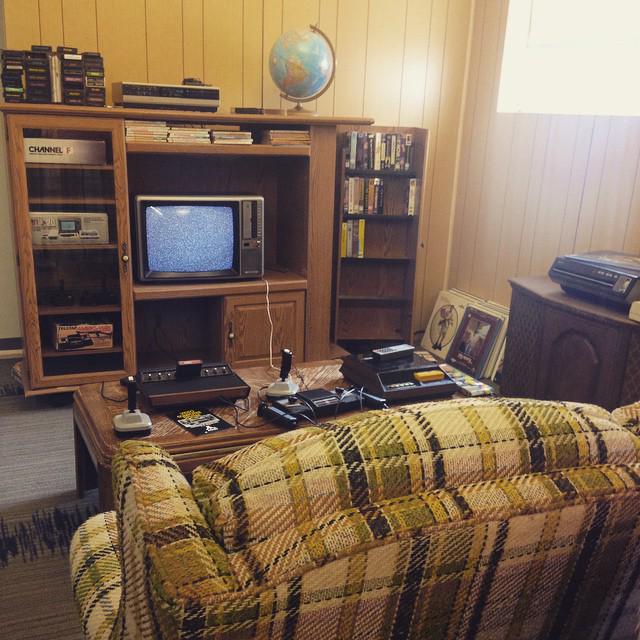
2018/365/035: Atari 2600 at CoWork

2018/365/038: “You Wouldn’t Download a Car...”

2018/365/041: Baby Jim’s Snack Bar

2018/365/045: Bishop of Battle

2018/365/046: Color Column

2018/365/049: Dead Zone

Mountain Boy

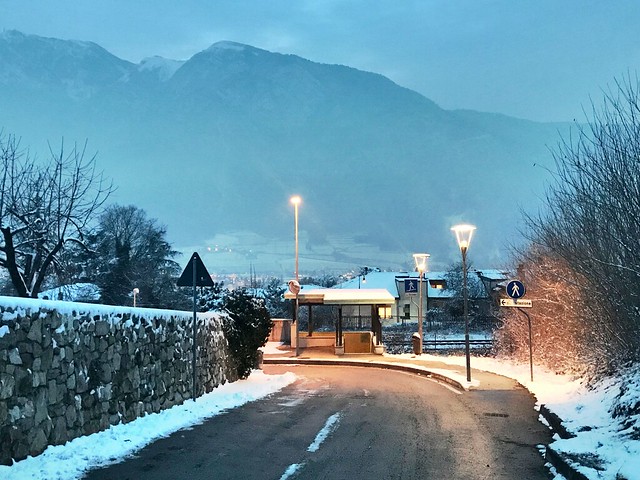
2018/365/055: Scenic Rest Stop

2018/365/060: A Snowy Symmetry

Evening Snow

2018/365/061: 3 Amigos

Posted in 2018/386, digital storytelling, Flickr, fun | Tagged , | Leave a comment

Multi Networks

Recently I’ve written about undoing and archiving the WordPress Multi Network setup on UMW Blogs I created eons ago to run various Faculty Academy sites, this post will be the opposite. I had the occasion this morning to revisit how to setup Multi Networks on WordPress Multisite (WPMS), and the process has gotten a bit easier for sure. I used the WP Multi Network plugin, and while it has not been updated for two years it still worked beautifully on WP version 4.9.4.

WP Multi Network

I made sure the multisite feature was enable for the WordPress instance I was working on using this guide. I am working with wildcard subdomains, so that was my network setup and in order for those to work I had to create a wildcard subdomain

*.mydomain.com

and pointed it at the directory where I have the WPMS installed. In my case the /home/public_html folder. After that was all setup, I added and network enabled the WP Multi Network plugin above. Once this is done, you go to the WPMS Network Admin page and setup your additional network. But before I do, I need to make sure my new network is all set. If you are running it off a new domain, like myotherdomain.com, then you would need to add that as an addon domain in cPanel:

Once that is done, you would once again need to make sure the wildcard subdomain is setup and pointed to the directory where the main WPMS lives (for me /home/public_html):

Once that is done, the last bit before we can create the new network is to go into the wp-config file and comment out the DOMAIN_CURRENT_SITE line.

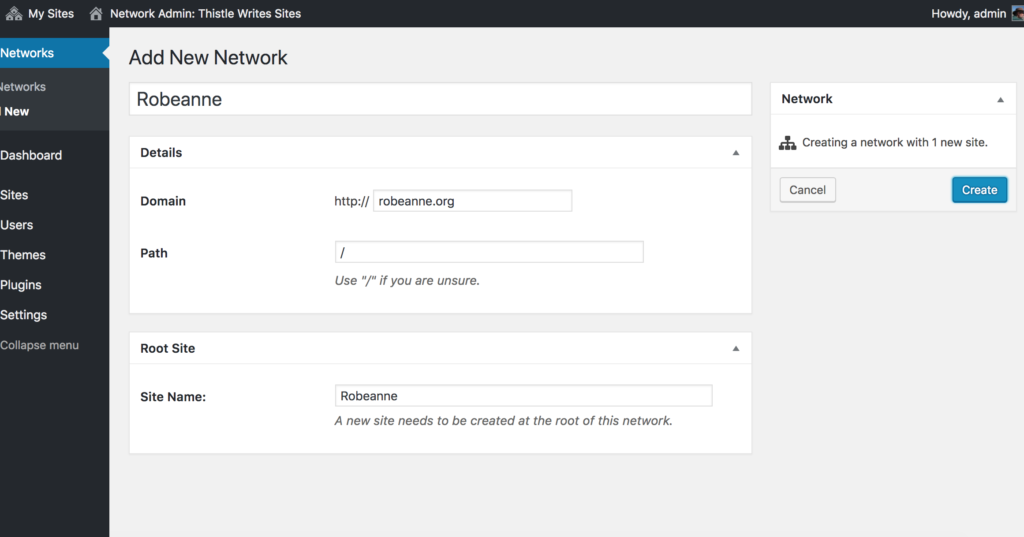
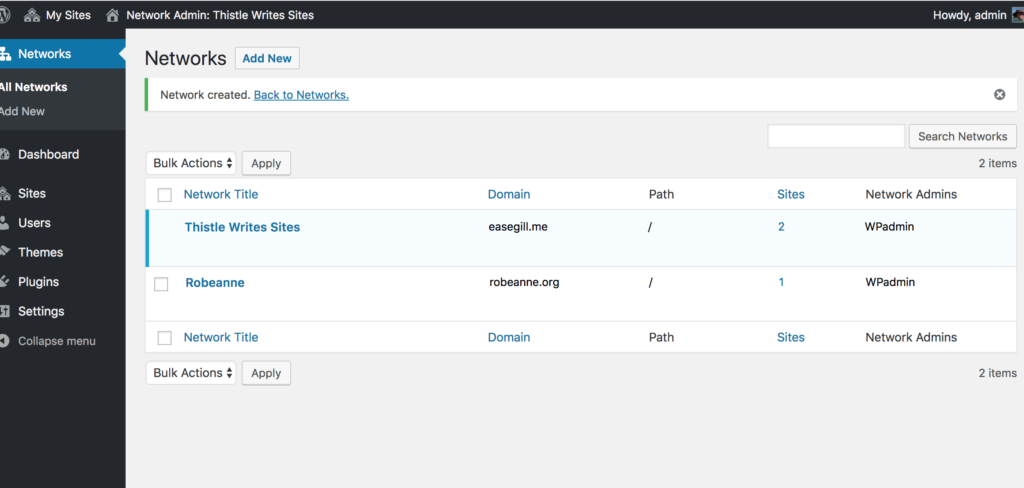
After that, you can head to the WPMS Network Admin dashboard and add a new network, which is as simple as adding the domain name and naming the site:

Once this is done, you will have not only various site, but multiple networks that can create unlimited sites as subdomains, such as reclaim.mydomain.com and hosting.myotherdomain.com. 

The plugin make it easy, but one issue to keep in mind is that you have to keep the plugin network enabled, otherwise the file structure for the additional network created gets wonky. The plugin corrects that as of now, but this is one potential issue to keep in mind.

Posted in plugins, WordPress, wpmu | Tagged , , | Leave a comment

We Want Your VHS!

If you have some old VHS hanging around the house, yet have gotten rid of your VCR long ago—it might be high time to let Reclaim Video take them off your hands. Rather than letting them sit around collecting dust or going to the Goodwill or even worse the dump—consider sending them to the following address:

Reclaim Video
2324 Plank Road
Fredericksburg, VA 22401

Keep in mind these tapes won’t just sit around or become part of a personal collection/archive, but rather will be available for others to enjoy. And to sweeten the pot, anyone who donates 25 or more VHS tapes gets free membership (including a laminated card) and a bitchin’ Reclaim Video t-shirt. 


If you already got rid of your VHS collection, no problem, this still applies if you send along some of your favorite 80s movies that you purchase online to the above address. We owe a great debt to Tim Clarke who went out of his way to send us the first donation to date: the 1983 Canadian classic Strange Brew

2018/365/044: Take off!

We want to encourage you to do the same, and once we get our act together your contribution will be registered on the hallowed virtual and physical walls of Reclaim Video.

Posted in Reclaim Video, ReclaimVideo | Tagged | 2 Comments

Coming Soon: Reclaim Video


when a business listing & front door decal make it official! ?#COMINGSOON #SPRING2018

A post shared by Reclaim Video ? (@reclaimvideo) on

The idea of running a video rental store has been bouncing around at Reclaim Hosting for over a year now. When we started renovating the CoWork space/Reclaim Headquarters over a year ago we realized we would soon have a vacant strip mall storefront at our disposal. I started floating the idea of a video rental store to Tim, but given he was knee-deep in actually designing and building CoWork with Lauren, those discussions were postponed. At this point it was not clear how it related to anything else we already do, namely run Reclaim Hosting and CoWork—it was just a fun idea.

Tim and Lauren in a recently completed CoWork

Tim and Lauren in a recently completed CoWork

Regardless of the fact, I was still toying with the idea throughout the Spring and Summer, and during my sojourn to Los Angeles last June I was bouncing the idea off my good friend Mikhail Gershovich, who being as much an 80s culture nerd as me was all Gung Ho—not the movie though*—which may have been a false sense of security. Feeling confident I broached the idea at a dinner with their friends, one being an Art History graduate student, who were quick to remind me that fetishizing the material culture of the past is not art, but rather myopic nostalgia. Which kinda killed my claim this would be something akin to an art installation, but reinforced the fact I was on the right track 🙂

People’s reaction to our building a 1980s video rental store was mixed to say the least. It was pretty much just a dream until November when the entire Reclaim Hosting team was on a company retreat in New York City. In many ways Reclaim Video lived apart from Reclaim Hosting as a kind of oddity, it was Tim who finally made the link between the two the made it all real. He noted we don’t do any advertising, and why don’t we use the Reclaim Video to anachronistically promote Reclaim Hosting. It is inline with our whole vision of web hosting as trailing-edge technology, and tries to put the long history of recent media revolutions in some perspective. It’s also an extension of the work that went into the UMW Living Room Console, which might have been one of the funnest things I was ever involved with. 

But more then anything, we all agreed it was time for us to have a little fun. We’ve been working hard the last few years, and the video store provides a welcome distraction. What’s more its pretty cheap and easy, we already have the space and VHS tapes and paraphernalia are still common enough that none of it is too expensive. So, in November Reclaim Video went from fantasy to impending reality, and we started planning in earnest.


..and so begins the renovation for the second half of CoWork! Stay tuned for @reclaimvideo!

A post shared by CoWork (@coworkfxbg) on

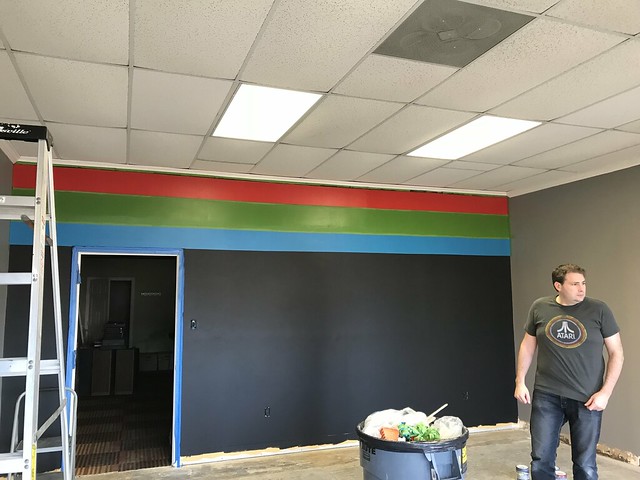
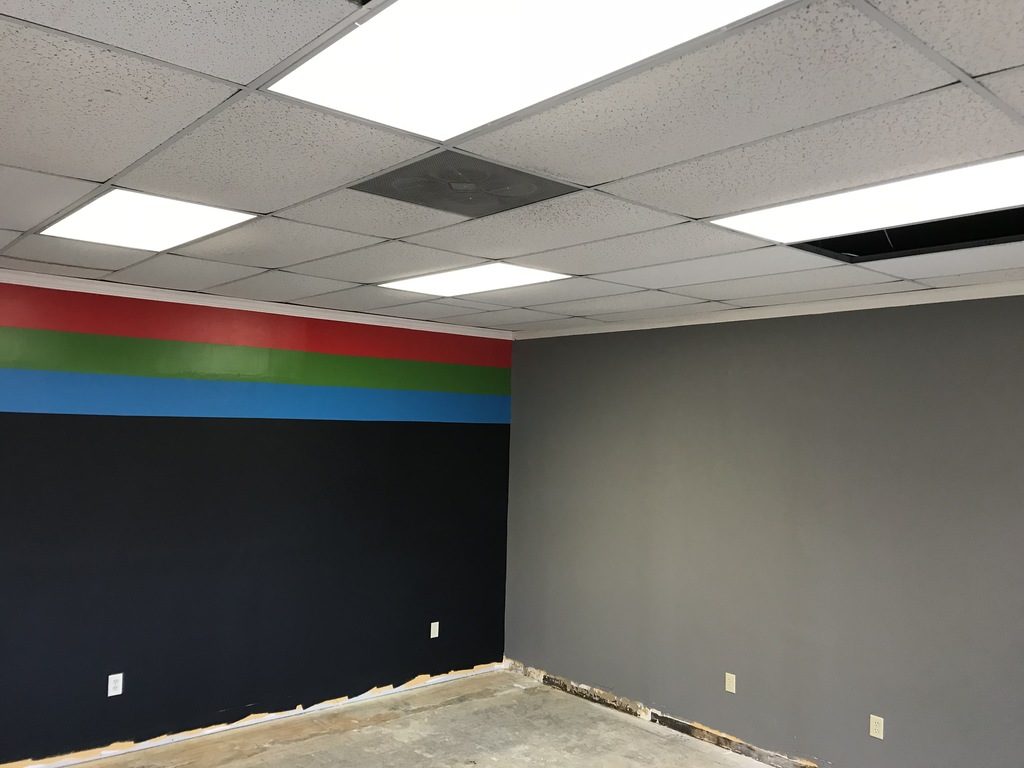
As already noted in two blog posts, the work on the space has begun. In fact, it is really coming along nicely.

These Colors Run

We’ve been working with Bryan Mathers to subtly rebrand Reclaim Hosting from record store to VHS store:

He’s a genius. But we wanted to work collectively on the Reclaim Video aesthetic. So while the Reclaim Hosting’s site will keep a consistent aesthetic with a nod to the expansion from record to video store, Reclaim Video as an aesthetic will be distinct. We wanted to keep it separate because this was part of the fun we wanted to reclaim 🙂 —and we started with a logo which I am pretty fired up about. The first we worked on was a long, horizontal visual for the storefront sign. We spent an hour or so in the CoWork conference room bouncing around ideas three weeks back, and it was a blast. We were playing with the Red Green Blue (RGB) chromatic that defined the VHS/VCR era, and we wanted to also nod to video games with the Sega-inspired font. 

From there we got a more compact/vertical icon for Reclaim Video that brings together the RGB color bar with the TV snow static. Masterful!

There’s more where that came from, but we’re gonna to have to save that for the Reclaim Video unveiling at #OER18. Oh yeah, that’s right, Reclaim Video, not Reclaim Hosting, is sponsoring OER18. The whole crew will be there in force, and we are very much looking forward to introducing those textbook wonks to the future of media!

That’s more a history of how we got to the brink of actually opening a VHS video rental store in 2018, what the store is actually going to do and how it will operate is still very much a work in progress. We want it to be equally accessible online as it is offline, and we are strongly considering renting old school gaming consoles and video games as well as the standard video fare such as VCRs, betamax players, VHS/Beta tapes, etc. We will also have a healthy laserdisc selection, as well as laserdisc players. The details of inventory are evolving, and we are going to make a real push here soon for donations as well.

Nightmares


We’re more than just video.

A post shared by Reclaim Video (@reclaimvideo) on

Red Dawn Laserdisc Triptych

Another idea Tim had that I think is awesome is creating actual memberships folks can get locally or online that will include a laminated Reclaim Hosting rental card, a t-shirt, free web hosting space with a movie review SPLOT, access to programming the in-store Reclaim Video TV remotely, and much, much more. The actual store will be an ongoing work in progress, and we’re planning to invite folks to help us think through how we make this space interactive and equally accessible remotely through the web as it would be locally in the storefront.

Animation Illustration GIF by octavioterol - Find & Share on GIPHY

Anyway, I think you get the idea, Reclaim Video is a way for us to try and have some fun. It’s really that simple. It’s indulgent, it’s vestigial, and it’s definitely nostalgic. All that said, if the experience of planning it is any indicator of how much joy it could result in, it’s gonna be worth every FBI warning we have to sit through. 


*Actually, the 1986 film Gung Ho about Japanese factory culture in the U.S. would  be an awesome VHS donation to Reclaim Video for anyone out their feeling both nostalgic and generous.

Posted in reclaim, Reclaim Video, ReclaimVideo | Tagged , | Leave a comment

The Idea Generator

Karlstad University

Nobody Puts baby in a Corner

A year ago I went to Karlstad University with Tom Woodward thanks to the kind invitation from the great Jörg Pareigis to run a workshop for a group of faculty running open courses. It was a fun workshop, we used ds106 as a model for an open course and quickly found ourselves encouraging faculty to consider how a tool like WordPress can be used to build the open course experience they imagine. This led to a group of faculty teaching a course on Idea Management for the Karlstad Business School. Here is a quick description of the course from its website:

This course is designed for professionals with an interest in idea management and is available to both for-credit (registered students) and non-credit participants (non-registered students). It features openly available, weekly, interactive video lectures from a variety of CTF researchers, other researchers as well as practitioners.

This course was run in conjunction with Karlstad’s Service Research Center, and the folks there were more than willing to explore what might be possible. In particular, professors Peter Magnusson, Lars Olsson, Johan Netz, and Alex Sukhov were keen on trying to design a tool wherein in ideas could be proposed and refined over time as part of an open course community. Sounds pretty ds106-y to me, but given I can’t build anything other  than animosity, the development of this tool was all on Tom. If it’s not already apparent through his regular documentation of his WordPress development at VCU over the past 4 years, Tom has become a seriously amazing ed-tech developer. He was already amongst the most imaginative, funny, and creative folks I’ve been lucky enough to work with in edtech, but he locked in the last four years and has the technical chops to make WordPress do his will—and that is good for all of us. I think his work on Anth101, to name just one thing that pops in my head, is nothing short of brilliant—so while I may be useless, I can pick a winner! 🙂

Tom in Sweden

Over the course of the two-day workshop the basics of the Idea Generator were born. Over the last year we have been working in fits and starts with Jörg, Johan, and Alex to actually build the tool, and just last week it went live for the second module of the course. It’s pretty cool, and very much in keeping with the SPLOT idea (or Tiny Targeted Tools) of small, easy to use tools (often built on top of WordPress) that accomplish a specific task for a course community. And ideally they can be abstracted out, as was the ds106 Assignment Bank, to have a broader appeal.

Anyway, the Idea Generator starts off as a form wherein folks submit their idea:

Simple enough, and as you might expect people can get feedback on their ideas and revise based on this feedback.

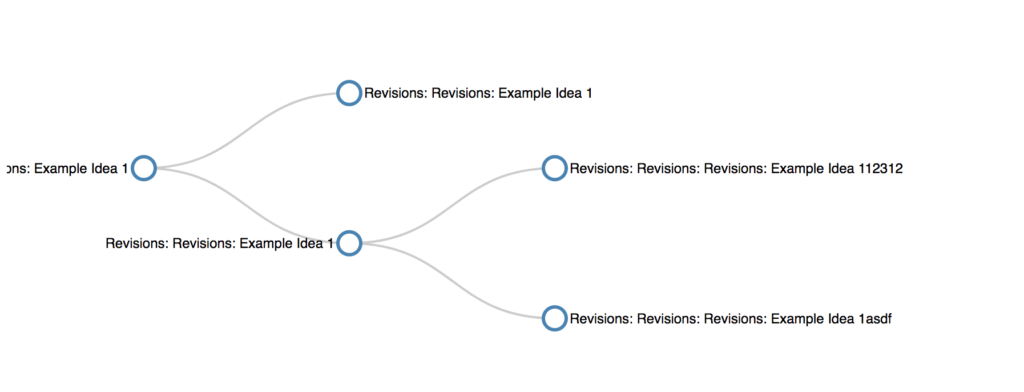
But where it starts to get cool is the tool will visually track changes and revisions of an idea over time:

Branching idea revisions based on feedback

And this starts to make good sense given that ideas discussed and cultivated as part of a communal feedback loop might get refined over time. I am really interested to see how the feedback and revisions loop goes. The ideas are just starting to be submitted, so the revisions will happen in the next few weeks, and I am excited to see how they branch out and change as a result of this tool.

Tom also did some custom development work to give everyone in the class a profile page, make posting to the blog seamless, making the aggregation of generated ideas simple, and generally making this WordPress site a robust, stand-alone resource site for this open course. It’s been fun to watch this become real, and it will be interesting to see how the tool is used, and whether or not it might make sense to abstract it as a SPLOT/plugin for others. An Idea Management course with fresh ideas for teaching, I can get behind that! Walk the walk….

Posted in Instructional Technology, open education, WordPress | Tagged , , , , | 2 Comments

Plan de Corones (Kronplatz)

2018/365/055: Scenic Rest Stop

This weekend the entire clan headed two hours north of Trento into the wilds of Alto-Adige. I’ve discussed Alto-Adige on this blog before, so I’ll spare you the geography/history lesson, suffice it to say it is a pretty gorgeous part of the world. The mountains there are breathtaking, and turns out the ski resort we chose, Plan de Corones, is about as scenic a spot as I have been to in the Italian Alps.  You are everywhere surrounded by spectacular mountains.

Plan de Corones

Naked Teepees atop Plan de Corones

What’s more, there are no fewer than twelve different slopes to choose from, and they are long and the snow was nearly perfect (actually it was perfect the first day, and just a tad icy day two given the colder weather—though still heaven compared to East Coast conditions). I think this is the eighth day of skiing/snowboarding we have gotten in this season (which has been a good one weather wise), and I have to say I love it. I snowboarded on and off since I was 13 or 14, pretty much at the beginning of the commercialization of the sport. I was never particularly good, but for me it was the perfect, transcendent mashup of skateboarding and surfing in my mind—but being far from anything resembling good snowboarding terrain for most of my life made regularly partaking of the sport near on impossible.

Stunning views from atop Plan De Corones

Plan de Corones

Thirty plus years later I finally made it to a resort where I understood how much better it could be then I even imagined. I think the only think left after two days in Plan de Corones is freeriding in Alaska a la Jeremy Jones —but I’ll just dream about that sheer insanity 🙂

I’m too old to have any real sporting aspirations, in fact I count my ass lucky just to be able to snowboard without keeling over.

Old Man Mountain Selfie

But watching my 3 kids start to really lock-in to skiing and snowboarding these past two months has been amazing. I have pretty much come to loathe the idea of my kids doing organized sports, if only because I have no desire to trudge around with a fold-up chair pretending to be interested. I want to actually do things with them, and snowboarding has been an awesome way at it—it also doesn’t hurt that Antonella’s a ringer.

Avanti!

Between hiking and snowboarding, I am really beginning to reclaim a bit of my life in terms of exercise, enjoying nature, and re-connecting with some of that thrill-seeking that lit my fire as a teenage skateboarder. Could very well be a mid-life crisis, but I’ll take this kind any day of the week!

Atop Plan de Corones

Here’s a video of Tommaso spilling/hamming and Tess mogul jumping, and Antonella working on her form.

Quick note, after taking these videos I thought I had put my phone safely back in my jacket’s breast pocket. Turns out I missed and the phone went straight through my jacket onto the snowy slopes. I didn’t realize until an hour later, and by the time I returned to the scene of the crime there was no sign of it. I was resigned to going back to the car and trying to track it down with my laptop via iCloud, but luckily there was no need. Someone turned it in, and we found it waiting for us at the ski lift. How about that for awesome?!

Anyway, greetings from the the Dolomiti!

2018/365/056: Dolomiti Olimpiadi Invernali

Dolomiti: Le Piu Belle Cime

Posted in family, fun | Tagged , , , | Leave a comment