Nightmares (1983)

Reclaim Video is currently under construction, and if all goes according to plan it should open sometime in Spring. I have promised a few folks a more comprehensive post about what exactly Reclaim Video is, and rest assured that’s in the works. But before I get there I needed to just post quickly about one of the gems of our VHS collection thus far: Joseph Sargent‘s 1983 horror anthology Nightmares. I’m a sucker for horror anthologies, you can trace the genre at least as far back as Mario Bava’s Black Sabbath made twenty years earlier. Another favorite horror anthology from the 70s was the made for TV movie Trilogy of Terror (1975)—which would be an awesome VHS tape donation for Reclaim Video. Probably the most famous, and arguably the best, is George Romero’s direction of Stephen King’s Creepshow (1982). And it would be hard not to think Nightmares transition from a made-for-TV horror anthology for NBC to a theatrical release in 1982 did not have something to do with the box office success of Creepshow the previous year.  Regardless, it was a box office flop. 
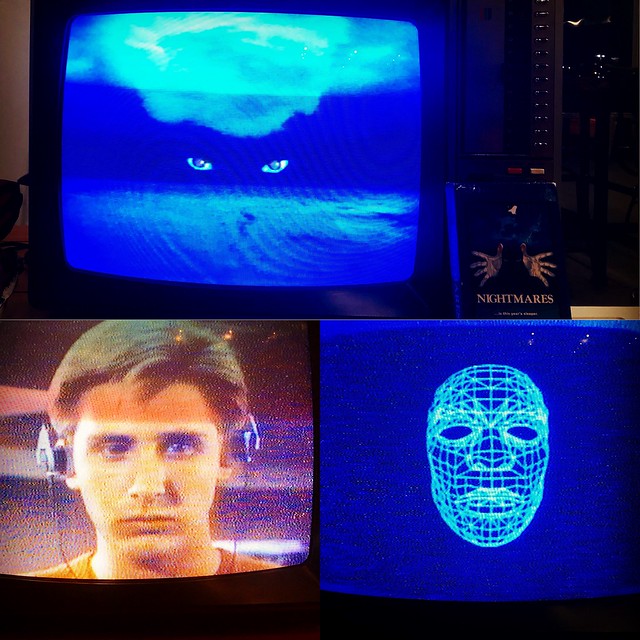
Nightmares Triptych

I’ve written about one particular episode of Nightmares, “The Bishop of Battle,” years ago on the bava. This particular stars Emilio Estevez as a punk* from the valley who goes to downtown LA to hustle vatos in an 80s arcade. [I remember the episode so clearly because the game he’s playing for the con is Pleiads, which was a personal favorite.] All of this to feed his increasingly disturbing obsession with the video game Bishop of Battle—and its mythical 13th level. Anyway, it’s an urban legend about video game addiction from the 80s (something I heard about all too often after being caught stealing my fair share of quarters from my parents). 

Pleiads in the “Bishop of Battle” episode of Nightmares (notice the cabinet misspelling of the game’s name based on the constellation name).

This Betamax Rundown post on the movie has an excellent summary of all four episodes with some great VHS screenshots, so if you want more of the nitty gritty check it out. But real quick, the other three stories are all similarly grounded in urban myths.† The first episode Terror in Topanga features another addict (this time a cigarette smoker) who goes out after dark, despite a killer being on the loose, to get a pack of smokes. She gets them but being low on gas on the way back she stops at a creepy gas station only to mistake the attendants attempts to pull her from the car with assault rather than trying to save her life from the killer hidden in the back seat. The killer hiding in your back seat was prevalent urban legend in the 80s, and I remember reports that a psychotic killer was hiding in the backseat of peoples car at Roosevelt’s Field Mall, although I don’t think it was based on any facts. That said, I still look in the back seat of my car before jumping in after leaving it in a mall parking lot. Quick fun fact about this episode, Fear’s lead singer Lee Ving is the psychotic killer in the back seat 🙂
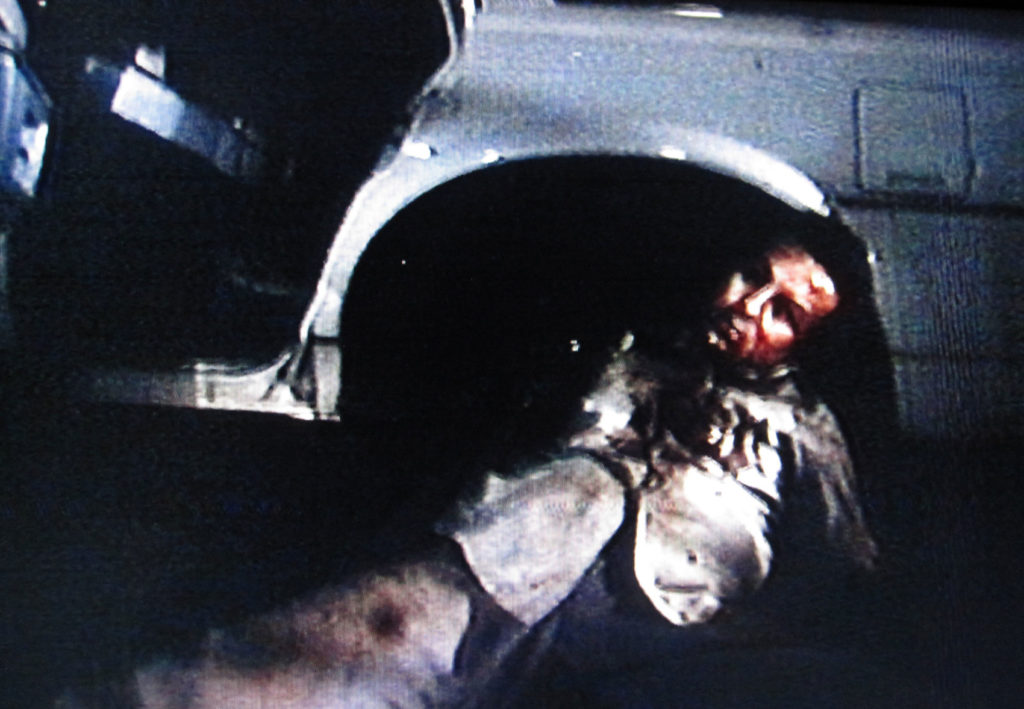
Lee Ving as psychotic backseat murderer in Terror in Topanga

“The Benediction” is the third episode stars Lance Henricksen as a Catholic priest who loses his faith and leaves his parish only to be chased down by a black pick-up with tinted windows. It’s a pretty straight rip-off of Christine, and the least interesting of the 4 episodes in my opinion. I’m a fan of Henricksen, but this one never really has a hook and you see the reveal coming from a mile away—not to mention the action is kinda like a Dukes of Hazzard dust up.
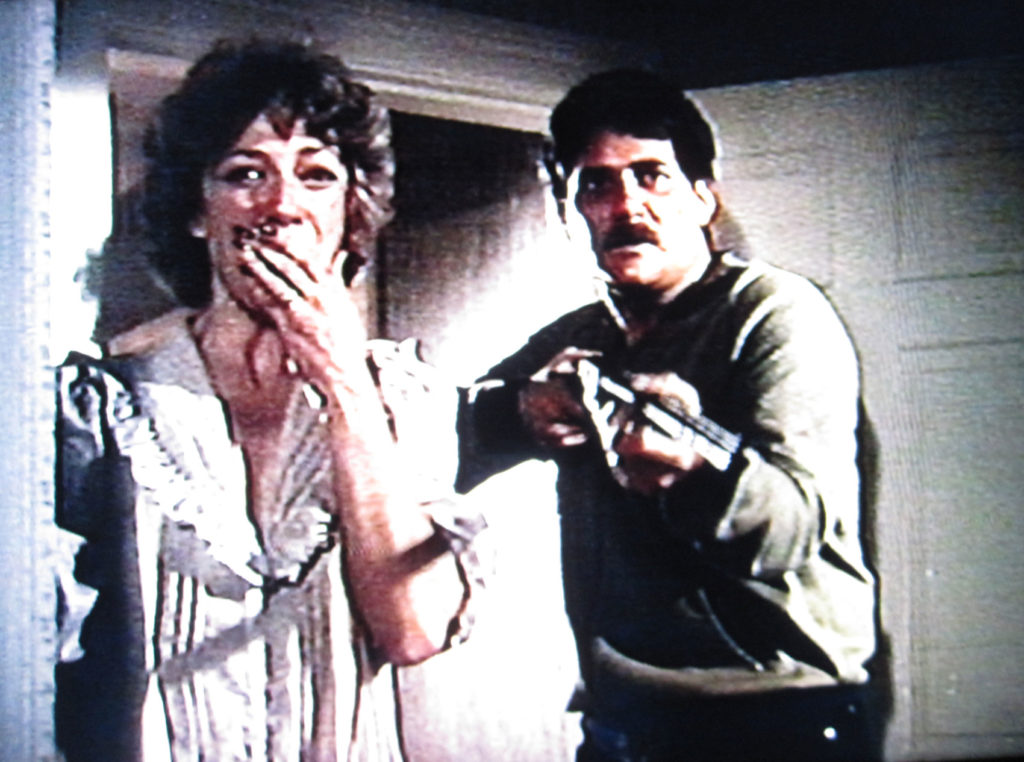
Veronica Cartwright and Richard Masur in the “Night of the Rat” of Nightmares.

The final episode deals with a gigantic, demonic rat that terrorizes a family. I love it because Veronica Cartwright has always been a favorite, and here she gets to revisit her role in Alien by looking freaked out and screaming. She is also the epitome of an 80s housewife in terms of clothes and hair, and Richard Masur plays the 80s lawyer prick brilliantly, with the period appropriate detail of him driving a Cadillac Seville that had the iconic trunk that looked like a prize-fighter’s nose. The gigantic rate ultimately ensnares their daughter after they killed its baby in a trap, and the special effects are worthy of the 1957 film The Incredible Shrinking Man. Anyway, this episode is remarkably similar in my mind to the final episode of Cat’s Eye (1985) titled “General,” another anthology horror movie that ends with a troll trying to steal the breath of a young girl (played by Drew Barrymore) while she sleeps. 

Breath stealing troll in “General” episode of Cat’s Eye

Watching this movie on VHS again after what must be over 30 year was awesome. I’m not so sure the movie is all that good, but that is besides the point. It is pure, unadulterated 80s urban legend with some fine acting, set design (by the fact it is filmed in the 80s), and music. Also the director, Joseph Sargent, had a pretty bizarre career when it comes to movies (Jaws 3?)—most of which were forgettable—but he directed the absolutely brilliant Taking of Pelham One Two Three (1974), so all is forgiven. More than anything Nightmares represents the phenomenon of home video when obscure films you may not otherwise have seen found there way into your home, and by extension your imagination and memory. If you know what I am talking about and you have a film that represents something similar, please let us know. We would love to add it to our Reclaim Video collection. What’s more, you can even find it on Ebay (or elswehere) and send it to the following address to help us collect and share some of that media history:

Reclaim Video
2320 Plank Road
Fredericksburg, VA 22401

Keep in mind anything you send us will be available to be rented out through our storefront—this is not a museum or an archive, but a soon to be fully functioning video store. We are also working on an online component as well, so stay tuned.

A note on the Nightmares tape, the quality was decent at best, and I think we will be running into a fair amount of this as we keep collecting old tapes. The last 3 episodes played cleanly, but the “Terror in Topanga” episodes showed some signs of tape deterioration, and even stopped the VCR twice. It will be interesting to trace the level of degradation of many of these VHS tapes.


*Speaking of punk, he listens to both Fear and Black Flag on his Walkman, which puts it a year ahead of Repo Man for breaking good LA punk to the masses.

†I love how Emilio Estevez’s character constantly references some kid in New Jersey who supposedly reached level 13 of the Bishop of Battle video game—it strikes me as quite authentic reality before the Web.

Posted in movies, Reclaim Video, ReclaimVideo | Tagged , , , , | 1 Comment

Serving Up Some Yo La Tengo

This has been quite a semester for shared hosting servers. We spun up D.O.A., Sebadoh, and Wire in January alone, but the hits just keep on coming at Reclaim Hosting. While I was back in Fredericksburg two weeks ago I was binge listening to Yo La Tengo. I could not get enough, and given they’ve been making music since the mid 80s there was plenty to choose from. When we decided we needed a fourth shared hosting server this semester*—there was no question this one would be dedicated to the indie-rock royalty from Hoboken, New Jersey.

Yo La Tengo

My introduction to Yo La Tengo started fairly late with their 1995 album Electr-O-Pura and then their 1997 masterpiece I Can Hear the Heart Beating as One. The latter is one of my favorite albums of all-time, and songs like “Sugar Cube,” “Autumn Sweater,” and “Little Honda” (a Beach Boys cover) offer a brilliant insight to this bands metaphorical agility, emo inclinations, and exhilarating joyrides that characterize so much of their music.  

https://www.youtube.com/watch?v=pYzcRAlsHdU

I also love their long, hypnotic instrumentals like “Heard You Looking” off their 1993 album Painful, or “Blue Line Swinger” off Electr-O-Pura:

Or their love ballad “You Can Have it All” (another cover) off And Then Nothing Turned Itself Inside-Out.

I could go on like this for a while. But I’m sure you get the point. And unlike most of the bands we name servers after, Yo La Tengo is still going strong after 30 years as a band, with an album due out in March and a tour that will bring them to Italy in May. So with that, I leave you with another ear worm from their album Fade, “Ohm:”

It’s hard not to respect the range, lasting power, and sense of joy this band brings to their work, and that might be one of the reasons they’re quickly becoming an all-time favorite.


*The fact we retired the Minutemen, Hüsker Dü, and Butthole Surfers servers last month and migrated all existing accounts to Wire, D.O.A., and Sebadoh respectively drove a significant amount of the server setup mania the last two months.

Posted in reclaim | Tagged , , , , | Leave a comment

Tech Infrastructure as OER

Recently on Twitter, Jöran Muuß-Merhol reminded me of a discussion we had back in 2016 at the OER Conference in Edinburgh, Scotland. 

I first met Jöran in the Spring of 2013 at the Reclaim Open Hackathon at MIT, which was also the first time I met Kin Lane and Audrey Watters. A formative trip for me personally, so it was interesting to catch up with Jöran 3 years later to see how the whole Reclaim metaphor that was cemented for me at MIT evolved. And now it is two years later than that, and turns out I never did blog it. So I took the opportunity this morning  to listen to it, and to its detriment it is certainly Jim Groom playing the hits (screw you, Lamb!).

But what was interesting for me about this discussion two years later is how focused I was on the possibilities of the Personal API. It is something I was still trying to make sense of, and my stumbling around defining APIs is proof of that. I knew I was venturing into dangerous territory when it comes to my own comprehension, but returning to it this morning made me want to return to ideas at the heart of the Personal API in light of giving folks more control over their data. Part of the reason this has been on hold since 2016 is that we’ve been busy managing the day-to-day at Reclaim. But I think both Reclaim and BYU have been on a similar trajectory of growth and building capacity when it comes to managing a Domains initiative, so we very well may be in a position to revisit this idea in the near future.

To that end I am not only going reach out to BYU, but also submit a talk proposal on the idea for the MyData conference in Helsinki this August. If accepted, it would provide a welcome opportunity to not only work through the ideas, but also listen and learn from others in the field re-thinking data ownership. And this return seems timely given David Wiley is currently exploring what open means in the context of courseware, and while I understand the argument for divorcing the idea of OERs from the courseware within which they often live—the fact that they live there at all seems the bigger issue for me.

Posted in open education | Tagged , , , , | Leave a comment

Reclaiming WordPress Multisite

Lauren Brumfield already announced that we’re officially rolling out WordPress Multisite (WPMS) hosting at Reclaim. What’s more, she created an online calculator that provides transparent pricing going forward, which is a big part of why we’re finally announcing something we have done for years. While we’ve been pretty laser-focused on shared hosting and Domain of One’s Own for the last four years, we’ve still picked up more than a few WPMS instances. In fact, we jumped in at the deep-end of the pool when we started hosting the colossus that is VCU’s Rampages. As a result Tim was able to really fine-tune high demand WPMS environments like Rampages, and we’re in a situation where we can comfortably manage just about anything out there in higher ed.
It’s fun for me because I cut my teeth on WordPress Multiuser (even before it was multisite), and when Tim came onboard at UMW the first thing we asked him was how he felt about managing UMW Blogs. The rest is Reclaim history, he proved an insanely quick study and went from UMW Blogs to Hippie Hosting to Domain of One’s Own to Reclaim Hosting in two short years. That’s a resume!

back to the future, we really weren’t comfortable with announcing WPMS at Reclaim too early because we were experimenting with different setups across various data centers like AWS, Linode, and Digital Ocean, so things were always custom based on several factors which meant the pricing varied. But when Digital Ocean recently announced their new plans and pricing model, we were sure we had a solid setup through Digital Ocean that would allow us to stabilize our WPMS offerings as well as making them extremely competitive when it comes to pricing.

Before we could announce anything we had to reach out to all existing customers we and let them know of the new setup, for many of them this meant a significant savings. Once took care of that, we figured it was high time to officially announce that we are in the WPMS hosting business. So if you have a WPMS site you want to offload to external hosting, let’s talk. Pricing is simple: server, backups, and software licensing (Bitninja, cPanel, etc) at cost, whereas our monthly maintenance and management fees starts at $250 per month. This model finally allows us to decouple server and software costs from management demands, and establishes a baseline for what our time is worth to ensure you get the service we’re known for. It also makes clear that what you pay us for is not the hardware or software, but the peace of mind that tried and true experts are on the job. I mean let’s be honest here, this isn’t some hack outfit working from a ramshackle UMW office in duPont Hall trying to duct tape together some kind of chitty-chitty-bang-bang syndication solution, we’re professionals—and for that you must pay!

Posted in reclaim, UMW Blogs, WordPress, wordpress multi-user, wpmu | Tagged , , , , | Leave a comment

Why a Domain of One’s Own?

I spent a fair amount of time this afternoon writing a bit of a defense of why a program should ask their faculty to explore a Domain of One’s Own. Thinkers like Martha Burtis and Audrey Watters have made the case much better than me, but I figured I’d try and take a crack at it as well. Seems to me the biggest issue folks have with Domains, and they are certainly justified, is that it can start to get too technical. Asking folks to use web hosting software like cPanel demands focused training, significant support, and a rationale for why you are asking them to go beyond setting up a blog on something like wordpress.com.

It’s a fair question, and I tend to take the value of having your own domain and web hosting (as well as the time and energy required to maintain it) for granted, so I tried to make the case. Not sure if I succeeded, but I’ll share my response below knowing full well it’ll be that much better for your critiques and feedback.

Is Domains the right tool?

It’s a good question, and I’ll try and give it my best answer 🙂 For me the answer would ultimately return to what you want folks to get out of their time. I do think that providing faculty a space to build out a course site, web page, portfolio is valuable, but there are many tools you can do that with: the LMS, wordpress.com, wikipedia, blogger, Wix, Squarespace, etc. Why give them access to cPanel and wide range of options? The biggest reason in my mind would be domains provides an opportunity to dive deeper into the infrastructure and architecture that is increasingly shaping the information landscape. What’s more, I whole heartedly think having an understanding of how the web works, and how you can build your own spaces online outside of third-party controls is an important skill. I don’t necessarily think Domains is the only way to do this, but it does provide one way of building a curriculum around how the web works and what it means for teaching and learning.

I guess if you really want to incorporate domains as part of your program, one of the foundations would be asking faculty to dig a bit deeper. This does not mean they need to become sysadmins or programmers, but they would need to get a strong sense of how these infrastructures work and what is possible with open source tools like WordPress. This would mean discussions about open source applications, running multiple applications, encrypting your site, exploring plugins and themes, information architecture, files structure, file naming, archiving, etc. All things that push against the seamless solutions that often elide the underlying logic of the how and why these tools work. So, a domains initiative without a focus on the technology that undergirds the web never really made much sense to me, I think that is why OER focuses so much on textbooks—it’s simple, it has already been defined for decades and has been something we’ve known our whole life. Only difference now is it is being remediated for online, its “digital” —but a book is a book is a book. Domains is about infrastructure and the very means of how contemporary world views are built on this decentralized lattice of machines, and helping faculty become a node on this web should be the raison d’être of any domains initiative. 

All that said, I certainly see the value of easy and can definitely appreciate a tech initiative for faculty without too much confusing overhead, but in some ways a curriculum around domains should resist the impulse to simplify too much. It should ask its participants to struggle with some of the issues surrounding what these digital spaces mean for their disciplines—and to some degree that would require thinking through how they work on a technical level. I understand this might be seen as potentially dogmatic, and I certainly run that risk, but it is hard for me to separate a meaningful experience with domains from a deeper interrogation of the technology that the web is built on. I think it would be up to you to sell that to faculty and participants so that your program is about more than just building a website, but a deeper understanding of the web. Then again, this may be far afield from what you intended with the project, and a simple website would be fine, and on that you would get no argument from me—I just think domains as an academic enterprise has to be about the foundations of the web and how we can build and rebuild it.

Posted in Domain of One's Own | Tagged , | 12 Comments

Working on Reclaim Video’s Storefront

During this trip back to Fredericksburg we wanted to make some progress on the renovations of the Reclaim Video storefront. This included ripping up the carpet and tile floor as well as cleanly up the walls and painting. We also came up with a bitching logo and got the storefront sign—so I think we made great progress.

We also ordered the carpet and that will be installed in March, so what’s left is shelving, a desk, and mounting the TV. We also made some good headway on how we might manage the rentals and membership, but some of that still needs to be fleshed out. We were also able to shop for some tapes and laserdiscs, as well as get a bunch of inventory out of storage, which means we have some stock once the store is up and running.

Venture

Found the 1971 portable, black and white Motorola TV, this will be on the Reclaim Video desk for sure.

2018/365/031: Motorola

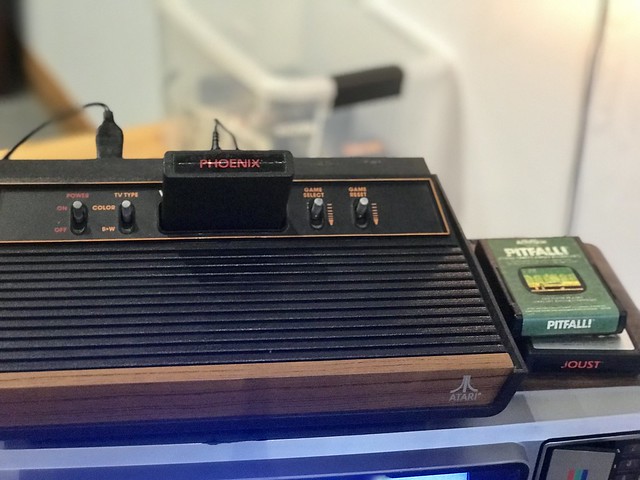
We are toying with the idea of also renting old school consoles through Reclaim Video, which I think would be kind of fun.

2018/365/035: Atari 2600 at CoWork

Phoenix

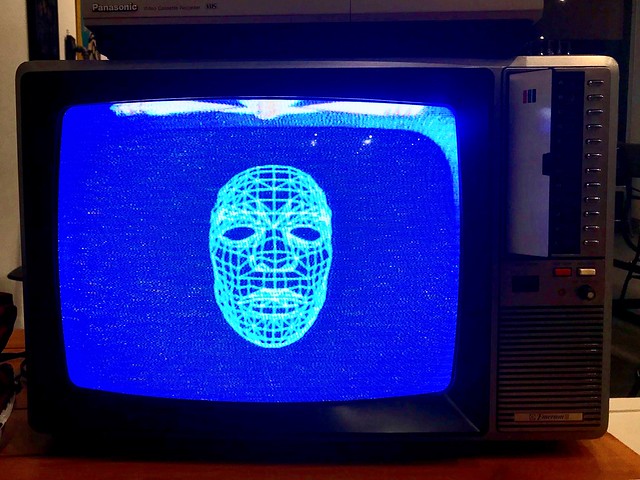
It was heaven to reconnect with my Panasonic Omnivision VHS player. A Cadillac of VHS machines.

Omnivision’s Naked Kiss

The floor rip-up was a bit of a chore, but we finally got a floor stripper, and the last of it went quite smoothly.

Reclaim Video Office Progress

Carpet coming up, but VCT offers another layer of fun

This rip-up brought to you by Civic TV

Carpet and Tile Rip-up

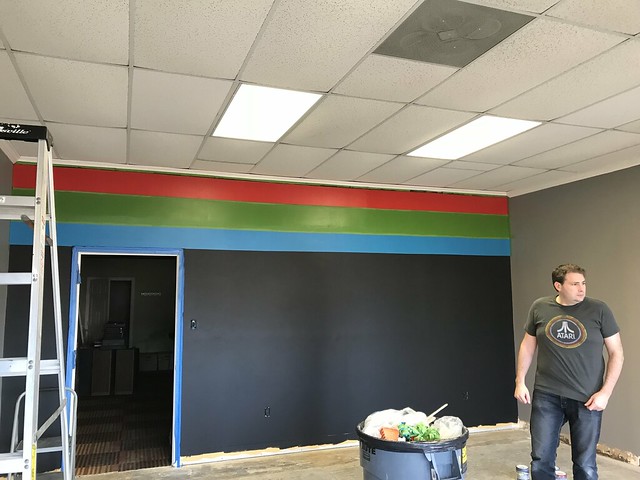
Once the floor was done we started patching and painting the walls. We went for black on the back wall, and gray on the sides.

Paint it Black

And the color bar along the back which will also have the logo.

These Colors Run

Reclaim Video Storefront

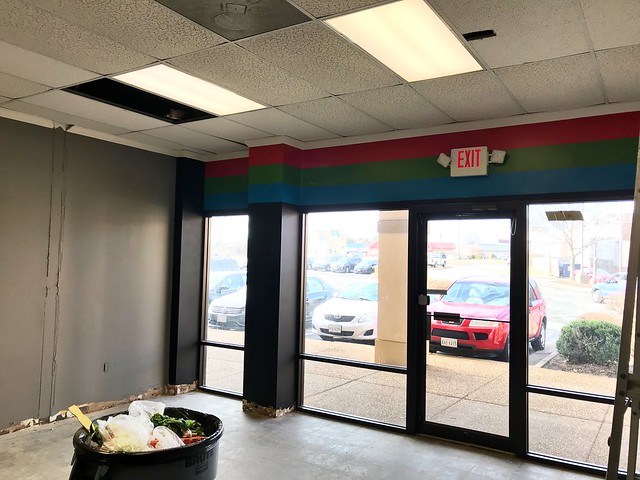
Loving how the RGB color scheme came out.

2018/365/046: Color Column

We also picked up a mint Pioneer DVL-700 Laserdisc/DVD player, and I tried it out with the 80s teen guerrilla film Red Dawn.

Pioneer DVL-700

Red Dawn Title

2018/365/042: When the Mongols could see each other they had worked themselves up into a pretty good frenzy.

AVENGE ME!

Reclaim Video also got its first donation, the classic early 80s comedy Strange Brew. A perfect choice, and we cannot thank Tim Clarke enough, and we really hope others follow suite.

2018/365/044: Take off!

I also got a chance to watch one of the true gems of our VHS colelction thus far, the 1983 film Nightmares. I’ll blog more about this classic shortly, but in the interim enjoy the resolution!

Nightmares

2018/365/045: Bishop of Battle

Emilio Locks In to the Bishop

Posted in Reclaim Video | Tagged , , , , | 7 Comments

Archiving Faculty Academy

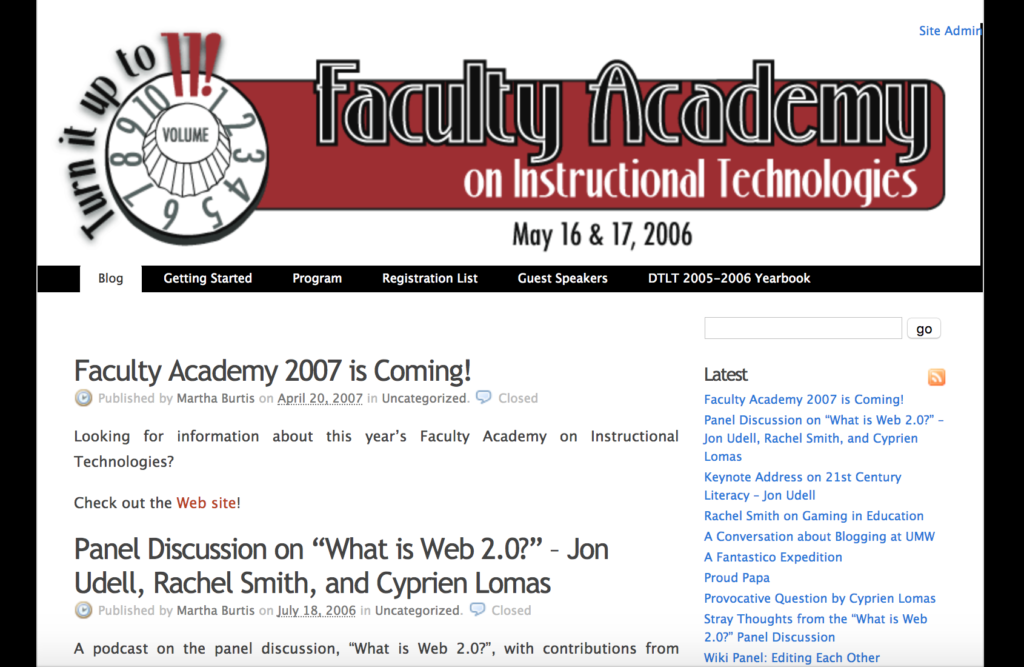
Faculty Academy 2006

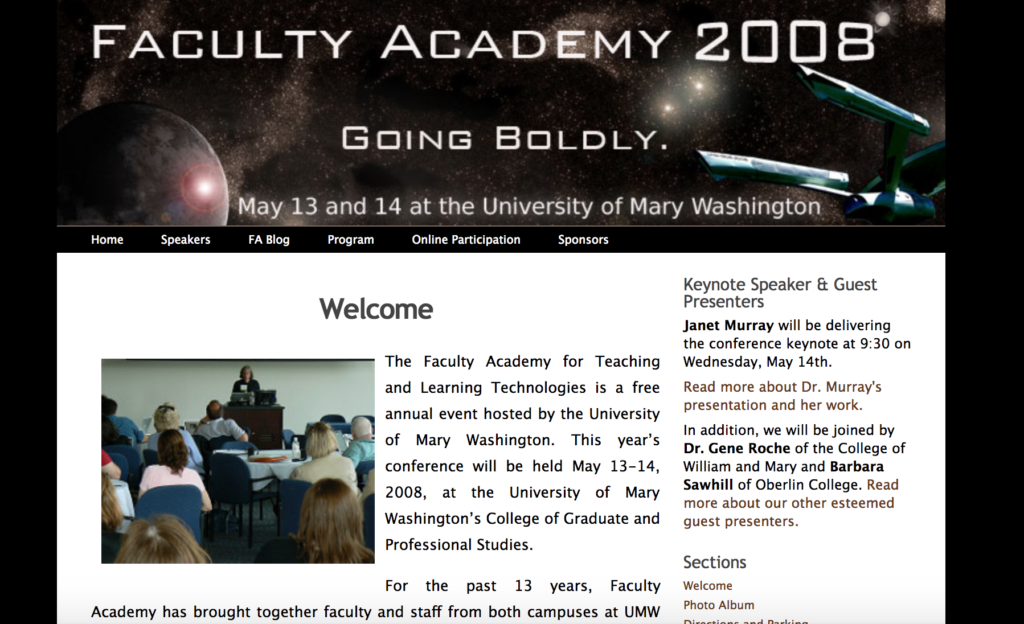
I mentioned in this post last month that the Faculty Academy sites were down. I discussed this with Martha and realized all the Faculty Academy sites had been created as an independent network within UMW Blogs, and given the plugin we used to do that has long been defunct we could no longer see it in the Network Admin interface. Legacy crap like this is crazy cause I honestly have a very vague memory of ever doing this. When we migrated UMW Blogs to a new server on Digital Ocean this summer, the A record for facultyacademy.org  was never updated to the new IP address, which explains the broken sites. That was fixed almost a month ago, and all is well. But given all these sites have not been updated in years, I asked Martha if they would be likely candidates for archiving as HTML sites, keeping the files and databases backed up should they ever need to be resurrected, and she said sure. 

So, seven years of Faculty Academy sites were packaged up as HTML and relocated to UMW Domains. I used SiteSucker, which I have raved about previously, and it was really dead simple, and the web legacy of Faculty Academy lives on with no concerns about broken plugins, themes, spam, etc. Going back through those sites reminded me how many great people came through UMW from 2006 through 2012. Good times! You can also see 2007, 2009, 2010, 2011, and 2012 for those historians and archivists out there.

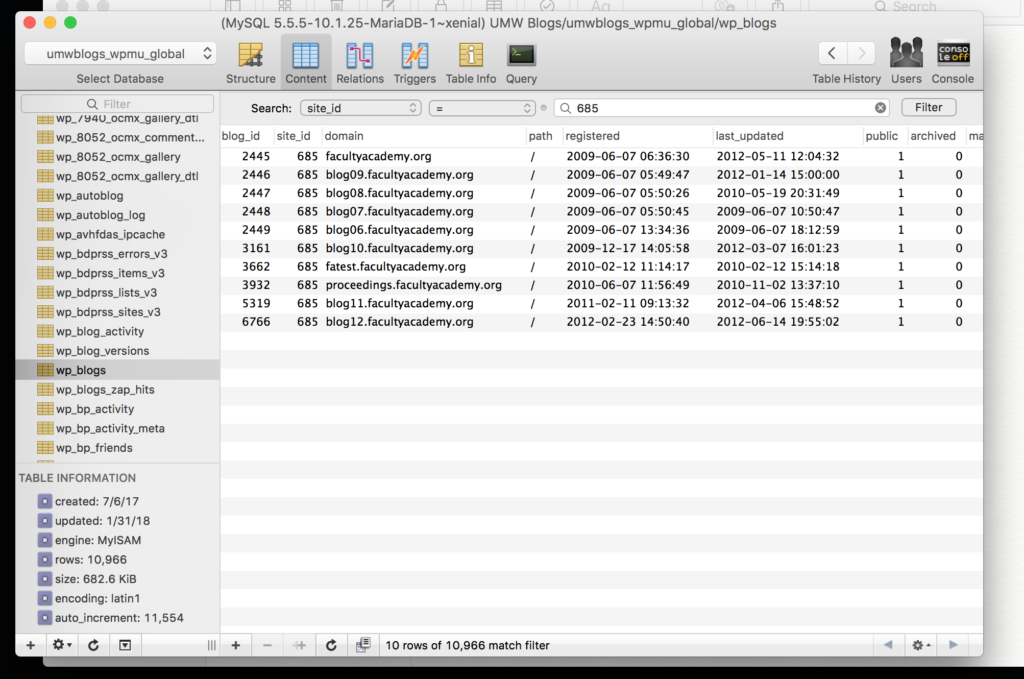
A quick note here that finding the sites amongst the thousands of blogs on UMW Blogs was not straightforward until Tim Owens pointed me to the Sites table in WPMS that gave me the site_id of facultyacademy.org sites, which allowed me to search all blog_ids on that site_id in the blogs table which gave me all the sites right away….god save THE OWENS!

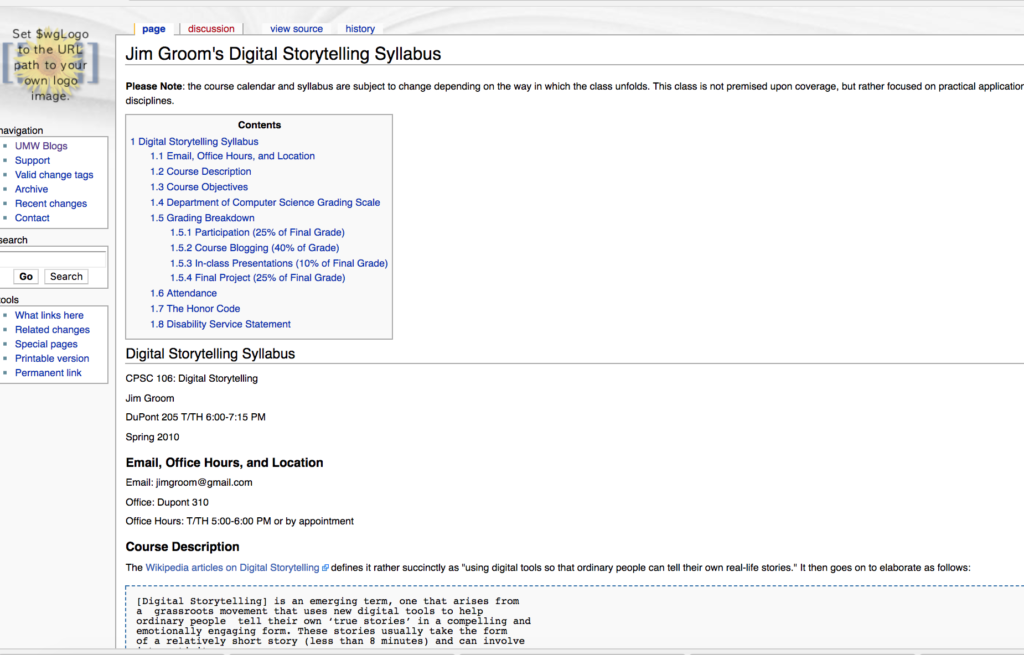
OG ds106 syllabus

While we were at it we did a quick HTML archive of the UMW Blogs Wiki, which now has a ton of sites back up like the original ds106 syllabus and some EMOboiler memoribilia.

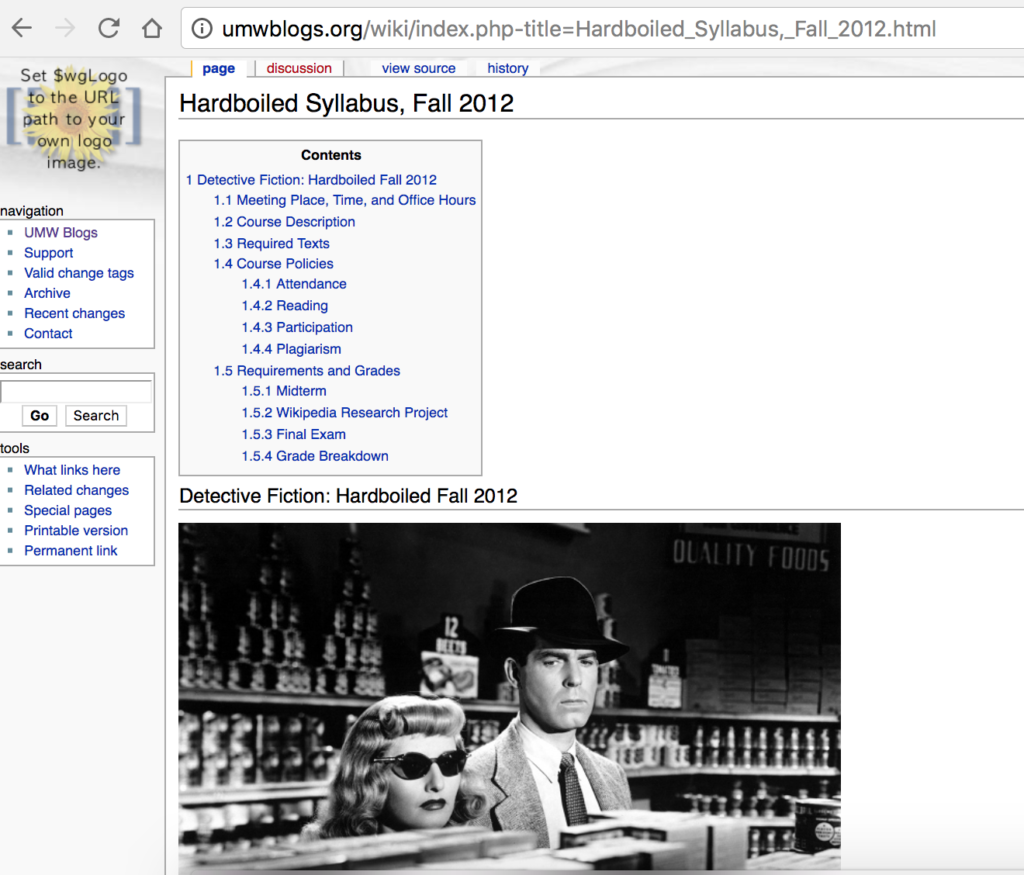
Hardboiled Syllabus

Felt good to get a bunch of that stuff back online because the webs we built should have a life beyond us, this whole disposable, third-party web shit is unacceptable.

Posted in Archiving, UMW Blogs | Tagged , , , , | 8 Comments

LMS Dogma

I mentioned in my last post that I recently was invited to talk to a group of students in Eddie Maloney’s Technology Innovation by Design course. This group are the pioneers of Georgetown’s new Masters program in Learning and Design. I was asked to talk about something, and I proposed a few things:

A Brief History of Learning Management Systems: I would take a course period to frame 20 years of Learning Management Systems and what they have meant to the field of educational technology in higher education. It would be a fun way for me to integrate the core principals of your program through the lens of the predominant systems we use to manage learning in Higher Ed. I like this cause it frames how we understand learning design, where we capture analytics, what passes for innovation, and how leadership understands all these things. The LMS is a perfect refraction point for so many issues at the heart of the program.

Future Visions: Hosted Lifebits and the Personal Cloud
This talk would provide an overview of existing technical infrastructure much of the innovation in higher ed has relied on since 2003 (LAMP stacks for self-hosted apps like WordPress, MediaWiki, etc.) while framing what will come next. It will look at the changing nature of cloud infrastructure that started with APIs at Amazon and led to Amazon Web Services, a cloud-based infrastructure that effectively changed the nature of how we imagine the basic plumping of the web. The implications for future innovations are remarkable given access to various technologies beyond the LAMP environment are increasingly just one-click way, not to mention the implications for managing and hosting your personal digital “lifebits” on your own cloud. This ties into practical work we are doing at Reclaim that builds on the Domains project.  In fact, I would love to teach an entire course about this topic.

The Problem with Analytics in Higher Education:
This would be a bit more of a provocation (although well grounded in the current reality of big tech) that would trace the discussion around analytics (much like I propose with the LMS) in order to lay bare some of the assumptions and problems with the promise of analytics as an excuse for unfettered data collection on the part of the various systems that we subscribe to in higher educational institutions (and beyond). I will discuss this in light of alternative models for imagining data collection and control on the part of the individual using “personal  APIs” and designing a system that gives  students and faculty far more control over their data—which should be a central concern given “data is the new oil.”

Practical Innovations: An Idiosyncratic History of Learning Design:
This would be a bit of the greatest hits of work we did at UMW to focus on practical ways in which you build a culture of innovation around learning technologies. This would cover UMW Blogs, ds106, Domain of One’s Own and move to Reclaim Hosting. I’ve done versions of this many times, and it will really focus on learning design and innovation, but will touch tangentially on the other two core tenets of the program.

I find it is easier to propose things than to do them, but when you commit to showing up you have to have something. We settled on the history of the LMS proposal, and I was happy to dig in. But once I started to prepare I remembered I’m not much of a historian, rather I’m just a lowly blogger. So I started searching around, and I started at the Learning Management System Wikipedia article. This led me to E.M. Forster’s story called “The Machine Stops”, which struck me as fairly bizarre starting point for distance learning in the 20th century. Wild to think the same writer behind novels like Passage to India, Howard’s End, and Room with a View could have a hand in the beginnings of the LMS. But that’s what’s remains compelling about the field of edtech: it’s a strange mix of Edwardian nostalgia, technological imperialism, and speculative science fiction. 

Around the same time I was reading Forster’s story, Audrey Watter’s published her review of Brian Dear’s The Friendly Orange Glow—a history of the “the first generalized computer-assisted instruction system.” After reading her review and following up on both the Brett Victor 1973 2013 “Future of Programming” talk (which I had not previously watched)  as well as a deeper dive into PLATO. And after that I had the preparatory reading/viewing for my class visit: E.M. Forster’s “The Machine Stops,” Brett Victor’s “The Future of Programming,” and Audrey Watter’s PLATO review. I liked the way the idea of dogma weaved its way through all three pieces, and it resonated with the students as well.

As I imagined we spent most of the time talking about Forster’s short story, which was fine by me. I came up teaching literature and I can’t get enough of it.  The parallels in that work are pretty striking, and it seems quite fresh more than 100 years after it was written. Folks make a lot of the idea of the everyone lectures and there is a distance ed machine, but for me the theme of dogma and the growing cult of technology as the next religion seemed far more interesting—not to mention the concomitant historical amnesia. Passages like the following meditation on the machine was pretty powerful for me:

Cannot you see, cannot all you lecturers see, that it is we that are dying, and that down here the only thing that really lives in the Machine? We created the Machine, to do our will, but we cannot make it do our will now. It was robbed us of the sense of space and of the sense of touch, it has blurred every human relation and narrowed down love to a carnal act, it has paralysed our bodies and our wills, and now it compels us to worship it. The Machine develops – but not on our lies. The Machine proceeds – but not to our goal. We only exist as the blood corpuscles that course through its arteries, and if it could work without us, it would let us die.

This may bleed uncomfortably close into artificial intelligence for many folks, but for me the sense of having lost control over the systems and online spaces we have helped champion was poignant. The idea of these systems existing somehow external to our collective will maps onto my experience with the LMS. A meek acceptance of this as the decided upon future for computer-mediated teaching and learning was always the worst part of instructional technology, a theme which both Brett Victor and Audrey Watters nail in relationship to the dogma of programming languages and the ahistorical dogma of edtech served up by Silicon Valley. In fact, the second half focused on Victor and Watters, and in the end I spent far more time talking about our current dogma of technology and the narratives we weave rather than anything resembling a history of the LMS. I tried to save myself by quickly running through the Wikipedia page on the History of virtual learning environments, which I got thanks to a Tweet from Audrey and turned out to be a real gem.

It was fun to do, and it gave me an idea for a fun presentation wherein one gives 2004/2005 era edtech talk in relationship to all that’s changed in the last 15 years when it comes to promise and possibilities of Web 2.0. I still think it is a bit too close, and unlike some I don’t think that work was for naught—but it does take on a different valence 15 years later. Anyway, I wanted to try and get out some of these thoughts down before they vanished, and say a special thank you to Eddie and the students in the course who made me feel so welcome and tolerated my two and a half hour indulgence. 

Posted in Instructional Technology, presentations | Tagged , , , , | 5 Comments

Back in the Burg

I’ve been back in the Burg for the last 10 days working from Reclaim’s HQ on a range of stuff. As a result the bava has been a bit quiet given the push to get as much done as possible in a relatively short time frame. I’ve been able to get some of my stuff out of storage on the first day of my return, which has been on focus of the trip. I’ve been going through boxes of toys, books, movies, and more which is always a fun past time for me. I’m figuring out how to get my stuff overseas in the next month os so, but until then I am using CoWork’s unclaimed spaces as a temporary waylay station. 

This rip-up brought to you by Civic TV

Paint it Black

We have also been working quite diligently on making Reclaim Video a reality, which has been quite a blast. I’ll post more on that soon, but we did a pretty intense carpet and tile rip as well as began painting the store, which Lauren blogged about earlier today. Watching the space come together has been a dream come true—I’ve pretty much wanted to run a VHS store since I was a pre-teen, so this is pretty exciting.

Pioneer DVL-700

I have also been doing some shopping for VHS tapes, laserdiscs, game consoles, and more. I went to Fat Kat Records 20 minutes south of here in Ladysmith and picked up a ton of mint laserdiscs as well as a mint Pioneer DVL700. I even tested it out with a showing of Red Dawn …. WOLVERINES!

Red Dawn Title

2018/365/042: When the Mongols could see each other they had worked themselves up into a pretty good frenzy.

I’ve also been a regular at the Library of Congress’s Packard Campus in Culpepper, VA, which has been amazing. I got to see Sense and Sensibility, Close Encounters of the Third Kind, The Last Picture Show, and Lawrence of Arabia , all of them in glorious 35mm. I even missed a few gems like Guess Who’s coming to Dinner, A River Runs Through It, and The Adventures of Baron Munchausen—world enough and time!

Packard Campus February Program

But that’s alright, there’s always March!

Packard Campus March Schedule

I was a little sad to learn that Culpepper’s 1938 State Theater had closed after only being re-opened for two years. There was a major funding drive to get investors help refurbish and re-open Culpepper’s movie house at the tune of $13 million dollars, It was an impressive remodeling to restore it to its original glory. I had the good fortune to see Independence Day there in 2014. But that was then, since it has gone defunct and just a few weeks ago it was auctioned to the highest bidder for $700,000.

I was also able to rekindle my ds106 roots with a quick stop by UMW yesterday to record a  video for The End 106 with the great Martha Burtis. She’s a genius.

 And later that afternoon I actually got back in the classroom after a long hiatus to talk to to an awesome group of students in Eddie Maloney’s graduate course Technology Innovation by Design, which is part of Georgetown’s new Masters program in Learning and Design. It was a thrill to talk to student who want to think critically about the future of educational design, and I’ll write more about my approach in a follow-up post. I do miss the classroom, it is always a lot of fun for me—but damn I tend to talk a lot.

Anyway, if nothing else, this post serves as a roadmap for all the posts I need to write after taking a bit of a hiatus from the blog in order to dig in a bit while here in the US. it’s been quite nice to work alongside Meredith, Lauren, and Tim in CoWork—it’s been a welcome change to reconnect in person with the awesome crew that makes Reclaim so damn good.

Posted in digital storytelling, movies, reclaim, Reclaim Video | Tagged , , , , , , , , | 1 Comment

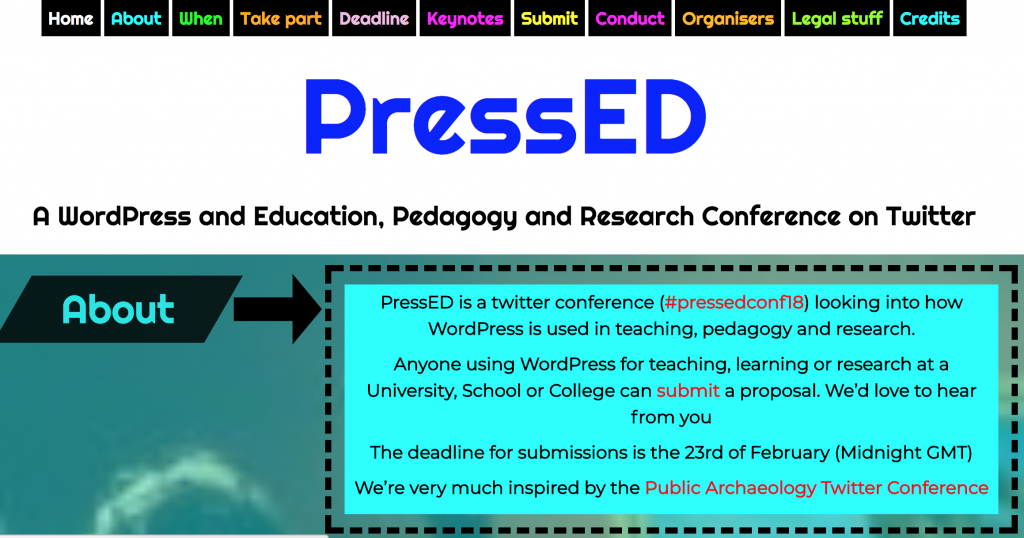
PressED: a Twitter Conference about WordPress

I dig what Natalie Lafferty and Pat Lockley dreamed up with PressEd, a conference about WordPress run through Twitter. It provides a fresh take on the online conference, and with that somewhat of a challenge to use the medium in an interesting, thoughtful way to get your point across. I was asked to give a featured talk, alongside Professors Gurminder K Bhambra and Mark Carrigan, which immediately puts me outside my academic depth. Add to that a whole new approach to a keynote, and I’m feeling the pressure—which I kinda like.
So I’ll use this post to try and get at two questions: 1) what should I talk about? and 2) how should I say it?

So, it’s a conference about using WordPress for teaching, pedagogy and research and I have some experience with that. I’ve been proselytizing WordPress in higher ed since 2005, and it quickly became the basis of my career from starting this blog in 2005 to UMW Blogs to ds106 to Domain of One’s Own to Reclaim Hosting. WordPress is present in just about everything I have been part of. And while cPanel was the environment through which I began to understand the inner working of the web, it was with WordPress that I was able to start creating and sharing on it easily. That was always the hook, WordPress made publishing on the web simple and attractive. I was totally sold, and that made it easy to try and sell others. In 2006 and 2007 when we were pushing WordPress heavily at UMW for personal sites, course sites, and even the university website people thought it was cute—it’s good for “blogs” if you are into cat diaries and bad politics.

Twelve years later it powers 1/3 of the websites on the internet. At UMW we trained faculty, students, and staff for more than a decade on how to use a web-based publishing tool that they were likely to use again in their personal and professional life. That is satisfying. And in 2010, when UMW decided to run its website on WordPress, there was a certain amount of vindication for that ragtag bunch of IT/academic hybrid outcasts ostensibly specializing in fixing printers. Watching WordPress steadily conquer the web has been a trip because what was a righteous cause for the first part of my career eventually became like oxygen, I stopped thinking about it and just involuntarily assumed everyone else needed WordPress to survive online. There were some exceptions, but iron lung social media sites like Twitter and Facebook don’t really count—you are not really breathing the fresh air of the open web there, you are more akin to Darth Vader sucking wind through the empire’s algorithm 🙂

So I think that’s part of what I want to talk about, but it needs example and it needs to be interesting. What’s more, it is through the empire’s iron lung, so you need to tell it slant, so to speak. How do you give a talk like this through Twitter? Is it just a headline-like tweet with a link to a cool example/resource? Maybe, but that seems too easy. It would be cool to see the keynote as an interactive sharing from a wide range of folks of their WordPress story. How and why are they using WordPress for teaching, learning, and research?

What if the presentation became a call for folks to share links to their sites/projects and provide some tweet-length contexts. How did they come to WordPress for their academic work? Why do they use it? But doing this during the presentation is tricky because it could always fall flat. What if no one plays along? I could make an open call for examples well before the conference in order to collect examples and create an ongoing resource, while still spinning my presentation narrative around them. That’s very much in the spirit of Alan Levine’s presentations like Amazing Stories of Openness. We could call it “Amazing Stories of WordPress,” and let folks narrate their tales of how they use WordPress. They would have to be short videos/posts with tweet-friendly descriptions, but that is very doable and would personalize the examples in ways I never could. What’s more it would highlight a community of people doing stuff rather than allowing me to fall into the same trappings of talking myopically about the work I’ve done (which you can see from what I wrote above is very real danger).

You can't do that on WordPress

I could also steal Tom Woodward’s model and talk about all the thing you can’t do with WordPress, only to demonstrate that you probably can.  This reinforces my early experience slinging WordPress, and it would be satisfying to count the ways.

But I have to assume both Alan and Tom will be submitting for this, so I may have to get original …. dammit.

So, a bit more amorphously, I could try and recruit a bunch of folks who have been working with WordPress and plan some kind of happening during the conference to  suggest all of this through a medium that is premised on distraction. A keynote of distraction, I don’t know what that means, but I kind of like it. Anyway, that’s all I have now on this idea, but the post served its post so far in getting me to this point. I’ll be trying to wrestle my way through this in the next week or so because I need to come up with something soon given I feel a bit out of my element with this one. And as always, any and all feedback and ideas to help me flesh this out would be most welcome!

Posted in presentations, WordPress | Tagged , , , | 14 Comments