The Monogamous Book Club: Inauspicious Beginnings

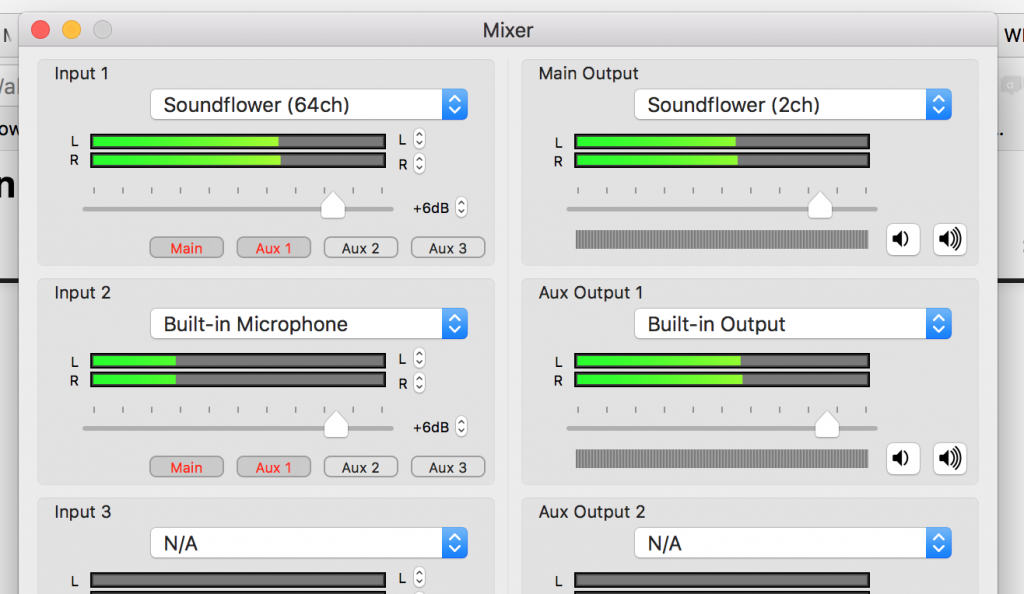
Well, I spent much of this morning configuring my computer for the first episode of The Monogamous Podcast. I use Alan Levine’s Rube Goldberg machine to broadcast on ds106rad.io. I am gonna leave a screenshot of my Ladiocast settings for future reference below:

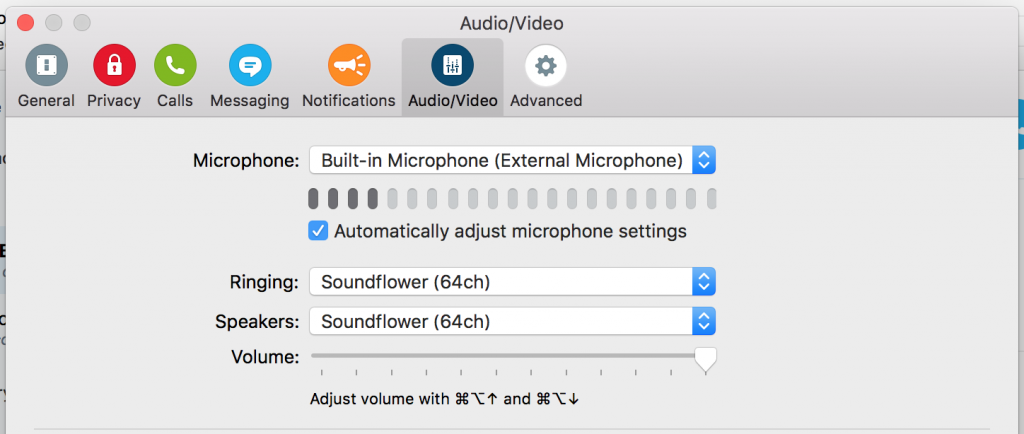
That worked a treat, and I use Skype for the discussion, here are the settings for that:

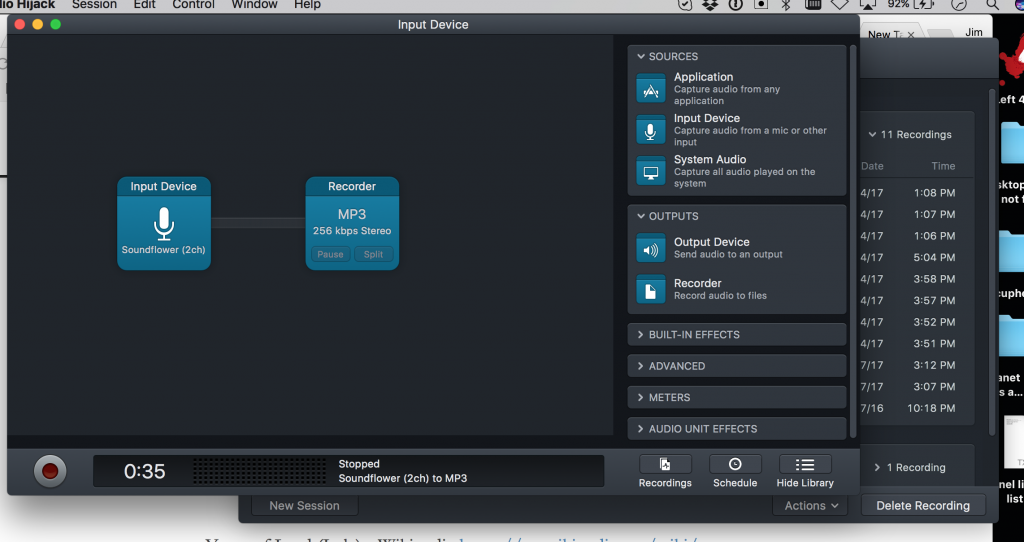
So all was good there, I even figured out how to record the system audio through Audio Hijack:

I recording the Channel 2 output to mp3 through Audio Hijack and it worked. I even tested it before we started. In fact, the test is all I have from the first episode I broadcast on ds106radio with Paul Bond discussing Giorgio De Maria’s The Twenty Days of Turin. That’s right, an hour long discussion about the book lost to the ether, so to speak. But it did happen:

https://twitter.com/grantpotter/status/922802570388746240

So, we are gonna try it again at the same time tomorrow because Paul is so mellow. Anyway, at least you can hear our 30 second outtake/theme song:

Posted in ds106radio, Monogamous Book Club | Tagged , , | Leave a comment

The Monogamous Book Club

Last week Alan Levine blogged about how infuriating it is that the U.S. has all but ignored the real plight going on currently in Puerto Rico. That U.S. Territory (a status defined by a history of imperialism) has recently been devastated by two hurricanes, and by all accounts little has been done to help. It’s shameful, but given how chock full of shameful the U.S. has been as of late, it’s getting harder to keep track or take notice. Alan has tried to frame the call for support as a bridge built around personal notes of support on postcards to the students and faculty at the Universidad del Sagrado Corazon—a place filled with great people I’ve been lucky enough to visit several times over the last 8 years. It’s a good thing to simply remind folks some of us care.

That post (and the subsequent Daily Create that asked folks to send post cards to Sagrado) led Chris Lott to point back to an online book club he ran using postcards back in 2010. It was a pretty impressive endeavor, and he even linked to a Flickr group with pictures of some of those post cards. I was a fan of the Motley Read project, and I responded to Chris saying as much.

https://twitter.com/fncll/status/920797451560165376

And as Chris often does in a very special way (I owe my most memorable presentation (OpenEd 2011 [tent,occupy] to him), he inspired me. I have been toying with a podcast idea, and when I he linked back to Motely Reads it encouraged me to try and spell it out. It’s actually quite simple:

It’s a one-on-one book discussion, it actually isn’t all that novel (#budumbump), as a podcast. Whoever is interested recommends a book and we schedule a time to talk about it for roughly an hour. It can be anything, a novel, a short story, a poem, a manual, whatever. Also, we both have to blog about it. Part of the  reason for this is terribly practical. I want to read more, but I am bad about it. I found a read that most when I was teaching and I had too, but I have not taught for near on 3 years, so I find I’m out of practice. I figured if anyone took me up on this, it would be good practice. Books always come to life for me in conversation. As it turns out, I already got quite  few takers before I even nailed down what exactly it is. Not to mention a logo thanks to Ron:

So, the idea is simple. If you also want a reason to set a deadline for yourself to discuss something you’ve been wanting to read, this is your opportunity. Just fill out the following form with your name, proposed book, and email. After that I’ll get back to you and we’ll schedule a time to chat live on the radio and it will soon after be a “podcast.” Easy! Use the following form or just put it in the blog comments.

Also, if you choose to let me decide on a book, I promise you it will be a doozy. Just answer the third question with “You Choose,” and oh will I ever—just remember you let me choose!

Are you in? I hope this is clear, because I think I somehow confused Sarah Honeychurch on Twitter 🙂

Anyway, like everything done in this spirit, we’ll see where it leads. I actually have the first episode lined up for tomorrow afternoon. I speak with Paul Bond tomorrow about The Twenty Days of Turin, which is something I have been wanting to do for weeks. In fact, Paul had a post today that reminded me we kinda have been doing this for one and off for awhile. Last year we had a book discussion about Cormac McCarthy’s Blood Meridian, and he noted that discussion has been viewed more than 800 times. How bizarre. So, here is to reading monogamously with all you freaks and geeks.

Posted in Monogamous Book Club | Tagged , | 10 Comments

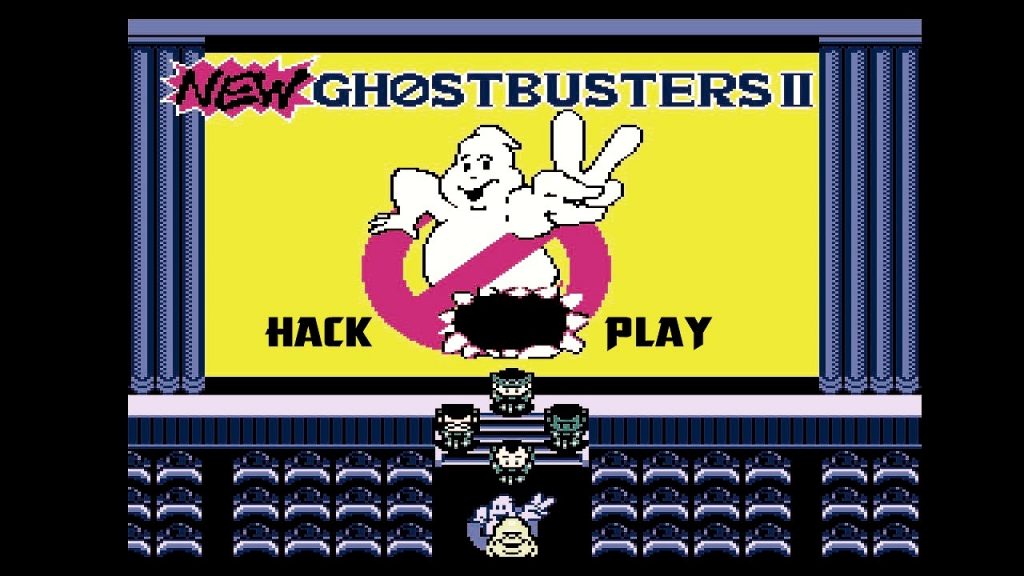
Who ya gonna call? Pat Lockley!

Your site is hacked
And it don’t look good
Who ya gonna call? (PAT LOCKLEY!)
I ain’t afraid of no Brits.
Yeah, yeah, yeah, yeah

I’m not sure, but I think Alan Levine maybe able to do something with that for another edtech show tune 🙂

Back in 2012 or so Pat Lockley was helping me wrangle a pretty bad hack I had on the bava.blog. It was a very cool thing to do, and I have been bantering and working with Pat ever since. But it did not occur to Tim and I until recently that it might be useful to have someone Reclaim Hosting can refer folks to in the event folks’ sites get repeatedly hacked. We try and clean up folks accounts after a hack, but there have been a rash of WordPress hacks over the last six months or so, and some of them have been pervasive. We found ourselves cleaning out a number of hosting accounts 2 or 3 times in just a few short weeks. That quickly becomes unsustainable for us given our pricing model for shared hosting, but we want to have something in place to refer Reclaimers—while at the same time avoiding being scummy like the Sitelock scammers. That’s when it occurred to me that Pat Lockley would be a perfect fit. He knows the inner working of WordPress well, and has even written the plugin Fewster for WordPress to detect hacks by tracking file changes.

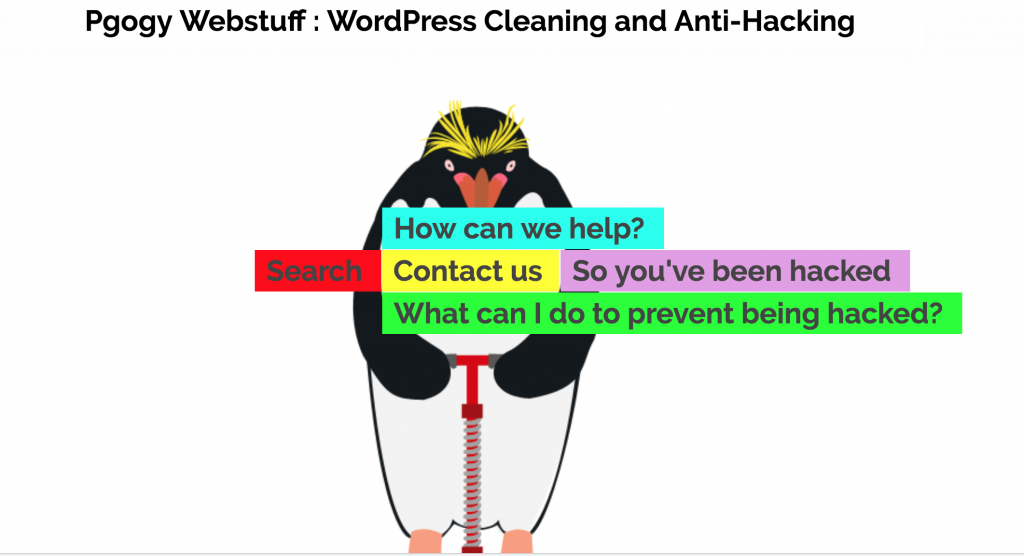
So, we reached out to Pat last week, and we asked him if he would be cool with us sending folks his way who were having hacking issues, and he was more than happy to help. He has even been kind enough to give us a site to direct folks to that has a link to his Fewster plugin as well as resources for keeping your WordPress site clean and advice for fixing it yourself if your site is hacked. So, we will be recommending Pat to anyone having regular hacking issues that move beyond our ability to remedy. He charges an extremely reasonable $25 an hour, and you can get in touch here.

I know he has helped out more than a few folks in the community, and it just makes sense to share the love more broadly for people who find themselves in the nightmare scenario of a regularly hacked WordPress site that they cannot get under control. Who ya gonna call? PAT LOCKLEY!

Posted in reclaim | Tagged , , | 3 Comments

Pushing It Real Good in Barcelona

Over two weeks ago I co-presented at the Open University of Catalonia’s “Pushing the Boundaries of Higher Ed”  symposium with Brian Lamb. Our session was centered on the “zen-like emptiness” of the Next Generational Digital Learning Environment (NGDLE). Brian and I actually prepared for this session months in advance, promising a new high-water mark for us as collaborators, and what did we got for it? An empty room 🙂

In fact, I’m not kidding, we did get an empty room. But that probably had more to do with a historic strike for independence in Barcelona than any of our “big ideas.” I guess some things are just more important than others. But let me tell you something, Brian and I were good. Damn good!!! Maybe the best we’ve ever been, but does anyone ever cry for the LMS when it goes offline during Winter break? Exactly.

I have a lot to say about my time in Barcelona and the folks I shared it with, but I think it would be easier to save that for another post lest this one get too unwieldy. So, for the sake of focus, this will simply detail my short 10-minute talk and the question and answer with Brian thereafter. In fact, the session formats is a good place to start. The design of the presentations were quite refreshing. You present for 5-10 minutes, do 5-10 minutes of Q&A with your co-presenter and the audience, and then your co-presenter presents, and you pose questions to him or her. This happened for two panels, and the closing panel was all 4 or 5 presenters being asked additional, pointed questions about a range of topics. It made for a fast-moving, often playful interactions that I quite enjoyed.

In fact, it is important to note CUNY’s own Laia Canals, now at the UOC, put an unbelievable amount of time and energy into the organization and design of this event. And despite the historic events that intervened, it was a truly refreshing and inspiring day. And so much of that has to do with the folks she brought together (although I’m biased), and I’ll dive deeper into that in my follow-up post, so let this stand as partial thank you to Laia for all she did to organize the event.

So, my talk was the shortest I’ve given in a while, and I’m finding less is more these days for me. The shorter the talk, the more focused I get—which avoids me trying to make every presentation a history lesson about everything I have done. I’m pathetic.

I started with a quote from Alan Levine’s post “This is Not the Onine Learning You (or we) are Looking For,” a line from which was then illustrated by the great Bryan Mathers. The line:

It’s folders of folders of [folders of…] of documents all the way down.

The LMS… by @bryanMMathers is licenced under CC-BY-ND

I did not elaborate the argument against the Learning Management System all that much, but noted that even when trying to be generous (and Alan certainly was in this post), the the basic design of the LMS has not changed much at all in almost 20 years. It’s file folders all the way down. 

NGDLE by @bryanMMathers is licenced under CC-BY-ND

But we really did not need to critique the LMS, as Brian pointed out brilliantly, because the folks behind the 3 year old EDUCAUSE white paper had done that for us:

What is clear is that the LMS has been highly successful in enabling the administration of learning but less so in enabling learning itself. Tools such as the grade book and mechanisms for distributing materials such as the syllabus are invaluable for the management of a course, but these resources contribute, at best, only indirectly to learning success. Initial LMS designs have been both course- and instructor-centric, which is consonant with the way higher education viewed teaching and learning through the 1990s.

Brian was right, we should send them all EDUPUNK t-shirts, because that’s all we were arguing 6 years before this paper was published. But, for some reason, the ed-tech establishment freaked out and alienated any real discussion that placed the needs and wants of vendors to the side. But 6 short years later the realities we screamed about seem to have become a given. Strange how that happens. And, to be fair, Jon Udell makes a case for the possibilities of LTIs and simple integrations like he has done between Hypothes.is and Canvas, but it was truly alarming just how few interesting and robust integrations have been done for any of the LMSs with something as wildly popular as WordPress. 

What’s more, Mike Caulfield was quite generous in the comments when I originally posted my paper for this conference noting his own experience at a NGDLE session during an ELI conference:

I asked what they had done towards student control of their data. And the impression I got was that this particular person, who had just detailed the months and months spent working on “all these amazing technologies” that were going to make online stores and exports etc possible had not once thought about student control of their data. Not once.

The flustered reply I got from her was that that was a thing no one was really looking for and besides it was hard.

Well, yeah, it’s hard. What the heck does “Next Generation” stand for if not for trying to do the hard stuff? And as far as people not asking for it, is that our idea of Next Generation? A punch list of what committees asked for?

It’s misnamed. It’s the Adjacent Future LMS. And the adjacent future is basically Blackboard with an Apple Store attached. recentering it on the student.

Mike has been firing on all cylinders for many a year now, so his idea of the NGDLE as the adjacent future resonates, as so much of his work does these days. But the key for me is the simple fact that there has been no thought or discussion about students controlling there data. Something that seems ever more important, no?
From my prepatory post for the session:

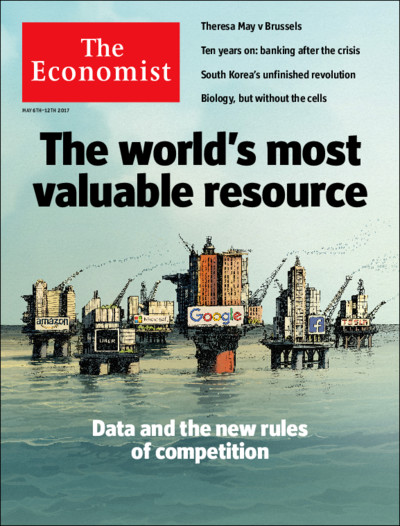
So, what’s the provocation? Beyond the less that overwhelming examples of integrations, my major issue with the vision laid out in the NGDLE article … was its disregard for how the data supposedly being shared between these systems was being used (and potentially abused) by the various parties involved.  Fact is, many of the services focused on personalization and analytics are third-party, commercial services that depend upon data collection for their business model. This opens up a series of very important questions and issues that are effectively glossed over by that article (not to mention the recent follow-up this month that dedicates an entire issue of EDUCAUSE Review to the NGDLE two years on).  This stands in stark contrast to a another model for integration of personal data across various systems. The white paper â€śMy Data: A Nordic Model for human-centered personal data management,” authored by Antti Poikola, Kai Kuikkaniemi, and Harri Honko, deals with the same issues facing educational institutions dealing with the NGDLE, but the vision is broader and the focus is not so much on the institution as the individual. It represents the closest thing I have read to a kind of bill of rights around online data:
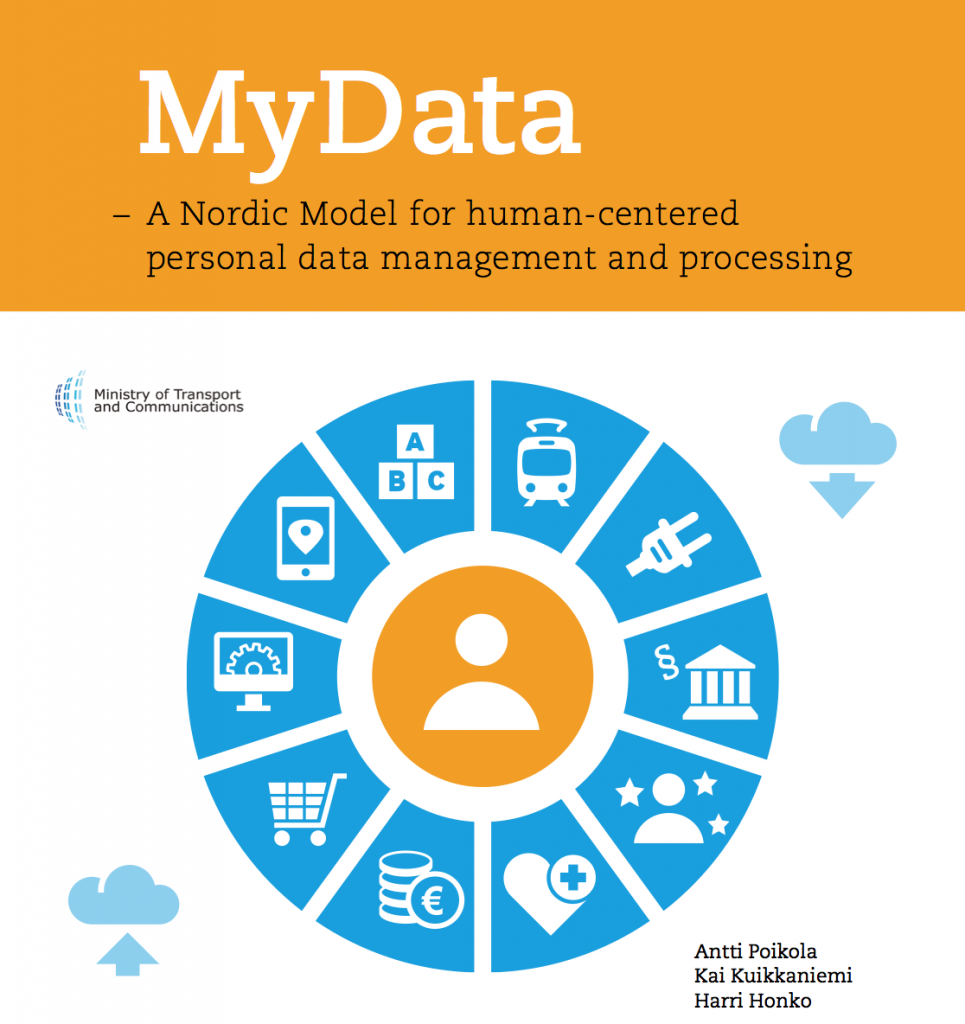
MyData: A human centered approach in personal data management

From there I pointed to models we have been using for years, personal sites, RSS, and one’s personal online presence as a hub that we can push and pull from—something that still makes sense. In fact, it makes a lot more sense then touting that the future of university systems for learning is premised on aggregating and sharing personal data with third party vendors. In fact, that is the nightmare scenario we are trying to wake up from, I’m not sure how the LMS + app store, as Caulfield suggests, is the next generation of anything we want to cultivate in higher ed.
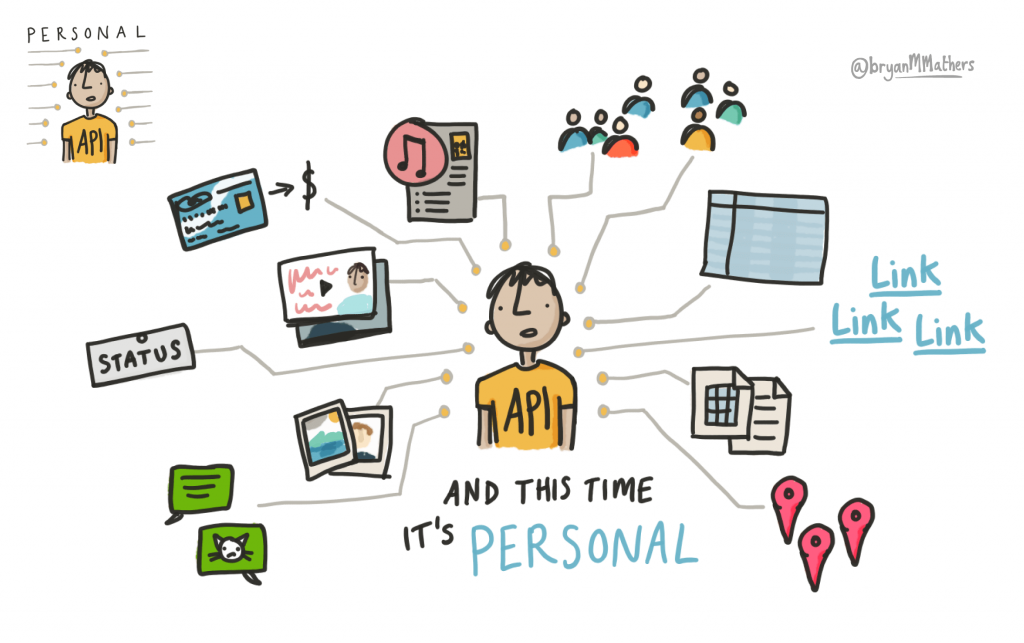
A personal API by @bryanMMathers is licenced under CC-BY-ND

And then, of course, I framed how Domain of One’s Own is one way to imagine this in action. And I believe it is a real alternative:
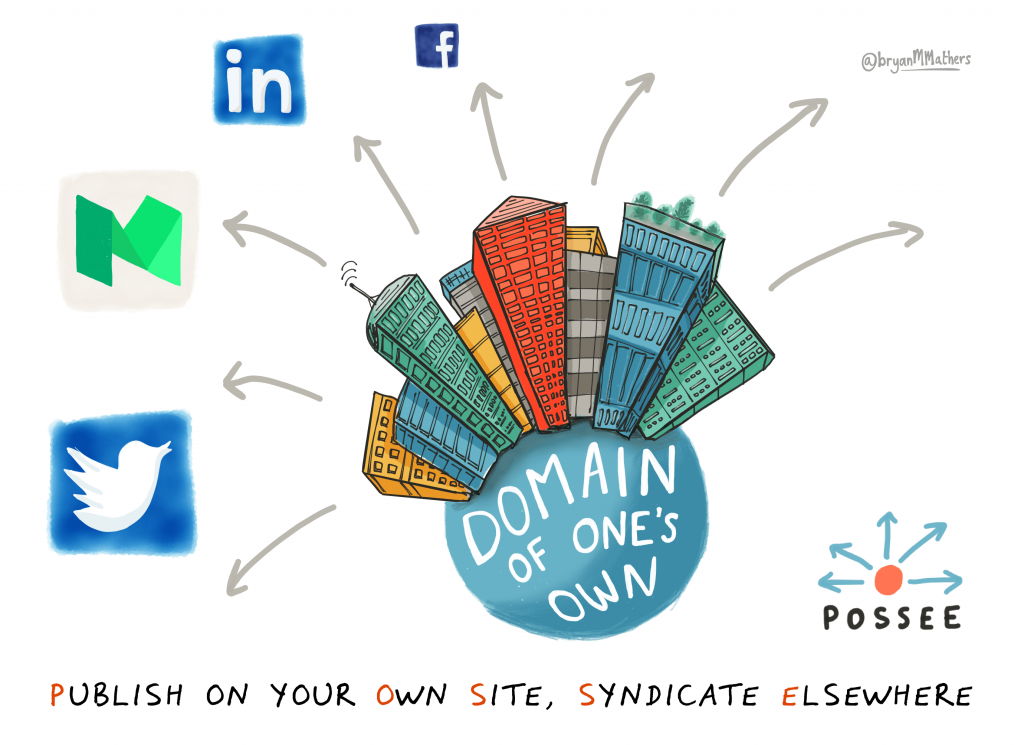
POSSEE by @bryanMMathers is licenced under CC-BY-ND

That was basically my talk, and it went fairly well.  I was concise, and I was fairly even keeled until Brian started asking questions, then it got fun ….

That picture of me laughing and Brian digging in might pretty much encapsulate the way I feel about my long-time friendship with Brian at this point. It works both ways too, I can just as easily be on the other side of that digging. But for me the image captures a comfort I feel with few people in my life, a sense of just letting it go. I know for sure that’s not always healthy, but I also know it can make for some fun and interesting things. The follow-up Q&A was a blast. Possibly the single best question I have been asked was when Brian so brilliantly built up the work we had done around blogs, wikis, EDUPUNK, RSS, ds106, etc. and asked why hasn’t it taken off? Why are you still here? And the kicker: “Jim Groom, what happened? Are you a fraud?” A brilliant Oblivion reference to boot, I love that guy!

And I answered as honestly as I could: “Yes, I am a fraud, but I am a consistent fraud.” So much fun, because it’s true. I have been playing characters whether WordPress fanboy, EDUPUNK poster boy, the EdTech Survivalist, Dr. Oblivion, Kim Droom, etc. —all a kind of fraud, but a fraud with a consistent, simple message that the open web should be our learning platform. And, as things get increasingly nuts on the open web, higher ed taking a position of stewardship for framing questions of literacy, fluency, and responsibility in arguably the most important space for the future of democracy, freedom, and liberty! Amen. 

I guess you get a sense of how it ended, and working with Brian Lamb proved to be yet another highlight of highlights in our more than 10 years of collaborations. I feel rich in edtech sometimes.


*Which, to be honest, has probably generated more EDUCUAUSE Review articles than any other topic in recent ed-tech (save maybe MOOCs and mobile learning) -despite the fact that the NGDLE is pretty much vaporware 3 years on.

Posted in presentations | Tagged , , | 1 Comment

Reclaim or, You Can’t Jinx Greatness

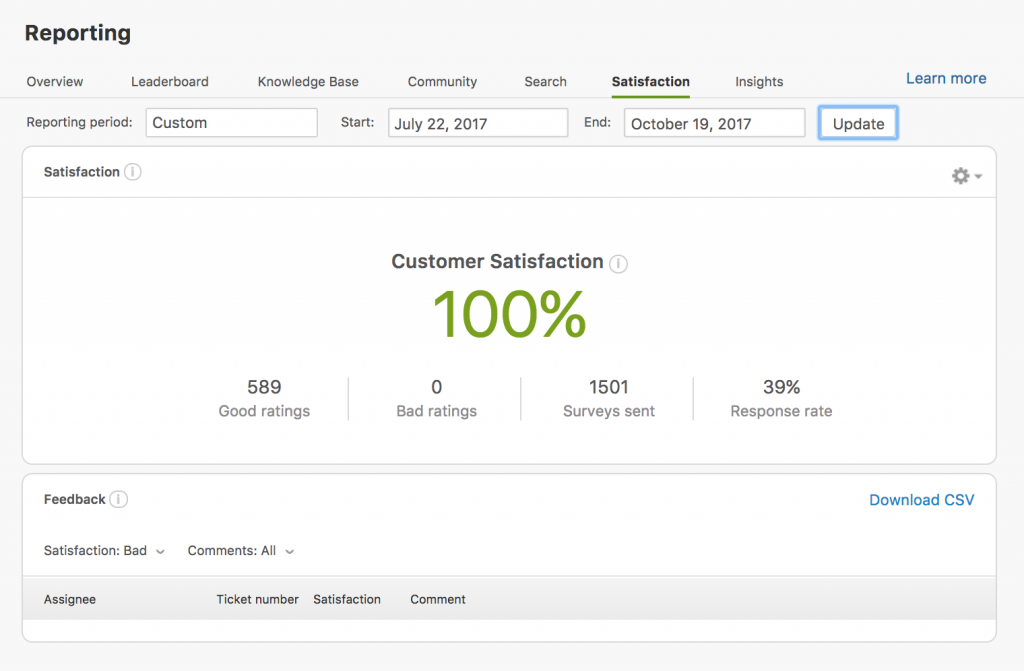
I can’t remember the last time we had a bad review of our support at Reclaim Hosting, so I went searching in our Zendesk account over the last 90 days—and I can safely say it was more than 3 months ago 🙂 Out of the 1501 tickets we have closed in the last 12 weeks, 39% were reviewed and every last one of them were good. Lauren Brumfield has already covered some of this ground in her post over a month ago when she noted that our support has been on point this semester. In no small way this is due to Meredith Fierro‘s remarkable start as Reclaim’s newest full time employee last month—I can honestly say she is giving Timmmmyboy a run for his money. OH…

Lauren and I having been using some of this new found time to organize accounts, work on new server setups, and focusing on outreach with interested, existing, and potential institutions. It’s been  fun to see Reclaim Hosting really catch its stride this semester. I already talking about the idea of building capacity at Reclaim, and I can honestly say we’re as tight and sharp as we’ve ever been right now. I know that if that is a total jinx, but as of now the support statistics bear out some of that. But beyond that, it also feels like we are in control of our financial destiny (still debt and investor free-independence is not being in someone else’s pocket!), we are insanely organized thanks to Lauren’s ability to finally inhabit her role as operations manager and more and more it feels like we are planning thoughtfully for the future—giving Tim the space to keep his sharp eye on what’s next.

Sometimes I feel I don’t have that much to say about Reclaim because everything is going so well. Not to mention the idea of my actual speaking it as its  undoing. But the strength of our work now is not by accident, but rather by design. And I do think it’s important to share the fact that we’re not only ever more real with each passing day, but we’re also not going anywhere anytime soon. So if you are not Reclaiming, my only question to you at this point is why the hell not? Pioneering your own bit of the open web not good enough for you anymore? You graduated to Medium or Facebook or Twitter only to bemoan shortly thereafter how you are locked into a system that is eroding democracy? You are not locked into anything, you can choose how and where you live online, and it’s never been cheaper or easier. So stop bitching and start pitching your tent on a re-decentralized vision of the future of the web. 

Posted in reclaim | Tagged , | 4 Comments

NCDU-fu

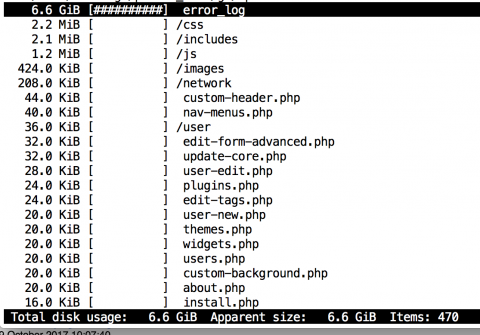
Sometimes it feels good to have some meager sysadmin competencies, such as knowing how to quickly identity where large files are in a particular hosting account. This issue comes up from time-to-time when someone discovers all their storage space has been eaten up, but they are not sure where and why.  Often this is a symptom of a larger problem, such as an error_log run out of control which suggests bad process for a particular application, etc. That was the case on a ticket this morning, and luckily I knew the NCDU command. What is NCDU, you ask?

Ncdu is a disk usage analyzer with an ncurses interface. It is designed to find space hogs on a remote server where you don’t have an entire graphical setup available, but it is a useful tool even on regular desktop systems. Ncdu aims to be fast, simple and easy to use, and should be able to run in any minimal POSIX-like environment with ncurses installed.

In other words, a script for a remote server that finds big files. You can install it on your server, and then run it by navigating in command line to the offending account, which on our cPanel servers would live at /home/offendingaccount and running the command NCDU. After that, it will list all the directories and their sizes, followed by files.  You can then locate the directory with the largest file usage, and then change to that directory and run NCDU again until you find the offending file. In the example this morning, it was a 6 GB error_log in a directory running WordPress, easy fix to clean out space, and a good heads up things in that account need to be checked for a bad plugins, theme, etc.

The life of a Reclaimer is always intense

Posted in reclaim, sysadmin | Tagged , , , | 4 Comments

There Will Be No Domains 18

It occurred to us at Reclaim Hosting that if we were going to run a Domains 18 conference, we would have to start the planning now. Fact is, we really don’t think there is a need for another conference right now. We want to avoid running the conference every year as if it is an inevitable necessity given the simple fact it’s not. Domains 17 was awesome and I believe meaningful for those whom attended, but 4 months later I’m not sure running another conference would add that much to what has already been done and said. Maybe there will be a Domains 19, I don’t know. But for right now it is enough to say there will be no Domains 18, and that’s a good thing.

Posted in Domains 2017, reclaim | Tagged , , | 9 Comments

Torino Bestiale!

Torino's National Cathedral of Cinema

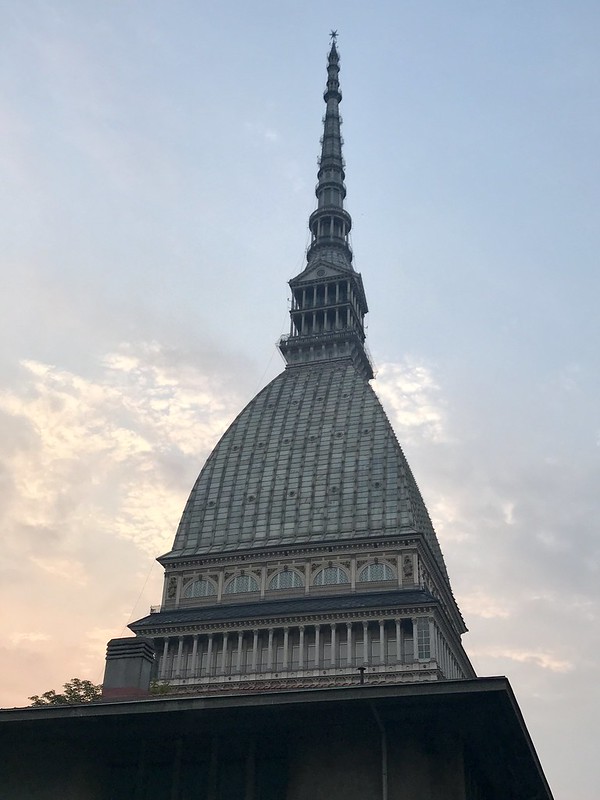
That inspired spire you see both above and below is Torino’s National Cinema Museum. Literally a cathedral devoted to film.

National Cinema Museum Spire

And I caught it during a great exhibit, namely …. 

BESTIALE!

An entire exhibit dedicated to beasts within film. And as you walk up the stairs to enter
the exhibit you hear a familiar theme:

Lo Squalo e Io

Jaws (or Squalo in Italian) being one of the most iconic beasts in film, but there are so many!

The Birds

The Birds on the Big Screen

Planet of the Apes

POTA!

Italy’s own Furia, more of a comic and TV show beast:

Furia 4

The great King Kong!

King Kong Arriva in Italia

More on the European/Italian art tip: Pasolini’s Uccellacci e uccellini, featuring the comic genius Totò. that’s how you know you are in Italy.

Toto

Radiozini B-X:

Radiazioni B-X

Also know as the Incredible Shrinking Man, a novel that blew my mind when I read it last year.

The Incredible Shrinking Man

An there was no shortage of bee-movie creature feature posters:

Bees

Cujo:

Cujo

Even homage to the grizzly bear attack scene in Revenant, which I thought fitting.

Revenant

Frogs:

Frogs

Venom:

Piranha:

Pirana

Orca:

L'Orca Assassina

Phase IV is legendary graphic designer Saul Bass’s only foray into directing:

Fase IV: Distruzione Terra

But the true star of the museum was the museum itself. You walked up the perimeter  around a truly magnificent building looking a b-movie posters…

Inside Torino's Cinema Museum

And looking down was quite vertiginous…

Bird's Eye View

You can see the wires running through the middle of the building, those are part of an elevator that takes you all the way up to the spire, along the way you get a look at the clock from Fritz Lang’s Metropolis.

Metropolis Clock

And once at the top, you get a stunning view of the city:

Torino from above

Torino from the National Cinema Museum


And even beyond the exhibit there were so many gems, like the homage to Bunuel that recreates a theater based on the toilet dinner party in The Discreet Charm of the Bourgeoisie.

The Discreet Charm of the Big Lebowski

As well as this trippy effect from Wizard of Oz

Wallpaper based on the Psycho script:

Psycho Script

And much, much more. What an awesome museum it was.

Posted in film, movies, museums | Tagged , , | Leave a comment

OpenMed

The Streets of Torino

A little over two weeks ago I ventured to nearby Torino, Italy for the final two days of a week-long training event that is part of the OpenMed initiative. What’s OpenMed, well I am glad you asked:

Five partners from Europe and nine from South Mediterranean Countries are working together to widening participation and adoption of Open Educational Resources (OER) and Open Educational Practices (OEP) as a bottom-up approach to support the modernisation of the Higher Education sector in MoroccoPalestineEgypt and Jordan.

It was an interesting get together to say the least. There were over 80 faculty and administrators from universities all over Northern African and the Middle East, and it was cool to hear their unique contexts. Some were serving as many as 250,000 students (insane), while others depended directly on creating their own textbooks for at least part of their livelihood, and still others were pushing forward with a declaration for open. There were both public universities and private universities, and at many of these institutions there was no such thing as tuition. I learned more from casual conversations that offered a glimpse into the world of their various universities than they could have possibly gotten from my talk. When I arrived that first day I felt utterly unprepared to talk to this group. I was fortunate enough to spend the afternoon in a session wherein various faculty highlighted how they envisioned incorporating “open” into their classrooms. There was some great stuff.

One of the things that I found compelling was a business professor from Palestine teaches her students about the Palestine Exchange, but all the open resources are geared towards the large Western exchange markets. Her vision was to turn her class visits to the Palestine Exchange into a series of educational resources her students will create through video interviews, blog reflections, web resources, etc. I couldn’t help but get excited, seems to me the most important aspect of open is the creative, communal act of a group of students reaching out and doing the work. I do greatly enjoy sitting around talking about possibilities for making courses more compelling by integrating small acts of open.

Additionally, I was really blown away by the workshop Daniel Villar-Onrubio led using the Image Collector SPLOT. What better way to highlight how to commit small acts of open than with a simple publishing tool. The workshop was spent highlighting how to use the tool by encouraging the 80+ participants to upload images and create a repository specific to the here and now of the OpenMed event.* It was a huge success, and it included all the usual discussions of licensing, re-use, and sharing, but thanks to the SPLOT they had an immediacy and shared purpose that didn’t seem doctrinaire or preachy. It was a masterful workshop.

I provided the presentation on the final day, with the idea of thinking outside the fairly narrow definition of OERs as a series of textbooks and licenses. My talk was not as sharp as it could have been. I had the right metaphor, but my timing and delivery was a bit off. It was a brand new talk framed around the idea of a Mediterranean Diet of Open Edtech, and as I tweeted soon after the talk:

I do think I got across my major points: use the open web as your platform, resist the urge to reduce open to a cost-saving textbook, and small tools are beautiful (SPLOTS, blogs, etc.). As always though, I ranged widely, but that is what keeps it fun.  Special thanks to Cristina Setfanelli and Fabio Nascimbeni for having me at this event, it was great to catch up with Daniel and Katherine Wimpenny from the Coventry Disruptive Media Lab (although Katherine has since moved to a new research group at Coventry).

The OpenMed Organizing Crew

I personally appreciate these gatherings because I get a look inside how Europeans are trying to build bridges and create connections with the Southern Mediterranean countries. It’s also nice to feel a bit more connected to the edtech world in Europe, and thanks to Fabio Italy more specifically. Fabio is awesome, and I really hope to work more with him over the coming years here in Italy. He has a great way about him, and his understanding of policy and how things work and what needs to get done are impressive. And watching him and Cristina Stefanelli works with the various parties at OpenMed to try and map out a localized strategy for open was eye-opening. Cristina appeared an organizational mastermind, and the tenor and quality of the OpenMed event spoke volumes to that. It was a fun event for many reasons, not least of which to see a possible path for me to try and embed myself a bit more deeply in the European edtech world. But damn i have a lot to learn, including the Italian language!


*I was sad to see the site empty two weeks later. Turns out Daniel just moved the repository to the OpenMed site here: http://oercollector.openmedproject.eu/ It is so beautiful!

Posted in open education, presentations | Tagged , , | Leave a comment

Living in Oblivion

I was on a roll blogging for a bit in September, and for me that is always a sign that I’m getting back into a work groove. But extended grooves have been harder for me this year given travel. I’m a creature of habit, and travel tends to disrupt my daily rhythms. That said, I travelled pretty regularly since 2007 (although not as much as this year where I will have spent more than 3 months on the road) and still have gotten an average of 250 posts published every year. But for some reason with each passing year the effects of travel on my psyche seem to be more disruptive. It’s hard for me to return to the blog after having been away.

But I guess I am wondering if it’s not so much the travel as the fact that I am in the novel situation of feeling both comfortable and happy. A fair amount of my writing on this blog since the very beginning was fueled in part by gut reactions, vocational desperation, and a healthy dose of imbuing some fun into a generally lifeless field. But things have changed since then, I feel grounded in a foreign country* where I’m lucky enough to spend the other 9 travel-free months of the year. Luckily my kids are not yet old enough that I have started to regret not spending more time with them, and the last two years have begun to make up for some of what I missed when I was obsessed with work.

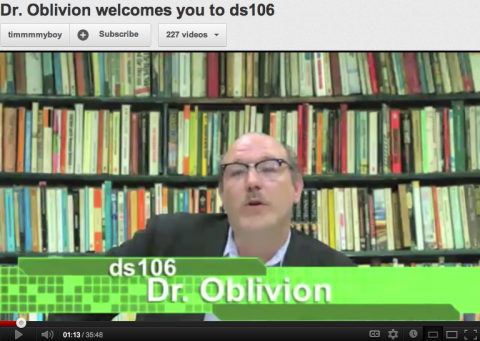
I joke about it sometimes, but in 2010, 2011, and 2012 ds106 was as an all-consuming enterprise. It was everything to me for a few years, and in some ways that process fucked a bit with my sense of self. In retrospect Dr. Oblivion seems an appropriate alter-ego for that period, a figure that aspired to symbolize transformative teaching and learning on the web, but also represented the concomitant crisis of identity and presence that haunts me (and I imagine many others).

It seems like a lifetime since Oblivion. That 5 week Summer course ended with me supine in my wood paneled basement for 2 days suffering from what I would later learn was an asthma attack due to smoking. I soon after quit cigarettes for good, and two years after that finally stopped drinking alcohol, which was long overdue. In other words, I tried to clean up my pathetic act as I stumbled into my forties. As I have mentioned from time-to-time already (and if you put up with me on Instagram it’s annoyingly apparent), over the last year I started exercising regularly, which has taken the form of hiking the beautiful mountains that everywhere surround me in Trentino.

Pano from Lagorai Hike

I guess what I’m trying to get at in this rather wayward post is whether part of my struggle with blogging this last year or two has as much to do with my being happy as it does with my being on the road. I’m in a weird position of knowing shit is bad in a lot of places†, while at the same time finally feeling I have some of my personal demons at bay (if only temporarily). I find myself happy and content in a world that seems entirely out of joint—a dissonance that harrows me daily. I understand I am conflating my personal life with geo-political events beyond my control, but the intersection of the two has made me feel a bit paralyzed. And to be clear I’m not so much looking for advice or any additional guilt (I can take care of those), but simply trying to blog myself through a strangely satisfying malaise of purpose—if that makes any sense at all.


*Feeling outside the horror show that is US politics may be part of my happiness

†My mind immediately turns to the folks in Puerto Rico who are needlessly suffering at this very moment under the cruel imperial rule of the US. 

Posted in digital identity | Tagged | Leave a comment