It’s not everyday your students accuse you of cheating on your wife with a Russian hitman

I’ve been remiss on posting about all the amazing work coming out of noir106, and that is a great loss because there is so much of it. In fact, there is 4,574 posts from 70+ students in just over 10 weeks. How could any of us keep up with it all? The firehose is on full blast. That said, I watched Sasha Kellogg’s interview (the assignment was Maggie Black‘s brilliant brainchild) and I have to say it was totally inspired. Sasha Kellogg is a character drawn beautifully by Kimberly Roehl. So much so that she has literally taken over her blog 🙂  I haven’t seen anything like this in #ds106 over the past 5 years. It seems to me like the introduction of characters in #noir106 has proved an evolutionary jump in the digital storytelling akin to the black monolith in 2001: A Space Odyssey.

6a00d8341c630a53ef015391422b9f970b

Posted in digital storytelling | Tagged , , | 3 Comments

Domain Knowledge

Screen Shot 2015-03-30 at 11.21.24 PMErika Spivey, Assistant Director of Media and Public Relations, published a follow-up on Domain of One’s Own today titled “Peer Mentoring Elevates Domain of One’s Own.” What I like about this piece is how it ties the ability for DTLT to scale a program that provides an entire campus their own domain and web hosting with the creation of the Digital Knowledge Center (DKC). This center, built and directed by the great Martha Burtis, has opened up new vistas for DTLT. Thanks to 9 ninja-like student tutors, we now have the ability to help students master a wide variety of digital skills—including managing their own domain—which has been a huge boon in our ability to carry-on with such an ambitious initiative.

It’s important to note that the DKC is not necessarily dependent on UMW Domains, and vice versa. Rather, the establishment of the DKC formalizes a peer tutoring environment to help students dive deeper into the possibilities of a wide-range of digital projects, and a crucial one for our community at the moment is Domain of One’s Own. The idea that every edtech group needs their own DKC is something that I would take to heart if I were running an edtech group—which I am, and I have.

Posted in Domain of One's Own, umw domains | Tagged , , | Leave a comment

An Art Portfolio of One’s Own

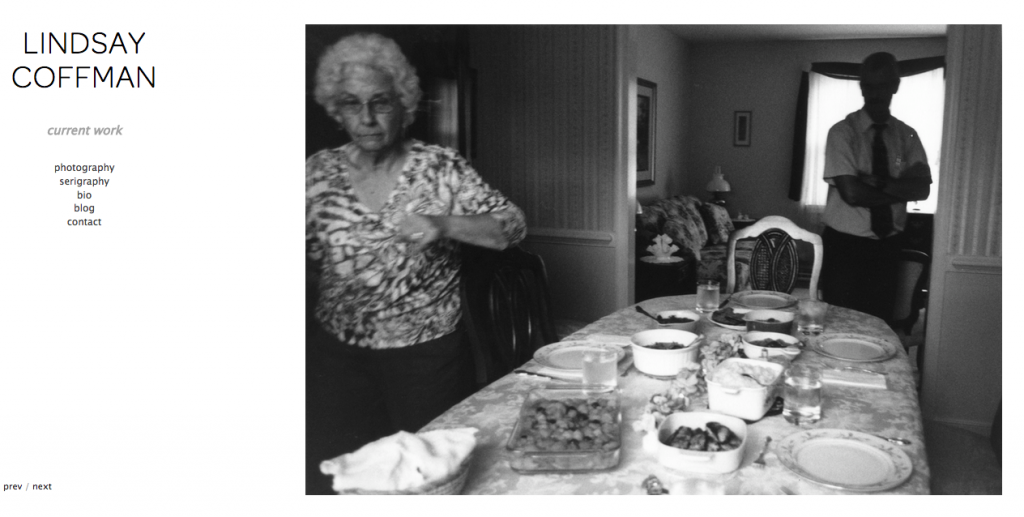
Lindsay Coffman Portfolio

Lindsay Coffman’s Art Portfolio

Over the weekend UMW alum Lindsay Coffman wanted to know how to point her portfolio’s domain to her Squarespace site. In fact, we got two different requests over the weekend from fine arts alum who wanted to do this—does that make it a trend? They were both using WordPress, but found Squarespace easier and more intuitive. I also noticed Lindsay was using Tumblr as her art blog, which is very cool and could make for another cool mapped subdomain: blog.lindsaycoffman.com.

While I want everyone to manage their own piece of the web, I also have to recognize that’s not gonna always possible or practical. Domain of One’s Own should put students and faculty in a position to make an educated choice about which they want to do with their space and why, understanding the limits and possibilities of their decision. While helping Lindsay point her domain this weekend,  it struck me how central a domain name remains to this experiment in digital identity. Lindsay can map her domain and subdomains on Squarespace, Tumblr, etc., and if and when she gets tired of those services, they go belly up, or she just wants something new, the domain remains the same. As long as the services have a viable exit plan for her data, the domain becomes the space that enables continuity and longevity of her portfolio across various iterations over time.

So, while so much of the philosophical push behind UMW Domains (at least for me) has been about reclaiming from silos and controlling your data, it’s nice to see students also recognizing the value of pointing their domains at a service (or several) in order to aggregate their loosely joined work in a fluid space of their own that can change as quickly as the web.

What’s more, this exchange helped me figure out how to map a UMW Domain to Squarespace, which is pretty easy. It also helped me start preparing to help students think about why they might want to move their domain to a registrar of their choice. This was a valuable exercise in understanding how some see the value of a domain name as far greater than their actual data, which may exist across several sites and hard drives in different forms—whereas a URL to point it all to is fairly unique. A nice reminder not to be too sure of the singular value of anything.

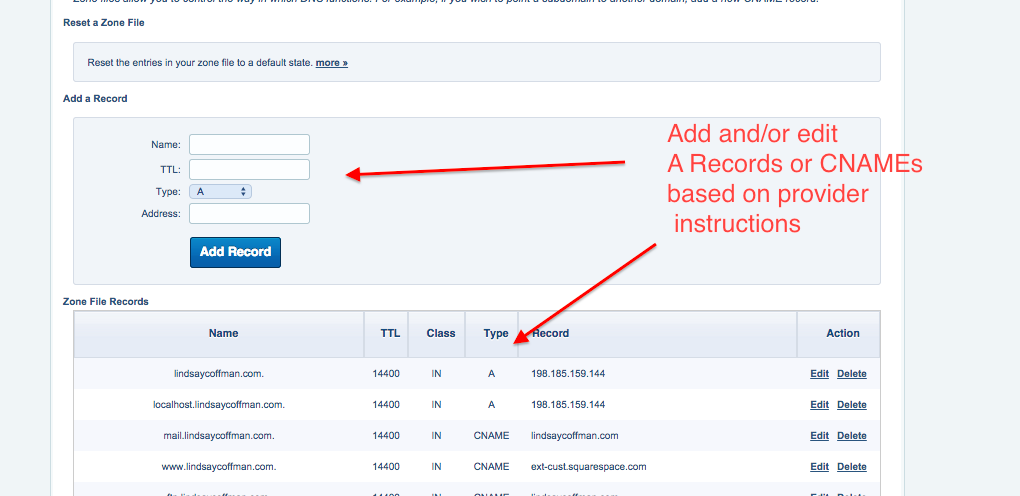
As far as mapping Squarespace domains, students and faculty can do it fairly simple on UWM Domains if they like, they just need to go into the Advanced DNS Zone Editor:

advanced_DNS_zone_editor


And then add the values that Squarespace provides in their documentation.

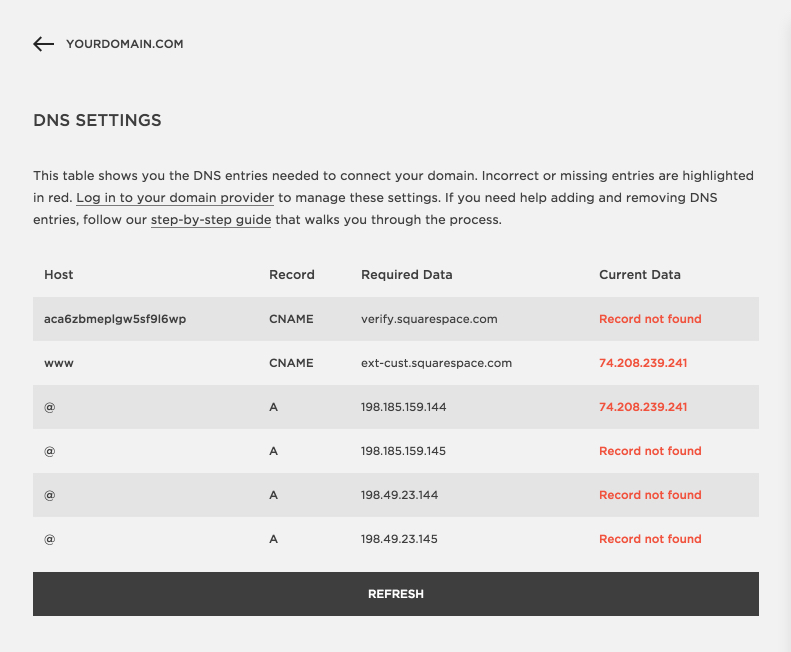
Squarespace dnsSquarespace added something interesting to the process I haven’t seen before. You basically have to add a verification CNAME to your DNS zone editor settings.

dns-settings

There are a number of students that realize the value of a website and their own domain, so much so that they’re willing to pay Squarespace $100-$120 a year (minimum) to make it dead simple. Balancing the cost of fluency versus convenience remains a constant struggle for educators who want to help folks think like the web. But between simplicity and the bava, I’ll take the bava every time.

Posted in Domain of One's Own, umw domains | Tagged , , | Leave a comment

UMW Domains Data through Spring 2015

UMW Domains through Spring 2015

UMW Domains through Spring 2015

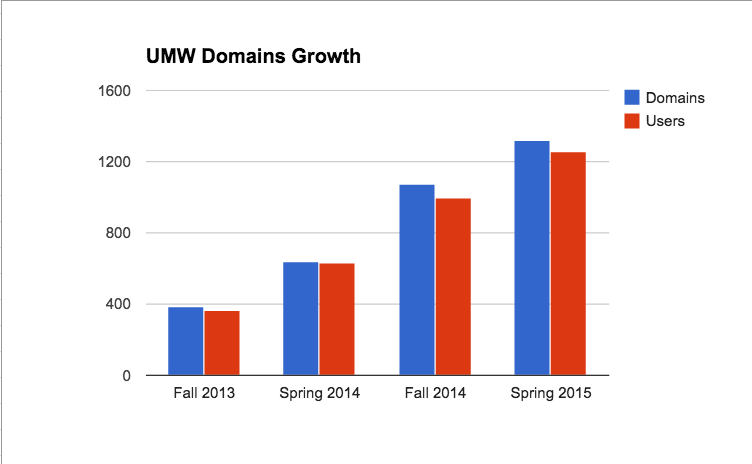
Mary Washington is doing a follow-up story on UMW’s Domain of One’s Own a year-and-a-half later. The occasion provided me an opportunity to start breaking down some of the data we’ve collected thus far. We got the data out of Banner thanks to Jill Ellington, who works in the enterprise systems group. We then imported that spreadsheet of data into the service Intercom—I wrote about it previously here—to help break down and segment the numbers to see how usage by class of student(i.e. Freshman, Sophomore, etc.), number of faculty/staff, active users, how many courses, number of faculty/staff, etc.

Also, we could break down the aggregate numbers to suggest growth over time:

Fall 2013:  389 Domains;  364 Users
Spring 2014:  638 Domains; 629 Users
Fall 2014:  1074 Domains;  993 Users
Spring 2015*: Domains 1320;  1260 Users

And here is a segmented view of those 1260 users:

975 Active students (or 997 -bit uncertainty here)
154 Graduates (students who are no longer matriculated)
131 Faculty and Staff

Also, we had 10 courses using DoOO in Fall 2013 and 14 in Spring 2014. In fall 2014 we had 23 courses, and 14 in Spring 2015.

Domains by student’s class year:

Freshman: 149
Sophomores: 206
Juniors: 244
Seniors: 420

Another interesting breakdown which reinforces what we learned the first year of the initiative is that juniors and seniors with their own domain outnumber freshman and sophomores two-to-one. Originally we thought we would roll this out to each class as freshman en masse over four years, but almost two years in we’re realizing that students further along with their degree (and settled in a major) are far more likely to have domains. This is reinforced by our decision to integrate UMW Domains into specific courses and departments with certain faculty—although that decision was made because students and faculty were not participating outside a curricular context.

One of the things that seems evident to me thinking about Domain of One’s Own at this point in time is curricular integration is king and culture always matters. Thoughtful, well-supported faculty members and enterprising departments that can integrate a broader vision of digital fluency into their courses and programs will continue to drive the value of UMW Domains.  Which, in my mind, means faculty development and support remain the gold standards to transforming our campus culture.

Update: Audrey Watters asked a couple of follow-up questions on Twitter that might be worth recording here. I mean, who the hell am I to argue with Audrey? She’s my god-damned hero 🙂

Posted in Domain of One's Own, umw domains | Tagged , | 6 Comments

And All Through the House

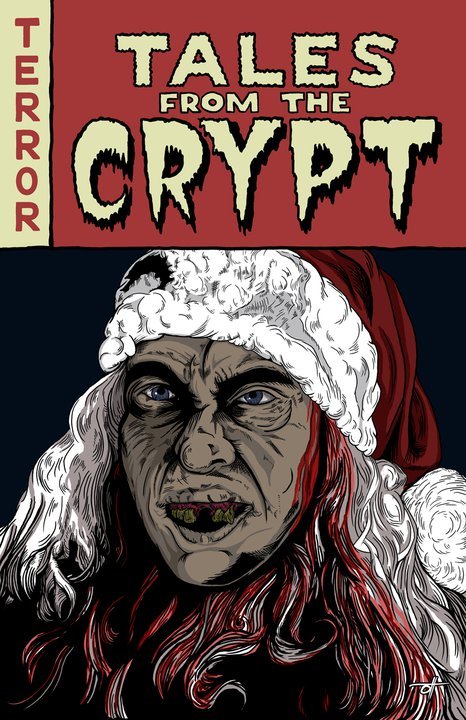
tftcI started watching the first few Tales from the Crypt episodes over break, and while it’s uneven, there are some crazy ass episodes. For example, the second episode of season 1, “All Through the House,” which aired on June 10, 1989, and was directed by Robert Zemeckis. Here is a quick plot summary via Wikipedia:

A greedy wife (Mary Ellen Trainor) kills her second husband (Marshall Bell) for his insurance money and is then visited by a hideous serial killer (Larry Drake) dressed as Santa Claus and realizes her daughter is in danger.

I didn’t get much of that from the actual episode. I had no idea about the second husband or the insurance money. And up and until the psycho Santa Claus, it sounds fairly noiry. But one detail the plot summary misses is the fact that this murderous Saint Nick has escaped from a local mental institution. A popular trope from 1970s and 80s slasher films, paging Michael Myers. What’s more, I imagine Zemeckis was aware of the 1984 b-movie Silent Night, Deadly NightI’m not sure if this is an updating of an original tale, but as soon as I make my way through all of EC’s Tales from the Crypt I’ll have a better idea of that.

Well, anyway, boys and ghouls, if you are brave enough you can sit back and enjoy a psychopathic Xmas tale in HD care of YuleTube 😉

https://www.youtube.com/watch?v=NHbavJxYBtk

Posted in pop culture, television, YouTube | Tagged , , | 2 Comments

Coleco Cartridges for Atari 2600

coleco_atari_2600_cartridges

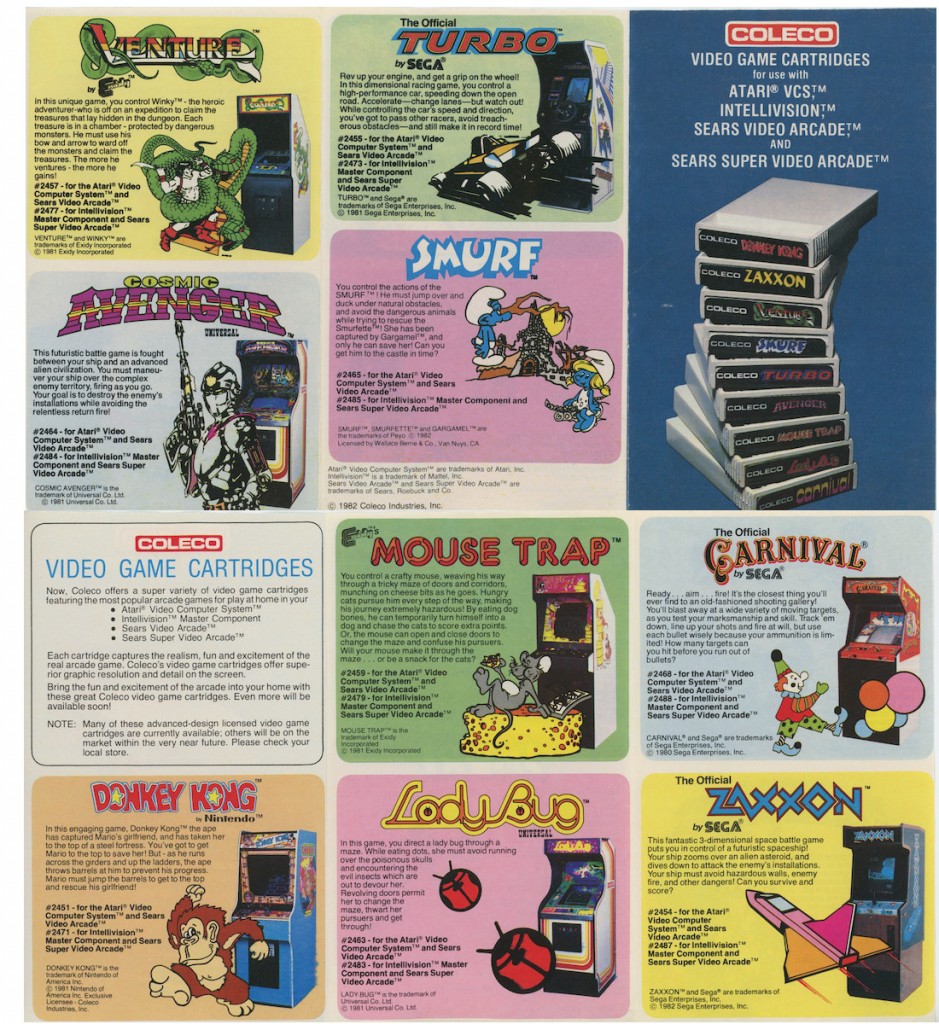
This is a 1983 (I think) promotional pamphlet that accompanied Coleco video games for the Atari 2600 console. Donkey Kong was just decent, but I loved Venture and the Smurf game: Rescue in Gargamel’s Castle. Never really cared for Zaxxon or Mouse Trap as games, and I never played the rest. Given how rudimentary Venture’s graphics were in the Coin-op version, it almost seemed like a flawless port to the 2600. As for Gargamel’s Castle, well, I’ve been an unrepentant Smurf fan since second or third grade.

Zach Whalen brought this gem over along with a ton of video cartridge manuals and other “paratext,” as he described it. This stuff is like a waterfall of context nostalgia. Between the cartridge art, the player manuals, advertisements like the one above, and the actual cartridges and consoles—I really couldn’t be happier. My office has transformed into an early 80s video game showroom. I’ll be scanning and blogging as much of the cartridge art, manuals, and advertisements as I can as part of the Console Living Room exhibit. And you can be sure I’ll be flooding all the social mediaz with what I discover. From here on out, there will be some serious bava2600!

B-xtPURXIAEj14X-1

Image credit: The great Michael Branson Smith

Posted in Console Living Room | Tagged , , | 6 Comments

Scaling Domains

One of the questions that came up during our trip to Georgetown earlier this week (read more about that visit here), was how do you effectively scale something like UMW Domains. It’s a good question, and we talked a bit about making the tech more seamless. But Tim Owens pointed to UMW DTLT’s latest addition, the Digital Knowledge Center (DKC), as one tremendous asset to scaling the work we are doing with UMW Domains—and that is absolutely right.

57921-Oprah-you-are-absolutely-right-Vu6s

Martha Burtis has done a brilliant job of getting her center up and running in the Fall. And there is no question DTLT’s presence and possibilities have been dramatically expanded as a result of her work. Martha has built a center that employs eight student aides who are equipped to help the broader student community at UMW with everything from media editing to managing WordPress to navigating cPanel to editing images to using TinkerCad, and much, much more. In short, the DKC is a peer-tutoring center for digital projects that coordinates with faculty development to further support and scale the work we do on campus. Martha’s recent post, “Why Every EdTech Group Needs a DKC,” lays out the various benefits the DKC offers a group like DTLT, and it comes highly recommended.

tumblr_m2chz6x2wX1r8bcel

When we talked briefly about the work Martha is doing with the DKC, everyone around the table at Georgetown was impressed. Scaling was not framed as solely a technical issue, but a development and support issue. At it’s heart, support and development is what the DKC helps us with when it comes to Domain of One’s Own. A center like this enables students who have issues or questions about what’s possible with their own domain and web hosting have immediate support and guidance from their peers. What’s more, it enables us to provide support for entire courses for faculty who want to explore UMW Domains, but are concerned about balancing tech support with their teaching. This goes a long, long way towards scaling a project that is deeply rooted in a broader vision of digital fluency.

B24uqmB

Katie Gach (who was one of Michael Wesch’s Anthropology students at Kansas State) was at the table, and she was immediately taken by the idea. We talked briefly at the break about the DKC, and she suggested how such a Center highlights the humanity of the Domains project. The space where the support and interaction around this process of becoming digitally fluent was anchored, and that’s a great way to think about what the DKC means to our group. I’m sure folks at Georgetown will be in touch with Martha, and I love that the question of scaling UMW Domains is not answered by a particular technology, but rather by investing in people and fostering relationships and conversations across campus. Now that’s scale that scales.

tumblr_mi74u7i3cq1qzgnzho1_400

Posted in Domain of One's Own, umw domains | Tagged , , | Leave a comment

UMW Domains Is Not Radical

giphy

On Tuesday Tim Owens and I spent the afternoon with the good people at Georgetown’s Center for New Designs in Learning and Scholarship (CNDLS). Rob Pongsajapan invited us up to talk about the work we’ve done with UMW Domains. Rob has led much of the WordPress development for CNDLS over the years. In fact, six or seven years ago he came to UMW to talk about the work we were doing with UMW Blogs at the time. So it was pretty cool to re-connect around Domains. There is a consistency to the work we have been doing over the last decade, and that became increasingly clear to me during this short day trip. In fact, best thing about both UMW Blogs and UWM Domains is the number awesome people in the field they have brought us into contact with. Sharing our work with other groups is the best part of what we do—and it has been one of the things that has made UMW’s DTLT distinctive.

walk-the-moon-walk

As I alluded to earlier, an interesting sense of convergence hit me while I was at Georgetown. I realized that CNDLS Executive Director, Eddie Maloney, was part of a panel Martha Burtis took me to back in 2006—she was a great director! The panel also consisted of Bryan Alexander and Dan Cohen, and it was titled “Scholarship 2.0: What Web 2.0 means for Digital Humanists.” That’s some crazy Digital Humanities history right there.

the-box

One of the things that really struck me during the panel was Maloney’s vision of the portfolio as a digital notebook that could move seamlessly across and between courses departments, and disciplines. It’s an idea that I came back to just months later right here on this blog while building UMW Blogs. I still love the idea of a digital notebook, it’s how I have thought of the bava for almost a decade. So when I met Eddie for the first time officially, I was kinda struck by the history there—although I didn’t formally mention stealing his ideas 🙂

Bueller-

As anyone in higher ed tech knows, the digital portfolio has become something of a white whale. We’re monomaniacally pursuing this all-encompassing monstrosity of integration, while at the same time we know it’s so many different things to so many different people. UMW Domains begins to pierce the skin of that leviathan-like mythos by reframing who manages, controls, and ultimately owns the portfolio well beyond their time at university. Your domain can certainly be a portfolio, but it can also be an upgrade to your institutional ~space infrastructure, a platform for digital scholarship, an engine for digital fluency, a highly customizable alternative for courses spaces, and on and on and on. It’s many, many things. It’s Protean. But back in 2006, as Rob noted while we were getting some coffee, the idea of rolling out a web hosting platform and providing your entire community personal domains would have been a non-starter. The idea would have never gotten off the ground, and even in 2006 commodity web hosting was no longer new. It had been around for 3 or 4 years. Hosting was not radical in 2006, but the idea of it as a tool in higher ed was.

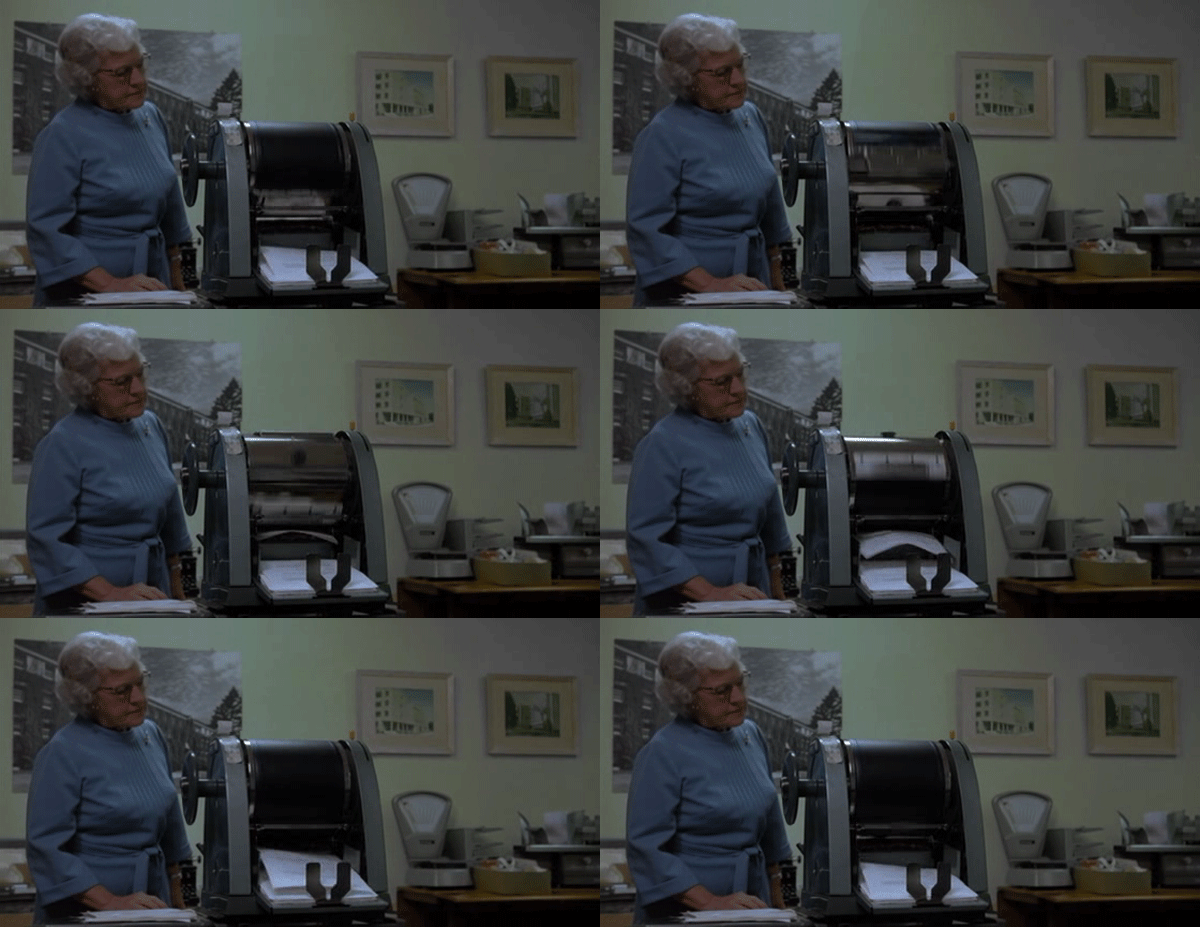
mimeograph

Almost 10 years on from that 2006 panel about the digital notebook at CHNM, we have folks from Georgetown’s CNDLS and their University Information Systems (UIS) at the table, and they immediately see its value. They realize the possibilities, and they’re mindful of the risks and potential issues, but none of those concerns seem to be deal breakers. I was deeply impressed with Peter Farkas, the Director of Educational Technology at UIS. His questions and concerns were on the money, while at the same time he got the immense possibilities of such an initiative. At no point during the afternoon did I get the sense that IT was an impediment at all—and that speaks to the fact that ten years later the idea of a Domain of One’s Own is no longer radical. In fact, it almost seems practical and necessary—and that’s a pretty striking shift.

looming-assessment

And that realization is not limited to our time at Georgetown. Tim and I talk to many schools who are interested in a Domains initiative, and the conversations have rarely been about convincing folks of the value, but rather how they can do it for their particular context. It’s become increasingly clear that the LMS will do what it does best: quizzes, grade books, etc. But it will never truly be a platform for personalization, exploration, and individual control outside the definitive and limiting confines of the course.  A domains project provides personalized namespaces, easy web publishing, and a whole suite of applications (all of which are portable) for those that need them beyond any one course—not to mention their time at university. It’s not radical anymore, in fact, it’s actually pretty trailing edge. It’s called the web, and its been around for more than two decades, it’s just time that universities start exploring how it fits the needs of their campus.

celebrate

________________

All GIFs in this post, save the first and last, are by Michael Branson Smith. I found them while randomly searching for eportfolio filtered through animated images. I should not be surprised.

Posted in Domain of One's Own, umw domains | Tagged , , , | 1 Comment

Server Admin Tips: SQL Command for Mass Deletion of Moderated Comments in WordPress

Tim Owens and I hung out in a coffee shop for a couple of hours before our afternoon visit with the folks at Georgetown’s CNDLS about UMW Domains (more on that in my next post). We were doing some maintenance work on UWM Domains server, and I am trying to learn as much from Tim as I can about server stuff. So, he gave me a pro-tip about the best way to delete large numbers (thousands) of moderated comments in WordPress other than point and click.

With comments marked as spam you can empty the folder (though if there are too many this might be less of  load on the server), but there is no easy way to get rid of moderated comments that are spam. And if you get 10,000+, this could take hours to delete manually. Below is a quick trick using an SQL command in phpMyAdmin.

Here’s how:

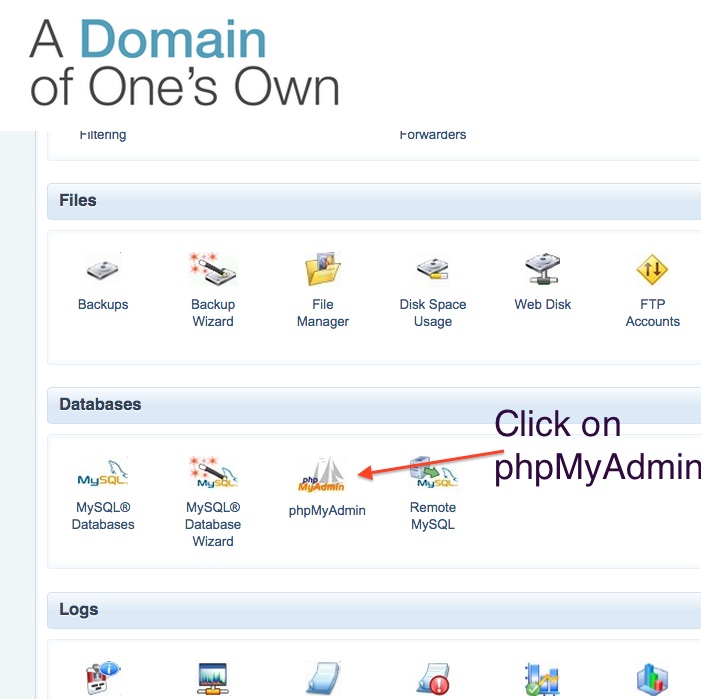
Make sure you know the proper database for your WordPress blog if you have several installed. You can find this in databases or the wp-config file in the blog directory (use File Manager for this). Once you know the proper database, click on phpMyAdmin in the CPanel dashboard.

click_on_phpmyadmin


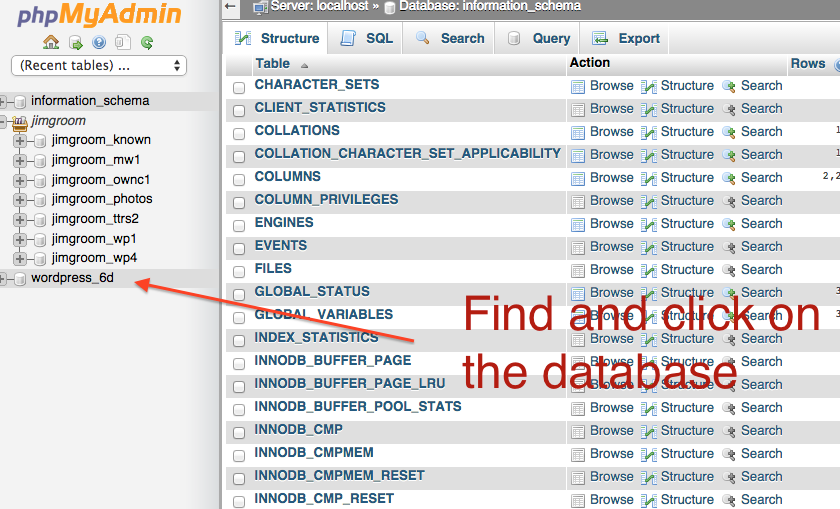
From there, find the database of the site that has all the moderated spam.

Screen Shot 2015-03-04 at 10.02.07 AM

After that, look for the wp_comments table in the database, and click on that table.

wp_comments_table

You should now be in the wp_comments table. From there, click on the SQL tab.

Screen Shot 2015-03-04 at 10.03.02 AM

You can now add the SQL command DELETE FROM 'wp_comments' WHERE 'comment_approved' = 0

Screen Shot 2015-03-04 at 10.06.08 AM

You’ll get a dialog box confirming the command.

comment_delete_dialog


After that, you should have gotten rid of every commented that has not been approved.

Screen Shot 2015-03-03 at 9.25.38 PM

This was a huge time saver yesterday, and I am logging it here because I don’t want to forget this trick.  Although, as Jason Parkhill noted on Twitter, when it’s WordPress, there is always a plugin for that 😉

Posted in Domain of One's Own, umw domains, WordPress | Tagged , , , , | 3 Comments

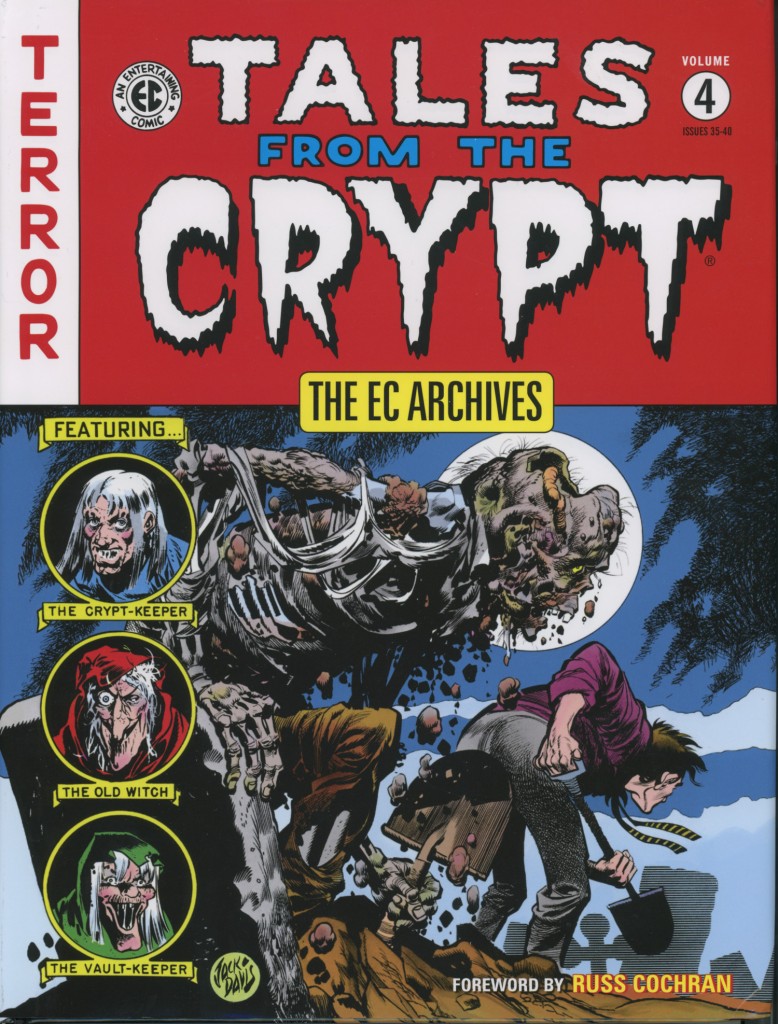
Tales from the Crypt: “Last Laugh”

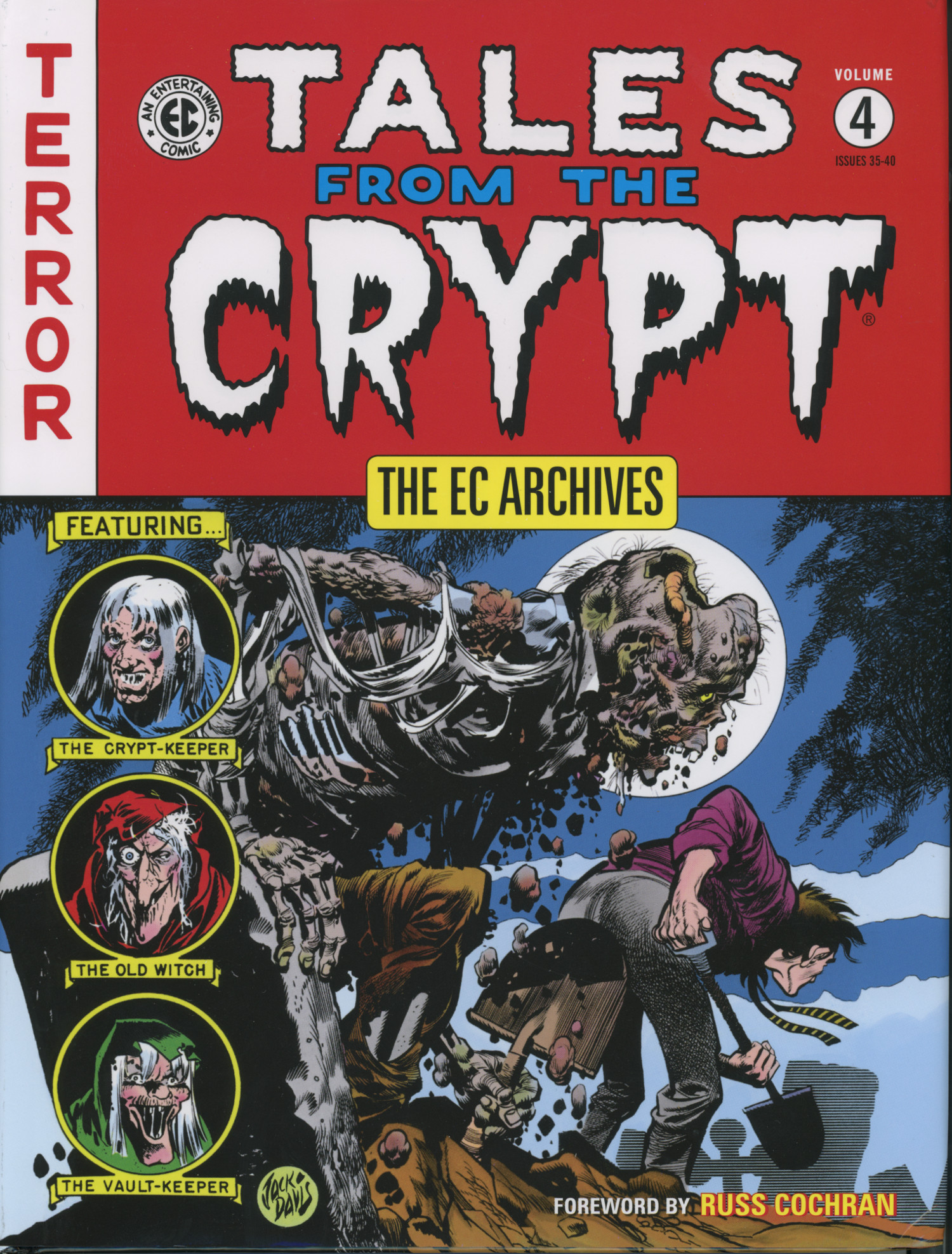
crypt_vol4

Click image for larger version.

I got volume 4 of the Tales from the Crypt archive last week, and it’s even crazier than volume 3. It’s a beautiful edition published by Dark Horse Comics, and I highly recommend it to any and all fans of early 20th century pop culture. My son and daughter have been eating this stuff up, and I am enjoying reading it to them at night. I put on my best crypt keeper screech. Miles reads it again and again, and when I asked him which one of all the stories is the scariest, he points to “Last Laugh.” But not so much because it’s scary, but rather because it’s sad. And damn is it sad—the ultimate in parental parables of neglect and revenge!
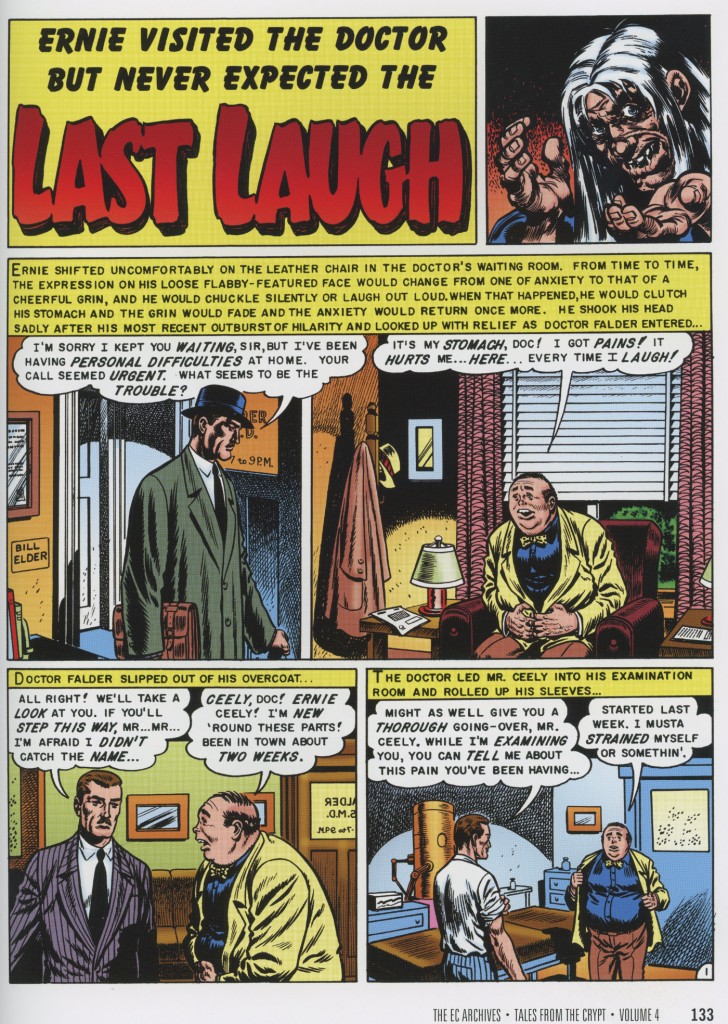
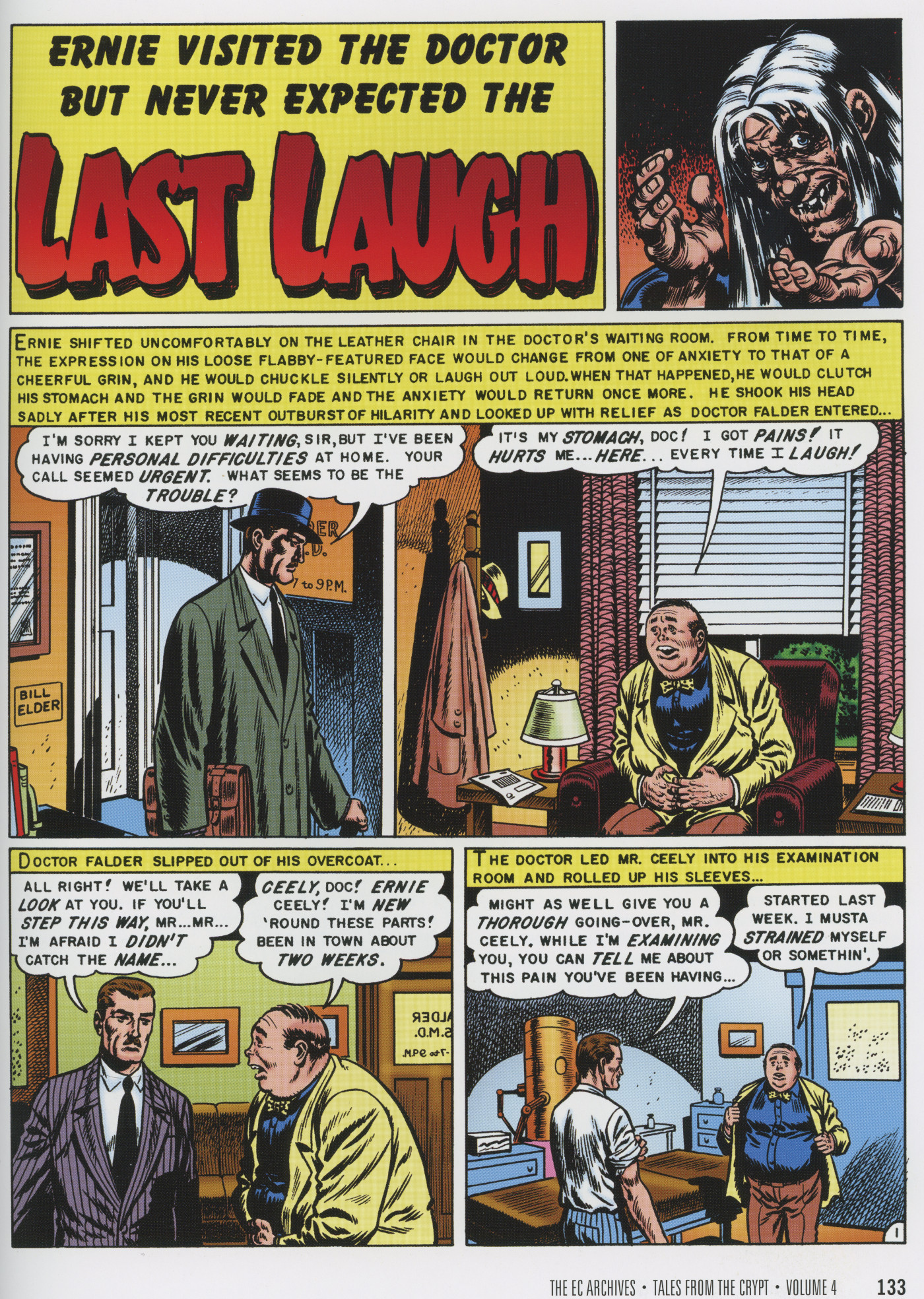
crypt_last_laugh_title_page

Click image for larger version.

Let me explain, Ernie is a practical joker who goes to the doctor complaining of stomach pains. While being examined he explains how he strained his stomach pulling a particularly funny stunt. But before he gets into the details, he recounts some of his more quotidian practical jokes. Nothing like a classic crank call to characterize a harmless prankster.
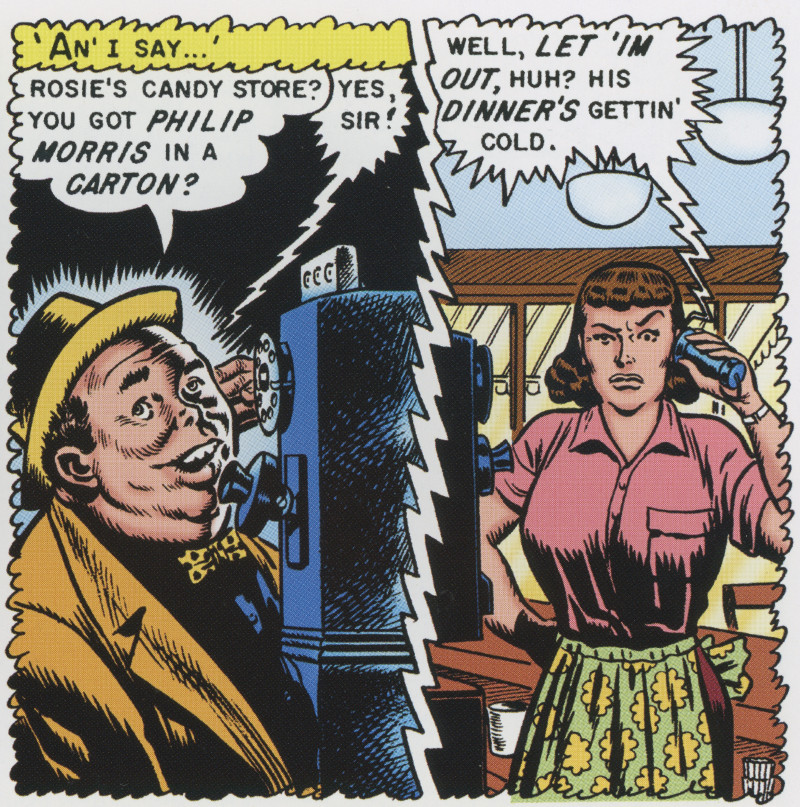
crypt_last_laugh_philip_morris

As a quick aside, the artist for this tale, Will Elder, was himself an inveterate prankster. He was also one of the founding artists for Harvey Kurtzman’s Mad magazine. In fact, as a testament to how formative EC Comics were to the comics industry, three of the four artists illustrating for this particular issue of Tales from the Crypt would eventually be comic industry Hall of Famers.¹ Also, any fans of Robert Crumb’s comics might quickly realize the influence of these artists on his own vision, the figure of the candy store proprietor seems right out of Crumb’s work.

Anyway, this practical joke takes is craft to the next level when he decides to dress up some horse meat in kids clothes and lay it on the local train tracks. WTF!
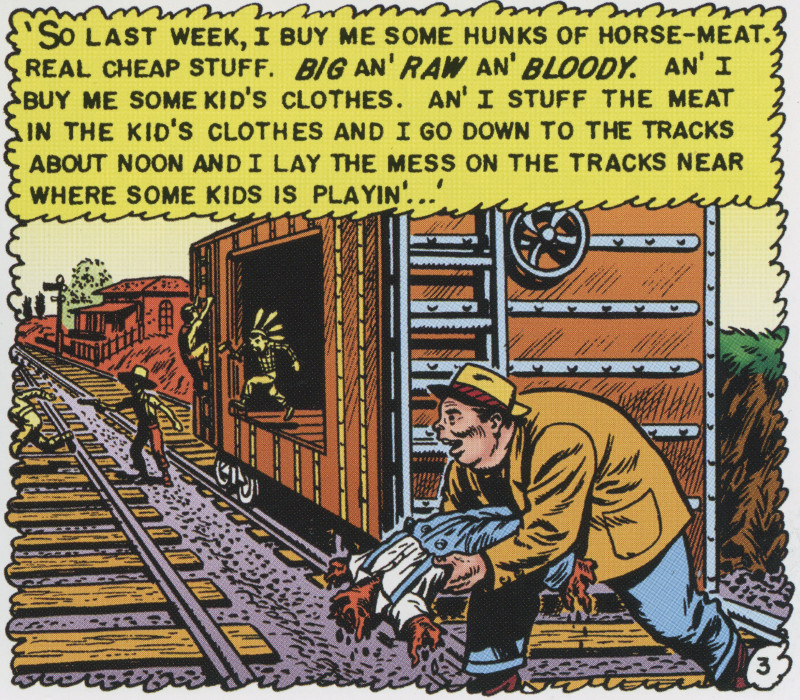
crypt_last_laugh_horse_meat

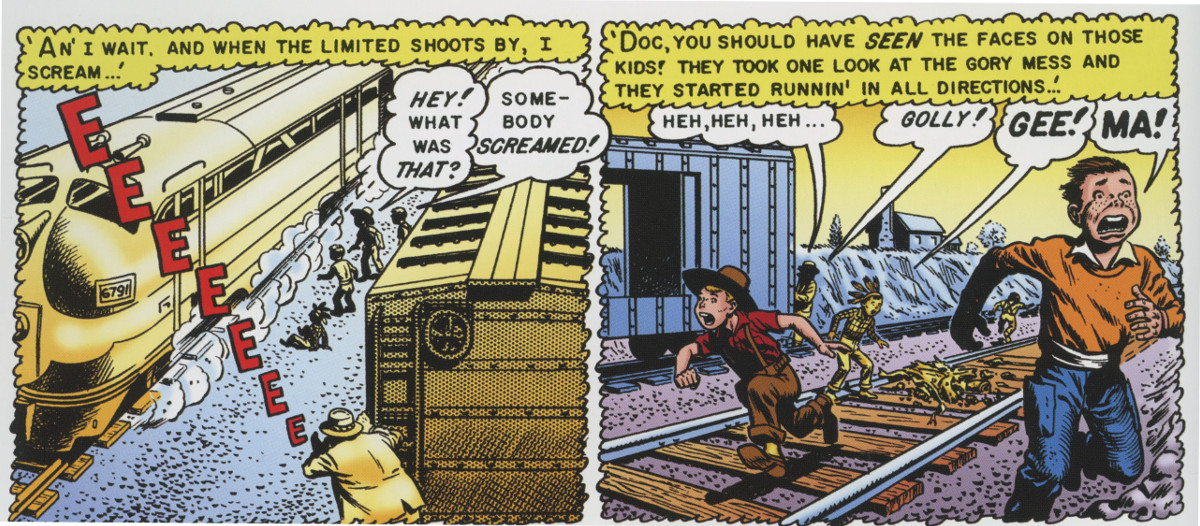
And, of course, why not hide behind a parked train car and let out a blood curdling scream to accompany the ravished torso to scare the neighborhood kids.
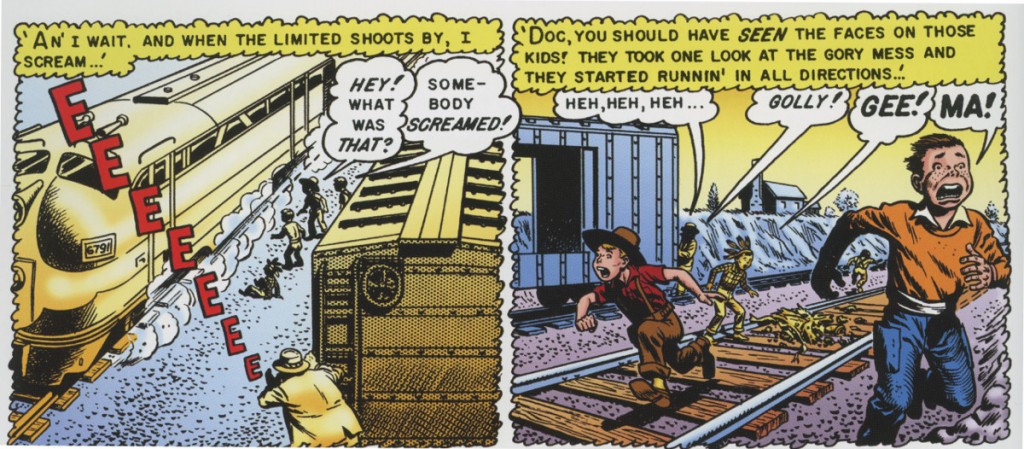
crypt_last_laugh_train

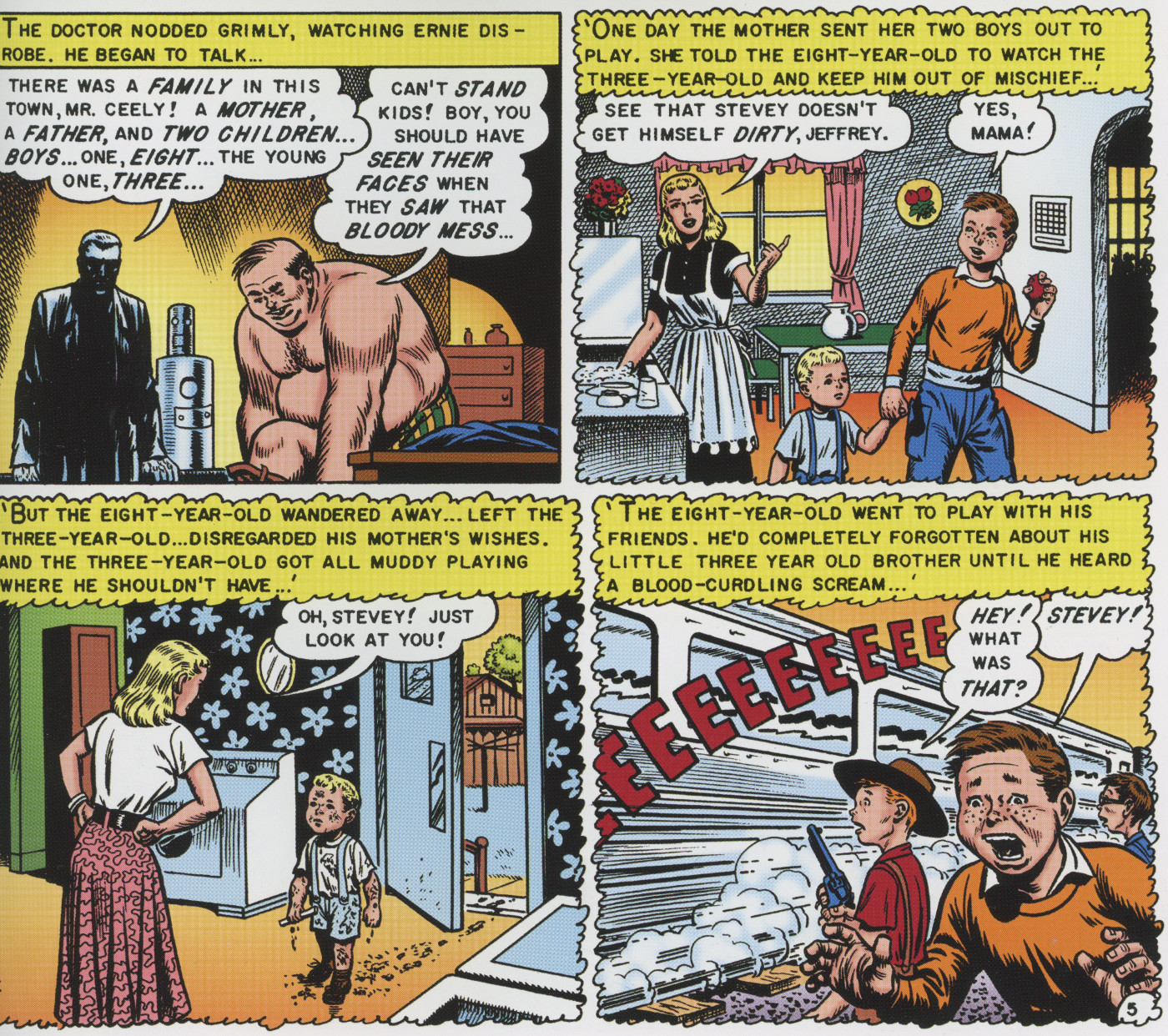
Can this comic get any darker? Well, yes actually. The shadowy doctor figure begins to recount a dark tale about a family from the area. Notice how the narrative is being filled in from another perspective, and you get another image of the train screaming by, but this time from the kids’ point-of-view. Also, I love how the Tales from the Crypt comics use the upper portion of the comic panels to provide full blown narration of events. Far more literary that most other comics in that regard.
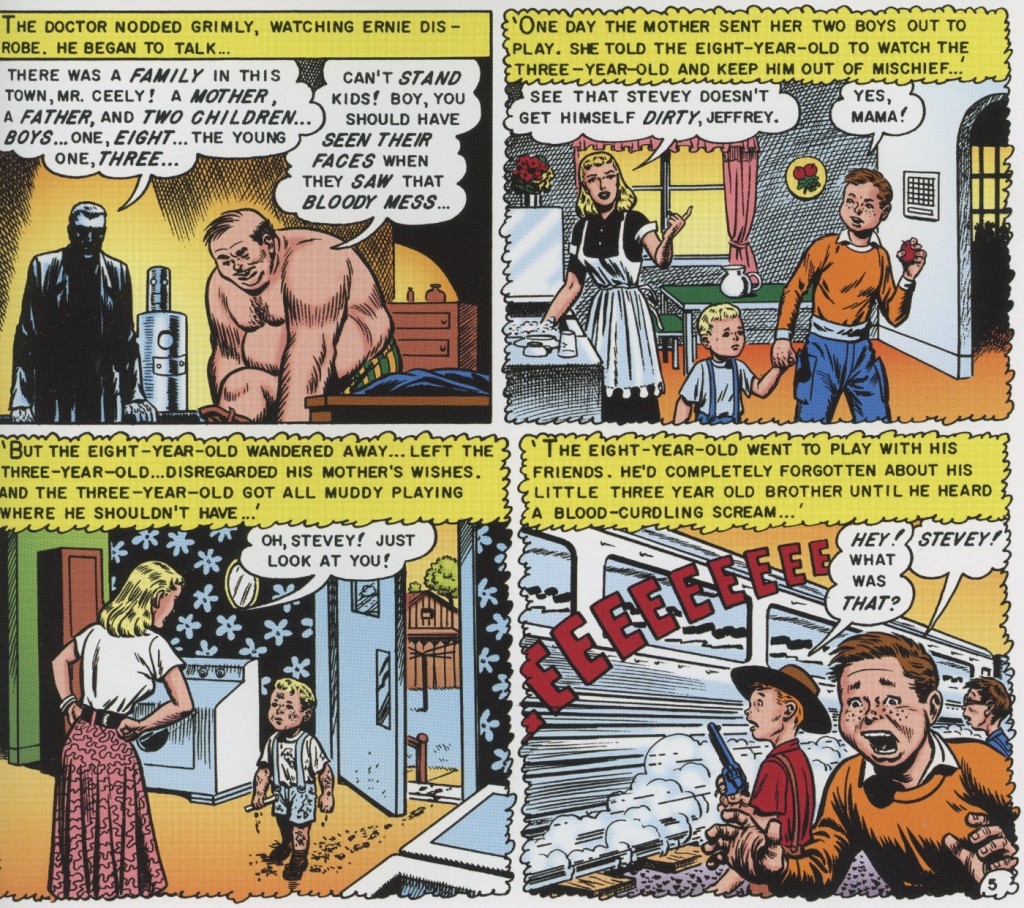
crypt_last_laugh_4panel

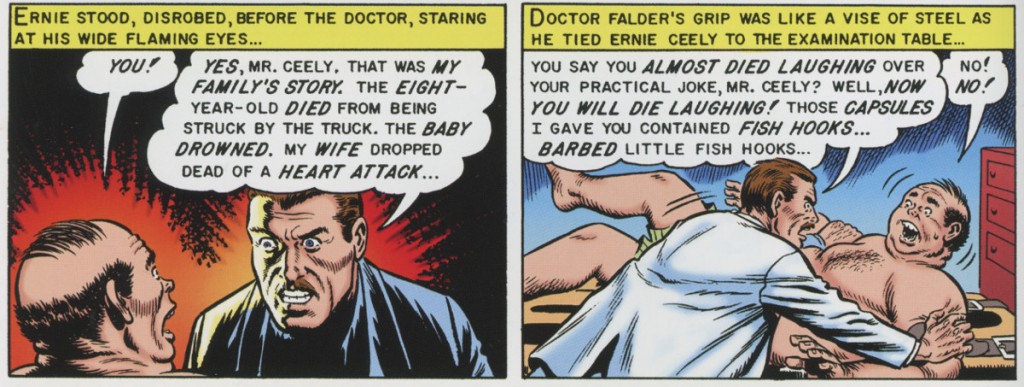
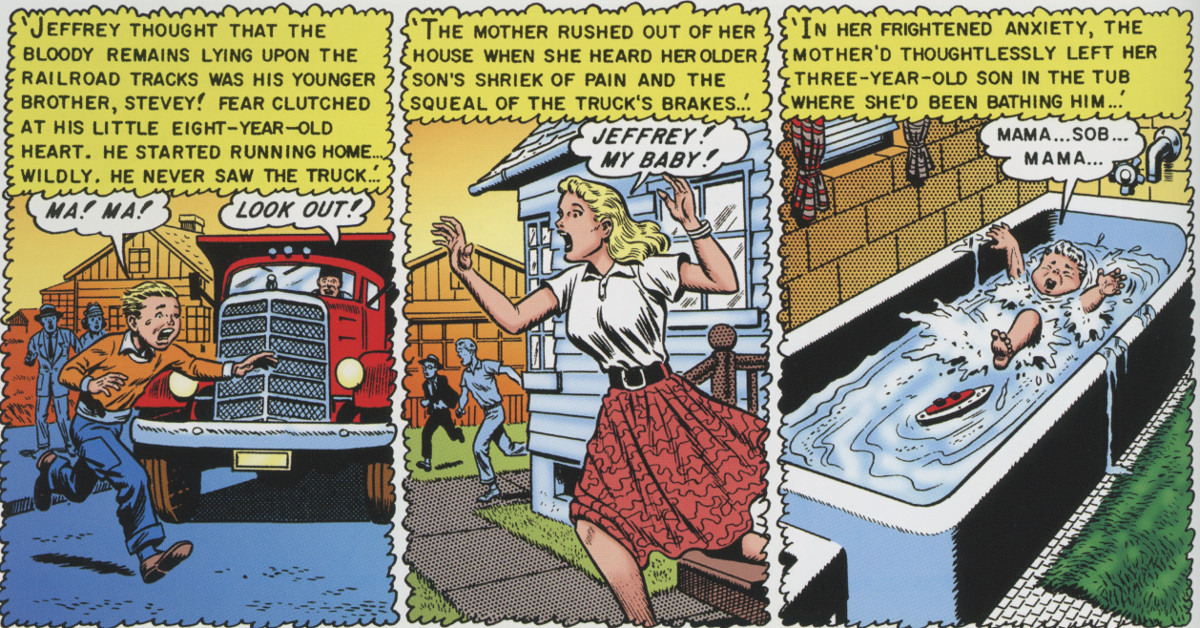
I mentioned it would get darker, right? This is the part that seems to have scarred Miles (Tess was unphased 🙂 ). Jeffrey, the 8 year-old charged with watching his three year-old brother, thinks the bleeding hunk of horsemeat is his younger sibling Stevey and freaks out. He runs home screaming bloody murder and in his state of trauma runs across the street and his hit by a truck. To make matter worse, his mother hears the scream and leaves the three year-old in the tub while running out to see what happened. Little Stevey drowns. Crazy, right?
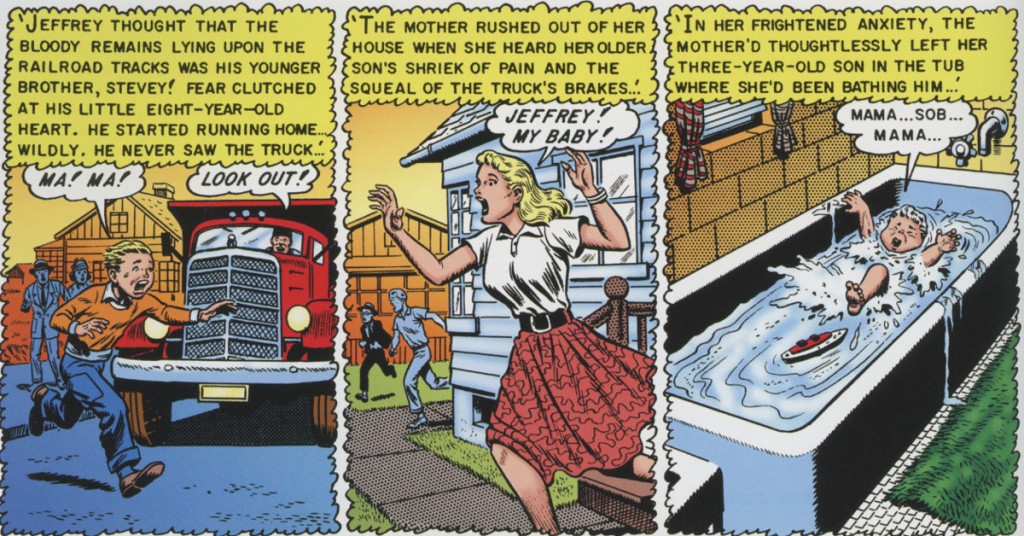
crypt_last_laugh_3panel

After that, we get the denouement.

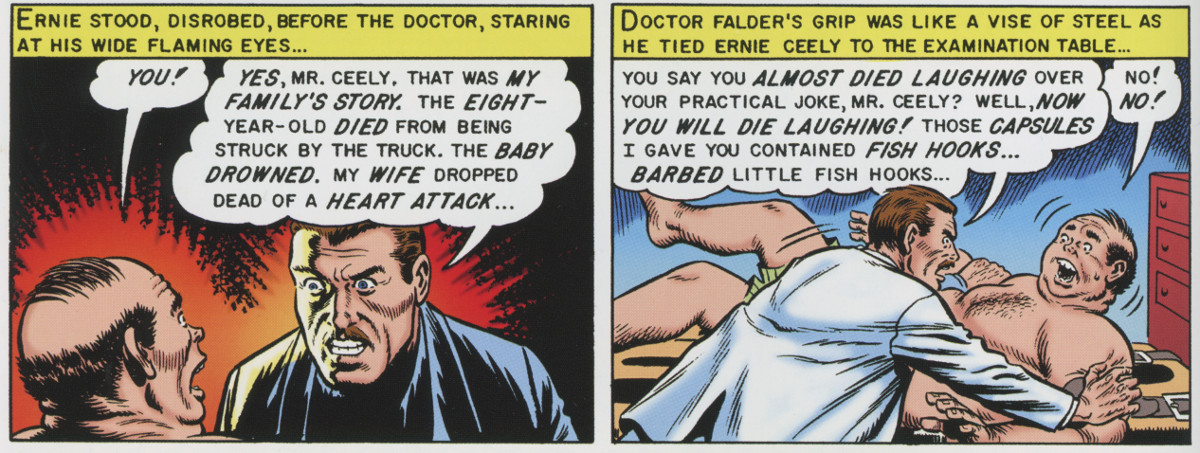
crypt last laugh_my_family

That was the doctor’s family, and turns out when his wife realizes both her children had died within minutes of one another, she dropped dead of a heart attack! The brutal revenge killing ensues, and the story wraps up with some quips from the crypt-keeper. I just love the panel when the doctor does the reveal—I’ve seen it a million tines since in all those Marvel comic moments—but never with this much emotional baggage. Now that’s entertainment!

Turns out EC Comics horror comics were relatively short-lived, and the center of a broader political campaign culminating in the US Senate Subcommittee on Juvenile Delinquency. The subcommittee targeted violent comics like Tales from the Crypt, arguing they contributed to the juvenile delinquency crisis in America. As a result,  the self-regulating Comics Code Authority was founded and introduced censorship that seemed to target EC Comics horror magazines:

Publishers were forbidden from using the words “terror” and “horror” in titles, for example, and forbidden from depicting zombies, werewolves, and other gruesome characters and outré horror fiction trappings.²

So, not only did this publication launch the careers of some of the greatest comic artists ever, but was also behind an unprecedented outbreak of juvenile delinquency. That’s awesome! No wonder Miles and Tess love them. Hell, soon they may even graduate to video games 🙂

_____________________________________

1. The three other artists that illustrated stories for the October/November 1953 issue  of Tales from the Crypt were Jack DavisReed Crandall, and Graham Ingels.

2. Tales from the Crypt Wikipedia article accessed march 3, 2015.

Posted in pop culture | Tagged , | 3 Comments