What is it With You Blondes?

I’m stealing the title idea for this post from this post on the ever great Media Funhouse blog. Ed Grant wrote about the death of character actor Val Avery more than four years ago, and he linked to a clip on YouTube featuring Avery opposite Gena Rowlands in John Cassavetes’s 1971 film Minnie and Moskowitz. I always remembered the scene he included in the celebration of Avery’s career, and given the link is now dead on his blog I figured I would continue the tradition. If you want to see an awesome bit of brilliant acting characterized by some tried and true Cassavettes discomfort, watch the following clip, all ten minutes of it!

It’s funny how almost five year later I remembered that post and sought out Minnie and Moskowitz. What’s more, I am really glad I did. Cassavettes is painful, difficult, frustrating, and as real as cinema gets—this film exposes all of this and more in some truly brilliant ways. I’m gonna have to write a much longer post to even begin to do it justice, but in the meantime here’s to hoping this preview pushes you, dear reader, to give it a shot sometime in the future. And, just so you know, as of yesteray it was available on Netflix for instant streaming.

Posted in movies | Tagged , , | Leave a comment

Brief History of the Future

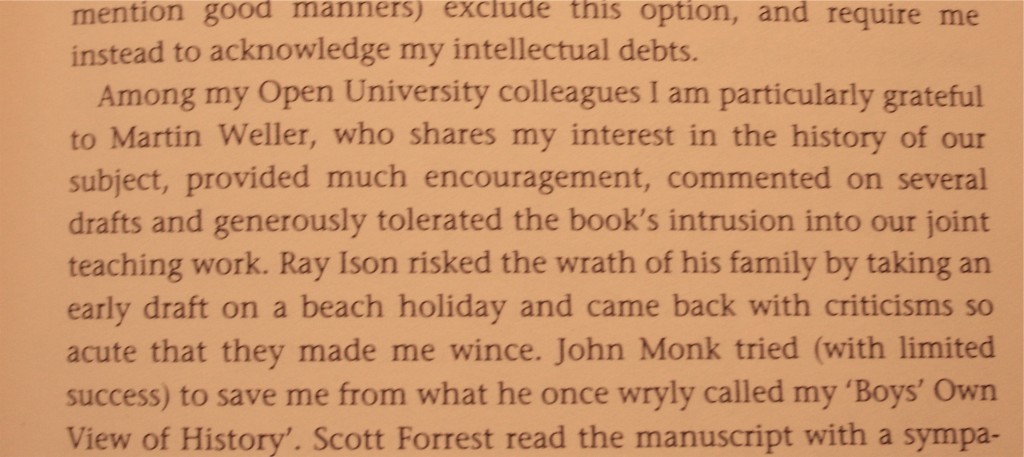
John Naughton’s 1999 history of the internet, A Brief History of the Future: From Radio days to Internet Years in a Lifetime, arrived at my house this afternoon. I plan on reading it during my imminent travel to Dallas, but I started flipping through it this evening when I noticed the following in the acknowledgements:

IMG_4727

Wait, what? Martin Weller? Isn’t he that wierd dude from Wales who runs a lot, does early histories of cross-dressing revolutions, and blogs about edtech. I know that guy, in fact I am a BIG FAN! More seriosuly, Martin Weller, Tony Hirst, and Scott Leslie independently pointed me to this book, and if that’s not a resounding recommendation from an edtech brain trust, I don’t know what is.

What’s more, reading Martin Weller’s name here actually reminded me how fortunate I am to have so many awesome folks regularly giving me feedback, recommendations, and encouragement on this blog. I know it shoudn’t take the acknowledgements section of a book published in 1999 to spark that realization, but this evening it did. Probably because I deal with Martin somewhat regualrly through his virtual presence and regular thinking on the web that he’s become just another person in my network—which is good in so many ways. But he is also someone who has a lot of experience and experitse in this field, and he has been really generous with sharing it, and has made me a better edtech as a result. I really appreciate that. Thanks Martin, and every other edtech hippie on the internet that shares their work and makes mine better as a result. I am a BIG FAN!

big_fan

Posted in fun, Instructional Technology | Tagged , , | 6 Comments

ARPANET: the First Decade

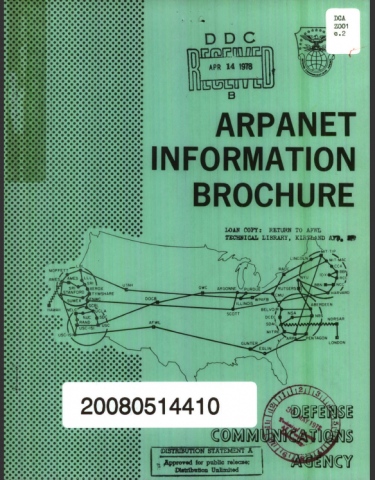
Arpanet Information BrochureIn response to my post about the “Three Visions of “ARPANET,” Paul Bond did some digging on the internet yesterday around the history of ARPANET as a way to demonstrate the possibilities of targeted Google searches limited to specific extensions, such as .gov, .mil, or .edu for students in The Internet Course:

I thought it might be interesting to see what kind of official documents are available online. I looked up what’s out there in the .gov domain (arpanet site:.gov) and the first hit is a nice looking site from the NSF on the birth of the internet.  I tried the same approach with military sites (arpanet site:.mil) and found the history of DARPA, and a 50 year retrospective.

What he found was pretty awesome. I particularly enjoyed the report published in 1981 by Bolt, Beranek, and Newman (the engineering firm that literally built the internet) titled “A History of the Internet: the First Decade.” The executive summary frames language that we often here in our day and age about the “revolution in computer technology”:

Just as the telephone, the telegraph, and the printing press had far-reaching effects on human intercommunication, the widespread utilization of computer networks which has been catalyzed by the ARPANET project represents a similarly far-reaching change in the use of computers by mankind. The full impact of the technical changes set in motion by this project may not be understood for many years. (I-2)

They were busting out the “printing press” analogy as early as 1981! I really appreciate the early awareness that the potential impact of the internet couldn’t be fully fathomed in 1981. It’s a nice executive summary ten years in. I’m also interested in how they explain the purpose of the ARPANET given that, as I blogged about yesterday, it’s often popularly conflated with a mission critical military communications network. According to this 1985 report published by the Defense Communications Agency,  a military network wasn’t formalized until 1983:

In 1983, the existing ARPANET was administratively divided into two unclassified networks, ARPANET and MILNET, to meet the growing need for an unclassified operational military network as well as the need for a research and development network. The physical split into separate networks was completed in September 1984. Each network now has its own backbone, and is interconnected through controlled gateways to the other. The ARPANET serves primarily as an experimental research and development network, while the MILNET functions as an operational military network for non-classified traffic. Communication and resource sharing between them continue, but are subject to administrative restrictions. (4)

The idea that from the beginning ARPANET was a “research and development network” reinforces that from the beginning, despite visions of a failsafe communcitaions network in the event of nuclear war, this network was very much an experimental network premised on sharing resources, preventing redundancy, and re-imagining communications. MILNET, the operational military network didn’t become its own entity until 1983.

The ARPANET Information Brochure published in 1978 discusses an earlier move. This brochure points out the network was moved from DARPA to the Defense Communications Agency (DCA) in 1975. So six years after the network was built, it was moved out of the initial experimental phase:

Following the successful accomplishment of initial ARPANET design goals and the expansion of the network, it was considered appropriate to transfer the responsibility for operation of the ARPANET from DARPA to the Defense Communications Agency (DCA). In July 1975, the DCA became the operational manager of the ARPANET.

In that same introduction there is an official overview of what ARPANET was designed for (I lovee to see this stuff spelled-out):

The ARPANET is an operational, resource sharing inter-computer network linking a wide variety of computers at Defense Advanced Research Projects Agency (DARPA) sponsored research centers and other DoD and non-DoD activities in CONUS, Hawaii, Norway, and England. The ARPANET originated as a purely experimental network in late 1969 under a research and development program sponsored by DARPA to advance the state-of-the-art in computer internetting. The network was designed to provide efficient communications between heterogeneous computers so that hardware, software, and data resources could be conveniently and economically shared by a wide community of users.

Exactly, an “experimental network …. to advance state-of-the-art in computer internetting.” The basic math that helped realize the fantastic vision of such a platform. I think it’s important to remember ARPANET wasn’t given to universities and commercial interests after all the hard work had be done—rather the work was being done by the government, universities, engineering firms, and telecoms from the very beginning. A complex series of relationships that often get lost in the historical afterglow.

Posted in The Internet Course | Tagged , | Leave a comment

Domain of One’s Own: as Limitless as the Web

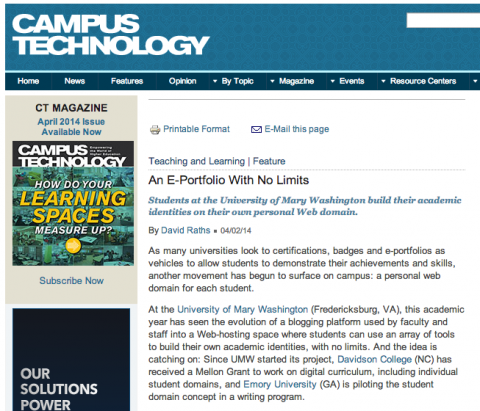
Campus technology DoOOUMW’s Domain of One’s Own is the focus of David Raths’s recent article “An E-Portfolio With No Limits” in Campus Technology. I have to immediately note how impressed I was with his reporting. Raths did his research; reached out to several different folks; linked to the various sites he was writing about; and generally spent the time and energy to fully understand a fairly complex teaching and learning ecosystem. What I like about the eportfolio lens is that it catches the attention of a broad base of readers who have struggled with rigid, vendor-driven options for providing such a service on their campuses. UMW Domains provides a new take on that formula that enables institutions to empower faculty, staff, and students alike to manage their work over the course of their career and beyond. By premising eportfolios on domain and commodity web hosting we can move the conversation to the roots of the open web—which is the only thing that scales beautifully, is eminently portable, and vendor agnostic.

The other thing I love about the eportfolio frame (something Mike Caulfield picked up on during a conversation we had back in the Fall) is that it acts like a Trojan Horse for a host of far more powerful possibilities. Once the eportfolio gets you in the door, we can introduce a host of underlying literacies that accompany managing your own space on the web. For example: how domains and web hosting works; what a subdomain is; how to install a host of open source applications; how databases store information; how Google finds your online presence; how you can export and port your data, etc. In other words, a portal (to reclaim a loaded edtech term) to a broader frame for digital literacy as part of the curriculum. More than a  portfolio, UMW Domains provides a robust platform that people can experiment with— a “user innovation toolkit” to quote Jon Udell. A space to return some of the immense potentiality of technology back to the community at large. This is truly where the idea of “no limits” comes in, the portfolio is just the gateway drug to the personal cyberinfrastructure which is as limitless as the web. Enjoy the article, I did. UMW Domains, the future is here and now!

Posted in Domain of One's Own | Tagged , , | Leave a comment

Three Visions of ARPANET

I’ve recently written about Larry Lewin’s 2001 guide Using the Internet to Strengthen Curriculum in regards to it’s argument that educators need to be “taming the web” for their students. Offering an approach to making research on the web palatable by trying to insure against serendipity. Such an idea seems bizarre in retrospect given that, rather than a bug, serendipity is proving to be the web’s most magical feature.

On the train trip back from NYC early Saturday morning I was reading the first chapter of Lewin’s book, “Why the Internet?” One particular bit about the history of the internet struck me:

The internet uses technology that has been around for over thirty years. Established in the 1960s, ARPANET was a computer network that functioned to keep U.S. military installations in constant communication. College and unversity researchers then started using the network to send data over telephone lines from campus computer to campus computer, and from there it grew. (Lewin 2)

Obviously this is an extremely condensed factoidal history, but it piqued my interest because I think the idea that “ARPANET was a computer network that functioned to keep U.S. military installations in constant communications” is an origin story few folks seem to question. It seems totally plausible that such a communications revolution would be spurred on by the Cold War rivalry for global supremacy—it was certainly true for the Space Race.  According to this version of history, ARPANET was a military creation that was then taken up by universities, commercial interests, etc. In fact, Lewin goes on to frame this chronology in the next sentence “College and university researchers then started using the network to send data…” This pervasive, almost commonplace, history that’s often repeated without question is quite different from the one told in Katie Hafner’s 1998 book Where the Wizards Stay Up Late.

This is not necessarily a knock on Lewin. He’s a teacher explaining how to integrate the web into curriculum for other educators. He’s not pretending his guide is a history of the web. In fact, it would be interesting to study the guides of the late ’90s and early ’00s to get a sense of how often this version of the internet’s beginnings gets reproduced. Anyway, the history of the internet is far more varied and complex than the progression from military to university researchers to corproate interests. In fact, from the very beginning all three sectors were deeply invloved in the development of the internet. Robert (Bob) Taylor, the director of the Department of Defense’s  Advanced Research Projects Agency from 1965-1969, got funding to create ARPANET, but the project wasn’t necessarily imagined as a military network for constant communciation between designated sites, rather….

Building a network as an end in itself wasn’t Taylor’s principal objective. He was trying to solve a problem he had seen grow worse with each round of funding. Researchers were duplicating, and isolating, costly computer resources. Not only were scientists at each site engaging in more, and more diverse, computer research, but their demands for computer resources were growing faster than Taylor’s budget. Every new project required setting up a new and costly computer operation….beyond cost-cutting, Taylor’s idea revealed something very profound. A machine’s ability to amplify human intellectual power was precisely what Licklider had in mind while writing his paper on human-machine symbiosis six years earlier. (Hafner 43-44)

Interestingly enough, the network was a way to have computers talk to one another and share resources so that the system would be more efficient and meet growing demand. Taylor was also a disciple of J.C.R. Licklider so the notion of computers as a way to harness the resources beyond time-sharing was the logical extension of his work. Rather than being dictated by Cold War bunker politics, this vision was very much inline with Vannever Bush’s post-WWII vision of the Memex in his 1945 essay “As we May Think.” Technology would make possible an entirely new paradigm for compiling, accessing, and sharing intellectual resources that woud transform our culture.

What’s more, according to Hafner, Bob Taylor’s vision of the ARPANET was not the only frame for the possibilities:

In the early 1960s …. two other researchers, Paul Baran and Donald Davies—completely unknown to each other and working continents apart towards different goals —arrived at virtually the same revolutionary idea for a new kind of communications network. The realization of their concepts came to be known as packetswitching. (Hafner 53)

Reading this blew my mind. The fact that Taylor, Baran, and Davies were all working towards the same idea between 1964 and 1965 is wild to me. What’s more, Baran and Davies had fairly distinct visions of how such a network might be used.

Baran was working on how to build communications structures whose surviving components could continue to fucntion as a cohesive entity after other pieces were destroyed. (Hafner 56)

Baran compares the structure of his distributed networks to neural networks, suggesting that when synapses in the brain breakdown the neural network remaps accordingly. He was very much thinking about the network in terms of the military explanantion of maintaining constant communication between military sites. So there is some basis for the Cold War military communciations explanation, but Baran was little more than a consultant for the building of ARPANET. He didn’t work for the U.S. military. What’s more, I’m not sure ARPANET, or the ensuing developements of the itnernet, were used for anything related to robust Military communications throughout the 60s and 70s.

The motivation that led Davies to conceive of a packet-switching network had nothing to do with the military concerns that had driven Baran. Davies simply wanted to create a new public communications network. (66)

Davies, who coined the term “packet-switching,” imagined this network as a way to rethink mail delivery and postal service more generally. Something Baran and Taylor weren’t necessarily even talking about, but with the creation of email in 1971. Davies vision would prove prescient, electronic mail being the most important application for popularizing the internet.

As for the progressions of ARPANET from Military -> Universities -> Businesses. In fact, Bolt, Beranek, and Newman Technologies (BBN)  was the engineering firm in Boston that ARPA turned to for building the network. What’s more, BBN was made up of a number of researchers who moved in and out of MIT—so much so it was called “the third university” in Cambridge. Military research, universities, and businesses were far more fluid and cooperative in creating the internet than the condensed history allows. What’s more, from 1970 through the 1980s universities developed the lion’s share of network protocols that defined the internet. And we haven’t even mentioned AT&T who partnered with all involved parties to provide dedicated phone lines for the experiment.

The details of the development of ARPANET are varied and truly compelling. What’s more, I’m thrilled a group from The Internet Course will be focusing their research for the final project on just this topic. They’ll be looking at the various visions that framed the development of ARPANET, as well as the various military, university, and commerical interests involved. I look forward to sharing out their work, and maybe they’ll make the soundbyte history of ARPANET that much more nuanced 🙂

Posted in The Internet Course | Tagged , , , , , | 4 Comments

Rotisserie Chicken

Yesterday was a fairly quiet April Fool’s Day. I didn’t see much on Twitter, didn’t read any scam newspaper articles/ads, and the folks on UMW’s campus didn’t seem to be feeling it either. That’s fine with me. Good pranks are hard to pull off, and forcing something mediocre isn’t worth the energy.

So last night, after Antonella and I had put the kids to bed, we were ready for a movie. We started surfing Netflix (Max let us down twice—but I still love him) and kept coming back to the home screen where the most recent original programming from Netflix “Rotisserie Chicken” was continually front and center.

Rotisserie Chicken Homepage

Usually I don’t click on stuff like this. I’m all business when it comes to watching movies. I want to see something good, which for me often means re-watching films I know are good. I don’t watch films about rotisserie chicken as a rule. Nonetheless, on a lark Anto adventurously said “Let’s ese what this chicken thing is.” And so ee did. And my estimation of Netflix rose a thousand fold as a result. For nearly six minutes we watched a chicken rotate in and oven. It looked exactly like the one below, it just rotated a bit slower:

Rotisserie Chicken GIF

I have to admit, it was mesmerizing. It was as if Andy Warhol had come back to life and made one more film 🙂 The entire film was 1:13 minutes long. We knew this not because we watched it all, but because after we figured out the prank we quickly scanned through the entire roast. Spoiler: the chicken dies. I can’t tell you how much I loved this whole thing. After finishing the abbreviated version, we went back and read the movie description: “witness a searing, chronology-defying return to one’s origins that stokes the imagination.” I wonder if the “return to one’s origins” bit might be playfully referring to Thomas Gunning’s “cinema of attractions” theory defining a particular thread in early film that…

‘solicits a highly conscious awareness of the film image engaging the viewer’s curiosity.’ Instead of having the audiences focusing on the narrative, I think the films from cinema of attractions encourage the audiences to remain aware of the act of looking, the impulse and excitement from the image. (from Vincent Li Sun’s Film Theory blog)

Probably not, but it’s fun to imagine—that’s why we have blogs, right? Also, it by no means lessens how awesome this prank was. Fine work Netflix, while you might be a big data gobbling corporation that will eventually engineer serendipity out of film watching, you made this year’s April Fool’s Day memorable. Stay golden, chicken boy!

Rotisserie Chicken Description

Posted in film, fun, movies | Tagged , , , , | 2 Comments

Re-routing Cyberinfrastructures

Mike Caulfield has a really interesting post on the future of personal cyperinfrastructures. The crux of the argument is while Domain of One’s Own is right, true and beautiful, no one really wants to manage their own bit of a server through a cPanel-driven web hosting environment. In fact, life is already far too cold, brutish, and short to add sysadmin to the mix 😉

His idea, instead, is that folks should have a virtualized server stack that they install apps on that they buy, but at the point of sale you own the app and its data which are both kept on your own server (which is encrypted so your virtual host can’t read). In other words, you own your data and your apps in a highly customizable, portable, and secure virtualized server environment, but you don’t have to worry about  the sysadmin headache.

I really like his vision as a broader cultural model to move towards, and I think it’s a pretty smart frame for what’s to come. But as Ryan Brazell notes in his comment on that post, it’s not exactly in the spirit of Domain of One’s Own as we’ve imagined it. We are far more interested in a curricular intervention. We actually want some of this stuff to be visible and remain challenging, we want students to struggle a bit with this environment, and we want faculty to consider the roots of the web. That said, I’m not suggesting folks need to suffer to learn. This isn’t the Christian vision of sacrifice for salvation. An investment in understanding conceptually and technically how the web works through the cPanel interface provides a curricular and technological platform for just that.

What’s more, at this point more than 600 people at UMW have have signed up for a domain and used CPanel to create subdomains, installed their own application, and  more. That’s something—it tells me that while we keeping saying this stuff is hard and we need it to be easier when, in fact, it’s (a) not all that hard and (b) a worthy concept space to struggle with regardless. But I agree with Mike that the struggle need not be for everyone all the time. UMW Domains might benefit from more seamless options for creating a subdomain or installing a new blog. Tim Owens has been talking about such a setup for a while using APIs in a WordPress dashboard—I’m totally onboard. There are times when the CPanel might not be necessary, but it’s presence as a tool for folks to explore and figure out remains essential to the project.

I wrote a post the other day that UMW is exploring virtualized server environments, so Mike’s argument speaks to me on this front. But I guess I tend to see reasons and possibilities for both the old gold LAMP environment with the CPanel GUI interface as well as the ability to fire up servers, experiment with apps, etc. I can even see us giving each student a virtualized environment down the road as well so they can map subdomains on various tools they are using in the virtualized environment. Why limit them to one space? Why limit freedom?

I both love Mike’s idea and I share Ryan’s concerns. Making something like Domain of One’s Own too plug-and-play defeats the purpose, at the same time making it too hard is not a solution either. Making it part of the discourse on campus around what the web is and how we need to think about it more broadly for our teaching is exactly what we want to communicate!

Posted in Domain of One's Own | Tagged , , | 17 Comments

Domains in (Stop) Motion

On Friday Martha Burtis made an amazing bit of stop-motion animation for the Domain of One’s Own project. It was designed for the EagleVision digital signage we have up around campus as a way to promote the project—explaining the absence of sound. I really love the idea of lowfi whiteboard animation art to showcase UMW Domains, it hearkens back to the old gold “Funny Faces” animation done by Stuart Blackton in 1906. Martha has nailed it, and I’m going to spend part of this week imagining another approach for using EagleVision to communicate this project to the campus community. It’s actually a cool, relevant, and localized challenge to tackle, and I’m excited to get back in creative mode for at least a bit. Thanks or the inspiration Burtis!

Posted in Domain of One's Own, fun | Tagged , , , , | 1 Comment

Reclaim the Handout

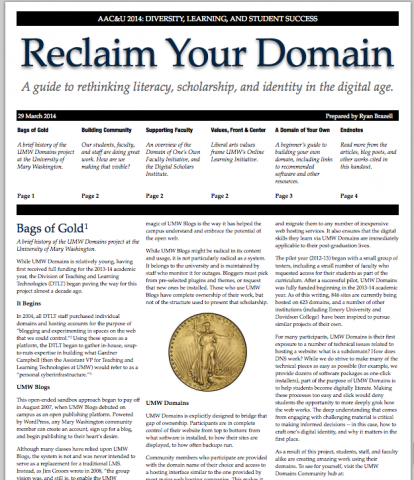
Reclaim Your Domain

Click image to download PDF

Ryan Brazell shared the prep work he did last week framing UMW’s various digital projects for the AAC&U Diversity, Learning, and Student Success conference in Chicago. Just yesterday he presented alongside Tim Owens and Mary Kayler on UMW Domains, the Online Learning Initaitive, and, based on the document below, at least a nod to the nascent Digital Scholars Instititue. If the document Ryan created as a resource for attendees is any indicator, it looks to have been an amazing session.

I really appreciate the way the handout balances the history and vision of DTLT’s work in the “Bags of Gold” section and then goes on to outline the convergence of the various digital initiatives happening at UMW. All of which is topped off with nuts and bolts resources for getting up and running with your own domain as well as a sidebar “Reclaim Toolkit.” I’ve been blogging about much of this work for over eight years now, and I’ve never been able to clarify and synthesize it all so cleanly. It’s such a great document because it captures the spirit of all the digital happenings at UMW so succinctly.

DTLT will be presenting Domain of One’s Own to the Board of Visitors in ten days time, and I think this would be an awesome addition to that presentation as a takeaway. In fact, I’m thinking about re-working this document a bit and printing a couple of hundred to distribute at both my “Reclaim Your Domain” workshop as well as the keynote presentation at Sloan-C talk in Dallas, Texas. Moreover, this would make an awesome addition to DTLT’s website given how crisply it tells our story. It would make a great pointer for the “bio page,” so to speak, for our group. It perfectly frames who we are, what we do, and why we do it. Brilliant stuff. All that said, I still didn’t find the supposed Easter Egg—I think he’s bluffing 🙂

Posted in Domain of One's Own, dtlt | Tagged , , | 11 Comments

Teaching & Technology in the Afterglow at Baruch College

I want to share my impressions of Baruch’s 17th Annual Teaching and Technology Conference before the sun sets on my memory and the experience dissipates in the afterglow of what was. I had a total blast doing it. I have deep personal ties and many a collaborator and friend at CUNY, so it’s always a ball when they ask me to present. And I’ve been fortunate enough to have been invited more than a few times now. I just can’t see how this pattern can be sustained much longer, especially after this talk 🙂 That said, I’m really honored Luke Waltzer and Baruch’s CIO, Arthur Downing, invited me to do the keynote.

On a more logistical tip,  I thought he format of this conference worked quite well. There were three time slots for general presentations from 9:30 AM to 10:30 AM, 10:35 AM to 11:35, and finally 11:40 to 12:40 PM. Each of these time slots had three or four concurrent sessions, all of which were full. After that, everyone met in a large conference hall for lunch and the all sorts of edtech wisdom (not necessarily in that order, mind you) from 12:45 to 2:00 PM.
tumblr_n35h6sL4Xf1rjkuv5o1_400

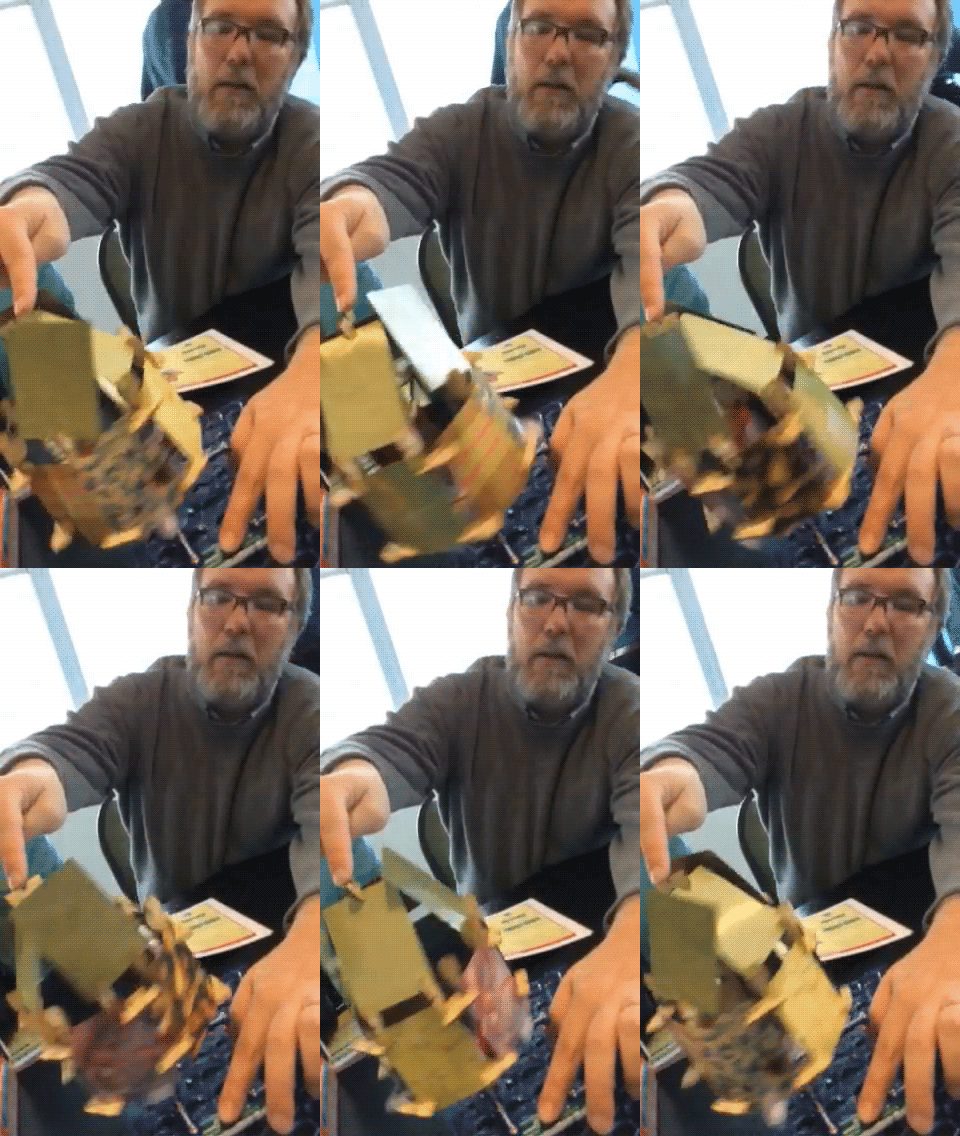
GIF care of the great Micahel Branson Smith

In terms of the nature of the sessions, the three talks I went to were excellent. A rarity at any conference. I started the morning with a presentation by Monica Dean and Allison Lehr Samuels about Baruch’s Pop-Up Makerspace. Although to start it wasn’t a presnetation at all, there were two long tables and people sat down at a table filled with circuitry, duplo legos, fabric, and much more. Right off Michael Branson Smith, myself and two other attendees started making stuff. It was amazing how quick a half hour went by without any sense of a presentation, and when they did grab our attention it was to share out what we made and provide a quick frame for Baruch’s Pop-Up Makerspace that we had all just experienced. Start with the demo, indeed. I loved their approach to the presentation, and I had a blast making a shanty house as well as collaborating on a DIY spinning night light that was a very rough prototype. There was also a 3D Printing working tirelessly in the background as we were playing around.

I spent a bit of time at the beginning of the second time slot for sessions getting the AV and streaming requirments for my presentation worked out. I’d like to take a quick moment to note that the technical support on the ground at Baruch making sure everything went seamlessly was the best I’ve ever worked with in the eight years I’ve be doing the conference rodeo. The were professionals through and through, and that makes all the difference. They recorded the talk and there should be an archived video of the keynote at some point soon. I have no doubt it will be excellent. Anyway, after that I caught the last half of the “Publishing with Blogs@Baruch” session featuring two students, Albert Mathew and Arvien Siswanto, who gave a brilliant talk about the blogging they do for the Weissman Center for International Business. I was really struck with what poised, yet passionate, presenters they were, it was quite the showing. Following them, the chair of Baruch’s Jounralism department, Josh Mills, discussed the award winning magazine on Blogs @Baruch Dollars and Sense. This magazine published students’ local reportage on topics such as homelessness,  Hurricane Sandy, Food Stamp cuts, etc.

BlogsBaruchLogo

The session struck me how much I’ve taken for granted how much amazing work is happening on Blogs@Baruch as a matter of course. The power of blogging never did go mainstream in highered, but the few of us who’ve pushed it to the limit have created some bonafide magic. Between the pop-up makerspace, state of the art publishing platforms, and the video assessment tool Vocat ( a presentation I didn’t attend), the work folks like Luke Waltzer, Tom Harbison, Suzanne Epstein, and Mikhail Gershovich have done over the last ten years has truly had a deep impact on the teaching and learning culture of Baruch. This conference was testament of that for me, and I’m sure for them too.

The final presentation I attended shared out of research collected by librarians Maura Smale of City Tech and Marianna Regalado of Brooklyn College about how students from at least five different CUNY colleges are using technology as part of their educational experience. They started with the quantitative demographic information which was fascinating. But it really became poetry when they started sharing the stories collected from the students. They did qualitative research that featured interviews, student drawn maps of their commutes (a huge part of anyone’s life in NYC), images of their favorite study spots, schematics of their technology, etc. They called this bit CUNY Tech Stories, and the way it dug deep into the aprticulars of the CUNY student, their particular challenges, and alos their unbelievable richness of experience. it was a surefire reminder of why CUNY is such a special place, despite all the bureacratic frsutrations that come with a system that big. They’ll be publishing this work, and I really can’t wait until they do, it’s deeply resonant and important. My only recommendation would be to do much more of it 🙂

Also, Luke Waltzer and Kate O’Donoghue presented their own findings of a survey they conducted about student preceptiosn of online learning at Baruch College which was very telling. I’d write about it here, but I’m not going to because Luke needs to freaking blog in his new role. As soon as CUNY makes him a director he’s already complaining about time, writing, etc. And he didn’t blog nearly enough already. Three words: deal with it. Two more: just blog. There are no excuses if you’re gonna preach open, you need to lead the way and set the example. Share these awesome stories regualrly, promote your faculty and students, carve out the time—it’s the most important work we do. Have you learned nothing from the bava, you Michigan hippie?! I kid because I love, but also because his voice is way too important to remain quiet.

Finally, the keynote. It was a bit meandering and indulgent, I’ll admit that upfront. This was the third version in as many weeks of the “Domains in the Afterglow” talk I’ve been working on. It started in its curren concept at the Digital Media Learnign Conference and was further tweaked for Mary Washicon. I say indulgent and meandering ebcause I spent an inordinate amount of time on the early web space stuff, tilde spaces, Geocities and the cultural history because I am so drawn to it right now. I should have gotten to UMW Domains sooner. Truth be told, I could’ve cut the history section down by half. That said, I warned Luke I might be a bit indulgent, and I was using the opportunity to try and get a rhythm around it.
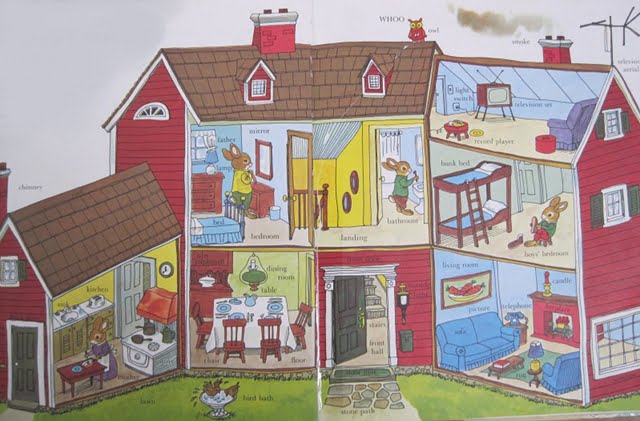
Also, I think I need to shorten and change-up the Domains/house/Richard Scarry analogy. While I love it, Michael Branson Smith gave me a better approach, and I’m going to run with it. I’ll be presenting this talk again for the Sloan-C Emerging Technologies Conference in Dallas in less than ten days, and again at the end of the month in Atlanta for Emory University’s Domain Incubator. I’m having fun with thus far, and I’m hoping to have it nailed for Atlanta because I’m putting this one to bed after that.

tumblr_mmf6ceIA6T1rsbbgxo1_500

In terms of the presentation for me, it was liberating not to talk UMW Blogs or ds106. It’s been years since they weren’t the foundation of some part of my talk. I’ve really been enjoying the move back into a bit of independent research of edtech more broadly spurred on by Domain of One’s Own. Alos playing around with popular concpetions of the web and teaching and technology with the GI Joe PSAs created by Fensler Films. A sign of a good project is it keeps you moving and searching, UMW Domains has certainly done that for me. Also, the push to blog my thinking has helped me incorporate invaluable feedback from folks like Chris Lott, Scott Leslie, Alan Levine, and Mike Caulfield into the talk. Actively writing about my thinking for this talk has been useful for challenging some of my assumtpions, and keeping me honest. What’s more, I’ve been inspired by Brian Lamb’s thinking and writing on this subject lately. I especially love it when he talks the learning objects repository history. This is one of the earliest lessons I got when orientating myself in the broader discourse of the field in 2006/2007. What’s more, it’s affirming for me that I want to do more work in this vein. The return to a bit more focused reading and writing has been doing my imagination and inspiration good, so why not feed it? As Brian noted: “Somebody should do a dissertation on the values embedded in guides like these.”

Before I throw the slides at you. While the presentation still needs work, I want to thank the CUNY folks in the audience for putting forth an encouraging front even if they it was tiresome. In fact, the Question and Answer portion of this talk was extraordinary. I’m not sure how long it went on for, but it seemed to be as long as, if not longer. than the talk itself. And I am not ashamed to admit much better. The questions were great and I felt like on some level I’d connected with at least a few people. That’s what I’m doing this for in the end, and I really do want to believe some of the ideas I’m sharing frame an ethos of liberating our imagiantion of edtech from rigid,  soul sucking systems. Alternatively, the open web as platform for teaching and learning. For me Baruch is a shining example that communities of people can make a real dent in institutional culture.

I’ll end on a personal bavalove note. I really missed hanging with Mikhail Gershovich while up in NYC this go around. He’s my Russian connection, and I sorely missed him yesterday. That said, it was awesome to see so much of the great work he helped set in motion continue to gain momentum!

Posted in Domain of One's Own, presentations | Tagged , , , , , | 7 Comments