
Virtualization

Lawnmower Man

Since I wrote a post last month about agile edtech, I’ve been thinking and talking with Tim Owens a fair amount about what a virtualized sandbox for DTLT (through something like Amazon Web Services) might look like. What would it mean for our group to have the ability to fire up a variety of server environments and corresponding applications (such as EdX’s MOOC platform) in minutes? As Tim noted, this could be the next chapter of the BlueHost experiment UMW’s DTLT embarked on a decade ago now.

I knew I’d read about these virtualized environments sometime last year on Brian Lamb’s Abject blog, and after a bit of digging  I found his “The squirming facts exceed the squamous mind” post in which he points to an approach, with prodding from Boris Mann, that might provide another way of thinking about deploying applications within educational environments.

A couple of days after Brian wrote that post, Stephen Downes OLDaily’d it, noting the following:

The old hack stack is and was called LAMP – Linux, Apache, MySQL, and Perl (or PHP). But these days servers are constructed in environments like Ruby on Rails or Django and services are often plug-in, hosted elsewhere and accessed via APIs, like MailChimp for mailing lists or Amazon Web Service for data hosting. Now LAMP itself is and was a viable alternative to large enterprise computing, the sort of environment you would set up for an institutional LMS….for full-service startup sites class2go the new stack is great. For institution-strength LMSs supporting services like Desire2Learn’s new Binder application, enterprise is the way to go. Just in the same way for groups and activities, Facebook and Twitter and other social networks give people what they need. But for personal computing, I think I’m still wanting my own server and my own applications, using but not depending on these online services.

Downes gets at the fact that depending on what you’re trying to do your mileage may vary with each of these approaches. It’s not all-in with either, though the LAMP stack becomes privilegedwhen it comes to ownership. That said, given UMW Domains provides a LAMP environment to anyone who wants to “own” their server and applications at UMW, that option is up and running. The next thing we’d like to explore is cloud-based server environments so that we can start experimenting with what’s possible there.Tim has already done some of the early forays. What’s more, we’ve been in discussion with both purchasing and IT about these possibilities and they’ve been really receptive. We’re also hoping to get a rep from Amazon out to us sometime soon to demonstrate whats available in this space more broadly. One example is Amazon S3 storage for all Domain of One’s Own users? Or maybe a the open source forum Discourse if folks want to play with that?

All this talk started me down a path of thinking about the next steps for OpenVA. We had our first call this week in a long while, and we’re turning to the confernece this Fall. One of the ideas I threw out there was to frame it around the theme of “Building an OpenVA.” What would it look like if the various colleges and universities around Virginia worked together to build a shared infrastructure with the possibilities of virtualized environments?

What am I talking about here? What if UMW, through a virtualized server environment, could seamlessly share various packages (or images) of our UMW Blogs environment or our Domain of One’s Own environment to any other VA school to use? What if other schools did the same? What’s more, could we begin to imagine a broader solution for shared hosting and adminstration as a consortium across schools so that we could truly start collaborating? It’s still a pipe dream of mine to enable Virginia’s colleges and universities to openly expose, through serendipitous juxtaposiiton, the broader life of the mind happening across the state of Virginia. If you think about what Domain of One’s Own did for UMW when it came to syndicating distributed nodes into the Community site, what might that mean at the scale of the state? A full-blown open platform for ALL of Virginia’s public higher education institutions. What’s more, the open publishing element would be just one of the many heads wielded by this beautiful internet-powered hydra! It might be a fool’s errand, but I’ve never not been a fool.


Posted in dtlt | Tagged , , | 3 Comments

Moneyball

I saw this tweet by Brian Lamb yesterday:

And I followed the link to this Guardian article on learning analytics by Rebecca Ferguson. It covers the idea of how big data can help us track and intervene in students’ progress before they’re beyond the pale. All this is managed through various data-driven systems that students work in—which, by the way, quickly pushes us right back into a centralized system mindset in higher ed. We’ll obviosuly need a vendor-sponsored product for that! The work is modelled on the tried and true datamining practives used extensively in commercial spaces like GMail, Amazon, Facebook, etc. The basic premise being that, and I’ll paraphrase here, “learning analytics is the Moneyball of education.” Performance predicted by data and value premised on numbers. I’ve read a nightmare scenario along these lines recently.

What struck me in the article was one of the examples used to showcase this technology links to a 2010 EDUCAUSE Review article about Purdue’s Course Signals. If Course Signals is the forerunner in the States of the promise of this technology we’ve got a problem. Why? Well, because a lot has happened since 2010. Mike Caulfield pointed out six months ago, and Michael Feldstein re-iterated, the research claims of the effectiveness of Course Signals to increase retention are deeply problematic. What’s more, there has been no response from Purdue about any of this. As Feldstein notes, their “credibility is on the line.” I’m not saying learning analytics might no hold some water, but if Course Signals is the city upon the hill in terms of examples and the research is shoddy and a pretigious academic institution is close-lipped about their research that is ultimately a product driving an approach to edtech, we should be very concerned.

What’s more, shouldn’t TheGuardian article have some sense of the other side of all this when it comes to learnign analytics. Data is always framed by the people who are collecting it and, in Purdue’s case with Course Signals,  packaging it as a product. I couldn’t have been prouder of Caulfield (as a representative of us lowly edtech types) actually doing the math, picking up on this issue, and in the academic tradition making his concerns a part of the public dicourse. Alternatively, I’m still flabbergasted that the learning analytics discussion has gone on seemingly unconcerned with the fact that the shining example being waved like a banner for the cause is making claims for retention that can’t be supported.

Posted in Uncategorized | Tagged , , , , , , | 8 Comments

Inspired by Olive Garden

Authentic Olive Garden Garlic Bread Sticks

Authentic Olive Garden Garlic Bread Sticks

Last night my family and I ate at Olive Garden. Not necessarily a fact one needs to share publicly, even if it is a partiular outing for our family. The chain mentality for Italian food is literally anathema to our DNA given Antonella is not only born and rasied in mother Italy, but a kickass cook to boot. Nonetheless, I was given a giftcard last week for Olive Garden, on a lark we decided to walk on the wild side of taylorized food. On the car ride over I couldn’t get the voice of Ray Liotta playing Henry Hill in Goodfellas telling me it’s “egg noodles and ketchup.”

Despite all this, we had a blast. There remains something reassuring to me about chainstore America, must be my resilient Long Island roots—even though Italian food on the strongest island has its own great tradition. But that’s not what this post is about, it’s the fact that throughout this whole experience I couldn’t stop thinking about one of the trippiest, creative, and most-inspiring ds106 internauts of all time: Andrew Allingham.He was part of the first open, online experience during the heady days of the Spring 2011, and his work was legendary. He created the buttload, boatload, shitload infographic that got redditted with over 70,000 hits in jsut a couple of hours

He was one of the first guests on ds106.tv (technical precursor to DTLT Today), wherein we discussed what is one of my favorite student projects for ds106 (or any other course) off all time: a 10 minute video essay about frame stories in the 1965 Polish psychedllic films class The Saragossa Manuscript. You can see the video essay below, which features Andrew’s brilliant, dry, and oh so sharp whit, as well as his unbelievable narrative acumen.

[youtube]http://www.youtube.com/watch?v=miMy-R_mw_8[/youtube]

But all that is to get to the actual reason why iw as thinking about Andrew while going to Olive Garden with my family. For his final project in ds106, he did a post of what he termed “Olive Garden fandom” that is narrated from the perspective of the authentic Olive Garden garlic bread sticks. I couldn’t get this piece out of my head, and it deals with all the issues that a red-blooded Italian and her New Yorker husband  in an stripmall sprawl Olive Garden fights with: authenticity! Here’s a bit from the piece, though you can read it all (and it’s pretty short) here:

The basket of fresh, warm garlic bread sticks, mid-conversation over the construction of racial identity and art in the 21st Century, sat in the middle of a table-for-one around lunchtime at the Olive Garden in Columbus, Ohio.

“I think, Marcello De Laurentiis, that you have said all there is to say. I agree with you wholeheartedly. The young garlic bread sticks must look back to their rustic Italian heritage for inspiration and to the old masters for form.” said Paolo Pappalardo.

“What rustic Italian heritage?” retorted Bradino with a snort.

“Why, from your ancestors, of course.” said Paolo Pappalardo.

“Which ones?” said Bradino.

“The Italian ones!” said Paolo Pappalardo, feeling as though he were speaking to a strip of uncooked dough.

“What about the rest?” said Bradino.

“What rest?” said Marcello De Laurentiis.

“My Mexican, Irish and German ancestors,” Bradino answered honestly. “How can I go back to the ovens of Tuscany when their fingertips have never even graced my buttery crust? I have no personal connection with them at all…”

“I think you’ve missed the point entirely, Bradino.” interrupted Paolo Pappalardo.

This just whets my appetite for a teaching ds106 again. There is so much amazing work generated as apart of that class. I’m also reminded of the ds106  world given that registration for Fall classes opened up this past Monday, and already my section—one of three!— is full with a five person wait list. I’m ever more excited given that I have a relatively new idea for approaching ds106 in the Fall. The entire course will be centered around the TV series The Wire, but more on that shortly. In the meantime, it’s really cool to be inspired by work of one of ds106’s finest, not to mention the ability to refer to his work so seamlessly as this post is a testament. Long live ds106, and long live teaching on the open web!

Posted in digital storytelling | Tagged , , | Leave a comment

What the Heck is Electronic Mail?

1977: “What the Heck is Electronic Mail?”

1977: “What the Heck is Electronic Mail?”

In last night’s The Internet Course the student panel did an excellent job sparking discussion around the social, economic, and cultural impacts of the internet. It made me think how remarkable it is that almost forty years later e-mail is still “the killer app.” So, as we’re talking about the impacts of the internet over the past forty years, I couldn’t help but think of this  1977 Honeywell advertisement Tim Owens shared with me a few weeks back.

Email was the application that helped people grok how the internet would dramatically shift the foundation of communication technologies in the future. In fact, in the late 1960s Donald Davies conceptualized an early vision of the internet as way of re-imagining the British postal system, something Ray Tomlinson’s invention of email in 1971 fully realized.

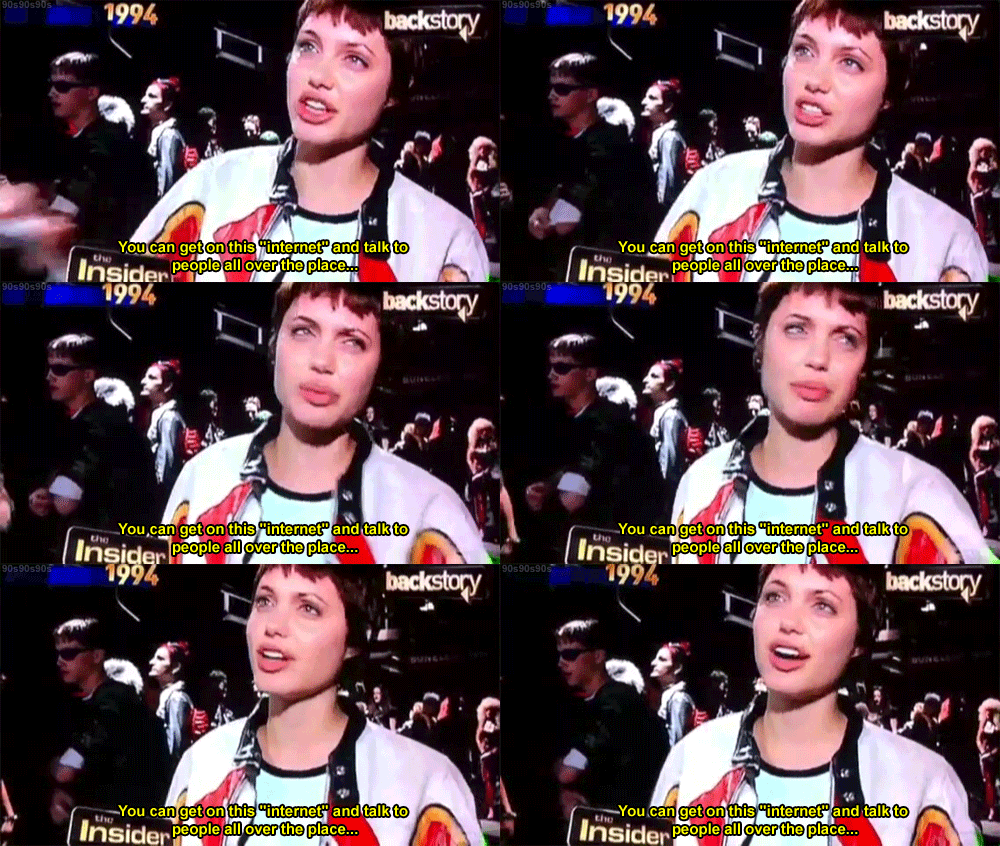
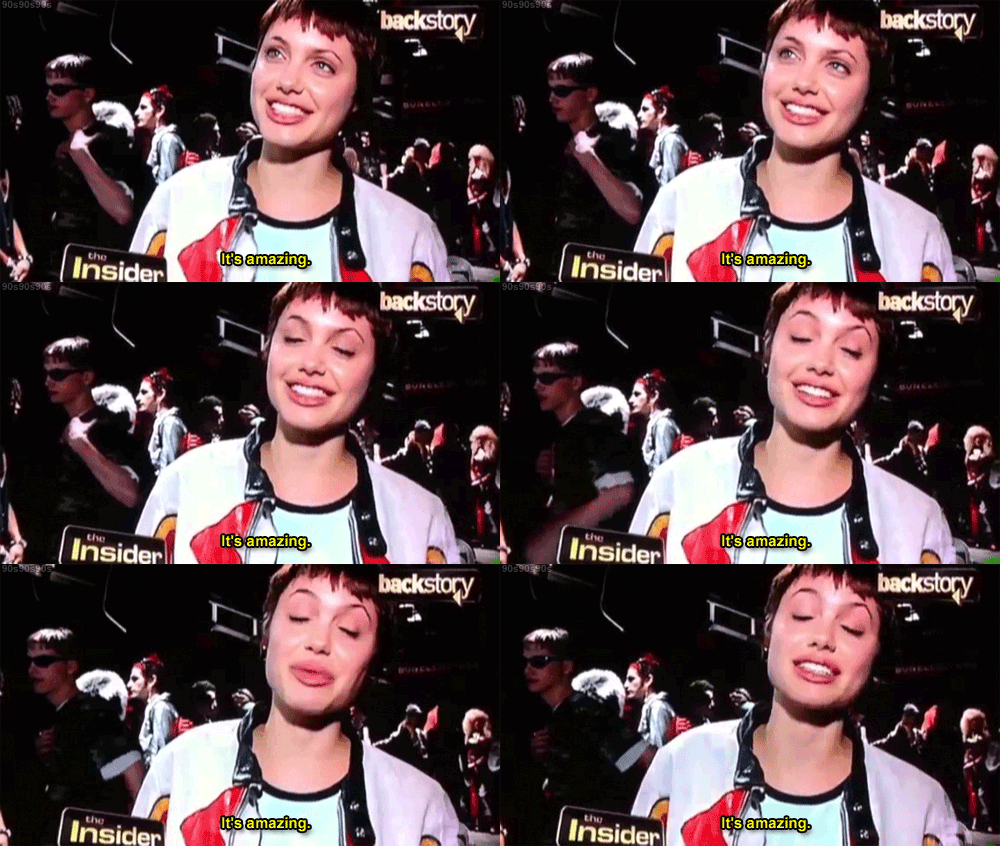
I think a much younger Angelina Jolie said it best:


Posted in fun, The Internet Course | Tagged , , | Leave a comment

Nerd Approved

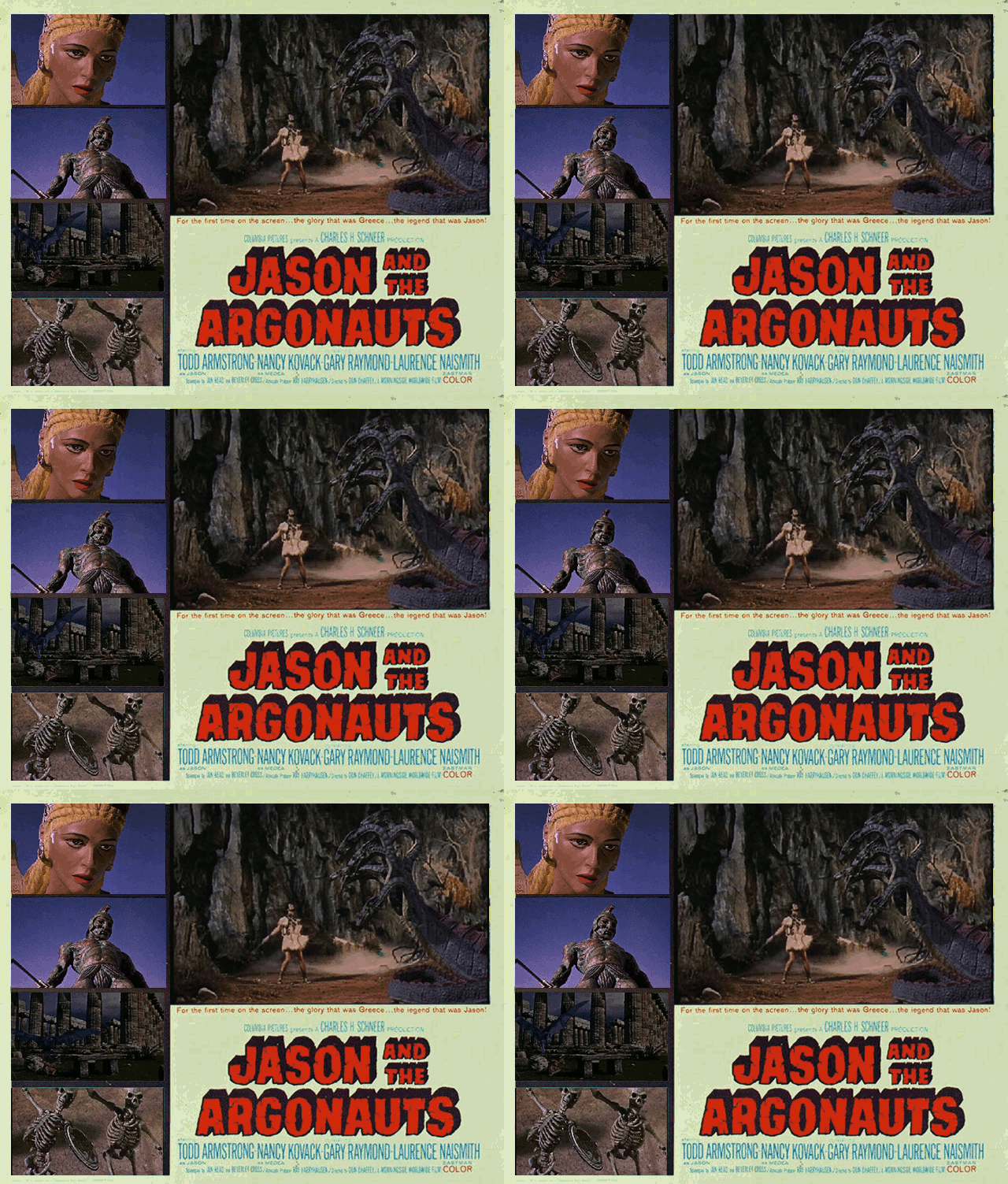
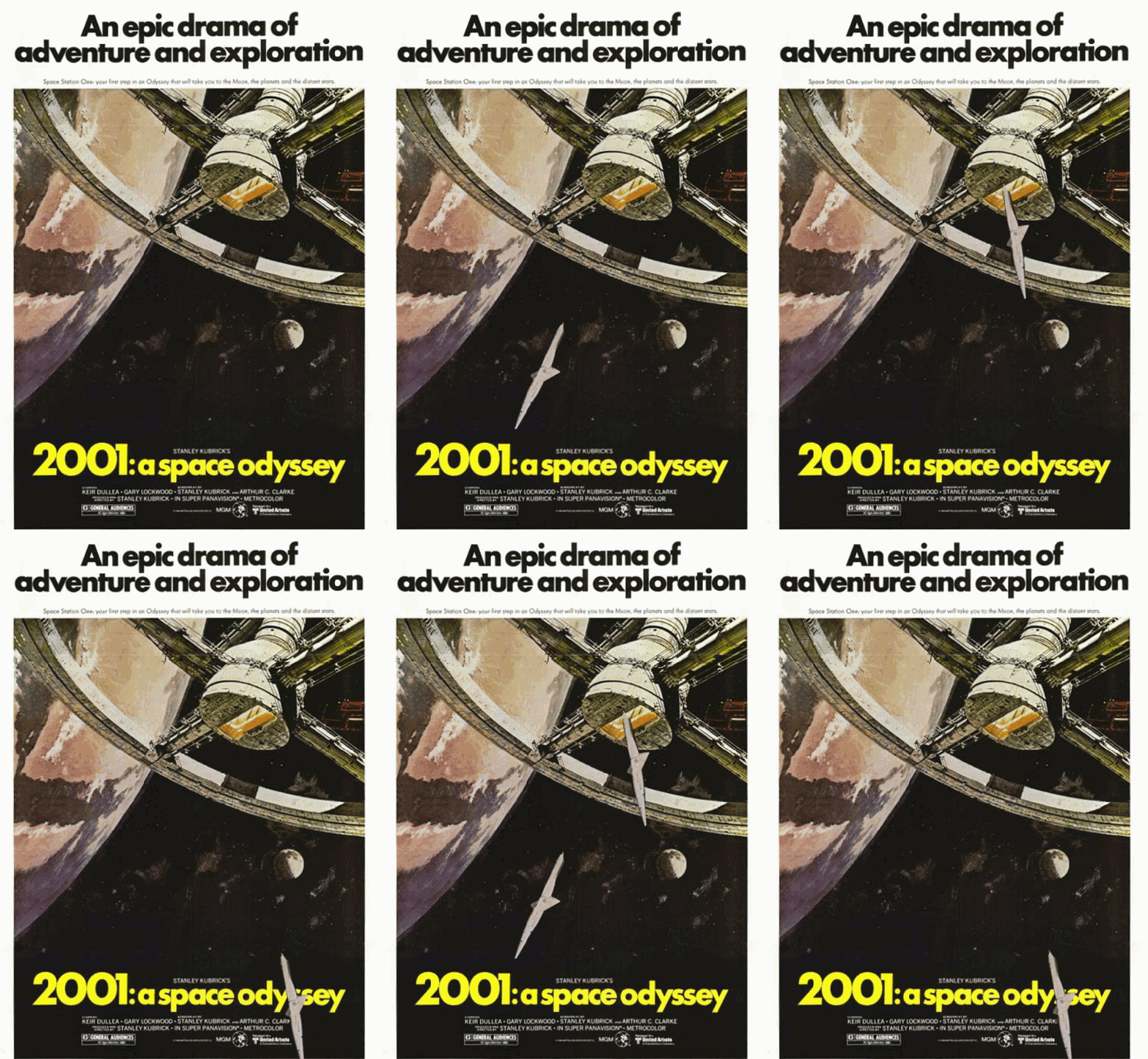
The Nerd Approved blog has featured an old gold animated GIF movie poster I created for the ds106 animated movie posters assignment back in January 2012. It’s fun to see stuff I created for ds106 get featured on other sites. I’m also glad they haven’t found Michael Branson Smith‘s animated GIF movie posters yet, because I would’ve never gotten featured otherwise.

fulljasonandtheargonauts

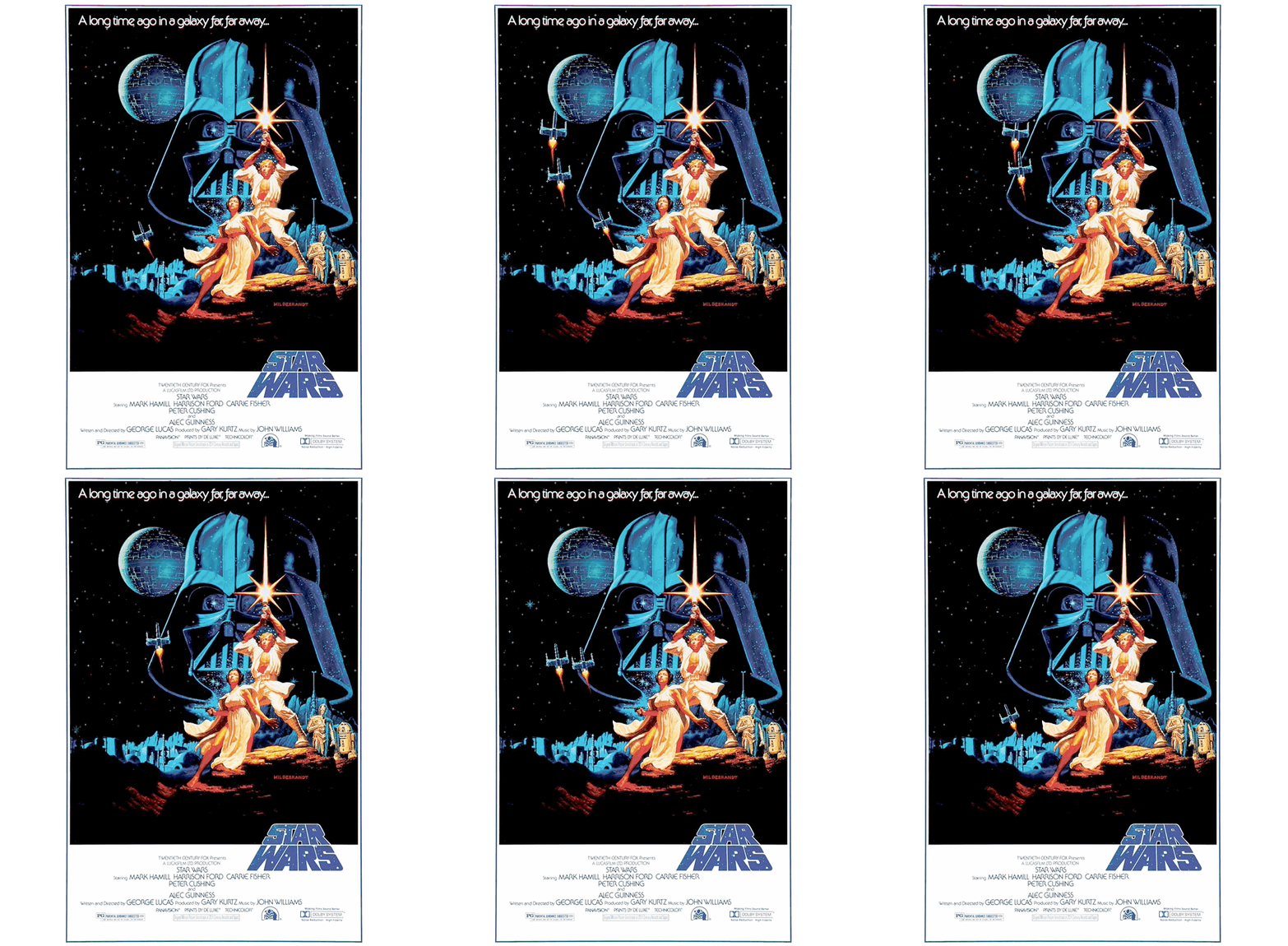
It was cool to see the other posters they featured, I particularly loved the original Star Wars movie poster animation.

star_wars_animated_poster

As well as the 2001: A Space Odyssey poster created by another ds106 stalwart, Norm Wright.

2001_animated_poster

ds106 is not just a course, it’s also the open web. And moments like this are a wonderful and welcome reminder of that fact.

Posted in digital storytelling, fun | Tagged , , , | 4 Comments

Tilde as Approximation

This symbol (in English) sometimes means “approximately”, such as: “~30 minutes ago” meaning “approximately 30 minutes ago”. It can mean “similar to”, including “of the same order of magnitude as”, such as: “x ~ y” meaning that x and y are of the same order of magnitude. Another approximation symbol is ?, meaning “approximately equal to” the critical difference being the subjective level of accuracy: ? indicates a value which can be considered functionally equivalent for a calculation within an acceptable degree of error, whereas ~ is usually used to indicate a larger, possibly significant, degree of error. —From the “Common Use” section of the Tilde Wikpedia article

On Saturday I gave a version of the “Domains in the Afterglow” talk that began taking shape after a panel presentation I was a part of at DML14. I’ll be presenting it in full-featured form Friday (alliteration FTW) at Barcuh College. The Mary Washicon audience consisted of two people; I’m lucky it was the right two.  Zach Whalen was kind enough to stay for my talk, as well as emoboiler Maureeen Iredell, who was crazy enough to invite me.

This run-through was really useful because after doing an abbreviated version Zach provided me some awesome feedback that I’ll be building into Friday’s talk. One recommendation was to explore the concept of afterglow a bit.  To think of this concept not only as the Wikipedia definition of apocalyptic sunsets made possible by our pollution, or the trashheap of technological history as Bruce Sterling defines it in his presentation at Transmedial 2014, but rather as an illumination remaining where light has disappeared—an aura akin to the glow of a CRT monitor after it’s turned off. A dissipated energy that we can and should be reharnessing and re-directeding, a frame that will work nicely with my vision for Domain of One’s Own towards the end of the presentation. This is not just another iPad giveaway or the next generation of churn and burn ware software, but a critical intervention in personal empowerment through the open web. What’s more, such a vision shouldn’t be limited to UMW—that narrative is not only getting lonely, dangerously myopic.

All of which reminds me of something else Zach mentioned that resonated deeply with me, this presentation can and should be placed within a broader history of the web in higher education. Like Zach’s talk on animated GIFs earlier that day, an attempt at an archaeology† of the web that frames the work we’re doing within a broader historical context is crucial. That said, I mut be clear that this presentation is an early, incompelte approximation of that at best. Nonetheless, I want this presentation to be the start of a focused resistance to the ahistorical impulse when talking about technology to suggest innovations, disruptions, and all the other buzzwords employed are actually deeply embedded signifiers within a complex network of social, economic, and cultural factors that have as much to do with the consolidation of power as they do with the liberation of networks.

But I digress,  because what I really wanted to talk about when I started this post was this idea of exploring the tilde space I’ve been writing about recently through a technical, typographical, and representational lenses. Zach mentioned that the typographical character tilde “~” is not only a Unix command for denoting a user’s home on the server, something like ~jgroom, the character also suggests an approximation. So, you can read ~jgroom as approximately Jim Groom. A space of approximation is fascianting to me because as we were talking about digital identity in the Internet Course last week the question of the traces one leaves online somehow approximate your presence, but can never truly represent the whole person. And you could easily say the same in the physical world. In fact, the ~ can move seamlessly between tehcnical, typographical, and representational readings, and it’s a close reading a literal sign—trippy.

So this notion of one’s online presence as an approximation of who we are that has become increasingly fragmented (which is not a bad thing by any means) is part of a technical an tradition at universities that is as old as the web. This talk needs to position UMW Domains within this narrative as a critical intervention to start digging into the deeper representational implications of online identity as they relate to the academic discourse. For higher ed to reclaim a sense of the deeper philosophical, technical, and practical visions the web was born of, and the resultant implications on our transforming notions of identity (digital and otherwise) as it relates to the curriculum and community on our campuses more generally. Does that sound like for a plan, or what?

_______________________________________________

† I’m imagining this is referring directly to Michel Foucault ‘s method he outlines in his book The Archaeology of Knowledge.

Posted in digital identity, Domain of One's Own, reclaimopen | Tagged , , , | 8 Comments

Understanding the Praxinoscope

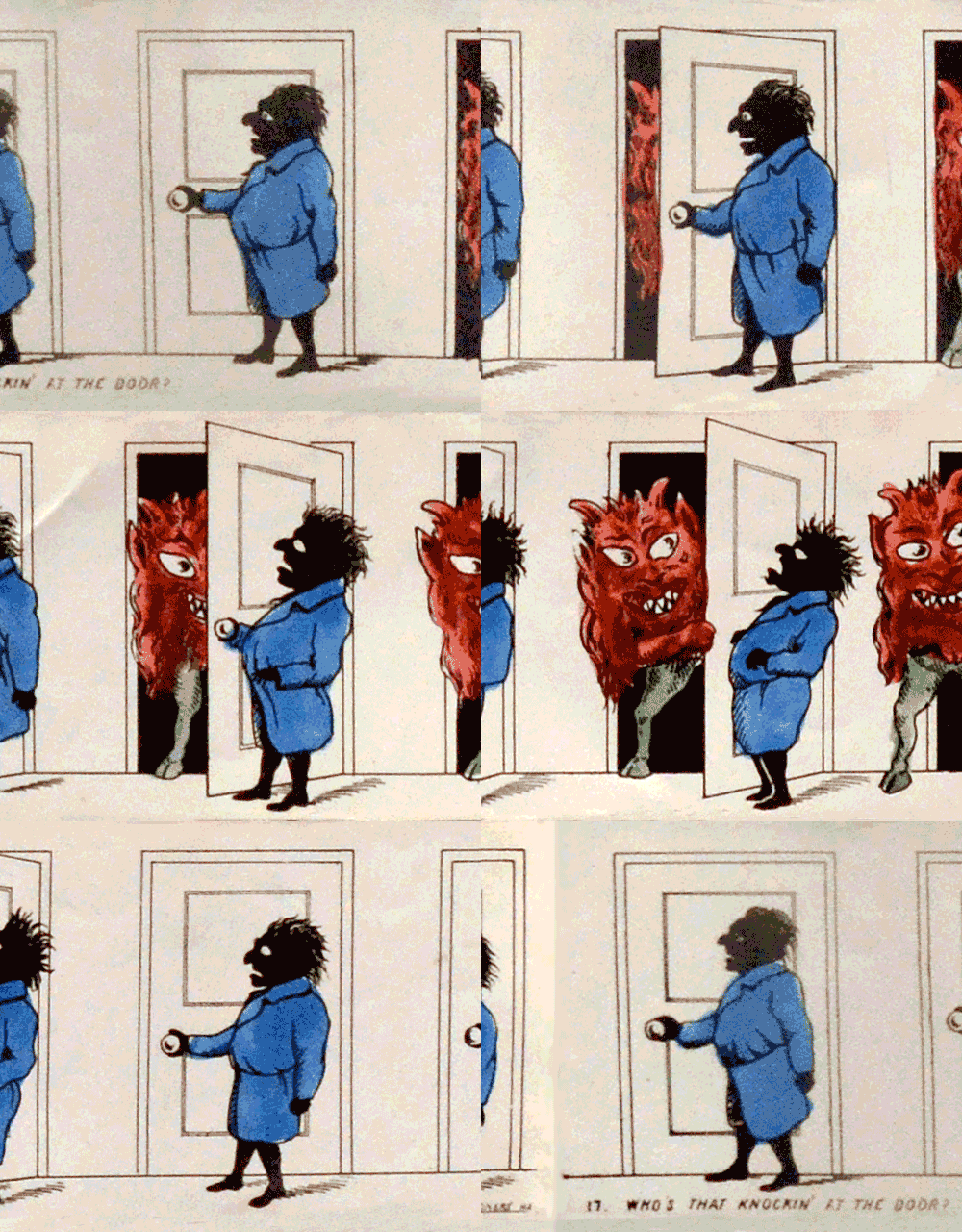
George Meadows’s comment on my last post reminded me that I did, indeed, have prior knowledge of this early animated GIF machine known as the praxinoscope:

Jim, about a year ago I gave you a toy praxinoscope – I bet you still have it stashed on the shelves of forgotten technology – and told you it was the earliest example of an animated gif. After reading this post I now realize at that time I was on the cutting edge of the trailing edge.

George Meadows is the selfsame faculty who’s been playing tirelessly with various gadgets throughout his tenure at UMW, and more recently broke bad with his experimentation with 3D Printing over the last two years—all of which led to UMW’s work with Makerbots, Makerspaces, and Printrbots. In fact, as a result of George’s work in this realm with student teachers in the local school systems we may very soon have a Printrbot in every classroom! So, when George calls me out, I listen 🙂

The Bava Cabinet of Wonders

The Bava Cabinet of Wonders

Lo and behold, when I dug into the bava cabinet of wonders (pictured above) I found the praxinoscope George was talking about, which I originally thought was a zoetrope, but I was wrong. Turns out the distinction is an important one:

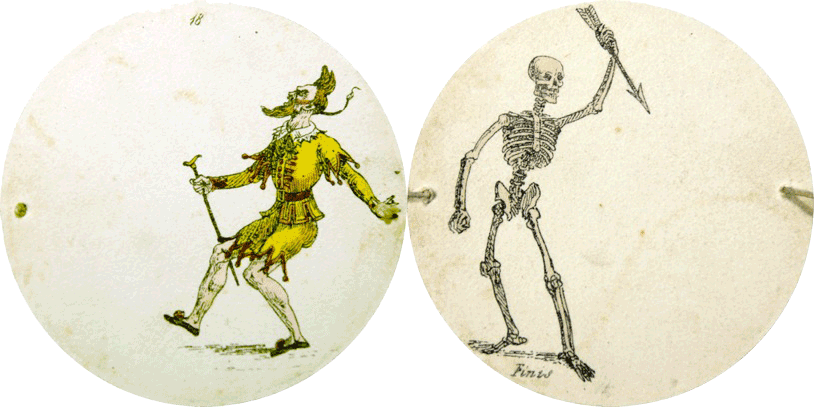
Like the zoetrope, it used a strip of pictures placed around the inner surface of a spinning cylinder. The praxinoscope improved on the zoetrope by replacing its narrow viewing slits with an inner circle of mirrors, placed so that the reflections of the pictures appeared more or less stationary in position as the wheel turned. Someone looking in the mirrors would therefore see a rapid succession of images producing the illusion of motion, with a brighter and less distorted picture than the zoetrope offered.

So I busted out the praxinoscope and gave it a spin, so to speak. Below is a two minute documentary narrated by me wherein I explore the praxinoscope. Andy Rush was responsible for the camera work and visuals (well, he gave me the small tripod at least).

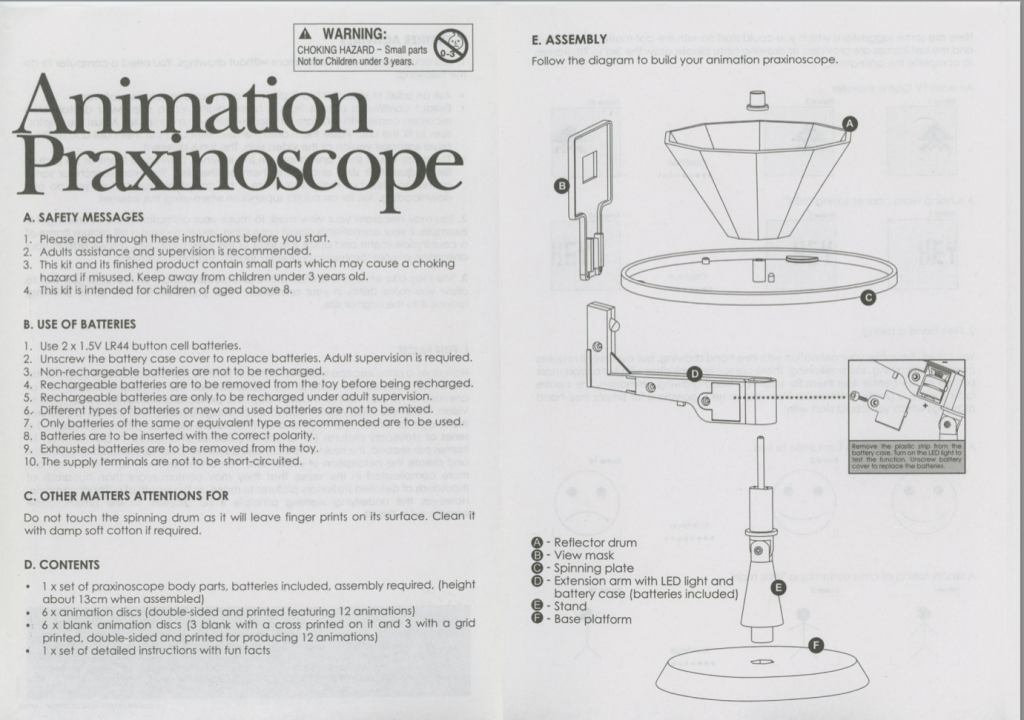
Also, here are some scans of 4M’s Animated Praxinoscope manual that provide a good schematic for the device, which might give you a better sense of how it works.

Animated Praxinoscope Manual

Animated Praxinoscope Manual

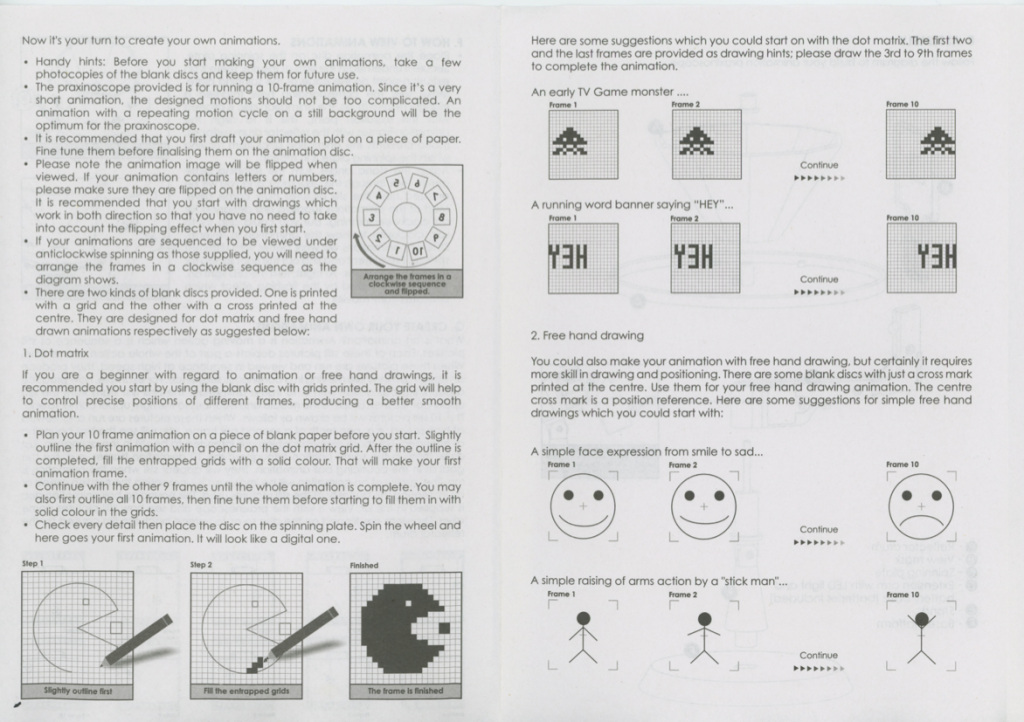
Also, here is a scan from the manual that explains how you might go about free hand drawing animations for the praxinoscope:
Animated Praxinoscope User Guide

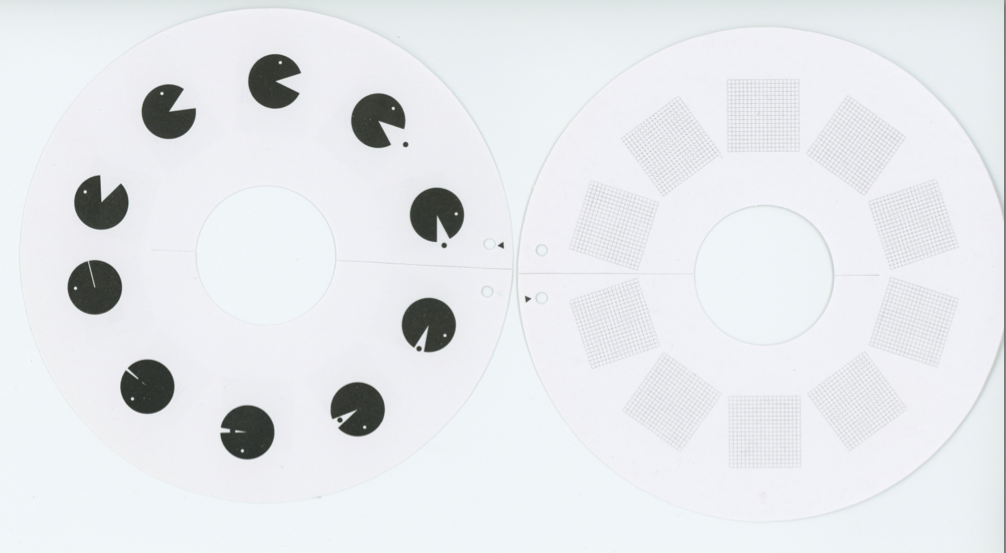
Finally, here are some scans of the Pac-man 10 frame animation as well as the blank grid they provide for you to create your own. I imagine my next post on this topic might actually be about something original I create for the praxinoscope. I can hear them now, “Enough historicizing, WE WANT ART, NOT WORDS—DAMMIT!”

Praxinoscope Inserts

Posted in digital storytelling, fun | Tagged , , , , | 2 Comments

Getting Schooled in Roots of Animation

Yesterday afternoon I attended Mary Washicon, a miniature convention, complete with panels, cosplay, and Artist Alley. I got to attend Zach Whalen‘s discussion of the Avant Garde roots of the aniamted GIF, and I was blown away. You can tell how good a presentation is by how many links yu take away from it, I got a boatload. I wanted to share some of them here before time-induced diffusion sets in.

Zach started by sharing a film hosted by Walt Disney about “The Story of the Animated Drawing.” It provides a brilliant overview of the history of animation, and it comes highly recommended.† It intridcues and explains several nineteenth century animation devices such as the Thaumatrope, the Phenakistoscope, the Zoetrope, and the Praxinoscope. It alos provides a history of Charles-Émile Reynaud’s Théâtre Optique, which provided the first presentation of projected moving images to an audience. The film is a veritable wealth of information, and If you have a spare half hour here is part 2, part 3 (taken down for copyright violation), and part 4—each weighing in at 15 minutes).

Several of these early animation devices depend upon the concept of “persistence of vision,” which is “the phenomenon of the eye by which an afterimage is thought to persist for approximately one twenty-fifth of a second on the retina, and believed to be explanation for motion perception.”  The site/blog/tumblr of Dick Balzer (which was recently featured in Wired) provide a number of thes animation sequences used on these  early devices, adn quite a few of them were nothing short of nuts:

Thaumatrope

Phenakistoscope – c. 1835

Zoetrope – France – 1870

What’s more, someone grabbed just the ten minute section about the Théâtre Optique from The Story of Animated Drawing, something Zach and I are currently in discussions around trying to build one 🙂

From here the talk started to transition into some  avant-garde animation during the early days of film. The talked turned me on to Stuart Blackton’s “Enchanted Drawing” from 1906 that were centered around Chalkboard drawings.

From there we went to Emile Cohl’s 1908 animated film Fantasmagorie. I lvoed to learn that Cohl was part of an late 19th century movement know as the Inchorents that seemed awesome. His aniamtion certainly fits in with the spirit of that movement—I lvoe it.

After that, we looked at two of Winsor McCay’s experimental animated movies: How a Mosquito Operates (1912) and Gertie the Dinosaur (1914). Zach referred to  How a Mosquito Operates as an early horror animation, and that nails it on the head, so to speak. The mosquito has this long-ass stinger it repeatedly sinks way too deep into the head of its sleeping victim, not easy to watch.

Whereas Gerti the Dinosaur is kind of a vaudville/animation mashup, wherein McCay actually enters the aniamtion from the stage. Trippy stuff.

We then jump to the stop-motion Russian film The Cameraman’s Revenge made by Ladislas Starevich and featuring a wide array of dead insects. I wonder if Franz Kafka saw this film? How trippy would that be.

After that, I was spellbound by german animator Oskar Fischinger’s “Radio Dynamics.” Framed as visual music, this work struck me as digital art before digital. It’s really mesmerizing stuff, and his insistence on abstract art resulted in him removing his name from the work he did on Fantasia because Disney made it far too representational for his tastes.  It’s really a shame there’s no real way for me to share his video work with you, his estate is really doing his legacy a disservice by clamping down so hard. The guy basically invented the digital aesthetic.

Screenshots from Osckar Fischinger’s Radio Dynamcis

I’m really thrilled to have caught Zach’s session, as you can tell I got a ton from it. And it reminded me how awesome a good class can be for the imagination. Subject matter your interested cuts through a lot of the bullshit about pedagogies and the like (somethign I’ve gotten caught up in lately), Zach provided a ton of interesting resources with thoughtful commentary and opened up a world anyone interested can get lost in. I really appreciate that, made me feel like I was back in Melnitz Hall at UCLA in the early 1990s getting schooled in all things film. I miss that, and I want more of it.

__________________________________________

† According to the description on the YouTube video:

Walt Disney began hosting his own television show for ABC in 1954 in an unusual contract: Disney provided ABC with a weekly hour-long television program in exchange for funding for the construction of Disneyland. As a result, the television show was also originally named Disneyland. The anthology series has since gone through a number of name changes over the years: Walt Disney Presents, Walt Disney’s Wonderful World of Color, The Wonderful World of Disney, Disney’s Wonderful World, Walt Disney, The Disney Sunday Movie, and The Magical World of Disney. The series spanned an incredible 54 years—13 seasons of which were hosted by Walt Disney, himself.

This episode takes a look at the history of animation and animation techniques throughout the ages. Especially profiled are many animation pioneers, including J. Stuart Blackton, Windsor McCay, J.R. Bray, Max Fleischer and, of course, Walt Disney.

Aired on Wednesday, November 30th, 1955 on ABC at 7:30pm

Posted in art, digital storytelling, fun, Internet Archive, YouTube | Tagged , , , , , | 5 Comments

Section 106

section_106

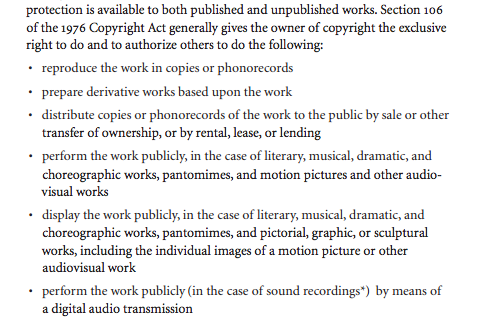
Of course this would be section 106 of the Copy Right Act of 1976: reproductions, derivative works, distribution, public performance, display, and, of course, digital audio transmission.  106 was never a coincidence, it was always already a numerological lattice of copyright intervention! And when you invoke section ds106 you automatically authorize others to do any and all of the above. Culture is the freedom to appropriate and interrogate.

Posted in digital storytelling | Tagged , | 5 Comments

Taming the Web

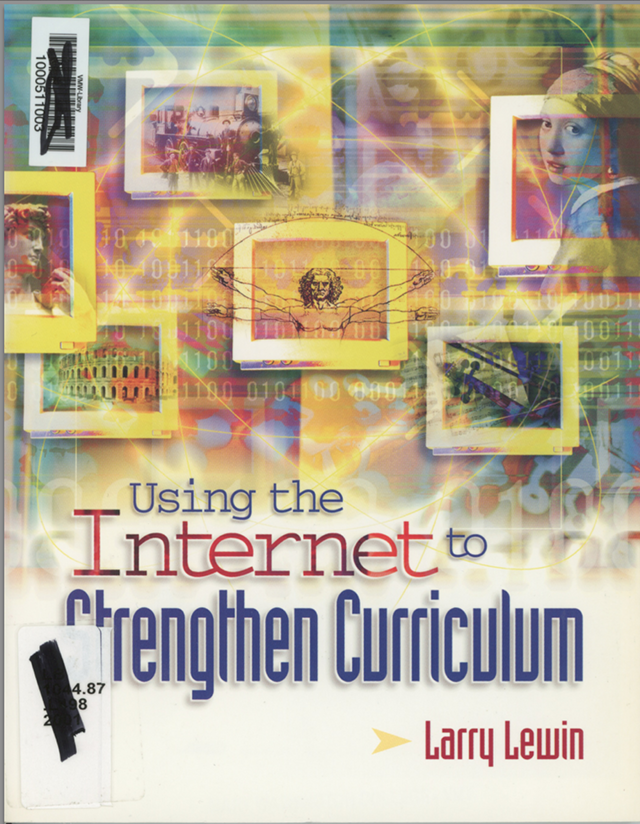
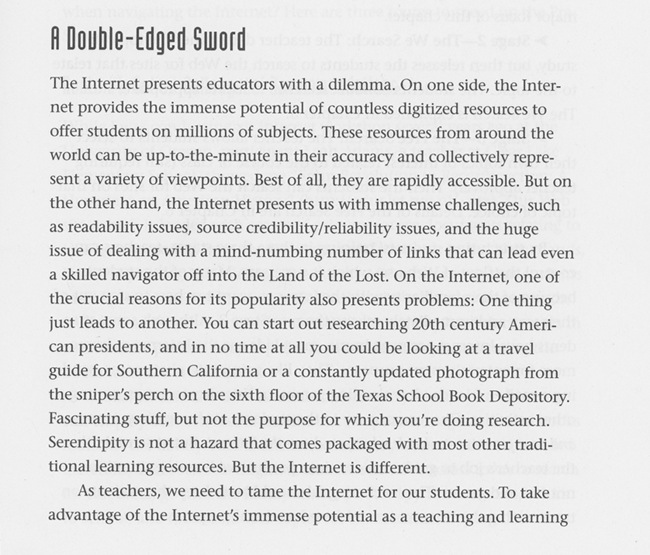
internet_curriculumAnother 2001 edtech book Shannon Hauser gave me earlier this week is Larry Lewen’s Using the Internet to Strengthen Curriculum. This guide to internet research is all about how to domesticate the internet for education, and some of the quotes are interesting when framed around the theory I’ve been pushing as of late, namely that the web increasingly became anathema to the intellectual work unviersities imagined themselves doing at the turn of the millenium. There’s an increasingly prevalent notion during the late 1990s of  a “dilemma” wherein the web becomes a “double-edged sword” for education. Take this quote from chapter 2 of the book, which is appropriately titled “Taming the Web”:
double-edged_sword

I love this idea of serendipity as a hazard of the internet, and one which distracts us from the point of….learning? It’s a truly bizarre idea, but at the same time it also fasicinates me. The idea of blazing pathways across resources, disciplines, cultures, etc., through hypertext is seen here as one of the real limits of the web for education. And the money quote for me,  “as teachers, we need to tame the internet for our students.” I can’t help but think this is still part of the mindset when it comes to the siloed learning management systems that are pervasive in education. The open web is just too confusing and messy when it comes to teaching, we need stay down in the lead-reinforced walls of the LMS bunker until this fad passes 🙂 Duck and cover!

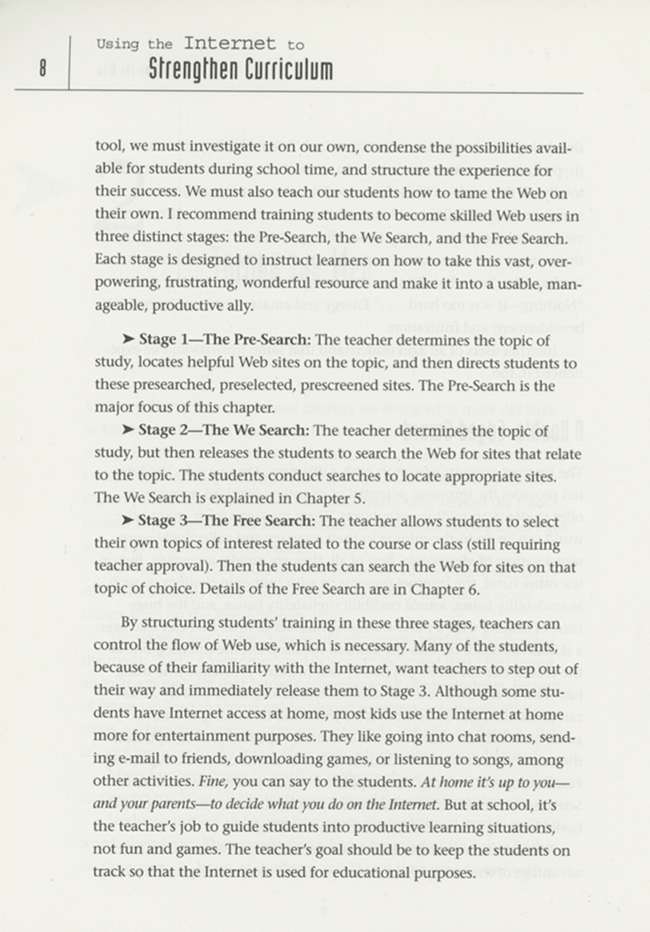
But that’s not all, the next page has a solution! “condense the possibilities for our students” and “structure the experience for their success.” The idea of the web as a network, even thirteen short years ago, was seemingly unfathomable in education.

strengthen_curriculum

And while I would like to applaud the idea of training students how to use the web for research, it’s remarkable how dominated the language in this book is with verbs like “control,” “manage,” and “tame,” as if it were even possible. I can’t help but think that during the decade since this book was published, framed by the explosion of Web 2.0, schools and universities moved away from trying to control the web—given the futility of such an enterprise—and simply refused to enagage it as part of the curriculum. Faced with the impossibility of control, there was a fear-driven retreat to the bunker.

If you didn’t like this post blame Ben Rimes because his comment here gave me the idea for it.

Posted in Instructional Technology, The Internet Course | Tagged , , , | 6 Comments